Tattoo Ideas
Back Tattoo Ideas
The back is the largest uninterrupted canvas on the human body, which makes it the most rewarding place to tattoo and the easiest place to plan badly. Almost every back piece we regret seeing was designed one panel at a time, with no thought for how the shoulder connects to the spine or where the piece will stop. Here's how we think about back tattoos at our Main Street studio in Santa Monica, from a single shoulder blade piece to a full backpiece that takes a year.
Book a consultationWhy the back is the best canvas on the body
The back is the largest uninterrupted area of skin a person has: flat, stable, low in nerve density across most of its surface, shaded from the sun by almost any clothing, and free of the joints and creases that distort a design everywhere else. It is the only place on the body where a tattoo can be as large as the idea deserves without being folded around anything.
It is also the easiest place to plan badly, for exactly the same reason. On an arm the anatomy makes the decisions for you — there is only so much room, and the limb tells the design where to go. A back gives you a blank wall, and a blank wall invites people to hang one picture at a time. Almost every back piece we regret seeing was built that way: a shoulder blade, then a spine column, then something over the lats, with nothing planned to connect them.
The other thing worth stating plainly: you will almost never see your own back tattoo. That sounds obvious and it changes how you should choose. A back piece is the one tattoo you get primarily for the object itself rather than for the daily experience of looking at it — which, in our experience, makes people choose better. It removes the impulse purchase entirely.
What are the types of back tattoos?
Four, distinguished by how much of the back they claim and what that commits you to afterwards. Choosing between them is the first real decision, and it constrains everything downstream.
- Single-panel pieces. One shoulder blade, one framed subject, self-contained. Typically one to three sessions. The smartest first large tattoo anyone can get.
- Vertical work. Spine columns, ornamental strips, vertical script. Narrow footprint, enormous visual presence, and a piece that visually claims the center line.
- Spanning and symmetrical designs. Wings, arches, mandalas that cross the shoulders or sit centered on the upper back. Demanding to stencil correctly and striking when done right.
- Full backpieces. The whole canvas as one composition. Typically thirty to sixty or more hours of tattoo time, spread across a year or more. The best tattoo most people will ever get, and the one that most rewards planning.
Start with the zone, not the subject
Most people arrive with a subject — a koi, a moth, a saint, a mountain range — and no idea where it belongs. We work the other way around. The back has four zones that behave differently under a needle and age differently over a decade, and the zone constrains the design more than the subject does.
- Upper back and shoulder blade panel. Flat, wide, stable skin over the scapula. The friendliest real estate on the body — low pain, holds detail well, ages slowly, and stays out of the sun under almost anything. If you want one large tattoo and you want it to still look sharp in twenty years, this is the answer. It also flows naturally into the shoulder if you ever want to connect it to a sleeve.
- Spine. Narrow, bony, and the most sensitive part of the back. Beautiful for vertical ornamental work, script, snakes, and florals — but the vertebrae mean short passes and more breaks.
- Mid back and lats. Wide and forgiving, but it stretches with body composition changes more than the upper back does. Fine for bold work, riskier for tight micro-detail. This is also the zone that wraps toward the ribs, which is a much sharper sitting than the back proper.
- Lower back and sacrum. Sensitive over the tailbone, softer skin, and it moves when you sit. Ornamental and symmetrical designs sit here well; heavy fine detail does not. It connects naturally to the hip if you want the piece to carry around.
Pick the zone that suits your pain tolerance, timeline, and how much of the back you actually want covered. The subject can then be drawn to fit the anatomy rather than being pasted onto it.
What are the best back tattoo ideas?
The subjects that thrive on a back are the ones that need room: things with wings, things that are long, things with a narrative, and things built on symmetry. Below is how the requests actually group, with the deeper page for each.
Winged and spanning subjects
The back is the only place on the body where a wingspan can be actual size, and it shows. These are the subjects that look undersized anywhere else.
- Moth tattoos — the most-requested single-panel back subject we see, because a moth is symmetrical, graphic, and reads perfectly centered between the shoulder blades.
- Butterfly and dragonfly tattoos — the same structural advantage, with more room for color.
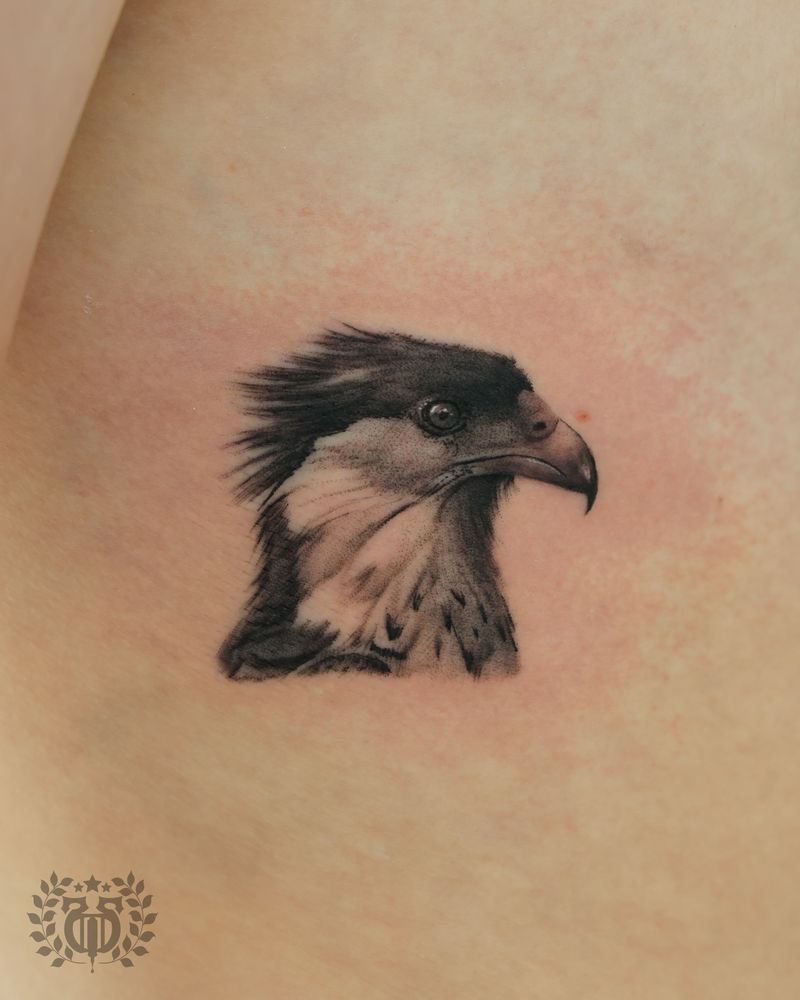
- Eagle and owl tattoos — a spread-winged bird across the upper back is one of the oldest and strongest back compositions there is.
Long-form and serpentine subjects
- Dragon tattoos — the canonical full-backpiece subject in the Japanese tradition, and the one the format was effectively designed around.
- Koi fish tattoos — typically running diagonally with water, which solves the composition problem and the background problem at once.
- Snake tattoos — the best subject in existence for spine and vertical work, because a snake is a vertical composition.
- Ship and mermaid tattoos — narrative subjects that want a scene around them, which a back can actually provide.
Ornamental, symmetrical, and geometric
- Mandala tattoos — the classic centered upper-back or lower-back piece, and the best possible use of the back's natural symmetry.
- Geometric tattoos — sacred-geometry panels and linework grids, with the parallel-line caveat below.
- Blackwork tattoos — large-scale negative-space and blackout work, the most durable option available and the strongest choice over existing ink.
Figurative, dark, and black-and-gray
- Skull tattoos and wolf tattoos — both hold up at large scale and give real range in the shading.
- Sacred heart and religious imagery — statuary, saints, and hands are among the most-requested black-and-gray back subjects in Los Angeles.
- Octopus tattoos — tentacles across the shoulders and down the lats, one of the few subjects that can genuinely fill a back on its own.
- Memorial tattoos — when the back is being used for the piece that matters most, this is usually why.
Botanical and script
- Floral back pieces — roses, lilies, lotus, peonies, and wildflower arrangements, which scale from a single stem along the spine to a full-back garden.
- Script and lettering — the classic spine placement, and the one with the strictest sizing rules on the whole body.
- Family and name tattoos — where dates and handwriting most often end up when they are meant to be large.
Cover-ups
The back is the best place on the body to cover old work, because there is room to build a composition large enough that the old piece becomes one dark passage inside something else rather than a shape you are fighting. Our cover-up tattoo ideas page covers what is actually possible and when laser lightening first is the better call.
What about spine tattoos specifically?
Spine tattoos have exploded in popularity and they are genuinely gorgeous — and they are the back idea we most often talk people through carefully, because the trade-offs are real and rarely mentioned.
Ornamental columns, vertical florals, snakes, chains, and script all read beautifully down a spine, because the eye follows a vertical line naturally and the body's own symmetry does half the compositional work. The honest counterweights: the bone makes it one of the sharper sessions on the body, hairline-thin script over vertebrae is the hardest thing on the back to keep crisp at ten years, and a spine piece visually claims the center of your back, which shapes anything you add on either side later.
The practical advice is the same one we give for every bony placement: go bolder than feels necessary. Leave the finest work for flat skin. A spine piece drawn one line weight heavier than the reference photo will look better in fifteen years and no worse today. Our spine tattoo page goes deeper on design and healing.
Getting symmetry right on an asymmetrical body
Wings, mandalas, and ornamental arches spanning the shoulders are demanding in the best way. Here is the thing nobody mentions: the back is not actually symmetrical. Almost everyone has some scapular or spinal asymmetry, and shoulder height differences are extremely common.
A good artist maps the stencil to your body while you are standing, sitting, and with your arms relaxed at your sides, then adjusts by eye — sometimes deliberately making the drawn design slightly asymmetrical so that it reads symmetrical on you. If someone applies a perfectly mirrored stencil without doing that, the piece will look subtly wrong forever and you will never be able to say exactly why.
This is also why symmetrical back designs are worth booking with an artist who has done them before. It is a stencil problem more than a tattooing problem, and it is entirely solved before the machine is switched on.
How much does a back tattoo cost?
Priced by time, like everything else. At Apollo, Blue, Hannah, and Rick work at $100 an hour; Raa and David work at $350 an hour. Multi-hour bookings with Raa or David are not strictly linear — a six-hour session is priced below six times the hourly — so for a project of this size, ask about the day-rate structure directly rather than estimating from the hourly figure.
What that means in practice, by type of piece:
- A single shoulder-blade panel is usually one to three sessions, and it is the only back tattoo where you can get a reasonably firm estimate up front.
- A spine column depends entirely on length and density, and varies more between designs than any other back placement.
- A full backpiece is a multi-session, multi-thousand-dollar project measured in tens of hours. Any studio quoting a firm total before the composition is designed is guessing.
- Touch-ups on work we did are $100, and on a large piece you should plan for at least one.
Price scales with time and density, not with how ambitious the idea is. A bold blackwork backpiece and a full-color realistic one on the same back can differ by a factor of two in hours. Budget per session rather than for a total, and see our tattoo pricing guide for what drives a quote up or down.
Do back tattoos hurt?
Less than most people expect across the majority of the surface, and considerably more in three specific places.
The upper back and the fleshy areas over the lats are among the easier places on the body to sit through — muscle underneath, relatively few nerve endings, and skin that does not move much. This is a large part of why the upper back is such a good first large tattoo.
The sharp zones are the spine, where bone sits directly under thin skin; the lower back over the tailbone, for the same reason; and anywhere the design wraps onto the ribs, which is a genuinely different experience from the back proper. A well-planned long session moves between zones rather than spending four straight hours on the spine.
The other thing about back sessions that nobody warns you about: lying face-down for hours is its own kind of tiring, separate from the tattoo. Your neck and lower back will complain before the tattooed area does. Eat a real meal beforehand, and speak up when you need to change position — tense skin tattoos worse than relaxed skin, so the break improves the result.
How do back tattoos age?
The upper back is one of the best-aging locations on the body: stable skin, minimal sun exposure under a shirt, low movement, and no joint flexing through it. That is the good news, and it is genuinely good — a well-executed upper-back piece can look essentially unchanged for decades.
The realistic notes:
- The lats and lower back move with weight and muscle changes. Plan larger pieces around a body you expect to keep, not a temporary one. This is not about being a particular size; it is about how much change you anticipate.
- Tightly packed fine detail merges. Hair strands, thin parallel lines under about a centimeter apart, and dense stippling will soften and blend over ten to fifteen years anywhere on the body, and faster where skin stretches.
- Sun is the largest controllable factor. Beach days in Santa Monica are exactly how a black-and-gray backpiece turns muddy in five years. Sunscreen on healed work is not optional here, and a back is the easiest place to forget it.
On healing timelines, we will give you the standard two-to-three-week surface figure that every studio gives — along with the honest note that it has never been established in a clinical study. We traced that citation chain and published what we found in our tattoo evidence review. Judge your heal by how the skin actually looks, not by a date on a calendar. A back also has one practical healing wrinkle worth planning for: you cannot see it, and you may not be able to reach all of it. Arrange for someone to help, or accept that you will be doing aftercare in a mirror.
Planning a full backpiece
The single most important decision is the overall composition, drawn and approved before the first needle touches you. Not every leaf and scale — those get drawn session by session — but the skeleton: what the piece is about, where the two or three focal points sit, which direction the composition moves, and what fills the space between the subjects.
Backgrounds are what make a backpiece look like one tattoo instead of a collection of stickers. Japanese wind bars and finger waves, black-and-gray smoke and drapery, ornamental fill, or solid black fields — whichever system you use, it needs to be decided at the start and laid in across sessions, not saved for the end.
Sessions on a large piece are typically spaced two to four weeks apart so the previous section is fully healed before adjacent skin gets worked. Expect the pace to be set by your healing and your budget rather than by a target date. And expect the piece to take longer than the estimate — every large tattoo does, and the ones that come in on schedule usually did so by cutting the background.
Bringing an idea in
Bring references — but bring them as direction, not as a blueprint. Five images that share a mood tell us far more than one image you want copied, and a copy of someone else's back piece will not sit right on your body anyway; it was composed for theirs.
Also tell us the boundaries up front: does it need to be covered by a t-shirt, do you want the shoulders left open for future work, is there scarring or existing ink to work around, are you planning to connect it to an arm or the chest later. Those constraints shape a good design; discovering them at stencil time wrecks a session.
If you are still narrowing things down, browse the tattoo ideas library for subject-level direction, or look at how our artists handle scale and composition in the portfolio. When you are ready to talk placement and timeline with the person who will actually be doing the work, book a consultation at the studio on Main Street. For anything larger than a single panel, that in-person conversation is where the piece really gets designed.
FAQ
Back tattoos: common questions
Zones, types, cost, pain and aging on the largest canvas the body has.
What are the types of back tattoos?
Four, distinguished by how much of the back they claim. Single-panel pieces sit on one shoulder blade and are typically one to three sessions. Vertical work runs down the spine as a column, strip or script. Spanning and symmetrical designs cross the shoulders as wings, arches or centered mandalas. Full backpieces treat the whole canvas as one composition and typically run thirty to sixty or more hours across a year or more.
What are the best back tattoo ideas?
Subjects that need room: winged and spanning subjects like moths, butterflies, eagles and owls, which are the only place on the body a wingspan can be actual size; long-form subjects like dragons, koi and snakes; ornamental and symmetrical work like mandalas, geometric panels and blackwork; and figurative black-and-gray such as skulls, wolves, religious statuary and octopuses. The back is also the best place on the body to cover old work, because there is room to make the old piece one dark passage inside something larger.
Where on the back should I get tattooed?
Start with the zone, not the subject. The upper back and shoulder blade panel is the friendliest real estate on the body - flat, stable, low pain, holds detail, shaded under almost any clothing. The spine is narrow, bony and the most sensitive area, best for bold vertical work. The mid back and lats are wide and forgiving but stretch with body composition changes. The lower back and sacrum are sensitive over the tailbone and suit ornamental and symmetrical designs over fine detail.
Are spine tattoos a good idea?
They are genuinely beautiful and they carry real trade-offs. Ornamental columns, vertical florals, snakes, chains and script all read well because the eye follows a vertical line naturally. Against that: the bone makes it one of the sharper sessions on the body, hairline-thin script over vertebrae is the hardest thing on the back to keep crisp at ten years, and a spine piece visually claims the center of your back, which shapes anything you add later. Go one line weight bolder than the reference photo.
How much does a back tattoo cost?
Priced by time. At Apollo, Blue, Hannah and Rick work at $100 an hour and Raa and David work at $350 an hour, with multi-hour bookings for Raa and David priced below a straight hourly multiple, so ask about day rates for a large piece. A single shoulder-blade panel is usually one to three sessions and is the only back tattoo where a reasonably firm estimate is possible up front. A full backpiece is a multi-session project measured in tens of hours, and any studio quoting a firm total before the composition is designed is guessing. Touch-ups on our own work are $100.
Do back tattoos hurt?
Less than most people expect across most of the surface, and considerably more in three places. The upper back and the fleshy areas over the lats are among the easier places on the body to sit through. The sharp zones are the spine, the lower back over the tailbone, and anywhere the design wraps onto the ribs. The other thing nobody warns you about is that lying face-down for hours is its own kind of tiring, separate from the tattoo - your neck will complain before the tattooed area does.
How do back tattoos age?
The upper back is one of the best-aging locations on the body: stable skin, minimal sun exposure under a shirt, low movement and no joint flexing through it. The realistic notes are that the lats and lower back move with weight and muscle changes, so plan larger pieces around a body you expect to keep; tightly packed fine detail such as hair strands and thin parallel lines under about a centimeter apart will merge over ten to fifteen years; and sun is the largest controllable factor, which in Santa Monica is not a small caveat.
How do I plan a full backpiece?
The overall composition gets drawn and approved before the first needle touches you - not every leaf and scale, but the skeleton: what the piece is about, where the two or three focal points sit, which direction the composition moves, and what fills the space between the subjects. Backgrounds are what make a backpiece look like one tattoo instead of a collection of stickers, and they need to be decided at the start and laid in across sessions rather than saved for the end. Sessions are typically spaced two to four weeks apart.
Why does symmetry go wrong on back tattoos?
Because the back is not actually symmetrical. Almost everyone has some scapular or spinal asymmetry, and shoulder height differences are common. A good artist maps the stencil while you are standing, sitting and with your arms relaxed, then adjusts by eye - sometimes making the drawn design slightly asymmetrical so that it reads symmetrical on you. A perfectly mirrored stencil applied without that step will look subtly wrong forever and you will never be able to say exactly why.
How long does a back tattoo take to heal?
We will give you the standard two-to-three-week figure for the surface that every studio gives, along with the honest note that it has never been established in a clinical study - we traced that citation chain and published what we found in our tattoo evidence review. Judge your heal by how the skin actually looks rather than by a date. A back has one practical wrinkle worth planning for: you cannot see it and may not be able to reach all of it, so arrange for someone to help.