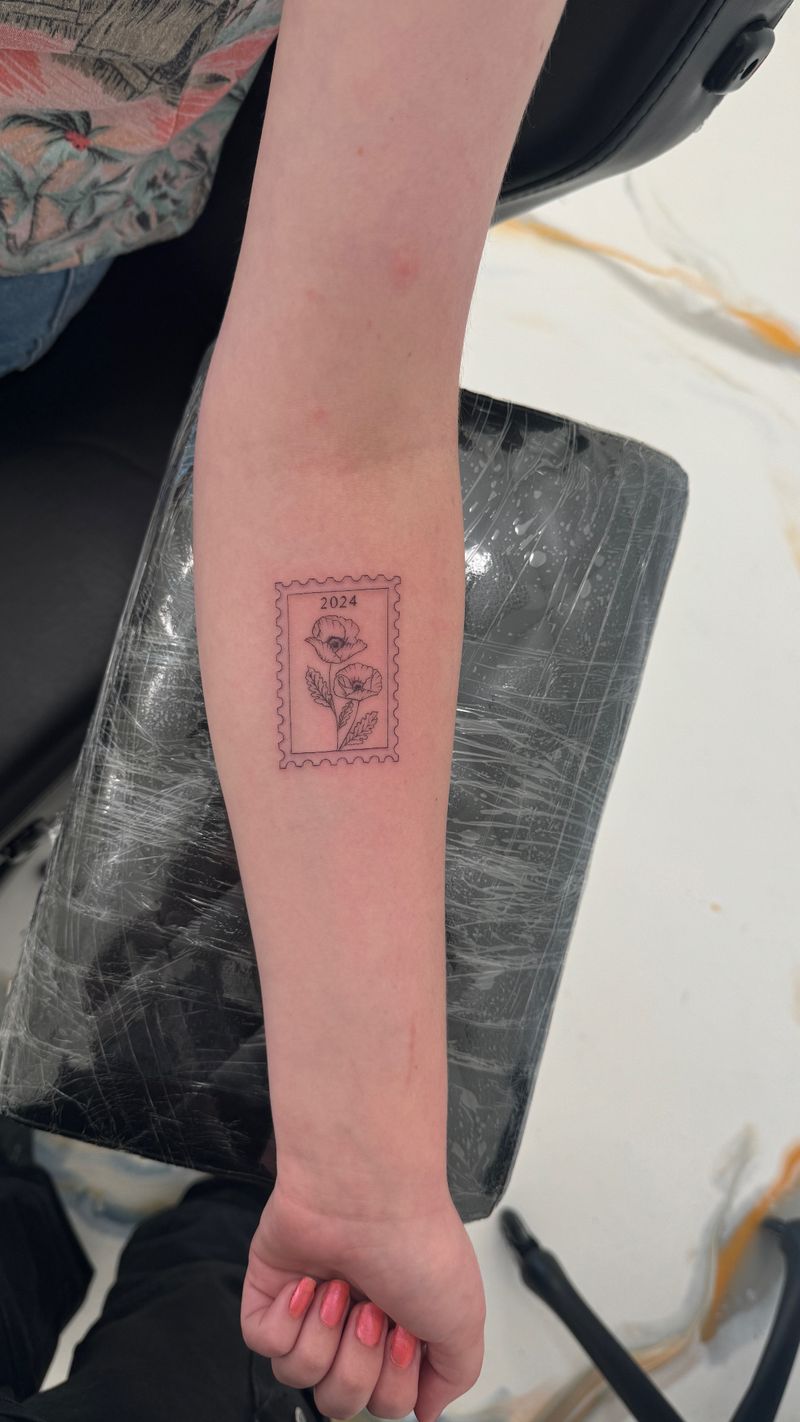
Tattoo Styles
Fine Line Tattoo in Santa Monica
This style asks the most honest question about time of anything in the library. Single-needle work looks flawless at week six and needs a plan by year five. What actually changes, what a good hand controls for, what nobody can promise you — from Main Street in Santa Monica.
Book a consultationFine line in Santa Monica
Fine line tattoo, done right on Main Street.
If you searched fine line tattoo near me from the Westside, Apollo sits at 2625 Main Street in Santa Monica — a few blocks from the beach, walkable from Ocean Park, Venice, and downtown Santa Monica.
Fine line is the style where specialist fit matters more than proximity — a 1RL line has the smallest margin for error in tattooing, so the artist's healed portfolio should decide the booking, not the drive time. That said, being local helps in ways that show up on the skin: an in-person consultation to read your skin and reference, a settling touch-up you can actually get to, and aftercare check-ins during the six weeks that decide how the piece ages. Apollo does all three under one roof in Santa Monica.
Santa Monica is also the right geography for this style historically. Fine line is a branch of the Los Angeles Chicano black-and-gray tradition (detailed below), and Apollo's fine-line work sits squarely inside that LA lineage rather than a filter borrowed from it. If you're comparing studios, start with the qualities that separate a fine-line specialist from a generalist, read how to choose a Santa Monica tattoo studio on safety and quality, or see the Apollo tattoo shop in Santa Monica and meet the artists before you book.
One needle
One needle, and everything that follows.
Fine line is defined first by its needle, then by its discipline, then by its lineage. At the needle it comes down to this.
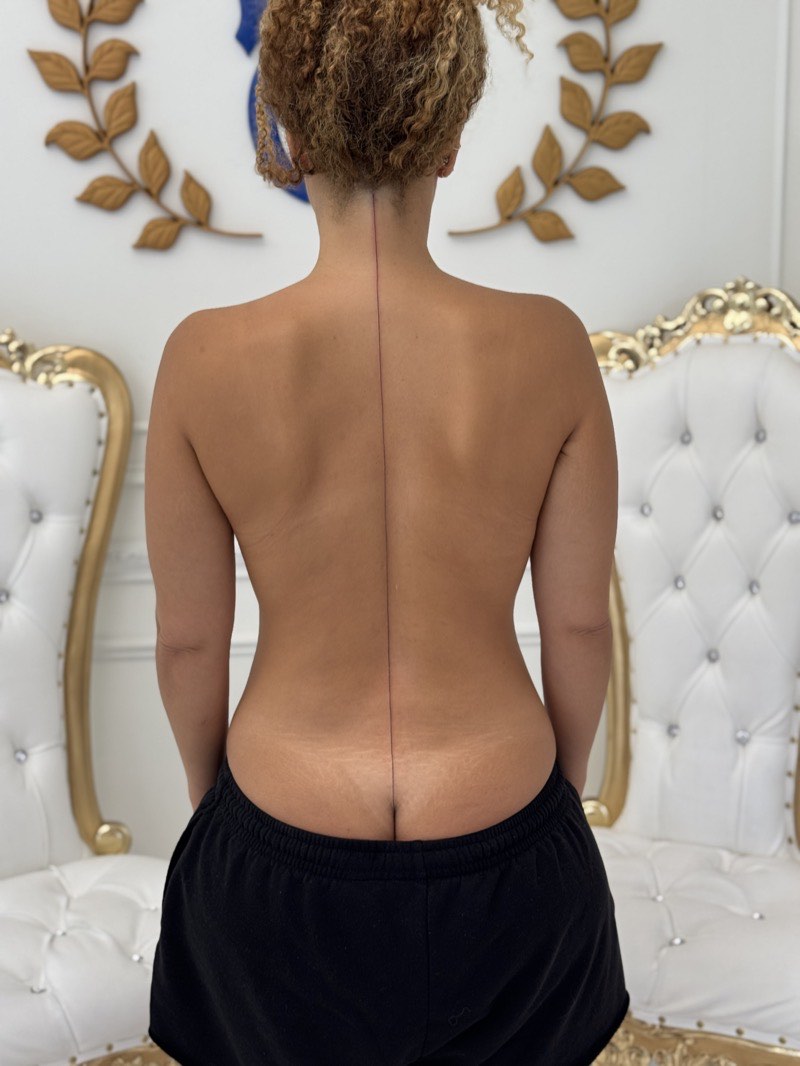
The dominant configuration is the 1RL — a single round liner — typically in a #8 or #10 gauge, roughly 0.25–0.30mm. For context, that's thinner than most mechanical pencil leads. The close cousin is the 3RL, three needles in a round grouping, which produces slightly heavier hairline work; single-point magnums appear occasionally for micro-shading passes. The thin needle is the style's entire premise: less surface area depositing pigment means a line delicate enough to read almost pencil-drawn on skin.
Machine type matters almost as much as the needle itself. Rotary machines dominate fine line because their consistent, motor-driven stroke produces uniform depth on every pass. Coil machines — with their electromagnetic cycling — introduce micro-vibration that a 1RL amplifies into wobble. Cartridge systems (Cheyenne Hawk, FK Irons Spektra, Bishop) made modern fine line viable at scale because they standardized needle stability and let artists swap configurations mid-session without retuning. Most fine-line artists run between 6.5V and 8V, and a shift of half a volt can mean the difference between a crisp line and one that heals patchy.
Ink depth is the hidden discipline. Fine line sits in the upper reticular dermis — shallower than traditional work but not so shallow that pigment sheds with epidermal turnover. Saturation is deliberately low; the craft is line-weight consistency across long curves rather than pigment density. Blowouts — ink bleeding laterally into subcutaneous tissue — are the signature failure mode, alongside pigment loss and line wobble on extended arcs. Every one of them is visible because there is no bold outline to hide behind.
One terminology note that trips people up at consultation: "single-needle" and "fine line" overlap but aren't identical. Single-needle refers strictly to 1RL work and carries a specific lineage association. Fine line is the broader modern genre — it includes 1RL, 3RL, and variable- weight hairline work where artists deliberately taper. Some of the best modern practitioners (Dr. Woo among them) use both within a single piece.
The LA lineage
The Los Angeles lineage.
The modern commercial version of this style is a branch of a specific Los Angeles tradition. Who did what, and when.
1960s – early 1970s
Prison single-needle
The aesthetic emerged inside the California prison system. With no access to professional equipment, incarcerated artists built rotary machines from cassette-player motors, guitar strings, and ballpoint pen barrels. A single sewing needle was the only available configuration. The fine, gray-washed, portrait-heavy look that resulted became the foundation of Chicano black-and-gray — and, a generation later, of everything called fine line.
1975 — East LA
Good Time Charlie's Tattooland
Founded by Charlie Cartwright in East Los Angeles. Jack Rudy joined shortly after and took over the shop; Freddy Negrete apprenticed there and is widely credited as the first professional tattooer to bring the prison single-needle aesthetic into a street shop setting. Rudy and Negrete together professionalized the technique — refining machines, formalizing gray-wash dilution, codifying the religious iconography and script lettering that defined Chicano black-and-gray.
1980s – 2000s
Shamrock Social Club
Mark Mahoney — a direct inheritor of the Rudy/Negrete tradition — established Shamrock Social Club on Sunset Boulevard and became the connective figure between Chicano black-and-gray and the broader Hollywood celebrity tattooing world. The shop's lineage runs continuously from East LA to the modern fine-line revival.
2012–present
Dr. Woo & the Instagram era
Brian Woo (Dr. Woo) apprenticed at Shamrock under Mahoney. Around 2012–2014, Woo pivoted the aesthetic: he kept the 1RL discipline but replaced Chicano portraiture and religious iconography with delicate botanicals, geometric linework, and minimalist illustration. The work photographed extraordinarily well on Instagram and became one of the platform's first viral tattoo categories. Modern fine line as the commercial world now understands it is that branch — cousin of Chicano black-and-gray, not a replacement for it.
Los Angeles is the geographic nexus of this lineage for reasons that are cultural, not incidental. The Mexican-American communities of East LA produced the incarcerated innovators and the shops that legitimized their work. Good Time Charlie's (still operating), Shamrock Social Club, and a network of East LA studios form a continuous line from 1975 to now. Fine line, as the modern commercial world knows it, is a descendant of this tradition — not a parallel invention.
Its natural briefs
The briefs hairline work handles.
Fine line has a narrow but deep range. These seven subject categories are where the style sings.
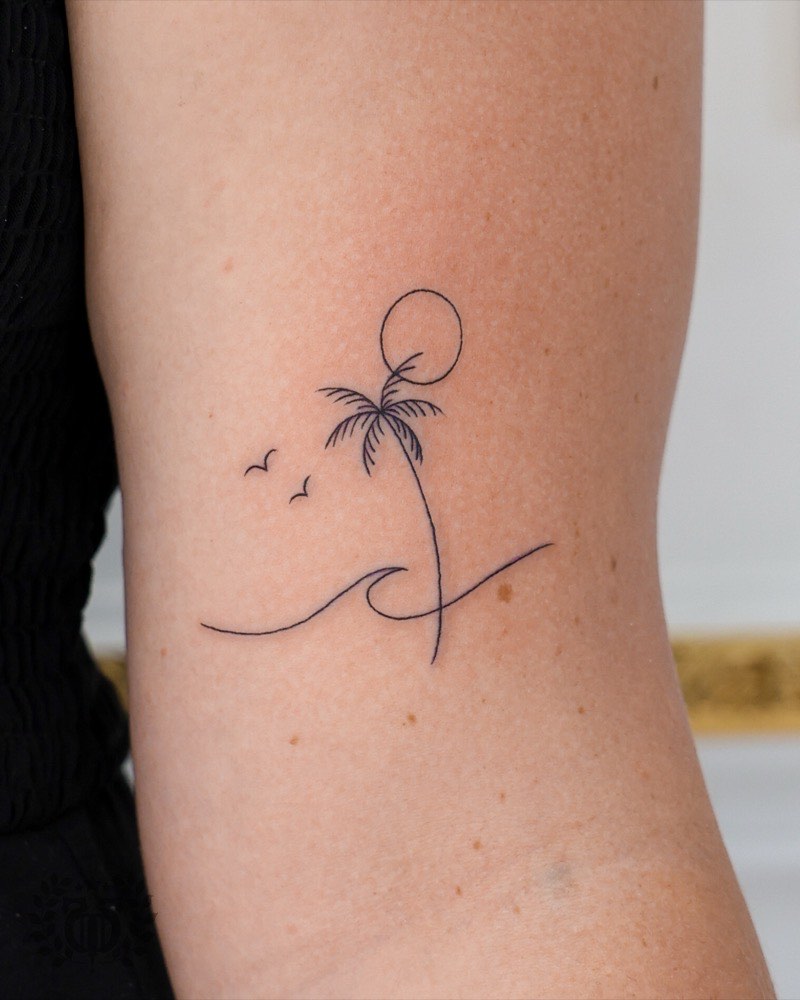
Botanical & floral
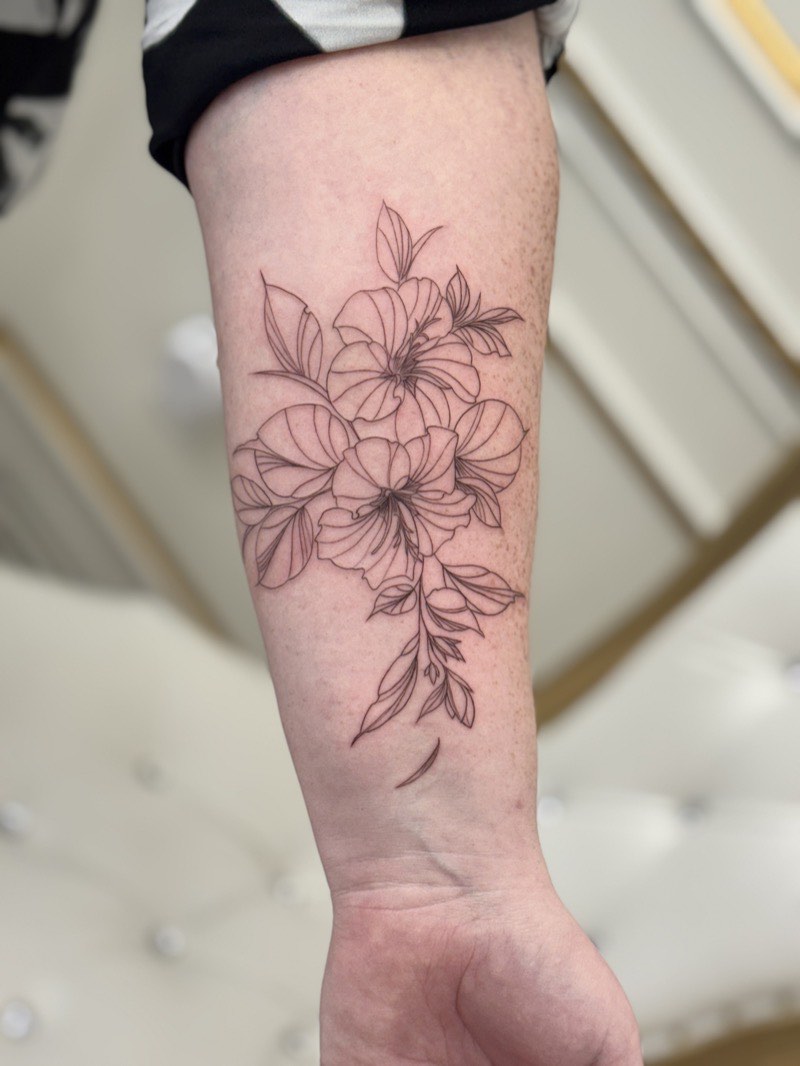
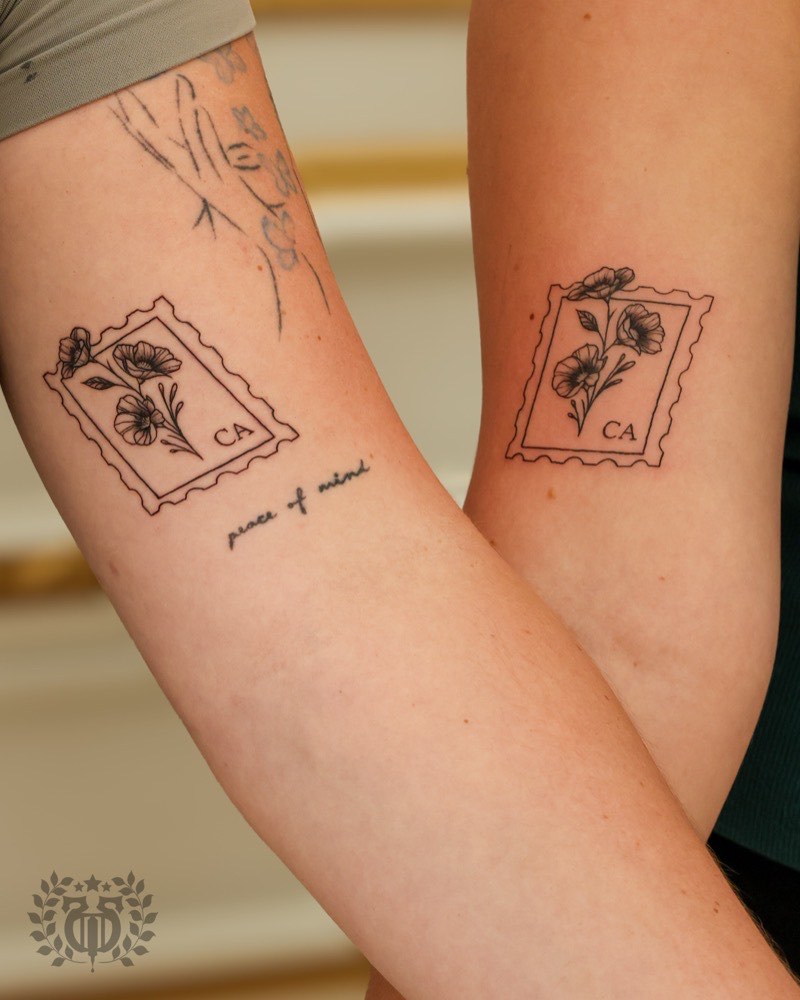
Fine line's native dialect. Single-stem roses, wildflowers, herb illustrations, and pressed-flower compositions translate because botanical line drawing is already a centuries-old tradition — Redouté, Kew-style scientific plates. The subject is built from outline and implied volume, which is exactly what a 1RL needle does best.
Script & lettering
Works when it respects the hand-lettering traditions it inherits — copperplate, Spencerian, signature-style cursive. Dates, short quotes, signatures, and single-word marks carry. Dense paragraphs and novelty fonts don't. The script reads when the letterforms have rhythm, not when they are merely small.
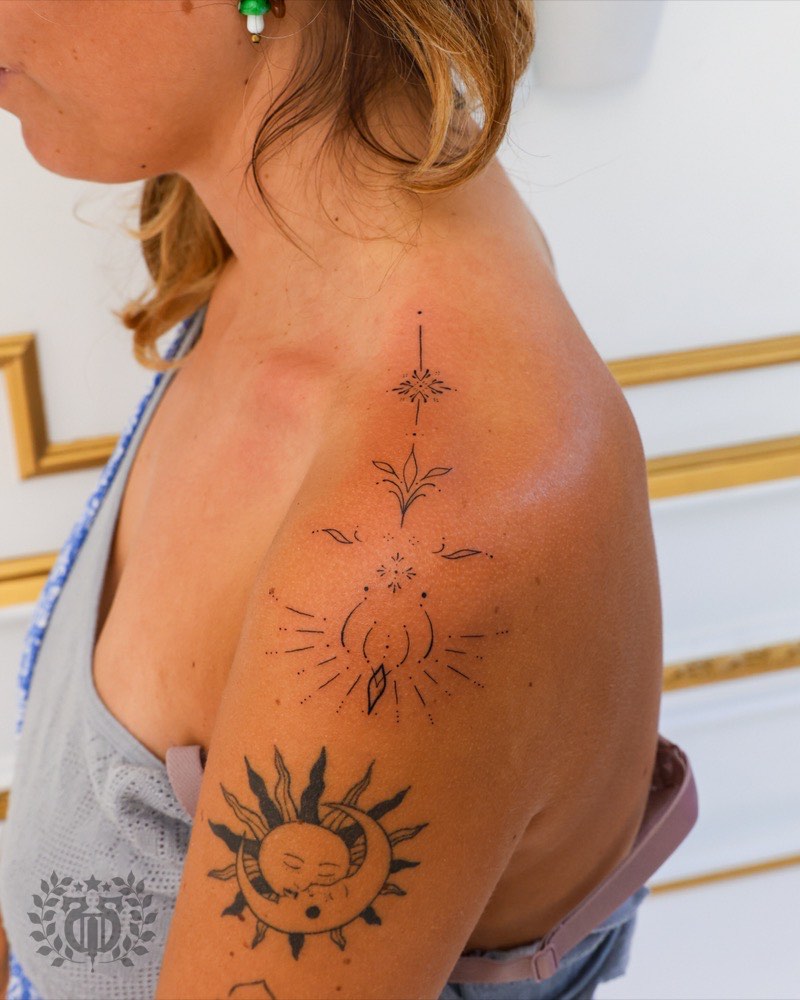
Celestial & astronomical
Constellations, moon phases, small planetary sequences. The subject is already built from points and connecting lines, so the style matches the reference material at a structural level. Node sizing matters — slightly larger than the connecting-line weight suggests.
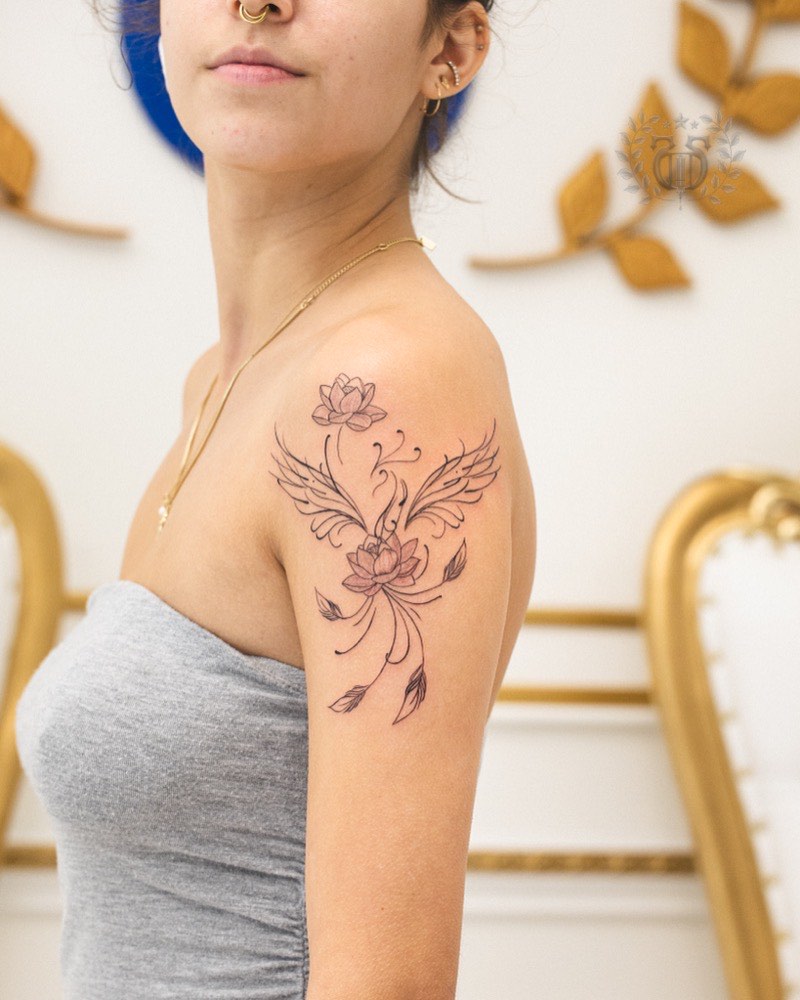
Delicate portraits
Only under narrow conditions — single-line continuous faces, abstracted profiles, gesture-drawing-style renderings. Photorealistic likeness is off the table (see the limits section below). When it works, it's because the artist distilled the face to its most recognizable contour.
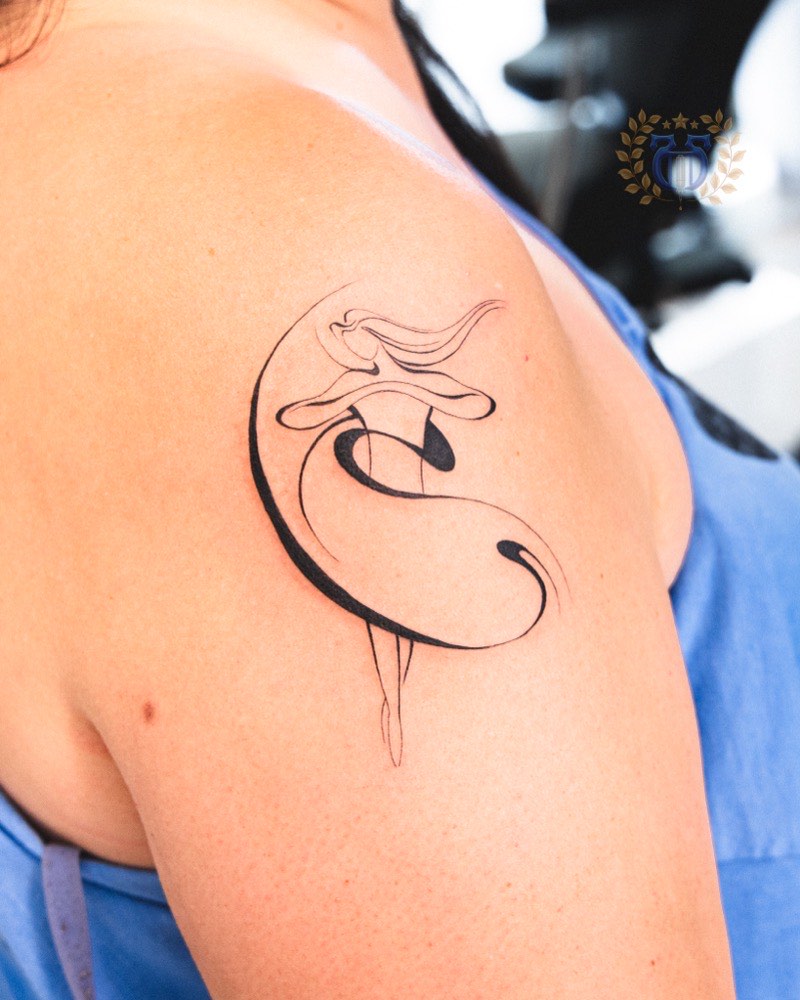
Micro-illustrative
Tiny animals, pets rendered as essential contours, symbolic creatures. The Dr. Woo-style micro bee is legible at 15mm because every line is load-bearing. Fine line is at its most demanding when the subject is distilled down to nothing but contour.
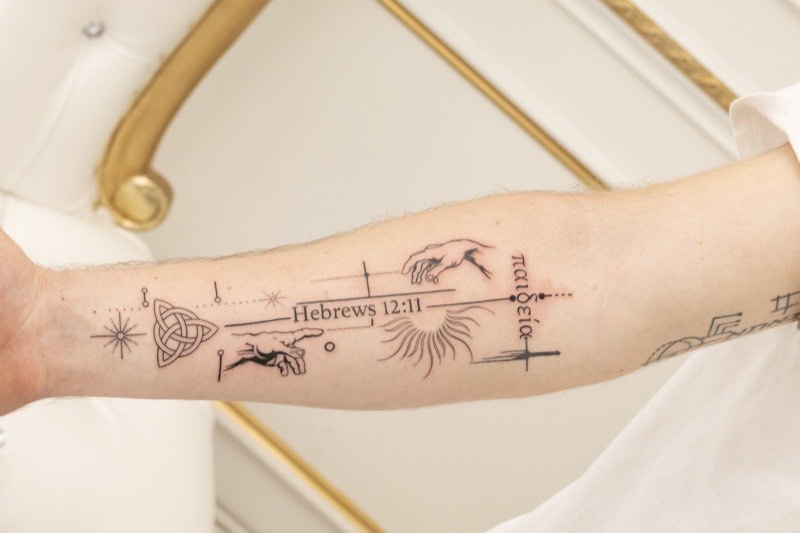
Geometric & line-art
Sacred geometry at small scale, one-continuous-line drawings, abstract linework. Fine line at its most architectural — mathematical precision and hairline weight made for each other. Rewards careful composition; punishes symmetry that doesn't account for body curvature.
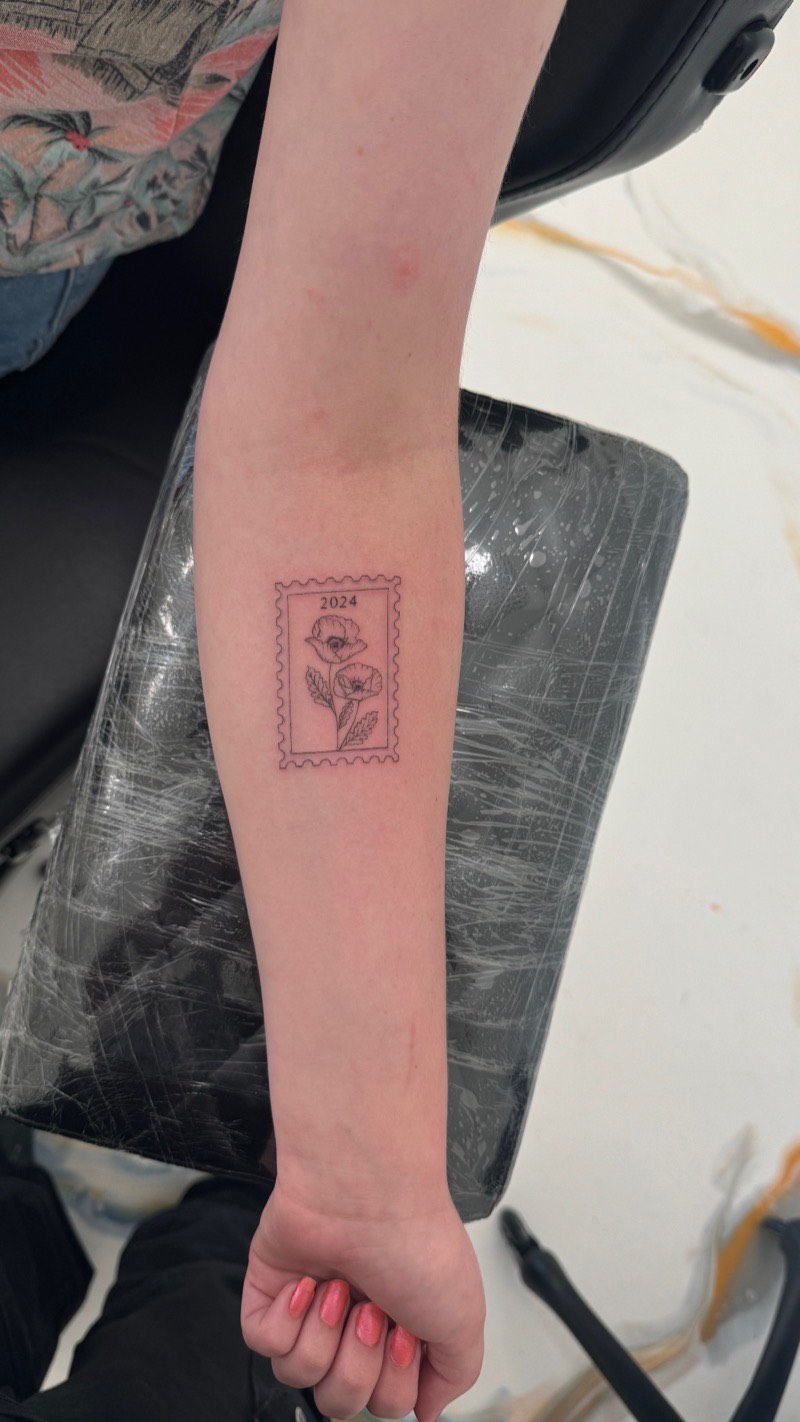
Minimalist symbols
Tiny keys, arrows, birds, anchors, single objects. Reads at a glance when it isn't trying to masquerade as traditional iconography. The design intention has to be specific — a particular object with a particular reason — or it drifts into generic-cutesy territory.
What can't be promised
What no fine-line artist can promise.
Fine line is not a filter you apply to any idea. These are the briefs hairline work will not carry, no matter who takes them.
Realistic portraits
The face reads through gradient, not outline. Monochrome hairline work can't produce likeness; attempts usually land in uncanny territory.
Traditional tattoo iconography
Swallows, daggers, pin-ups, panthers were engineered for bold line and solid black. Strip a swallow to fine line and you remove the structural logic that makes American Traditional hold up for 40 years — you end up with a shape that is neither traditional nor convincingly fine line.
Watercolor-adjacent concepts
Fine line's stylistic opposite. Watercolor leans on diffuse color bleeds and soft edges; fine line leans on edge clarity. The two can coexist on a body but never inside a single piece.
Large-scale pieces without structure
A full sleeve composed only of hairline florals tends to dissolve visually — the eye needs anchors. Successful large-scale fine line pieces always have an underlying compositional armature.
Heavy shading gradients
Require wider needle groupings to deposit enough pigment for smooth transitions. Attempting gradient in true fine line either heals patchy or forces the artist out of the style.
Cover-ups over dark ink
The hardest no. Fine line can't cover existing dark ink — the pigment load is too low to mask saturation underneath. A cover-up needs density; fine line is defined by its absence of density.
Millimeters and ground
Millimeters that decide the outcome.
Fine line ages on a narrower margin than any other style. The rules below aren't preferences — they're the floor below which a piece is unlikely to read at year ten.
The hairline size floor
Smaller script tends to blur into haze over 10 years as ink migrates and skin texture shifts.
Stays legible at year 10. Constellation pieces benefit from slightly larger node sizing than the connecting lines suggest.
Shorter marks tend to read as imperfections rather than deliberate design.
A 2cm botanical on a forearm usually benefits from being rendered at 3cm — larger lines age with more grace because they have room to soften without merging.
Ground that stays still
- Outer forearm. Steady skin, moderate sun, flat working surface.
- Upper arm (outer). Consistent skin movement, easy to protect from sun.
- Shoulder blade & upper back. Large canvas with minimal friction.
- Calf (outer). Great for pieces you want visible year-round.
- Chest & sternum. Fine line reads beautifully here — follows natural body lines.
- Ribs (for script). Works for short script pieces, but expect more pain and longer healing.
The high-churn zones
- Fingers. High cell turnover; fine line fades fast here — often a truism in the trade.
- Palms & soles. Friction zones shed pigment; lines blur within months.
- Inside of wrists. Thin skin, high flex, aggressive aging for delicate work.
- Inside of upper arm. Constant bending distorts thin lines; composition loses integrity.
- Feet. Shoe friction wears ink faster than almost any other placement.
- Behind ear (large pieces). Works for micro marks; larger pieces tend to age poorly.
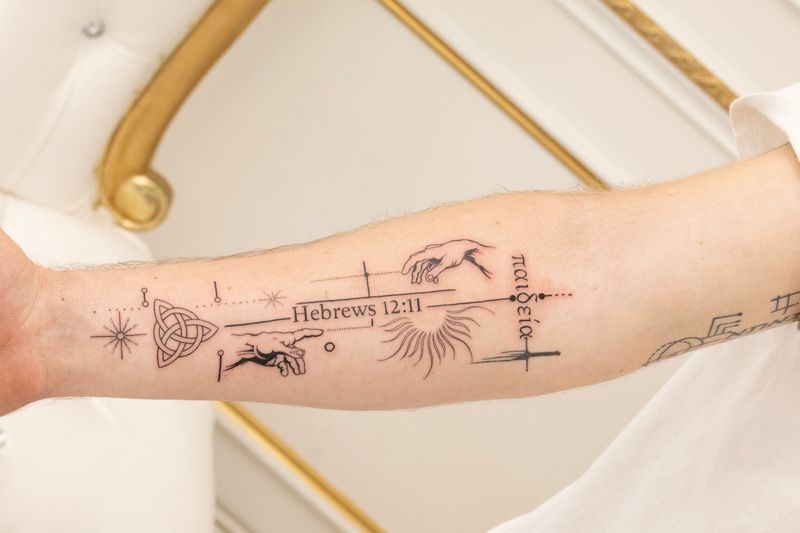
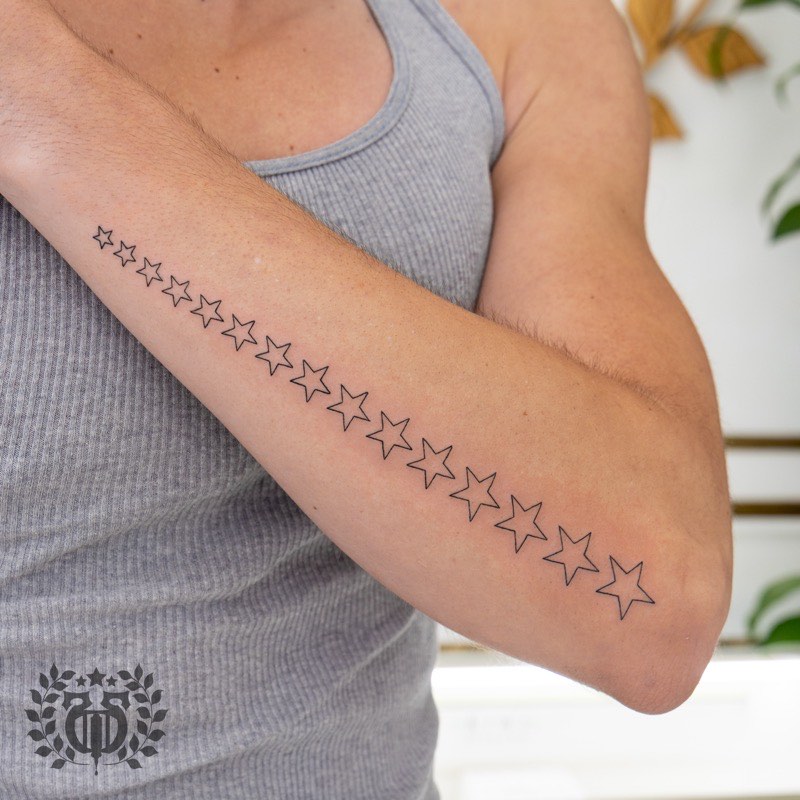
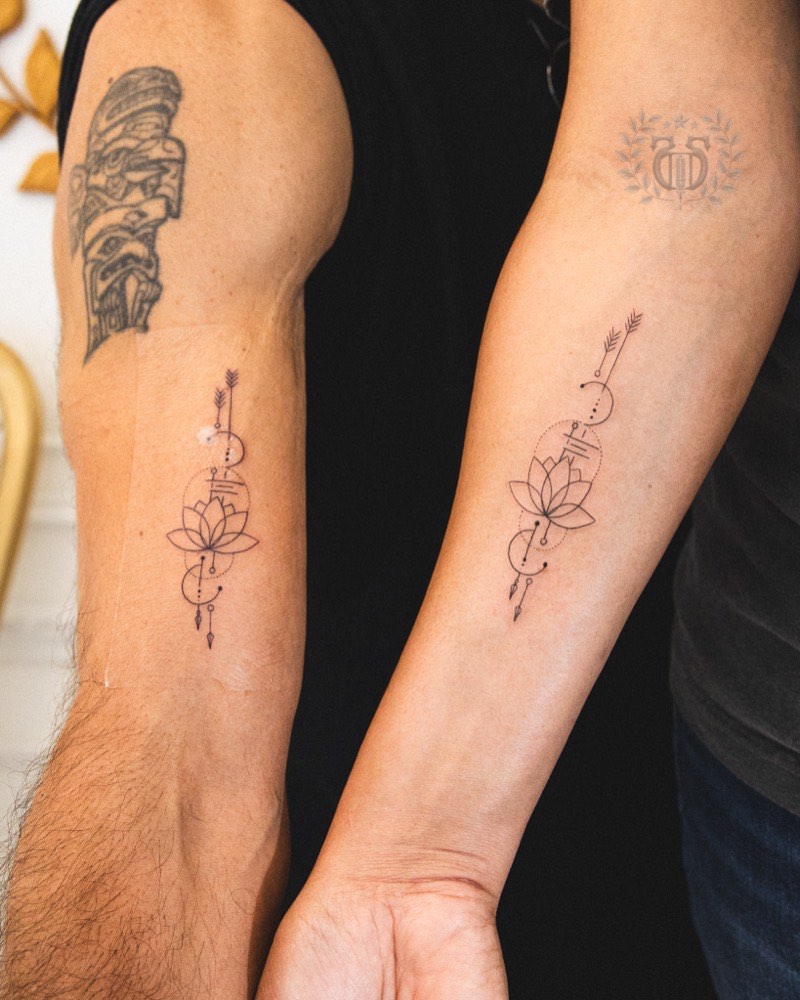
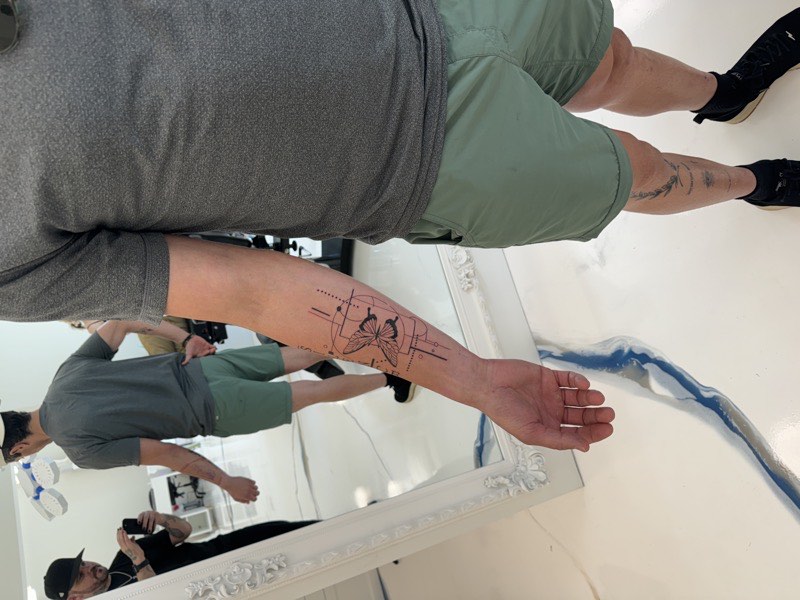
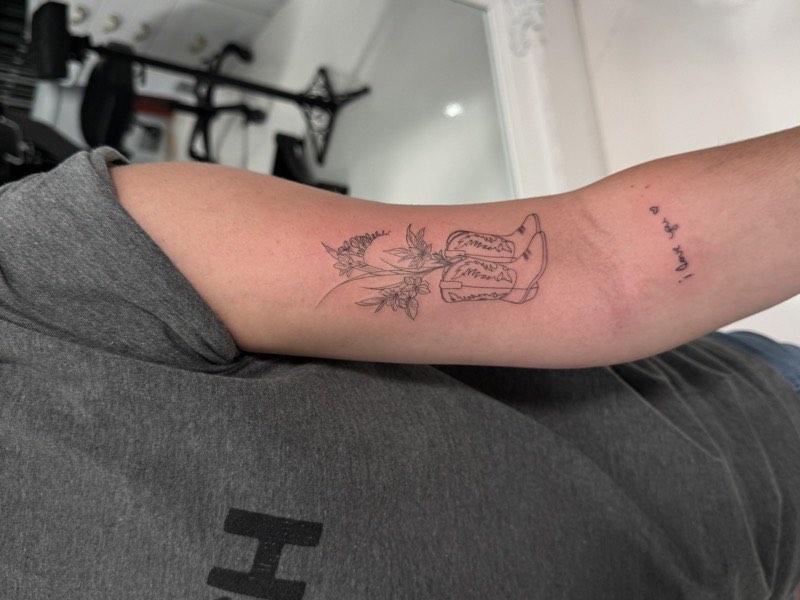
Fine line in the wild
Hairline work, close up.
Year by year
Year five, year ten, year twenty.
Aging is a feature of the medium, not a flaw. What follows is the honest read, year by year.
Settling, not fading
A healed fine-line piece at one year reads quieter than it did in the chair, and that's correct. The wet-ink sharpness clients photograph at day three is never the final tattoo — it's the piece plus surface plasma, scab texture, and inflammation. Once the epidermis fully regenerates (4–6 weeks) and the dermis settles over the next 12–18 months, edges soften by a hair and shading lifts a shade or two. This is settling, not fading.
The early-touch-up window
Crisp hairlines begin their slow translation into lived-in linework. On script at 2mm cap height, lowercase stems may start reading slightly rounder. On botanicals, the thinnest taper-outs — the tip of a leaf, the end of a stamen — are where settling shows first. This is the normal first-touch-up window for clients who want to hold a “fresh” read.
When the line needs help
Most fine-line pieces receive their first real touch-up somewhere in this window. What gets refreshed is almost always the outline — the anchoring lines that define the piece — rarely the internal shading, which typically ages more gracefully than expected. Dotwork and stippling often read surprisingly well at 8 years because the gaps between dots absorb skin movement.
Significant softening is the norm
Micro-text under 2mm may need rework or be accepted as its aged form — some collectors prefer the watercolor-fountain-pen read at this age. A traditional bold-line tattoo at 12 years still reads as the same tattoo; a fine-line piece at 12 years reads as an older, softer version of itself. Both outcomes are valid. The expectation should be set at consultation, not discovered a decade in.
Where it stands at year twenty
Fine line executed at correct dermal depth with modern pigment still reads as a tattoo at 20 years — recognizable, intentional, aged. Fine line executed too shallow (a common failure mode with inexperienced artists) may be largely gone by year 15, surviving only as ghost-shadow. Traditional work at 20 years will always have more visual presence pound-for-pound. That's the tradeoff clients accept when they choose the style.
Three variables dominate how fine line specifically ages: needle depth (too shallow sheds, too deep blows out), UV exposure (fine line is more vulnerable than traditional because pigment mass per square millimeter is lower), and skin biology (dermal thickness, collagen turnover, age at time of tattoo). Counter-intuitively, fine line placed at 55 tends to hold sharper longer than fine line placed at 22 — older dermis remodels more slowly, consistent with published dermatology literature on skin aging.
Planning grid
The fine-line planning grid.
The grid our fine-line artists plan against. None of these are rules. Line weight and size both shift once someone has looked at your skin.
What gets repeated
Five briefs we usually resize.
Things first-time fine-line clients get told and then repeat. This is about the next tattoo, not the ones already on you.
“I'll just do my idea in fine line instead of traditional.”
Style is not a filter. A dagger-and-rose built for bold line will not translate. The design has to be built for the style from the first sketch.
“Small equals cheap and quick.”
Micro fine-line work is among the most time-intensive per square centimeter in tattooing — the margin for error is smallest, which means every stroke requires disproportionate care.
“I want it to look aged from day one.”
Fine line already softens over time; pre-aging the design accelerates illegibility. Let the medium do its own aging work.
“Infinity symbol with a script word inside.”
The most repeated fine-line request, and the one most likely to look generic within two years. Specificity in subject is what prevents cliché.
“Wrist or finger for my first tattoo.”
Among the worst placements for fine-line longevity. High cell turnover and friction shed thin pigment quickly. A well-placed forearm piece will outlast a wrist piece by a decade.
Vetting the artist
Vetting a fine-line artist.
Fine line is the style where specialist fit matters most because the technique is the least forgiving. How to read a fine-line portfolio, the tells that should slow you down, and what to ask at the consultation.
Signs of a real fine-line hand
- Multi-year-old healed photos posted proudly
- Consistency across different substrates — wrist, ribs, forearm, ankle all in the same hand
- Willingness to post rework or “learning” photos — confidence, not perfectionism theater
- Specific craft language: cartridge configuration, voltage, pigment line
- A track record of declining bad-fit projects publicly
- Long-form captions that walk through the piece
Reasons to pause
- Portfolio shows only fresh, wet-ink photos — no healed documentation
- One strong fine-line piece surrounded by realism, color, and traditional work (generalist showing range, not specialist showing depth)
- Saturation inconsistency inside a single line — visible wobble or unsteady pressure
- Blowout visible in “finished” portfolio photos
- Stencil traces still visible in finished work
- Captions that never discuss process, needle choice, or aftercare follow-up
- The “I can do any style” pitch, applied to fine line specifically
Six questions about line weight
- What fine-line work of yours has healed this year, and how does it read now?
- What fine-line subjects do you find hardest, and why?
- At this size and placement, what would you recommend — and what would you talk me out of?
- What needle configuration and machine do you prefer for this kind of work?
- What does your touch-up window look like, and what falls inside vs outside it?
- Have you ever told a client not to get a fine-line piece? What was the situation?
A real fine-line specialist answers each one without hedging. Deflection at this stage is information.
FAQ
Fine line, asked plainly.
Seven questions about hairline work — how long it holds its shape, what it costs, and when it needs help.
How long do fine line tattoos actually last?
Fine line tattoos placed correctly with modern pigment still read at 15–20 years — recognizable, intentional, aged. What you shouldn't expect is for a fine-line piece at 12 years to look identical to one at 12 months. Think of aging as a feature of the medium, not a flaw: the tattoo softens in a way that mirrors how a charcoal sketch softens on archival paper. The pieces that fail early were usually placed too shallow by an artist still learning the style. The pieces that age beautifully were placed by specialists who have done the same placement and subject combination many times.
What's the difference between fine line and single-needle?
The terms overlap but aren't identical. Single-needle refers strictly to 1RL — a single-needle configuration — and carries the Los Angeles Chicano lineage association (Good Time Charlie's, Jack Rudy, Freddy Negrete). Fine line is the broader modern genre, which includes 1RL, 3RL, and variable-weight hairline work where artists taper intentionally. Dr. Woo-era fine line is a branch of the single-needle tradition but has distinct subject matter: delicate botanicals and illustrative work rather than Chicano portraiture and religious iconography.
Can fine line work on darker skin tones?
Yes, with craft adjustments. On Fitzpatrick I–III skin, 1RL black reads with high contrast. On IV–VI skin, the same line can lose visibility as it heals, and experienced artists often recommend slightly heavier weights (3RL instead of 1RL) or alternative compositions for long-term readability. This is a craft conversation, not a limitation — part of how thoughtful artists match technique to client. The best signal is an artist whose portfolio shows healed fine-line work across multiple skin tones.
Why is fine line considered so difficult to do well?
Because there is nothing to hide behind. A traditional American piece uses a bold outline that absorbs micro-inconsistencies; shading and color fill cover the rest. In fine line, every stroke is the finished surface — a 1RL line that wavers by half a millimeter on a long curve is permanently visible. Fine line demands repeatability: depositing ink at the same depth, speed, and pressure across a line that may run several inches. Voltage and needle tension are set once and must hold throughout. It's the tattoo style with the smallest margin for error.
How much does aftercare matter for fine line specifically?
More than for most styles. Fine line sits shallower in the dermis than traditional work, so aftercare errors — over-moisturizing, picking scabs, sun exposure during healing — translate directly into migration and fade. The American Academy of Dermatology's standing guidance on daily broad-spectrum SPF 30+ applies with particular force to fine-line owners because there's less pigment mass per square millimeter to resist UV photobleaching. Good aftercare isn't optional care; it's part of how the design ages over 20 years.
When should I schedule my first touch-up?
The standard industry window for a settling touch-up is 6–12 months post-session, and it's typically about settling, not flaws. Many specialists include one complimentary settling touch-up within a defined window. Past that, the next meaningful touch-up conversation usually lands somewhere in the 5–7 year range — refreshing softened outlines, occasionally re-saturating a shaded area. Outside of those windows, touch-ups become rework, which is a different conversation and should be approached as designing a new piece inside the same footprint.
Can fine line be used to cover up an old tattoo?
Almost never, because fine line is defined by its absence of density. A cover-up has to out-value the original ink underneath, which requires saturation and pigment load — the opposite of what fine line does. Cover-up specialists work in blackwork, neo-traditional, or Japanese ranges because those styles have the density to absorb existing ink. If you want to cover an old piece and preserve a fine-line aesthetic, the honest conversation is about laser lightening first and then building a fine-line piece into the faded area — a multi-year process that some collectors do undertake, with specialist involvement throughout.
Where can I get a fine line tattoo near me in Santa Monica?
Apollo is at 2625 Main Street in Santa Monica, CA 90405, walkable from Ocean Park and a short drive from Venice, Mar Vista, Brentwood, and the wider Westside. Fine line specifically rewards booking with the right artist over booking the closest chair, so use the consultation to bring reference and let the artist read your skin and placement in person. Being local also makes the settling touch-up and aftercare check-ins realistic — both matter for how a hairline piece ages.
Is fine line a good choice for a first tattoo?
It can be, with the right expectations. Fine line is delicate and reads quietly, which suits a lot of first-timers — but it also softens more over 20 years than bold-line work, and the placement rules are stricter (skip fingers, wrists, and feet for longevity). Come in with a specific subject and two or three reference images; the Apollo artist will steer scale, placement, and whether fine line is the right medium for the idea before anything is booked.
Getting started
Start with reference, subject and placement. We take it from there.
Fine line is a specialist's craft. Bring the subject, a reference or two, and the placement — including whether it is somewhere that rubs, folds or sees sun. Then we have the honest conversation about how many years you need it to look exactly like the drawing, and what that implies for line weight and size.