Tattoo Styles
Traditional
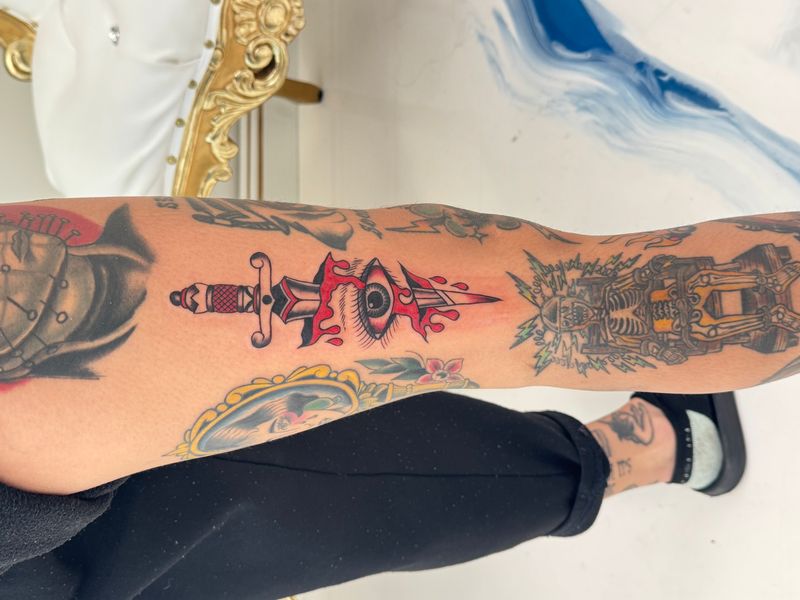
Engineered to still be legible from across a room in forty years. Heavy outline, small palette, flat packed color — every rule in the style is a durability decision, made by people tattooing in port towns whose work had to survive sun, salt and time.
Book a consultationBuilt to last
What American Traditional actually is.
Defined at the needle by a tight set of technical constraints — not aesthetic whim. Bold outlines, limited palette, flat saturation. Every choice engineered for forty years on skin.
Outlines. Thick, black, continuous. Typically 2–3mm in width, laid with bold round liners — 7RL, 9RL, 11RL are the working range, with 14RL reserved for the heaviest outlines on large-scale back or chest pieces. Lines are drawn in one confident pass; chasing a wobbly line is immediately visible in Traditional work because there is nowhere for the line to hide.
Palette. Historically limited to five or six pigments: black, red, yellow, green, and in some lineages a warm brown, blue, or purple. Colors are used flat — a single saturated fill with no gradient transitions, no dimensional sculpting. Black smoke shading (a diluted black applied with a round or small magnum) serves as the sole shading style.
Saturation. The \u201Cfully packed\u201D Traditional color fill is not one pass. Artists pack pigment in two or three passes, working at a controlled depth in the dermis, to achieve the dense, opaque fills that are the genre's visual signature. Under-packing — color that reads translucent, patchy, or thin after healing — is the most common Traditional failure and the clearest tell of an artist who does not specialize in the style.
Machines. Coil machines remain the preference of many dedicated Traditional artists. The mechanical \u201Cpunch\u201D of a coil — the hammer-like delivery of the needle group — is widely credited by genre practitioners with packing pigment more densely than the smoother, quieter cycle of a rotary. Rotaries are used in Traditional work today, but the coil preference is a meaningful lineage signal.
Port towns
Port towns, flash sheets, Sailor Jerry.
The style didn't emerge by accident. It was codified in specific shops, by specific hands, in specific decades — and the names carry authority weight when you understand the chain.
1911–1973
Norman Keith Collins (Sailor Jerry)
Honolulu, Hawaii
The figure most responsible for codifying the style. Working out of his Chinatown shop in the decades surrounding WWII, Collins synthesized U.S. Navy flash culture with compositional and color lessons drawn from correspondence with Japanese tattoo masters — notably Kazuo Oguri (Horihide). His flash sheets remain the canonical reference library of the genre.
Correspondent of Collins
Don Ed Hardy
California, later trained under Horihide in Japan
Widely cited as the bridge figure who moved American tattooing into serious critical conversation. Hardy is often described as Collins' apprentice; he was not. He apprenticed under Phil Sparrow — the tattooing name of the writer Samuel Steward — and knew Collins through a long exchange of letters, photographs and designs rather than through time at his side. It was Collins who put Hardy in contact with the Japanese tattooers he later trained with. Hardy documented the era in his memoir Wear Your Dreams.
Apprentice under Collins
Mike “Rollo” Malone
Hawaii
A protégé of Collins who bought — not inherited — the Honolulu shop after Collins' death in 1973, renamed it China Sea Tattoo Company and ran it until 2001. With Hardy he later produced the flash books that put Collins' sheets into general circulation. Malone died in 2007.
Early 20th century forward
Bert Grimm, Cap Coleman & the regional shops
Long Beach · Norfolk · North American street shops
Bert Grimm (1900–1985) apprenticed in the early 1920s and worked through St. Louis, Portland and Seattle before buying the Long Beach Pike shop at 22 Chestnut Place in 1954; that address still trades as the longest continuously operating tattoo shop in the United States. August “Cap” Coleman (1884–1973) settled in Norfolk, Virginia around 1918 and tattooed the naval traffic there until the city outlawed tattooing in June 1950 and pushed the trade across the river to Portsmouth. Their regional vocabularies sit alongside the Sailor Jerry canon rather than under it.
Present-day torchbearers
Sylvia, Grez, Vargas, Byrne, Swenson & peers
San Francisco · London · and beyond
Scott Sylvia, Grez (Sure Shot Tattoo, SF), Valerie Vargas (London), Steve Byrne, and Jeremy Swenson are among the artists whose current work sits in direct, unbroken lineage with the flash vocabulary Sailor Jerry codified. Their books are the best ongoing evidence the craft is alive.
The core insight of Sailor Jerry's generation is that a tattoo is a forty-year object. Skin stretches, thins, sun-exposes, flexes. Pigment migrates. Fine detail dissolves. The design elements that survive this half-century of wear are the ones Traditional was built around: bold outlines, limited palette, saturation packing, carbon black smoke. Not aesthetic preferences. Engineering decisions with an aesthetic consequence.
The motif library
The canonical Traditional vocabulary.
Traditional is a representational style built around a shared library of motifs — each with specific symbolic weight, classic compositional conventions, and a century of walking-around use. These are the core eight; ten more live in the secondary canon. The meanings below are the ones the craft has held in common for about a hundred years. Where a meaning is shop tradition rather than documented history, we say so, and the sourcing is set out further down.
Swallow
Shop tradition says one bird is earned at 5,000 nautical miles and a second at 10,000 — a rule repeated everywhere and documented nowhere before the late twentieth century. What the bird reliably carries is homecoming and safe return. Still one of the most frequent “first Traditional” pieces.
Rose
Beauty with thorns — love, romance, mourning, the tension between the three. Rendered with a tight spiral bud, bold outer petals, and green leaves flanking a black-outlined stem. Ages more gracefully than almost any other Traditional subject.
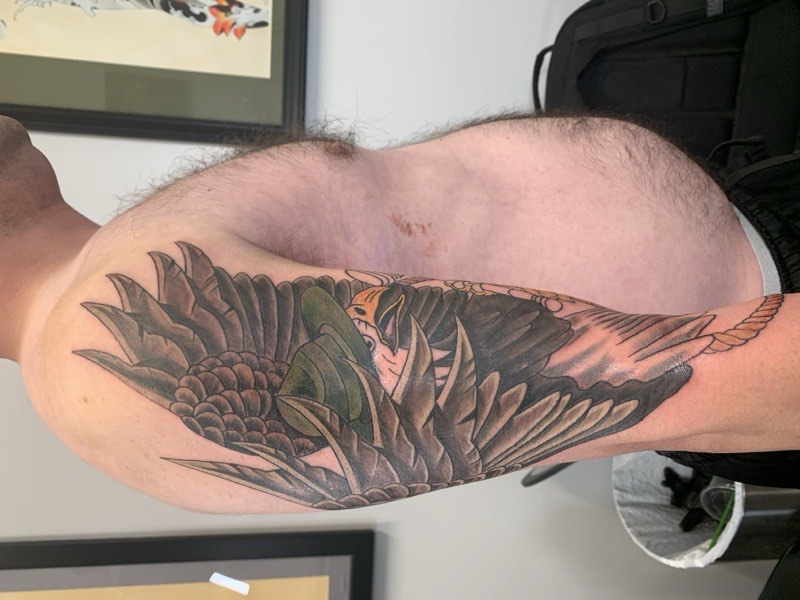
Anchor
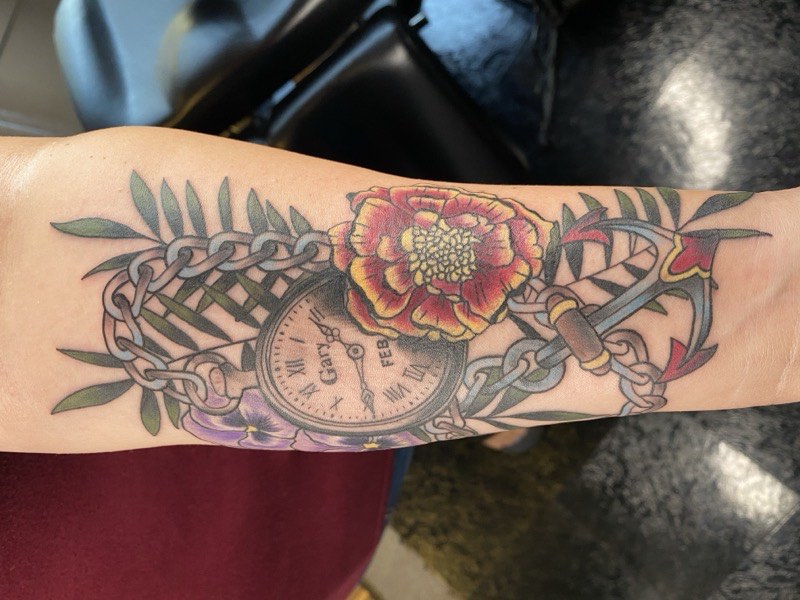
Stability, home, and the maritime lineage of the whole style. “Mom” or “Dad” banners wrapped around an anchor are some of the most iconographic images in tattoo history. The shape is purpose-built for Traditional's line vocabulary.
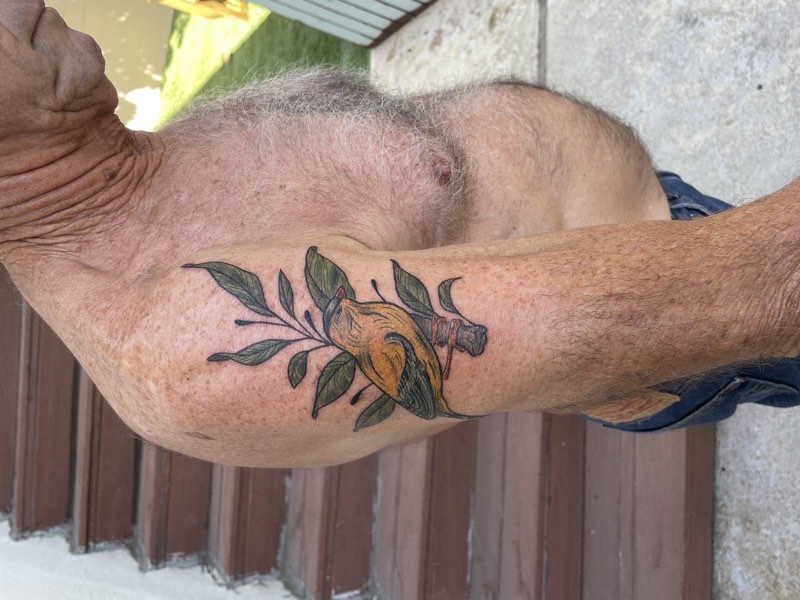
Panther
Power, stealth, protective aggression. The walking black panther — head-on snarl, claws out, often climbing down an arm — is one of the most recognizable silhouettes in tattooing. Near-solid black fill makes it exceptionally durable; 1950s panthers still read cleanly today.
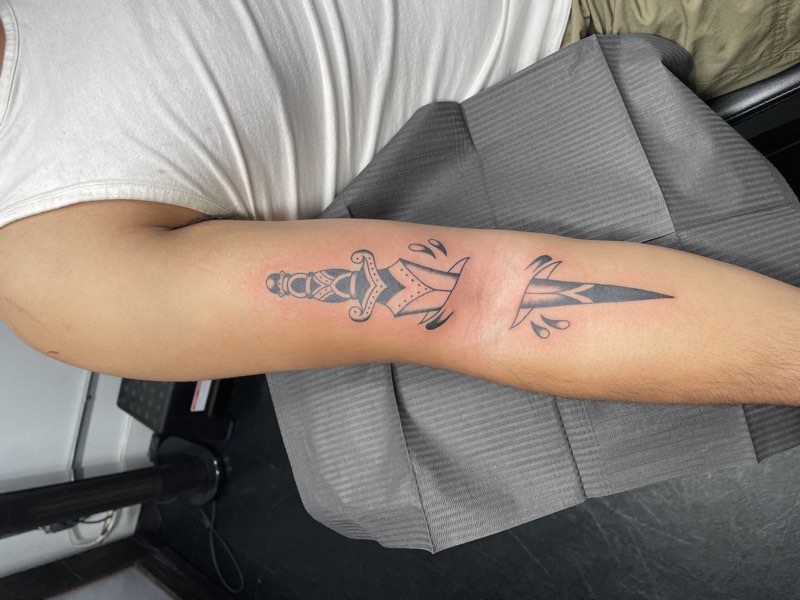
Pin-up
Mid-century American femininity rendered for the sailor and serviceman audience that built Traditional's market. Classic archetypes: hula girl, sailor girl, cowgirl, devil girl. Demands larger real estate than most motifs because the face has to carry character at Traditional resolution.
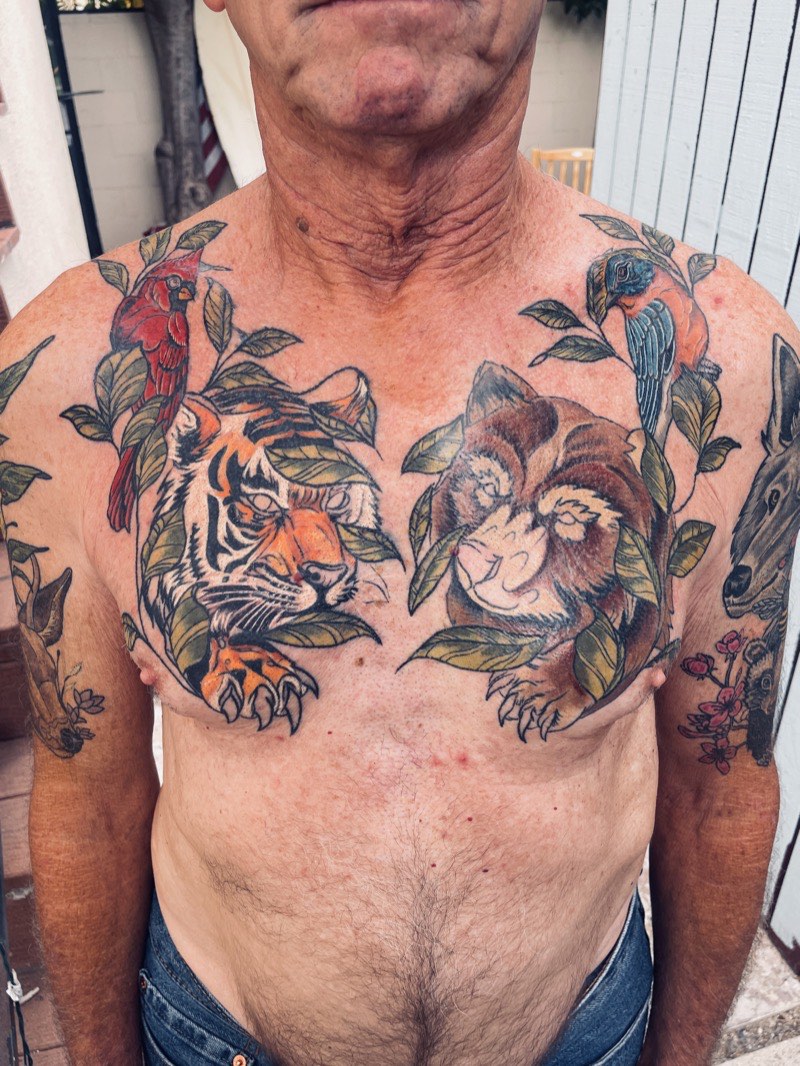
Eagle
Patriotism, freedom, military identity. Spread-wing compositions work beautifully across the chest; side-profile eagles with banners work on the bicep. The strongest overlap with military and veteran clients and one of the most common chest-piece motifs in the canon.
Flaming / Sacred Heart
Descended from Catholic Sacred Heart imagery — devotion, sacrifice, love made visible. In the secular Traditional canon it reads as love, loyalty, or mourning, often banner-wrapped with a name. One of the few motifs that translates well even at smaller scales.
Secondary canon
Ship / clipper
Full-rigged clipper ships — voyage, journey, leaving and returning. Demands scale (chest, back, large thigh) for rigging and sail detail to breathe.
Skull
Memento mori rendered without horror-movie detail. Clean sockets, heavy jawline, often crowned with roses or daggers. Forgiving to age because the negative space is architectural.
Snake
Temptation, renewal, power, healing. Coiling form is tailor-made for wrapping around arms, legs, and other motifs as connective tissue in larger compositions.
Dragon
Entered American Traditional through Japanese influence via Collins' correspondence with Horihide. Sits at the border of two traditions — touching Japanese iconography, not pure Americana.
Wolf head
Loyalty, family, wilderness, protective instinct. A more recent addition to heavy rotation, expanding the “noble predator” slot that panthers and eagles originally occupied.
Bird of prey
Hawks and falcons — vision, freedom, hunting focus. Often rendered mid-dive or perched; fits well on forearms and calves.
Nautical star
Five-point, half-shaded — guidance and finding your way home. One of the smallest viable Traditional motifs; common filler or standalone first tattoo.
Horseshoe
Luck, typically oriented opening-up to “catch” fortune. Often paired with dice, four-leaf clover, or a banner — lives in the gambler sub-canon.
Cross
Faith, memorial, devotion — often banner-wrapped with a loved one's name or date. The Latin cross is structurally ideal for Traditional's bold lines.
Mermaid
Maritime fantasy, part pin-up, part sea legend. Typically rendered large enough to carry a face and tail composition — thighs, ribs (with caveats), or backs.
What it won't do
Traditional's honest limits.
A few ideas will not sit inside a bold outline, whoever draws them. Traditional earns its reputation by being disciplined about what it refuses — not by pretending the style is universal.
Photorealistic likeness
Traditional is graphic, not photographic. For a face you could identify across a room, you want realism — not a bold-outlined approximation.
Watercolor diffusion
Traditional and watercolor are opposite aesthetic philosophies. The bold outline exists to prevent exactly what watercolor deliberately courts.
Hyper-detailed micro work
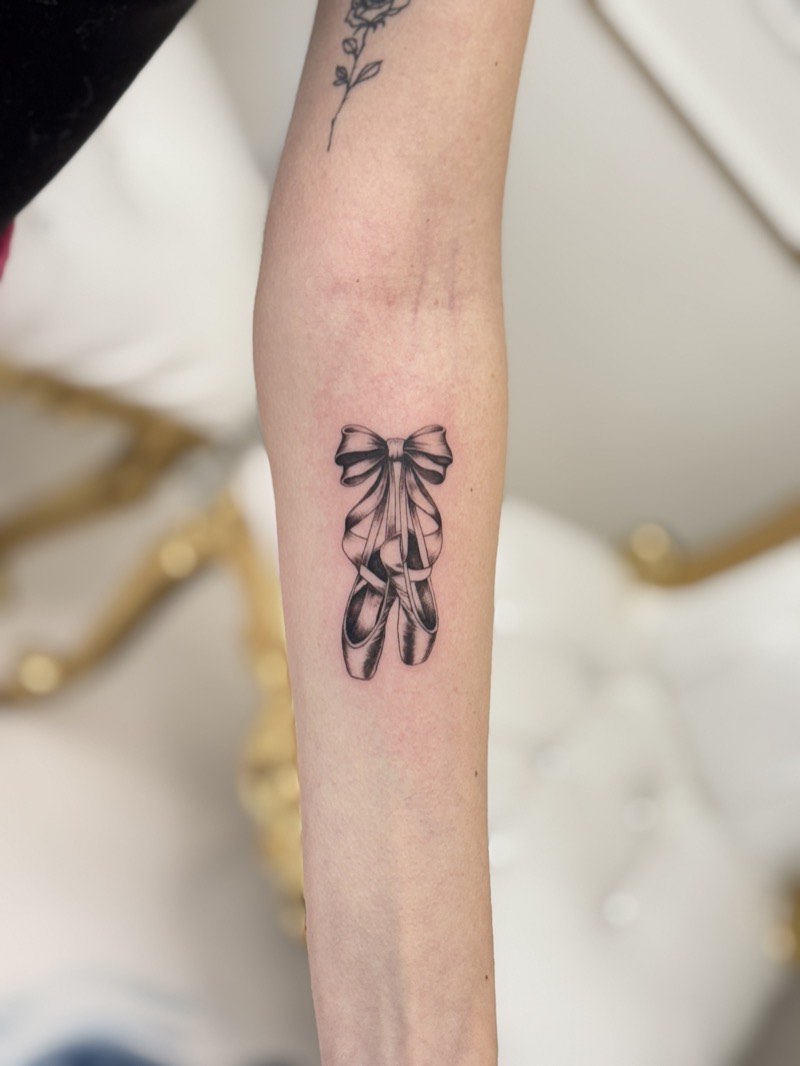
Falls under Traditional's resolution threshold. Bold lines demand scale; micro-detail demands the opposite. The two styles cannot coexist in the same piece.
Single-line minimalist pieces
Traditional is maximalist by construction. A single line divorced from bold fill and smoke shading is no longer Traditional — it's a different style altogether.
Purely abstract work
Traditional is a representational tradition built around a canonical motif library. Abstract work belongs in blackwork, ornamental, or illustrative.
Weight and scale
Scale lets the outline breathe.
Bold outlines need room to read. The minimums below are where Traditional's graphic vocabulary starts working as designed rather than collapsing into crowded-looking ink.
Line weight against size
Below this, bold line weight crowds the design and the composition reads disproportioned. 3 inches is the floor where Traditional's bold outlines have room to breathe.
The sweet spot for most single-motif Traditional work — enough canvas for bold outline + saturated fill + black smoke without crowding.
Multi-element composition needs room. A panther at 4 inches loses the snarl; a ship at 4 inches loses the rigging.
Multi-motif compositions need real estate. Below 10 inches, the stacking grammar Traditional sleeves rely on starts to collapse.
Classic ground for bold work
- Bicep / upper arm. Sailor Jerry's classical canvas — consistent skin, flat working surface, visible but covered when you want.
- Outer forearm. Visible daily, steady skin, ideal for single motifs and stacked compositions alike.
- Outer calf. Flat canvas with moderate sun exposure — handles panthers, ship scenes, and large single motifs beautifully.
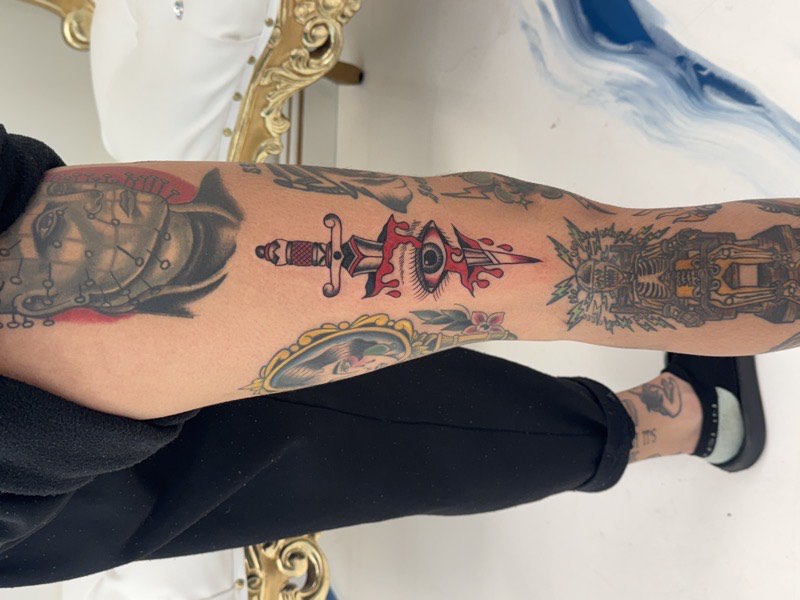
- One-sided chest (sternum to shoulder). Genre-native territory for larger Traditional pieces. Eagles, hearts, dagger-and-rose compositions all sit here.
- Thigh. Modern expansion for larger compositions — pin-ups, mermaids, multi-motif stacks.
- Full back. For narrative compositions with multiple motifs — the largest Traditional canvas.
- Side neck (stylized). Fits the old-school aesthetic when the design respects the placement.
Placements even a bold line struggles with
- Inner arm / inner forearm. Bending distorts bold outlines over years of daily flex.
- Palms and soles. Friction-based fade regardless of style, but especially damaging to bold Traditional.
- Behind ears. Too small for Traditional's line weight and bold aesthetic.
- Ribs / torso sides. Skin movement distorts bold lines; the curvature also fights the style's graphic character.
Flash & custom
The flash tradition is not a lesser form.
Flash is the tradition. Walk-in flash days are a living Traditional shop practice. Custom Traditional exists in constant dialogue with the flash canon — and knowing the relationship matters.
Flash is pre-drawn designs displayed on sheets, ready to tattoo as-drawn. Sailor Jerry's flash sheets — reproduced in Don Ed Hardy's archives — are the genre's canonical reference and the foundation of the entire Traditional vocabulary. Many Traditional artists still do primarily flash work, and that's not a lesser form of the craft. It IS the craft.
Custom Traditional exists in constant dialogue with the flash canon. The best custom Traditional work reads like it could have come off a sheet, because the vocabulary stays consistent. Motifs, composition rules, line weight conventions — all inherited. A custom Traditional piece that abandons the flash grammar isn't really Traditional anymore; it's neo-traditional or illustrative.
If you want something unique, you want custom work IN the Traditional vocabulary — not flash modified beyond recognition. That distinction keeps the style coherent across decades and lets your tattoo stay in conversation with the hundred-year tradition it's part of.
Names for the same thing
Are old school tattoos and American Traditional the same style?
Yes. “Old school tattoos”, “American Traditional” and plain “Traditional” all name the same visual grammar: heavy black outline, a small opaque palette, flat unmodelled colour, black smoke shading. The names differ by who is speaking, not by what is on the skin.
“Old school” is the shop-floor term and the older one — it came into use to separate this work from the fine-line and photorealistic styles that arrived later, and it carries a mild affection for the era it points at. American Traditional is the term the craft uses about itself when it wants to be precise, because it distinguishes the style from other national traditions — Japanese, and the British and European street-shop vocabularies that developed in parallel.
The one distinction worth holding onto is old school versus new school. New school is a separate style: exaggerated proportion, cartoon and graffiti influence, a wide bright palette and heavy dimensional rendering. It borrowed the bold outline and almost nothing else. If someone says “old school” they mean what this page describes. If they say “new school” they mean something else entirely.
Documented history vs shop lore
What do traditional tattoo symbols and meanings actually mean?
Most of them mean what a hundred years of tattooers have agreed they mean — which is real, and is not the same thing as historically documented. The confident maritime origin stories attached to these motifs are mostly untraceable. That is worth saying plainly, because nobody else does.
What the primary record actually contains
The largest body of primary evidence for early American sailor tattoos is a study of Seamen's Protection Certificate applications — physical descriptions taken down for American sailors between 1796 and 1818 so they could prove citizenship against Royal Navy impressment. Those descriptions recorded tattoos, which makes them a rare census of what was actually on people's skin. They record the designs. They do not record what any of them meant. The meanings were either never asked for or never written down.
Where the meanings entered print
A large share of the symbolic canon now repeated as maritime fact traces back to Albert Parry's 1933 book Tattoo: Secrets of a Strange Art. Parry gathered stories widely and published them without verification. His book is the point at which many of these meanings first appear in writing — which makes it the origin of the folklore rather than independent confirmation of it. When a modern article states an anchor meaning as though it were established in the age of sail, the chain of custody usually ends at Parry.
What has been searched for and not found
The naval historian B. R. Burg worked through nineteenth-century US Navy records and reported finding no evidence of the tattooed pig on the foot, no “Hold Fast” across the knuckles, and no tattooed dragons until shortly before the First World War. An absence in surviving records is not proof a practice never existed. It does mean the precise dating attached to these motifs online has nothing underneath it.
The swallow, specifically
The 5,000-nautical-mile rule is the most repeated claim in traditional tattooing and the least supported. It does not appear in the 1796–1818 protection papers, and the earliest sources anyone has traced for it are late twentieth century — well over a hundred years after the era it supposedly describes. What is well founded is the association with homecoming: swallows migrate and return, and a swallow seen from a deck meant land was close. The bird meaning safe return is old. The mileage tariff is shop tradition, and we tattoo it as shop tradition.
One piece of folklore that is genuinely early
The pig-and-rooster superstition — the pair tattooed on the feet against drowning — was described in 1908 by a US Navy surgeon reporting on tattoo practice aboard the USS Independence, as a belief already current among older sailors. That is a contemporary observation rather than a later retelling, which makes it one of the few items in the whole folk canon with an early source behind it.
Why any of this matters when you are choosing a tattoo
It does not make the motifs less worth wearing. A swallow has meant homecoming to tattooers and the people they tattoo for a century, and a meaning held continuously for a century is a real meaning regardless of where it started. What changes is the claim you are making about it. If you want the bird because it marks a return, that is true and always was. If you want it because you believe you are wearing a documented naval decoration, you should know that the record does not support that, and an artist who tells you otherwise is repeating the internet rather than the history.
Sources for this section
- Ira Dye, “The Tattoos of Early American Seafarers, 1796–1818”, Proceedings of the American Philosophical Society, vol. 133, no. 4 (1989), pp. 520–554.
- Albert Parry, Tattoo: Secrets of a Strange Art as Practised by the Natives of the United States, Simon and Schuster, New York, 1933.
- B. R. Burg, “Sailors and Tattoos in the Early American Steam Navy: Evidence from the Diary of Philip C. Van Buskirk, 1884–1889”, International Journal of Maritime History, vol. 6, no. 1 (1994), pp. 161–174; and Burg, “Tattoo Designs and Locations in the Old U.S. Navy” (1995).
- A. Farenholt, “Tattooing in the Navy, as shown by the records of the U.S.S. Independence”, United States Naval Medical Bulletin, vol. 2, no. 2 (April 1908), pp. 37–39.
- Biographical dates for Norman Collins, Mike Malone, Bert Grimm and August Coleman are from the Tattoo Archive artist histories and contemporary obituaries.
Disclosure on these citations. Apollo has not read the Dye, Parry, Burg or Farenholt originals. They are cited here as the documents the secondary literature identifies as the evidentiary base and the folklore's point of entry, and they are named so that a reader can go and check rather than take our word for it. If any of them turns out to say something other than what is described above, this page is wrong and we would like to be told.
Forty years
The benchmark for tattoo aging.
Traditional is the style every other style's longevity is measured against. Here's the year-by-year honest read — not a gradual decline but a slow settling into patina engineered in from day one.
Initial settling
Bold black outlines hold essentially untouched. Saturated color fills may show minor softening at the edges where pigment meets outline. A settling touch-up at 6–12 months is minimal — usually addressing spots that didn't take fully during the heal.
Still largely unchanged
The combination of bold outline, full-saturation color fill, and limited palette keeps the design reading at arm's length exactly as it did on day one. Prime Traditional readability — and it lasts.
Prime readability
Color fills may soften slightly — red and yellow families are first to show it. Outlines remain crisp. The piece still reads as designed because the design was built around the outline carrying the composition, not the color.
Softer edges become patina
Outlines hold. Colors mellow into a warmer, lower-contrast version of themselves. The image still reads because Sailor Jerry and the flash generation engineered it to. 1950s and 60s Traditional pieces reading clearly today are proof of concept.
The Traditional promise
Bold outlines plus saturated primary colors plus carbon black smoke shading equals 40+ years of legibility. A Sailor Jerry piece from 1965 still reads as a Sailor Jerry piece today. Traditional is one of only a few styles that can still read as designed at this age.
Five reinforcing engineering decisions stack in Traditional's favor: bold outlines carry the design even as interior color softens; limited primary palette avoids less-stable pigment chemistries; high saturation creates pigment depth that resists long-term fade; carbon black smoke shading is the most photostable pigment in the palette; and simple composition means nothing complex can fade into mush. Pigment behavior over decades: red fades slowly and shifts warm rather than disappearing, yellow goes muddy slowly rather than transparent, green is essentially indefinite, black is permanent. Purple (occasional) is less stable — modern Traditional often substitutes navy blue or a black-with-purple-wash.
Traditional in the wild
The canon, as we draw it.
Motif planner
Motif → scale → placement.
A consolidated reference for the canonical motifs — scale minimums, native placements, avoid placements, realistic touch-up windows.
What people say
Five ideas we push back on.
What people say about Traditional before they get one. Said about the next tattoo, not the ones behind you.
“Traditional looks old-fashioned.”
It's engineered to look the same at forty years as it did on day one. The consistency is the point, not a limitation. A 1965 Sailor Jerry piece still reads as a Sailor Jerry piece today because the style was designed for that exact durability.
“Traditional is easy.”
Saturation packing and line weight discipline are among the most technically demanding skills in tattooing. A generalist's Traditional piece looks nearly identical to a specialist's at day one — and nothing like it at year ten.
“Old-school means outdated.”
Reframe: old-school means proven. Traditional is the only tattoo style with 100+ years of walking-around evidence that the engineering holds.
“I want flash but make it unique.”
Flash is a tradition unto itself — not a menu. If you want something unique, you want custom work inside the Traditional vocabulary, not flash that's been modified beyond recognition.
“Bold lines mean cheap work.”
The opposite. Solid saturation at scale often takes multiple sessions, and the best Traditional artists command rates that reflect the hours and the specialization. Packing a panther properly takes as long as rendering a realism portrait.
Who to trust
Who to trust with a bold line.
Traditional is deceptively easy to fake fresh and impossible to fake at year ten. The packing technique is unforgiving — and the gap between a generalist's Traditional and a specialist's only surfaces as the piece ages.
What forty-year work looks like
- Healed work at 5, 10, 20 years showing composition and saturation holding
- Flash portfolio alongside custom work
- Discussion of machine choice (coil vs rotary) with specific reasoning
- Explicit grasp of Traditional motif vocabulary and compositional grammar
- Multiple examples of the same motif category — ten swallows across ten clients, for instance
- Outlines that hold consistent weight through long curves
Signals to walk on
- Outlines that vary unpredictably in weight — vs intentional variation for composition
- Under-saturated color fills that look washed out even at day one
- Gradient shading inside what should be flat color (unless clearly intentional)
- No healed work — Traditional photographs beautifully fresh; you want 5-year healed proof
- “I do all styles” framing
- Color that doesn't match the canonical palette — oranges, pinks, light blues usually signal neo-traditional
Six questions about packing and line
- Can I see healed Traditional pieces from at least 10 years ago?
- What machine do you use for Traditional work, and why that machine?
- Walk me through your saturation packing approach — how do you know when a fill is fully packed?
- Do you prefer flash or custom? What's your approach to each?
- At this scale, what line weight are you using, and why?
- What canonical motifs fit the subject I'm thinking about?
Traditional rewards the specialist who can show you healed work from a decade ago. If an artist can't show you that, they haven't earned the claim.
FAQ
Old-school questions, current answers.
Nine questions about a style engineered before anybody was photographing healed work.
How long do Traditional tattoos actually last?
Traditional is the benchmark against which every other tattoo style's longevity is measured. Bold outlines hold 40+ years. Colors mellow gracefully over decades — red shifts warm rather than disappearing, green holds essentially indefinitely, black smoke shading is permanent. Most Traditional pieces need a major touch-up every 15–25 years, which is two to five times longer than any modern style. The proof is walking around: tattoos from the 1950s and 60s that are still reading cleanly today prove Sailor Jerry's engineering works.
What's the difference between Traditional and Neo-Traditional?
One diagnostic question: is there sculptural shading inside the outline? Traditional uses a 5–6 pigment palette, flat color fills, and only black smoke shading. There's no dimensional modeling — a Traditional rose reads as a graphic rose with flat petal fills and black cast-shadow. Neo-traditional expands the palette to ten or more colors (teals, pinks, muted earth tones), adds sculptural shading that models form under the outline, and renders more illustratively. Both use bold outlines. The differentiator is everything happening inside the outline.
Why do Traditional artists still use coil machines?
Because the coil's mechanical “punch” — the hammer-like delivery of the needle group — is widely credited by dedicated Traditional artists with packing pigment more densely than the smoother, quieter cycle of a rotary. Dense pigment packing is one of the two or three most important Traditional skills, and coils are the tool many specialists consider best-suited for it. Rotaries are fine; coils are a craft preference with a specific technical argument behind it. An artist who can articulate why they've chosen one over the other is telling you something real.
What makes something “flash” and is flash worse than custom?
Flash is pre-drawn designs displayed on sheets, ready to tattoo as-drawn. Sailor Jerry's flash sheets — reproduced in Don Ed Hardy's archives — are the genre's canonical reference and the foundation of the entire Traditional vocabulary. Flash is a living tradition, not a lesser product. Walk-in flash days remain a classic Traditional shop practice and produce excellent tattoos. Custom Traditional exists in constant dialogue with flash: the best custom Traditional work reads like it could have come off a sheet, because the vocabulary stays consistent. If you want something unique, you want custom work IN the Traditional vocabulary — not flash modified beyond recognition.
Is Traditional a good choice for a first tattoo?
Yes — arguably the best choice. Forgiving placement, proven aging, readable at a glance, and a canonical motif library to choose from. Small Traditional pieces (swallow, nautical star, small anchor) at 3–4 inches on a forearm or bicep will look essentially identical at year twenty as they did at year one. Compare this to fine-line work at the same scale and placement, which frequently needs rework within a decade. The Traditional first-tattoo experience is also honest to the craft's original function — walking into a shop, picking from flash, getting tattooed same-day with confidence the piece will last.
How do I find a Traditional specialist vs a generalist?
Ask to see healed pieces from 5, 10, and 20 years back. Traditional photographs beautifully fresh, but the saturation gap between specialists and generalists only surfaces as the piece ages. Look for outlines that hold consistent weight through long curves, saturated fills that look deeply packed (not washed-out), and a portfolio that shows multiple examples of the same motif category — ten swallows or five panthers across different clients tells you this artist has solved the same problem many times. Ask about machine choice and saturation approach; specialists have real answers, generalists deflect.
Can I put a modern subject in Traditional style?
Within reason, yes. Contemporary Traditional-trained artists routinely expand beyond the Sailor Jerry canon — bears, foxes, songbirds, stylized family portraits, even cultural references — rendered in Traditional's bold-line-plus-flat-color grammar. Modern iconography (film characters, video game imagery) is contested: some purists view it as tourism, others as healthy evolution. The honest conversation is whether your subject can carry Traditional's graphic vocabulary or whether it needs a different style. A specialist will tell you straight — and sometimes redirect you toward a style that actually fits what you're after.
Are old school tattoos the same as American Traditional?
Yes. Old school, American Traditional and Traditional all name the same style: heavy black outline, a small opaque palette, flat unmodelled colour, black smoke shading. “Old school” is the shop-floor term, “American Traditional” the precise one that separates it from Japanese and European street-shop traditions. The distinction that does matter is old school versus new school — new school is a different style with exaggerated cartoon proportion, a wide bright palette and heavy dimensional rendering. It kept the bold outline and little else.
Does a swallow tattoo really mean 5,000 nautical miles?
That is shop tradition, not documented history. The mileage rule does not appear in the Seamen's Protection Certificate records of 1796–1818, which are the main primary source for early American sailor tattoos, and the earliest sources anyone has traced for it are late twentieth century. The swallow's association with homecoming is much better founded — the birds migrate and return, and one sighted from a deck meant land was near. Wear it for safe return, which is true. Do not wear it believing you are carrying a documented naval decoration.
Ready to commit to the forty-year tattoo?
Bring the motif, the placement instinct, and an appreciation for the craft.
Traditional is specialist work and a multi-decade investment. Bring flash, archive plates, or work by artists you respect, plus the placement — and expect a good Traditional artist to tell you when an idea does not belong in the style. Then we check the motif against the style's own rules. If an idea will not sit inside a bold outline, a good Traditional artist says so instead of forcing it.