Tattoo Styles
Animal Portrait
Your camera roll decides this one before an artist ever touches skin. Eye-level light, sharp eyes, no flash — pet, wildlife and fantasy likeness work at Apollo, with the reference standards, the sizing floors that keep fur and feather readable, and the color-versus-monochrome call.
Book a consultationAt the machine
What animal portraiture actually is.
A rendering discipline defined by likeness. The piece succeeds or fails at the eyes, the fur direction, the catchlight.
Animal portrait tattooing is a representational discipline in which the artist renders a specific animal — whether a beloved pet, a wildlife subject, or a mythological creature — with portrait-level fidelity. The defining goal is recognizable likeness: the finished piece should read unmistakably as THAT animal, not simply AN animal.
The viewer should be able to identify the subject down to species, and in the case of pets, down to the individual animal. That demands a technical foundation in realism — value structure, edge control, tonal gradient — plus subject-specific fluency: the directional flow of a coat, the overlapping architecture of feathers, the refractive quality of reptile scales. These are not the same skills, and generalist artists rarely carry both.
Because of the likeness requirement, animal portraits are the most reference-dependent tattooing in the studio. The pet the owner knows intimately, the wildlife subject the client has researched extensively, the dragon the client has imagined for years — all require reference discipline that most first-time clients underestimate. The piece is largely determined before the machine ever turns on.
Three subcategories
Pets, wildlife, fantasy.
Each subcategory has different reference demands, different fidelity targets, and different consultation rhythms.
Ι
Pet portraits
The most reference-dependent branch. Because the owner knows every marking — the asymmetric ear tip, the freckle above the left eye, the exact gradient where black fur transitions to gray — the finished tattoo is judged against intimate memory. A pet portrait cannot be convincingly invented; it must be rendered from high-resolution photographs, ideally several, taken in natural light at the animal's eye level.
ΙΙ
Wildlife portraits
Tigers, wolves, eagles, foxes, bears, stags, orcas — rendered with enough accuracy that the species and often subspecies reads clearly. The fidelity target is looser than pet work: the client usually doesn't know one specific tiger, so the artist has latitude to composite references. That said, species accuracy still matters — a Siberian tiger is not a Bengal.
ΙΙΙ
Fantasy / mythological animals
Dragons, griffins, phoenixes, unicorns, kirin, wyverns — portrait-level rendering vocabulary applied to animals that don't exist. The artist borrows from real anatomy (reptiles for dragons, raptors for phoenixes, equines for unicorns) and composites them into a creature the client recognizes from imagination or established lore.
ΙV
The composite case
Increasingly, clients want combinations — a beloved pet alongside a spirit animal, a deceased companion beside a symbolic wolf, a matched pair drawn from personal meaning. These require a composition conversation: scale, relationship, and which animal carries likeness weight versus symbolic weight.
Technical requirements
Six variables that determine success.
The discipline stack behind every strong animal portrait.
Artist specialization
Animal portraiture sits inside the realism family and demands the same training: light-source behavior, value structure, edge control, skin-as-substrate. Beyond that, animal work requires specific texture fluency — short fur vs. long fur, directional flow of a coat, overlapping architecture of feathers, refractive quality of reptile scales. An artist strong in human portraiture does NOT automatically render a convincing Pomeranian.
Reference quality
For pet portraits, high-resolution photographs are mandatory — ideally 2000+ pixels on the long side, sharp focus on the eyes, natural daylight, camera held at the animal's eye level (not shot down from above). Multiple images help the artist choose expression and understand three-dimensional structure.
Size minimums
Detail requires real estate. Pet portraits generally need a minimum of 4 inches on the long axis to carry recognizable features; anything smaller loses the marking specificity that makes the portrait read as THAT pet. Wildlife portraits, particularly full-body compositions or heavily furred subjects, usually want 6 inches or more.
Skin placement
Flat planes carry portrait detail best — outer thigh, calf, upper arm, back, chest panel. High-movement or high-stretch areas (inner elbow, knee, ribs under the arm, hands, feet) distort linework and soften detail over years, which is costly in a piece that depends on precision.
Session count
A detailed animal portrait is rarely single-session. Four to eight inches of fur-rendered work typically runs 4–8 hours, and larger or more complex pieces are staged across 2, 3, or more sittings to protect skin quality and rendering accuracy.
Color vs. black-and-gray
Color animal portraits are vivid and immediate but fade faster — especially on placements exposed to sun. Black-and-gray ages more gracefully and holds detail longer, which matters for a piece intended to last decades. Many memorial pet portraits are rendered black-and-gray specifically for this reason.
Where and how big
Where animal portraits live.
Portrait detail requires real estate. The right placement doubles the longevity of the piece.
Where a portrait sits best
- Upper arm (outer) — best. The industry standard for animal portraits. Flat, stable skin with enough real estate for 4–7 inch pieces. Ages beautifully when properly cared for.
- Outer forearm — best. Excellent visibility for clients who want to display the piece, with a natural rectangular canvas that suits both full portraits and profile compositions.
- Thigh — best. Generous real estate for larger wildlife or fantasy subjects (8+ inches). Skin tension is forgiving and the surface tolerates detail density.
- Upper back / shoulder blade — best. Premier placement for ambitious full-scene compositions — wolves in landscapes, eagles mid-flight, lions with environmental context.
- Chest (pec panel) — best. Strong for front-facing animal faces, especially predators (lion, tiger, wolf). Commands presence and allows symmetrical framing.
- Inner bicep — moderate. Intimate placement frequently chosen for memorial pet portraits. Softer skin requires careful shading strategy but rewards with a personal, hidden keepsake.
- Calf — moderate. Works for vertical compositions (standing wolves, howling silhouettes). Watch for stretch distortion in athletic clients.
- Hands, fingers — avoid. Insufficient surface area for the detail animal portraits require. Ink also migrates heavily in these zones, blurring the fine work within 2–3 years.
Sizing against the animal
- Pet portraits — 4 inches minimum. 4–5 inches is the sweet spot for capturing eye detail and fur texture that make a pet recognizable. Smaller and the marking specificity collapses.
- Wildlife — 5–6 inches minimum. Wolf, fox, eagle, bear subjects carry more textural complexity — layered fur, feather barbs, muzzle structure — and need canvas to resolve properly.
- Large predators — 7–8 inches. Lion, tiger, full bear compositions. Mane and stripe detail multiply the rendering demands; the extra inches are not optional.
- Fantasy creatures — 8 inches and up. Dragons, phoenixes, griffins. Scale work, flame rendering, and compound anatomy require significant real estate.
Compositions that work
Eight compositions that work on skin.
Tested frameworks for pet, wildlife, and fantasy commissions. Starting points for the consultation.
1. Realistic dog portrait, black and gray
The signature commission. Head-and-shoulders composition rendered in black-and-gray with particular attention to eye catchlights, nose texture, and directional flow of fur along the muzzle and brow. Typically 4–5 inches on outer forearm or upper arm. Works best from high-resolution reference with strong directional lighting.
2. Front-facing tiger portrait
A symmetrical, forward-staring tiger portrait emphasizing the intensity of the eyes and the radial pattern of stripes emanating from the muzzle. Best at 6–8 inches on chest, upper back, or thigh. Full color or converted to high-contrast black-and-gray for a more graphic effect.
3. Wolf howling silhouette with detail
A wolf mid-howl, head tilted skyward, with detailed fur and musculature in the neck and chest while the silhouette's edge reads cleanly against the skin. Excellent for calf, outer forearm, or shoulder blade placements at 5–7 inches vertical. Pairs naturally with a moon motif, pine tree line, or mountain ridge.
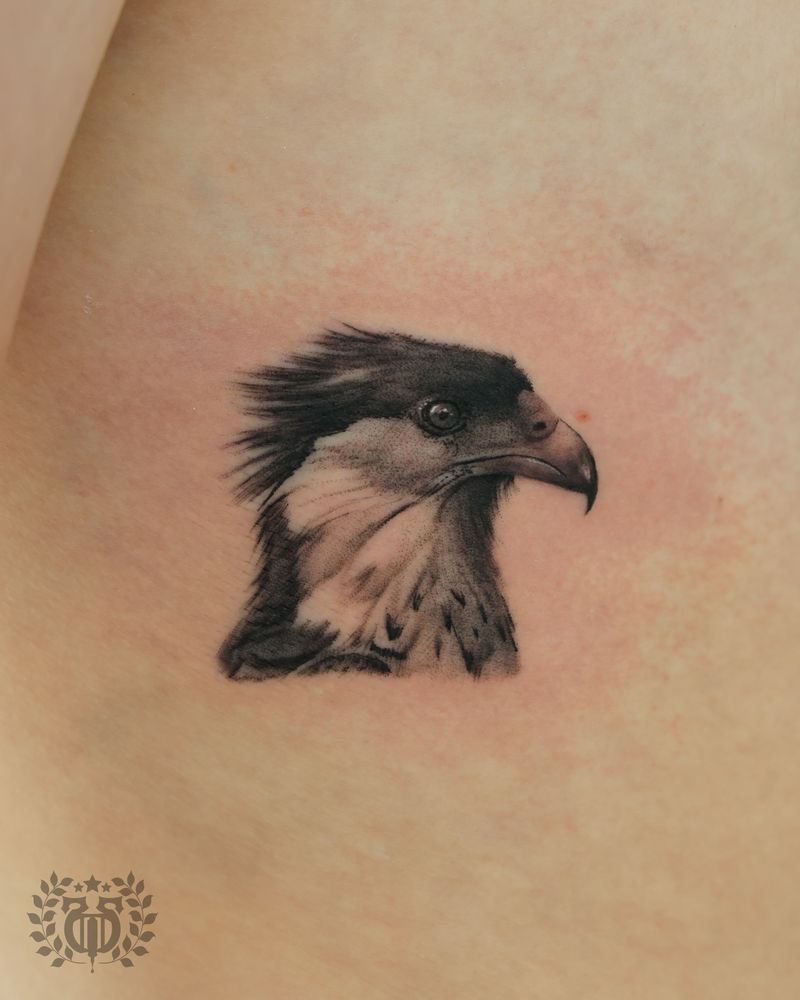
4. Eagle portrait, feather-rendered
A bald or golden eagle in three-quarter profile, with the beak and eye as focal points and each feather individually rendered along the head and neck. 5–7 inches on upper arm or chest. The beak's specular highlights and the piercing eye make or break this piece.
5. Lion face with mane
Frontal or three-quarter lion portrait where the mane occupies as much rendering attention as the face itself — radial fur flow, directional shading, layered density. 7–9 inches on chest, upper back, or thigh.
6. Fox in woodland setting
A fox portrait integrated with environmental elements — ferns, birch bark, pine needles — creating a narrative scene rather than an isolated subject. 6–8 inches. Works in a limited palette (orange, cream, forest green) or as black-and-gray with a single spot-color accent on the eyes.
7. Horse portrait
A head-and-neck composition emphasizing the horse's mane flow, the wet gloss of the eye, and the delicate texture of the muzzle. 5–7 inches on outer forearm, upper arm, or thigh. Can be rendered as a specific breed portrait from a client reference.
8. Dragon as realistic creature
Dragon treated as if it were a real animal — scale-by-scale rendering, anatomically plausible musculature, textural realism on horns and claws. 8–12 inches on back, thigh, or full upper arm. Departs from traditional Eastern or Western stylization in favor of cryptozoological plausibility.
Mixing in
Mixing portraiture into other work.
The hybrids that complement likeness without compromising it.
Pairing
Animal portrait + black-and-gray realism
The benchmark standard. Photographic rendering of fur, eyes, and anatomy from a high-quality reference. The default style for durable, long-lasting pet and wildlife portraiture.
Pairing
Animal portrait + color realism
For animals whose identity is tied to pigment — a red fox, a macaw, a tiger. Requires pigment discipline and a realism specialist fluent in color chemistry.
Pairing
Animal portrait + neo-traditional
A stylized alternative that trades photographic fidelity for bold linework, saturated color, and decorative framing. Ages exceptionally well due to strong line foundations.
Pairing
Animal portrait + illustrative
A middle path — rendered with realistic proportion and shading but allowing stylistic liberties in line weight, texture shorthand, and compositional framing. Suits clients who want recognizability without strict photorealism.
Pairing
Animal portrait + watercolor accents
The animal itself rendered in black-and-gray realism with watercolor splashes or color washes layered behind or around the subject as accent. Preserves longevity while adding visual interest.
First animal portrait
Eight steps before you send photos.
The preparation that separates a great portrait from a disappointing one.
- Gather ten reference photos. Not one. Ten. Multiple angles, multiple expressions, multiple lighting conditions. The artist composites from your archive.
- Shoot at eye level. Get the camera down to the animal's face. Overhead shots distort proportions and flatten personality.
- Use natural light. Window light. Overcast outdoor. Avoid overhead fluorescents and direct flash.
- Scale up deliberately. Accept the artist's size recommendation. First-time clients almost universally underestimate how much canvas a portrait needs.
- Pick a flat placement. Upper arm, thigh, back, chest. Save curves and joints for later pieces.
- Choose black-and-gray first. If you're undecided on palette, black-and-gray ages better and holds detail longer. Color can be added later in a separate piece.
- Budget multi-session. Expect 2–3 sittings for a mid-size portrait, with healing time between. Not a one-day decision.
- Protect the healed piece. UV is the enemy, especially for color. Daily SPF 50+ on the finished tattoo is the minimum standard.
Your animal
Three ways to make it your animal.
Details that lift a portrait from generic realism into personal record.
Memorial context
Names, dates, handwritten script from the animal's owner, background elements that reference a favorite place or activity. The composition carries deeper weight when it's rooted in specific shared memory.
Environmental framing
Ferns, pine needles, water, sky, architecture — the environment anchors the animal in its context. Lifts the piece from isolated portrait to narrative scene.
Paired subjects
A beloved pet alongside a spirit animal. Two pets from the same household. A wild counterpart to a domestic one. Paired compositions require extra consultation for scale and relationship.
Reference problems
Six reference problems we catch early.
The failure modes we watch for, and the conversations that prevent them.
Using low-resolution reference photos
A 480p phone screenshot doesn't contain enough detail for a convincing portrait. The artist cannot invent fur direction, eye reflections, or markings that aren't visible in the source. Budget time to take or gather the best reference possible.
Choosing a generalist because they're available sooner
Animal portrait realism is a specialized skillset. Waiting three months for a specialist will almost always give you a better tattoo than booking next week with someone whose portfolio shows mostly other styles.
Going too small
Animal portraits require real estate. A 2-inch dog face will lose fur detail, eye definition, and likeness within a few years as fine lines soften. Most realism specialists will push back if you ask for something under 4 inches — listen to them.
Picking a trendy pose that won't age
Stylized pop compositions with heavy neon splashes, exaggerated watercolor bleeds, or over-the-top geometric backgrounds tend to date quickly. Traditional three-quarter head studies and straight-on eye contact compositions age the best.
Not discussing likeness priorities
For pet portraits, you should articulate what matters most — the eyes, the ear shape, the specific marking on the chest, the expression. If you don't say anything, you're letting the artist guess.
Rushing the design phase
The consultation and reference-gathering should take longer than you expect. Revisions happen before the appointment, not during it. Actually review any digital mockup carefully — this is your one chance to catch issues before they're permanent.
Ask this
Ask your artist these eight.
An animal portrait specialist answers all eight without hedging.
- Which animal portraits of yours have healed best, and can I see them at a year out?
- How many animal portraits has this artist completed — not realism generally?
- What reference quality do you need from me for a pet portrait?
- Would you recommend color or black-and-gray for this subject?
- How many sessions will this take?
- How do you handle fur direction and catchlights?
- What's your touch-up policy for color animal work?
- Have you ever told a client not to proceed with an animal portrait?
Vague answers on reference quality, session count, or fur-rendering technique are telling you something.
FAQ
What owners ask before we start a portrait.
The questions people bring once they realize the photograph on their phone is doing half the work.
What's the difference between animal portrait and pet portrait?
A pet portrait captures a specific animal you know — your dog, your cat, your horse — where likeness to that individual is the entire point. An animal portrait is a broader category that includes wildlife subjects like tigers, wolves, owls, or elephants, where the goal is species fidelity and emotional weight rather than rendering a specific known animal. Pet portraits demand reference photos you supply; wildlife portraits draw from curated reference the artist sources or builds.
How long does an animal portrait tattoo take?
Small black-and-gray animal portraits around 3–4 inches typically run a single 3–4 hour session. Mid-size color work on a forearm or calf usually takes 5–7 hours, often split across one long day or two sessions. Large-format wildlife pieces — a full wolf, lion, or eagle on a thigh, back, or chest — run 10–20+ hours across multiple sittings.
Can I use a photo from Google of a tiger?
You can use it as inspiration, but not as a direct tattoo reference without checking licensing or working with your artist to source clean, high-resolution alternatives. Many wildlife images online are copyrighted. Apollo artists working on wildlife portraits typically build composite references from licensed wildlife photography, zoo visits, or stock libraries. A low-resolution Google grab also usually lacks the detail needed to render fur, eyes, or whiskers convincingly.
Should I get color or black and gray?
Both age well when executed by a realism specialist, but each serves a different goal. Black and gray emphasizes mood, shadow, and the sculptural quality of the animal — excellent for wolves, elephants, or any subject where emotional intensity matters more than species color. Color shines for animals whose identity is tied to pigment: a red fox, a macaw, a tiger.
How is pricing handled for animal portraits?
We quote animal portraits at consultation. Animal portraits often require custom reference work and a longer design phase, so expect a design deposit and a consultation conversation before the first needle touches skin. Hourly rates depend on artist seniority and specialization — a realism specialist with years in animal work commands a different rate than a generalist, and that specialization is what you're paying for.
Will my portrait age well?
Yes, when three things align: the artist is a realism specialist who understands saturation and line economy, the placement avoids high-friction areas like palms and fingers, and you commit to sun protection and moisturization for the life of the tattoo. Realism ages differently than traditional — fine detail softens, contrast compresses — so your artist should design with 10-year legibility in mind.
Can I get my dog AND a wildlife subject in one piece?
Absolutely, and it's a meaningful request we see often — a beloved pet rendered alongside a spirit animal, a deceased companion beside a symbolic wolf or owl, a matched pair drawn from personal meaning. These pieces require a careful composition conversation: scale, relationship, and which animal carries likeness weight versus symbolic weight. Usually the pet is the likeness anchor and the wildlife subject is styled to complement rather than compete.
What placement photographs best?
For single-subject portraits, flat, broad canvases photograph cleanest — outer forearm, outer calf, thigh panel, chest plate, and upper back. Curved surfaces like the bicep or inner forearm work beautifully in person but require more careful composition so the portrait doesn't distort when the muscle flexes. Avoid ribs and sternum for highly detailed portraits unless you're committed to touch-ups.
How do I tell if an artist can do realistic animal work?
Ask specifically for healed animal portrait photos, not just fresh work. Look for convincing eyes, directional fur flow that follows anatomy, and soft gradients that don't look muddy. An artist who primarily tattoos portraits of people may not translate directly — human skin, fur, and feathers render differently. If an artist's portfolio shows only one or two animal pieces among dozens of other styles, they're likely a generalist, not an animal portrait specialist.
Can I get a tattoo of my cat without a good photo?
Sometimes, with caveats. If you have multiple low-quality photos that together capture the cat's coloring, eye shape, facial markings, and proportions, a skilled artist can composite a reference. If you only have one blurry image, expect the final tattoo to be a stylized interpretation rather than a strict likeness. For pets who have passed, we strongly recommend bringing every photo you have to the consultation — more reference almost always improves the outcome.
Ready to talk likeness?
Bring the reference, bring the memory — we'll talk through composition and timeline.
Animal portraits are reference-driven and specialist-led. Bring five to ten high-resolution photographs of your subject (or a detailed description for fantasy creatures), the placement you're considering, and a sense of palette. Then we settle the two things that actually decide the outcome: how large the eyes can be drawn, and whether monochrome serves this animal better than color.