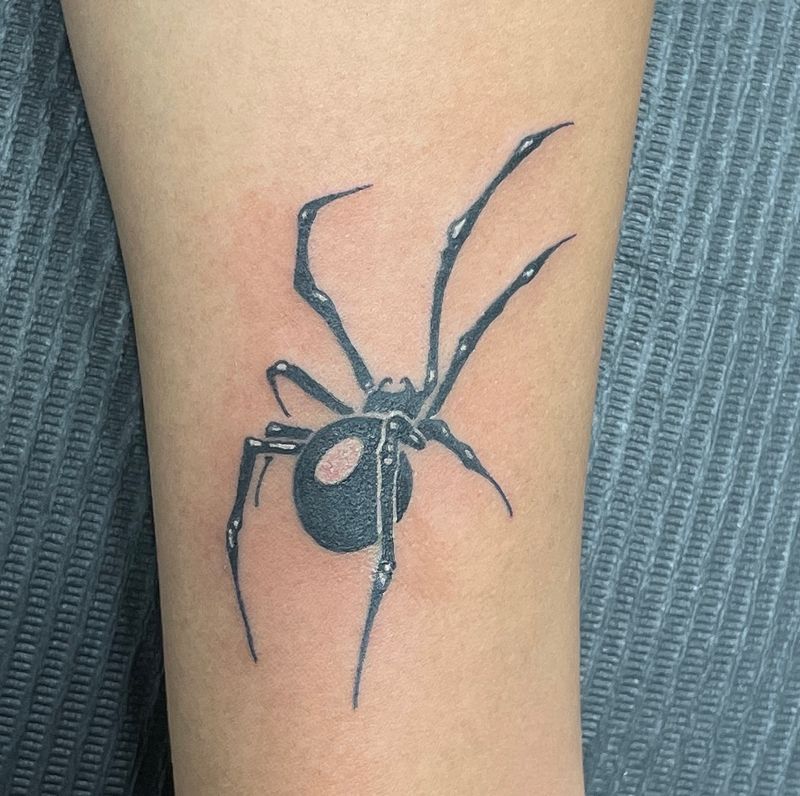
What a cover-up actually is
A redesign around existing ink.
The word “cover-up” is misleading. It suggests a second tattoo can sit on top of an old one the way paint sits on top of paint. Skin doesn’t work that way. Tattoo pigment isn’t surface-level — it’s suspended in the dermis. The old ink doesn’t move aside for the new one. It mixes with it, shows through it, or is outweighed by it. Those are the three honest outcomes.
A cover-up is a piece of custom work that treats the old tattoo as a fixed element — a shape that has to be composed into the final image the way a pre-existing scar, a mole, or a birthmark would be. The artist doesn’t decorate around it. The artist doesn’t hide behind it. The artist builds a new piece that incorporates the old ink as a darker, denser part of the underlying tone — and designs the image so that old tone becomes shadow, silhouette, or saturated fill in the new composition. That’s a specific skill set. Not every tattoo artist does cover-up work.
Possible vs impossible
What the old ink will and won’t allow.
Whether a cover-up will work is mostly a question of what the old ink lets the new piece do. The artist’s skill matters. The client’s openness matters. But the constraint is the tattoo that’s already there.
Cover-ups that tend to be possible
- Original is faded or old — ink has broken down over time
- Original is relatively light (black outline, minimal fill)
- Original has moderate density, not a solid block
- Client is willing to go bigger (1.5x–3x the original is typical)
- Client is flexible on style (bold, dense styles are cover-up-friendly)
- Placement supports larger scale
Cover-ups that tend to be hard
- Original is very dark with solid fill (heavy black tribal is the classic difficult client)
- Original is densely saturated with color — red especially resists coverage
- Original is small and intricate — less tattoo to work with, less room to breathe
- Original is hand-poked — ink sits in the dermis differently
- Original is small-scale lettering or script — clean typographic shapes resist absorption
- Client wants a small cover-up — often mechanically impossible
- Client wants fine line, watercolor, micro-realism, or minimalist — these styles lack the density to cover
Often impossible without laser first
- Portrait tattoos — too much detail to absorb without becoming muddy
- Very dark, solid blackwork — the original outweighs almost any new piece
- Highly saturated color pieces — especially full-coverage traditional with no skin showing through
- Anything the client wants rendered as delicate fine line — structurally incompatible
The bigger-denser-darker rule
Subtractive coverage, not replacement.
Cover-ups work by subtractive coverage. New ink doesn’t erase old ink. New ink joins old ink in the same dermis, and if the new tone is heavier, it visually dominates. That principle generates the three rules that shape nearly every cover-up conversation.
Bigger
The new piece has to be larger than the old. The old shape must fall inside the new composition with room to breathe. A cover-up sized exactly to the original reveals its own outline at the edges. 1.5x the original is the functional minimum; 2–3x is typical.
Denser
More ink per square inch. More layering. More saturation. The new piece has to carry enough pigment to overpower the old tone through sheer weight of ink. Fresh work builds on empty skin. Cover-ups build density on density.
Darker
The new palette has to skew toward values deeper than the old. Light can’t cover dark in skin the way it can on paper. The math runs one direction — only dark ink covers dark ink, and only at the cost of a darker, denser, larger new piece.
The trade-off is that the new piece has less design flexibility than fresh work. You can’t cover a dark piece with a light piece. You can’t cover a detailed piece with a minimalist one. You can’t cover a color piece with fine black linework. The old tattoo narrows the field of what the new tattoo is allowed to be. That narrowing is the cost of a cover-up.
A cover-up is not a fresh tattoo. It’s a tattoo with a second tattoo already committed to the design — and the new piece has to absorb it, not decorate around it.
Cover-ups work by subtractive coverage, not by replacement. New ink doesn’t erase old ink. New ink joins old ink in the same dermis, and if the new tone is heavier, it dominates.
The bigger-denser-darker rule isn’t an artistic preference. It’s a mechanical one. Light can’t cover dark in skin the way it can on paper. The math runs one direction.
The consultation
Where the cover-up is actually made.
A fresh tattoo consultation solves a design problem. A cover-up consultation solves a design problem on top of someone else’s design, through skin that already has a history. The conversation is heavier, the constraints are tighter, and the decisions made in that first hour quietly determine whether the finished piece reads clean at three feet or looks like a tattoo trying to hide something.
Bring photos
Multiple angles, natural daylight, no filter, no flash. Phone photos from across the room don’t carry the density information a cover-up artist reads — how saturated the black is, where lines are solid, how old the pigment looks through the current epidermis.
Explain why a cover-up
An ex-partner’s name, a cultural regret, and a bad flash piece are three different conversations. The first is often a laser conversation before a cover-up conversation. The second may come with a specific-placement wish. Knowing which kind tells the artist how much to push back on ideas that won’t hold.
Scale, style, placement — tied together
In a cover-up these three decisions are mechanically linked in ways fresh work never forces. A small fine-line rose is a fine idea for fresh work. It’s not a cover-up candidate on top of a saturated black tribal band. The consultation is where the client hears what the underlying piece will actually allow.
The numbers conversation
Cover-ups cost more per square inch than fresh work of the same size. More time, more density, more layering, often a touch-up after healing. Session counts run longer. Clients who expect cover-up economics to match fresh-tattoo economics are setting themselves up to be disappointed.
Subjects that work — and don’t
Density does the work.
Some designs have the structural density to absorb whatever is underneath. Others can’t absorb a shadow. Knowing which camp your idea lives in is half of what the cover-up consultation is for.
Subjects that reliably work
Florals
Roses, peonies, chrysanthemums
Dense, organic, petal-on-petal layering. A peony has enough shape variation that dark patches from underneath become part of the depth. Florals also forgive placement constraints — you can pull a stem wherever you need coverage.
Animals in neo-traditional
Wolves, lions, foxes, snakes
Fur and scale texture layered over saturated shading reads as dimensional form, not as a tattoo hiding a tattoo. Eyes and nose become focal points; the rest of the underlying piece disappears into the texture.
Japanese motifs
Koi, dragons, tigers, waves, chrysanthemums
One of the strongest cover-up toolkits in the craft. Compositions flow and wrap the body, wind and water fill negative space with dense black, and the whole visual language assumes heavy saturation.
Dark ornamental & blackwork
Mandala, sacred geometry, solid fills
Density does the work. When the cover piece is darker and more saturated than the underlying piece everywhere it needs to be, the old tattoo stops existing visually.
Skulls with dense shading
Anatomical, illustrative, symbolic
Structure plus shadow. Eye sockets, teeth, and cranial planes absorb underlying patterns into what reads as form.
Abstract & illustrative
Compositional pieces designed around the existing shape
The underlying piece becomes a constraint the design was built to solve. Dark-art and surreal work often fit here — atmospheric, heavily shaded, flexible in composition.
Subjects that almost never work
Specific portraits
A face can’t absorb random underlying ink. The eye tells the difference immediately between a shadow that belongs on a cheekbone and a shadow left over from tribal lines.
Fine-line botanicals
Beautiful on clean skin. Completely wrong for a cover-up — the line weight can’t carry enough pigment to sit on top of anything.
Small symbols & initials
If the old piece is bigger than the new one, no design decision can make the math work. Scale is the cover-up artist’s best tool; removing it removes the option.
Script
Thin, structurally fragile, and unforgiving of any pattern bleeding up from underneath.
Placement & scale
Does the placement support what the piece needs?
The question most clients don’t know to ask. Not “will this placement look good?” but “does this placement have room for what a cover-up of this underlying piece actually requires?” A name on the inner wrist is a hard cover-up — not because names are hard, but because the inner wrist has almost no room to scale up.
High flexibility
Back · thigh · ribcage · upper arm
Real estate, predictable skin quality, compositions can stretch. Almost any cover-up strategy is available here.
Moderate flexibility
Forearm · calf · shoulder · chest
Size-constrained but still workable for most subjects. Specific subjects and placements may require creative composition.
Low flexibility
Wrists · ankles · fingers · hands · feet · neck
Small canvas, thin or high-friction skin. Cover-up options narrow to heavy density in a very specific style — or laser first. Sometimes the correct answer is a different placement for a fresh interpretation of the same meaning.
Session expectations
Cover-ups take longer than fresh work of the same size.
Because the artist is working density onto density. First pass outlines and begins heavy shading that starts to absorb the underlying piece. Second pass packs color or black into areas that need the most lift. Third and subsequent passes refine, deepen contrast, and finish.
Simple cover-up
1–2 sessions · 3–6 hours total
Small-to-medium piece, straightforward underlying ink, design that works naturally with coverage.
Complex cover-up
3–5 sessions · 8–15 hours
Larger, denser underlying piece, more layering required. Most clients land here for real cover-up work.
Very dense or large
6+ sessions · measured in months
Full sleeves over existing sleeves, back pieces over dense blackwork, old tribal that’s deeply saturated. Post-heal touch-up almost always planned in.
Healing between sessions runs longer than fresh work — usually 6–8 weeks. Dense pigment takes longer to fully settle. Post-heal touch-ups are more common on cover-ups than on fresh work. Plan for one rather than being surprised by it.
Touch-ups
What is a tattoo touch-up?
A touch-up is a short return session that re-saturates ink which healed unevenly, faded, or dropped out. It is routine maintenance on a finished tattoo, not a repair of bad work — and on a cover-up it is close to expected.
The healing touch-up
Weeks 6–12 after the session
Skin does not accept ink evenly everywhere. Small patches lift during scabbing, a line thins where the piece flexed, a fill reads patchy once the swelling settles. This is the most common touch-up and the least dramatic — an artist re-works the specific areas that dropped out, usually in under an hour. It is only assessable once the tattoo is fully healed, which is why no honest artist will book it at week two.
The maintenance touch-up
Years later
Every tattoo softens. Fine lines soften first, high-friction placements (fingers, hands, feet, inner wrists) soften fastest, and sun exposure accelerates all of it. A maintenance touch-up restores line weight and contrast on a piece that has aged rather than failed. Older work sometimes needs the lines re-drawn rather than simply re-inked, which is a longer conversation than a re-saturation.
The cover-up touch-up
Planned in from the start
Cover-ups need touch-ups more often than fresh work of the same size, because the artist is layering density onto density and the old pigment keeps interacting with the new as everything settles. Plan for one rather than being surprised by it. If a cover-up starts to show the old piece through at year two or three, that is the touch-up conversation — not a failed tattoo.
The same job goes by several names. Retouch, tattoo correction, fixing a tattoo, redoing a tattoo, adding detail to an existing piece — clients arrive using all of them, and the studio answer depends less on the word than on what is actually wrong. If the ink did not take in places, or black is not staying where it was packed, that is a healing touch-up. If the drawing is right but tired, that is maintenance. If you want the piece to say something different, that is a redesign, and on this page that means either a rework or a cover-up. Send a photograph and describe what bothers you; naming it correctly is our job, not yours.
Cost and timing
How much does a tattoo touch-up cost?
At Apollo, a touch-up with Blue, David or Raa is booked as its own $100 service (as priced in our booking system on 27 August 2026). Anything larger than a touch-up — re-working, extending, or re-lining an old piece — is quoted as regular tattoo work.
The distinction that matters is touch-up versus rework. A touch-up returns an existing design to the state it was meant to be in: re-saturating a patch, tightening a line, lifting contrast. A rework changes the design — new elements, new structure, a different scale — and is priced by time like any other tattoo. Our hourly rates run $100 per hour with Blue, Hannah or Rick and $350 per hour with Raa or David; the current picture lives on our tattoo pricing page. If you are not sure which side of the line your piece falls on, send a photo before you book — that is a two-minute answer, not a consultation.
Old work
When should you touch up an old tattoo?
When the design still works and only the ink has faded. If the drawing itself is the problem — the proportions, the subject, the placement — a touch-up will hand you a crisper version of a tattoo you already do not like.
Touch up
- Lines are soft but the shapes are still right
- Black has gone grey or blue-grey but reads as intended
- Colour has dulled in patches rather than across the whole piece
- A small area dropped out during healing and never came back
- You still like the tattoo and want it to look like it did
Rework instead
- Lines have spread enough that detail has closed up
- The piece was drawn too small or too fine for the placement
- You like the subject but not the execution
- The tattoo needs to grow to sit properly in the space
Cover up instead
- You no longer want the subject at all
- The piece carries a meaning you have moved past
- No amount of re-inking makes it a tattoo you want
- You are ready for the scale increase a cover-up requires
One caution that costs people money: faded is not the same as removable. A tattoo that has faded to your eye is still fully present in the dermis, and a cover-up over faded ink still has to obey the bigger, denser, darker rule. Fading buys you a little latitude on density. It does not buy you a small, delicate replacement.
Before and after
What does a tattoo touch-up look like before and after?
Less dramatic than the photos suggest, and that is the point. A good touch-up is invisible as an event: the piece simply looks the way it did in the healed photo, with even saturation and lines that read cleanly at conversational distance.
What honestly changes: patchy fill becomes even, greyed black returns to black, thin or broken lines close up, and edges regain definition. What does not change: the size, the composition, the placement, or how the design was drawn. A touch-up cannot make a piece read as finer, smaller, or more detailed than it was — ink spreads in one direction only. Be sceptical of any before-and-after set where the after is visibly more delicate than the before; that is either a different tattoo or a photograph taken before the second one healed. The most useful before-and-after is your own healed photo — take one at the six-week mark of every tattoo you get, and you will know years later exactly what a touch-up is restoring it to.
Choosing an artist
How do you choose a cover-up tattoo artist?
By looking for healed cover-up photos, not fresh ones, and by listening for the word no. Cover-up work is a distinct skill set inside tattooing, and the artists who are good at it are the ones who turn work down.
What to look for
- Healed cover-up photos in the portfolio, not just fresh ones — a fresh cover-up always looks good
- Before shots alongside the afters, so you can see what the old ink actually was
- Depth in a cover-up-friendly style: neo-traditional, blackwork, Japanese, American traditional, or dark illustrative
- A consultation that starts with your photo and your constraints, not with a price
- A willingness to say the piece needs laser first
What should worry you
- “Any tattoo can be covered” — the single clearest sign someone is selling rather than reading the ink
- Agreement to a cover-up in a style that structurally cannot cover: fine line, watercolour, micro-realism, minimalist
- Agreement to a cover-up at or near the original’s size
- A quote given from a description, without seeing a photograph of the existing tattoo
- No healed work in the portfolio at all
Questions worth asking
- How many cover-ups of roughly this density have you done?
- What size does this need to be, honestly?
- Would you laser this first if it were yours?
- How many sessions, and how long between them?
- Is a post-heal touch-up included or booked separately?
Failure modes
What makes a bad cover-up tattoo?
Almost always one of three things: the new piece was too small, too light, or in a style that could not carry the coverage. Bad cover-ups are rarely a failure of technique. They are a failure to respect the constraint before the machine was switched on.
The recognisable failure is the muddy middle — a piece that neither hides the old tattoo nor reads as a new design, because the artist tried to satisfy an ask the ink could not support. It usually starts with a client who is inflexible on scale or style and an artist unwilling to lose the booking. The second failure mode is delayed: a cover-up that looked complete at the healed photo and starts showing the original through at year two or three, as the new pigment settles and the old one re-asserts. That is under-densification, and it is why post-heal touch-ups matter more on cover-ups than on fresh work.
A note on white ink, since it comes up in almost every cover-up consultation. White is the weakest pigment in the tray and the one clients most often hope will do the heavy lifting. It sits over existing ink rather than replacing it, it yellows and greys as it ages in skin, and it fades faster than any other colour — white-ink-only tattoos frequently read as a scar or as nothing at all within a few years. White works beautifully as a highlight inside a dense design. It does not cover, it does not lighten what is underneath, and no amount of white will turn a dark tattoo into a light one. If the plan you have been sold depends on white ink erasing something, get a second opinion before you book.
Laser-first strategy
When laser comes before the new piece.
Not every unwanted tattoo wants to be covered. Some want to be faded first. Some want to be gone. Cover-up is the default conversation because it’s the faster path to a finished piece. For a specific set of originals, it’s also the wrong one.
Laser for partial fading
The most useful laser conversation for most cover-up clients. Reduce density by 40–60% and stop there. 3–5 sessions typically sufficient. Doesn’t clear the piece — softens the bass note enough that the cover-up artist can work with, rather than around, the original. Colors that couldn’t exist on top become possible. Scale that would have required a forearm-eating solution can shrink back.
Laser for complete removal
Different project. 8–12+ sessions typical, often more. Some pigments (certain whites, neons, metallics) resist laser almost entirely. Even “cleared” tattoos often leave a faint ghost outline visible under side light. Deeper skin tones require operators with specific expertise. Right call when the original should never have been a tattoo on this body — and the client doesn’t want anything in its place.
Laser-plus-cover-up economics
A laser-prepped cover-up tends to cost less in the chair than an unprepped one — the piece can be smaller, simpler, less dependent on heavy black. Laser sessions add back cost. Total investment lands somewhere between a single complex cover-up and two complex cover-ups. The real cost is time: a year or more between decision and finished new piece. For clients in that window, the upside is a piece that wouldn’t have been possible otherwise.
The laser consultation — what to ask
- Device type — Q-switched vs picosecond changes session count and pigment compatibility
- Before-and-after photos on similar skin tones and comparable pigment depths (not just their best-case gallery)
- Session pricing, estimated session count, touch-up policy
- What they do when a pigment isn’t responding
- Whether they coordinate with cover-up studios in the area — shared vocabulary between laser and tattoo sides shortens the timeline
When cover-up isn’t the answer
Four alternatives honest studios will surface.
Laser-first isn’t universally better. It’s a tool, not a default. Sometimes the right answer isn’t laser or cover-up — it’s removal alone, or leaving the piece alone, or retiring the idea entirely.
When cover-up is still the right move
The original is already light or faded. The client wants a dense, bold new piece anyway (heavy coverage was going to be the move). Time and budget don’t support the laser runway. The client is emotionally ready to just move forward.
When removal alone is the answer
Cultural-appropriation regret — the piece shouldn’t be there, period. Ex-partner work with no desire for a new piece in the same spot. Hand, finger, or neck placement the client wants gone. Medical or professional concerns. The legitimate desire for clean skin again. Removal alone is a valid finish line.
When a piece should be left alone
The aging is consistent with the style’s normal trajectory — fine line thins, traditional holds, watercolor softens. The client only dislikes it on bad days. A touch-up (not a cover-up) could restore it. The piece has meaning that outlasts the aesthetic regret. Life circumstances make any major work unwise right now.
When to retire the idea
Some pieces aren’t fixable through any route. Aging has moved past touch-up territory. Placement or subject no longer fits the body. Cover-up would require compromises the client isn’t willing to make. Laser would take years the client doesn’t want to spend. Aging into acceptance is sometimes the right answer — and a studio that will say so is doing the client a real service.
What to bring
The cover-up consultation checklist.
Six items that separate a productive consultation from an information-gathering session.
- ·Photos of existing piece — multiple angles, natural light, no filter or flash, several shots
- ·A photo of the same placement area in flat light, so the artist can see surrounding skin
- ·References for direction — not exact designs to copy, but images that show the style and density you’re drawn to
- ·The story of why, if you want to share it (helps more than clients expect)
- ·A flexible mind on style and subject — the cover-up that works may not be the one you imagined
- ·A realistic budget for longer sessions, more sessions, and a post-heal touch-up
Clients often exhale differently after the second session. That’s the point at which the old piece is visibly gone — and part of what they’ve been carrying goes with it.
The laser conversation isn’t “erase vs cover.” It’s “fade to flexibility, clear to gone, or leave it alone.” Three different answers to three different questions.
A surprising number of cover-up consultations end with the suggestion to do nothing — or at least, nothing big. A studio that will say so is doing the client a real service.
FAQ
The questions every cover-up consultation surfaces.
Eleven questions Apollo hears most often when a client walks in with a piece that no longer fits the body it’s on.
Can any tattoo be covered up?
No. Very dark solid blackwork, heavily saturated color pieces (red especially), portrait tattoos, and anything the client wants rendered as fine line, watercolor, or minimalist are often impossible without laser first. Cover-ups work by subtractive coverage — only dark ink covers dark ink, at the cost of a darker, denser, larger new piece. If the math doesn’t allow that kind of increase in density or scale, laser prep is the honest answer. A studio that tells you every tattoo can be covered is selling, not reading the math.
How much bigger does a cover-up need to be?
1.5x the original size is the functional minimum. 2–3x is the typical range. For very dark, very saturated, or very detailed originals, 4–5x. The new piece has to have enough room to compose around the old shape — a cover-up sized exactly to the original reveals its own outline at the edges. First-time cover-up clients almost always underestimate the size increase; the mental model is “a tattoo the same size, just different,” but the reality is closer to “a tattoo that uses the old one as one element of a larger composition.”
What styles work best for cover-ups?
Neo-Traditional (thick black outlines, saturated color, dimensional shading), Blackwork (solid fills that erase almost anything), Japanese / Irezumi (large scale, bold line, flow and composition around existing elements), American Traditional (thick outlines, bold color), and Dark Art / Illustrative (heavy shading, atmospheric elements). These styles share density, bold outline, and the ability to absorb underlying pigment into structural or atmospheric form. Fine line, watercolor, micro-realism, minimalist, and most B&W realism don’t work for cover-ups — they structurally lack the density needed to overpower existing ink.
How long does a cover-up take compared to fresh work?
Longer. Simple cover-ups run 1–2 sessions (3–6 hours). Complex ones run 3–5 sessions (8–15 hours). Very dense or large cover-ups run 6+ sessions over months. Cover-ups take longer than fresh work of the same size because the artist is working density onto density — first pass outlines and begins heavy shading that starts to absorb the underlying piece; second pass packs color or black into areas that need the most lift; third and subsequent passes refine, deepen contrast, and finish. Post-heal touch-ups are more common on cover-ups than on fresh work — plan for one rather than being surprised by it.
Should I get laser first or just do the cover-up?
Depends on four variables. Laser-first is usually better when: the original is very dark or heavily saturated; you want a specific new design the current ink can’t absorb; you want a smaller piece than the original; or you want fine line, watercolor, or another non-cover-up-friendly style. Straight cover-up is usually the move when: the original is already light or faded; you wanted a dense, bold new piece anyway; time and budget don’t support the laser runway; or you’re emotionally ready to just move forward. Partial laser fading (3–5 sessions, 40–60% reduction) is the sweet spot for many clients — converts a compromise cover-up into the piece you actually wanted.
Will the old tattoo ever show through?
A well-executed cover-up should not — once fully healed, the new piece should read as its own design. Immediately after the first session, the old piece is often still partly visible through the new black. This is normal. By the second session the old piece starts to genuinely disappear as color-packing and density layering happen. By third session refinement, the piece reads as the new design. If the cover-up was rushed, under-densified, or attempted in a style that couldn’t carry the coverage, the old piece can show through at year two or three as the new ink settles — which is why post-heal touch-ups and style-appropriate artist choice matter more for cover-ups than for fresh work.
What’s the worst mistake first-time cover-up clients make?
Insisting on a design the old ink can’t absorb — a small piece, a light palette, a delicate style — and finding an artist willing to try anyway. The outcome is almost always a muddy, compromised tattoo that neither covers the old one nor reads as the new one. A good cover-up starts with an honest conversation about what’s possible. A bad one starts with an inflexible ask. The cover-up that works is often not the one you walked in wanting — the consultation is where you learn to love the piece that will actually hold.
How much does a tattoo touch-up cost?
At Apollo a touch-up with Blue, David or Raa is booked as its own $100 service (as priced in our booking system on 27 August 2026). That covers returning an existing design to the state it was meant to be in — re-saturating a patch, tightening a line, lifting contrast. Anything that changes the design itself is a rework, priced by time like any other tattoo: $100 per hour with Blue, Hannah or Rick, $350 per hour with Raa or David. If you are unsure which one you need, send a photograph before booking.
How long should you wait before a tattoo touch-up?
Until the tattoo is fully healed, which in practice means six to twelve weeks rather than the two weeks it takes to stop looking raw. Skin that is still settling will read as patchy in places that end up fine, so touching up early risks re-working areas that never needed it and putting a second trauma through skin that has not finished the first. On cover-ups the wait is longer still, because dense pigment takes longer to settle and the old ink keeps interacting with the new.
Can a faded white tattoo be fixed?
Sometimes improved, rarely restored. White is the weakest pigment in the tray: it yellows and greys as it ages, it fades faster than any other colour, and white-only work often reads as a scar or as nothing at all within a few years. Re-inking white over faded white can lift it briefly, but the same fading follows. The durable fix is usually to build a design around the area with pigments that hold, using white as a highlight inside it rather than as the tattoo itself.
How do I find a cover-up tattoo artist near me?
Look for healed cover-up photographs rather than fresh ones, look for before shots alongside the afters, and look for depth in a cover-up-friendly style — neo-traditional, blackwork, Japanese, American traditional, or dark illustrative. Then listen for the word no. An artist who tells you the piece needs to be larger than you hoped, or needs laser first, is reading the ink. An artist who agrees to any request without seeing a photograph of the existing tattoo is not.
Ready for the cover-up conversation?
Bring the photos. Bring the story. Bring an open mind on scale and style.
Apollo cover-up consultations run honestly — what the old ink will and won’t allow, whether laser-first is the smarter sequence, what subjects and placements will hold the piece. Book a consultation and walk in literate.