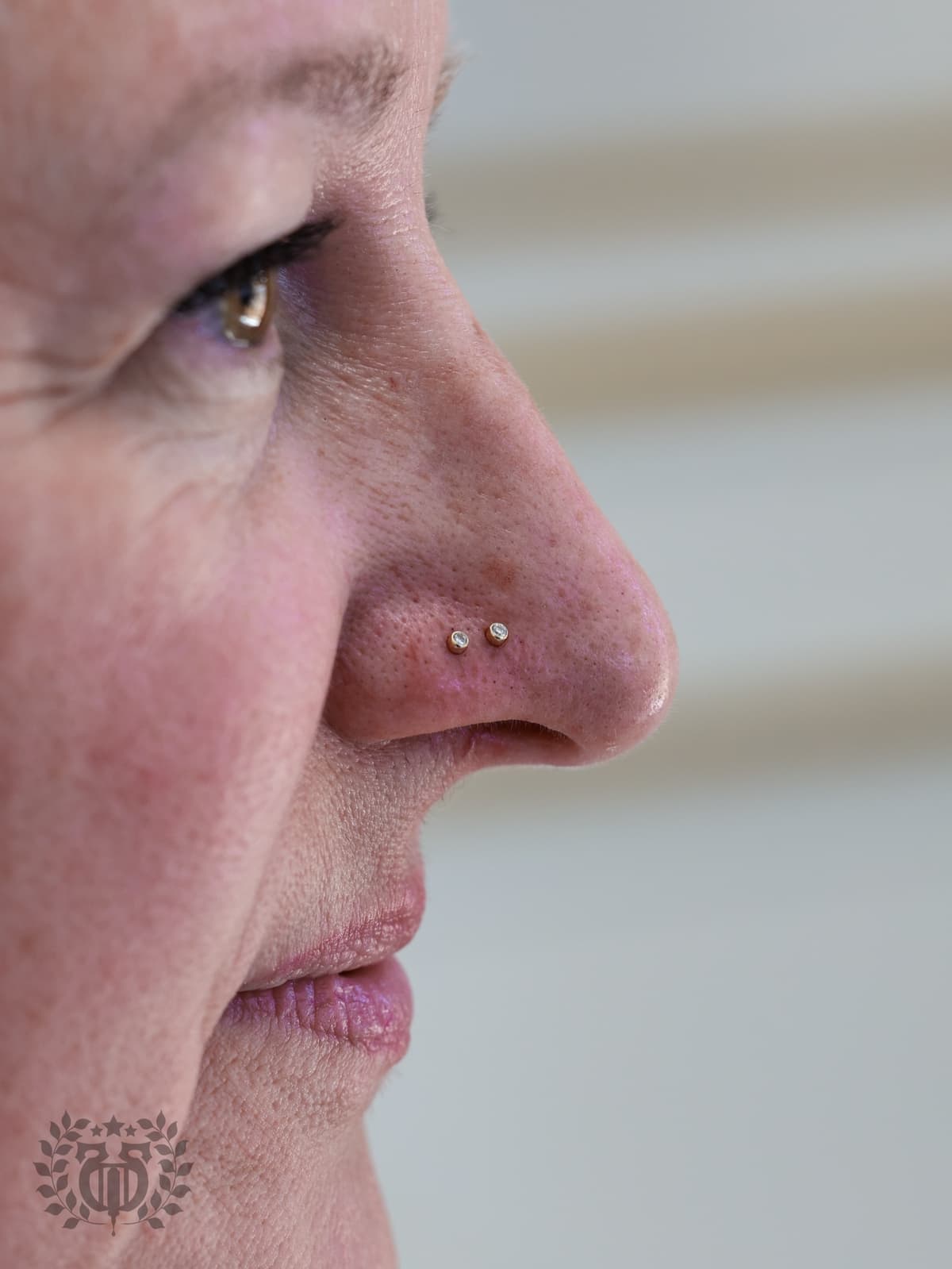
The line where your nostril folds into your cheek is called the alar crease, and a nose piercing lives just above it. Not in it. Sit a stud down inside that fold and it vanishes when you smile and chafes when you talk. Sit it too far up and there's nothing for it to relate to, so it reads as stranded on the flat of the nose. The gap between those two mistakes is a couple of millimetres wide, and reading it correctly on your particular face is most of the job.
Then there's the part nobody mentions at the counter. A nostril piercing has a reputation as the quick, easy, low-commitment one, and the pass really is over in a second. The heal is four to six months, often longer, because a nostril is a curved flap that moves every time you laugh or sneeze or push your sunglasses up. That's why we start you in a flat-back titanium stud, and why we'll ask you to wait half a year before a hoop goes anywhere near it.
Book Your Nose Piercing 5000+ clients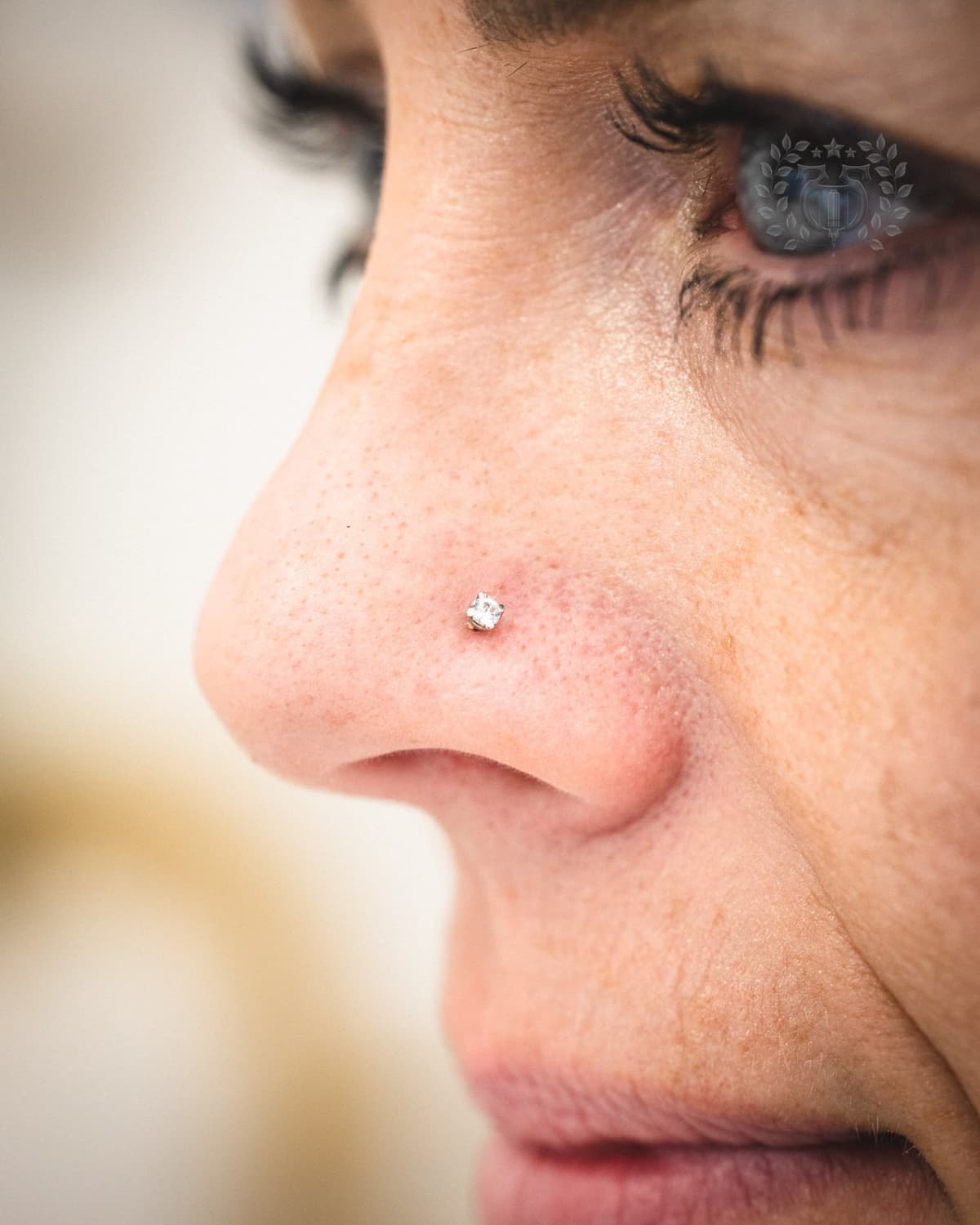
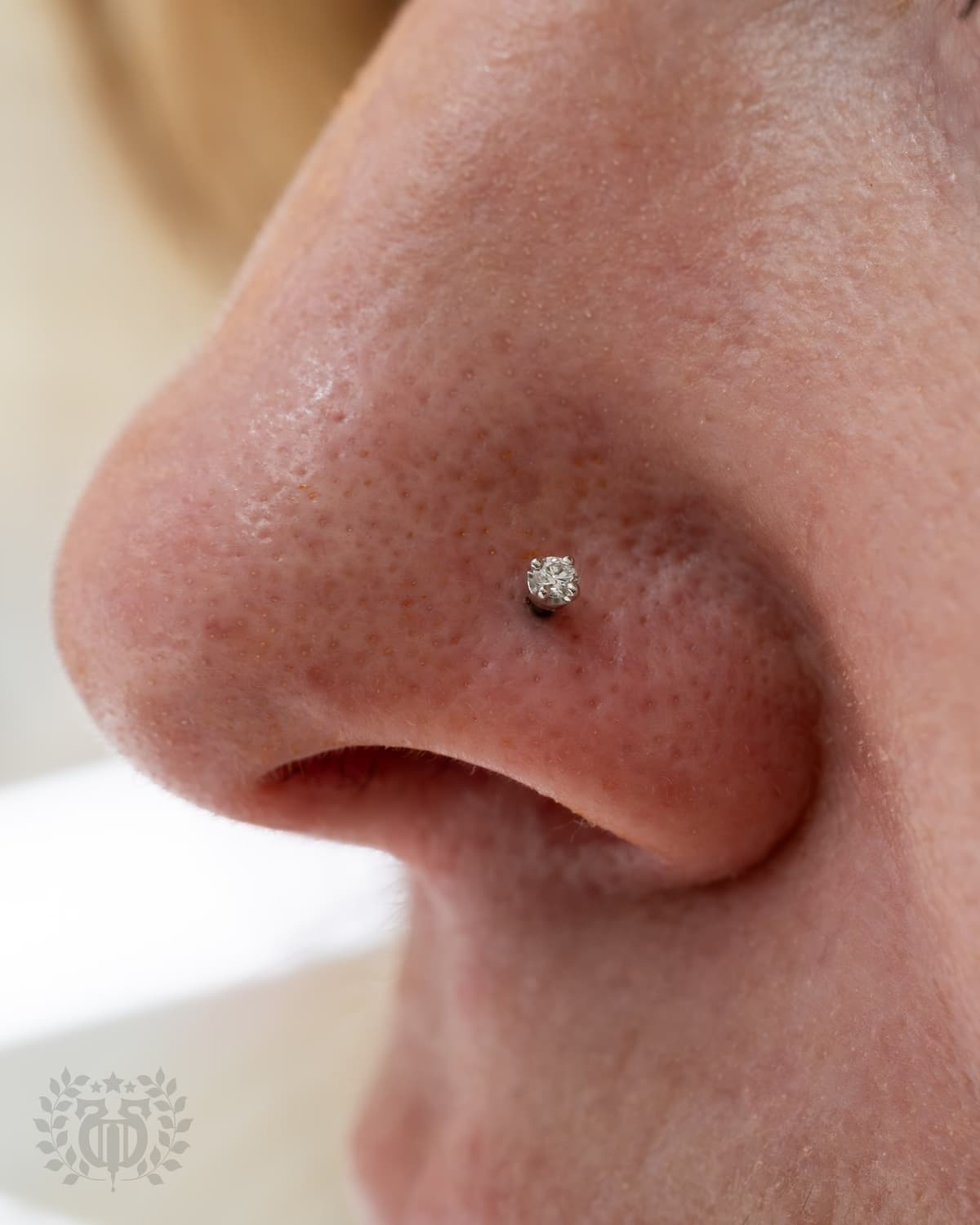
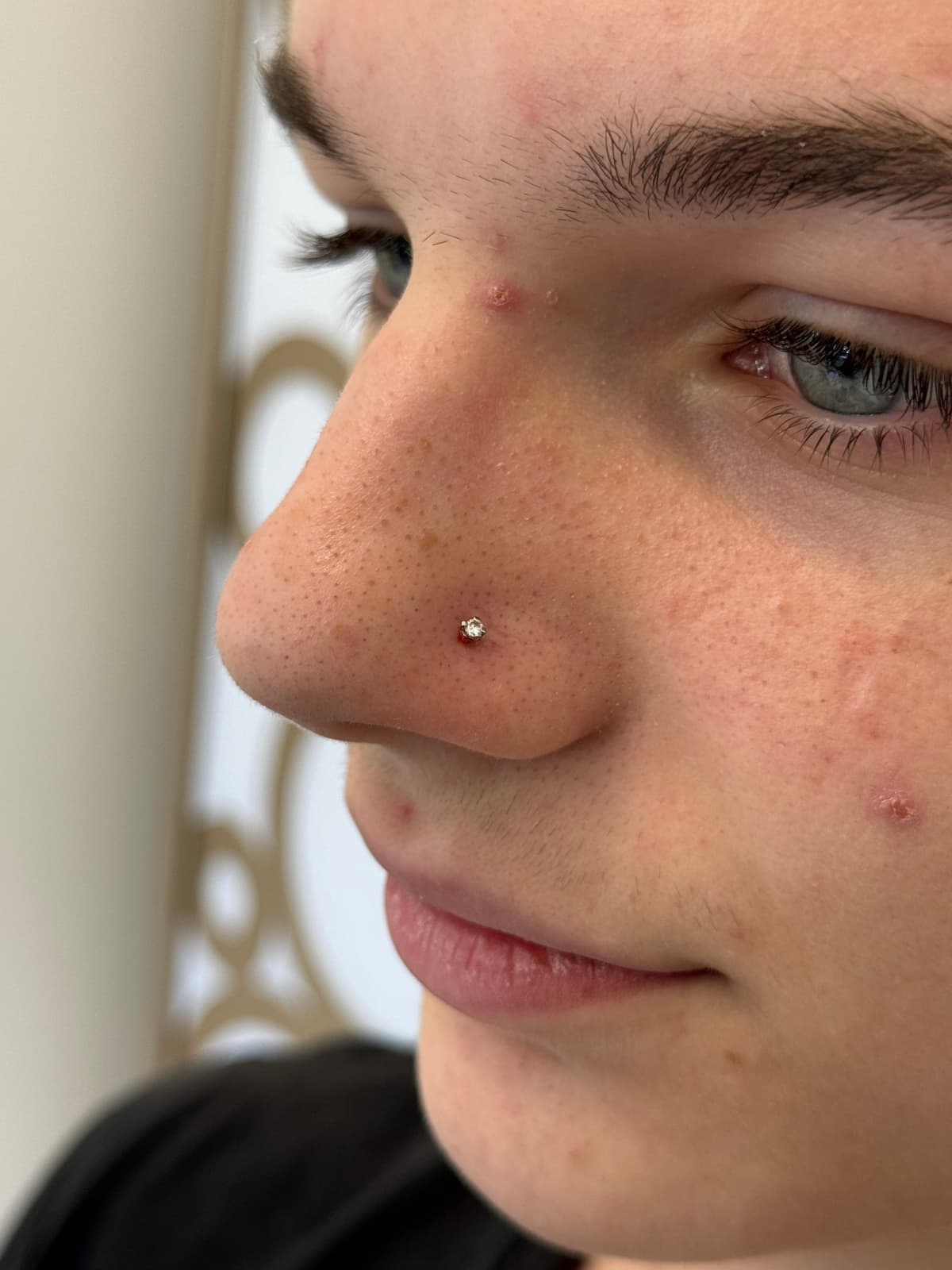
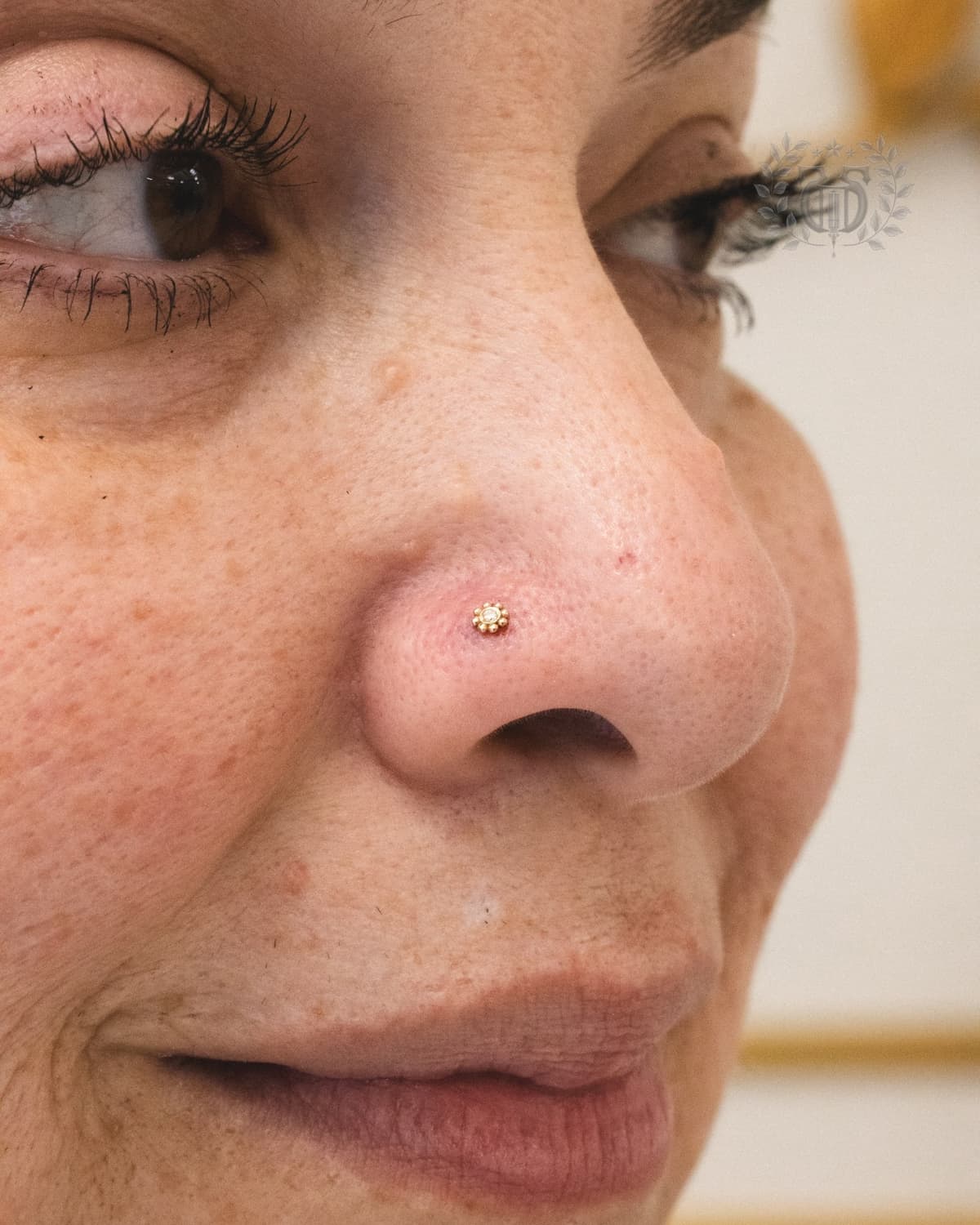
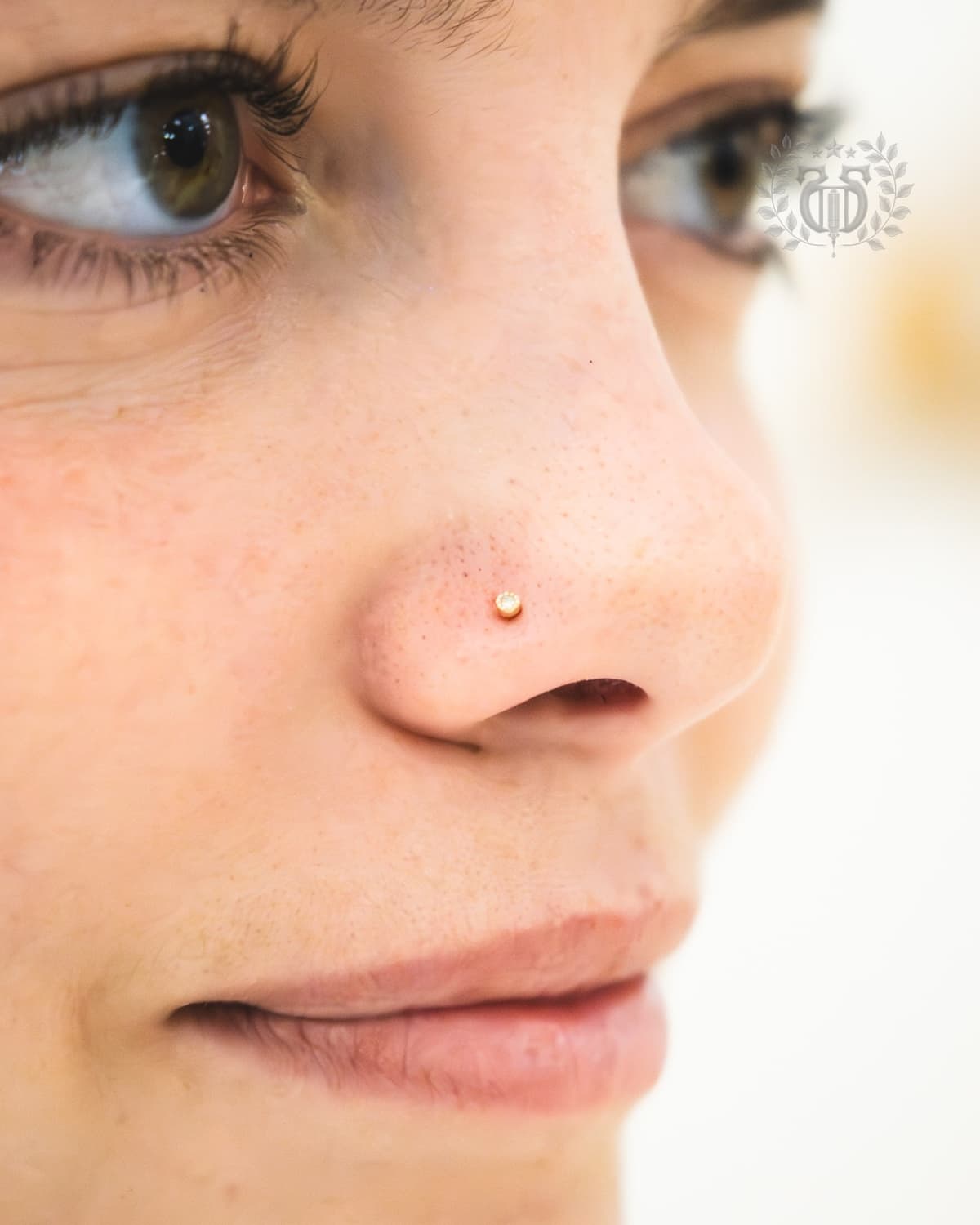
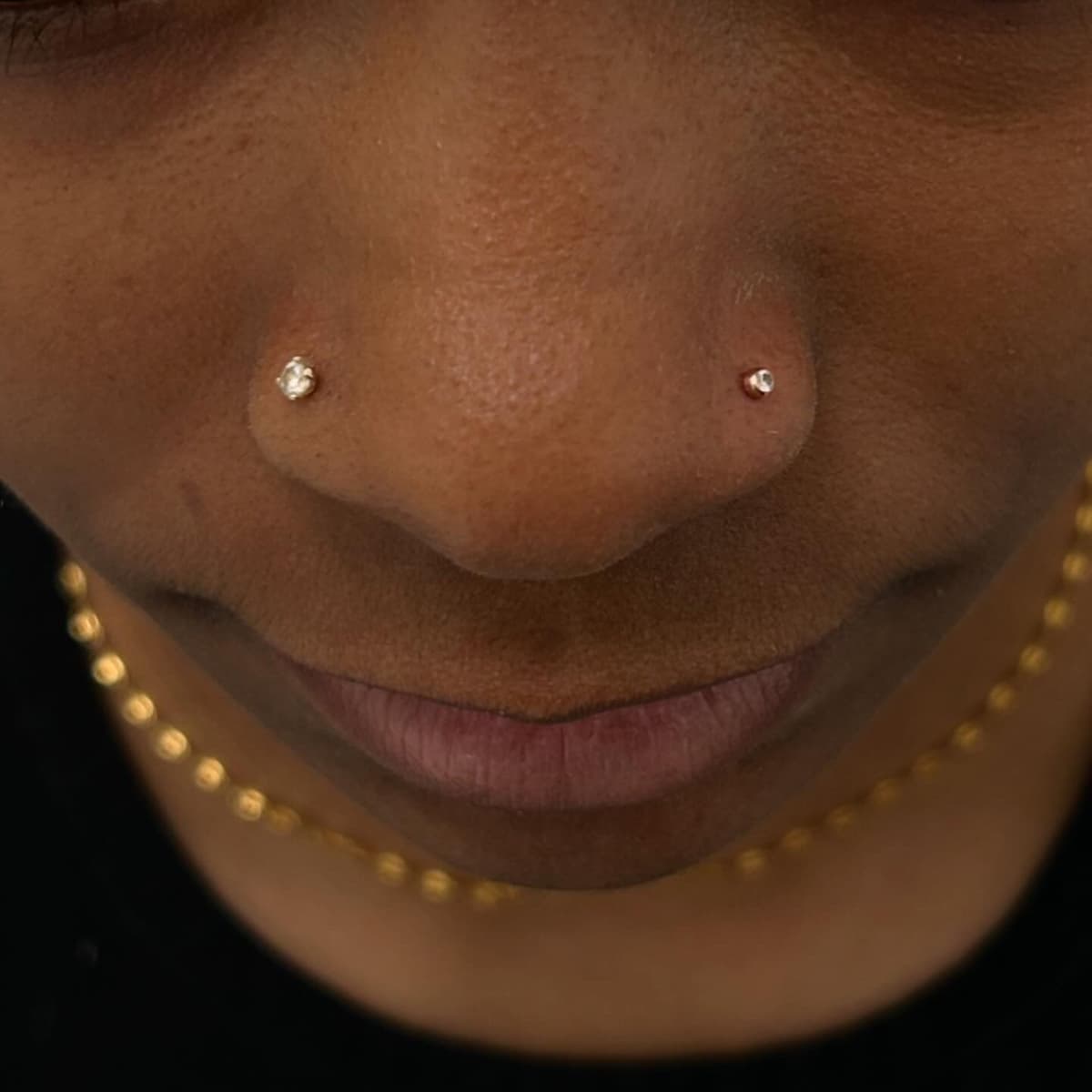
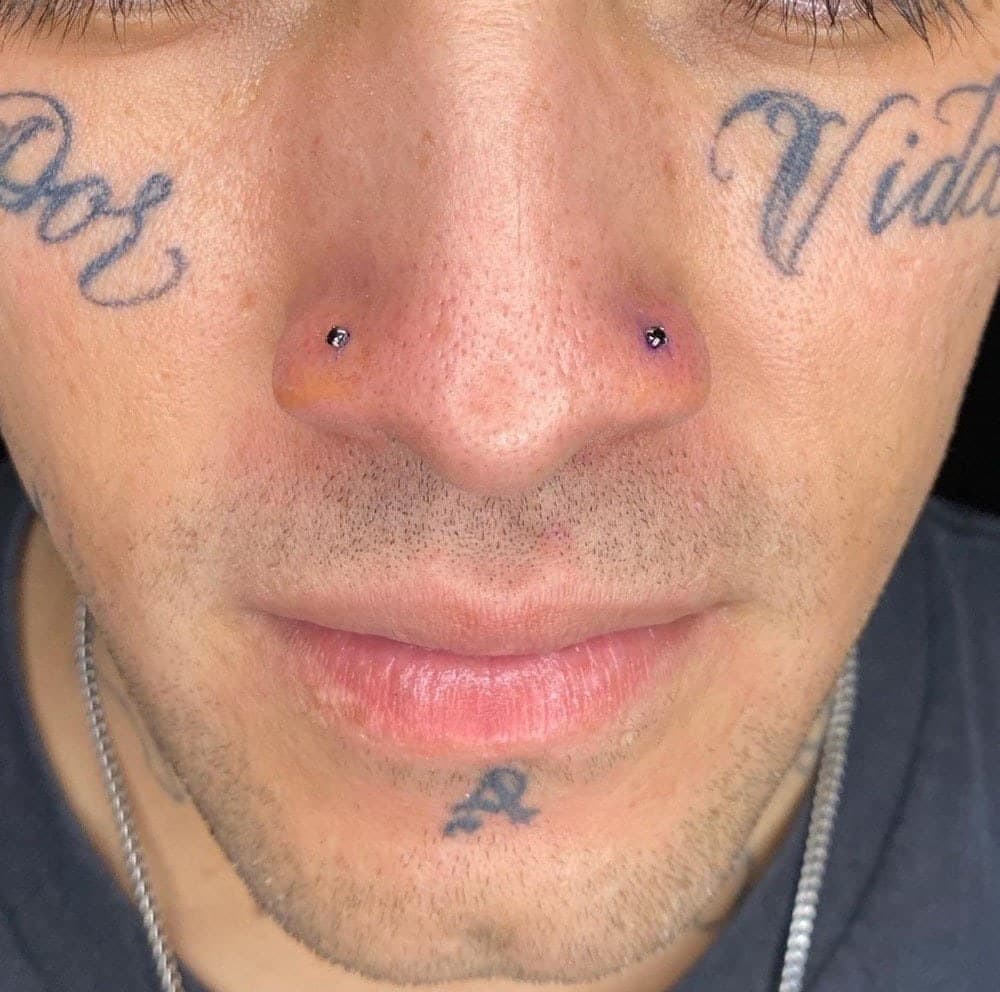
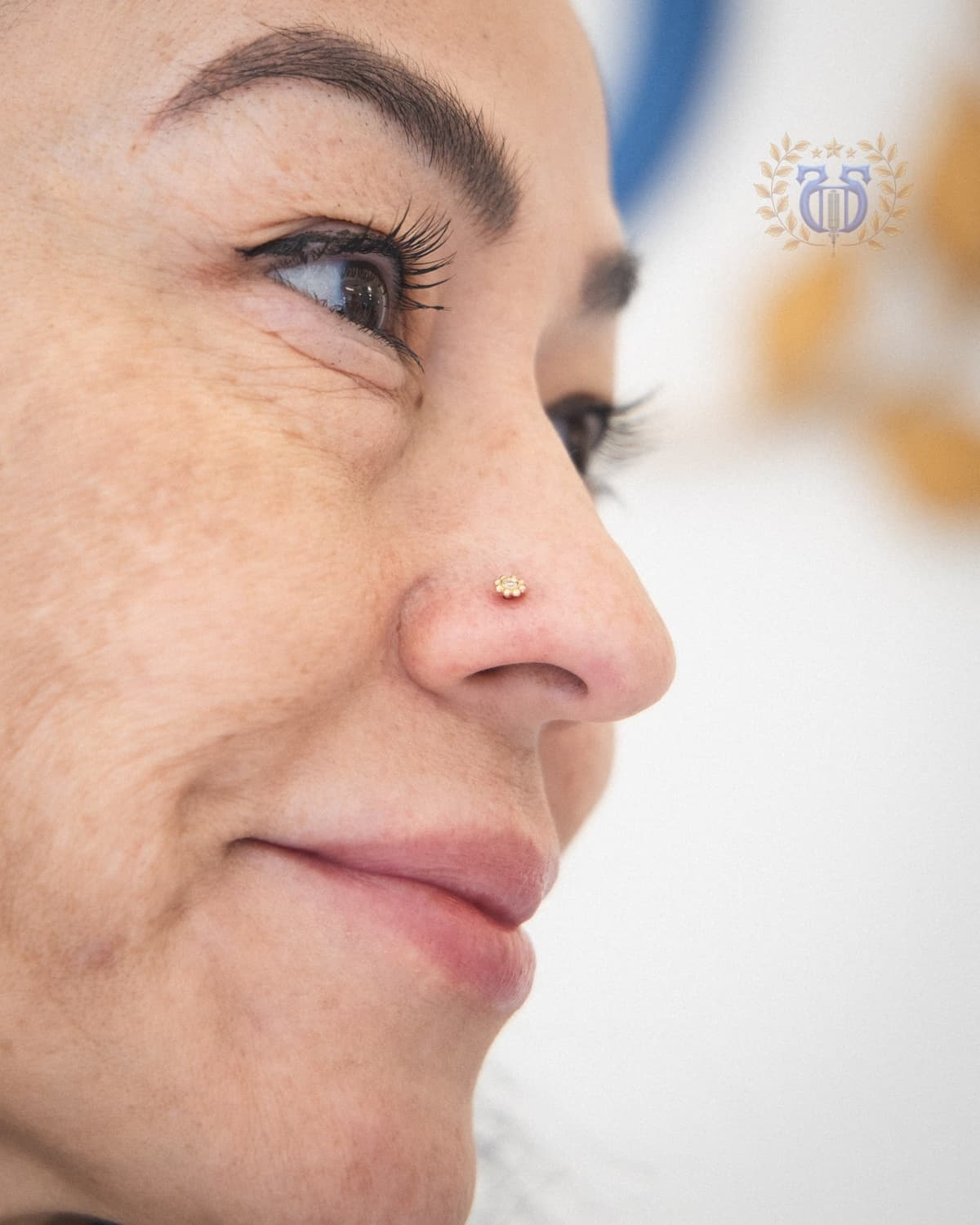
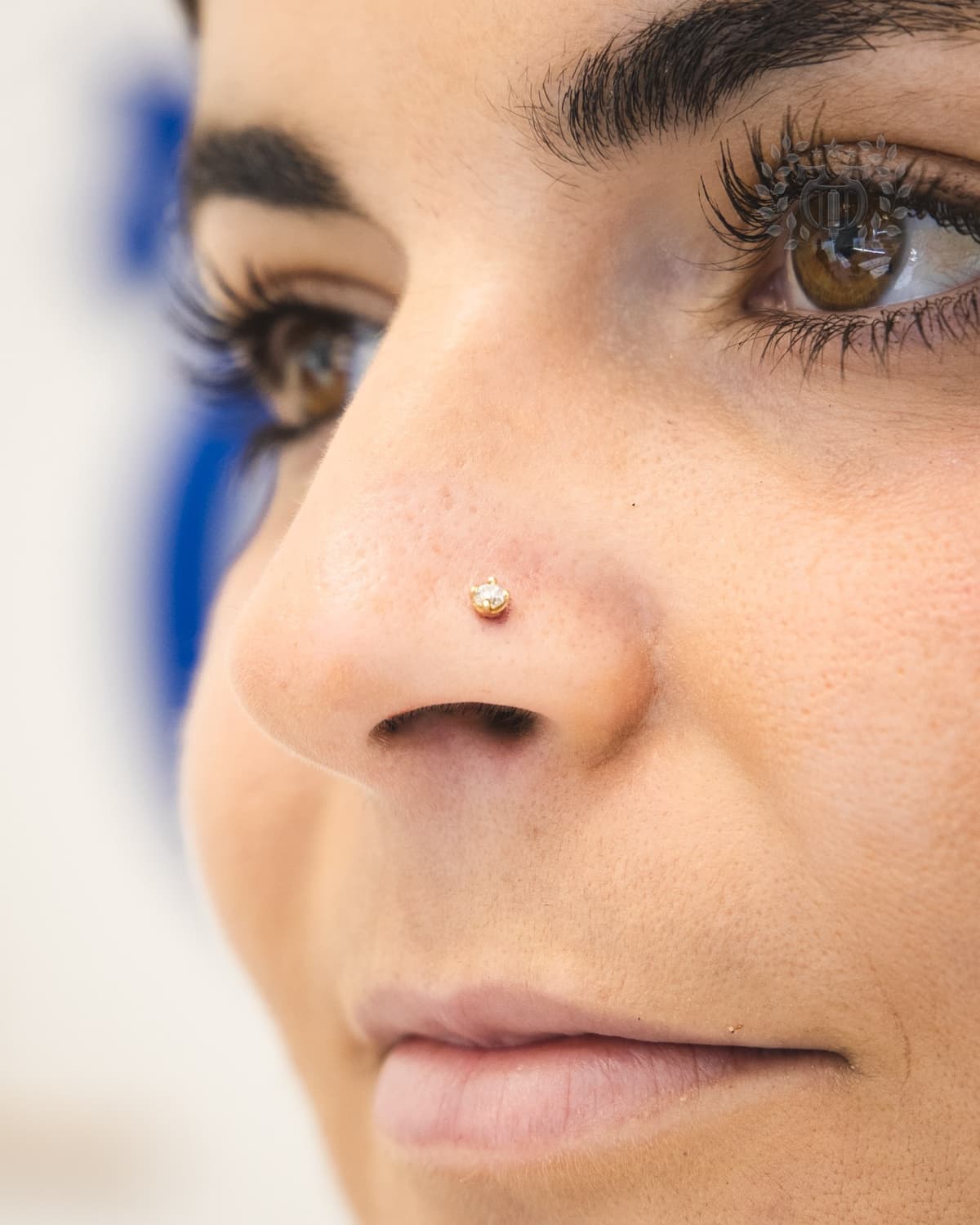
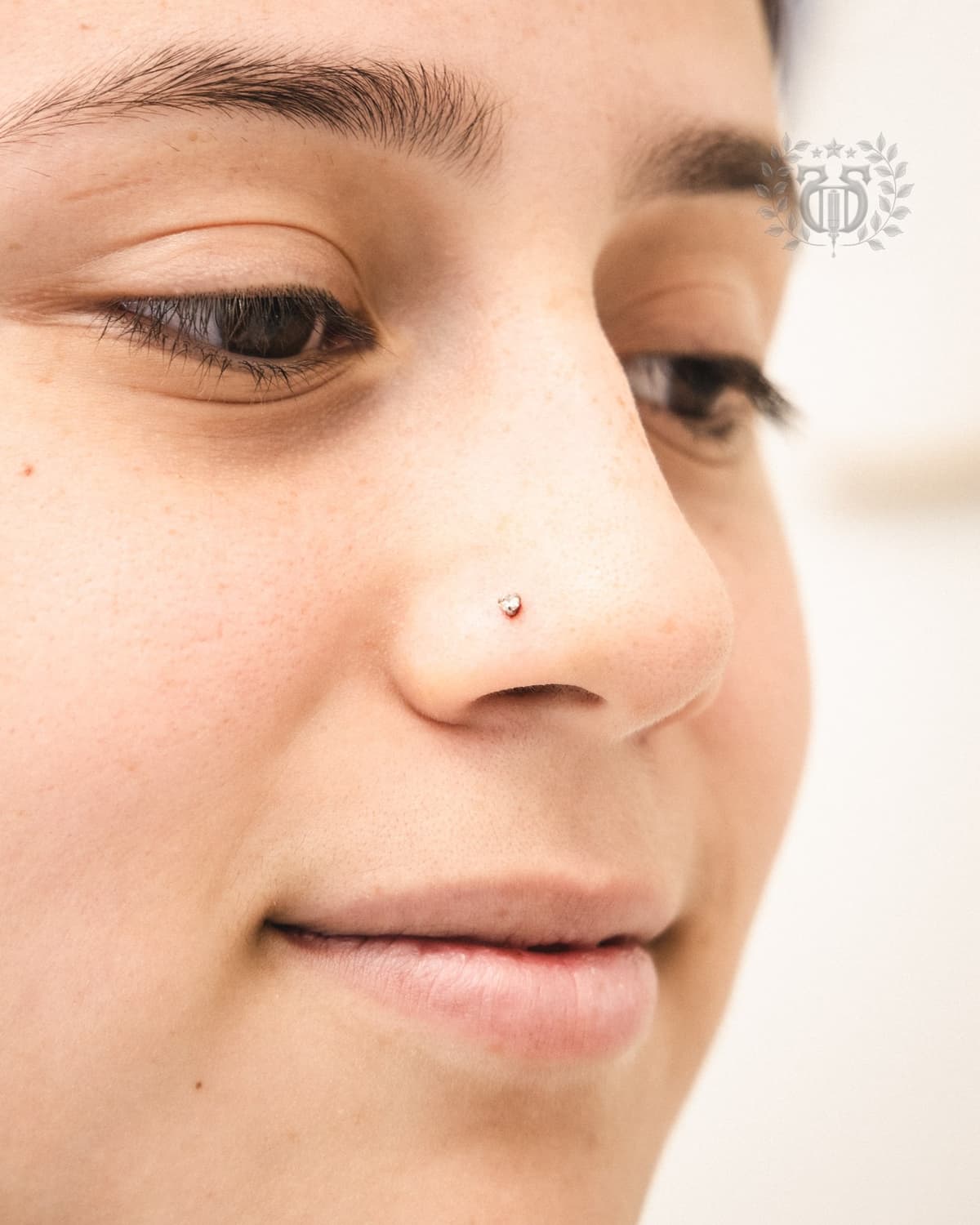
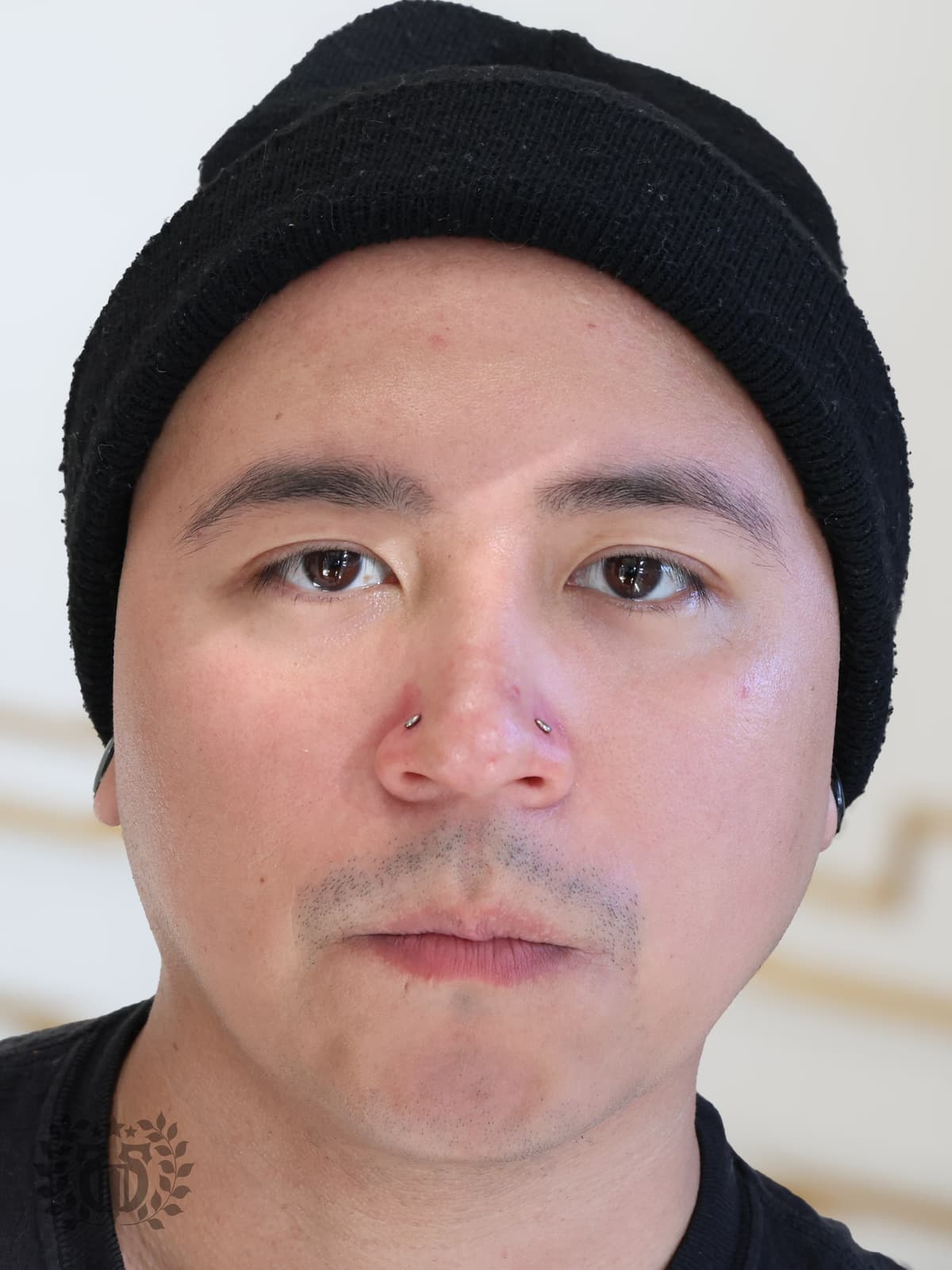
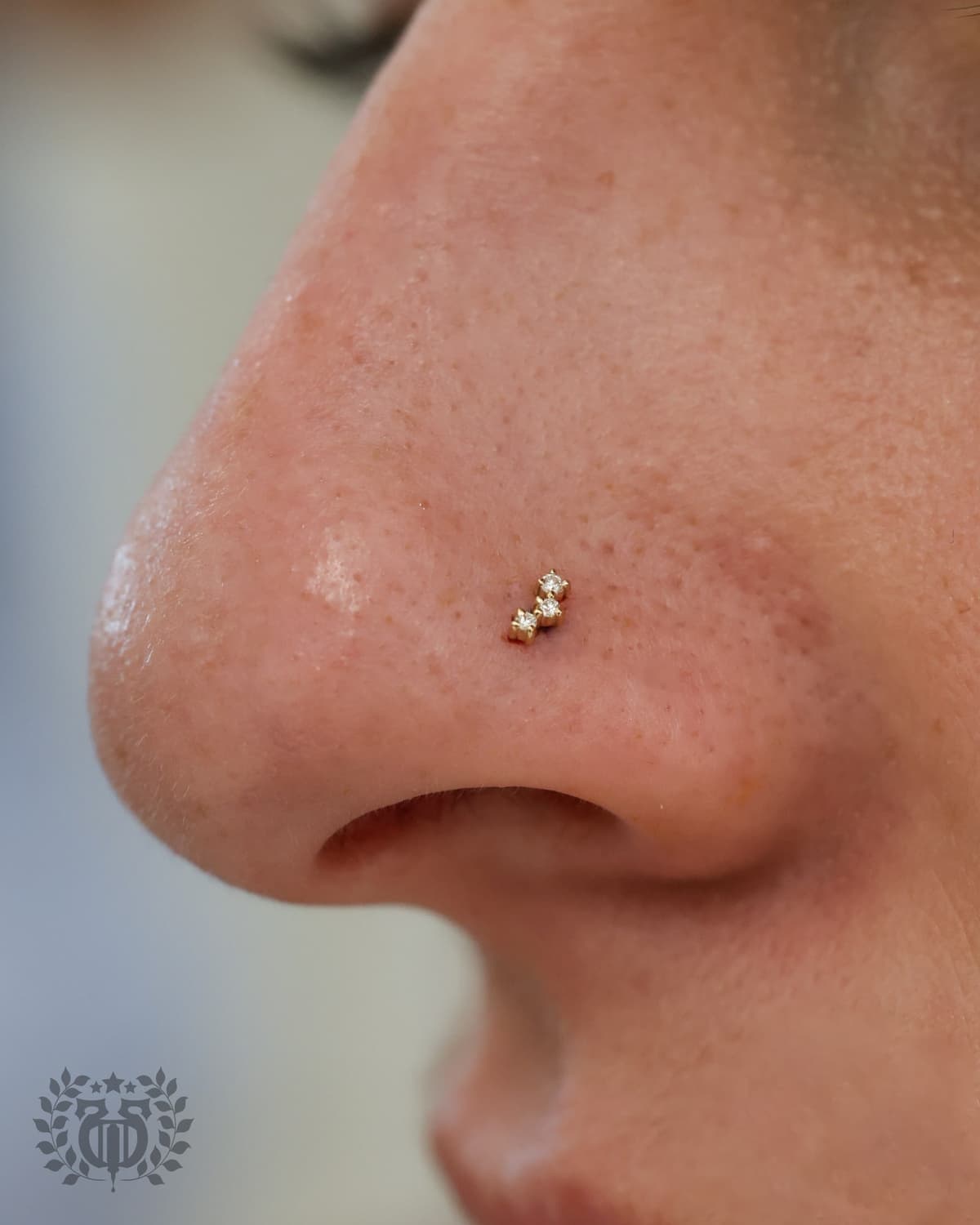
A few millimetres decides whether this looks placed or looks accidental. Here's what we're actually looking at.
Run a finger from the corner of your nostril down toward your cheek. That fold is the alar crease, and it's the reference line for the whole piercing. A nostril stud belongs just above it, close enough that the crease gives the jewelry something to sit against, far enough up that the fold doesn't swallow it every time your face moves.
Both errors are common and both are more or less permanent. Pierced inside the crease, the stud disappears when you smile and the disc on the back rubs the wall of the fold all day, which is a reliable recipe for a channel that never quite settles. Pierced too high, there is no relationship between the jewelry and the shape of your nose, and the eye reads it as a dot somebody put there rather than a piercing that belongs on that face. Photograph it and the second mistake shows up more than the first.
Now the complication. Creases are not the same on everyone. Some are deep, crisp and run almost straight; some fade out halfway and become a suggestion rather than a line. A wide, rounded nostril has a long shallow curve to place along, and a narrow one gives you a much shorter window. On most faces the two sides don't match, and one crease is noticeably better defined than the other, which is a real argument for taking the side we recommend rather than the side you assumed.
Then there's thickness. The nostril wall is skin on the outside, a thin lining on the inside, and cartilage sandwiched between, and how much of each varies a lot. A thick wall needs a longer post and swells more. A thin one is quick to pierce and quick to complain if the jewelry is a millimetre too long. We pinch it, we look at it in profile as well as head-on, and we watch what happens to the crease when you smile, because you spend more of your life smiling than sitting with a neutral face in a piercer's mirror.
All of that takes about five minutes and it's free. The dot goes on with a surgical marker, you look at it square to the mirror and then turned to a three-quarter angle, and it moves as many times as you want it to move. Nothing gets opened until you have said yes to a specific spot.
Most creases are sharpest at the bottom and fade as they curve up. The usable window is the stretch where the line is still readable, and on some noses that window is barely a centimetre long.
Too close and it chafes in the fold. Too far and it floats. We aim for the band where the stud has the crease to relate to without living inside it, and we show you the difference on your own face.
Skin, lining, and a layer of cartilage between them. A thicker nostril wall takes a longer post and swells more in week one, and knowing that before we pierce is how you avoid a post that's buried by day three.
Faces aren't matched. One crease is usually cleaner than the other, and that's worth knowing alongside the more practical question of which side you sleep on.
A crease deepens and shifts when the face moves. We mark you relaxed, then ask you to smile and look again, because a dot that only works on a neutral face is a dot in the wrong place.
Straight through, perpendicular to the surface, or the disc on the inside sits at a slant and presses on the lining. The entry angle matters as much as the entry point and it's decided before the needle moves.

Apollo's Premium Jewelry Partner
Handmade in Los Angeles since 1996. Lifetime guarantee. Implant-grade gold, platinum, and titanium. Over 3,000 original designs in our case — ask your piercer for a tour.
See the BVLA story →Five placements, five different tissues, five different heals. The septum is the one people most often confuse with a nostril, and it isn't remotely the same piercing.
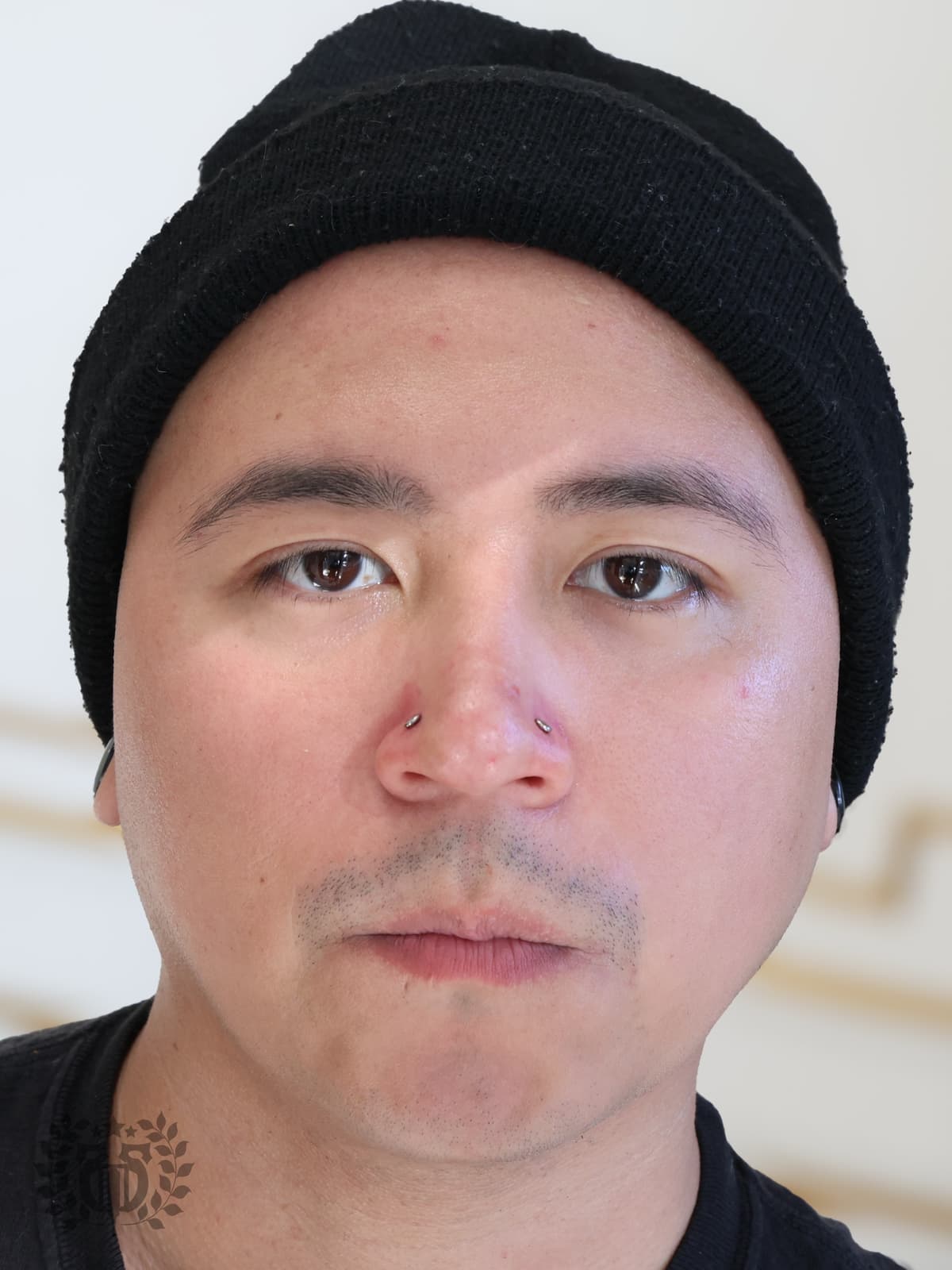
The one this page is about. Through the nostril wall a few millimetres above the alar fold, healed in a flat-back stud, and slower than its reputation suggests. Healing: 4-6 months, and don't be surprised by nine.
Sits well up the side of the nose where the wall is thicker and there's no fold to work with. Only a flat end fits, hoops are out permanently, and cleaning it is fiddlier. Healing: 6-9 months.
Passes through a thin membrane below the cartilage rather than through anything you would call a nostril. Heals faster than a nostril, flips up out of sight, and needs a completely different assessment. Healing: 3-4 months.
Sits in the pinch of skin over the bridge, so it is a surface piercing and carries a surface piercing's honest risk of migrating out over time. Curved barbell, no rings ever. Healing: 6-12 months.
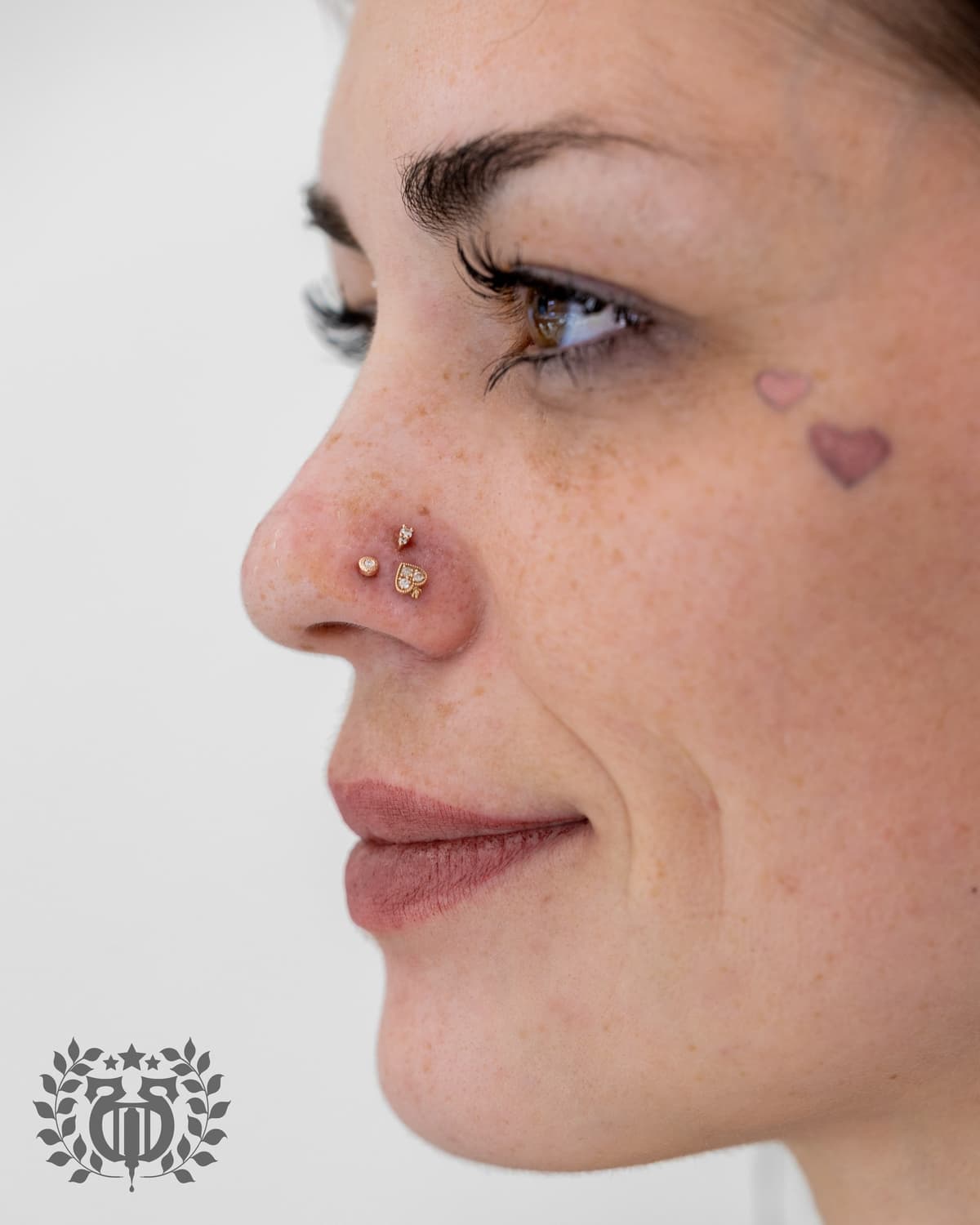
One straight barbell through nostril, septum and nostril in a single pass, which means all three have to line up perfectly and all three heal together. Not a first piercing. Healing: 9-12 months.
Clear next step
Five minutes, a marker and a mirror. You can look at the dot and leave without being pierced, and people do exactly that every week.
Recommended first step
Choose a facial or oral piercing appointment with clearer placement guidance.
Every piercing heals differently — here's what to expect
| Piercing Type | Location | Initial Healing | Full Healing | Pain Level |
|---|---|---|---|---|
| Nostril | Side of the nose | 2-3 months | 6-9 months | 3-4/10 |
| Septum | Tissue between nostrils | 6-8 weeks | 3-6 months | 4-5/10 |
| Bridge | Skin across nose bridge | 2-3 months | 6-9 months | 5-6/10 |
 5000+ clients
A nostril exits into the inside of your nose, which is warm, damp and full of bacteria. That changes a couple of things about how this one is done.
A sterile receiving tube goes inside the nostril to catch the needle. It keeps the pass perpendicular and it means nothing sharp reaches the far side of your nose.
Single-use, pre-sterilised, and the seal gets broken where you can watch it happen. A studio that opens one out of sight has told you something.
A stud gun forces its way through rather than cutting, it cannot be sterilised properly, and it cannot be aimed at a crease. Needle only, on every piercing in this building.
Your nostril wall gets measured and the starter post picked for it, with room for the swelling that arrives in the first two days. That happens before anything is loaded, not after.
Reusable tools run through a hospital-grade autoclave, surfaces get an EPA-registered disinfectant between clients, every piercer here is bloodborne-pathogen certified, and LA County licenses and inspects us. Ask to see any of it.
Almost everyone comes in wanting the hoop. Almost nobody should leave wearing one.
A ring is what people picture when they picture a nose piercing. It's also the single most reliable way to give yourself a six-month problem, and the reason is mechanical rather than mysterious. A hoop is bigger than the hole it lives in, so it hangs, rotates and levers. Sleep on that side and the pillow pushes the ring up into the nostril and drags the channel with it. Pull a jumper over your head and it catches. Every one of those movements happens inside a wound that hasn't finished laying down a lining yet.
So you leave with a flat-back labret: a straight post, a flat disc on the inside of the nostril, a small end on the outside. Nothing hangs off it. It doesn't rotate. The disc is smooth against the lining rather than a ball pressing into it. It is dull compared with a gold hoop, and it is the reason your gold hoop will eventually go in without drama.
How long is the honest question. Six months is the earliest we would sign off on a hoop, and nine is a more comfortable answer for most nostrils. It isn't a fixed date on a calendar; it's a state. The channel should be dry, unremarkable, painless to touch, with no crust for weeks and no lump next to it. If any of those are still true at month six, wait. There's no prize for being early, and the cost of being early is starting over.
Come to us for the first change either way. It takes a couple of minutes, we check the channel while we're in there, and we can size the ring against your actual nostril. A diameter that looks right in a photograph is very often too big or too tight once it's on a face. After the first one, plenty of people are happy to swap ends themselves.
Four ways to keep a piece of metal in a nostril, and only one of them is a sensible thing to heal in
The inside of a nostril is not a friendly place to park hardware. It's damp, it's curved, and whatever sits against it is in contact with a mucous lining for months at a stretch. That single fact is what separates the jewelry that heals well from the jewelry sold at a mall kiosk.
A nose screw is the little corkscrew-tailed pin most people picture. It stays in by the shape of its tail, which means it has to be twisted into place at exactly the right angle, and it can spin. A bent L-shape does the same job with less fuss and comes out more easily, which cuts both ways. Both rely on friction and geometry. A flat-back labret relies on neither: it's a straight post with a disc that seats flat against the inside wall, and the end unscrews or presses in from the outside. That's what you'll leave here wearing.
The fee below buys the piercing, the sterile needle, the marking, the aftercare talk and as many follow-up visits as you need. Jewelry is a separate line.
Jewelry sold separately
Jewelry sold separately
Jewelry sold separately
Jewelry sold separately
Jewelry sold separately
Jewelry sold separately
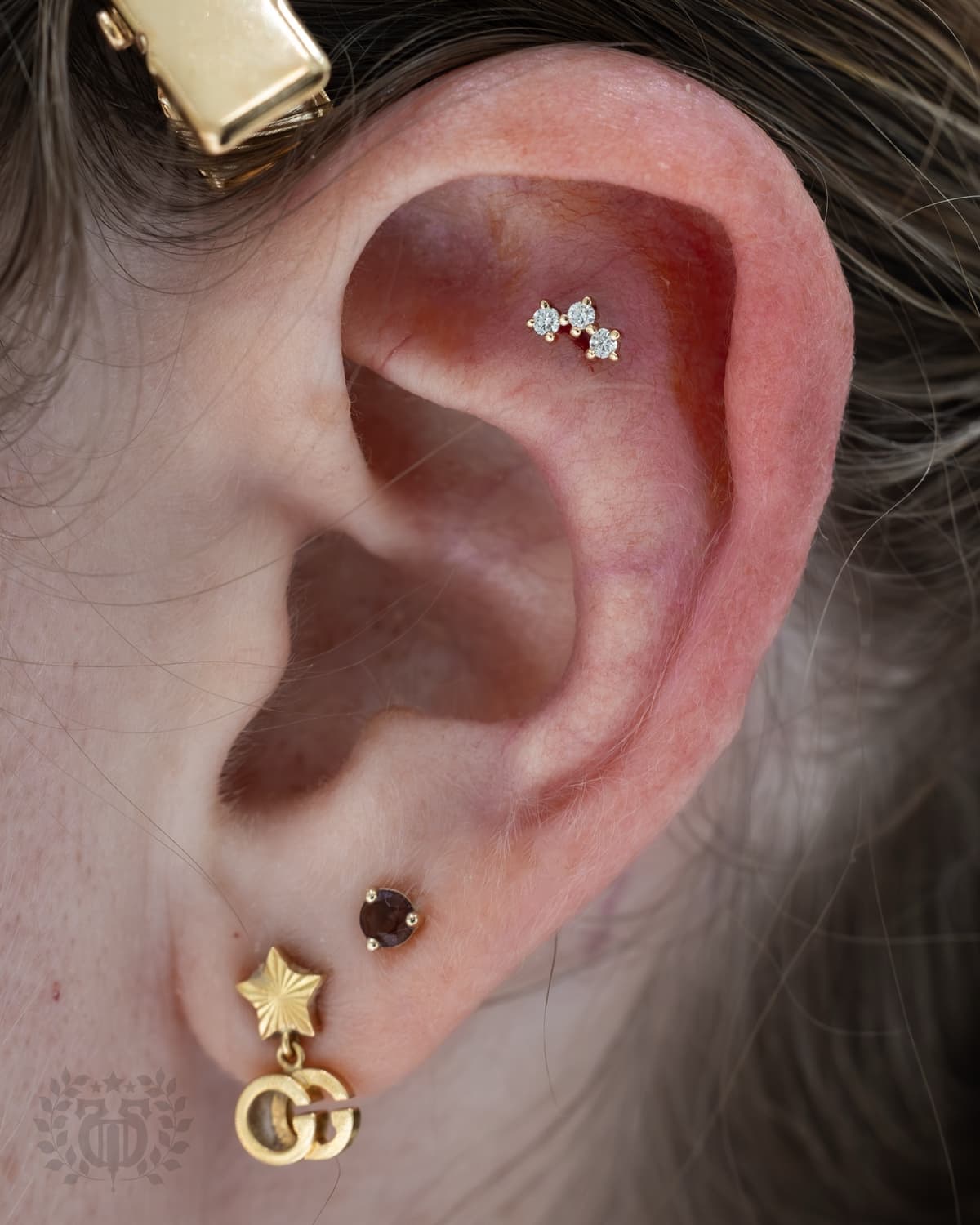
Jewelry Upgrades: Premium jewelry upgrades available. BVLA, Industrial Strength, and gold pieces priced separately based on selection.
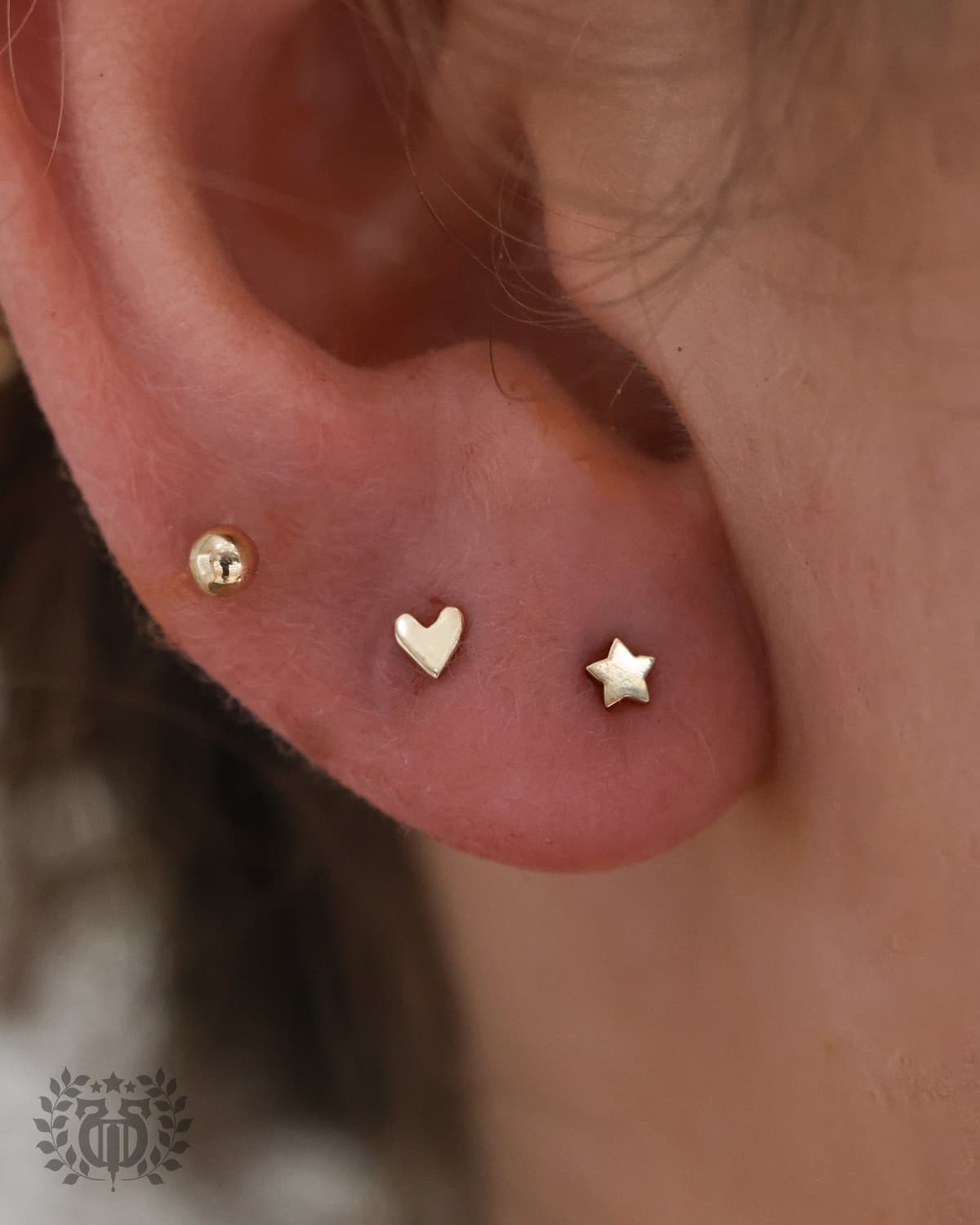
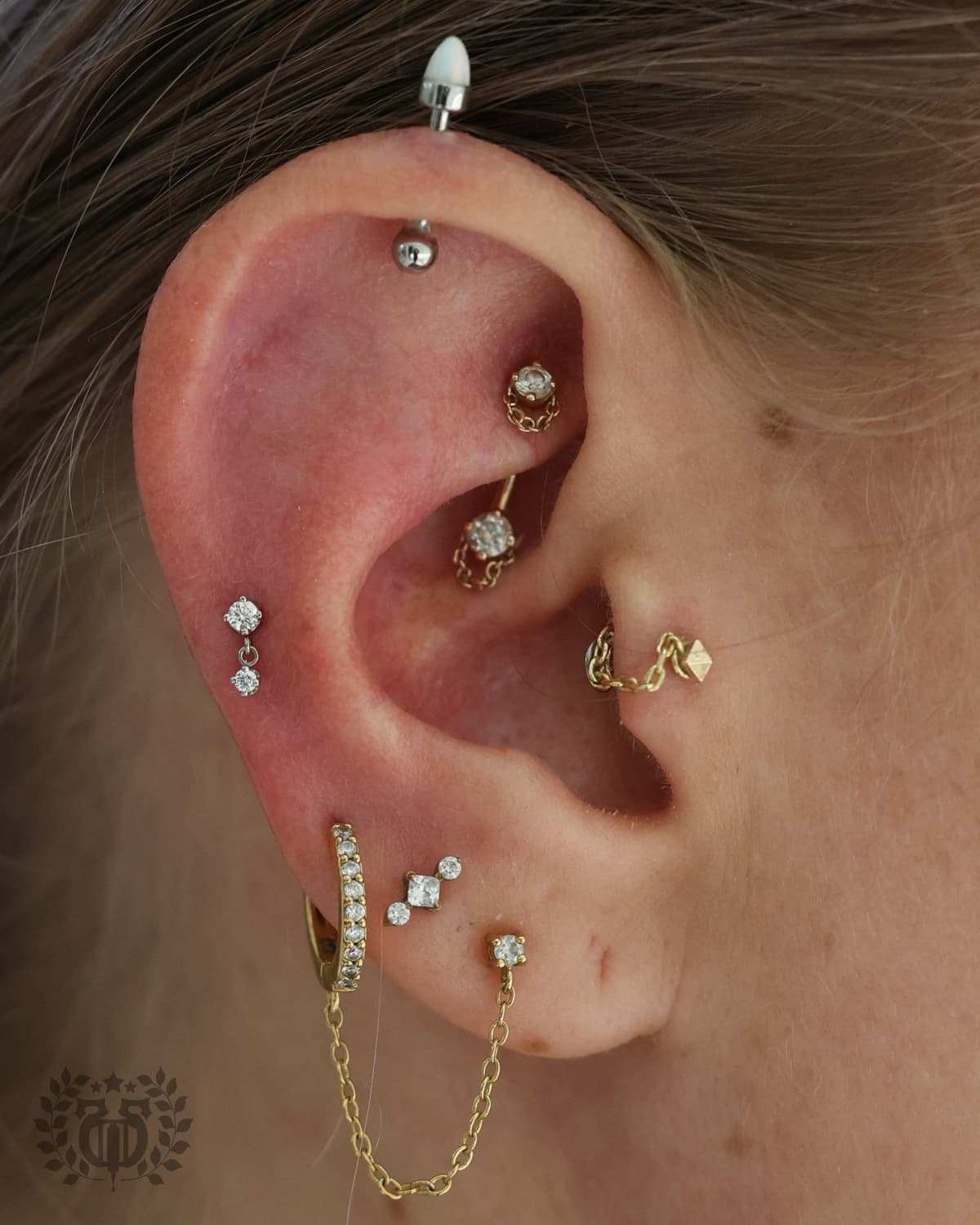
 Senior Piercer
 Senior Piercer
Bunny Vogt, a dedicated Senior Piercer, specializes in nose piercings and ear styling and curation at our Los Angeles studio since 2019. Her gentle technique and expertise in nostril, septum, and high nostril placement ensures a comfortable piercing experience every time.
 Founder
 Master Piercer
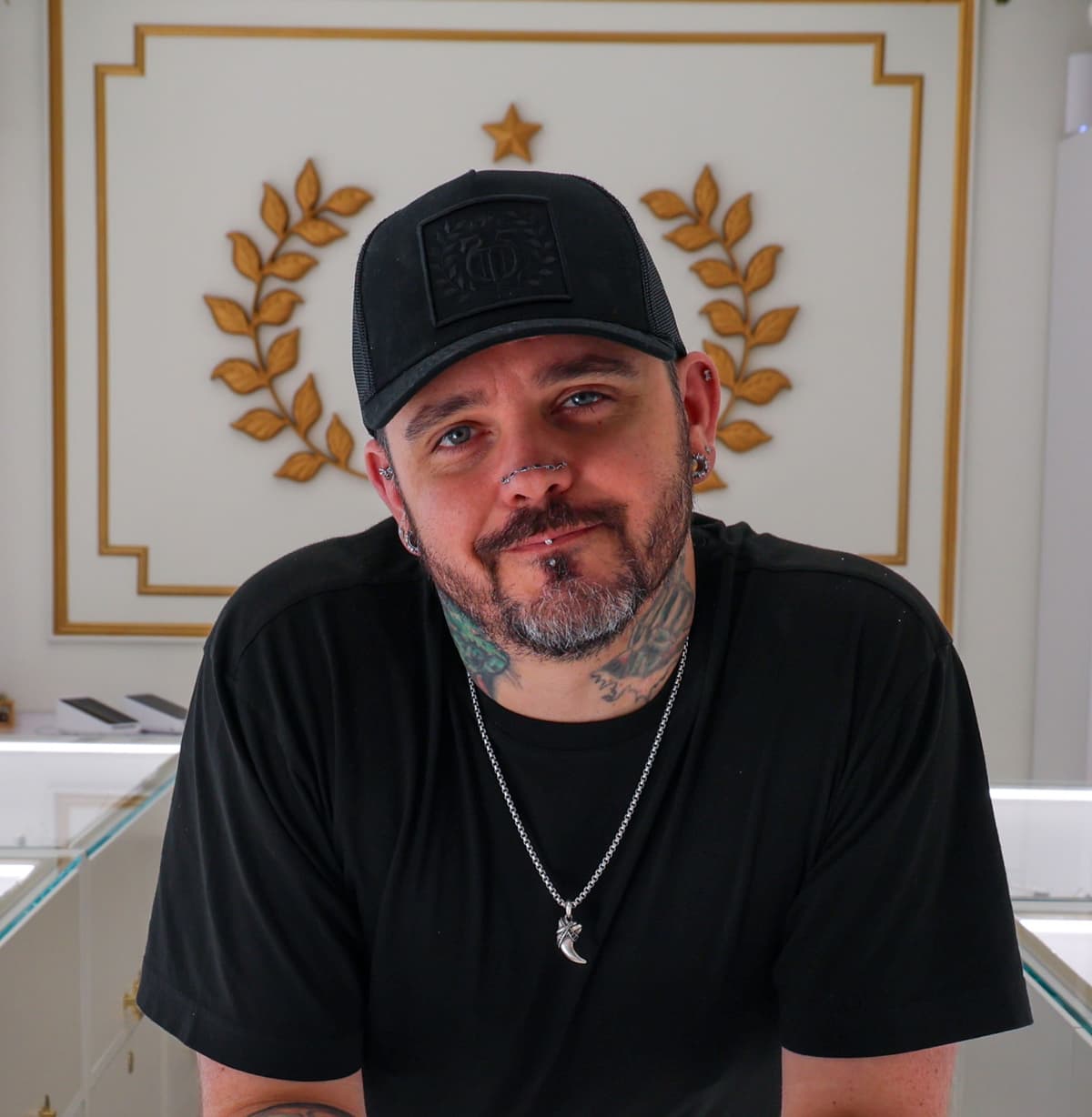
Blue Mason, our Master Piercer and studio founder, has performed thousands of nose piercings and advanced genital work over 20+ years. His precision and expertise ensures perfect placement for nostril, septum, high nostril, bridge, and nasallang piercings.
Ask around and a nostril is the beginner piercing. It costs $75, the needle takes a second, and the internet will cheerfully tell you it's healed in six weeks. The first two of those are true.
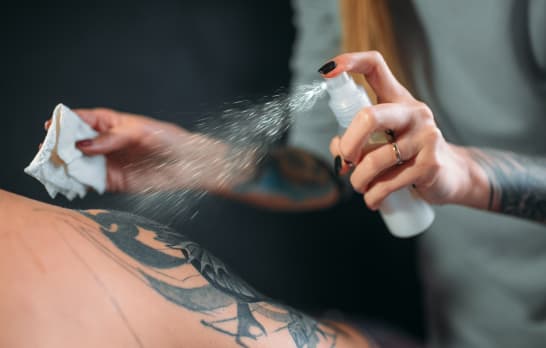
The cleaning routine is short: sterile saline twice a day, sprayed on the outside and then up the nostril so it reaches the disc, and otherwise hands off. No twisting, no turning it so it doesn't stick, no tea tree oil, no alcohol, no hydrogen peroxide. That's the easy half. The half people actually get wrong is the rest of the day.
Sunglasses get pushed up from the bridge with two fingers, not shoved with the heel of a hand. Heavy frames with low nose pads can sit right on a high nostril, so if you wear those, mention it before we mark you. Blow your nose gently and one side at a time, then rinse. Foundation, primer and setting powder stay off the piercing until it's healed, and if you have had a full face on, saline afterwards rather than product sitting in the channel overnight. Face-down sleeping is the big one: six months of pillow pressure on a fresh nostril is the most common cause of the lump you'll see people asking about online. Change the pillowcase often. Keep the piercing out of pools, lakes, hot tubs and the ocean, which is a genuine nuisance in Santa Monica and still worth doing.
Book AppointmentThe nostril puffs for the first two or three days, and the starter post is deliberately long enough to allow for it, so it will stand slightly proud of your nose. That's correct, not a mistake. Saline twice a day, gentle nose-blowing, don't sleep on it, and expect a little clear crust at the entry. Sneezing hurts for about a week.
Swelling has gone, it doesn't hurt, and the outside has closed over neatly. This is where nostrils get ruined. The inside of the channel is still soft, and a hoop put in now, or a week of skipped saline, is what produces the irritation bump that shows up around month three. Come in and we'll shorten the post to your settled nostril if it's sitting loose.
Dry, painless, no crust for weeks, no lump beside it. That is healed, and a nostril usually gets there between four and six months. High nostril runs 6-9, bridge 6-12. Now a ring is reasonable, and we'll size the diameter against your actual nose rather than a photo. Come to us for the first change and we'll show you the knack of it.
A nostril is one of the piercings we're happiest to do off the street, and we're open 8am to 8pm every day. A few small things make the difference between a smooth walk-in and a wasted trip.
Verbatim reviews from Apollo's Google Business Profile
"This is 1 of the best places i have experienced!! Highly recommended!! Leydi is the best and would recommend her to anyone looking to get a piercing!!"
"Amazing service for piercings with Bunny & Lee. Very knowledgeable and made me feel so comfortable & confident :)"
Reviews from Google · Read all 623 on Google
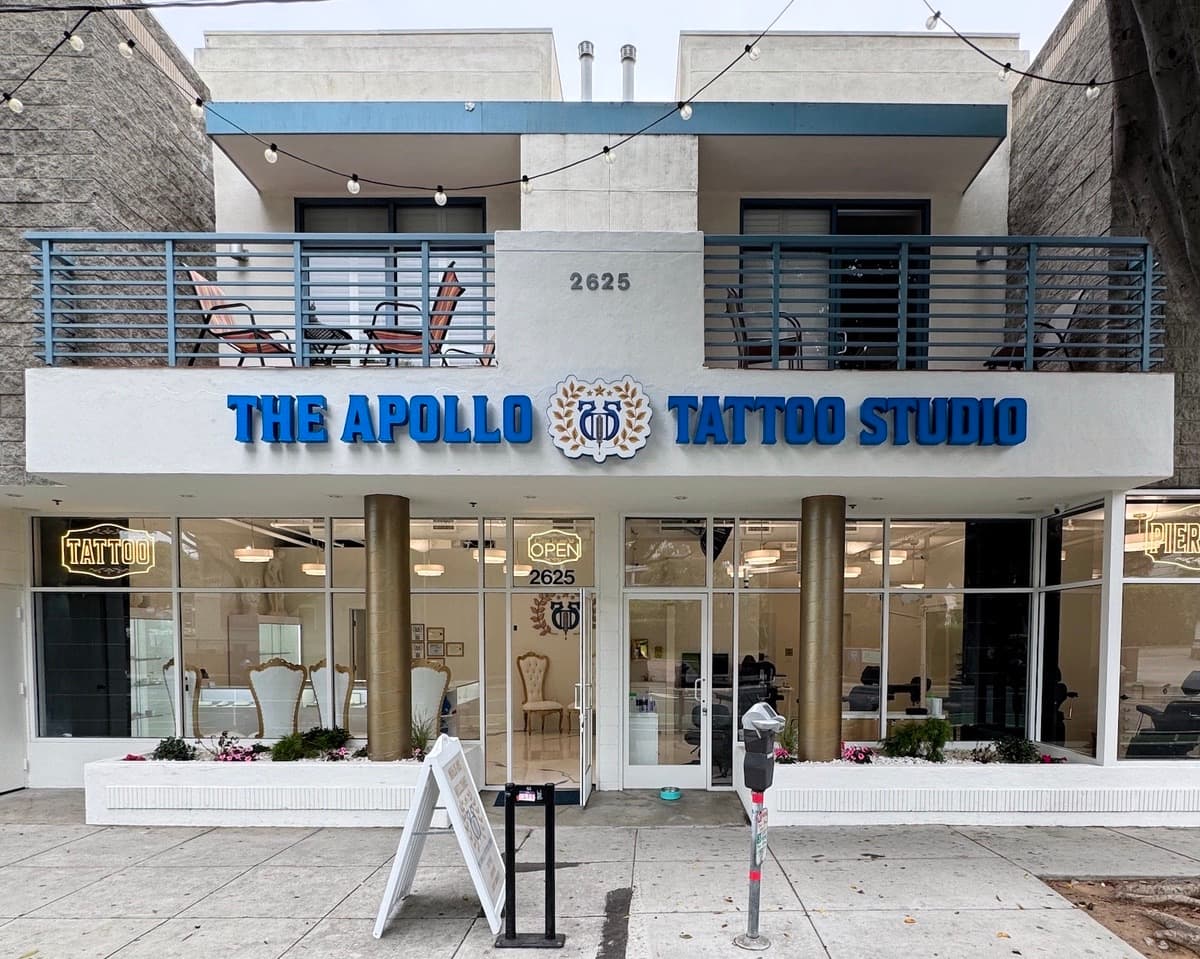
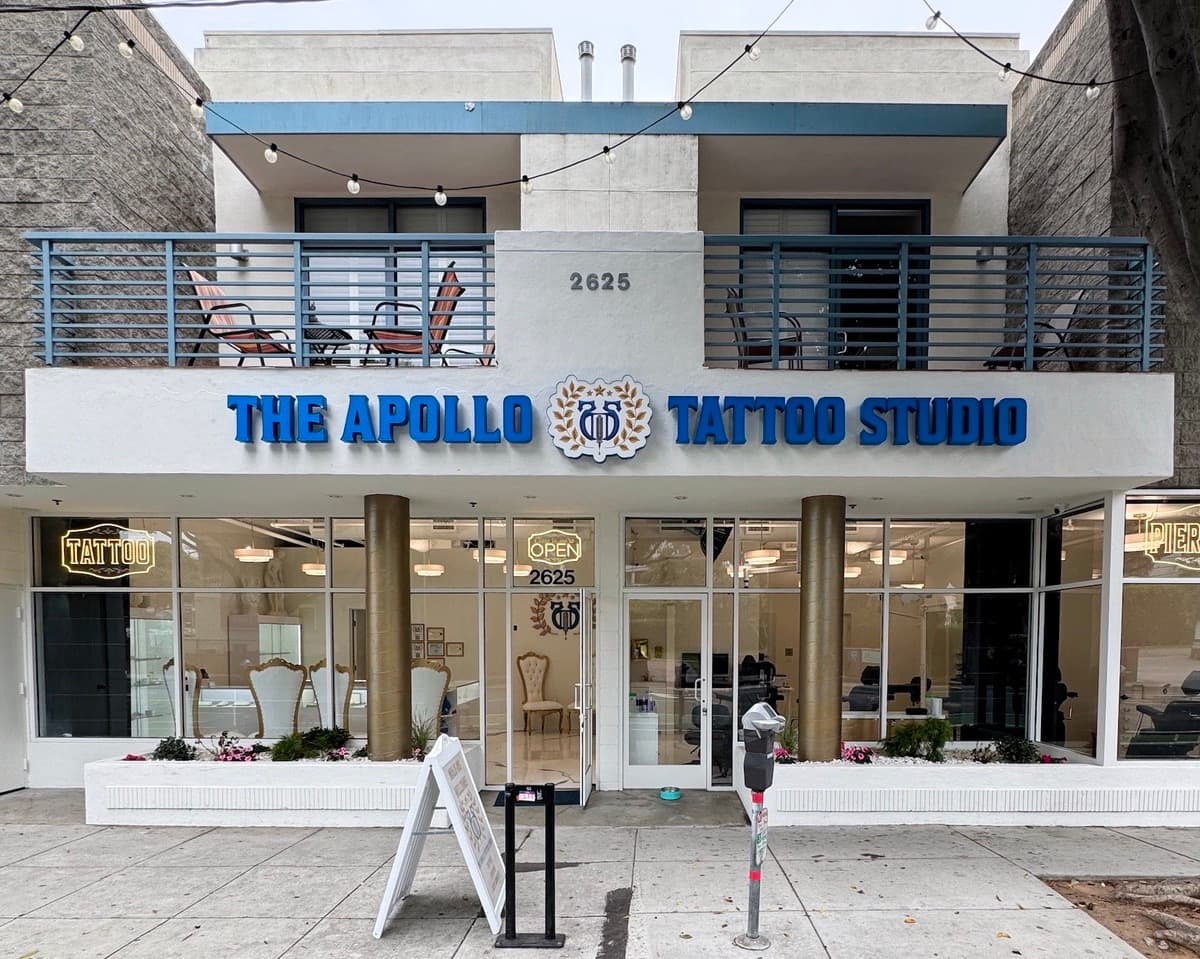
5000+ clients2625 Main Street, open 8am to 8pm seven days a week. Metered parking runs along Main, and there are side streets a block inland when the meters are full. Give yourself a few extra minutes if you're crossing town in the afternoon, because the 10 does what the 10 does.
Santa Monica, CA
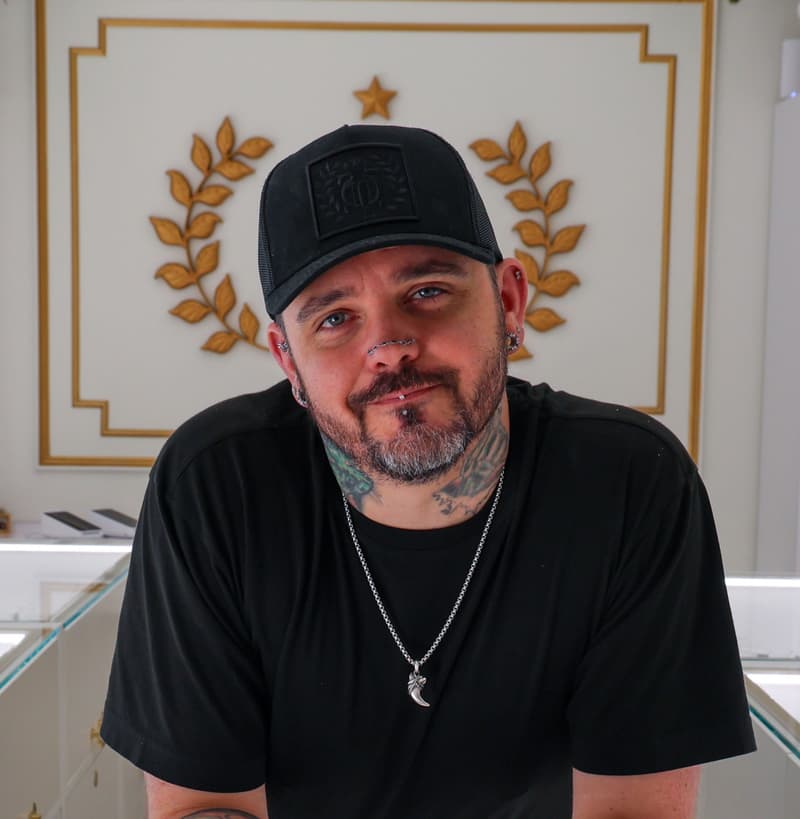
Apollo was founded by Blue Mason in 2007. With 20+ years of body art experience, Blue brings master-level expertise to every piece. Read Blue's story →
Roughly in the order they get asked at the counter, starting with the one about placement and ending with the one about taking it out for good.
Just above the crease where your nostril meets your cheek, and usually a hair further up than people expect. Sit in the crease itself and the jewelry disappears into a fold and rubs every time you smile. Sit too high and the stud strands itself on the flat of the nose with nothing to relate to. We mark it, you look at it straight on in a mirror and then in profile, and it moves if you want it moved.
Quick in the chair. The pass itself is over in about a second and most people rate it a mild sting rather than pain. Easy afterwards is the part that isn't true. Four to six months is a realistic full heal, and plenty of nostrils take longer. It's a small hole through a curved flap of cartilage-backed skin that flexes every time you talk, laugh, sneeze or wipe your face, and that constant movement is why it takes far longer than a lobe.
Six months at the earliest, and honestly a lot of nostrils are happier at nine. A ring moves. It rotates when you sleep on it and it levers the channel sideways every time the pillow catches it, and a channel that is still soft in the middle will respond to that by getting angry or by thickening a bump around the exit. If a hoop is the whole reason you're getting pierced, get pierced anyway and be patient about it. Everyone who rushed this step is the person in the chair at month three asking about a bump.
Almost always irritation rather than infection, and on a nostril it usually has a cause you can name. Sleeping face-down. A hoop put in early. Glasses arms knocked against it. Somebody catching it with a towel. It's a localised pile-up of tissue at the exit, and the fix is removing whatever is annoying it rather than attacking it with tea tree oil or aspirin paste, both of which make it worse. Come in and let us look. Spreading redness, heat, throbbing and thick green discharge are a different story and want a doctor.
Yes, and that's the standard advice everyone gets wrong the other way round. Glasses arms run along the side of your head, not across the nostril, so they're rarely the problem. What is a problem is the nose pads on a heavy frame if your piercing sits high, and the habit of shoving sunglasses up your nose one-handed. Push them up from the bridge with two fingers instead. If you wear a mask for work, the ear loops are fine but the wire pinched over the nose can press on a high nostril all shift.
Whichever side you don't sleep on, if you have a strong preference for one. That's a more useful tiebreaker than anything about symmetry, because six months of face-down pressure is the single most common reason a nostril heals badly. Beyond that, look at which nostril has the cleaner crease line. On most faces one side is slightly better defined than the other, and we'll tell you which is which when we look.
You blow your nose. That's fine, just do it gently and one nostril at a time rather than clamping both and forcing it. Then rinse with saline afterwards, because what has just been pushed past a healing channel is not sterile. Avoid tissues with lotion or fragrance in them. If you know your allergies flatten you every April, book the piercing for a month when you can breathe.
Not while it's healing, no. A fresh nostril channel can shrink enough to make re-insertion painful within a couple of hours, and forcing jewelry back through a tightened hole is exactly how people restart the whole heal. If you need something invisible at work, a clear or flesh-tone retainer sits flat and reads as almost nothing. Ask us and we'll fit one. Once you're properly healed, an hour out is a different matter, though even then some people find the hole snug on the way back in.
A small mark, usually a pale dot, sometimes a faint dimple where the channel was. It fades but rarely vanishes entirely, and a piercing you had for years leaves more than one you had for months. The hole itself closes over in most people, though a long-worn nostril can stay open enough to take a stud back years later. Worth knowing before you decide, rather than after.
Keep it off the piercing while it heals. Foundation, primer and setting powder all end up in the channel and none of it is sterile, and a nostril is right in the middle of the area most people cover heavily. Work around it for the first few months. If you have to wear full face for something, clean afterwards with saline rather than leaving product sitting in the hole overnight.
We pierce minors for nostrils with a parent or legal guardian present, and we ask for the guardian's government-issued photo ID and a signed consent form. Our recommendation is 13 and up for a nostril, and 16 and up for a septum. Call the studio before you drive over if you're bringing a child, so we can tell you exactly what to bring.
Apollo sits at 2625 Main St in Santa Monica, a block from the beach and easy to reach from anywhere on the Westside. Here's roughly how long it takes to get to us for tattoos and piercings:
There's metered street parking on Main Street and Ocean Park Blvd, plus a public lot on 2nd Street a short walk away. We recommend giving yourself an extra 10 minutes to park on weekends — Main Street gets busy with the farmers market and beach traffic. If you're running late, text us at the studio and we'll hold your appointment.
The marking is free and nobody here works on commission. If your crease says the dot belongs somewhere other than where you pictured it, we'll say so before anything is opened.
Recognized in Santa Monica's Most Loved 2025 & 2026


We'll respond within 24 hours
Or reach us directly:
We use cookies to run this site, remember your preferences, and understand how it's used. Read our Privacy Policy for full details.