Tattoo Guides
Tattoo Pain Chart
A tattoo pain chart by body part, with its sourcing shown. The consensus tiers are labelled as practitioner consensus rather than measurement, and set beside the small amount that has actually been measured — including the finding that body area did not predict pain intensity at all.
Book a consultationThe short answer
Where do tattoos hurt the most?
Ribs, sternum, spine, kneecap, inner wrist, hands and fingers, feet, and the face are the placements working artists consistently name as the hardest. That ranking is practitioner consensus, not measured data. The one large study that tested body area against a pain score found body area did not significantly predict pain intensity. What did predict it: how long the session ran, how stressed the client was, and whether the skin bled.
This is a pain chart with its evidence attached. Almost every tattoo pain chart online assigns each body part a number out of ten. No published study supports any of those numbers, including the ones this page used to carry. They have been removed and the removal is recorded at the bottom of the page. What replaces them is a body-area table built from studio consensus and labelled as such, plus the small amount that has actually been measured, with the sample each figure came from.
The load-bearing figures on this page
| Figure | Value | Sample and population | Source |
|---|---|---|---|
| Mean pain during tattooing, NRS 0–10 | 4.35 (SD 2.60) | 1,092 tattooed adults, self-report survey, Poland (863 women, 229 men) | Witkoś & Hartman-Petrycka, IJERPH, 2020 |
| Mean pain directly after tattooing | 2.07 (SD 2.02) | Same sample | Same |
| Participants reporting any pain during the procedure | 88.9% | Same sample | Same |
| Body area as a predictor of pain intensity | Not significant (p = 0.094 during, p = 0.742 after) | Same sample, four coarse categories: upper limb, lower limb, torso, neck | Same |
| Predictors that were significant for pain during tattooing | Session duration, stress level, bleeding, education, painkillers taken beforehand | Same sample, multiple regression | Same |
| Published studies assigning a 1–10 pain number to a named placement | None found | Europe PMC title and abstract searches on tattoo plus pain; six results, none a body-site pain ranking | See the method note below |
| Tactile afferent nerve fibres in whole-body skin | ~230,000 (plausible range 200,000–270,000) | Young adults. 15% innervate palmar hand skin, 19% the region around the face and lips | Corniani & Saal, J Neurophysiol, 2020 |
| Controlled trials showing a topical anaesthetic blunts tattooing pain | One, in rabbits | 8 New Zealand White rabbits, ear tattoos, crossover design | Keating et al., PLoS ONE, 2012 |
| Maximum lidocaine permitted in a US over-the-counter external analgesic | 4% (permitted range 0.5–4%) | United States, FDA over-the-counter monograph order M017 | FDA Warning Letter 666693, 25 March 2024 |
| Studies measuring how long tattoo pain lasts after the session | None found | Only pain directly after the procedure has been measured | See the duration section |
Apollo tattoos and pierces in Santa Monica. No figure on this page describes Apollo’s own clients, because Apollo has never measured its clients’ pain scores and will not publish a number it did not collect. Where this page states something from the bench rather than from a study, it is labelled practitioner observation. Every source is listed at the bottom of the page.
The chart
Tattoo pain chart by body part
Thirty-two placements, grouped into four tiers. These tiers are studio consensus, not measurement. They describe how the sensation is usually reported by clients and how experienced artists pace a session, and they are the same broad ordering you will find in any working shop. Nothing in this table came from a clinical trial.
| Placement | Consensus tier | The anatomy usually credited |
|---|---|---|
| Outer thigh | Most forgiving | Thick skin over a large muscle mass; no bone near the surface |
| Back of calf | Most forgiving | Well padded and muscular |
| Outer upper arm (deltoid) | Most forgiving | Muscle absorbs the machine’s vibration; the classic first-tattoo placement |
| Upper shoulder / trapezius cap | Most forgiving | Thick skin over a dense muscle shelf |
| Upper and mid back | Most forgiving | Broad muscled plane away from the spine |
| Outer forearm | Moderate | Moderate skin thickness with muscle underneath |
| Front of thigh | Moderate | More sensitive than the outer thigh, still well cushioned |
| Upper chest, off centre | Moderate | Varies a great deal with build and pectoral development |
| Outer shin | Moderate | Bone is close, but the tibial ridge is narrow and avoidable |
| Shoulder blade | Moderate | Bone under thin cover at the ridge, muscle either side of it |
| Inner forearm | Moderate to high | Softer, thinner skin than the outer forearm |
| Hip | Moderate to high | The iliac crest is a bony prominence with little padding over it |
| Lower back | Moderate to high | Close to the spine; sensitivity varies with build |
| Stomach | Moderate to high | Soft and mobile; sensitivity varies widely between people |
| Behind the ear | Moderate to high | Thin skin directly over the mastoid bone, but the area is small so the session is short |
| Back of the neck | Moderate to high | Varies with exact height and hairline |
| Inner thigh | High | Thin skin and dense sensory innervation despite no bone beneath |
| Inner bicep | High | Soft skin, nerve-dense, close to the brachial plexus |
| Elbow ditch | High | Soft skin over a constantly moving joint |
| Armpit and inner-arm fold | High | Nerve-rich, poorly cushioned, and hard to hold still |
| Collarbone | High | Thin skin directly over a ridge of bone |
| Top of the hand | High | Thin skin stretched over the metacarpal bones |
| Top of the foot | High | Thin skin over the tarsal bones with minimal cushion |
| Ankle | High | Bone close to the surface from every angle |
| Side of the neck | High | Thin skin over the carotid sheath |
| Fingers | Highest | Very thin skin, bone immediately beneath, and among the most densely innervated skin on the body |
| Inner wrist | Highest | Radial and ulnar nerves run close to the surface |
| Ribs | Highest | Thin skin directly over bone, and the ribcage moves with every breath |
| Sternum / centre chest | Highest | Bone beneath thin skin, breath-sensitive |
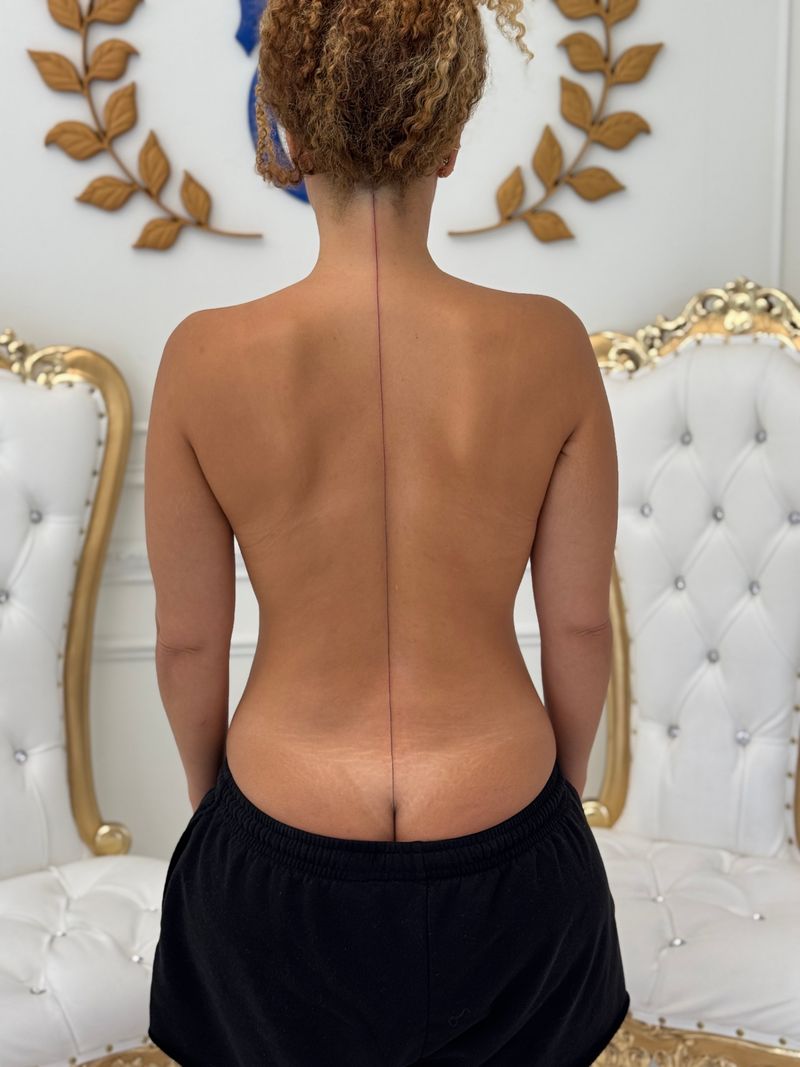
| Spine | Highest | Vertebrae directly under thin skin |
| Kneecap | Highest | Almost no soft tissue between skin and patella |
| Sole of the foot and palm | Highest | Thick surface skin over a nerve bed built for grip and weight-bearing; also notorious for poor ink retention |
| Face and head | Highest | Very thin skin over bone and the densest facial innervation in the body |
How to read this chart honestly. It tells you which placements experienced artists plan differently for. It does not tell you what you will feel. The single largest study of tattoo pain could not show that body area predicts pain intensity at all, and it is the study most likely to have found the effect if one exists at the scale people imagine. Treat the chart as a planning tool, not a prediction.
What has been measured
What does the research actually say about tattoo pain?
Very little, and the little there is undercuts the pain-chart genre. One study dominates the field. It surveyed 1,092 tattooed adults, scored pain on a standard 0–10 numerical rating scale, and tested body area as one of nine predictors.
Witkoś and Hartman-Petrycka, 2020
Witkoś J and Hartman-Petrycka M, “Gender Differences in Subjective Pain Perception during and after Tattooing,” International Journal of Environmental Research and Public Health 2020;17(24):9466 (PMID 33348763). A survey of 1,092 tattooed adults in Poland — 863 women and 229 men — using the Numerical Rating Scale, on which 0 is no pain and 10 is the worst pain the respondent has ever felt. Multiple regression tested gender, age, BMI, education, body area, session duration, bleeding, stress level and painkillers taken beforehand.
| Outcome or predictor | Result | Significant? |
|---|---|---|
| Mean NRS during tattooing | 4.35 (SD 2.60) | — |
| Mean NRS directly after tattooing | 2.07 (SD 2.02) | — |
| Body area → pain during | p = 0.094 | No |
| Body area → pain after | p = 0.742 | No |
| Session duration → pain during | B = 0.35 (95% CI 0.27 to 0.43) | Yes, p = 0.001 |
| Stress level → pain during | B = 0.45 (95% CI 0.31 to 0.60) | Yes, p = 0.001 |
| Bleeding → pain during | B = 0.36 (95% CI 0.00 to 0.72) | Borderline, p = 0.052 |
| Painkillers taken beforehand → pain during | B = 1.42 (95% CI 0.60 to 2.23) | Yes, p = 0.001, in the positive direction |
| Gender → pain during | B = 0.05, p = 0.781 | No |
| Gender → pain after | B = 0.62 (95% CI 0.34 to 0.90) | Yes, p = 0.001, women higher |
| Body area → radiating pain | More frequent with upper-limb tattoos than lower-limb (p = 0.003) or torso (p = 0.031) | Yes |
Read the limitations before you quote it
Four of them matter, and none of them are hidden — the authors state them.
1
The body-area categories are coarse
Participants were sorted into four buckets: upper limb (45.1%), torso (32.1%), lower limb (19.3%) and neck (3.6%). That design cannot compare ribs against outer thigh. It can only ask whether limb-versus-torso matters, and it found that it did not. A study built to test individual placements has not been done.
2
It is retrospective self-report
People recalled and rated a tattoo they had already had. Remembered pain is not measured pain, and the two are known to diverge.
3
The painkiller finding runs backwards
Taking analgesics before the session predicted more pain, not less. The most likely reading is reverse causation — people who expect a hard session medicate for it — and the study cannot separate the two. Do not read it as evidence that painkillers make tattoos hurt more.
4
One country, one sample, 79% women
A single Polish survey is not a global result. It is simply the largest one that exists, which is itself the finding worth carrying away.
The method note behind “no study found”
Searching Europe PMC for tattoo and pain in title and abstract returns six records. They are: a study of musculoskeletal pain in tattoo artists; a case report of dermatitis after a henna tattoo; two papers on reducing pain during laser tattoo removal; a case report of complex regional pain syndrome after a wrist tattoo; and a patent application. None of them ranks body sites by tattooing pain. That is the entire published field. When a tattoo pain chart gives you a number for the ribs, it is not reporting research, because there is none to report.
Mechanism
Why do some places hurt more than others?
Four anatomical explanations are offered, and they are reasonable. What none of them has is a study connecting them to tattoo pain scores. Keep the distinction: the anatomy is established, the link to how a tattoo feels is inference.
1
Bone under thin skin
Where skin sits directly on bone — ribs, sternum, spine, kneecap, ankle, top of the foot, collarbone — there is no muscle or fat to absorb the machine’s vibration. This is the mechanism most often cited and the one that best matches the consensus ranking. It has not been measured against tattoo pain.
2
Nerve density is genuinely uneven
This part is measured. Corniani and Saal, in the Journal of Neurophysiology in 2020, estimate about 230,000 tactile afferent fibres across the whole body, of which 15% serve the palmar skin of the hands and 19% the region around the face and lips. Important caveat: those are touch fibres, not pain fibres. High touch acuity and high pain sensitivity often travel together, but the study measures the first and not the second, and this page will not pretend otherwise.
3
Major nerves near the surface
The inner wrist sits over the radial and ulnar nerves, the inner bicep near the brachial plexus, the side of the neck along the carotid sheath. Clients sometimes report sensation referred away from the needle. Witkoś 2020 is the one place this shows up in data: radiating pain was significantly more common with upper-limb tattoos than with lower-limb or torso work.
4
Movement, and how long you are there
Ribs move with breathing; elbows and knees move with everything. Beyond the anatomy, the strongest measured predictor of tattoo pain is simply duration. Awkward, mobile placements take longer to work, and longer sessions score higher. A hard placement may hurt partly because it keeps you in the chair.
Duration
How long does tattoo pain last?
Only the first few minutes after a session have been measured. Mean pain directly after tattooing was 2.07 out of 10, against 4.35 during. Beyond that point, nobody has measured it.
That drop is the most useful thing in the data and it is rarely reported: pain roughly halves the moment the machine stops. What happens over the following days has not been studied. There is no published curve, no average number of hours, and no measured comparison between placements for how long soreness persists.
Practitioner observation, not data: at Apollo, clients most often describe the first 24 to 48 hours as a sunburn-like soreness that fades over the following days, with bony placements and larger pieces staying tender longer. That is what the bench sees. It is not a measurement, and anyone presenting a healing-pain timeline as clinical fact is inventing it. Anything hot, spreading, or genuinely worsening after the first couple of days is a doctor question rather than a tattoo question — see the tattoo aftercare guide and tattoo healing for the rest of the recovery picture.
Numbing cream
Does numbing cream work for tattoos?
There is real evidence that a lidocaine-prilocaine cream blunts tattooing pain. It is in rabbits. No human randomised trial of topical anaesthesia during tattooing was located, and the FDA has issued warning letters to companies selling tattoo numbing products at concentrations above the over-the-counter limit.
The controlled evidence, stated exactly
Keating SC, Thomas AA, Flecknell PA and Leach MC, “Evaluation of EMLA cream for preventing pain during tattooing of rabbits,” PLoS ONE 2012;7(9):e44437. Eight New Zealand White rabbits, crossover design, ear tattoos with and without prior lidocaine-prilocaine cream. Tattooing without the cream produced significantly more struggling and vocalisation, higher grimace scores, higher peak heart rate and higher blood pressure. With the cream, the responses were indistinguishable from sham tattoos. The authors’ conclusion is that ear tattooing causes transient and potentially severe pain in rabbits, “which is almost completely prevented by prior application of local anaesthetic cream.”
That is a genuine result and it is also eight rabbits and a rabbit ear. It is not a human tattoo, not a human dose, and not evidence about the products sold to tattoo clients.
What the FDA has actually said
In a warning letter dated 25 March 2024 (MARCS-CMS 666693) to a company selling tattoo numbing cream and spray, the FDA set out the regulatory position plainly. Over-the-counter external analgesics marketed without an approved application must conform to monograph order M017, which permits lidocaine only in the range 0.5% to 4%. The products in question were labelled lidocaine 5%, combined with prilocaine and epinephrine, neither of which M017 permits at all.
The safety reasoning in the letter is the part worth reading before you buy anything online. FDA states that it has warned in multiple public health advisories about lidocaine and other “-caine” products “when applied over large areas of skin, particularly on irritated or broken skin, for prolonged periods of time, and when the skin is covered after application,” because those uses “increase the amount of active ingredient that passes into the bloodstream and, if used improperly, may cause serious injury.” A tattoo appointment is exactly that scenario: a large area, broken skin, hours of exposure, often under wrap, and typically applied by someone who is not a clinician. The letter also records that FDA “is not aware of any adequate and well-controlled clinical studies in the published literature” supporting those products for that use.
What this means in practice
1
Ask your artist first, always
Numbing products change how skin takes ink and how it reads under the needle. Some artists work with them, some decline them outright. This is a per-artist decision made at consultation, not something to spring on the day.
2
Concentration is the check that matters
Anything above 4% lidocaine is outside what the FDA permits over the counter in the United States. Products combining lidocaine with prilocaine or epinephrine are outside the monograph regardless of strength.
3
Nobody has shown it works on people getting tattooed
Not that it fails. That the trial has not been run. Claims about how many hours of coverage a tattoo numbing cream gives are manufacturer marketing, not clinical findings.
Tattoos vs piercings
Do tattoos hurt more than piercings?
No study compares them head to head, so any confident answer is invented. What can be said is structural, and it points in a clear direction.
A piercing is a single needle pass measured in seconds. A tattoo is a sustained procedure measured in hours. The strongest measured predictor of tattoo pain intensity in Witkoś 2020 was session duration, which is the one variable on which the two procedures differ most. On that evidence, the reasonable expectation is that a piercing is sharper and far shorter, while a tattoo is lower-intensity and cumulative — but that is inference from one study’s regression, not a measured comparison, and it should not be quoted as one.
Practitioner observation, not data: clients at Apollo who have had both very often describe the piercing as the more intense single moment and the tattoo as the harder overall experience, mostly because of how long it lasts. Cartilage piercings are the ones most often described as sharper than expected. If you are weighing the two, the piercings section covers what each placement involves.
First tattoos
How much does a first tattoo hurt?
The honest anchor is 4.35 out of 10. That is the mean pain during tattooing across 1,092 tattooed adults on a scale where 10 is the worst pain the person has ever felt in their life. Most people land somewhere in the middle of the scale, not at the top of it.
Two of the three strongest measured predictors are things a first-timer can influence. Stress level was a significant predictor of pain during tattooing (B = 0.45, p = 0.001), which means the standard advice to manage anticipation has actual evidence behind it rather than just being reassurance. Session duration was the other (B = 0.35, p = 0.001), which is a direct argument for starting with a piece that finishes in one comfortable sitting rather than an ambitious first commitment.
The consensus tiers above still have a use here: a first tattoo on the outer forearm, outer thigh, outer calf or upper arm is the standard recommendation, and the reason is that these placements rarely surprise anyone. For the rest of the planning — how a placement ages, how visible it is, and whether your design fits the canvas — see the tattoo placement guide, and for the full pre-appointment walkthrough the first tattoo guide.
In the chair
Tattoo pain management: what you can actually influence
Two of the predictors that reached significance in Witkoś 2020 are partly in your hands: how long the session runs and how stressed you are when it starts. Everything else below is practitioner observation, and it is marked.
Be careful about how much weight that carries. The study is a retrospective survey, so it establishes that higher stress and longer sessions went with higher pain scores — not that lowering either one lowers pain. No trial has tested any pain-management technique during tattooing. The rest of this section is what artists at Apollo do at the bench because it appears to help clients get through a session, and it is offered on that basis rather than as evidence.
Before the session
1
Eat, and arrive hydrated
Practitioner observation. A proper meal beforehand is the single most common piece of advice given at the counter, because the clients who struggle earliest are usually the ones who came in on an empty stomach. Loose, comfortable clothing that gives the artist access to the placement without you holding it out of the way is the other practical one. Neither has been measured against pain scores.
2
Skip alcohol the day before
Practitioner observation. The standing studio guidance is no alcohol in the twenty-four hours before a session. The nearest thing to supporting data is that bleeding during the procedure was a borderline predictor of pain in Witkoś 2020 (B = 0.36, p = 0.052) — but that study did not measure alcohol, and the step from one to the other is inference. The stronger reason is simply that artists will not work on someone who turns up intoxicated.
3
Arrive rested
Practitioner observation. Sleep deprivation raising pain sensitivity is well established in the general pain literature. What does not exist is a figure for what it does to a tattoo specifically — this page used to carry one and it was removed for having no source. “Sleep before a long session” is good advice; a number attached to it would be invented.
4
Painkillers are not the shortcut
This one is measured, and it runs backwards. Taking analgesics beforehand predicted more pain, not less (B = 1.42, p = 0.001). The likely explanation is reverse causation: people who expect a hard session medicate for it. The honest reading is that the data gives you no reason to premedicate, not that painkillers make tattoos hurt more. Ask your artist rather than deciding on the day.
During the session
1
Box breathing
Practitioner observation. Inhale for four seconds, hold for four, exhale for four, hold for four, repeat. It is what artists here talk clients through when a passage gets hard, and the reason it is worth a mention is that stress level was one of the strongest measured predictors of pain in the one large study available. It has not been tested during tattooing, by anyone. Treat it as a technique that helps people stay still and settled, not as an analgesic.
2
Bring a distraction, within limits
Practitioner observation. Music, a podcast, or conversation with your artist if they are working in a way that allows it. Stress balls and fidget tools are the exception worth flagging: anything that moves the area being worked on makes the artist’s job harder and the session longer. Ask before you bring one out.
3
Breaks, and the tension in them
Asking for a break is normal and no artist minds. It is worth knowing that it cuts both ways: session duration was the strongest measured predictor of pain intensity, so breaks that stretch a three-hour piece into five are not free. The practical version is to take the break you actually need, early, rather than grazing through a dozen short ones.
4
Say something
Practitioner observation. Artists read breathing, stillness and colour, and will usually stop before you ask. That is not the same as knowing what you are feeling. If a passage is worse than the rest of the piece, saying so is useful information about the placement, not a complaint.
What is sourced here and what is not. The stress, duration, bleeding and painkiller figures are from Witkoś 2020 and appear with their coefficients in the evidence section. Everything else in this section is labelled practitioner observation, because that is what it is: what artists at Apollo see across many sessions, not a measurement. For what to do after the session, see the tattoo aftercare guide.
The forgiving zone
Where is the least painful place to get a tattoo?
Outer thigh, back of the calf, outer upper arm, upper shoulder, and the upper and mid back. Studio consensus, for the same reason every time: thick skin, muscle underneath, no bone near the surface.
These are the placements artists steer nervous first-timers toward, and the reasoning is consistent across shops. They are also, usefully, among the placements that age best, so the low-pain recommendation and the good-aging recommendation point the same way. What they are not is a guarantee. Individual variation in the one study large enough to show it was wide — a standard deviation of 2.60 on a 10-point scale means people getting comparable work reported anything from barely noticeable to severe.
The chart tells you which placements we plan differently for. It does not tell you what you will feel.
The number people are most afraid of is the one nobody has ever measured. The measured average is 4.35 out of 10.
Duration is the variable with the best evidence behind it. A shorter first session is not a compromise, it is the recommendation.
The correction record
What this page used to say, and why it was removed
This page previously carried the standard tattoo-pain-chart material. Three items could not be traced to any source and have been cut. Recording the cut is part of the standard the rest of this site is held to.
| Removed claim | Why it went |
|---|---|
| A 1–10 pain number for each of thirty-odd placements (ribs 9, outer thigh 3, fingers 8, and so on) | No published study assigns a pain number to a named placement. The figures were studio estimates presented in the visual language of data. Replaced with named consensus tiers that say what they are. |
| “Most clients report the second tattoo as 40–60% easier than the first” | No source found for either the effect or the range. Nothing in the located literature measures pain across a person’s first versus second tattoo. |
| “Research on tattoo pain specifically doesn’t support gender as a reliable variable” | Half wrong, and the half that is wrong matters. Witkoś 2020 found no gender difference in pain during tattooing (p = 0.781) but a significant difference directly after, with women reporting higher pain (B = 0.62, p = 0.001). The corrected statement is now in the FAQ. |
One further claim was softened rather than cut. The page previously asserted that rested clients rate the same session one to two points lower than unrested clients. Sleep deprivation increasing pain sensitivity is well established in the general pain literature, but the specific one-to-two-point figure for tattooing has no source and is no longer stated.
Merged in on 1 September 2026. A separate article, Tattoo Pain Management: A Guide To A Comfortable Ink Experience, covered the same ground with none of the sourcing and now redirects here. Its preparation and in-session material was carried across and labelled as practitioner observation. Three things were not carried across: its lists of lower-pain and higher-pain body areas, superseded by the chart above; its description of box breathing as a “proven” technique, since no trial of it during tattooing was located and the word was doing work the evidence does not support; and a client testimonial about a navel piercing, which had nothing to do with tattoo pain.
Sources
Every source used on this page
- Witkoś J, Hartman-Petrycka M. Gender Differences in Subjective Pain Perception during and after Tattooing. International Journal of Environmental Research and Public Health. 2020;17(24):9466. doi:10.3390/ijerph17249466. PMID 33348763. Open access.
- Corniani G, Saal HP. Tactile innervation densities across the whole body. Journal of Neurophysiology. 2020;124(4):1229–1240. doi:10.1152/jn.00313.2020. PMID 32965159.
- Keating SC, Thomas AA, Flecknell PA, Leach MC. Evaluation of EMLA cream for preventing pain during tattooing of rabbits: changes in physiological, behavioural and facial expression responses. PLoS ONE. 2012;7(9):e44437. doi:10.1371/journal.pone.0044437. PMID 22970216. Open access.
- US Food and Drug Administration. Warning Letter to Sky Bank Media, LLC dba Painless Tattoo Cream Co., MARCS-CMS 666693, 25 March 2024. Center for Drug Evaluation and Research. fda.gov.
- US Food and Drug Administration. Over-the-Counter Monograph M017: External Analgesic Drug Products for Over-the-Counter Human Use (Order ID OTC000033), cited within the warning letter above.
- Europe PMC literature searches on tattoo and pain, run against title and abstract fields, used to establish the absence of body-site pain rankings in the published literature.
Statements labelled practitioner observation come from artists and piercers at The Apollo Tattoo & Piercing Studio in Santa Monica. They describe what the bench sees across many clients. They are not measurements, they were not collected systematically, and they are marked so you can weigh them accordingly. For the wider evidence picture on tattooing — ink composition, the cancer studies, the healing evidence gap — see tattoo facts.
FAQ
Tattoo pain: common questions
Where do tattoos hurt the most?
Working artists consistently name ribs, sternum, spine, kneecap, inner wrist, fingers, the sole of the foot, the palm, and the face as the hardest placements. That ranking is practitioner consensus rather than measured data. The largest study of tattoo pain, a survey of 1,092 tattooed adults published in 2020, tested body area against a 0 to 10 pain score and found it was not a significant predictor of pain intensity, either during the session or directly after it. Its body-area categories were coarse, so it could not compare ribs against outer thigh directly. No published study assigns a pain number to a specific placement.
Is there a real tattoo pain scale?
There is a real pain scale, but no real tattoo pain chart. Researchers use the Numerical Rating Scale, a standard 0 to 10 measure where 0 is no pain and 10 is the worst pain a person has ever felt. Applied to tattooing in the one large study available, it produced a mean of 4.35 with a standard deviation of 2.60 during the session and 2.07 directly afterwards. What does not exist anywhere in the published literature is a validated scale that assigns each body part its own number. Every per-placement number circulating online, including the ones this page used to carry, is a studio estimate rather than a measurement.
How long does tattoo pain last?
Only the moment directly after the session has been measured. Mean pain fell from 4.35 out of 10 during tattooing to 2.07 out of 10 immediately after, so it roughly halves the moment the machine stops. Nobody has measured what happens over the following days. There is no published timeline, no average number of hours, and no measured comparison between placements. From practitioner observation at Apollo, clients most often describe the first 24 to 48 hours as a sunburn-like soreness that fades over the following days, with bony placements and larger pieces staying tender longer. Anything hot, spreading, or worsening after the first couple of days should be seen by a doctor.
Does numbing cream work for tattoos?
No human randomised trial of topical anaesthesia during tattooing was located. The only controlled evidence found is a 2012 crossover study in eight rabbits, in which a lidocaine and prilocaine cream almost completely prevented the pain responses of ear tattooing. Beyond that, the practical guidance is regulatory. In a March 2024 warning letter, the FDA stated that over-the-counter external analgesics may contain lidocaine only in the range 0.5 to 4 percent, and warned that applying these products over large areas of skin, on broken skin, for long periods, or under a covering increases how much drug enters the bloodstream and may cause serious injury. A tattoo session is exactly that scenario. Ask your artist before using anything, because numbing products change how skin takes ink and some artists decline them.
Do tattoos hurt more than piercings?
No study compares the two directly, so any confident answer is invented. The structural difference is that a piercing is a single needle pass lasting seconds while a tattoo is sustained over hours, and session duration was the strongest measured predictor of tattoo pain in the one large study available. On that basis the reasonable expectation is that a piercing is sharper and much shorter while a tattoo is lower in intensity and cumulative. From practitioner observation at Apollo, clients who have had both usually describe the piercing as the more intense single moment and the tattoo as the harder overall experience.
Do women feel more tattoo pain than men?
Not during the tattoo, and yes directly afterwards. In a 2020 survey of 1,092 tattooed adults, gender did not predict pain intensity during the session at all. Directly after the procedure, women reported significantly higher pain than men. The effect was small in size and the sample was 79 percent women, so it should not be overread. What predicted pain far more strongly than gender were session duration, stress level, and bleeding during the procedure.
Where is the least painful place to get a tattoo?
The outer thigh, back of the calf, outer upper arm, upper shoulder, and the upper and mid back. All five share thick skin, muscle underneath, and no bone close to the surface. This is studio consensus rather than measured data, but it is consistent across working shops and it happens to line up with the placements that age best, so the low-pain recommendation and the good-aging recommendation point the same way. Individual variation is wide: the one study large enough to show it reported a standard deviation of 2.60 on a 10-point scale.
How can I make a tattoo hurt less?
Two of the things that predicted tattoo pain in the one large study available are partly under your control: how long the session runs, and how stressed you are. Stress level and session duration were both significant predictors in a 2020 survey of 1,092 tattooed adults, which is an argument for booking a first piece that finishes in one comfortable sitting and for managing anticipation beforehand. That study measured association, not treatment, and no trial has tested any specific pain-management technique during tattooing. From practitioner observation at Apollo: eat beforehand, arrive rested and hydrated, skip alcohol the day before, bring a distraction, and ask for a break before you need one rather than after. Taking painkillers beforehand is not supported by the data, which found it predicted more pain rather than less, most likely because people who expect a hard session medicate for it.