Tattoo Ideas
Dragonfly
Four wings, not two, and that is the detail most reference lets people get wrong. They are transparent, which turns the design problem into what shows through them. Twelve directions, the Japanese tombo and its samurai association with an insect that only flies forward, and the narrow placements a long abdomen suits.
Book a consultationThe wings
Four wings, not two. Almost nobody checks.
Count them on the stencil. A dragonfly has two forewings and two hindwings, four in total, hinged independently and able to beat out of phase with each other, which is why the animal can stop dead in the air and reverse. Half the dragonfly tattoos in circulation have two wings, or four wings drawn as two mirrored pairs fused at the base like a butterfly. It is the single most-botched detail on the subject and it takes ten seconds to catch. Then worry about veining, which is what carries the design and therefore what fails first.
Membrane texture vs. flat fill
A real dragonfly wing is translucent, veined, slightly iridescent. A tattoo that flat-fills the wing with solid color kills the insect — reads as a costume brooch, not a creature. Even a single-needle silhouette should leave the wing open, not filled.
Vein structure
Every species has specific venation. A green darner’s wings differ from a blue dasher’s. An artist referencing a real species renders the veining correctly; an artist inventing the veining produces a wing that reads as decorative pattern rather than insect anatomy.
Iridescence
Realism carries it as reflected highlight — a shift of value, not a shift of color. Watercolor carries it as wash. Neo-traditional carries it as a panel of color inside a bordered wing. Fine line often skips it and lets the veining do the work. Each style has its move. Choose one.
Wing-to-body proportion
Real dragonfly wings are roughly twice the body length. Tattoo versions often compress the wings to fit the available skin, and the result reads as a hybrid insect the brain can’t place. If the zone won’t fit the proportion, change the zone.
Open vs. folded
Dragonflies at rest hold their wings open (unlike damselflies, which fold them over the body). A dragonfly tattoo with folded wings is actually a damselfly tattoo — not wrong, different insect. Name it correctly and render it correctly.
The five readings
One of these five decides which direction the insect faces.
A dragonfly carries no fixed meaning the way an anchor or a swallow does, which is freeing and also the reason so many of them come out looking pleasant and unspecific. Five readings cover most of the consults we take on this subject. Hold as many privately as you like. The artist needs exactly one to design against, because two of these five point the insect in opposite directions and one of them dictates the whole palette.
Transformation, most of it underwater
The Western default · safe anchor
Dragonflies spend most of their life underwater as nymphs and emerge, briefly and vividly, as the winged adult. The long unseen work, the visible becoming. Sobriety, divorce, the end of a long illness, the move out of a childhood home. Doesn’t require announcement — just needs to be true for you.
Japanese victory (tombo)
Samurai lineage · forward motion
The samurai wore the tombo because dragonflies fly forward and never retreat. A specific cultural reading with a specific visual vocabulary — Japanese composition, traditional palette, paired with waves, chrysanthemum, or peony. If you choose this reading, you’re committing to a Japanese-specialist artist.
For someone who died
The loved one who visits
The grandmother, mother, partner, or child who now shows up on the porch, at the trail, in the garden. Grown steadily for a decade. Overlaps with transformation but is emotionally distinct — you’re marking someone else’s arrival, not your own.
Maturity & wisdom
Emotional clarity · the quiet version
The quiet version of transformation — you are not becoming, you are become. Clients in their late thirties and forties choose this reading more than any other demographic. Often pairs with a single element (a book, a key, a small banner) that names what the clarity cost.
Lightness & freedom
The creature that skims water · never lands long
Autonomy, unclaimability, the refusal to be pinned. The creature that skims water and never lands long, always moves. For the client who is, finally, answerable to no one.
Katsumushi, the victory insect
In Japan the dragonfly is a war motif, and it decides which way yours faces.
Western clients tend to arrive with a pond in mind: summer, still water, something light and a bit fleeting. The Japanese reading of tombo is almost the opposite, and it is the older of the two in tattooing. A dragonfly is fast, territorial, and hunts on the wing. It does not hover backwards the way a bee or a hummingbird can, so it was read as an insect that only ever advances. That single observation turned it into a samurai emblem, and it is also the reason a Japanese-informed dragonfly has a rule about orientation that a botanical one does not.
The insect that never retreats
Katsumushi, the victory insect, is the name that attaches to the dragonfly in a martial context, on the reading that it only flies forward. Whether or not that is entomologically airtight is beside the point; it is what the emblem meant to the people wearing it. If you want that reading in your piece, it is not decorative. It sets the composition.
Worn into battle
Dragonfly motifs turn up across Japanese arms and armour: on helmets and helmet crests, on sword fittings, in the patterning of armour lacing and on the fabric of everyday dress. It is one of a small handful of insects that was considered fit for a warrior to wear, which puts it in very different company from the butterfly.
Dragonfly Island
Akitsushima, an old poetic name for Japan, is usually glossed as Dragonfly Island. The traditional account has an emperor looking out over the land and saying it lay like a dragonfly with its tail curled round. The insect is not a minor motif in that culture. It is close to a national one.
An autumn word, not a summer one
In classical Japanese poetry tombo is an autumn seasonal word. That is a real difference in mood from the Western pond reading, which is high summer. If the piece is going next to cherry blossom you have a small internal contradiction on your hands; next to maple, susuki grass or a late harvest moon it agrees with itself.
Which way it flies is load-bearing
This is the practical consequence and the one worth taking away. In the victory reading the dragonfly must appear to be advancing. On an arm that usually means flying up the limb or toward the front of the body, never trailing off behind the shoulder. Get the orientation backwards and a Japanese-literate viewer reads retreat, which is precisely the opposite of what the motif exists to say. Decide the direction before the stencil, and check it on the skin rather than on paper, because a stencil flipped for placement is an easy mistake to make and an expensive one to keep.
Borrowing it honestly
None of this is off limits, and a Japanese dragonfly is not a closed motif the way certain marks in other traditions are. But if you take the emblem, take it knowingly: bold outline, flat colour, correct orientation, and ideally an artist who works in the idiom. A tombo drawn in soft grey wash with the wings drifting backwards is not a Japanese dragonfly. It is a fine-line dragonfly with a Japanese name attached, which is fine as long as nobody is pretending otherwise.
A dragonfly tattoo has no meaning until you assign it one. Pick a reading before you pick a design.
Every style choice is really a decision about how to render wings that are, by nature, almost not there.
The wing veining is what carries the design — which means the wing veining is also what fails first.
Twelve dragonflies
Sorted by how much wing a given approach asks you to draw.
Every direction below is really an answer to one question: what do you do about wings you can see through. A dragonfly wing is a transparent membrane on a lattice of veins, which means the design problem is not the wing itself but whatever sits behind it. Skin shows through. Ink shows through. Whatever the artist puts underneath is part of the wing whether they planned it or not, and that is why so many of these twelve are really twelve different dodges around the same difficulty.
One hairline dragonfly
The 2020s default
Hair-thin single-needle, wings as linework only, body articulated by fine segmentation. Size stays 2–4 inches, which matches the style and keeps the wing veining readable. Appeal is restraint: wings feel translucent because they’re mostly negative space. Ages well because there’s no large pigment mass to soften. Expect a touch-up around year 7–10 if you want the vein detail to stay crisp.
Realistic specimen dragonfly
Entomological accuracy
Photorealistic rendering of a specific species — common green darner, blue dasher, eastern pondhawk, ruby meadowhawk — with entomological accuracy down to wing venation and thorax coloring. Works for naturalists, biologists, anyone with a specific species attachment (often tied to a place or a parent). Commit to color — a monochrome realistic dragonfly loses the iridescence that makes the reference worth chasing.
Washed colour running off the wing edge
Iridescence as color wash
Splash-style color bleeding behind or through the wings, pigment pooling outside the linework in controlled drifts. Suits the dragonfly because the wings’ iridescence reads naturally as color wash — blues, violets, teals layered without hard boundaries. Caveat: watercolor ages faster. Pair with a fine-line structure underneath so the silhouette stays legible.
Geometric / sacred geometry
Tessellated wings · mandala body
Wings composed of geometric tessellation — hexagons, overlapping circles, Penrose-style patterns — with the body rendered as a segmented column of geometric shapes. Reads as design-forward and symbolic rather than naturalistic. Pairs with clients who want the dragonfly symbolism without the entomology. Geometric density has to stay consistent across both wing pairs or the piece looks asymmetric.
Japanese irezumi (tombo)
Samurai victory · never retreat
The tombo flies only forward, which made it a symbol of victory and a common motif on samurai armor. Rarely a solo piece — hybridizes with peony, chrysanthemum, wind bars, or water, and lives inside the larger irezumi grammar of color, outline weight, and compositional flow. The one direction where dragonfly goes big; the cultural approach supports scale that fine-line and watercolor can’t.
Over open water
Implied motion · illustrative
Dragonfly skimming the water surface with a circular ripple or two below the body implying the moment of contact. Solves a common dragonfly problem — the subject feels static when it’s just a specimen floating on skin — by introducing motion and environmental context. Ripples can be fine-line concentric circles or soft black-and-gray gradients.
Settled on a reed
The quiet visitor
Dragonfly perched on a stem, leaf, or flower — lavender, cattail, wheat, wildflower — rendered in fine line or neo-traditional. A quieter direction than specimen realism; the botanical element grounds the dragonfly and gives the eye somewhere to land besides the wings. Fine-line versions keep both subjects delicate; neo-traditional versions add color blocking on the flower.
Plotted as a star pattern
Star-map composition
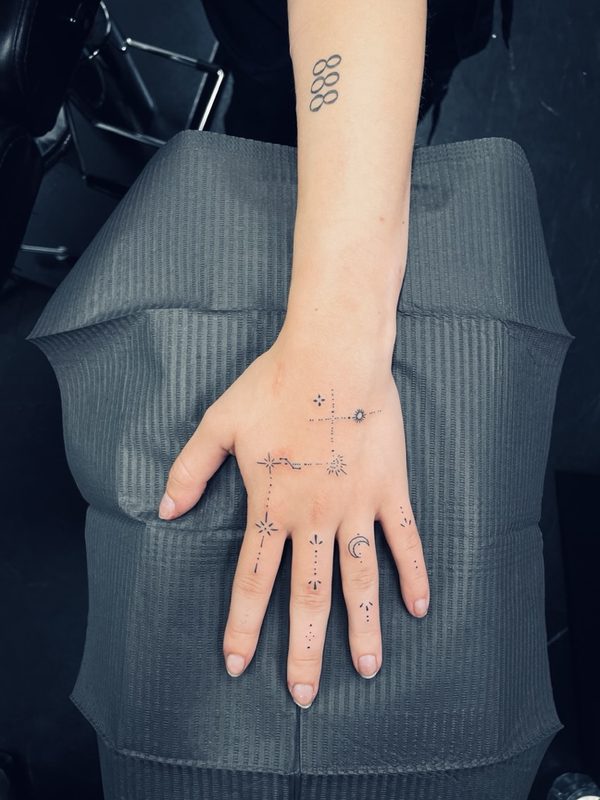
Dragonfly composed of dots and thin connecting lines, evoking a star map or constellation chart. Reads as both insect and celestial navigation. The challenge is legibility: too few dots and the dragonfly disappears; too many and it stops reading as a constellation. A good version balances 15–25 anchor points with connecting lines that suggest wing and body without hard outlines.
The dragonfly seen at the funeral
Name · date · initials
Dragonfly paired with a name, date, or set of initials — usually in fine-line style, with text integrated into the composition rather than floating below it. The transformation symbolism carries the memorial weight. Often marks the loss of a mother, grandmother, or close friend. Text sizing and font choice matter as much as the dragonfly rendering.
Solid black with the venation cut out
Solid fill · architectural silhouette
Solid black fill, architectural silhouette, minimal internal detail. Opposite pole from fine line: instead of describing the dragonfly through the thinnest possible lines, blackwork describes it through weight and negative space. Wing veining either disappears into solid fill or gets carved out as negative-space linework. Ages exceptionally well — solid black holds longer than any other pigment.
Ornamental dragonfly
Lace · filigree · mandala wings
Wings rendered with lace, filigree, or mandala-style patterning layered over or replacing the natural venation. Sits between neo-traditional and ornamental blackwork — body stays recognizably dragonfly, but the wings become a decorative surface. Pairs with clients who already have ornamental sleeves or mandala work and want a subject-based piece that extends the same language.
Cluster of dragonflies
Three · five · seven in motion
Three, five, or seven small dragonflies in apparent motion — not a tight stack but a distributed composition across a limb or panel. Fine line dominates. The design challenge is varying angles and scales so the cluster reads as a swarm rather than a repeat stamp. Odd counts read as a flight. Even counts read as wallpaper. Seven dragonflies at graduated scale is the current strongest version.
Six styles
Six answers to a transparent wing.
Realism tries to reproduce transparency with tone. Fine line ignores it and draws the lattice only. Blackwork inverts the whole thing and lets negative space be the membrane. Geometric redraws the venation as a lattice you could have designed. Each answer ages differently, prices differently and asks a different amount of the artist.
Fine line — four separate wings in hairline weight
Dominant 2020s style
Hairline wings rendered as veined lace, body as a thin black stroke, antennae as a single hair-pull of ink. Caveat: single-needle softens faster than traditional linework because the lines are thinner. On a forearm or sternum, holds for a decade. On a finger, foot, or outside of hand — fuzzes inside 3 years.
Black-and-grey realism — the membrane problem, solved with tone
Photorealistic specimen
Membrane wings rendered as translucent tissue, iridescence carried as reflected highlight rather than color. Often the reference is a specific species (common whitetail, green darner, blue dasher), which makes the piece collectable rather than generic. Realism will not compress. Bring a photograph of the actual species, not an illustration of one.
Watercolour — wash where the wing should be see-through
Splash · iridescent wash
Saturated splash behind the body, iridescent wash pulled across the wings, deliberate ink drips or bleed edges. Photographs spectacularly at day one. Caveat: watercolor ages faster than any other style because the wash carries the work without the scaffold of an outline. Plan for a touch-up at year 7–10.
Neo-traditional — heavy outline on a very thin body
Bold outline · expanded palette
Bold outline on body and wing edges, expanded palette inside the wing panels — dusty teals, burgundies, muted gold. Decorative internal wing patterning borrowed from Art Nouveau or ornamental flash. Gives you ornament and color without committing to realism’s scale floor. Where most mid-scale 2026 dragonfly work lives.
Japanese tombo — orientation is fixed before anything else
Samurai tradition · never retreats
Traditional style with rules about composition, background (wind bars, water), and how the insect sits inside a larger panel. Only booked with artists inside the Japanese tradition. A dragonfly in “Japanese-inspired” hands is a decorative fusion piece — which is fine, as long as it’s named honestly. A tombo is different.
Geometric — the venation redrawn as a lattice
Sacred geometry · dot-work fill
Wings built from sacred-geometry grids, mandala-adjacent compositions, dot-work fill inside architectural outline. Ages well because the whole style is built on line and dot, both of which hold longer than wash or wide color fill. The style for clients who want the dragonfly to carry meaning without reading literal — symbol rather than specimen.
Five zones
A long thin body wants a long thin run of skin.
The dragonfly has an unusual shape for a tattoo: a narrow abdomen two or three times the length of the wingspan is wide. That geometry is a gift on the forearm, the spine, the outside of a calf, the line of a collarbone, anywhere the body already runs long and straight. It fights you on a square of skin like a shoulder blade, where the abdomen has to be foreshortened or the whole insect tilted. Five zones, and what the shape does in each.
Private — the small tombo nobody else sees
Sternum · inner bicep · behind ear
The default dragonfly placement at Apollo in 2026. Insect is small, meaning tends toward the private, and these zones reward the scale the design wants to be. Fine line or ornamental style matches the placement style. A tattoo the wearer sees first, the room sees second.
Along the forearm, where the body is already long
Inner forearm · inside wrist
Where fine-line dragonflies live when the wearer wants the piece in their own eyeline. Inner forearm is the modern neutral — reads as “tattoo of a dragonfly” without locking in a style-era. Inside wrist is the smaller version. Both hold fine-line work well because the skin is stable.
Following a bone — spine, clavicle, shin
Shoulder blade · upper back · outer thigh
Where realism dragonflies live. Large enough to carry 5–7 inches of specimen detail, skin is stable enough to hold it for decades, and the natural curve of a shoulder blade frames a pair of wings the way a display case frames a specimen.
Wings open across the shoulder
Outer forearm · bicep
Less-common for dragonfly than for rose, but the right answer for neo-traditional work. Reads at six feet, reads in a t-shirt, announces rather than whispers. If the meaning is defiance, forward motion, or a tombo reading, bold placement matches the meaning.
Micro — where four wings quietly become two
Finger · ankle · earlobe
Single-needle silhouette only. Under 1.5 inches, a dragonfly reads as a shape — four wings, a body, done. Detail collapses. Finger placements fade fastest of any body zone — budget for a touch-up at year 3–5, and accept the piece is a gesture, not an archive.
Four brackets
The size at which four wings stop being four wings.
There is a specific size below which the gap between forewing and hindwing closes up and the insect starts reading as a butterfly at a glance. In fine line that happens somewhere around an inch and a half; in anything with a heavier outline, higher. Either commit to a scale that keeps the four wings separate, or commit to a deliberate silhouette and stop expecting the venation to survive.
Pricing, honestly
Session lengths, and what they come to at Apollo rates.
Apollo runs $100 an hour with Blue, Hannah or Rick and $350 an hour with Raa or David. A half day is $400, a full day $600, a touch-up $100, a consultation $100. What any given dragonfly costs comes down to artist, size, design and placement, and the number is quoted off the finished drawing rather than off a description.
Seven companions
Water, reed, lotus: what a dragonfly needs to be near.
There is a practical reason dragonflies get paired so often, and it is not symbolism. Transparent wings need something behind them, and an empty field of skin is a weak answer. A reed gives the venation something to overlap. A ripple gives the whole insect a plane to sit above. Seven companions, and what each one does to both the composition and the meaning.
Over a lotus
Eastern style. Perched on or hovering above an open bloom. Works in Japanese, neo-traditional, or fine-line hands; refuses watercolor, because the lotus needs a line to read. Thigh, ribcage, back panel. 5–8 inches minimum.
Above a ripple, with a shadow
Illustrative and the most literal pairing. The insect’s native habitat rendered as concentric lines or a single meniscus. Fine-line or black-and-gray realism carry it best. Inner forearm or shoulder blade.
Gripping a reed
The fine-line default. A single stem, a cluster of leaves, the insect as visitor rather than subject. Scales from 3 inches on the wrist to 8 inches on the ribcage. Most-requested dragonfly pairing at Apollo.
A name on a ribbon below
The memorial style. Banner below the insect, fine line or neo-traditional. Reads as tribute without sentimentality. Forearm or bicep. Ages as well as the name does.
Against a crescent
Witchcraft-adjacent style. Fine line, often on sternum or inner forearm. Pairs cleanly with the 2020s aesthetic that powers moon-and-moth work.
Cluster of dragonflies
Family pairing. Three insects for three siblings, four for four children, often at different scales to suggest age or birth order. Thigh or back panel, 6+ inches. Neo-traditional or fine line.
On one named flower
The curated botanical. Cherry blossom for impermanence, lavender for calm, lily for memorial. The dragonfly softens the flower’s gender-coding, which is often the point.
The memorial dragonfly
Why a dragonfly turns up so often after a death.
Part of it is the emergence: a dragonfly spends most of its life underwater as a nymph and flies for a matter of weeks, which is a shape that grief recognises without needing it explained. Part of it is simply that people report seeing one at a funeral. Four decisions the memorial version should make deliberately.
Initials or date
Initials on a wing or a small banner beneath. Significant dates worked into the tail. Text sizing and font matter as much as the dragonfly rendering.
Open-winged vs. perched
Open-winged in flight reads as arrival / visitation. Perched on a stem, reed, or flower reads as presence / company. Different emotional styles for different grief states.
Colour choice on a memorial piece
All-black for mourning and formality. Dusty blue for memory and distance. Iridescent color for celebration of a life fully lived. None is wrong — different answers to who this person was.
Which zone for a memorial piece
Inner forearm, inner bicep, ribcage. Private style — memorial dragonflies most often live where the wearer sees them first and the room sees them second.
Where dragonfly work fails
Seven failures. Four of them are the wings.
Four of these seven are wing problems, which tells you where to look. Check the stencil against a photograph of a real dragonfly before anyone starts, not against another tattoo.
The scale-collapse mistake
A four-wing insect at 1.5 inches is a smudge in 5 years. Fine-line venation at small scale is the single most common cause of dragonfly regret we see in touch-up chairs. Fix: commit to scale or commit to a different subject.
Wash with no key line under it
Watercolor dragonflies are beautiful day-one. They also require touch-ups every 5–7 years to hold edges and pigment. Fix: if you can’t budget for ongoing maintenance, choose a style that ages without it.
Drawing a damselfly by accident
“Just a dragonfly” produces a generic dragonfly. If your grandmother’s dragonfly was a green darner, say green darner. Fix: bring reference photos, species name, or both.
The placement-vs-wing-direction mismatch
An open-winged dragonfly flying downward on an upward-facing forearm reads wrong for the entire life of the tattoo. Wing direction has to agree with placement orientation. Fix: decide orientation in consultation, not at stencil.
Booking inside the first six months
A memorial tattoo within 6 months of loss is almost always re-negotiated later — cover-up, addition, or quiet regret. Grief is not yet design. Fix: wait. This is not a subject that goes out of fashion.
Taking the algorithm’s dragonfly
“A small fine-line dragonfly on the inner forearm” is currently the most-ordered configuration in LA. It’s not wrong. It’s also not yours unless you’ve chosen a reading. Fix: aesthetic without reading produces a tattoo that feels like someone else’s within 3 years. Pick the reading first.
The Japanese hybrid without a specialist
A tombo drawn in a fine-line idiom is not Japanese. If you want the Japanese reading, you need a Japanese-trained artist. Fix: accept the wait, find the specialist. Don’t force the tradition into the wrong hands.
Fresh fine-line looks crisp for everyone. Healed fine-line, 2 years out, is where the real craft shows.
A tombo drawn in a fine-line idiom is not Japanese. If you want the Japanese reading, you need a Japanese-trained artist.
Grief is not yet design. Wait.
Before the drawing starts
Six answers, and the first one is which way it flies.
Orientation, wing position and scale are decided in the first ten minutes of a good consult, and everything downstream depends on them. We would rather run the appointment long than start drawing without them.
Which reading are we building on?
The first question, the one clients most want to skip. Transformation, Japanese victory, memorial, maturity, or lightness. If you arrive without a reading, we spend the first half of the consultation finding yours — because everything downstream descends from it.
Species or stylized?
A common darner, a green darner, a ruby meadowhawk, a blue dasher, and a generic “dragonfly” are five different tattoos. If the dragonfly is memorial — the specific one your grandmother had on her porch — we want the species. If the reading is symbolic, stylized is usually honest.
Wings out, or wings back?
Open wings read as arrival, flight, visitation. Folded wings read as rest, arrival completed, presence. Memorials most often want open. Maturity readings often want folded. A small question with a large emotional consequence most clients haven’t thought about.
What scale can you commit to?
Four wings and fine venation. Under 2 inches, venation disappears and you own a silhouette. Under 3 inches, you own a stylized insect. Detailed dragonflies begin at 4 inches and reward 5 or more.
Is this a matched set?
Siblings, partners, mothers and daughters all ask for matched dragonflies. If yes, we design the pair at once and price accordingly. If the matching intent is unresolved (“maybe she’ll get one someday”), we design yours as standalone and revisit.
Is this a memorial piece?
We ask plainly because memorial design is its own conversation — date conventions, initial placement, color style, and whether you are ready yet. Memorial dragonflies within 6 months of loss almost always get re-negotiated later.
Your first dragonfly
Two to three inches, fine line, and count the wings on the stencil.
Seven settings, chosen because they are the ones least likely to disappoint you at year five. The wing count is the only one you personally have to police, and it takes ten seconds.
FAQ
Eight dragonfly questions, and most of them are about wings.
Eight questions covering meaning, style, scale, memorial conventions, micro pieces, watercolor aging, tombo specificity, and the dragonfly-vs-damselfly distinction.
What does a dragonfly tattoo mean?
Five primary readings. Transformation — the Western default, dragonflies spend most of their life as aquatic nymphs before emerging as the winged adult. Japanese victory (tombo) — samurai wore the dragonfly because it flies forward and never retreats. Memorial — the loved one who “visits” as a dragonfly, a growing style especially for grandmothers and mothers. Maturity and wisdom — the quiet version of transformation, emotional clarity in one’s late 30s–40s. Lightness and freedom — the creature that skims water, never lands long, autonomy made visible. Name one as the primary before the drawing starts. A dragonfly without a chosen reading ages generic.
What style works best for a dragonfly tattoo?
Fine line / single-needle is the dominant 2020s style — 2–4 inches, hairline wings, works on inner forearm, wrist, sternum, behind the ear. Black-and-gray realism at 4–7 inches for species-specific specimen work — requires a reference photo. Watercolor for iridescence (caveat: ages faster, touch-up at 7–10 years). Neo-traditional at 3–6 inches for decorative mid-scale pieces. Japanese irezumi (tombo) at 5–10 inches only with Japanese-tradition artists. Geometric / ornamental for symbolic rather than literal renderings. Match the style to the reading: transformation reads clean in fine line, memorial reads in fine-line with text, tombo reads in Japanese only.
How big should a dragonfly tattoo be?
Depends on style. Under 1.5 inches works for single-needle silhouette only — wings become a blur within 3 years if you try veining at this size. 1.5–3 inches is fine-line sweet spot. 3–6 inches is neo-traditional, watercolor, and geometric sweet spot. 6+ inches is realism, illustrative specimen, Japanese tombo. The honest rule: dragonflies have 4 wings and fine venation. Commit to the scale that holds the detail, or commit to a silhouette without expecting detail. Trying for veining under 2 inches is the most common cause of dragonfly touch-up requests.
What’s the memorial dragonfly convention?
The dragonfly is, after the rose, the most-requested memorial subject at Apollo. Convention: the loved one’s initials on a wing, a date worked into the tail, or a small banner with name or date beneath the insect. Composition divides cleanly — open-winged in flight (arrival, visitation) or perched on a stem/flower (presence, company). Color style carries weight: all-black for mourning, dusty blue for memory and distance, iridescent for celebration of a life fully lived. Placement tends toward inner forearm or inner bicep — private style. Wait 6+ months after loss before booking; grief reshapes quickly in the first year.
Can a dragonfly tattoo work at 1 inch?
Only as silhouette. Under 1.5 inches, a dragonfly reads as a shape — four wings, a body, done. Wing veining, specimen detail, and fine venation all collapse at this scale within 3 years. If you want a sub-1.5-inch dragonfly, commit to fine-line silhouette and accept the piece is a gesture, not an archive. Micro placements like finger, earlobe, and ankle fade faster than any other body zone — budget for a touch-up at year 3–5. Going smaller doesn’t save money long-term because small detailed work requires more touch-ups than mid-scale simple work.
Why does watercolor work on dragonflies specifically?
Because the subject is already watercolor in nature. Real dragonfly wings are iridescent — the color shifts with viewing angle, saturates and drains across the wing panel, has no hard boundary. Watercolor tattoo technique — splash, wash, bleed, drip — mirrors that behavior. Caveat: watercolor ages faster than any other style because the wash carries the work without the scaffold of an outline. Pair watercolor with a fine-line structure underneath to keep the silhouette legible after the color settles. Plan for a touch-up at year 7–10. If maintenance isn’t in the budget, pick fine line or neo-traditional instead.
How do I know if I want a Japanese tombo vs. a regular dragonfly?
Tombo is specific. If you’re drawn to the samurai-never-retreats reading, to waves, chrysanthemum, or peony pairings, to traditional Japanese color palette and compositional rules, and you’re planning a sleeve or thigh composition rather than a standalone piece — you want a tombo. If you want a dragonfly in Western aesthetic, fine-line or watercolor style, solo placement, any other reading (transformation, memorial, maturity, freedom) — you don’t want a tombo, you want a regular dragonfly. A tombo drawn in non-Japanese hands is a decorative fusion piece, which is fine as long as it’s named honestly. A real tombo requires a Japanese-tradition artist and the wait to find one.
What’s the difference between a dragonfly and a damselfly tattoo?
Wings at rest. Dragonflies hold wings open horizontally at rest; damselflies fold wings together over the body. If you ordered “a dragonfly” and your tattoo shows folded wings, you actually have a damselfly tattoo — not wrong, different insect. Also: dragonflies are larger, bulkier-bodied, stronger fliers; damselflies are slender, weaker fliers, often with differently-colored wings. Both carry similar symbolism (transformation, water, emergence), but the visual signatures are distinct. Specify which you want at consultation, especially for memorial or species-specific pieces. Most tattoo clients mean dragonfly but the iconography sometimes drifts into damselfly territory without the artist catching it.
Decided which way it flies?
Bring the reading and the direction. We will handle the venation.
Four wings, one orientation, and a reading you choose before the drawing starts. Come in knowing which way you want it flying and whether the wings carry venation or stay open. That is most of the design already decided.