Piercings
Sensitive Skin Jewelry
A working-studio guide to jewelry for sensitive skin — why nickel is the villain, what the ASTM standards actually mean, and the safe-materials shortlist of implant-grade titanium, niobium, and nickel-free gold.
Book a consultationThe sensitive-skin problem
10–17% of the population carries it. Most don’t know.
Somewhere between one in ten and one in six people walking around Santa Monica carries a nickel sensitivity they may or may not know about. The commonly cited range from contact-dermatitis literature is 10–17% of the general population — a number that has been climbing over decades alongside cheap jewelry, low-grade studs, and unregulated imports.
The myth is that metal sensitivity is something you’re born with and know about by age ten. The reality is the opposite. Sensitivity is acquired, cumulative, and usually permanent once it shows up. A client who wore the same cheap earrings for 15 years can develop a reaction in year 16 — often from the exact pair that never bothered them before. A first piercing in reactive metal can sensitize a client for life.
What a nickel allergy actually is
Type IV delayed hypersensitivity — not hives.
A nickel reaction is not an “allergy” in the acute-reaction sense most people picture. It’s Type IV delayed hypersensitivity — a contact dermatitis mediated by T-cells, not antibodies. That distinction shapes how the reaction shows up.
The sequence: nickel ions leach from the metal into the skin (sweat, body fluids, sebum, and saline all accelerate this). Free nickel ions bind to proteins on the skin’s surface and in the outer dermis. The immune system’s T-cells recognize this nickel-protein complex as a foreign invader. The inflammatory cascade fires 12 to 96 hours later — not immediately. The reaction stays localized to the contact zone.
Because the reaction is delayed and localized, people routinely misread it. A rash that appears two days after inserting a new hoop gets blamed on aftercare, on a new soap, on “just healing.” The jewelry sitting quietly in the piercing is the last suspect anyone checks.
This is not the reaction most people associate with the word “allergy.” No hives. No throat swelling. No anaphylaxis. Just a slow, frustrated, itchy piercing that refuses to behave — often misdiagnosed as infection, irritation bump, or poor aftercare.
Signs of a reaction
Seven diagnostic flags.
Any two of these together, running past the normal inflammatory window, warrant downsizing the investigation to: what is this jewelry actually made of?
Persistent redness
Beyond the normal inflammatory phase. Normal redness fades past day 14. Redness that stalls or spreads is a flag.
Itching that won’t resolve
Healing piercings don’t itch. Reactive ones do. Persistent itch on an otherwise healed-looking piercing is suspicious.
Clear discharge that doesn’t taper
Healthy lymph slows by weeks 2–4. Continuous clear weeping past that window points at the material, not the healing.
Rash extending outward
A ring, patch, or halo of dermatitis around the jewelry — sometimes the whole earlobe, not just the channel.
Skin darkening or discoloration
Hyperpigmentation or a greyish/greenish cast under and around the jewelry. Copper oxidation can turn skin green; nickel can leave darker pigmentation.
Piercing that refuses to heal
Saline 2x/day, no sleeping on it, clean hands — and it still won’t close out. Reactive jewelry is the first thing to rule out.
Dandruff-like crust
Flaky, scaly, dry — not the thin yellow-tinged crust of a normal healing piercing.
Other reactive metals
Nickel is the headliner. It’s not the only one.
Cross-reactivity is common. A nickel-sensitive client is statistically more likely to also react to cobalt. Once the immune system has built the memory cells that recognize nickel-bound proteins, they don’t forget.
Sensitivity is acquired, cumulative, and usually permanent once it shows up.
A nickel reaction is not the reaction most people associate with the word “allergy.” No hives. No anaphylaxis. Just a slow, frustrated, itchy piercing that refuses to behave.
“Surgical steel” with no ASTM number is a marketing phrase. It tells you nothing about the alloy, the nickel content, or the biocompatibility testing.
The ASTM standards
Three specifications that separate signal from noise.
ASTM International publishes the material specifications that define whether a metal is genuinely implant-grade or just marketing. A piece is either certified to specification with documentation (mill certificate, ASTM reference, supplier spec sheet), or it is not. There is no middle category.
ASTM F-136
Ti-6Al-4V ELI Titanium
The gold standard. Titanium alloyed with aluminum and vanadium at Extra Low Interstitials grade — the same specification used for surgical implants inside the human body. Hypoallergenic by measured property, not marketing. Anodizes to color without plating. Virtually no free nickel. Professional piercing organizations’s first-line recommendation for fresh piercings.
ASTM F-138
316LVM Surgical Steel
“Surgical steel” with actual specification behind the name. Strong, polishable, less expensive than titanium. Contains 10–15% nickel by weight — bound in the alloy matrix, but not invisible to a truly sensitive client. Acceptable baseline for clients without nickel sensitivity.
ASTM F-1537
Cobalt-Chromium Alloys
Used in some specialized medical implants and occasionally in body jewelry. Less common in a piercing studio context. Cobalt component means nickel-sensitive clients often cross-react.
“Hypoallergenic” has no legal definition in the US for jewelry. The FDA does not regulate the term for body jewelry. Plenty of “hypoallergenic” jewelry triggers reactions. Replace the word with a question: Is this piece certified to ASTM F-136 or F-138? Can I see a mill certificate? If the answer is yes, the material is what it says. If the answer is a shrug, assume unsafe.
The safe-materials shortlist
Six materials sensitive-skin clients can rely on.
Once you know the material you need, the shortlist narrows fast. Titanium is the default. Niobium is the alternative. Solid nickel-free gold is the healed-piercing upgrade. Platinum is the rare luxury. Silicone and glass cover edge cases.
ASTM F-136 Implant-grade Titanium
Gold standardTi-6Al-4V ELI. Corrosion-resistant in body fluids, lightweight enough to forget you’re wearing it, anodizable to yellow, rose gold, rainbow, blue, purple, black — the color IS the oxide layer, no coating to wear off. The default for anyone with a history of reactions.
Best for. Fresh piercings · first choice for any sensitive client
Niobium
Second gold standardFully biocompatible, essentially inert in body chemistry. Anodizes to a similar color range as titanium. Denser than titanium — pieces of the same size feel heavier. Some clients love the weight; others prefer titanium’s near-weightlessness. Both correct answers.
Best for. Healed piercings · clients who prefer heavier jewelry
Solid 14k/18k/22k Gold (nickel-free)
Healed upgradeAcceptable for healed piercings — but the alloy must be specifically nickel-free. White gold historically contained nickel; modern sensitive-skin-safe white gold uses platinum or palladium instead. Higher karat is generally safer (less alloy content). 18k is the safer default for sensitive skin; 22k is softer and safer still.
Best for. Healed piercings · luxury upgrade · heirloom quality
Platinum
Rare luxuryGenuinely hypoallergenic for nearly everyone. Heavy, expensive, primarily found in high-end settings from makers like BVLA. If budget allows and you want a permanent upgrade for a healed piercing, platinum is an excellent endpoint.
Best for. Healed piercings · investment pieces
Medical-grade silicone / PTFE
RetainersFor flexible retainers used to conceal piercings at work. Generally safe; brand quality varies, so stick to reputable piercing suppliers. Not appropriate for fresh piercings — a tool for healed holes that need temporary concealment.
Best for. Healed piercings needing concealment
Glass (borosilicate, fused quartz)
Healed onlyChemically inert with zero metal contact. Ideal for healed stretched lobes, available in captive rings for some applications. Borosilicate and fused quartz both acceptable; avoid soda-lime glass or anything described vaguely as “art glass.”
Best for. Healed stretched lobes
Materials to avoid entirely for sensitive skin
- “Surgical steel” without an ASTM F-138 specification — the phrase alone means nothing
- Any nickel-containing alloy, even trace, for nickel-sensitive clients
- Plated jewelry of any kind — plating wears, base metal underneath is the problem
- Costume jewelry and mass-market “fashion” earrings
- Sterling silver — tarnishes, oxidation products can be reactive in piercings
- Bone, wood, horn — porous, harbor bacteria, not appropriate for still-healing channels
- Acrylic and plastic in any healing piercing — leaches plasticizers and harbors biofilm
Sensitive-skin choices by piercing type
The right material by where the piercing lives.
Material selection adjusts by placement. Oral piercings need different tolerances than ears; dermal anchors have stricter requirements than surface wear; fresh piercings need lighter, more forgiving pieces than healed upgrades.
Earlobes & cartilage
Titanium studs for new piercings; niobium hoops once healed; gold bezel-set pieces as upgrades. Skip anything plated — especially cheap backed studs.
Nostril & septum
Titanium or niobium studs during healing, solid gold as upgrade. L-bar, nose screw, flat-back all in implant-grade material. Cheap stainless steel is a common trigger for nostril reactions.
Body (navel, nipple)
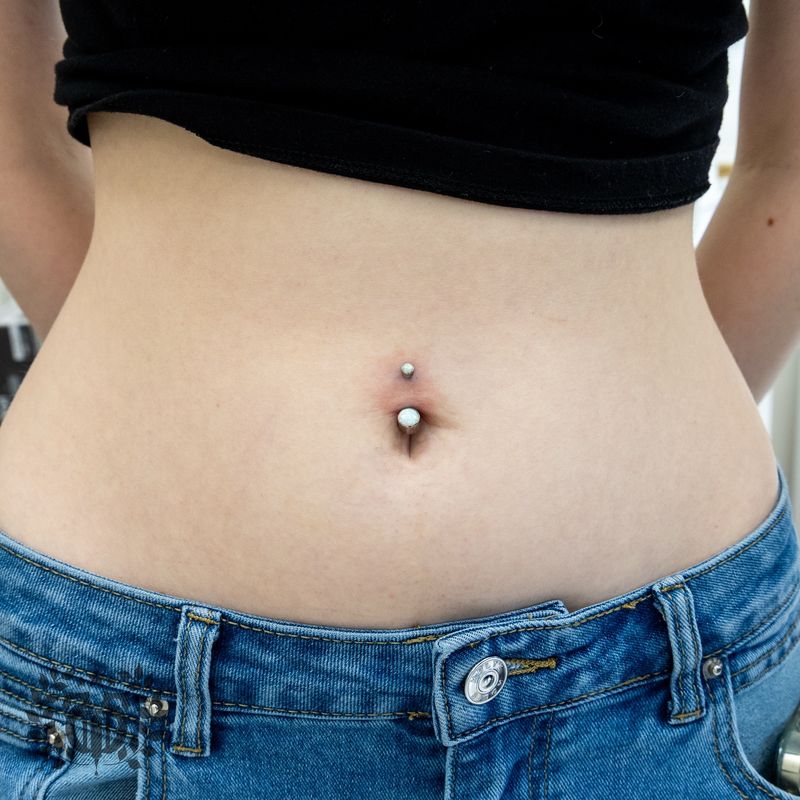
Titanium curved barbells and niobium bent bars, internally threaded always. Gold ends for healed upgrades. Never externally threaded jewelry for sensitive skin — the threads drag through the channel.
Oral (tongue, lip)
Implant-grade titanium only for any bar in contact with teeth or gums. Plastic ends sometimes used for comfort in specific applications, but titanium is the default.
Dermal anchors
The anchor plate under the skin MUST be titanium. The top can be titanium or gold. Mixed-material assemblies where the anchor is not titanium are not acceptable for sensitive clients.
Where to buy
Three trustworthy sources. Five to avoid.
Not every storefront that sells “hypoallergenic” jewelry actually stocks implant-grade material — the word is largely unregulated in retail. Here’s how the sourcing decision actually sorts.
professionally-apprenticed studios
Best choiceIndustry-listed studios have committed to verifying mill certifications for every piece they stock. The shortest path to documented ASTM F-136 titanium and 18k+ nickel-free gold. Ask to see the mill cert — any professional studio will show it.
Certified manufacturers direct
Trusted brandsNeoMetal, BVLA, Industrial Strength, Anatometal, Junipurr. Most sell only through studios, not direct-to-consumer — itself a quality signal. These names are what piercers reach for when they need material they can vouch for.
Vetted online retailers
Filter aggressivelyBodyArtForms and Body Candy stock implant-grade material alongside costume pieces. Filter aggressively: read the material field, only buy items that name the exact ASTM spec. If the listing says “surgical steel” or “hypoallergenic” without a spec, skip it.
Where NOT to buy
Mall kiosks & piercing guns
Claire’s, Piercing Pagoda, department store counters. Gun piercings use studs of unverified alloy content and can’t be autoclaved. A common source of first-time sensitization.
Fashion & costume jewelry
Plated, mixed-alloy, often nickel-heavy. Not designed for prolonged skin contact inside a wound.
Amazon & eBay without verified sellers
Counterfeit “titanium” is common; the listing photo doesn’t always match the shipped item. The material specification you can’t verify is the material specification that isn’t there.
Craft fairs & handmade sellers
Artisan skill is real, but implant-grade raw stock is rarely what independent makers work with. Great for earrings that clip on — not for piercings.
Travel markets abroad
Material regulations vary country to country. A piece sold as “gold” may be a low-karat alloy with significant nickel content.
Transitioning from reactive jewelry
Three scenarios. Three paths.
Depends on whether you’re currently reacting, wearing reactive material without symptoms, or simply unsure. Each path is different.
If you’re currently reacting
Remove the jewelry as soon as you can. Rinse the site with sterile saline 2–3 times daily and give the tissue 1–2 weeks to calm before reinserting anything. Don’t force a fresh piece through an inflamed channel — see a piercer for clean reinsertion in titanium or niobium at the same gauge. If the site has closed or scarred, don’t re-pierce through reactive tissue; wait, then start over with a safe material from day one.
If you’re wearing reactive material but haven’t reacted yet
Switch anyway. Sensitization builds with exposure time, and the piercings that have been healed longest are often the ones that start reacting first. If cost is a barrier, upgrade the highest-contact pieces first — nostrils, lobes that bear weight, anything in constant skin-and-sweat contact.
If you don’t know whether you’re sensitive
Default to titanium. It’s the safest starting assumption and costs little more than quality steel. Reactions to implant-grade titanium do exist but are rare enough that a dermatology referral is warranted if one occurs.
Long-term management
Four practices to build in.
Sensitive-skin piercings need a slightly different long-term practice. Monthly self-checks, annual piercer visits, a seasonal awareness of what affects your skin.
Monthly self-check
Look at each piercing under good light. Compare to 6 months ago — redness creeping up, a lip starting to purple, a lobe itching at the end of the day. Sensitization is gradual; catching it at week 3 is easier than at month 3.
Annual piercer check-in
Even fully healed piercings benefit from professional eyes once a year. Piercers catch thinning tissue, migration, and early reaction signs that are easy to dismiss in the mirror. Right time to discuss upgrades — moving from titanium to solid gold on healed sites, swapping basic ends for curated pieces.
Seasonal patterns
Heat and humidity increase sweat, which increases metal leaching from lower-grade jewelry still in rotation. Winter dryness can thin and irritate sensitive skin around piercings. Sunscreens, retinoids, and some acids interact with certain metals — apply skincare around piercings, not onto them.
Travel prep
Pack an implant-grade titanium retainer for each piercing you care about. If a piece is lost or damaged abroad, local replacements may not meet the standard you need — and an overnight closure of a piercing channel is a real risk.
Populations with extra reason to be careful
Kids
Higher prevalence of metal sensitivity in children, and first piercings set the trajectory. Start with titanium — never a piercing gun, never a mall kiosk. Early sensitization is much harder to walk back than to prevent.
Athletes
Sweat is aggressive on lower-grade metal. Implant-grade titanium isn’t optional at this exposure level. For contact sports, silicone retainers protect both the piercing and the athlete.
Medical & food professionals
Constant hand-washing, glove changes, chemical exposure — jewelry sees more stress than average. Retainers for any placement under PPE. For jewelry that stays visible, implant-grade only.
“Hypoallergenic” has no legal definition. Any manufacturer can print it on any package for any reason.
Upgrade the piercings that touch sweat and pillow first. Those are the ones where a reaction will find you.
Your piercer’s memory of your last ten visits is part of what you’re paying for.
FAQ
Questions Apollo hears most often about sensitive skin.
Seven questions covering sensitivity, reactions, safe materials, and the transition path.
How common is nickel sensitivity?
Between 10 and 17 percent of the general population carries a nickel sensitivity — a number that has been climbing over decades alongside cheap jewelry, low-grade piercing studs, and unregulated imports. Sensitivity is acquired, cumulative, and usually permanent once it shows up. Someone who wore the same cheap earrings for 15 years without incident can develop a reaction in year 16 — often from the exact pair that never bothered them before. A first piercing in reactive metal can sensitize a client for life. Treat every first piercing as a potential sensitive-skin case until the material proves otherwise.
What does a nickel reaction actually feel like?
A nickel reaction is not an “allergy” in the acute-reaction sense most people picture — no hives, no anaphylaxis. It’s Type IV delayed hypersensitivity: contact dermatitis mediated by T-cells, not antibodies. Nickel ions leach from the metal, bind to skin proteins, and 12 to 96 hours later the immune system fires an inflammatory cascade localized to the contact zone. Because the reaction is delayed and localized, clients routinely misread it. A rash two days after a new hoop gets blamed on aftercare, a new soap, or “just healing.” The jewelry is the last suspect anyone checks. Signs: persistent redness past day 14, itching that won’t resolve, clear discharge that won’t taper, a rash extending outward, a piercing that refuses to heal on clean protocol.
What’s the difference between “surgical steel” and ASTM F-138?
“Surgical steel” is a marketing phrase. It tells you nothing about the alloy, the nickel content, or the biocompatibility testing. ASTM F-138 is the actual standard — 316LVM stainless steel, surgical-grade, with documented specification. The difference is documentation: F-138 jewelry comes with a mill certificate tracing its metallurgy; “surgical steel” could be anything the manufacturer wants it to be. For sensitive-skin clients, the documentation is the whole point. If a seller can’t produce a mill certificate or an ASTM reference, the material is not body-jewelry grade — assume the worst.
Is implant-grade titanium really safe for everyone?
Nearly — ASTM F-136 implant-grade titanium (Ti-6Al-4V ELI) is hypoallergenic by measured property, used for surgical implants inside the human body, and produces reactions so rarely that a dermatology referral is warranted if one occurs. It’s the first-line industry recommendation for any sensitive-skin client and the default starting assumption for clients who don’t yet know whether they’re sensitive. Niobium is a comparable second gold standard — fully biocompatible, anodizable, slightly heavier. Solid 18k+ nickel-free gold is safe for healed piercings. Platinum is hypoallergenic for nearly everyone but rare in body jewelry. Plated “gold”, plated anything, sterling silver, and “surgical steel” without ASTM spec are all no-go for sensitive clients.
How do I transition from reactive jewelry to safe jewelry?
If you’re currently reacting: remove the jewelry, rinse with sterile saline 2–3x daily, give the tissue 1–2 weeks to calm before reinserting anything. Don’t force a fresh piece through an inflamed channel — see a piercer for clean reinsertion in titanium or niobium at the same gauge. If the site has closed or scarred, don’t re-pierce through reactive tissue — wait, then start over with safe material from day one. If you’re wearing reactive material but haven’t reacted yet, switch anyway — sensitization builds with exposure time. Upgrade highest-contact pieces first: nostrils, lobes that bear weight, anything in constant skin-and-sweat contact. If you don’t know whether you’re sensitive, default to titanium — it’s the safest starting assumption.
What should I look for when buying jewelry for sensitive skin?
Buy from professionally-apprenticed studios (they verify mill certifications for every piece stocked), certified manufacturers direct (NeoMetal, BVLA, Industrial Strength, Anatometal, Junipurr), or vetted online retailers with filter-heavy selection (BodyArtForms, Body Candy with aggressive filtering). On the product itself: specific ASTM number (F-136 for titanium, F-138 for steel), full material name spelled out, gauge and length clearly marked, recognizable manufacturer name, threaded or threadless indicated, sealed single-use packaging. Avoid: mall kiosks, fashion jewelry stores, Amazon/eBay without verified sellers, craft fairs for handmade pieces, travel markets abroad. Never trust “hypoallergenic” with no material spec, “surgical steel” without ASTM number, or “nickel-free” as an unsupported claim.
Can I get a metal allergy test before getting pierced?
Yes — a T.R.U.E. Test patch panel from a board-certified dermatologist is the definitive move if you’ve had two or more unexplained reactions to jewelry. The standard panel tests for nickel sulfate, cobalt chloride, chromium, and dozens of other common contact allergens. Applied to the back, worn 48 hours, read by a dermatologist at 48, 72, and 96 hours. Cost typically [pricing discussed at consultation] covered by most insurance plans with a dermatology referral. Results are permanent — the panel doesn’t need repeating. Bring the panel results on paper to a piercing consultation. A studio that stocks certified materials can match the result sheet directly to a known-safe jewelry category. A studio that can’t do that math is the wrong studio for a sensitive client.
Ready to find what actually works?
Bring your reactions. Bring your questions. Bring the jewelry that didn’t work.
Apollo consultations are built for sensitive-skin clients — implant-grade titanium named by ASTM spec, mill certificates on request, documented brand names you can look up, and a downsize plan that’s honest about when and why. Book the consult and see what safe material actually feels like.