Kids & Family Piercing
Upgrading Jewelry After Healing
A parent's guide to the first jewelry change after a child's piercing has healed — when (six-plus months for lobes, twel
Book a consultationWhy upgrade matters
The upgrade is the moment the channel graduates.
A fresh piercing is a wound with jewelry in it; a healed piercing is a skin-lined channel that hosts jewelry permanently. The upgrade acknowledges the transition. Timing matters because surface closure is the lagging indicator — the channel keeps maturing for months after the outside looks done. Metal matters because the channel lasts a lifetime. And the occasion matters because a six-month milestone in a child’s body is worth marking.
The short version. Wait the window. Six months for a lobe, twelve-plus for cartilage. First change at the studio, with sterile technique. Stay on the safe list — implant titanium, niobium, solid nickel-free gold. Stud-to-stud at the first upgrade; hoops and heirlooms at the second or third. Pricing is a consultation conversation, not a catalog one.
Five readiness decisions
The questions that decide the upgrade date.
Five filters that sort 'ready' from 'not yet' and 'good idea' from 'wait a month.' A parent who runs these five doesn’t need to guess.
Is the piercing actually healed?
Surface closure isn’t deep healing. A lobe looks healed at 6–8 weeks and remains channel-immature for months. Apollo checks for: consistent absence of crusting, no tenderness on rotation, symmetrical skin texture, no lymphatic weeping. Six months is the floor for a child’s lobe; cartilage is closer to twelve.
Who is doing the change?
The first jewelry change after initial healing should happen at the studio, by a piercer, with sterile technique. The kitchen-table change is where otherwise healed piercings re-injure. Once the first swap is done successfully and the parent has been shown, home changes become lower-risk.
What metal is going in?
The same universe that belongs in a fresh piercing stays safe forever: ASTM F-136 titanium, ASTM F-1295 titanium, commercially pure niobium, and solid nickel-free 14k/18k gold. A healed lobe adds tolerance for sterling silver, rose gold, and platinum for occasional wear. Costume metal remains a no.
What shape and size?
A healed lobe usually downsizes — the initial post was longer to accommodate swelling. A shorter post, a smaller flat-back disc, and a jewelry style that fits the grown-in channel. A helix or cartilage site measures differently than the initial spec; the piercer re-gauges before choosing the new piece.
Is there a meaningful occasion?
School picture day, a religious holiday, a family wedding, a grandparent’s birthday. The healed-piercing mark is when heirloom earrings and cultural pieces that didn’t belong in the initial piercing finally get their turn. The studio can schedule the upgrade to land the day of the occasion.
Twelve upgrade paths
The jewelry that belongs in a healed child’s piercing.
Twelve specific upgrade pieces, sorted from the everyday safe list at the top through the once-in-a-while wear options in the middle to the costume category that still doesn’t belong at the bottom.
Titanium flat-back labret stud
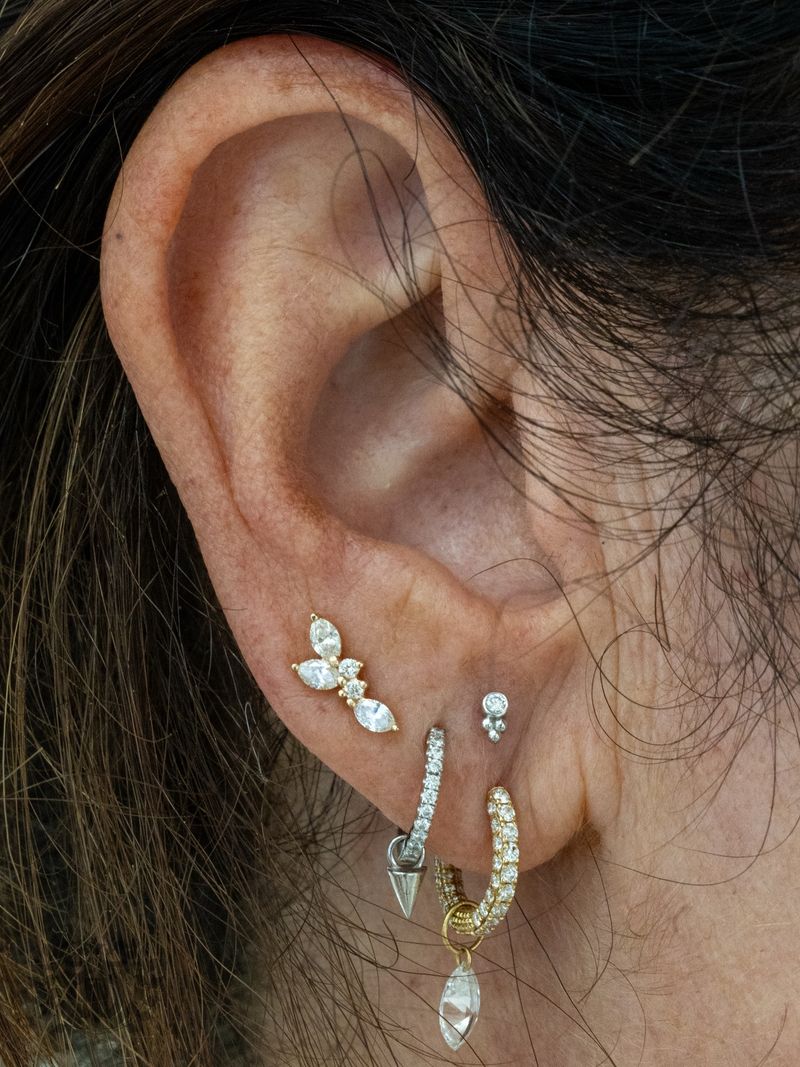
The Apollo default downsize. Internally threaded, ASTM F-136, with a shorter post than the initial piece to match the healed channel. A decorative gem, a solid disc, a subtle shape — the spec stays constant, the top swaps freely.
Solid 14k gold flat-back stud
Nickel-free alloy, BVLA or Anatometal manufacture, with a documented mill certificate. The tradition-compatible upgrade for families that wanted gold from day one and used titanium initially while healing. Chemistry is identical to an adult gold piece; shape suits a child’s ear.
Solid 18k gold flat-back stud
Higher gold content (75%), softer metal. Appropriate for a fully healed channel in a child who isn’t prone to catching jewelry on hair or sports equipment. A jewelry-counter upgrade that feels heirloom-grade.
Titanium seamless ring / captive bead ring
A healed lobe can transition to a small, light ring for everyday wear. ASTM F-136 titanium, internally threaded opening. Only after the channel has fully closed around the post — usually the six-month mark or later.
Solid gold hoop (light gauge)
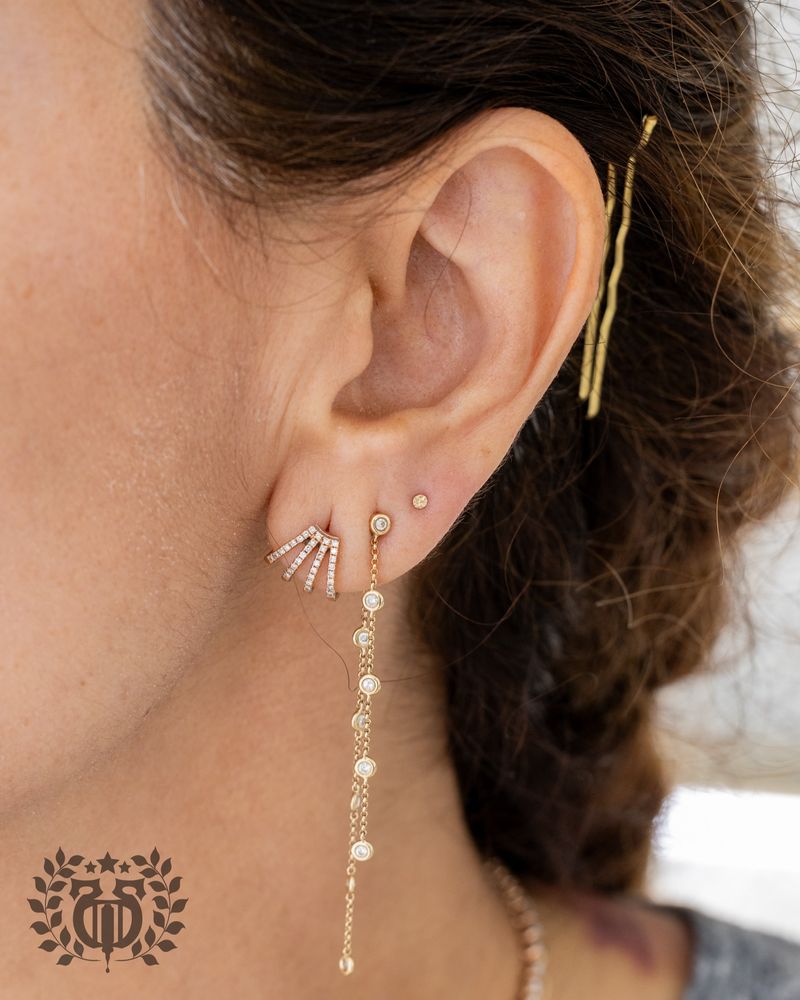
A small-gauge solid 14k/18k gold hoop, nickel-free alloy, for the classically finished lobe. Light enough not to pull on the healed channel; verified enough to stay safe long-term.
Cluster or decorative end (threadless)
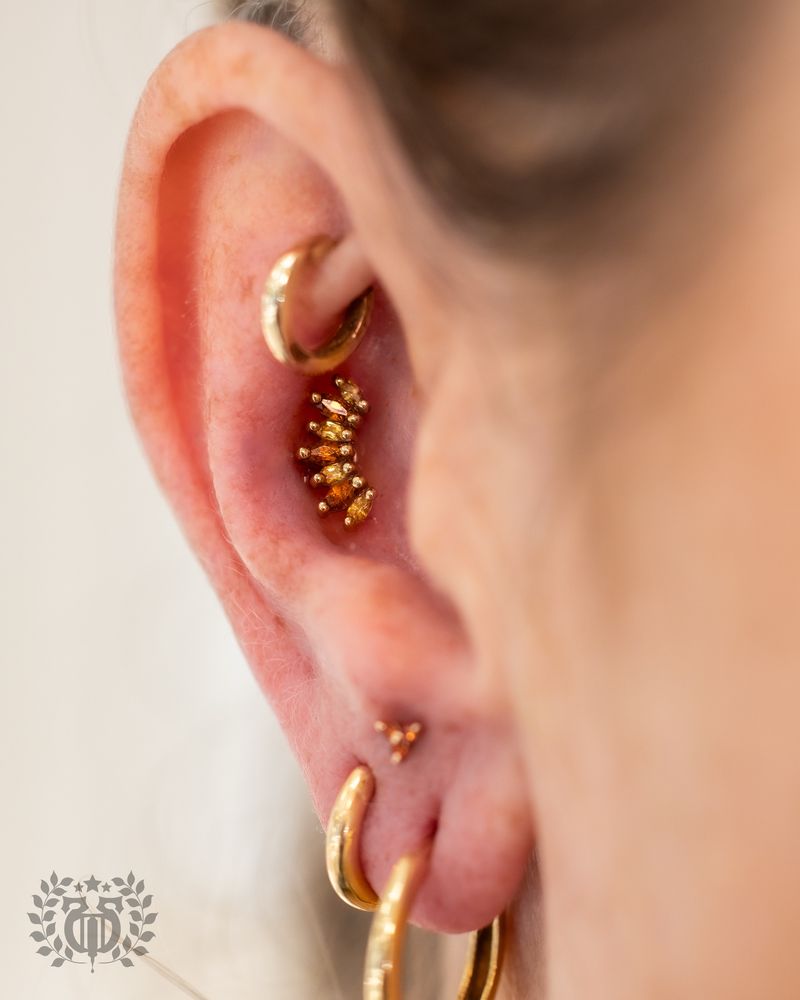
A gemstone cluster, a miniature flower, a crescent. Threadless tops swap onto a standard titanium post, so the post stays put while the decorative end changes for occasions. The post is the implant; the top is jewelry.
Anodized titanium color ends
Titanium and niobium anodize to a spectrum — gold, rose, blue, purple, rainbow. The color is a surface oxide, not a coating, and doesn’t flake into the channel. A safe way to give a healed child color without introducing plating.
NeoMetal / Anatometal threaded end
US reference brands with mill certificates on request. NeoMetal pioneered the threadless post; Anatometal carries a broad catalog of titanium and solid-gold tops. Either answers the spec question cleanly.
Industrial Strength / BVLA fine jewelry
Industrial Strength and BVLA (Body Vision Los Angeles) are the reference manufacturers for implant-grade fine jewelry in the US. BVLA specializes in solid-gold tops with documented alloys. Worth the wait once the channel can host them.
Sterling silver (healed only, occasional wear)
Safe in a fully healed channel for occasional wear — photo day, a family event. Not for daily overnight wear; silver still tarnishes in contact with sweat and skin oils. Save for the heirloom moment, not the everyday stud.
Rose gold (healed only, copper alloyed)
Rose gold gets its color from copper, not nickel. Fine for a healed child’s lobe unless there’s a copper sensitivity. Warmer tone than yellow gold, lovely with many skin tones; still verify the alloy balance with the jeweler.
Costume / plated / fashion jewelry
Not an upgrade. Plated pieces wear to base metal against skin; costume metals release unknown alloy components. A healed piercing survives a little costume wear, but a chronic reaction still looks like a chronic reaction. Save it for clip-ons, not post-through.
Six months is the floor for a child’s lobe upgrade. Cartilage is twelve-plus. Surface closure is not deep healing.
The first jewelry change belongs at the studio, by the piercer, with sterile technique. The kitchen table is where healed piercings re-injure.
Implant-grade titanium, commercially pure niobium, solid nickel-free 14k/18k gold. The safe list that worked in the first piercing still works forever.
Six upgrade windows
The moments when a change actually belongs.
The downsize window, the healed-lobe window, the cartilage window, the heirloom window, the occasion window, and the not-yet window. Six calendar moments; each has its own rules.
The downsize window (first change)
4–8 weeks after the initial piercing for most lobes; longer for cartilage. The post that accommodated swelling comes out; a shorter post goes in. Not a free-for-all jewelry swap — the piercing is still healing. The metal stays implant-grade; just the length changes.
The healed-lobe window (first style change)
Six months after the initial piercing for a child’s lobe. The first moment the channel tolerates style changes: a threadless top swap, a switch from stud to small hoop, a gold upgrade from titanium. The piercer confirms healing before the change happens at the studio.
The healed-cartilage window
12–18 months after the initial cartilage piercing. Cartilage heals slower than lobe tissue because it’s avascular — the blood supply reaches it indirectly. A helix or tragus that’s been asymptomatic for a year is a good candidate for its first real upgrade.
The heirloom window
Anytime after full healing, at the family’s pace. Grandma’s sterling earrings, a cultural gold piece, a piercing gift from a relative — all of these sit in a jewelry box until the channel is ready. Installing at the studio the first time protects the piece and the ear.
The occasion window
School picture day, a family wedding, a religious holiday. Schedule the upgrade to land the day of, so the child has fresh, well-installed jewelry for the photo. Sterling or rose gold for one day, titanium or solid gold for the everyday that follows.
The upgrade-is-not-ready window
A piercing that still crusts, still feels tender on rotation, still leaks clear lymph. Surface healing is not deep healing; a premature upgrade re-injures the channel and resets the clock. The answer is to wait another month, not to push through.
By placement
Upgrade shape differs by site.
A lobe upgrade is not a cartilage upgrade; a nostril upgrade is neither. Five placements, five distinct upgrade pathways.
First lobe upgrade — titanium to solid gold
At six months, an older-than-five child can move from implant titanium to solid nickel-free 14k/18k gold in the same flat-back labret shape. The channel is ready, the jewelry is documented, the chemistry is clean. The Apollo classic upgrade.
Lobe — flat-back to hoop
A healed lobe (six-plus months) can take a small, light solid-gold or titanium seamless ring. The ring moves more than a stud; the channel accommodates after full healing. A favorite upgrade for tweens and teens who want a finished-jewelry look.
Cartilage — initial post to shorter post
Helix and tragus piercings downsize 8–12 weeks in, still within the healing window. The shorter post prevents the jewelry from catching on hair, pillows, and earbuds. The piercer does this at the studio; it’s a technical change, not a style change.
Cartilage — first style upgrade at 12–18 months
The first real jewelry change for a cartilage piercing. Titanium cluster, solid gold end, anodized color, or a different internally threaded piece. Done at the studio; the channel is healed but still benefits from sterile technique on the swap.
Nostril — post to hoop (teen)
A teen nostril piercing that’s been asymptomatic for a year or more can move from a titanium L-bar or corkscrew post to a small solid-gold seamless ring. Nostril tissue is thin; the jewelry has to be light. The piercer sizes for the individual nose, not the internet.
Four readiness tiers
From ready-now to wait-longer.
Tier 1 is green-lit. Tier 2 is shape-change only. Tier 3 is close. Tier 4 is not yet. Honest self-sorting saves the channel from avoidable setbacks.
Tier 1 — Ready for upgrade
Piercing is six-plus months old for lobes, twelve-plus for cartilage. No crusting in the last month. No tenderness on rotation. No lymphatic weeping. The channel looks like skin, not like a wound. The pediatrician’s check-up didn’t flag it. Upgrade is green-lit.
Tier 2 — Ready for shape change, not metal change
Piercing is healed but the channel still feels new. A stud-to-stud swap is fine; a stud-to-hoop swap might be premature. The piercer feels out whether the channel has fully matured for the shape change or only for an in-place jewelry swap.
Tier 3 — Close but not yet
Occasional crusting, mild tenderness on rotation, a few weeks out from the minimum window. Push the upgrade a month or two. Surface healing is the lagging indicator; patience is free and prevents re-injury. A child who waits doesn’t regret it; a child who rushed sometimes does.
Tier 4 — Do not upgrade yet
Persistent tenderness, consistent crusting, any visible change in redness or discharge, a pediatric visit flagging the site. The piercing is not healed. Upgrade waits, possibly by months. A reactive channel gets a check-in with the piercer first, a plan second, and a future upgrade when the signals clear.
Pairings & swaps
Eight practical combinations for the upgrade year.
Post-and-top, downsize-and-upgrade, heirloom-and-healed, sibling-and-match. Real decisions that recur at the six-month and twelve-month marks.
Downsize + first photo-day upgrade
The downsize at 4–8 weeks is a medical change, not a style one. The photo-day upgrade at six months is the first real style moment. Two separate appointments, two separate conversations, same channel.
Solid gold upgrade + mill certificate
The upgrade to a solid-gold piece is the moment to ask the manufacturer for the alloy breakdown. BVLA, Anatometal, and NeoMetal can produce it. A file copy in the family records makes a future pediatric question easy.
Threadless post + swap-on tops
The implant is the post; the decorative end threads on (or snaps on) separately. A single titanium post can host a dozen swap-on tops across a childhood. The investment is in the spec; the variety is in the style.
Healed lobe + grandmother's earrings
Sterling or gold-plated heirlooms from a beloved relative can finally go in at the six-month healed mark, for occasional wear. Scheduled at the studio, inserted sterile, returned to the jewelry box between wearings. The meaning arrives intact; the channel stays protected.
Matched sibling upgrades
Two kids, one set of matching titanium starters, two sets of matching solid-gold upgrades later. Easier to track whose is whose, easier to sync downsize and upgrade appointments, visually cleaner for family photos.
Cartilage upgrade + hair tuck plan
A healed helix or tragus upgrade lands at twelve-plus months. The jewelry has to clear pillows, earbuds, hoodies, sports equipment. A downsized piece and a quick hair-tuck habit prevents the catching-on-clothes injury that rewinds healing.
Teen nostril hoop + cleanliness plan
The nostril upgrade from post to hoop comes with an aftercare reminder. The hoop spins more than a post, which is cosmetically lovely and hygienically different. A saline rinse after sports practice becomes part of the routine.
Occasion upgrade + everyday fallback
A sterling or rose-gold piece for one day, a titanium or solid-gold piece for the weeks that follow. The occasion piece goes back in the box; the everyday piece wears the year. The channel sees less metal variation this way, and the heirloom stays a treat.
Six questions for the piercer
The upgrade consultation is a two-way check.
Six questions any kids-piercing studio should answer easily. The answers tell the parent whether the studio is ready to handle the upgrade — and whether the channel is.
“How do you know a lobe is fully healed?”
Correct answer names specific indicators: consistent absence of crusting for several weeks, no tenderness on gentle rotation, symmetrical skin texture front to back, absence of clear lymphatic weeping. A calendar date (6+ months) is a floor, not a ceiling. A studio that waves this off and just upgrades is skipping the check.
“Who should do the first jewelry change?”
Apollo says: the studio, by the piercer, with sterile technique. Pulled off at home, a sterile piece becomes a contaminated one between the drawer and the ear; the channel re-opens; the upgrade becomes an incident. After the first professional swap, home changes are lower-risk — but not zero.
“What metals are safe for a healed child?”
Same safe list as for initial healing (ASTM F-136 titanium, commercially pure niobium, solid nickel-free 14k/18k gold) stays forever safe. A healed channel also tolerates sterling silver, rose gold, and platinum for occasional wear. Costume metal still doesn’t belong, even in a healed channel.
“Can we install a grandparent's heirloom now?”
At six-plus months of full healing, yes — at the studio, with sterile technique, by the piercer. The heirloom probably isn’t implant spec, and that’s fine for a healed channel. Occasional wear, back in the box between events, protects the heirloom and the ear both.
“Do you carry solid gold from documented manufacturers?”
Apollo stocks from implant-grade brands with mill certificates available on request. BVLA, Anatometal, NeoMetal, Industrial Strength. The answer to expect: a specific brand name plus a willingness to produce the alloy documentation. Anything vaguer is a flag.
“When is the best time to schedule an upgrade?”
When the channel is ready and the calendar has an occasion. Many families align the first upgrade with a birthday, a religious holiday, a school photo, or a ceremony day. The piercer can book the appointment for the right date; the parent can make it a small family moment.
Eight upgrade mistakes
Each one with a fix.
Common missteps at the six-month and twelve-month marks. None are fatal; all are avoidable.
Changing at the kitchen table because it seems easy.
Fix: A healed-looking channel re-injures fast under home conditions. Unsterile jewelry, unwashed hands, bad angle, panicked pull. Fix: first change at the studio, piercer supervising. After watching one professional swap, home changes become much lower-risk.
Upgrading at three or four months because it looks healed.
Fix: Surface closure isn’t channel maturity. A lobe that looks done at ten weeks can still leak lymph at the six-month mark. Fix: wait the full window. A child who waits doesn’t regret it; a child who rushed often does.
Installing the grandparent's plated heirloom in a not-yet-healed channel.
Fix: The emotional moment isn’t the chemical moment. Plated metal in a healing channel wears to base metal; the family gift becomes an irritant. Fix: install the heirloom at six months, not at six weeks. The meaning survives; the channel doesn’t get tested.
Buying the online lookalike instead of the implant-grade piece.
Fix: Marketplace 'titanium' jewelry often isn’t ASTM F-136; marketplace 'gold' is often plated. The child’s healed channel can handle more than a fresh one, but chronic contact with unknown alloys is how new allergies start. Fix: buy from implant-grade brands or the studio.
Skipping the downsize and leaving the initial long post in for months.
Fix: The long post is a swelling accommodation; it catches on hair, pillows, sports equipment. A tugged long post is how a healed-looking piercing gets set back. Fix: book the downsize at 4–8 weeks. It’s often the same visit as the parent’s scheduled check-in.
Trying a hoop too early on a lobe that just graduated.
Fix: A hoop moves more than a stud, stresses the channel differently, and wants a fully matured channel rather than a barely healed one. Fix: start with a stud-to-stud upgrade at six months. Introduce hoops at twelve-plus months, once the channel has settled into its post.
Letting a cartilage upgrade ride at six months like a lobe.
Fix: Cartilage heals slower — often twelve to eighteen months for full maturity. A cartilage upgrade at six months is a lobe-calendar mistake. Fix: separate timelines for separate tissue. The piercer checks cartilage on its own schedule.
Upgrading without writing down the new jewelry spec.
Fix: The pediatrician’s office later asks what metal is in the ear. 'Gold, I think?' is not a helpful answer. Fix: note the brand and spec (e.g., BVLA solid 14k yellow gold nickel-free) in the family file. Future questions resolve in a sentence.
First upgrade checklist
Eight steps from ready to installed.
Print, screenshot, stick to the fridge. Walk through it once the six-month mark arrives.
- ·Wait the window. Six months minimum for a child’s lobe; twelve-plus for cartilage. Surface closure is not deep healing.
- ·Check the channel with the piercer before buying anything. Two green-light indicators: no crusting for a month, no tenderness on gentle rotation.
- ·Choose the new metal with the safe list in mind. ASTM F-136 titanium, commercially pure niobium, solid nickel-free 14k/18k gold. Mill certificates available from BVLA, Anatometal, NeoMetal, Industrial Strength.
- ·Match shape to channel age. First upgrade is usually stud-to-stud with a shorter post. Save hoops for the second upgrade at twelve-plus months.
- ·Book the upgrade at the studio for the first swap. Watching a professional change teaches the home-change technique for later.
- ·Align the upgrade with an occasion when it fits. Birthdays, religious holidays, school pictures, a family wedding — the timing becomes meaningful.
- ·Write down what went in. Brand, alloy, threading, gauge. One sticky note in the family records saves a future pediatric call.
- ·Keep the old piece. The initial titanium post has no downstream use, but the threadless top collects the memory — a first-piercing artifact for the jewelry box.
Heirloom, color, teen autonomy
Three upgrade layers the chemistry still supports.
The meaningful, the personalized, the self-chosen. Three recurring upgrade stories, each paired with the spec that keeps them safe.
Heirloom and cultural jewelry installation
Grandparent earrings, cultural gold pieces, religious gifts that didn’t belong in the initial piercing finally get their turn at the six-month healed mark. Apollo installs them at the studio, sterile, with the family present for the moment. The meaning arrives with the occasion; the chemistry is handled professionally.
Color and personalization for tweens
Anodized titanium in gold, rose, blue, purple, or rainbow. A healed lobe can host a swap-on top that changes with the child’s taste without touching the post. The implant spec stays constant; the expression varies. The first step into self-chosen jewelry.
Teen autonomy and upgrade decisions
Once the piercing is healed and the teen is thirteen-plus, the jewelry decision shifts toward the teen. Apollo talks directly with the teen about spec, style, and timing; the parent is present for consent but the conversation centers on the person in the chair. The upgrade becomes a practice run for adult body-autonomy decisions.
Siblings, families, gifts
Four practical family upgrade notes.
Sibling sync, first-generation families, multi-generational ceremonies, and gift-to-install handoffs. Small coordination choices that make the upgrade better.
Siblings upgrading together
Two kids, one weekend, two matched upgrades. Easier to schedule, easier to remember whose is whose, visually cleaner for family photos. Matched solid-gold pieces in matching flat-back stud shapes are the most common sibling-upgrade look at Apollo.
First-generation piercing families
The parent who didn’t grow up with piercing traditions is often unsure when to upgrade. The piercer’s timeline takes the guesswork off the parent — the studio does the check, the studio recommends the moment, the family chooses the style.
Multi-generational piercing ceremonies
Families with long traditions — South Asian, Latin American, Middle Eastern, Jewish — often plan the gold-jewelry installation as part of a life-stage ceremony. The upgrade date aligns with the ceremony date. Apollo can slot the appointment to land where it belongs.
Gift-to-install handoff
A gift from a grandparent, aunt, or family friend often arrives months ahead of when it can be worn. The gift sits in a safe place; Apollo installs it at the right healed moment. Communicating the timeline to the gift-giver prevents hurt feelings about the delay.
Grandmother’s earrings belong in a healed channel, not a fresh one. The meaning arrives with the occasion; the chemistry is handled at the studio.
A threadless post is a platform. One titanium implant can host a dozen decorative tops across a childhood.
Write down the spec. The pediatrician’s file is easier to update with one sticky note than with a year-old memory.
FAQ
Nine questions parents ask at the six-month mark.
Short versions. Pillar sections above hold the full answers.
When can my child change their jewelry for the first time?
Six months at the earliest for a child's lobe, twelve to eighteen months for a cartilage piercing. These are floors, not ceilings. Surface closure happens earlier — a lobe often looks healed at 6–8 weeks — but the channel underneath continues maturing for months afterward. Apollo checks for specific indicators before green-lighting an upgrade: no crusting for several consecutive weeks, no tenderness on gentle rotation, no lymphatic weeping, symmetrical skin texture front to back. A downsize appointment (the first 'technical' change, where the initial longer post is swapped for a shorter one) happens earlier — 4–8 weeks in — but that's a medical adjustment by the piercer, not a free-for-all jewelry change. See the healing-timeline page for the full window by placement.
Can we change the jewelry at home the first time?
Apollo strongly recommends the first post-healing change happens at the studio, with the piercer, using sterile technique. A healed-looking channel re-injures quickly under home conditions: unsterile jewelry from a drawer, unwashed hands, a difficult angle, a panicked tug. Once a parent has watched one professional swap, subsequent home changes become lower-risk — the parent knows the angle, knows what the channel should feel like, knows when to stop and come back in. But the first change earns a studio visit; that's the appointment where the channel gets checked, the new jewelry gets verified, and the installation happens cleanly.
What metal should my child upgrade to?
The same safe universe that worked for the initial piercing continues to work forever: ASTM F-136 implant-grade titanium (Ti-6Al-4V ELI), ASTM F-1295 titanium, commercially pure niobium, and solid 14k or 18k gold with a verified nickel-free alloy. Reputable manufacturers — BVLA, Anatometal, NeoMetal, Industrial Strength — produce mill certificates on request. A fully healed channel also tolerates sterling silver, rose gold, and platinum for occasional wear, but not for daily overnight jewelry. Plated, gold-filled, vermeil, and unknown-alloy costume metals remain risky regardless of healing status; chronic contact is how new allergies start.
Our family wanted gold from day one — can we upgrade now?
Yes. This is the classic upgrade path for families who used implant titanium for the initial piercing to protect the healing channel and planned a gold piece for once the channel was ready. At six months for a lobe, with Apollo's confirmation of full healing, the titanium stud is swapped for a solid 14k or 18k gold piece with a verified nickel-free alloy. BVLA is the US reference manufacturer for fine jewelry with documented alloys. The family tradition and the healed-channel moment align, and the upgrade often becomes part of a ceremony or family occasion.
Can I install a grandparent's heirloom earrings now?
At six-plus months of full healing, usually yes — installed at the studio with sterile technique. A sterling silver heirloom, a gold-plated antique, a piece whose exact alloy is unknown: all of these are risky in a fresh channel and acceptable for occasional wear in a fully healed one. The pattern that works: wear the heirloom for a specific occasion (a family wedding, a religious holiday, a birthday), clean it before installation, return it to the jewelry box between wearings. Day-to-day wear stays with implant-grade titanium or verified solid gold; the heirloom becomes a treat.
Can my child move from a stud to a hoop at the first upgrade?
Not usually the first upgrade. A stud-to-stud change at six months, with a new metal or a smaller profile, is gentler on a newly matured channel than a stud-to-hoop change. Hoops move more, distribute pressure differently, and catch on hair and clothing in ways that a flat-back stud doesn't. A reasonable rhythm for a child's lobe: first upgrade at six months (stud-to-stud, possibly titanium to solid gold, definitely a shorter post), second upgrade at twelve months (add a hoop option if the channel has stayed asymptomatic), ongoing upgrades at the family's pace thereafter. Cartilage is slower — hoops on a cartilage piercing wait even longer.
What about upgrading a cartilage piercing?
Cartilage heals slower than lobe tissue because it's avascular — blood supply reaches it indirectly through surrounding tissue rather than via internal vessels. A helix, tragus, or conch piercing that's asymptomatic for twelve-to-eighteen months is a candidate for its first style upgrade. The intermediate milestone — the downsize at 8–12 weeks — is a shorter-post swap that most cartilage piercings need to prevent the jewelry from catching on hair, pillows, earbuds, and headphones. Full style upgrades (different jewelry shape, new decorative top, color change) wait for the twelve-plus month mark and happen at the studio, sterile.
Are threaded ends safe for a child?
Threadless ends are preferred for children's piercings, during healing and for most of the upgrade life afterward. Threadless tops snap onto a standard post and don't require the child (or parent) to correctly thread tiny parts without cross-threading. Internally threaded pieces are also appropriate and are the second-place default. Externally threaded pieces — where the threads are on the outside of the post — are not recommended for any piercing, child or adult; the threads drag through the channel on insertion and removal. Apollo uses internally threaded and threadless exclusively.
Do I need to book an appointment for every upgrade?
The first post-healing upgrade benefits from a studio appointment — Apollo checks the channel, verifies the new jewelry, installs it sterile. After that, once the parent has watched a professional swap and the child is comfortable with the process, subsequent changes for lobe piercings can often happen at home with clean technique. Cartilage piercings benefit from studio swaps longer, because the channels are deeper and less forgiving of a mistimed home change. Any upgrade where the jewelry is a meaningful piece, where the child is anxious, where the placement is complex, or where the channel has had any inflammation history is worth a studio visit — the expense is in the metal and in the consultation; the change itself is the quick part.
Ready when the channel is ready.
Book the upgrade consultation. We’ll check the channel and walk through the options.
Apollo confirms the healed state first, discusses spec and style second, and installs sterile third. Pricing is discussed at consultation based on the specific piece and placement — implant-grade titanium, solid nickel-free gold, documented manufacturers. Bring the grandparent heirloom if you have one; we’ll time its install to the occasion that suits it.