Tattoo Ideas
Eagle
The spread-wing chest eagle lives on a chest for a geometric reason: the wing sweep is drawn to fill a pec-to-pec span and reads as cramped anywhere else. Twelve directions, the feather-group structure that separates a real eagle from a bird-shaped mass, and the taka-is-a-hawk distinction that trips up Japanese-style requests.
Book a consultationThe browsing framework
Five forks, and the first one is whether this bird carries service.
Every eagle consult runs the same five forks, in order, because each one closes off roughly half of what is left. The first fork is the one that matters: a service piece has to be right in ways a decorative bird does not, and that changes the paperwork, the timeline and who draws it.
American patriotic / service, or something else?
We ask this first because the answer reshapes everything downstream. A military service eagle wants accuracy — branch crest, dates, unit motto. A general patriotic eagle leans Traditional American with stars, banner, shield. A nature-study bald eagle or golden eagle reads differently — closer to wildlife realism. Tell us which lane before we sketch.
Whole bird or head portrait?
Full-body eagles with wings spread need real estate — chest, full back, outer thigh. Head-and-shoulders portraits fit a forearm or calf and photograph better. Talons-with-prey compositions (eagle clutching snake, flag, anchor) need forearm-to-elbow minimum. Cropping a full eagle down to fit a small slot almost always fails.
Color or black-and-grey?
Black-and-grey eagles age exceptionally well — we've touched up pieces from 2011 that still read clean. Color eagles (brown body, white head, yellow beak, red-white-blue banner) hit harder day one but need a refresh around year 8–12, especially yellows. Sun exposure on a forearm accelerates that timeline.
Visible or private?
A chest eagle stays yours — a collared shirt covers it at work, a tank top shows it at the VFW. Forearm and hand eagles are public-facing and invite conversation, which matters if the piece is service-related. Back pieces live private unless you want them. Tell us which before we scale.
Five inches, or a feather instead?
An honest eagle portrait starts around 5 inches. A full-wing composition starts around 10. If budget or chair tolerance caps you under 5 inches, we'd rather steer you toward a feather, a talon-and-banner, or a single eagle head medallion than cram a full bird into a 4-inch slot.
Why the chest
The spread eagle is a chest tattoo because of geometry, not tradition.
People assume the chest eagle is a flash-era convention that stuck. It stuck because it is the only place on a body where the drawing actually fits. Four reasons, and they decide about half of the twelve directions below.
A bird with its wings out is a wide, symmetric drawing
Almost every other subject in tattooing is taller than it is wide, or is happy in profile. An eagle with its wings spread is the opposite: a broad horizontal design with a mirror line straight down the middle. There is exactly one plane on the human body that is broad, roughly flat and mirrored about a centre line, and you are wearing it under your shirt.
The wing sweep and the collarbones agree
Drop the wings onto a chest and the leading edges want to sit almost exactly along the clavicles, with the body over the sternum and the tail running down toward the solar plexus. Nothing has to be bent to make that work. That coincidence is why the composition survived a century of flash sheets more or less unchanged, and why shrinking it into a six-inch square is always a downgrade rather than an adaptation.
Symmetry loses on a cylinder
Put a front-facing symmetric bird on a bicep or a calf and it only reads correctly from one angle. Walk around the person and one wing foreshortens away while the other swells. Heraldic designs, the Great Seal composition included, were drawn flat for flat surfaces. On a limb the honest fix is to redraw the bird in profile, and we will offer that before we will crop it.
The back works, with one compromise
An upper back is the other wide symmetric plane, and it takes a spread eagle beautifully. The compromise is the spine, which runs straight down the mirror line and will crease and shadow across the body of the bird whenever you move. Good back compositions accept that and put the breast or a shield over it deliberately. Bad ones pretend the spine is not there.
Which is why the head-only portrait exists
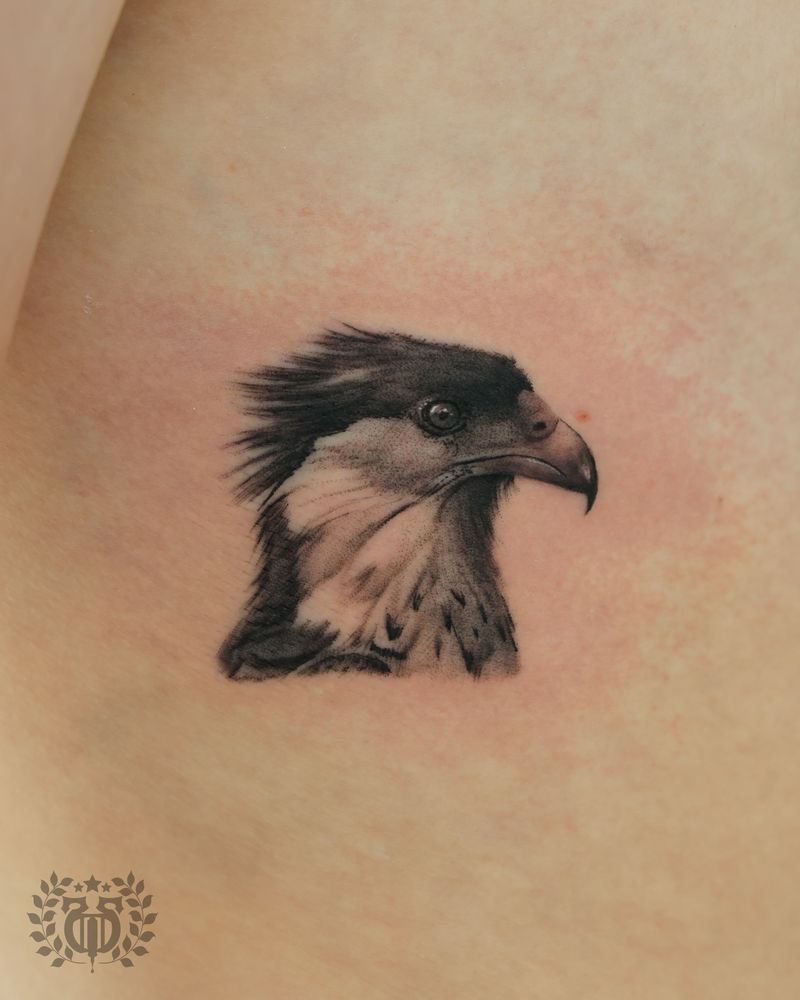
If you want an eagle on an arm, the answer that has always worked is to stop drawing the wings. A head-and-shoulders eagle is asymmetric, vertical, and perfectly happy on a forearm or calf at five or six inches, and it concentrates everything into the beak and the eye. Most people who arrive asking for a small spread eagle leave having booked this instead, and they are happier for it.
Flash · ready to ink
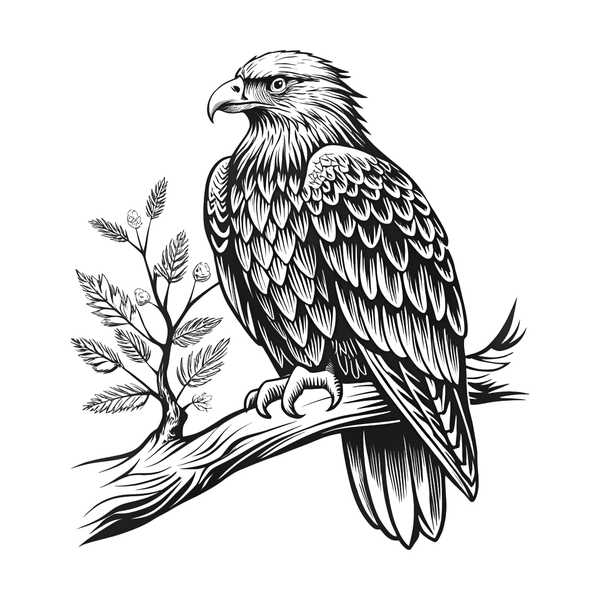
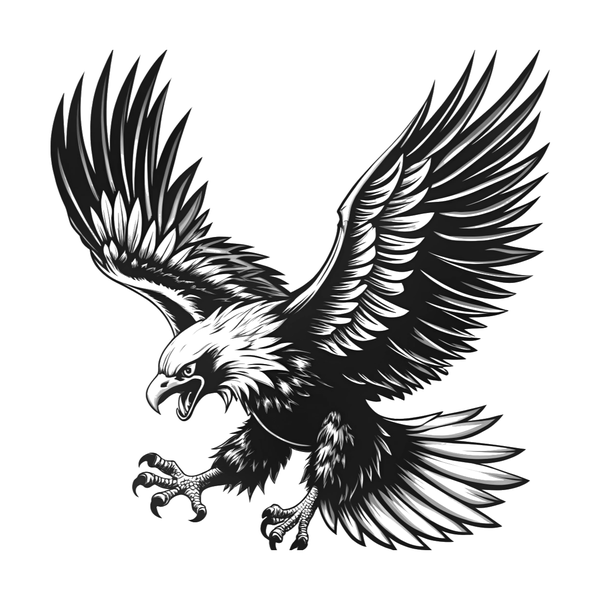
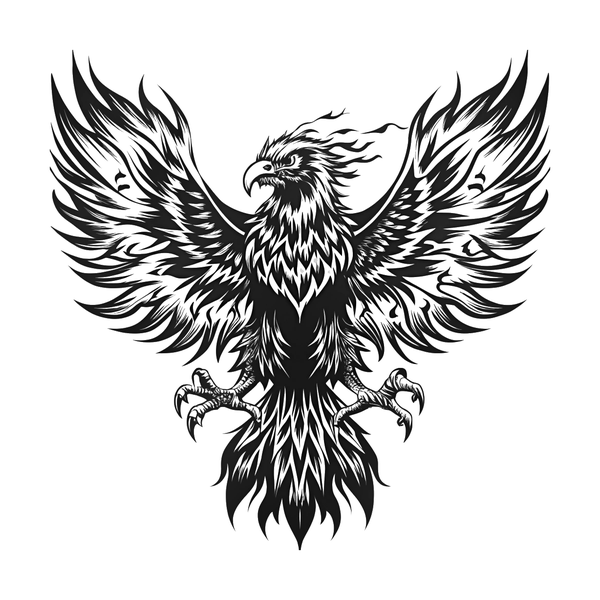
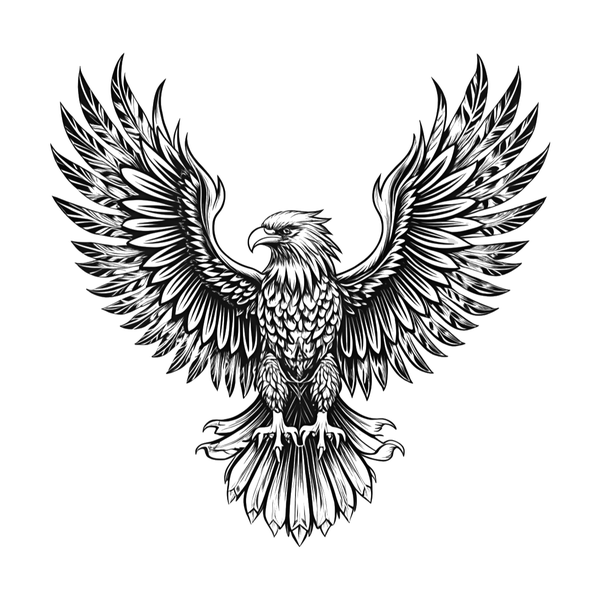
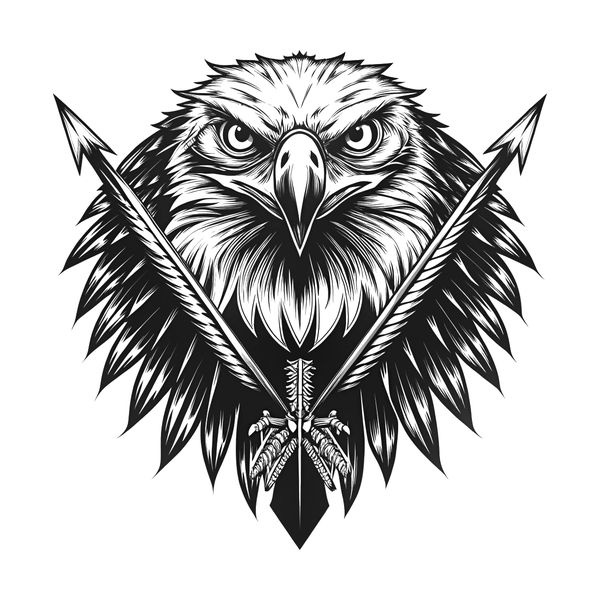
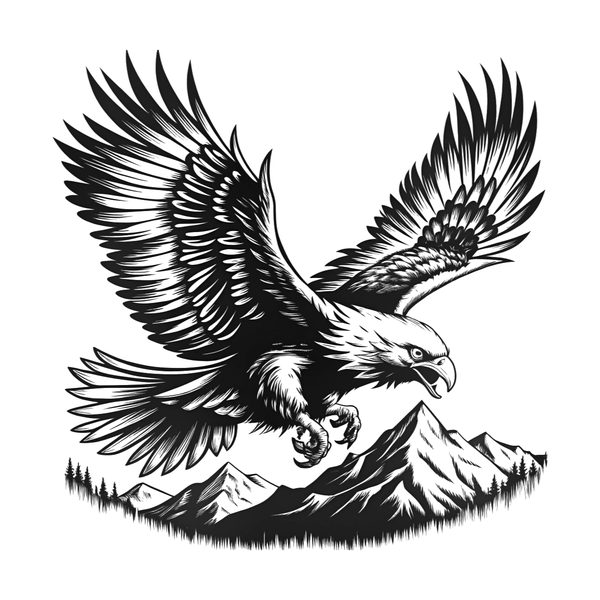
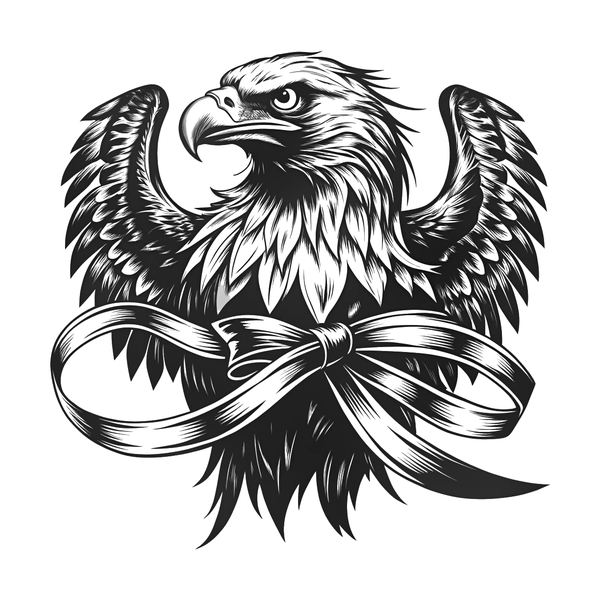
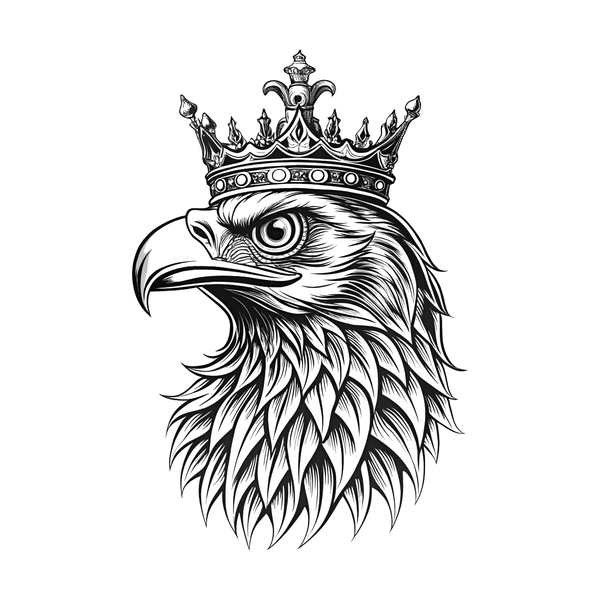
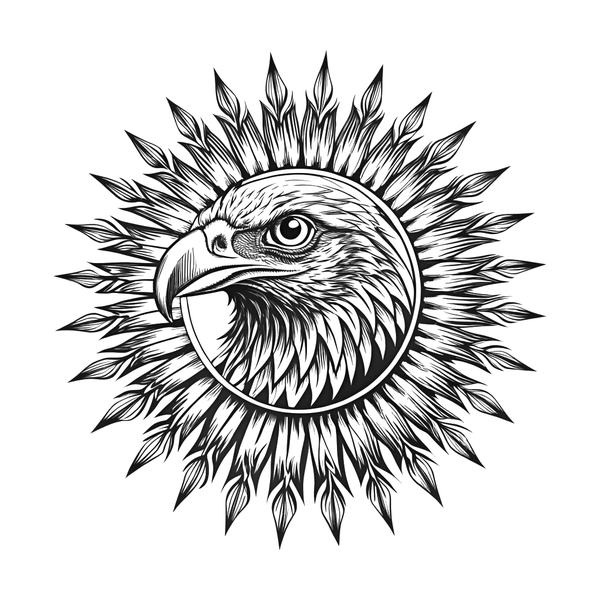
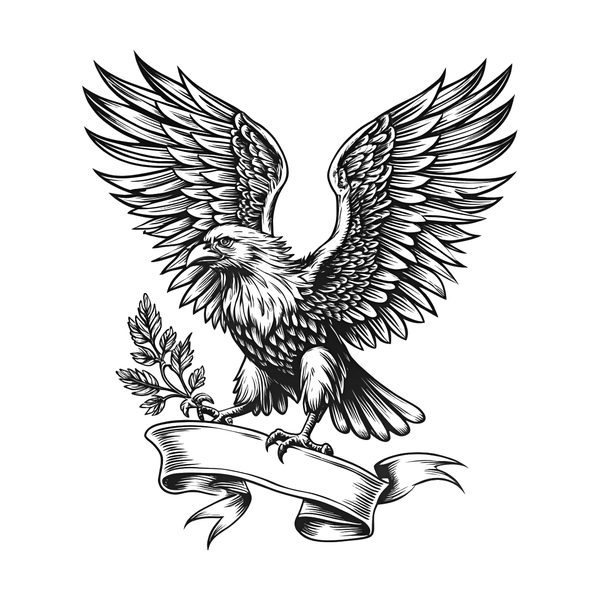
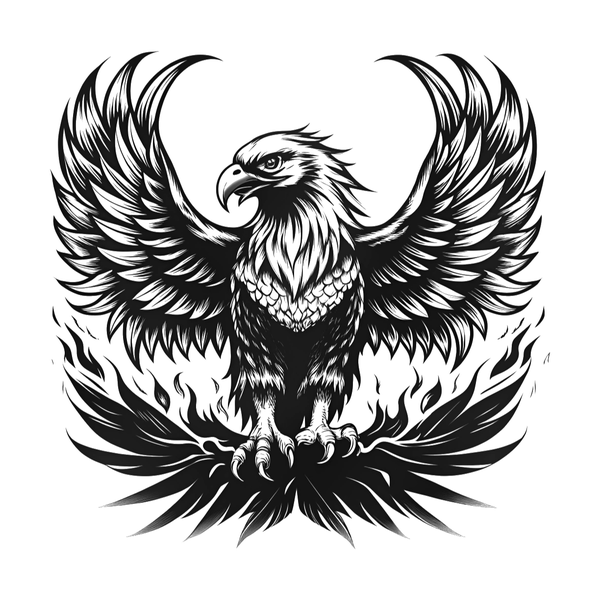
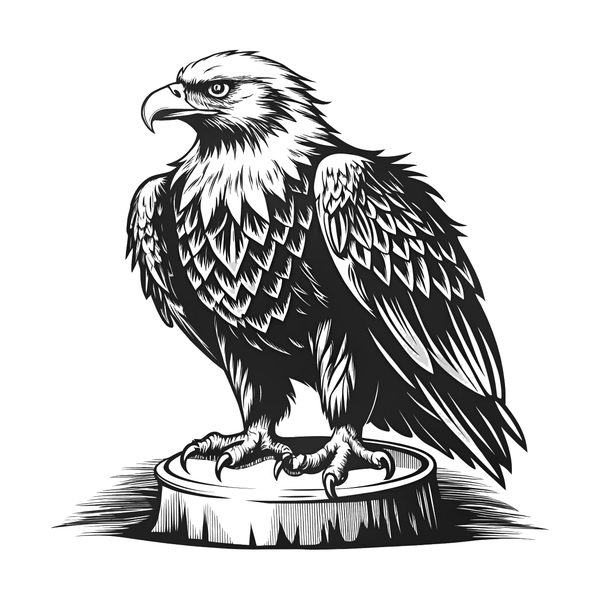
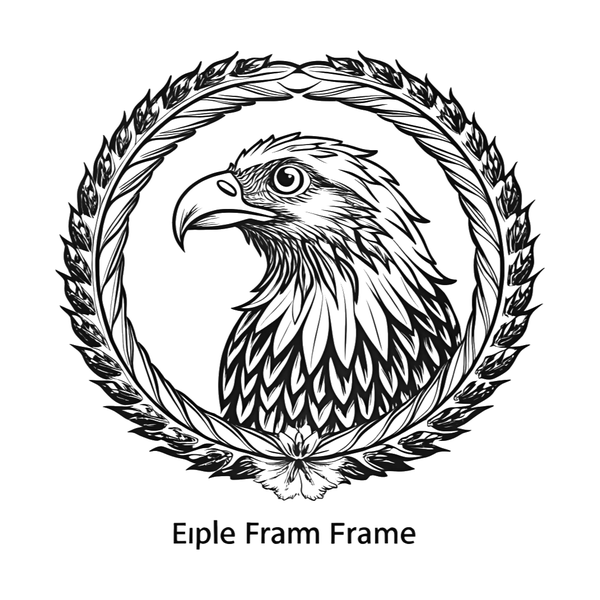
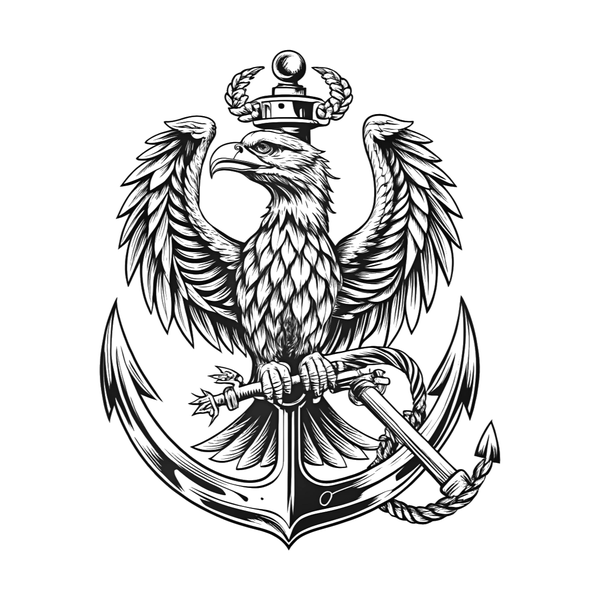
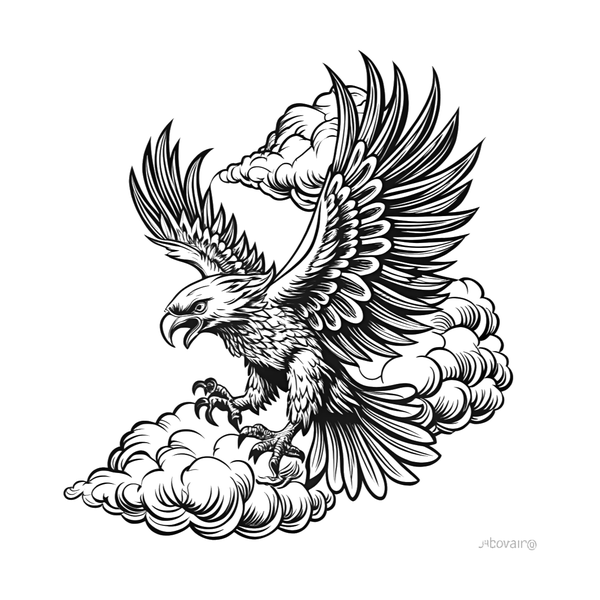
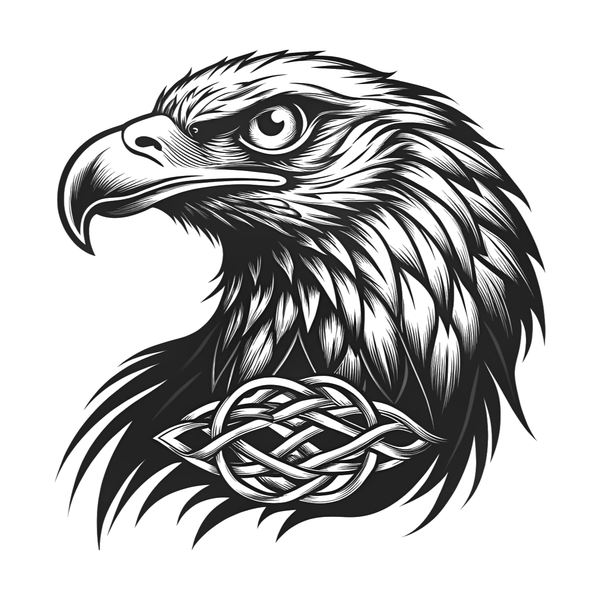
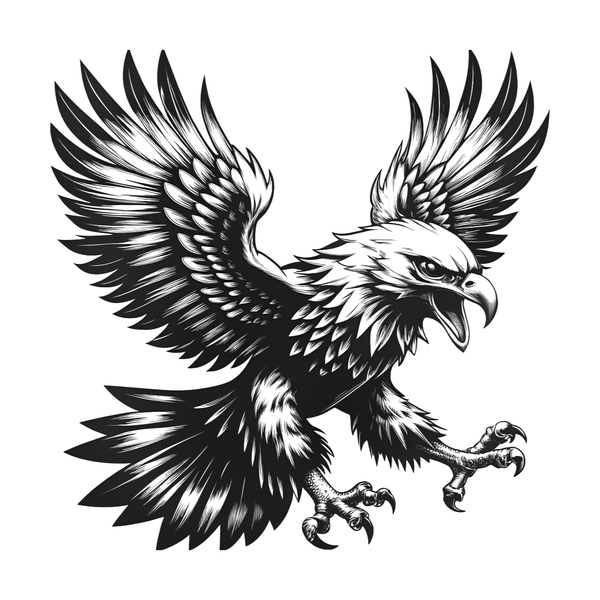
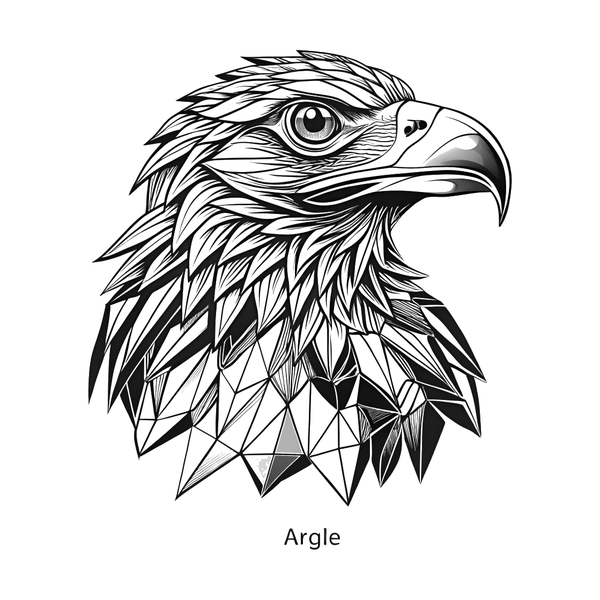
Eagle flash designs
18 hand-drawn designs from our flash collection — book any one as-is, or use it as the starting point for a custom piece. Sizing, placement and linework dialed in at your consultation.
Five placement styles
Five zones, from the quiet inner arm to the full wingspan.
The chest is the only wide symmetric plane you own, which is why the wings-out composition lives there and struggles everywhere else. Everything below is a variation on how much of that symmetry you are prepared to give up.
Inner arm — quiet read, easy skin
Inner forearm · inner bicep · lower ribs
Where the skin is softer and the read is quieter. Inner forearm and inner bicep take fine-line and small Traditional work beautifully. The tattoo is visible to the wearer constantly, less visible to the world. Good for memorial pieces and first eagles.
Outer bicep and chest plate — where the flash bird lived
Outer forearm · outer bicep · chest plate · outer calf
The classic eagle real estate. Outer bicep is where Sailor Jerry's eagles lived. Chest plate carries the wings-spread composition. These zones read from across the room and hold Traditional color for decades. If you want the tattoo to be seen, this is where it goes.
Thigh, shoulder cap, upper back — room to grow into a sleeve
Outer thigh · shoulder cap · upper back
High-real-estate zones that accept any style at any scale. Thigh handles Japanese sleeves-in-progress. Shoulder cap carries Neo-Traditional ornamental work. Upper back fits the Great Seal composition. The zones we recommend when a client wants flexibility for future work.
Ribs and sternum — the silhouette fits, the pain is real
Upper ribs · sternum · inner bicep · hip
Covered by most clothing. Ribs take the soaring silhouette and fine-line profile well, though the pain is real — budget two shorter sessions instead of one long one. Hip and sternum work for clients who want the piece for themselves rather than for display.
Full chest, full back, full sleeve — the wingspan placements
Full back · full chest · full sleeve
The big canvases. A full-back Great Seal or Japanese taka-and-wave composition. A chest-spread Sailor Jerry eagle. A full sleeve built around a descending bird. Multi-session commitments — four to six sits minimum — planned from the first consultation to the last touch-up.
A palm-sized realistic eagle is a waste of chair time. Go six inches or go Traditional.
We don't do Native American eagle-feather imagery for non-Native clients. Culturally protected.
One banner. One message. We'll talk you out of cramming three.
12 design directions
Twelve eagles, sorted by how much chest you are willing to give up.
Twelve compositional patterns cover almost every eagle we've booked in the last five years. They're not interchangeable — a Sailor Jerry chest-spread and a Roman aquila aren't scaled versions of the same tattoo.
Traditional American bald eagle with banner
Sailor Jerry's bird, done right
The bird that built American tattooing. We draw this the way Norman Collins drew it — head turned three-quarters, beak open mid-scream, wings spread in a near-perfect chevron, talons around a banner reading MOM, USN, or the client's call. Bold 9-round outliner, solid black shadows, a red tongue, yellow beak, blue-grey feather shading. A flash-sheet bird built to read across the bar at three a.m.
Sailor Jerry chest-spread eagle
Collar-to-collar, wings along the clavicles
A full chest piece where the eagle's wings follow the line of the collarbones and the body sits over the sternum. We run this 12–16 inches wide, minimum. Banner optional across the belly of the bird. The composition is two hundred years old — Ed Hardy tattooed it, Mike Malone tattooed it, their apprentices tattoo it now. It works because the anatomy lines up with yours. Don't ask us to shrink it.
Black-and-grey realistic portrait head
Feather-by-feather, eye front and center
The head-only portrait — beak, eye, crown feathers, cape of the shoulders. We pack this in washes using Fusion Gray Wash and 15-mag shaders, building up from 5-percent dilution to solid black. The eye is the whole tattoo. If we don't get the catchlight right, the piece is dead. Three to four sessions for anything larger than 6 inches. A palm-sized realistic eagle is a waste of chair time — go 6+ inches or go Traditional.
Eagle-and-flag composition
Bird in front, Old Glory behind
Eagle centered, wings forward, American flag rippling behind as backdrop. We do the eagle in full Traditional color and keep the flag in softer values so the bird reads first. Veterans bring us this one constantly. We'll adjust the banner to carry a unit, a KIA name, or a date — and we'll talk you out of cramming three banners into one piece. One banner, one message, done clean.
Great Seal eagle (arrows and olive branch)
E Pluribus Unum, heraldic front-facing
The wings-out, front-facing bird from the Great Seal — thirteen arrows in the left talon, olive branch with thirteen leaves and thirteen olives in the right, shield on the chest, scroll in the beak. Heraldry, not nature illustration, so we draw it flat and symmetrical. Beautiful as a back piece. Poor as a forearm tattoo because the symmetry fights the limb. If you want this on an arm, let us redraw it in profile.
Japanese taka with wave
Hawk tradition applied to the eagle
Strictly the Japanese tradition is taka (hawk) rather than washi (eagle) — but the compositional rules carry over. Bird descending through clouds, talons extended toward a koi or a snake, wind bars behind, wave curl below. We build these with sumi black outlines, full-saturation color packing, and large-scale background. Minimum two sessions for a half-sleeve. No fusion of American flag imagery into a Japanese composition.
Roman aquila (legionary standard)
SPQR, wings raised, perched on the signum
The eagle from the top of a Roman legion's standard — wings up, head in profile, clutching a lightning bolt or mounted on a pole with SPQR banners. We draw this tight and architectural, with heavy blackwork and minimal shading. Good fit for clients who want eagle imagery without American military associations. Ed Hardy's Roman work is our reference point. Keep the lettering clean — we use Trajan caps, not gothic.
The soaring silhouette
Wings fully extended, viewed from below
The bird seen from underneath against sky — wings at full span, head and tail in silhouette. We execute this in solid black blackwork with negative-space feather separations, or in soft black-and-grey with cloud work behind. A favorite for wrap-around placements because the wing tips curve across a rib cage or shoulder blade. Simple read, high impact. We draw these with a 2–4mm feather gap so it doesn't blob out as it heals.
Memorial military eagle with insignia
Branch emblem, unit, dates
For veterans and Gold Star families. We build these around the branch seal — Marine Corps EGA, Navy fouled anchor, 101st Airborne Screaming Eagle, Army heraldic eagle — with the bird as the compositional anchor. Banners carry name, rank, dates, or KIA. We sit with you for a full consultation before drawing. Consultation is $100 and on these we use the whole sitting rather than a quick sketch review, because verifying a crest and a set of dates takes as long as drawing the bird. Blue handles most of them personally.
Eagle clutching a snake (Mexican flag)
The Aztec foundation myth
The image from the Mexican flag — golden eagle perched on a prickly-pear cactus, rattlesnake in its beak. This is the Tenochtitlan founding vision, and we draw it with the specificity it deserves: golden eagle (not bald), serpent with visible rattle, nopal with red tunas. Traditional color or black-and-grey both work. We treat this as Mexican heritage work, not costume — we ask about the meaning before we draw.
Neo-Traditional ornamental eagle
Traditional bones, wider palette, decorative frame
Traditional structure — bold outline, saturated color — expanded with a wider palette, ornamental wing feathers, and framing elements like laurel, geometric halos, or art-nouveau linework. Color opens up to teals, dusty pinks, mustard yellow. The eagle still reads as an eagle, but it lives inside a decorative composition. Strong choice for clients who love Traditional but want something less flash-sheet.
Fine-line eagle profile
Single-needle, small scale, whisper-quiet
The smallest piece we'll recommend — an eagle head in profile, done with a 1RL single-needle liner in soft black. No fill, no color, no shading beyond the barest feather hatching. We run these 2–4 inches. Heals into a delicate illustrative line that reads like an etching. Not for everyone — fine-line fades faster than Traditional and needs a touch-up at year 5.
Six styles
Six styles, and what each one does with a wing.
The eagle has been tattooed in every major style American and Japanese tattooing have invented. The choice isn't which style you like most; it's which style matches how you'll wear the piece for the next thirty years.
Traditional American — the outline survives what the feathers cannot
The bird the art form was built on
Bold black outlines, a tight color set — red, yellow, green, blue, black — and shading that reads from across the room. We draw from the Sailor Jerry Collins, Ed Hardy, and Mike Malone canon. This style ages better than any other. Three decades in, a Traditional eagle still reads clean. We use a 9-round liner and 7-mag shader, Eternal or Fusion inks, and we don't overwork the shading.
Black-and-grey realism — every feather group rendered separately
Feather-by-feather photorealistic rendering
Greywash dilutions from 5-percent to solid black, built up in passes with 15-mag and 23-mag soft shaders. We work from high-resolution reference — usually our own photo library or a client-supplied image we've cleared. A realistic eagle piece is a commitment: three to four sessions minimum, and we won't do this style under 6 inches. The eye is non-negotiable — if the catchlight is wrong, the tattoo is dead.
Japanese — the tradition is taka, and that is a hawk
Taka tradition, full-body compositional rules
Sumi black outlines, saturated color packing, and large-scale background work — wind bars, clouds, water. The Japanese tradition is taka (hawk), which we apply to eagle work with care. This is not a style for small tattoos. A proper Japanese eagle lives inside a half-sleeve or larger composition with background. Built the traditional way, with room to grow.
Neo-Traditional — ornament in the wing coverts, Traditional in the bones
Traditional structure, wider palette, ornamental detail
Built on Traditional bones — bold outline, saturated color — but expanded with a broader palette (teals, dusty pinks, mustard) and decorative framing. Wing feathers get ornamental detail. We use a tighter liner (7-round) and smaller mags for the detail passes. Ages nearly as well as Traditional if the outlines are drawn correctly. A good middle path for clients who love Traditional but want something more current.
Fine line — profile only, and a touch-up on the calendar
Single-needle, illustrative, small-scale
1RL single-needle liner, soft black only, minimal fill. Reads like an etching or pen-and-ink drawing. Beautiful for small pieces but not built for longevity — fine-line fades faster than any other style and will need a touch-up at year 5. We tell every client that before the needle touches skin. Best in low-friction placements. Not for outer forearms or hands.
Service work — where the drawing waits on the paperwork
Traditional execution, consultation premium
Technically Traditional or black-and-grey — but this work sits apart because of what it carries. Branch insignia, unit patches, KIA dates, service numbers. Blue handles most personally. The $100 consultation gets used properly here: research, reference verification against source documents, and the time it takes to get a date right. We don't rush these. Veterans and Gold Star families get the full sit-down.
Anatomy of a good one
Feather groups are what separate an eagle from a bird-shaped shadow.
A wing is not a texture. It is three or four distinct sets of feathers of different lengths, laid over each other in a fixed order. Draw them as one field of strokes and you get something that could be any large bird. Draw the groups and it reads as an eagle from across a room.
Primaries, secondaries, coverts
The long primaries sit at the outer end of the wing and do the steering. The shorter secondaries run along the inner half. Over the base of both lies a tiled roof of small covert feathers, in rows, each row shorter than the one beneath it. Those rows are where an artist earns the piece: they give the wing its shoulder and its thickness. Skip them and the wing reads as a flat blade stuck onto a body.
The slotted wingtip
A soaring eagle spreads its outer primaries so that they separate into distinct fingers at the wingtip. That slotting is the single most recognisable thing about the silhouette, more than the head or the beak. It is also the first detail lost when a piece is drawn too small, because each slot is a narrow gap of clean skin between two dark shapes. Once those gaps close, an eagle silhouette becomes a crow silhouette. Ask what the gap measurement is at stencil.
The white head is bare skin, and that is the hard part
In black-and-grey there is no white ink worth relying on for a whole head. The white of a bald eagle is the skin you leave alone. So the head has to be built almost entirely from its edges and from the very lightest greys, sitting next to a body packed dark. Push a little too much value into it and the head goes pale grey, and a bald eagle with a grey head is a golden eagle with a lighting problem. This is the single most common reason a technically competent black-and-grey eagle stops reading as the bird the client wanted.
Bald and golden are different birds
A golden eagle is brown all over with pale gold hackles across the back of the head and neck, and it has feathering right down the leg to the toes. A bald eagle has bare yellow legs and, as an adult, the white head and tail. Juvenile bald eagles are mottled brown and do not get the clean white head for several years, which is why so many mislabelled photographs circulate. If your reference has a dark head, you are looking at either a golden or a young bald, and those are three different tattoos.
Tail, and how the bird is held in flight
A bald eagle soars on wings held flat, like a plank. That flatness is part of the read. Draw the wings raised into a shallow V and you have moved toward a vulture whether you meant to or not. The tail is short and wedge-shaped rather than long and forked. On a silhouette piece, where there is no colour and no feather detail to help you, wing angle and tail shape are carrying the entire identification.
Scale honesty
Wingtip slots are the first casualty of going small.
Not the other way around. If you want detail, commit to the scale that holds it.
Eight compositional pairings
The eight things people put in the talons, and what each one commits you to.
Several of these come with a count you can get wrong in public. Thirteen arrows, thirteen leaves, thirteen stripes. We check them at stencil, and so should whoever else you book.
Eagle + American flag
The definitive patriotic pairing — flag rippling behind the bird as backdrop, or folded into the talons beside shield and arrows. We render the flag at a slight angle with honest fold shadows so it reads as cloth rather than decal, and we keep stars and stripes count accurate. Chest, upper back, or half-sleeve carries it best.
Eagle + shield
The heraldic shield across the eagle's breast is the Great Seal's anchor element — thirteen vertical stripes beneath a chief of blue, no stars on the shield itself. We build it faithful to the 1782 design rather than inventing a custom crest, and we set the shield first so the wings and talons resolve around it cleanly.
Eagle + arrows & olive branch
Thirteen arrows bundled in the left talon, olive branch with thirteen leaves and thirteen olives in the right — readiness balanced against peace. We confirm the count on both before the stencil goes down. The pairing works in Traditional, black-and-grey, and engraving styles, and it signals the Great Seal without requiring a full shield.
Eagle + Latin motto banner
'E Pluribus Unum,' 'Semper Fidelis,' 'De Oppresso Liber,' unit mottos, or family names set on a curling banner beneath the bird. We keep text short, letter spacing generous, and the banner chunky — thin scripts and long phrases are the first element to blur as the tattoo ages. Spelling is confirmed in writing before we ink a letter.
Eagle + mountain or landscape
Bird in flight above a ridgeline, coastline, or a specific landscape tied to service or home. Adds scale and gives the eagle somewhere to be, rather than floating on blank skin. We map the horizon line first so the bird's altitude reads correctly, and we keep the landscape atmospheric rather than photo-literal so it doesn't compete with the feather work.
Eagle + snake
Two traditions converge here — the Mexican flag's eagle on a cactus devouring a serpent (from the Aztec founding of Tenochtitlan), and the classical opposition motif of eagle mid-strike against a coiled snake. We ask which tradition you're working from at consult, because the composition and cultural weight are different. Back or thigh, ten inches minimum.
Eagle + branch insignia
USMC Eagle-Globe-and-Anchor, Navy fouled anchor, 101st Airborne Screaming Eagle, or an Army unit crest. We render branch insignia to regulation proportions and confirm dates, unit designations, and motto spelling with you or your service records before drawing. Bicep, chest, or upper back — placement matches how you want to wear the service.
Eagle + sun and clouds
Atmospheric setting with the bird breaking through a cloud bank, sunburst rays behind the wings, or a high-altitude sky. Gives a realistic or Neo-Traditional eagle room to breathe and adds depth without competing elements. We use negative skin as the sky where possible so the composition holds up as the ink settles, and we keep the ray work symmetric to frame the bird.
Consultation
Six answers, and one of them should arrive on paper.
One of these is not a question so much as a request: if the bird carries service, bring the document. Everything else on this list can be worked out across the desk.
What branch and dates?
If this carries service weight, we need branch, rate or MOS, unit, and service dates on paper before we sketch. Wrong crest, wrong ribbon order, wrong dates — these are the errors we see most often on walk-in work done elsewhere, and the fixes are expensive cover-ups rather than clean adjustments.
Who is this eagle for?
Is this your service, your father's, a shipmate you lost, or general patriotism? The answer changes composition. A memorial eagle often carries dates, dog tags, or a folded flag underneath. A personal-service eagle usually stays cleaner — just insignia and banner. We ask so we draw the right piece.
Reference eagle — live bird or tattoo?
Clients bring photos of real bald eagles, museum paintings, or other tattoos. Each reference type pulls the piece in a different direction. Nature photos push toward realism and color. Historical paintings push toward illustrative. Other tattoos push toward whatever style the source artist works in. We need to know which you want.
Pose — perched, diving, or wings up?
Perched eagles read stately and fit vertical slots (outer calf, spine). Diving or attacking eagles carry motion and need horizontal real estate (chest, upper back). Wings-spread frontal eagles need symmetry and live best on chest or full back. We'll sketch the pose that matches your placement, not the other way around.
Any banner or lettering?
Banners carry mottos, dates, names, units. We ask because banner text at realistic scale demands the eagle be large enough that the text still reads at 5 and 10 years. If you want 'SEMPER FI 1968–1971' legible long-term, the eagle around it gets sized to that lettering, not the other way.
Color palette — full patriotic or muted?
Full patriotic is bald-eagle browns plus saturated red, white, blue, gold. Muted keeps the bird natural and drops the flag color or renders it desaturated. Muted ages better and reads less 'bumper sticker.' Full patriotic hits harder day one. Tell us which you want owning your arm in 20 years.
Wrong crest, wrong ribbon order, wrong dates — these are cover-up jobs, not touch-ups.
Blue handles eagle consultations personally. Honesty books more than ego.
A Traditional American eagle still reads clean at year thirty. That's why we built the style.
Common mistakes
Eight ways an eagle goes wrong. Two of them become cover-ups, not touch-ups.
Two of these eight cannot be repaired later. A wrong crest and a wrong date are cover-up work, and cover-up work on a service piece is a bad afternoon for everybody.
Palm-sized realistic eagle
Feather structure needs space. Under about 5 inches, individual feathers blur into a dark mass within 3–5 years as ink spreads. Clients show us 2-inch forearm eagles from elsewhere and ask why the bird now reads as a crow. Fix: size up to 6 inches minimum for realism, or switch to Traditional American where bold outlines survive small scale.
Banner text that nobody can read at year 5
Tiny script banners under eagles are the second-most-common fix request we get. Thin lettering under 4mm letter-height thickens and blurs. 'SEMPER FIDELIS' becomes an illegible smudge. Fix: either size the whole piece so banner text runs 6mm minimum letter-height, or drop the banner and let the eagle carry the meaning alone.
Mixing Japanese waves with Traditional American eagle
We see this on Pinterest — bald eagle over Hokusai-style waves. The two styles have opposite line logic. Japanese wants flat color and bold black outlines with specific wave conventions; Traditional American wants banner-and-shield staging. Fix: pick one style and commit. If you want water under the eagle, we'll draw it Traditional American with stylized foam.
Native American feather iconography without heritage
Eagle feathers carry specific meaning in many Indigenous nations and their ceremonial use is federally protected under the Bald and Golden Eagle Protection Act. Non-Native clients asking for 'dreamcatcher eagle' or 'war-bonnet eagle' are borrowing ceremonial objects. Fix: we decline these compositions. If the draw is the eagle itself, we redirect toward patriotic, heraldic, or naturalist eagles.
Service insignia wrong — wrong branch or date
We've seen Marine eagles done with Navy anchors, SEAL tridents with wrong number of prongs, wrong enlistment dates. Once it's healed it's a cover-up job, not a touch-up. Fix: bring DD-214 or a photo of your official insignia to consultation. We draw from source documents, not from Google Image search thumbnails.
Generic 'stock' eagle reference (not tattoo-native)
A Getty Images bald eagle photo does not translate to tattoo ink. Photo references have gradients and detail densities that ink physically cannot hold. The result looks sharp for 6 months then muddies. Fix: we redraw any photo reference into tattoo-ready linework and value structure before needle touches skin. Adds one consultation round. Worth it.
Booking first-available rather than specialist
Not every tattooer draws eagles well. Feather anatomy, beak curvature, talon structure — these are specialist skills. A great Neo-Traditional artist may not be your eagle artist. Fix: ask to see healed eagle work specifically, not a general portfolio. At our studio we'll tell you honestly which chair is the right fit, even if it means a longer wait.
Rushing a memorial service piece
Grief-timed memorial eagles often get revised within 2 years — names added, dates corrected, composition changed. Grief has no timeline, but urgency pushes clients to book before the design has settled. Fix: we ask memorial clients to sit with the sketch 60–90 days before the appointment. Nobody loses the spot. Grief evolves; skin is permanent.
The first-eagle guide
If this is your first, the answer is Traditional American at six inches on the bicep.
Eight decisions the first eagle should make on purpose.
Personalization
Three layers, and the middle one is the reason you brought documents.
Layer two is the reason we ask you to bring paper, and it is the layer that stops an eagle from being interchangeable with every other eagle on the beach. Layer three costs nothing and nobody but you will ever see it.
Which eagle, and which way it is facing
The foundation. American bald eagle versus golden eagle versus heraldic double-headed eagle — these are different birds with different silhouettes and different cultural weight. Pose sits here too: perched, diving, wings-spread frontal, or profile. Style choice — Traditional American, Neo-Traditional, realism, illustrative — locks the visual language. Every later decision builds on this base.
The crest, the hull number, the dates — from source documents
This is where the piece becomes yours and not a flash sheet. USS Enterprise figurehead eagle. 101st Airborne Screaming Eagle with your dates. Navy Chief anchor-and-eagle-and-trident with your rate. A father's Vietnam service dates in the banner. A specific historical eagle — the Great Seal, the NASA mission patch, the Eagle Scout medal. Bring source documents. We draw from them, not around them.
What is hidden in the covert feathers
Things only you and maybe one other person will ever notice. A shipmate's initials tucked into the feather shadows. A wedding date in the banner filigree. The number of tail feathers matching a unit size or family member count. A micro-cross for faith, a small star for a lost child. We make these deliberate and invisible-at-a-glance. The eagle reads public; the meaning stays private.
Matching eagles
Unit-mates. Father-and-son service. Memorial pieces for the fallen.
Most matching tattoos only have to survive a friendship. These often have to survive a deployment, a funeral, or forty years of a family. We sketch them as a set from the first appointment, even when they get inked years apart.
Unit-mates matching eagles
Two or more service members from the same unit booking coordinated eagles — we do this often. The eagles don't need to be identical. Same pose, same banner motto, matching placement works. Variations in size or insignia keep each piece personal. We book unit groups on consecutive days when possible.
Father/son or multi-generation service
Dad's Vietnam eagle and son's OIF eagle as companion pieces — we sketch them together even if inked years apart. Same style family, same general composition, different dates and insignia. The pieces talk to each other across a generation. Bring both sets of service documents to the first consultation.
Paired national and religious eagles
Some clients want a patriotic eagle paired with a religious or historical one — Saint John's eagle, Roman legion eagle, heraldic ecclesiastical eagle. Two birds, two meanings, matched scale and placement. We sketch as a pair from the start so the stylistic language stays unified across both pieces.
Memorial matching for lost service members
Surviving unit members getting matching eagles for a fallen brother or sister — we treat these with extra weight. Names, dates, and any unit-specific emblem get verified against official records before we sketch. We schedule these sessions close together so the group sees each other's pieces heal, which matters for grief more than most people expect.
FAQ
Ten answers, including the two about who gets to wear what.
Ten questions covering meaning, veteran status, cultural boundaries, style choice, sizing, placement, branch insignia, aging, and the Roman aquila.
What does an eagle tattoo mean?
It depends on the tradition you're drawing from. American patriotic and military eagles carry service, country, and Great Seal symbolism adopted in 1782. Sailor Jerry flash eagles read as mid-century Americana and liberty. Roman aquilae signal classical discipline. Japanese taka carries samurai clarity. We ask what the bird stands for in your life first, then match the style to the meaning.
Do I have to be a veteran to get an eagle tattoo?
Not at all. The eagle is a widely shared American symbol and appears across secular, classical, and Americana traditions. Veterans and active service members carry specific authority around branch insignia, unit crests, and service-dated memorials — and we honor that line. A civilian eagle with flag, shield, or olive branch is fully yours to wear.
Can I get a Native American-style eagle if I'm not Native?
We decline war bonnets, tribe-specific feather arrangements, and ceremonial motifs for clients outside those communities. Eagle feathers are federally protected under the Bald and Golden Eagle Protection Act, and in many nations they are earned in ceremony rather than chosen as decoration. If your connection is heritage-based, bring documentation.
Sailor Jerry Traditional vs. Japanese taka — how do I choose?
Traditional American is bold-line flash built for the chest, bicep, or forearm at eight to twelve inches — red, yellow, green, black, ages for decades. Japanese taka is a hawk-eagle set inside a weather system of waves, wind bars, and pine, and it wants a full back, sleeve, or thigh. Budget and canvas size usually decide it.
Color or black-and-grey?
Traditional American and Mexican-flag compositions need color to read correctly — the red-white-blue or green-white-red is load-bearing. Black-and-grey realism rewards feather detail and eye work and tends to age with softer edges. Roman aquilae and engraving-style pieces favor black-and-grey to evoke carved stone. Blue will walk you through what your design asks for at consult.
Eagle head only, or full bird?
A head-and-shoulders portrait concentrates the emotional weight into the eye and beak and fits a five-to-seven-inch forearm or calf placement. A full-body eagle tells a bigger story through pose and wingspan and wants ten inches minimum. If you want an eagle at four to six inches, head-only is almost always the stronger call.
Can I get my branch or unit insignia integrated?
Yes, and we want to see the documentation. Bring your unit crest, DD-214 or equivalent, dates, and any motto or deployment text to the consult. We render USMC Eagle-Globe-and-Anchor, Navy fouled anchors, 101st Airborne Screaming Eagle, and Army heraldic eagles to regulation proportions. Spelling and dates are confirmed in writing before the stencil.
How big should a chest piece be?
A full-spread Traditional chest eagle typically runs ten to fourteen inches across the sternum with wings reaching toward the shoulders. That's eight to twelve hours spread across two or three sittings. A Great Seal composition with shield, arrows, and olive branch needs the full twelve to fourteen to resolve every element cleanly. Anything under eight inches loses the heraldic weight the chest placement earns you.
Do eagle tattoos age well?
Traditional American eagles were engineered for decades of sun and skin movement — bold outlines, tight palette, generous negative space. Those age beautifully. Photorealistic eagles with fine feather gradients soften earlier and usually want a touch-up at the ten-to-fifteen-year mark, particularly on the white head and tail. Banner text is the first element to blur.
What about a Roman SPQR eagle — is it appropriate to wear?
SPQR stands for Senatus Populusque Romanus — 'The Senate and People of Rome' — and the aquila was a legionary standard from Marius's reforms in 107 BCE. It's a historical symbol, and most clients drawn to it are engaged with classical history, Stoic philosophy, or Mediterranean heritage. Be aware that some far-right groups have attempted to co-opt SPQR iconography, so think about context and consider pairing with laurel or architectural elements.
Chest, arm, or back?
If the bird carries service, bring the document. Everything else we can settle across the desk.
Apollo eagle consultations start with the five-decision browsing ladder and build the design outward. Blue takes eagle consultations personally and routes each booking to whichever chair matches the style — Traditional, realism, Japanese, or military memorial.