Kink & Ink
Fine Line Kink
A working-studio guide to fine-line kink tattoos — hairline single-needle and 3RL work that disappears in a work shirt a
Book a consultationThe browsing framework
Five decisions narrow fine-line kink to one piece.
Fine-line is a discretion-friendly approach — not a sanitized one. The decisions that follow shape the piece into the discreet, specific, paired, or planned- series piece you actually want.
How discreet does it need to be?
Fine-line is a discretion-friendly approach — hairline weight, micro-scale, often readable only at conversation distance. Some clients want the piece truly invisible at work; others want it noticed by people who would recognize the symbol. Pick the level of discretion before you pick the design.
Glyph, script, or ornamental?
Three families. Glyph: triskelion, infinity heart, single symbol. Script: Latin phrase, safeword cipher, chosen name. Ornamental: rope knot, single-line collar contour, lace edge. Each carries different rendering requirements. Glyphs need a symbol-fluent artist; script needs a dedicated letterer; ornamental needs a fine-line specialist who can hold pattern at hairline weight.
Read by whom — full-coded, semi-coded, or open?
There is a spectrum: full-coded (only you and your partner know what it is), semi-coded (your community recognizes it, strangers don't), and open (clearly readable to anyone who's seen the symbol before). All three are valid. Naming the spectrum out loud at consult prevents the most common disappointment — a piece that's more legible than the wearer wanted, or quieter than they hoped.
Visible to your work life?
Fine-line excels at hidden-by-clothing placement — sternum, inner bicep, ribs, upper thigh, behind the ear. A buttoned shirt and trousers cover the first four entirely. True deniability lives in placement choice; a coded symbol on the inside of the wrist still gets seen at the beach, in summer, in a tank top. Plan for the realistic week, not the office-only week.
Are you ready for touch-ups?
Fine-line ages differently than thicker styles. Hairline ink softens and lines spread slightly as the dermis remodels — the AAD describes this as normal pigment redistribution, not a defect of any individual piece. Plan for a settling touch-up window in the first year and an aesthetic refresh down the road. Your artist will quote a touch-up policy at consult; ask before booking. If a touch-up rotation is a dealbreaker, neo-traditional or blackwork carry similar meaning at heavier weight.
Fine-line is a discretion-friendly approach — it doesn't sanitize the symbol, it just lets the wearer choose who reads it.
A 1RL needle and a coded symbol are a natural pairing. Both are designed to read only to those who know what they're looking at.
Discretion isn't the same as small. Plan the scale to age, not to hide today.
12 design directions
The fine-line kink catalog clients actually browse.
Twelve directions across glyphs, script, ornamental work, and paired pieces. Each variant uses fine-line's properties — discretion, hairline weight, conversation- distance legibility — for a different purpose. Not every kink symbol belongs in fine-line; the directions below are the ones that do.
The triskelion glyph
BDSM three-armed emblem, hairline weight
The most-requested fine-line kink glyph. The Quagmyr-1995 emblem rendered at single-needle scale, around 25–30mm so the three arms separate cleanly and don't compress to a generic spiral. Reads as abstract pattern to anyone outside the community. Inner bicep edge, sternum, behind ear, inner forearm. See the bdsm-triskelion-tattoos guide for symbol history before booking.
The infinity heart
Continuous-line polyamory glyph
An infinity symbol whose loop forms a small heart at one side, drawn as one unbroken line. Reads as romantic-aesthetic to outsiders; reads as a specific community symbol to those who know it. Common at sub-1-inch on inner wrist, behind ear, or sternum-edge. Fast in the chair; deceptively hard to draw cleanly at this scale — ask to see the artist's continuous-line work.
Single-line collar contour
A collar rendered as one hairline arc
A continuous fine line that traces a collar silhouette around the base of the neck — a partial arc, no clasp, ends just past the clavicles. Sits above a standard work-collar at the neckline, invisible under most shirts, surfaces under an unbuttoned top. This is a collar; we don't sanitize what it is. The wearer chooses whether the room reads it that way.
Continuous-line knot
Bowline, square, or shibari loop in one line
A specific knot — bowline, square, lark's head, simple shibari loop — drawn as one unbroken line at 25–40mm. The cleanest fine-line solution to rope iconography. A literal shaded rope rendering is a heavier-style job; this is the hairline version that actually holds. Inner forearm, sternum, ribs.
Latin phrase or motto
The cipher of language
A short Latin, French, or Italian phrase that carries meaning between two people without announcing it. Servire, dominari, or a private noun-pair. A dedicated letterer is worth the wait — the gap between a generalist's script and a specialist letterer's is visible at conversation distance. Minimum 6–8mm cap height for long-term legibility. Inner forearm, sternum, nape, ribs.
Safeword cipher
Roman numerals, monogram, abbreviation
A safeword rendered as a cipher rather than spelled out — a Roman numeral run, a two-letter monogram, an abbreviation only the wearer's partner can decode. Private signaling in the language of fine-line lettering. Inner wrist, ankle, sternum-edge. Sub-1-inch most common; the artist will tell you the smallest the design can go and still hold over time.
Lace-edge band
Negative-space ornamental thread
A fine-line band — wrist, ankle, thigh — rendered as lace pattern with negative-space cutouts. Reads as decorative ornament. Holds at fine-line weight on stable, low-flex skin: inner wrist and upper thigh hold; outer wrist softens faster. Ask the artist where the band can sit so the pattern still reads at year ten.
Lock and key minis
Paired pieces around 20mm each
A small lock on one partner, a matching key on the other. Fine-line single-needle. Pairs work best at matching scale (~20mm each) on matching placements — both inner wrists, both inner biceps, both ankles. Reads as old-fashioned aesthetic to strangers; reads as paired commitment to the wearers and their people.
Date in Roman numerals
Anniversary, contract, ceremony
A date in Roman numerals — formal partnership ceremony, contract anniversary, a private milestone. Sits as decoration to outsiders. Often paired with a small symbol element. Inner forearm, sternum, ribs. Single session, often under an hour. Cap height set by the letterer to stay legible long-term.
Lambda or pink-triangle micro mark
Queer + kink crossover symbol
A queer-community symbol rendered in fine-line at 10–15mm — lambda, pink triangle, a discreet pairing of the two. Sits at the intersection of queer identity and kink identity for many wearers. See the queer-and-kink-iconography-crossover guide for symbol history. Inner wrist, ankle, behind ear.
Constellation collar
Connected dots forming a ring
Connected dots forming a ring around the throat or around the wrist — reads as celestial fine-line first, collar-coded second. Best at a 4–6cm span; tighter than that and the dots merge into a smudge as the work softens. Constellation fine-line is a documented fine-line tradition (Vogue, Allure trend coverage) so the dual-read is real.
Hidden coded glyph
Legible only to insiders
A symbol legible only to community insiders — a kink iconography piece a stranger would read as ornament. Discretion lives in placement as much as in symbol abstraction. Inner thigh, inner bicep edge, sternum. See hidden-and-coded-kink-symbols for a longer treatment of the discretion conversation.
Six approaches inside fine-line
Pick the approach before you pick the artist.
Fine-line is a family of related approaches — single- needle, 3RL, dotwork-accented, continuous-line — that age, photograph, and read differently. Single-needle is one tool, not a universal upgrade. Pick the approach that matches the piece you actually want.
Pure single-needle (1RL)
The truest hairline weight
A single needle delivers the thinnest line modern tattooing makes — the LA Chicano 1RL tradition that Mark Mahoney carried out of Good Time Charlie's and that Dr. Woo refined for the post-2010 fine-line wave. Maximum delicacy, fastest softening. The choice for sub-1-inch glyphs and lettering at the smallest readable scale.
Fine line (3RL)
The standard fine-line workhorse
Slightly thicker than single-needle. Holds saturation more reliably across rib, sternum, and near-joint placements. Apollo's existing fine-line guidance and most working fine-line specialists recommend 3RL over 1RL on Fitzpatrick IV–VI skin and on substrates that flex. Ages closer to standard linework. The default for 1-to-4-inch fine-line work where the absolute smallest scale isn't required.
Lettering specialist (fine-line script)
Distinct craft from general fine-line
A dedicated letterer working at fine-line weight produces script that sits like carved marble. The gap between a generalist's fine-line script and a specialist's is visible at conversation distance. For Latin phrases, safeword ciphers, and chosen-name script — book the specialist. Wait the extra weeks. Travel if needed.
Hairline + dotwork accents
1RL line plus 3RL stipple for texture
Fine-line work paired with dotwork shading or stipple texture. Dots tend to absorb skin movement as a dot grid rather than as a thinning line, so the accent ages with less visible softening than a pure hairline rendering. Strong choice for triskelion variants where a small amount of internal weight makes the symbol read at smaller scale.
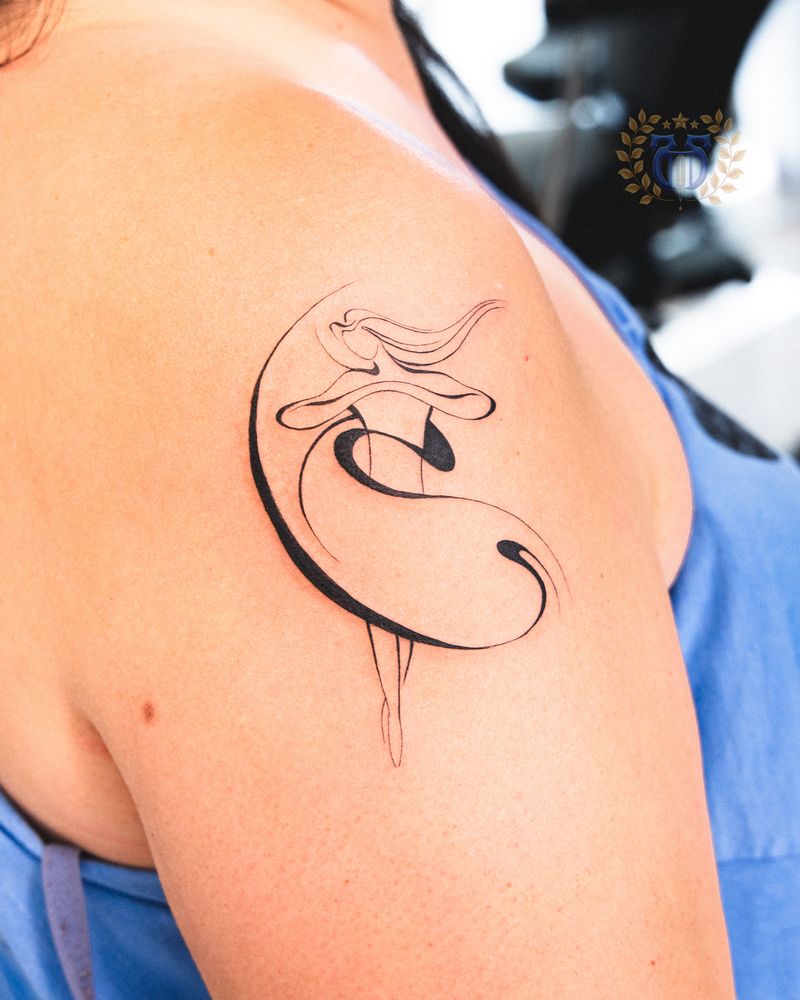
Continuous single-line illustration
One unbroken line forms the image
Picasso-derived single-line drawing — a knot, a heart, an abstracted figure rendered as one unbroken line. A documented fine-line sub-tradition. Strong choice for knots, infinity-hearts, and abstracted figural work. Reads as art-historical first, kink-coded second — useful when the dual-read matters.
Geometric / sacred-geometry adjacent
Hairline precision with mathematical structure
Hairline work organized around mathematical structure — concentric arcs, intersecting rings, lattice patterns. Works for triskelion variants, intersecting-ring polycule symbols, and ornamental polyamory glyphs. The geometry has to be precise; a sloppy triskelion reads as Celtic spiral, not as the BDSM emblem.
Five placement intents
Placement is half the discretion.
Fine-line ink combined with the right placement gives the wearer almost full control over who sees the piece and when. Five placement intents — including the zones the AAD cautions against for any thin-line work.
Work-shirt invisible
Sternum · inner bicep · upper back · ribcage
A buttoned shirt and trousers cover all four. The piece is yours all week unless you choose to show it. The most-requested placement family for fine-line kink work. Honest pain note: ribs and sternum read higher on the pain scale than the inner bicep; experienced shops disclose this rather than discovering it mid-session.
Surface at conversation distance
Inner wrist · behind ear · neckline · inner forearm
Visible at close range, especially when the wearer chooses to show. Inner wrist surfaces under a watch strap; behind ear surfaces with hair pulled back. Honest aging note: inner wrist sees friction from cuffs, watches, and bracelets — expect more wear there than on a stable forearm. The placements that let the wearer control the moment of recognition.
Hidden by sock or sleeve
Ankle · inner ankle · inner upper bicep · upper thigh
Standard work footwear and shirts cover all four. Surfaces only at the beach, in bed, or when the wearer rolls a sleeve. The placements for clients whose work environment requires absolute coverage. Inner thigh is friction-prone — slightly larger scale recommended there.
Intimate-only
Inner thigh · underboob · sternum-low · upper hip
Visible only in intimate contexts. The piece is for the wearer and the wearer's chosen people. Often paired with private-meaning fine-line work — a Latin phrase, a date, a small figure. The most-private placement family.
Avoid for fine-line
Fingers · palms · side of hand · soles · lips
The American Academy of Dermatology specifically cautions placements where skin sheds and rubs constantly — fingers, palms, side of hand, soles. Fine-line work in those zones can fade visibly within months and frequently needs touch-ups; many artists won't warranty finger work. If discretion is the goal, sternum, inner bicep, ribs, and behind-ear are equally hideable and far more durable.
Scale honesty
Four tiers. Below the artist's stated minimum, fine-line detail can't hold.
Fine-line wants a specific scale range. Outside that range, the approach is doing work it isn't built for. Match scale to subject — and let the artist veto smaller-than-readable.
Eight compositional pairings
A glyph plus one element does most of the work.
A single glyph reads one way; a glyph plus one anchor element reads as a specific dedication. Eight pairings that land the piece in different categories.
Glyph + date
Triskelion plus anniversary in Roman numerals. Most-requested fine-line kink pairing at Apollo. Inner bicep or sternum. Sub-2-inch combined.
Phrase + small symbol
Latin phrase with a single small element — a tiny knot, a star, a flower. The phrase carries the meaning; the symbol anchors the pairing. Inner forearm, sternum, ribs.
Knot + script
A continuous-line knot with a partner's name, ceremony date, or a single chosen word in fine-line script. Inner forearm or ribs. The knot reads as the object; the script reads as the dedication.
Constellation + word
A constellation with a single word — its mythological name, a private noun, a chosen phrase. Turns aesthetic celestial work into specific personal symbol. Sternum, ribs, inner forearm.
Lock + key (paired bodies)
Around 20mm lock on one partner's inner wrist; matching key on the other partner's inner wrist. Fine-line single-needle. The classical paired piece in its quietest rendering. Same artist, same day.
Triskelion + small flower
A triskelion paired with a small botanical sprig — softens the kink-coded read for clients who want the symbol present and the room not always reading it. Sternum or inner forearm.
Lambda + triangle
A queer-and-kink crossover micro-mark — a lambda nested with a small triangle. Sits at the intersection of the two communities. See queer-and-kink-iconography-crossover for context.
Mirrored constellations
Two halves of a binary-star pair across two bodies — Castor on one, Pollux on the other. Sternum or inner forearm. The piece exists fully only when the two wearers are together.
Consultation
Six questions to bring with you.
Bring answers to these and the consult moves directly from intake to design. The artist's job is execution; yours is clarity.
Discretion ceiling — and discretion floor?
How invisible does the piece need to be in your daily life? Work environment, family environment, public-facing role — list anywhere the piece would need to be covered. The artist plans placement around the strictest requirement. And ask the inverse: at the beach, in summer, when you've thought about it less — is that visibility still inside what you want?
Have you tattooed this specific symbol before?
Ask to see healed examples. The geometry of a triskelion or a community-coded glyph is precise; an artist who hasn't drawn it before can land on a sloppy version that reads as Celtic spiral or generic ornament instead of the symbol you came in for. If the answer is no, the artist's job is to refer you to a colleague who has — that's professional, not a deflection.
What needle configuration are you planning, and why?
Single-needle (1RL) and 3RL are not interchangeable. The artist should be able to explain why they're choosing one or the other for your skin, your placement, and the design — not because single-needle is inherently more skilled but because it's the right tool for that specific piece. The right answer here is technical, not marketing.
Touch-up policy?
Industry-standard practice includes a settling-window touch-up in the first year and a longer-horizon refresh down the road. Shop policies vary — some cover the settling touch-up, some don't. Ask the policy at consult; knowing the process up front beats finding out years later.
Healed examples on skin like mine?
Fine-line content online is overwhelmingly photographed on light skin where black hairline ink reads with maximum contrast. On medium and deeper skin tones, line weight, ink choice, and contrast all need calibration. Ask your artist to show healed work on skin similar to yours; a competent fine-line artist will discuss this at consult, not surprise you with it after.
Read by whom?
Yourself only, your partner, your community, or anyone who happens to know the symbol? Each answer changes placement and sometimes design. The artist can build for your audience once they know who it is.
We will tattoo the symbol once you understand its history. We will not tattoo it because Pinterest told you it looks cool.
The triskelion you get in our chair is a triskelion — not a Celtic spiral, not a triple-curl flourish. The geometry has to be right.
Fine-line softens. Plan a touch-up rotation and the piece reads as itself for the long arc.
Common mistakes
Eight patterns that make fine-line kink work disappoint.
Most disappointing fine-line pieces fall into one of these patterns. Catching it in consult prevents it in the chair.
Going too small for the placement
A 10mm triskelion on the outer forearm reads as a smudge as the piece settles. Below the artist's stated minimum, fine-line detail can't hold the way it looks on paper. Fix: scale up by 30–50% from your reference image, and let the artist veto smaller-than-readable.
Choosing fingers, palms, or sides of the hand
The AAD specifically cautions these placements because the skin sheds and rubs constantly. Fine-line on fingers, palms, and side-of-hand can fade visibly within months and frequently needs touch-ups. Fix: if discretion is the goal, sternum, inner bicep, ribs, or behind-ear are equally hideable and far more durable.
Forcing a high-density symbol into hairline weight
Some kink iconography wants visual mass — a leather-era pride flag, a Tom of Finland figure, photorealistic shaded rope. Stripped to single-weight line, those symbols lose every visual quality the original had. Fix: match the approach to the iconography. For density-driven symbols, see blackwork-leather-era-tattoos. Fine-line carries glyphs and contours, not silhouettes.
Booking by aesthetic, not by subject fluency
Many fine-line specialists are deep in botanicals and script; many kink-affirming artists work in blackwork or neo-traditional. The artist whose Instagram you love may not have tattooed your symbol. Fix: ask before booking — have you tattooed this specific symbol? Can I see healed examples? See kink-affirming-consultation for the longer treatment.
Skipping the symbol-history conversation
A coded symbol with cultural origins (the BDSM triskelion, leather-pride lineage, queer crossover marks) deserves more than 'I saw it on Pinterest.' Fix: read the relevant Apollo guide first, then bring questions about origin community, conventions, and reading to consult.
Booking a paired piece without the partner
A paired fine-line piece is a relationship decision and a tattoo decision at once. Designing one body's piece without the partner present produces matched pieces only by luck. Fix: have the partner in consultation, in the text thread, or in the chair. If matching matters, both bodies show up the same day with the same artist.
The fresh-photo trap
Choosing an artist based on Instagram fresh-wrap shots. Fine-line ink looks pristine at day one and tells its real story at year one or later — every dermatologic source on choosing a tattoo artist (including the AAD) recommends asking for healed work. Fix: ask explicitly for 1-year-plus healed examples. The portfolio that matters is the one that hasn't been touched up for the photo.
Pairing fine-line with watercolor or heavy color
Stylistic opposites; the tattoo reads confused. Fine-line is structurally a black-ink approach. Adding color usually shifts the piece toward illustrative or neo-traditional. Fix: keep fine-line pieces monochrome black, or place them adjacent to other fine-line work rather than fused into a multi-style composition.
The first-piece guide
If this is your first fine-line kink piece, start with a single glyph.
Sub-1.5-inch glyph at 3RL weight on sternum or inner bicep edge. Single session, easy to live with, easy to add to.
Personalization
Three layers turn a stock glyph into yours alone.
Fine-line glyphs are by nature widely shared symbols. The layers that make a piece yours sit beneath the symbol — most clients only think about the first.
Choose your spot on the spectrum
Full-coded (only you and your partner know what it is). Semi-coded (your community recognizes it, strangers don't). Open (clearly readable to anyone who's seen the symbol before). Each end of the spectrum changes placement and design. Most fine-line kink work sits at semi-coded — that's what the style is built for.
Add the personal element
A specific orientation of the glyph, a paired tiny element, a date or initial nested into the design, a placement that has private significance. This layer is where the piece begins separating from the catalog — and where future Apollo pieces in your collection will have somewhere to land.
Hold the private meaning
What the symbol marks for you and your partner or community. Nobody else needs to know. The cipher, the date, the relationship structure that brought the piece into existence. The private layer is what keeps the piece from ever feeling generic — even if the design itself reads as standard fine-line work.
Matching pieces
Paired fine-line kink work needs paired planning.
Lock-and-key minis, mirrored constellations, and paired ciphers are the most-requested matching fine-line kink pieces. Same artist, same day, same stencil.
The lock-and-key default
The most-common paired fine-line kink piece at Apollo. ~20mm lock on one partner's inner wrist; matching key on the other's. Often paired with a physical key worn on a necklace so the tattoo has a worn counterpart. Single session, both bodies, same artist, same day.
Match the bones, vary the detail
Same base glyph, small variation per partner — different orientation, a single different element, different placement. So each piece still belongs to the wearer while the relationship between the pieces is the design.
Plan for the piece to outlive the structure
Formal partnership structures evolve. Design the piece so it works as a single-element piece if the relationship ever needs to. Not pessimism — the same respect any permanent decision earns. A fine-line glyph that means something on its own is the most durable matching piece.
Same artist, same day
The only way matching fine-line tattoos actually match is identical execution. Two artists, two sessions, two months apart will produce two related pieces, not a matched pair. If matching matters, schedule both bodies for the same appointment block.
FAQ
Nine questions every fine-line kink consult surfaces.
Discretion, longevity, dual-reading, scale floors, work-life placement, skin-tone calibration, paired pieces, cover-up limits, and the wait-or-go-now question.
How discreet is fine-line kink work in everyday life?
At appropriate scale and placement, very. A 25mm triskelion behind your ear or on your inner bicep edge reads as a small contour mark to a stranger and as a triskelion to someone in the community — that's what the approach is built for. Sternum, inner bicep, ribs, and upper back stay covered by a buttoned shirt and trousers. Inner wrist sits under most watch straps. Behind ear stays covered when hair is down. Discretion lives in placement choice; a coded symbol on the inside of the wrist still gets seen at the beach, in summer, in a tank top — plan for the realistic week, not the office-only week.
How does fine-line ink age compared to thicker styles?
Fine-line softens and lightens faster than thicker traditional tattoos because there's less ink in the skin and finer lines disperse more visibly as the dermis remodels — the AAD describes this as normal pigment redistribution, not a defect. Tightly-spaced detail — script, micro-charms, the loop of a tiny padlock — softens first. Plan for the design to read at a slightly lower resolution years later than at week one. Industry artists including Dr. Woo and JonBoy have described the look as 'softening beautifully' rather than holding pristine. We won't quote a specific year-by-year timeline because individual variation — skin type, sun exposure, placement, aftercare — is too large; your artist will give you a planning anchor at consult.
Can a triskelion or BDSM symbol be misread as something else?
Yes, often deliberately. The BDSM triskelion at fine-line scale reads as abstract pattern to most viewers — most people see a small spiral, not a community symbol. The infinity heart reads as romantic-aesthetic. A continuous-line knot reads as nautical or decorative. The dual-reading is part of why fine-line carries kink imagery cleanly: the symbol is recognized only by people who already know it. Clients who want explicit recognition usually choose neo-traditional or traditional rendering at larger scale; clients who want coded recognition stay in fine-line.
What's the smallest fine-line kink tattoo that still reads cleanly?
Your artist will tell you the minimum for your specific design — the needle still has a minimum line width, and ink spreads slightly in healed skin. As a working anchor, a triskelion below about 25mm tends to lose the separation between its three arms; a tiny lock-and-key under about 15mm reads as abstract shape rather than a locked symbol. Below the artist's stated minimum, fine-line detail can't hold the way it looks on paper. If you want truly tiny, design as a single-element glyph rather than a multi-element composition.
Where should a fine-line kink tattoo go for maximum work-life discretion?
Sternum, inner bicep, ribs, and upper back are entirely covered by a standard work shirt and trousers. Inner wrist is covered by most watch straps. Ankle is covered by a sock and dress shoe. Behind ear is covered when hair is down. For clients in client-facing roles, sternum and inner bicep are the most-requested placements because they stay covered through a full week without the wearer thinking about it. Avoid fingers, palms, sides of the hand, soles, and lips — the AAD cautions those zones for any tattoo because of constant friction and skin shedding, and fine-line in particular fades visibly there within months.
Does fine-line work the same on every skin tone?
Line weight, ink choice, and contrast all need calibration. Fine-line content online is overwhelmingly photographed on light skin where black hairline ink reads with maximum contrast; on medium and deeper skin tones, a 1RL hairline can read greyish or require a slightly heavier line weight to remain legible at the same viewing distance. A competent fine-line artist will discuss this at consultation, not surprise you with it after. Ask your artist to show healed work on skin similar to yours — and ask whether 3RL or hairline-plus-dotwork would carry better than pure single-needle for your specific piece.
Should I book a paired piece with my partner?
Treat paired fine-line kink work as a relationship decision and a tattoo decision at once. The most-common paired pieces are lock-and-key minis, mirrored constellations, paired Roman-numeral dates, and the same glyph on coordinated placements. Working rules: same artist, same day, same stencil — matching pieces drift across artists and sessions; design so the piece works as a single-element piece if the relationship structure ever changes; have your partner in consultation, not just in your head, before the deposit. Apollo books paired appointments back-to-back specifically for matching work.
Can fine-line work cover a scar or replace older heavier ink?
Cover-ups are almost never a fine-line job. Fine-line is hairline weight; covering darker existing ink or scar discoloration generally requires denser pigment and heavier line. A fine-line piece placed near a scar or older tattoo can sit alongside it as a quiet companion, but pure fine-line cover-up of older work is rare and usually unsuccessful. If cover-up is the goal, blackwork, neo-traditional, or illustrative styles carry the work. If sitting alongside is the goal, fine-line works beautifully.
I'm new to the community — should I get a kink tattoo now or wait?
We're not the right people to make that call. A common community guideline is wait until the identity is settled, not exploratory. Talk to people who know you and who share the community context. We'll be here when you decide. Apollo tattoos clients eighteen and over, and we walk you through what a given coded symbol means in its origin community before booking — because we want the piece to be right, not because we want to gatekeep.
Ready for a quiet, specific piece?
Bring the symbol you've been thinking about for months. Bring the placement you've already mapped against your wardrobe.
Apollo fine-line kink consultations start with the discretion ceiling and build outward. Book the consult and walk out with a piece whose specialist, scale, placement, and approach all agree on what the piece is for.