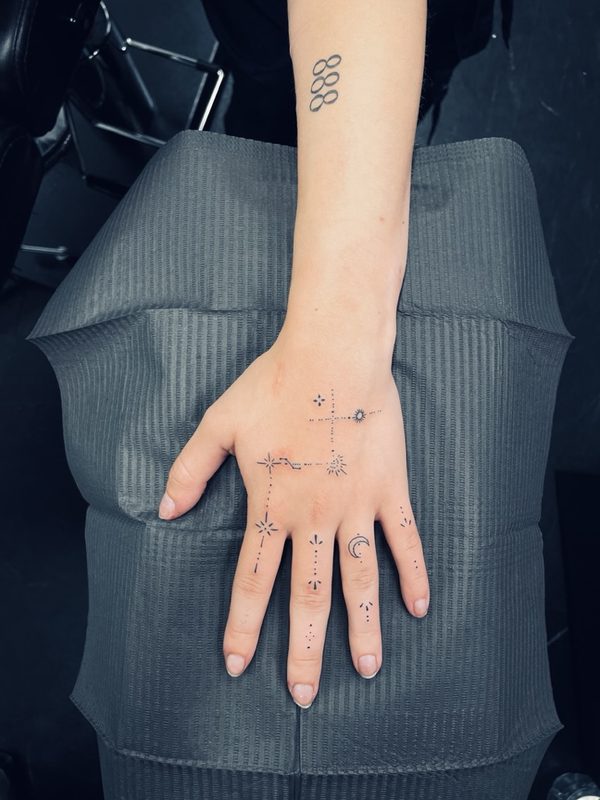
Tattoo Ideas
Moon Phase
Waxing and waning are mirror images, and getting the direction wrong is the most-botched detail on this motif. Anyone who looks at the sky will see it. Twelve arrangements from the eight-phase row to the radial dial, the placements a straight run of skin dictates, and honest scale tiers.
Book a consultationStart here
Eight circles in a row need a straight run of skin to sit on.
Most subjects let you choose a spot and then size the drawing to fit it. This one works backwards. An eight-phase row is a long, thin, rigidly spaced object, and there are only so many places on a body that will take one — which is why the forearm, the spine and the collarbone keep coming up, and why almost everything else on this page follows from that fact. Read this before the catalogue, not after it.
The horizontal runway
Inner forearm · collarbone · ribs · above ankle
The natural runway for the eight-phase row. Forearm is the most common choice — delivers high visibility, a comfortable tattooing surface, and enough length for all eight phases at legible scale. Collarbone frames the row gracefully but limits phase size. Ribs echo the arc of the moon across the sky.
The vertical runway
Spine · side of neck · inner bicep
The spine is the favored vertical runway — allows phases to descend from nape to lower back like a celestial timeline. Demands strong stencil-straightness from the artist. Side of neck and inner bicep hold shorter vertical runs. Ages well because these zones see minimal sun exposure.
Centerd on the body’s own axis
Sternum · back of neck · shoulder blade · upper back
For triple moon, solo crescent, ornamental filigree, and sacred-geometry mandala compositions. The sternum and back of neck in particular reward symmetric compositions — the body centerline becomes the composition’s axis. Shoulder blade holds contained 5–8 inch pieces.
One moon, kept quiet
Inner wrist · behind ear · finger · inner ankle
For refined, discoverable, intimate pieces. Single crescents, solo phases, small triples. Fine-line style fits naturally here because the scale matches the style. The moon that lives mostly inside the wearer’s eyeline.
Full-moon feature scale
Upper arm · calf · full back · thigh panel
For realistic full moons, moon-and-wolf compositions, and sacred-geometry mandalas at feature scale. Upper arm holds 5–7 inch compositions; back and thigh hold 8–14 inch statement pieces. Usually the anchor of a larger composition.
The browsing framework
Five decisions, and the phase count settles the other four.
When a client walks in and says I want a moon phase, the question is almost never which composition. It’s a sequence of five narrowing decisions, and “a moon phase” is the answer to none of them. Answer the second one — how many phases — and three of the remaining four fall out almost automatically.
What are you marking?
Personal transformation, feminine cycles, a birth moon, a lunar date, a spiritual practice, or pure aesthetic resonance with cycles and change. “It’s my recovery year.” “It’s the phase the night my child was born.” “It’s a reminder that healing isn’t linear.” Any sentence that lands in one breath is enough. “I like the moon” will not carry a tattoo.
Full cycle or single phase?
An eight-phase row is a calendar. A triple goddess is an archetype. A single crescent or full moon is a specific moment — a date, a feeling, a letting-go. These are three different design problems. Decide this before you decide placement or style.
Symbolic or realistic?
Illustrative or symbolic moons (solid fills, simple line crescents) hold legibility for decades at any size. Realistic moons with stippled craters and soft shading read as photographic but require more skin real estate and touch-ups. For a multi-phase row specifically, illustrative style holds consistency across eight small moons. For a single feature piece, realism earns its keep.
Linear run or contained composition?
Eight-phase rows want uninterrupted horizontal or vertical canvas — forearm, spine, collarbone, ribs. A triple moon, single phase, or radial mandala wants a contained spot — sternum, behind ear, shoulder blade, back of neck. Placement logic follows the composition, not the other way around.
How big can you realistically go?
An eight-phase row under 3 inches with hair-thin lines will blur over 10–15 years. A row built at 4–6 inches with slightly thicker linework and proper full-moon fills ages significantly better. A single realistic full moon needs at least 2 inches to carry crater detail. A row that has to hold eight separate objects cannot be shrunk to fit a placement you have already fallen for.
Each phase should carry its weight visually — uniform spacing, matching line weight, matching shading. And each phase should carry its weight symbolically too.
Eight is visually balanced. It fills a forearm, spine, or clavicle without feeling cramped or sparse.
Waxing moons curve one way, waning moons the other. If the phases carry personal meaning, directional accuracy is non-negotiable.
Order and direction
Get the direction wrong and anybody who looks up will see it.
This is the only subject in the ideas catalogue that can be factually incorrect. A rose can be any rose. A moon row either matches the sky or it doesn’t, and the people who notice are not tattoo people. They are anybody who has watched a month go by. Six things worth settling before the stencil, none of which cost anything except the asking.
The sequence isn’t a design choice
New, waxing crescent, first quarter, waxing gibbous, full, waning gibbous, last quarter, waning crescent. That is the order, and it runs one way. Rows that put the full moon anywhere other than dead center of an eight-phase sequence have usually been laid out for visual balance by somebody who wasn’t thinking about the sky. If you want the full moon somewhere else in the composition, the honest answer is to build a different composition rather than to reshuffle the cycle.
Waxing and waning are mirror images
This is the single most-botched detail on the motif, and it is botched the same way every time: a reference image gets flipped somewhere between a screenshot and a stencil, and the whole row ends up running backwards. From the northern hemisphere the moon brightens from the right-hand edge as it waxes and empties from the right as it wanes, so a waxing crescent opens to the right and a waning crescent opens to the left. Look at the stencil on your skin and check that one thing before anybody starts. It takes four seconds and it is permanent either way.
Which hemisphere was the moon in
Seen from Sydney, Buenos Aires or Cape Town, the lit side is on the opposite edge. The same moon, viewed from the other side of the planet, looks reversed. It matters for exactly one kind of client and it matters completely: if your piece marks a night in the southern hemisphere, say so out loud, because every reference chart your artist finds online will default to the northern view.
The terminator is a curve, and then it isn’t
The edge between lit and unlit is called the terminator, and its shape is the difference between an accurate moon and a decorative one. On a crescent or a gibbous it bows as an ellipse: the outer edge of the disc is a true circle, the inner edge is not. At first and last quarter it flattens into a straight line, because you are looking at exactly half a lit sphere. Crescents drawn as two circular arcs are the stylised version, which is a legitimate choice; just make it a choice.
Horns up, horns sideways
A solo crescent has a second orientation question the phase rows never raise: which way the points face. Tipped so the horns aim upward it reads as a bowl or a boat, and it is what the moon actually looks like from the tropics. Turned on its side it reads as the classic emblem, the shape on a hundred flags and a thousand pieces of jewelry. Neither is wrong, but they carry very different weight, and a crescent placed along a collarbone will be pulled towards one or the other by the curve it sits on.
The triple moon is modern, and that’s fine
Waxing crescent, full circle, waning crescent, read as Maiden, Mother and Crone. It is a real and meaningful symbol inside contemporary Wicca and neo-paganism, and it is genuinely worn by practitioners. It is not an ancient inheritance, whatever a Pinterest caption says — the triple-goddess reading is a twentieth-century construction that spread through modern pagan revival. Knowing that changes nothing about whether you should wear it. It changes quite a lot about what you say when somebody asks.
Twelve moons
Twelve lunar compositions, and only one of them is a calendar.
An eight-phase row on an inner forearm and a lunar mandala across a back share a subject and nothing else. One is a sequence, read left to right like a sentence. The other is radial, read from the center outward, and it belongs to a completely different set of specialists. These twelve are what actually gets asked for.
The eight-phase linear row
The definitive moon-phase composition
All eight lunar stages in a horizontal band — new, waxing crescent, first quarter, waxing gibbous, full, waning gibbous, last quarter, waning crescent. The most-requested moon-phase tattoo in any working shop. Reads along forearm, spine, collarbone, or above the ankle. Balanced by consistent spacing, matching line weight, and directional accuracy (waxing curves right, waning curves left in the Northern Hemisphere). Fine-line or soft black-and-grey.
The triple moon (Wiccan goddess)
Maiden, Mother, Crone
Known as the Triple Goddess symbol in Wiccan and neo-pagan traditions. Waxing crescent, full circle, and waning crescent unified into one composition. Honors the archetypes representing youth, creation, and wisdom. Compact, balanced, versatile across body locations. Bold traditional linework, delicate fine line, or ornamental with filigree and dotwork mandalas. The style that signals spiritual affiliation.
The single meaningful phase
Birth moon, anniversary, transformation
Sometimes one moon says everything. The specific phase from a birthday, a wedding night, a transformative evening — rendered as a standalone piece with careful attention to shadow and light. A waxing crescent represents intention and new beginnings, a full moon marks manifestation, a waning phase honors release. Works small behind the ear or scaled up as a feature piece with crater texture.
The realistic full-moon
Photorealistic crater topography
Actual lunar topography — craters, maria, terminator shadows, and surface texture rendered with careful black-and-grey stippling. Requires skilled shading to achieve the dusty, pitted appearance of the true lunar surface. A standalone statement piece on upper arm, calf, or shoulder blade. Demands real scale — under 2 inches, the craters muddy. Ages beautifully when sized and executed correctly.
The sacred-geometry mandala
Eight phases in a radial circle
The eight phases arranged radially inside a circle, forming a lunar mandala. Frequently combined with sacred geometry — Flower of Life, Metatron’s Cube, alchemical symbols, zodiac marks. Excellent for upper back, chest, or thigh where the full symmetry can be appreciated. The composition that bridges astronomy and ritual. Requires a dotwork or geometric specialist.
The ornamental crescent with filigree
Art Nouveau · mandala ornament
Crescent moon adorned with hanging gems, pearl strands, delicate chains, lace-like filigree, or mandala detailing. Evokes Art Nouveau and sacred geometry influences. Often incorporates dotwork stippling, linework flourishes, and symmetrical ornament above or below the lunar form. Sternum, spine, thigh, or back of neck where symmetrical design lands cleanly.
The moon-and-wolf
Blackwork or realism silhouette
Howling wolf or wolf head paired with a full moon backdrop. Draws on folklore and primal imagery. Typically rendered in blackwork or black-and-grey realism on the bicep, calf, or back. The nocturnal pairing — classic enough to age predictably, specific enough to carry a lineage of its own. Commits to the subject rather than floating it.
The moon-face (Man in the Moon)
Vintage astronomy · traditional
The traditional anthropomorphic moon with a face in profile — a nod to vintage astronomy prints and old-school American Traditional flash. Bold outline, limited palette, often gold or silver accents. Great as a medium-sized standalone piece on forearm or thigh. Pairs cleanly with Traditional sleeves and flash-lineage work.
The moon with stars / constellation
Celestial scatter
Crescent or full moon surrounded by scattered stars, a specific constellation, or a single bright planet. Adds cosmic context and natal-chart symbolism. Works as shoulder, ankle, or behind-ear piece. Pairs naturally with astrology-inspired linework. Keep the scatter restrained — overcrowding turns a clean piece into visual noise.
The moon with flowers
Nightshade, moonflower, datura
Pair a crescent or full moon with a nocturnal bloom — nightshade, moonflower, datura, evening primrose. All flowers tied to lunar symbolism and the night garden. Works at any scale and combines botanical softness with celestial structure. Ribcage, thigh, inner forearm. The pairing that feminizes the subject without leaning cliché.
The moon-and-sun pair
Duality, balance, opposites
Dual luminaries rendered together, often interlocking or mirrored. Symbolizes balance, duality, the union of opposites — masculine/feminine, conscious/unconscious, light/shadow. Common as matching tattoos or a single composition on forearm, back, or chest. The style that carries the archetypal-duality reading rather than pure lunar symbolism.
The solo crescent
Minimalist single-line
A single sliver rendered minimalist or ornate. Carries associations with intuition, femininity, night, beginnings, endings. Ideal behind the ear, on the inner wrist, tucked along a finger, or along the collarbone. Fine-line or single-needle. The quiet piece — reads as personal style rather than declaration.
Six styles
Six ways to draw the same circle eight times.
The test for every style below is repetition. A single moon is easy in any of them. Eight in a row, matched for weight and spacing and circle geometry, is a completely different ask — and it is the reason a fine-line specialist and a dotwork specialist are not interchangeable here.
Fine Line / Single-Needle — the eight-phase default, and where it fails
The dominant moon-phase style
Hairline work, precise circle geometry, uniform spacing. The natural home for the eight-phase row and for solo crescents. Honest caveat: single-needle lines soften faster than Traditional lines, especially under 3 inches on high-flex zones. On forearm, ribcage, or sternum, they hold. For phase rows specifically, this is the default style.
Blackwork — the moon as solid mass, or as bare skin
Solid silhouette, graphic impact
Amplifies the silhouette — crescent in solid black, full moon rendered as pure negative space surrounded by inked sky, wolf-and-moon compositions. Graphic impact that ages well because the black mass holds structure. Best for bold single-feature pieces rather than fine-detail phase rows.
Dotwork / Stippling — craters built out of density
Crater texture and gradient shading
Pointillist technique for lunar surface work — craters, maria, gradient shading from light to dark limb. The natural partner for realistic full-moon pieces and for ornamental mandala compositions. Ages exceptionally well because dots hold their edge longer than line. Requires a specialist.
Sacred Geometry — the cycle bent into a ring
Radial mandalas and ritual framing
The style for phases-in-circle lunar mandalas. Flower of Life, Metatron’s Cube, alchemical symbols, zodiac marks. Requires precise geometric linework and a portfolio showing consistent spacing and symmetry across multiple mandala pieces. Pairs cleanly with astrology iconography.
Illustrative / Botanical — the Victorian astronomy plate
19th-century astronomy plate
Deliberate line weight mimicking etching or engraving, detailed craters and terminator shading. Pulls from Victorian astronomy plates and alchemical manuscripts. Reads editorial. Because every value in it is carried by line weight rather than by soft grey, it holds its structure for as long as an engraving does. Pairs cleanly with botanical elements — nightshade, moonflower, datura.
Black-and-Grey Realism — maria, terminator, limb
Photorealistic crater topography
Photorealistic lunar surface — soft gradient shading, terminator shadow, maria and crater detail. Realism doesn’t scale down — 3 inches is the floor for crater legibility. Best as a standalone full-moon feature piece rather than a phase row. Pairs well with wolf silhouettes and realistic night-sky scenes.
Scale honesty
Four tiers, set by how small a full moon can be and still read as a disc.
Not the other way around. If you want eight phases that still read at year fifteen, commit to the scale that holds them.
Eight compositional pairings
A moon alone is one sentence. A moon with a constellation is an almanac.
A moon is a shape with almost no fixed meaning of its own, which is why it takes companions so easily and why the companion ends up doing most of the talking. Eight the studio draws regularly.
Moon + fine-line constellation
The astrology pairing. A specific constellation alongside a crescent or birth-moon phase — Orion, Lyra, Cassiopeia, natal sign. Fine-line style, ribcage or inner forearm. The composition that carries a chart’s worth of meaning in a small footprint.
Moon + sacred geometry
Flower of Life, Metatron’s Cube, or a simple triangle can anchor a lunar composition into something ritualistic and symbolic. Back, chest, thigh. The natural style for phases-in-circle mandalas.
Moon + wolf
The classic folklore pairing. Howling wolf or wolf head against a full-moon backdrop. Blackwork or realism on bicep, calf, back. Draws on primal imagery and the nocturnal style.
Moon + botanical (nightshade, moonflower)
The night-garden pairing. Nightshade, moonflower, datura, evening primrose — all blooms tied to lunar symbolism. Ribcage, thigh, inner forearm. Combines botanical softness with celestial structure.
Moon + sun
The duality pairing. Dual luminaries rendered together — balance, opposites, masculine/feminine, conscious/unconscious. Common as matching tattoos or as a single interlocking composition. Forearm, back, chest.
Moon + dotwork stippling
The crater-texture pairing. Pointillist technique for realistic lunar surface. The natural style for realistic full-moon pieces. Pairs cleanly with any contained single-moon composition.
Moon + Ramadan / crescent tradition
The Islamic crescent style. The waxing crescent that marks the start of Ramadan carries specific religious meaning. If drawn to this category from within the tradition, treat the piece as a commission with research; if drawn to it from outside, consider a secular crescent instead.
Moon + hummingbird
The nocturnal-intuition pairing. Crescent moon behind a fine-line hummingbird. Ribcage, sternum, inner forearm. Pairs cleanly with the 2020s fine-line style.
What to bring
Six answers, plus a screenshot of the right night.
Five of these you can answer in the car. The sixth needs a free ephemeris lookup, and it is the one that most often changes the drawing.
Which meaning cluster?
Personal transformation, feminine cycles, a specific date, spiritual practice, cosmic aesthetics. Pick one primary. A moon phase can carry more than one reading, but the design has to be built around the one that matters most. Try to honor all five at once and you get a committee tattoo — technically a moon, emotionally diffuse.
How many phases?
Eight (full cycle), three (Wiccan Maiden-Mother-Crone), five (half cycle), or one (birth moon, feature phase). Each number has its own composition logic and placement style. Decide this before you decide size or style.
Which style lineage?
Fine line, blackwork, dotwork, sacred geometry, illustrative, or black-and-grey realism. If you don’t know, say so, and ask to see healed rows in two of them side by side — the difference between a fine-line row at five years and a dotwork row at five years is more obvious than any portfolio shot will tell you. For phase rows specifically, fine line and dotwork dominate.
Which direction for the phases?
Waxing curves one way, waning the other (in the Northern Hemisphere, waxing opens to the right; waning to the left). If the phases carry personal meaning — a birth moon, a specific date — directional accuracy is non-negotiable. Bring the date and location to consultation so the artist can reference ephemeris data.
What scale can you commit?
A 3-inch triple moon is 1–2 hours. A 5-inch eight-phase fine-line row is 2–4 hours. A 6-inch dotwork full moon is 3–5 hours. A sacred-geometry mandala with zodiac ring is usually two sessions. Know your ceiling before you fall in love with a design that lives above it.
Matching with someone?
If yes, is the other person’s piece a complementary phase (waxing for one, waning for the other; Maiden for one, Crone for another) or an identical match? Treat it as its own design problem. The other person should be in consultation if possible, or at minimum sign off on the final design before the stencil goes on.
A gorgeous individual moon means nothing if the row looks lopsided from two feet away.
Pick one style and hold it across all eight phases. Consistency is the entire point of the composition.
Moon phase tattoos have quietly become one of the most popular minimalist designs of the last decade — and for good reason.
Common mistakes
Eight ways a phase row goes wrong.
Five of these eight are spacing and geometry problems, which is a useful thing to know when you are choosing who does the work.
The inconsistent spacing
The most frequent regret — rows where the gaps between phases drift wider or narrower as the sequence progresses, making the piece feel rushed. Fix: uniform spacing is the whole craft of a phase row. Ask the artist whether they use a printed stencil for the full row (strongly recommended) versus sketching freehand on skin.
The wrong-direction crescent
Waxing moons should curve one way and waning moons the other. Plenty of tattoos in the wild have the sequence reversed because the reference was flipped. Fix: if the phases carry personal meaning (birth moon, specific date), directional accuracy matters. Bring ephemeris data to consultation.
The too-small row
Clients request a row under 2 inches to fit a dainty placement, then watch the fine lines blur within 5–10 years as the individual moons lose distinction. Fix: size up, or pick fewer phases (triple moon at 3 inches holds better than an eight-phase row at 2).
The mismatched-style row
Pairing a photorealistic full moon with geometric line crescents in the same row creates visual dissonance. Fix: pick one style and hold it across all eight phases. Consistency is the entire point of the composition.
The inconsistent line weight
A gorgeous individual moon means nothing if the row looks lopsided from two feet away. Line weight, fill saturation, and circle geometry must match across every phase. Fix: scroll the artist’s grid and ask — are their circles actually circular, or slightly egg-shaped? Is spacing uniform, or does it drift?
The over-crowded composition
Adding stars between every phase, a vine threading through the moons, a zodiac ring around them — all in a 3-inch row. Guarantees every element loses impact. Fix: pick one accent, not three. Empty space between phases is part of the composition.
The ephemeris guess
Getting a “birth moon” tattooed based on a rough guess of the phase rather than actual data. The moon was not a crescent on every birthday. Fix: use a free ephemeris tool (timeanddate.com, stardate.org) to render the exact phase for the exact date and location. Bring the image.
Taking the first opening on the books
Booking with whoever can get you in this week rather than matching a portfolio to repeated-element precision. Fine line, dotwork, and sacred geometry are different specialists. Fix: scroll a prospective artist’s grid and look for CONSISTENT circle geometry across multiple pieces.
The first-moon-phase guide
If this is your first moon phase, boring is the correct answer.
Boring ages well. The honest starting recipe is fine-line eight-phase row at 4 inches on the inner forearm. Eight decisions the first moon-phase piece should make on purpose.
Personalization
The sequence, the source data, and the phase you don’t explain.
Three layers. The first is the one every row in your saved folder already has. The second takes one lookup and about ten minutes. The third takes nothing at all and is the reason the piece stops looking like everybody else’s.
How many moons, and how they sit
Number of phases, style, size, placement. These are the bones. They determine whether the piece reads as a full-cycle calendar, an archetypal triple, a quiet solo crescent, or a radial mandala. Most clients start and stop here — which is why most end up with rows that look like every other row in their feed.
The night it actually was
A specific birth-moon phase from ephemeris data. A constellation for a natal sign. A botanical frame from a grandmother’s garden (nightshade, moonflower, datura). A zodiac ring around a mandala. A date, a coordinate, a name in small script beneath. One ephemeris lookup is what separates a real date from a decorative one.
The phase you don’t explain
Whatever the row is actually counting. Nobody else needs to know. The private layer keeps the piece from feeling generic — even if the design reads as a standard moon-phase row to strangers, you know what’s underneath. The waning crescent that marked a release. The full moon of a night you’ll carry. That’s enough. That’s often the whole point.
Matching moon-phase tattoos
Partners, sisters, mothers and daughters.
Complementary phases across two bodies read better than two identical rows, and they have the useful property of still working if one of the two people stops being in your life.
Who books a matched cycle
Partners most commonly (often complementary phases — waxing for one, full between them, waning for the other), then sisters or close friends honoring shared cycles, then mothers and adult daughters (triple-moon archetype pairs). Memorial matches for lost family members are a distinct subset.
Match the cycle, vary the phase
Same base composition, different emphasized phase per person — one carries the waxing half, one carries the full, one carries the waning. Each piece still belongs to the wearer while the set reads as one cycle across multiple bodies.
Plan for the piece to outlive the relationship
If a breakup, estrangement, or death would destroy the piece, redesign it so it works as a solo moon cycle on its own. That isn’t cynicism about the relationship. It is the same planning you would do for anything else you intend to keep for forty years.
One stencil, one artist, one sitting
The only way matching phase rows actually match is if the execution is identical. Two different artists, two months apart, produces two tattoos with drifted line weight and proportion — not a matching set.
FAQ
Eight moon-phase questions, answered the way we answer them in the shop.
Eight questions covering design selection, the eight-phase logic, Wiccan association, single-phase choices, first-tattoo guidance, birth moons, aging, and placement.
How do I know which moon phase tattoo design is right for me?
Take the five decisions in the order they appear above and don’t skip. First: what are you marking — personal transformation, feminine cycles, a specific date, spiritual practice, or aesthetic resonance? Second: full cycle (eight phases), archetype (triple goddess), or single meaningful phase? Third: symbolic (fine line, blackwork) or realistic (dotwork crater texture)? Fourth: linear run (forearm, spine, ribs) or contained composition (sternum, back of neck, shoulder blade)? Fifth: what scale can you realistically commit to for detail retention? A moon-phase tattoo that answers all five cleanly is the one that’s actually yours.
Why the eight-phase row specifically?
The eight-phase row is the astronomically accurate breakdown of a full lunar cycle: new, waxing crescent, first quarter, waxing gibbous, full, waning gibbous, last quarter, waning crescent. Eight is also visually balanced — it fills a forearm, spine, or clavicle without feeling cramped or sparse. Three-phase (Maiden-Mother-Crone) and five-phase rows exist, but eight remains the standard because it matches both the astronomy and the anatomical canvas of the most-requested placements.
Is a moon phase tattoo religious (Wiccan)?
Not inherently. The triple moon is strongly associated with Wicca and neo-pagan traditions, and some clients choose it for that reason. A plain eight-phase row is culturally broad — it appears in astronomy, feminist art, indigenous calendars worldwide, and secular minimalist design. Context around the tattoo (added pentacles, runes, Hecate imagery) is what signals a specific spiritual affiliation. A solo crescent or phase row on its own reads as a cycles-and-change piece without religious specificity.
Can I get just one moon phase?
Absolutely, and many clients do. A single crescent or full moon can carry personal meaning without the full cycle. A lone waning crescent often represents letting go; a full moon marks culmination or a specific date; a waxing crescent represents intention. Single-phase tattoos scale better to very small placements like behind the ear or on a finger where a full row would blur. For a meaningful date, use ephemeris data to render the exact phase for that day and location.
What’s the best moon phase style for a first tattoo?
Fine line or single-needle, black only, eight-phase row on the inner forearm at 4 inches. The fine-line style is the dominant moon-phase style for a reason — it suits the repeated-element composition, photographs beautifully, and ages predictably when sized correctly. Plan on two to three hours of chair time in a single session, quoted from the drawing at consultation. Book with an artist whose HEALED fine-line portfolio at one-year-plus shows consistent circle geometry across multi-element pieces.
How do I find my birth moon phase?
A birth moon is the lunar phase on the day you were born. Free online tools (timeanddate.com, stardate.org) let you enter your birthday and location and return the exact phase. Clients often tattoo their own birth moon alongside a partner’s or child’s as a quiet memorial or family marker. Your artist can reference the image to render the phase accurately — this is the single most common use of ephemeris data in moon-phase work. Accuracy here is non-negotiable.
Will a small eight-phase row age well?
It depends on size and line weight. A row under 3 inches with hair-thin lines will blur over 10–15 years, especially in sun-exposed spots. A row built at 4–6 inches with slightly thicker linework and proper full-moon fills ages significantly better. Placement away from heavy friction zones (inner wrist, fingers) also helps preserve the sequence’s crispness. Black-only ink holds longer than any color work. If longevity matters, size up and pick a less-trafficked placement.
Best placement for a moon phase tattoo?
For an eight-phase row: inner forearm (the most common choice, natural horizontal runway, comfortable session), spine (vertical descent, demands stencil straightness), or ribs (echoes the lunar arc across the night sky, sensitive session). For a triple moon: sternum, back of neck, inner forearm. For a solo crescent: behind ear, inner wrist, finger, collarbone. For a realistic full moon: upper arm, calf, shoulder blade. The composition drives the placement, not the reverse.
Know how many phases?
Bring the phase count, and the date if there is one, and we’ll look the night up together.
Bring the run of skin you want to use, because the geometry decides everything else. We check phase order and illumination direction twice. A reversed crescent is the one error every person who looks at the sky will catch.