Tattoo Ideas
Hummingbird
Iridescence is not pigment. A gorget shifts colour with viewing angle, which is a real problem in a medium that cannot move. Crisp still wings read as a dead bird, so the hover pose demands blur or a figure-eight. Twelve directions, species-diagnostic bill shapes, and the Aztec Huitzilopochtli reading.
Book a consultationFive decisions
The bird is the easy part. These five are not.
Nobody arrives wanting a hummingbird in the abstract. They arrive with a feeder on a porch, a species they could not name, a grandmother, a garden, or a colour they saw once for half a second. Five questions turn that into something an artist can draw. Take them in order. The fifth one is the one people want to answer first, and answering it first is how you end up in love with a design that will not fit where you want it.
What made you want this bird?
Joy, survival, a specific messenger, heritage, or garden memory. “It’s for my grandmother’s trumpet vine.” “It’s the bird that hovered at the window the morning of the funeral.” “It’s my recovery year.” Any sentence that lands in one breath is enough. “Hummingbirds are pretty” is not — that ends in a stock tattoo.
Solo bird or composed with a flower?
A hummingbird alone on skin reads as abstract — almost logo-like. The brain wants a flower. Pairing with a nectar-source bloom (trumpet vine, salvia, fuchsia, passionflower, hibiscus) grounds the hover and opens a second layer of meaning. Decide composition before style.
Iridescent color or black-and-grey?
Color realism carries the gorget and wing shimmer at the cost of faster warm-tone drift. Black-and-grey trades iridescence for decade-plus stability and a portrait style that suits memorial work. Pick the style before you pick the artist — a color realist and a black-and-grey specialist are different people.
Who is meant to see it?
Forearm, shoulder, and calf read public. Inner bicep, sternum, and ribcage read private. A memorial hummingbird often wants the private style; a garden-memory hummingbird often wants the wearer’s own eyeline. Placement is where meaning meets audience.
What will the space actually take?
Below three inches head-to-tail, iridescent color realism stops reading — the eye catchlight and beak taper collapse. For a realistic gorget with wing blur, four to five inches is honest. For fine-line silhouette, 1.5–2 inches still carries. Your scale sets your style, not the other way around.
Lightness isn’t fragility: staying aloft takes constant, deliberate work. That’s the whole tattoo.
A hummingbird floating alone on skin reads as abstract, almost logo-like. The brain wants a flower.
The eye is the anchor. If it loses definition, the bird looks generic — no matter how good the tail work is.
Flash · ready to ink
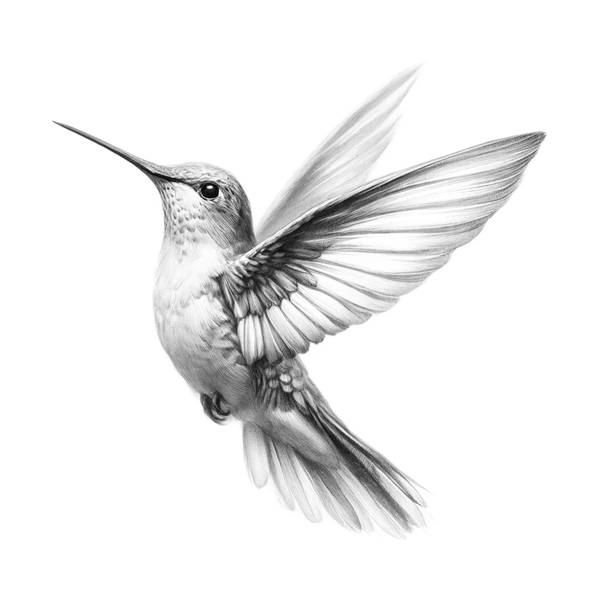
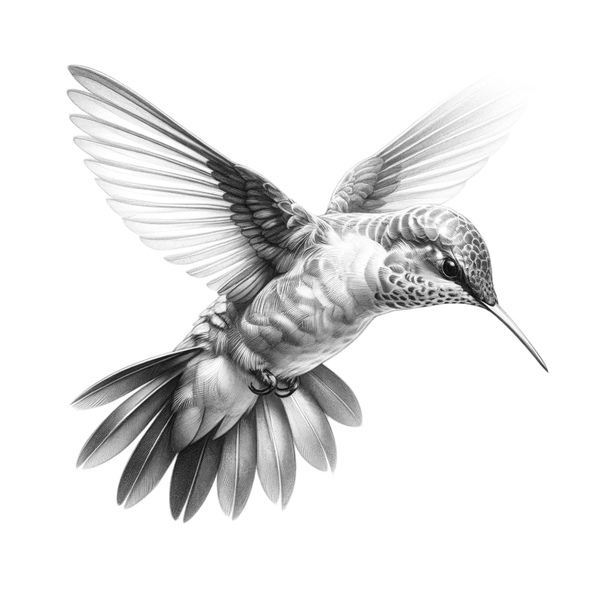
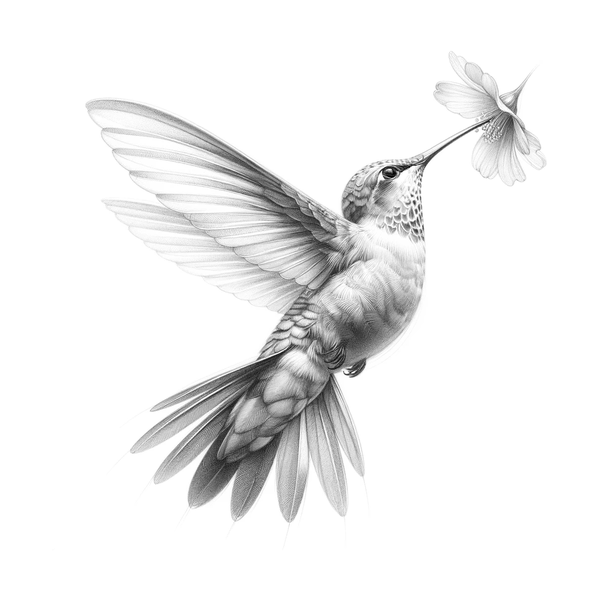
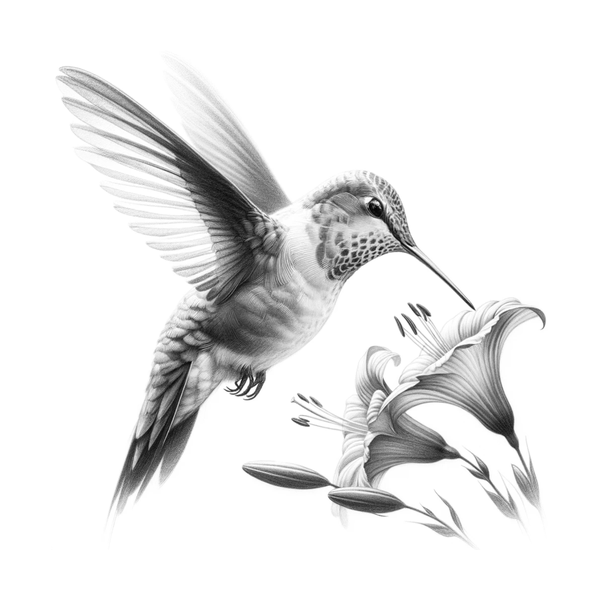
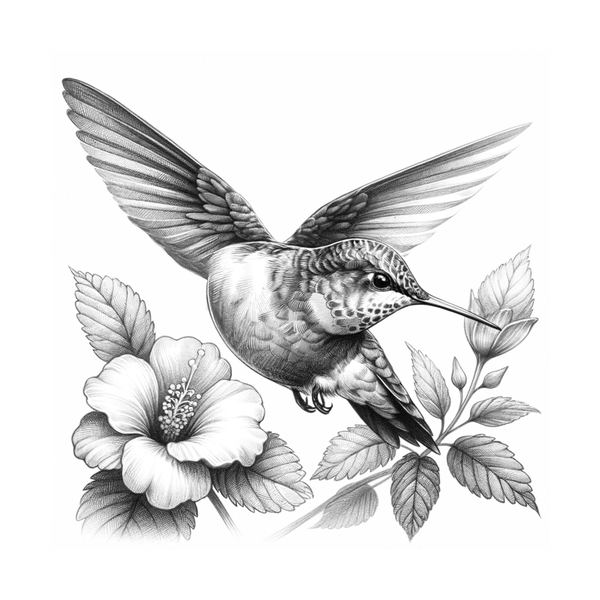
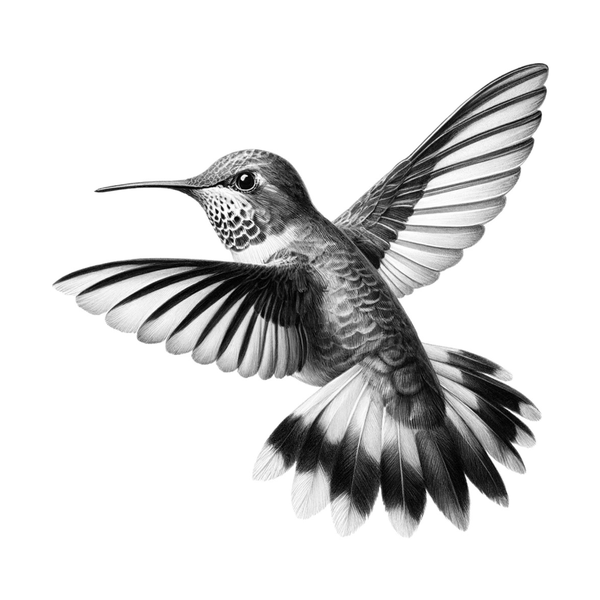
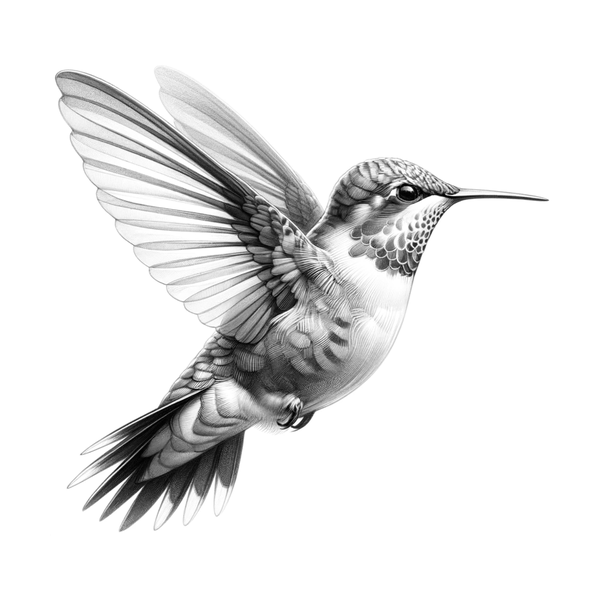
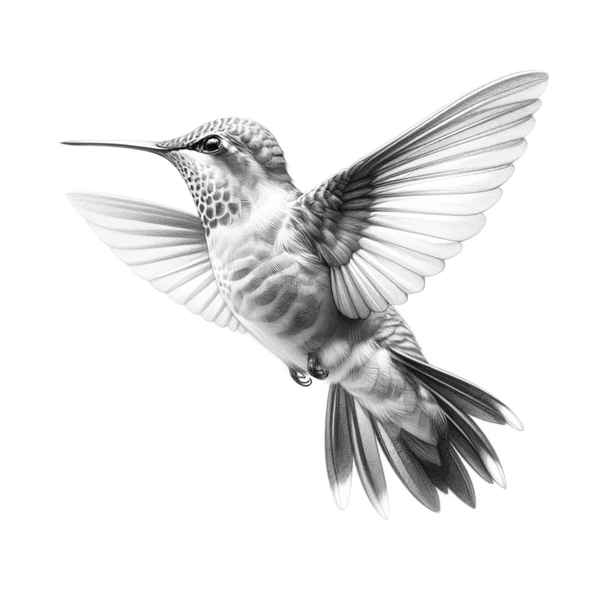
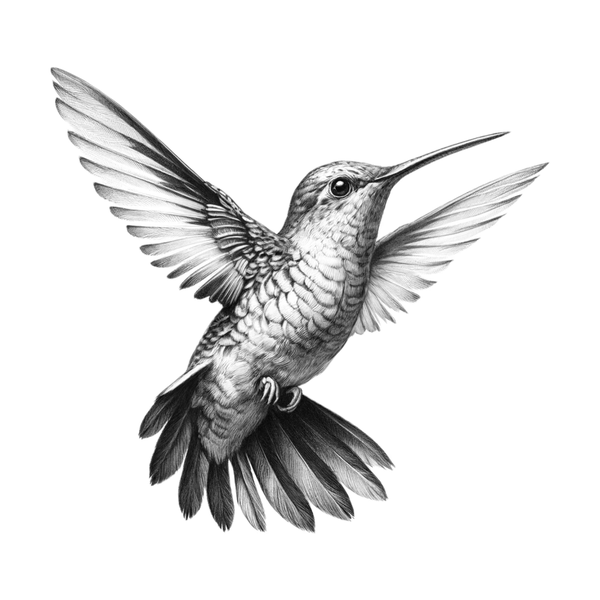
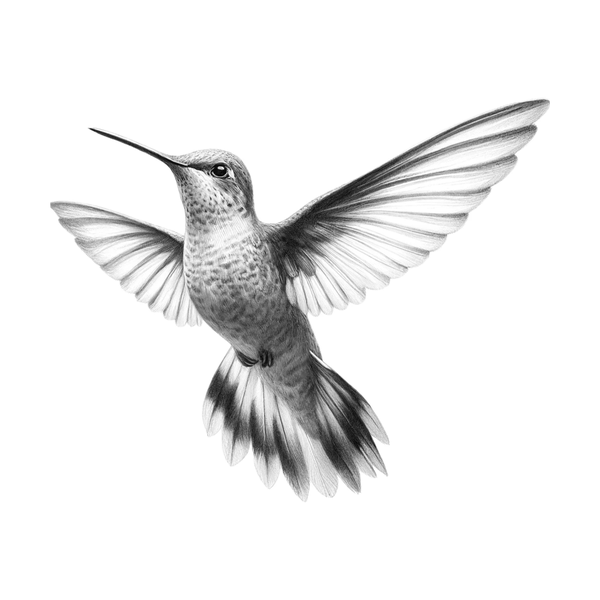
Hummingbird flash designs
11 hand-drawn designs from our flash collection — book any one as-is, or use it as the starting point for a custom piece. Sizing, placement and linework dialed in at your consultation.
The gorget and the hover
Two things about this bird are physically impossible to tattoo, and both have workarounds.
A hummingbird presents a specific technical problem that no other small-bird subject does, and it presents it twice. The throat colour is not a colour. The wings are not visible. Everything difficult about hummingbird tattooing comes out of those two facts, and the reason so many hummingbird pieces look almost right but slightly wrong is that the artist ignored one of them. Neither is unsolvable. Both have to be decided on purpose, before the stencil, because the fix for each one changes the composition rather than the shading.
The throat is not painted, it is built
The flare on a male Anna’s throat is not pigment. The barbules of those gorget feathers are stacked with microscopically thin layers that interfere with light, so the colour you see depends entirely on the angle between the bird, the sun and your eye. Rotate the bird ten degrees and a blazing magenta throat goes flat black. This is the same physics that makes an oil film on a puddle change colour, and it is why photographs of the same bird taken seconds apart look like different species.
Ink does not change with viewing angle
A tattoo is flat and permanent and looks the same from every position in the room. So an iridescent throat cannot be reproduced; it can only be quoted. The artist has to choose one instant of the flash and commit to it, which means choosing how lit the bird is, from which side, and how much of the throat is caught. That is a compositional decision, not a colour decision, and it should be made out loud rather than drifted into.
One highlight, not three
The most common way a colour-realism gorget fails is over-highlighting. Two or three bright hits across the throat cancel each other out and the whole area goes chalky and flat, because the eye has no single light source to believe in. One decisive highlight, placed where the light is coming from, reads as shimmer. Ask to see the highlight plan before the colour goes in. It is a two-minute conversation that decides most of the piece.
The honest option is a dark throat
Most of the time, in life, a gorget looks black. That is what your eye actually sees on a bird at a feeder for most of the seconds you watch it. A tattoo that renders the throat dark with one narrow flash at the edge is closer to the truth than a fully lit magenta bib, and it tends to read as a real animal rather than as an illustration of one. Underused, and it ages far better because there is less saturated colour to lose.
Why black-and-grey sometimes wins outright
Greyscale cannot pretend to reproduce the colour, so it does not try. It has to imply the flash through value contrast alone, and a good black-and-grey artist will build the throat as the darkest value in the piece with one hard specular hit. Clients arrive assuming colour is obviously correct for this subject. Sit with the greyscale option for a day before you dismiss it, particularly for memorial work, where the restraint suits the reading and the piece holds its contrast for decades.
A crisp still wing reads as a dead bird
This is the second impossibility, and it is the one that ruins more hummingbird tattoos than any colour problem. A hovering hummingbird traces a figure-eight with its wings at a rate the human eye cannot resolve. Nobody has ever seen a stationary hummingbird wing on a hovering bird. So when an artist renders every primary feather, crisply, in perfect focus, on a bird posed mid-hover, the brain files it as a specimen held up for photographing. There are four honest fixes: blur the wing, ghost a second wing position behind the first, imply an arc and let the feathers dissolve into it, or drop the hover entirely and perch the bird. Perched is legitimate and badly underused, and it lets you keep every feather sharp without lying about physics. Whichever you pick, commit hard. Tentative half-blur is the worst of both and reads as a shading mistake every single time.
The bill tells you the species
Length and curve are diagnostic. A ruby-throated or Anna’s bill is short and effectively straight; other species run long, decurved, or in extreme cases longer than the body. If the piece is meant to be a particular bird — the one at your grandmother’s feeder, the one native to where you grew up — the bill is where that gets settled, more than the colour. Bring a photograph of the actual species rather than a search result for “hummingbird”.
Twelve birds
From an Anna’s gorget to a stepped-line Huitzilopochtli.
The hummingbird sits in two lineages at once, and they do not blend. American tattooing arrived at it through Traditional bird-and-rose flash and then through colour realism. Mesoamerica arrived at it centuries earlier, through Huitzilopochtli, whose name is usually rendered as hummingbird of the south or hummingbird on the left, and through the reading of fallen warriors returning as hummingbirds. An iridescent Anna’s on a shoulder and a stepped-line Aztec bird on a chest are not two sizes of the same tattoo. Twelve directions, and it is worth reading the Aztec entries even if you land somewhere else, because they explain why the geometry of this bird works at all.
The iridescent Anna’s
Full-color realism, California-native
The flagship hummingbird at Apollo. Anna’s or Allen’s rendered with true-to-species gorget color — magenta for Anna’s males, emerald crown, copper for Rufous — caught mid-hover with trumpet vine or salvia. Demands 4–5 inches to hold eye and beak detail. The artist treats iridescence as structural refraction rather than pigment: layered complementary hues, tight value shift, one decisive highlight pulled late in the session.
The memorial messenger
Black-and-grey with a name or date
Among the most-requested hummingbird pieces in consultation. Soft greyscale rendering, often paired with a loved one’s handwriting, a birth-and-passing date, or that person’s favorite flower. The cross-cultural folk belief — a hummingbird appearing after a death is the departed checking in — runs strong across the American South, Pacific Northwest, and Latinx communities. The style wants tonal restraint rather than color fireworks.
The Traditional bird-and-rose
Sailor Jerry flash lineage
Bold 3/0-liner outline, limited palette (red, green, gold, black), classic bird-and-rose composition pulled from Sailor Jerry and Bert Grimm. Reads cleanly at six feet, ages predictably over decades, and slots into a Traditional sleeve. Choose this when you want a piece that will still look itself at year twenty-five without touch-ups.
Hairline outline, nothing inside it
Single-needle minimalism
Single-weight linework, often just the profile in flight with a suggested stem. Elegant behind the ear, on the inner wrist, or along the ribs — but the smaller you go, the more the face becomes a compromise. Requires true fine-line discipline; the line doesn’t get to hide behind color. Photographs beautifully, ages quietly.
The Aztec Huitzilopochtli
Mesoamerican warrior-spirit style
Huitzilopochtli — literally “left-handed hummingbird” or “hummingbird of the south” — was the solar and war deity of the Mexica, and fallen warriors were said to return as hummingbirds circling the sun. Stepped-line geometry, limited palette with selective red or turquoise, often paired with sun or feathered-serpent motifs. Best commissioned by clients with Mexica or Aztec heritage.
The watercolor with botanical
Contemporary fine-art style
Loose color washes — magenta, orange, turquoise — behind a structured line-drawn bird and a tropical bloom (hibiscus, passionflower, California fuchsia). Photographs best on day one and ages fastest; the splashes lack the scaffold of an outline. Plan for a touch-up at year seven. Best for clients prioritizing the current look over long-term stability.
The neo-traditional ornamental
Mucha-inspired art nouveau frame
Bold outline and saturated neo-trad palette wrapped in filigree, mandala segments, or whiplash curves borrowed from Alphonse Mucha. Accommodates memorial banners, birth flowers, and layered symbolism. The style that turns the hummingbird from a subject into a device. Two sessions are common for anything over six inches.
Greyscale realism, no colour at all
Photorealistic · tonal control
Photorealistic rendering in smoked greys, letting value and texture carry what color usually does. Particularly strong for memorial pieces where the tonal restraint feels appropriate. Demands portrait-calibre gradient control and an understanding of feather direction as topology. Below four inches the face goes before anything else, so this has a hard floor there.
The dotwork / stippling bird
Pointillist feather texture
Smooth grey-wash body paired with stippled feather texture and a dotwork radial backdrop. Reads as illustration rather than photograph. Ages exceptionally well because dots hold their edge longer than line in most placements. Favored for sacred-geometry-adjacent compositions and mandala pairings.
The mirrored pair
Two birds facing each other
Mirrored composition for partners, siblings, or memorial work — often with interlocking floral elements between the two. Works as a single chest or sternum piece, or as split tattoos on two people. The symmetry is load-bearing: both birds must match in proportion, palette, and line weight, which makes this a same-artist-same-day booking.
The silhouette with sunrise
Graphic coastal style
Graphic silhouette against a gradient sun or Pacific horizon — a natural fit for Santa Monica clients referencing the coast. Clean shape, minimal interior detail, strong read at a distance. Works in black-only or with a single warm-tone gradient. Pairs well with small waves or a suggested horizon line.
The sacred-geometry bird
Mandala or Metatron backdrop
Bird layered over a Flower of Life, Metatron’s Cube, or a single mandala ring in fine dotwork. Grounds an asymmetric subject inside deliberate geometry and lands in the interior-transformation style — intuition, sudden movement, quiet devotion. Requires an artist fluent in both organic subject and precise geometric line.
Eight companions
The flower is not decoration. It is what stops the bird floating.
A hummingbird alone on skin reads as abstract, almost like a logo, because a hovering animal with nothing to hover near has no scale and no reason to be there. A bloom fixes it in one stroke: it gives the bird a size, a purpose, a direction to face, and somewhere for the composition to end. It also happens to be the layer where most of the personal meaning ends up living, because people can usually name a flower from a garden faster than they can name a bird.
Trumpet vine, the honest California pairing
The California-native pairing. Anna’s actually feeds from coral trumpet (Distictis buccinatoria), which grounds the composition botanically. Shoulder or outer thigh in full color realism.
Rose, in the Traditional grammar
The American Traditional duet. Bold layered rose petals and a jewel-toned bird. Forearm or upper arm, built to age for decades. The flash-lineage pairing.
Hibiscus, for the tropical reading
The watercolor and tropical style. Loose color washes behind a defined bird, magenta and orange dominating. Thigh or shoulder at 7–10 inches — requires an artist who controls pigment migration.
A name on a ribbon beneath
The memorial composition. Curly-script banner holding a name, date, or short phrase; bird as messenger. Inner forearm or chest. Neo-traditional or fine-line style.
Framed inside a mandala
The sacred-geometry pairing. Flower of Life, Metatron’s Cube, or a single dotwork mandala ring behind the bird. Back, shoulder blade, or thigh. Grounds a naturally asymmetric subject inside deliberate geometry.
With an Aztec sun disc
The Huitzilopochtli style. Stepped-line sun or rayed disc behind a stylized bird — fallen warriors returning to circle the sun. Best commissioned by clients with Mexica or Aztec heritage. Upper arm, back, chest panel.
With a crescent behind it
The nocturnal intuition style. Crescent or full moon paired with a fine-line hummingbird. Ribcage, sternum, inner forearm. Pairs cleanly with the 2020s fine-line style and moon-phase iconography.
Passionflower, for the vine work
The vertical-rib composition. Passionflower, wisteria, or honeysuckle vines drape the torso while the bird feeds; the vine becomes the compositional spine. 8–12 inches along the ribcage.
Six styles
Six ways to fake an angle-dependent colour with flat ink.
Every style below is really a different position on the gorget question. Colour realism attempts it head-on and needs both a specialist and four inches of skin. Traditional refuses the question and gives you four flat colours behind a key line that will still be crisp in forty years. Black-and-grey sidesteps it and often wins. Fine line does not engage at all and lets the composition carry the piece. None of these is wrong. They are answers to the same problem with wildly different ageing profiles.
Colour realism — the only style that attempts the gorget literally
The iridescence home style
Photorealistic bird with full-color gorget, wing shimmer, and accurate botanical. Demands layered complementary hues, a tight value shift, and one decisive highlight. Warm tones (pinks, magentas, gorget reds) drift fastest under UV — plan a touch-up window at year seven to ten on sun-exposed placements.
American Traditional — bold key line, four flat colours, no pretence
Sailor Jerry flash lineage
Bold 3/0-liner outline, limited palette (red, green, gold, black), classic bird-and-flower composition. Ages better than any other style — thick outline holds as color drifts. For a first hummingbird this is the honest recommendation, because the outline is still carrying the piece at year forty when the colour has gone soft.
Neo-traditional — the ornament goes around the bird, not inside it
Ornamental framing, expanded palette
Bold outline with dimensional shading, expanded palette, and decorative frame work — filigree, mandala segments, Art Nouveau curves. Where most modern ornamental hummingbird work lives in 2026. Two sessions common for anything over six inches. The style that handles memorial banners without clutter.
Fine line — line only, so the shimmer has to be implied
The dominant 2020s minimalist style
Hairline work, botanical accuracy, usually black with optional muted wash. Below 2 inches the face becomes a compromise. On stable skin (forearm, ribcage, sternum) the line holds. On high-flex zones (knuckles, feet, hand) it softens fast.
Black-and-grey realism — value stands in for the flash
Photorealistic · portrait-caliber
Smoked greys carry what color usually does. The tonal restraint suits memorial pieces especially well. Feather direction as topology, beak taper as the final refinement, catchlight in the eye as the anchor. Colour realism will not compress. Four inches is the floor, and below it the honest move is to switch to a stylised bird rather than a shrunken realistic one.
Watercolour — the wash reads as motion, not as feather
Splash, wash, bleed behind a defined bird
Loose color washes behind a structured line drawing. Honest caveat: watercolor ages faster than line-based work because the splash lacks the scaffold of an outline. Most watercolor hummingbirds need a touch-up at year seven. If that’s a dealbreaker, pick neo-traditional instead.
Four brackets
The face collapses before the wings do.
People assume the wings are the first casualty of going small. They are not. The eye and the taper of the bill go first, and once the eye loses definition the bird stops being a specific animal and becomes a bird-shaped mark, no matter how good the tail work is. Four inches is where a face with a bloom beside it survives a decade.
Five zones
A hovering bird needs somewhere to be hovering toward.
A hummingbird is almost always drawn in motion, which means it has a heading, and the heading has to make sense with the limb it is on. A bird flying down the forearm toward the wrist reads as leaving. The same bird flipped reads as arriving. Clients feel this immediately and usually cannot say why. Decide which one you want, then pick the zone that supports it.
Soft curves — shoulder cap, hip, upper back
Shoulder blade · upper back · outer thigh · inner bicep
The anatomical sweet spot for a hovering posture. The slight curve of the shoulder or the vertical stretch of the outer thigh lets wings blur outward without cramping. Reads as draped ornament rather than announcement.
Outer forearm and bicep — reads across a room
Outer forearm · bicep · chest over heart · calf
The Traditional placement and the Traditional style. Reads at six feet, reads in a t-shirt, carries the bird-and-rose or bird-and-banner composition. If someone in the family has a Traditional bird on the forearm, this is the lineage you’re inheriting from.
Inner forearm and ribcage — neutral ground
Inner forearm · ribcage · sternum · back of upper arm
These placements read as “hummingbird tattoo” without locking in a style-era. Good for fine line, good for neo-traditional, good for illustrative. Inner forearm in particular is the default 2020s placement for memorial hummingbirds.
Behind the ear, inner bicep, sternum
Inner bicep · underbust · inner thigh · behind ear · nape of neck
Private style — a tattoo for the wearer, not for the room. Usually fine line or single-needle, because a small private piece and a hairline weight suit each other. The hummingbird that lives mostly inside the wearer’s eyeline, visited in a mirror.
Chest panel, back, half sleeve
Full back · full sleeve anchor · chest panel · full thigh
Not placements — compositional commitments. A statement hummingbird anchors a larger piece (Aztec panel, art-nouveau frame, Japanese wave composition), planned from day one, often executed over three to five sessions.
One decisive highlight reads as shimmer. Three cancel each other and the throat goes chalky.
Tentative blur reads as a mistake every time. Commit to the wing or change the pose.
Iridescence in life comes from structural refraction, not pigment — we’re translating a physical effect into flat ink.
Where hummingbird work fails
Eight failures, and half of them are the wings.
None of these are exotic. They are the same eight, over and over, and every one is visible on paper before anyone reaches for a machine.
Under four inches, where the face goes
Wanting a photorealistic iridescent hummingbird at 2 inches. The eye catchlight, beak taper, and gorget layering don’t fit — blurs within five years. Fix: if you want iridescent realism, commit to at least 4 inches. If you only have 2 inches, pick fine-line silhouette or Traditional.
The no-flower mistake
A hummingbird floating alone on skin reads as abstract, almost logo-like. The brain wants a flower. Fix: pair with a nectar-source bloom (trumpet vine, salvia, fuchsia, hibiscus). Even a single bloom gives the hover a reason to exist and opens a second layer of meaning.
The muddy wing layering
Stacking too many iridescent hues without value separation turns shimmer into brown mud within a year. Fix: fewer colors, cleaner transitions, one decisive highlight. Three highlights compete and flatten.
The static-wing-on-hover problem
If the body posture says hover but the wings are crisply outlined and tucked, the piece reads as taxidermy rather than flight. Fix: commit to the blur or change the pose. Tentative blur reads as a mistake every time.
Referencing an illustration instead of a bird
Pinterest is full of digital illustrations oversaturated, over-detailed, structurally wrong — never designed to live in skin. Fix: use photo reference of actual hummingbirds, or tattoo-native flash from artists with healed portfolios. The reference is the tattoo’s DNA.
The ignored-proportion mistake
Hummingbirds have a compact body, a disproportionately long beak, and wings roughly equal to body length. Stretching the body or shrinking the wings to fit a composition breaks the species read instantly. Fix: design around real proportions, not convenient ones.
Taking this month’s opening
Booking with whoever can get you in this week rather than matching a portfolio to your style. Color realism, Traditional, and fine line are different artists. Fix: pick the specialist. Wait three weeks for the right portfolio match rather than settling for this week’s opening.
Booking inside the first year
Booking a memorial hummingbird within six months of the loss. Grief is still moving at that point, and the piece you need at month four is not the one you will want at year two. Fix: wait. Hummingbirds are not a passing trend.
Before the drawing starts
Six answers, and one of them is a flower.
Five of the six take a minute. The wing question is the one worth thinking about on the way in, because it changes the pose and the pose changes everything else.
Joy, memorial, heritage or garden?
Joy, memorial, heritage, garden memory, feminine power, or interior transformation. Pick one primary. A hummingbird can carry more than one reading, but the design has to be built around the one that matters most. Try to honor all six and you get a committee bird — technically a hummingbird, emotionally nothing in particular.
Species-specific or generic?
An Anna’s male has a magenta gorget and emerald crown; a Rufous has copper and rust; a Ruby-throated has red and black. If the bird is a specific visitor at a specific garden, bring a reference photo and commit to species-accurate color. If it’s the idea of a hummingbird, the artist has more freedom.
American flash, or Mesoamerican?
Colour realism, Traditional, neo-traditional, fine line, black-and-grey realism, watercolour, or Aztec. Not knowing is a perfectly good answer as long as you say it out loud. Then ask for healed examples in each — a hummingbird at three years shows you whether the gorget held its contrast or went muddy, and a fresh photo of the same piece would have told you nothing.
Which botanical companion?
Trumpet vine, salvia, fuchsia, honeysuckle, hibiscus, passionflower, bee balm — all botanically correct because real hummingbirds feed from them. Roses and peonies work visually but pull toward generic floral. Pick the bloom with a reason to be there; the composition gains meaning for free.
How many inches, realistically?
A 4-inch Traditional bird is 2–3 hours. A 6-inch color realism with gorget work and a flower is 5–7. A full neo-traditional frame at 8 inches is two sessions. Know your ceiling in time and sitting tolerance before you fall in love with a design that lives above it.
Memorial context?
If memorial, whose — and is the piece for remembrance, messenger symbolism, or both? Bring the specific story: the bird at the window, the grandmother’s feeder, the day the visitor appeared. That specificity is what keeps the piece from feeling like stock memorial iconography.
Your first hummingbird
Traditional, four inches, one bloom, and no iridescence yet.
Leave the gorget alone on a first piece. Colour realism on an angle-dependent surface is the hardest thing this subject asks of an artist, it costs the most, and it is the thing that most often disappoints at year five. Traditional gives you a bird that will still be legible when you are seventy. Eight settings, all of them deliberately unadventurous.
Matched sets
Same bird, different bloom.
The bird is the shared part. The flower is where each person gets to be themselves, which is also what keeps the set from becoming a problem if the relationship changes. Build it that way from the first sketch.
Who it’s usually for
Mothers and adult children most commonly, then siblings, then partners. Memorial pairs (surviving family members honoring a shared loss) are a distinct subset with their own design logic.
Match the bird, vary the bloom
Same base hummingbird, different flower per person — one feeds from trumpet vine, one from salvia, one from fuchsia. Each piece still belongs to the person wearing it while the birds stay visibly a set.
Every bird has to stand alone
If a breakup, estrangement, or death would destroy the piece, redesign it so it works as a solo hummingbird first. Not pessimism — design hygiene, same respect paid to any permanent decision.
Same artist, same day, same stencil
Line weight is a handwriting. Two artists working from one drawing produce two visibly different birds, and eight weeks apart the second one is being drawn against a healed first one that has already shifted slightly. One stencil, one artist, one afternoon, or accept that you are getting a family resemblance rather than a match.
Three layers
A named species, a named garden, and one thing you keep.
Layer one is what gets debated for forty minutes in the consult. Layers two and three take about ten minutes together and are the entire difference between your bird and the one at the top of everyone’s search results.
Layer one — bird, style, size, zone
Style, size, placement, palette. These are the bones. They determine whether the piece reads as Traditional, color realism, fine line, or neo-traditional, and whether it reads bold, classical, modern, or intimate. Most clients start and stop here — which is why most end up with birds that look like every other bird in their feed.
Layer two — the garden it came out of
A specific species (Anna’s, Allen’s, Rufous, Ruby-throated). A specific bloom from a garden that matters — grandmother’s trumpet vine, a mother’s fuchsia, a father’s bird-of-paradise. A color choice tied to a story. Almost every hummingbird that people still love at fifteen years has something in this layer, and almost none of them cost extra.
Layer three — the part you keep
What it marks for you. Nobody else needs to know. The private layer keeps the piece from feeling generic — even if the design reads as a standard hummingbird to strangers, you know what’s underneath. That’s enough. That’s often the whole point.
FAQ
Eight hummingbird questions, mostly about colour and wings.
Eight questions covering design selection, first-tattoo guidance, aging, scale, memorial meaning, heritage considerations, flower pairings, and session time.
How do I know which hummingbird tattoo design is right for me?
Take the five decisions in the order they are set out above, and resist jumping to the last one. First: what are you marking — joy, memorial, heritage, garden memory, feminine power, or interior transformation? Second: solo bird or composed with a flower? Third: iridescent color realism or black-and-grey? Fourth: visible or private placement? Fifth: what scale can you realistically commit to in time, sitting, and dedication? A hummingbird that answers all five cleanly is the one that’s actually yours. A hummingbird that skips any of those steps ends up someone else’s tattoo.
What’s the best hummingbird style for a first tattoo?
American Traditional or neo-traditional at 4 inches on the outer forearm, upper arm, or shoulder cap. Bold outline, limited palette (red, green, gold, black), paired with a single bloom — rose for Traditional lineage, trumpet vine for California-native, fuchsia for soft coastal. Plan on two to three hours in one sitting, at $100 an hour with Blue, Hannah or Rick or $350 with Raa or David, with the final figure set by artist, size, design and placement. Book with an artist whose HEALED Traditional portfolio at one-year-plus is documented. Iridescent color realism is not a first-tattoo style — it asks the skin to carry more than a beginner piece should.
Which hummingbird style ages the best?
American Traditional, hands down — bold outline plus flat color fills means the piece holds its structure even as ink drifts over decades. Neo-traditional holds up reasonably well, because the heavy outline keeps the shape long after the wider palette has faded. Black-and-grey realism ages well on stable skin, poorly on high-flex zones. Color realism with iridescent gorget work needs a touch-up window around year seven to ten on warm tones (pinks, magentas, gorget reds). Watercolor ages fastest. If you want a hummingbird that still reads at thirty years with no maintenance, pick Traditional.
How big does a hummingbird tattoo need to be?
Depends on the style. Under 2 inches: fine-line silhouette only — interior detail blurs within five years. 2–4 inches: Traditional, neo-traditional, and dotwork work; color realism starts to struggle. 4–7 inches: where color realism and black-and-grey earn their keep, the universal size for memorial work and shoulder-blade pieces. 7+ inches: back pieces, thigh panels, Aztec compositions. The honest rule: your scale sets your style. If you want iridescent detail, commit to the scale that holds it.
Do hummingbird tattoos carry memorial meaning?
Yes — among the most-requested memorial subjects. A widespread folk belief across the American South, Pacific Northwest, and Latinx communities holds that a hummingbird appearing after a death is the departed checking in. Clients often bring a specific story: the bird that hovered at the window the morning of the funeral, the one that kept visiting their mother’s feeder. These pieces frequently pair with a date, the loved one’s handwriting, or their favorite flower. The memorial style usually wants black-and-grey or neo-traditional with a banner, at 4–7 inches, on a private placement (inner forearm, chest, inner bicep).
Are there cultural considerations with Aztec or Huitzilopochtli imagery?
Yes. The hummingbird holds specific sacred meaning in Mexica, Aztec, and several Indigenous American traditions — Huitzilopochtli being the most well-known association, the solar and war deity of the Mexica, where fallen warriors were said to return as hummingbirds circling the sun. If you are drawn to that iconography and share that heritage, the Aztec style is yours to claim with research and a specialist artist. If you don’t share the heritage, a thoughtful conversation with your artist about a naturalistic or neo-traditional approach is the respectful move — the meaning belongs to the people it came from.
Which flowers pair best with a hummingbird?
Trumpet vine, salvia, fuchsia, honeysuckle, bee balm, hibiscus, passionflower — all botanically correct because real hummingbirds feed from them. Pick a bloom with a natural reason to be there and the composition gains narrative weight for free. Roses and peonies work visually but pull toward generic floral territory. For the California-native Anna’s, coral trumpet vine is the signature pairing. For watercolor or tropical palettes, hibiscus carries the saturation. For memorial pieces, the loved one’s favorite flower carries more meaning than any stock pick.
How long does a detailed hummingbird tattoo take?
A small Traditional or fine-line piece typically runs one to three hours in a single session. A color realism hummingbird with gorget iridescence and a bloom runs four to seven hours, sometimes across two sessions if the palette is layered. Neo-traditional with ornamental framing or an Aztec composition at 8–10 inches is usually two to three sessions. Back pieces with waves, vines, and multiple birds span three to five sessions. Apollo rates are $100 an hour with Blue, Hannah or Rick and $350 an hour with Raa or David, with a $400 half day and a $600 full day. The total depends on artist, size, design and placement, and it gets quoted from the finished drawing rather than from a description.
Got a flower in mind?
Name the bloom and we can work backwards to the bird.
Most hummingbird consults here start from the flower and the wing question, then work outward to species, style and size. Blue Mason has been tattooing since 2007 and the studio is at 2625 Main St in Santa Monica. Walk out with a bird whose pose, palette and companion bloom all agree about what the piece is doing.