Kids & Family Piercing
Cartilage Piercings For Older Kids & Teens
A working-studio guide for parents and teens on cartilage piercings — helix, tragus, daith, conch, rook, industrial — wh
Book a consultationWhy cartilage is different
Lobe and cartilage are not the same piercing with a longer name.
They're different tissue, different healing, different complication rates. Treating them as the same is the category error that creates most teen cartilage problems.
A lobe is six weeks. Cartilage is a year. The aftercare discipline required is not comparable between the two — and it's the single most underestimated factor in a teen's first cartilage piercing.
Age thresholds at Apollo
Cartilage minimum age is higher than lobe minimum age.
Complication rates for cartilage piercings run higher in younger kids. Activity level, sleep behavior, and self-management of aftercare all work against a 6–12 month heal. The threshold reflects that.
Under 12
Generally no cartilage at Apollo. Complication rates run higher in younger kids — activity level, sleep behavior, and self-management of aftercare all work against a 6–12 month heal. The minimum age for cartilage is higher than for lobes.
12–13
Case-by-case. Simple outer helix on the right anatomy with a parent committed to aftercare oversight can be a yes. Daith, conch, rook, industrial — usually a not-yet.
13 and up
Cartilage becomes appropriate for most teens, with informed consent that includes the full 6–12 month aftercare commitment. Parent consents; the teen voices the choice and leads the conversation.
Adult-only
Studio policy. Nipple, genital, oral tongue and surface piercings are not performed on minors at Apollo regardless of parental consent.
A lobe is six weeks. Cartilage is a year. The aftercare discipline between those two isn't comparable — and it's the single most underestimated factor in a first cartilage piercing.
Sleep position is the #1 cause of cartilage bumps. Side sleepers and a helix on that side are a bad pair.
The daith-migraine claim is popular. The peer-reviewed evidence does not support it. Our obligation is honesty, not agreement with whatever is trending.
The six main cartilage placements
Each placement heals on its own clock.
Where it sits on the ear, how the piercer hits it, and what it asks of aftercare. The right first cartilage for a teen is the one the anatomy supports, the teen understands, and the aftercare can survive.
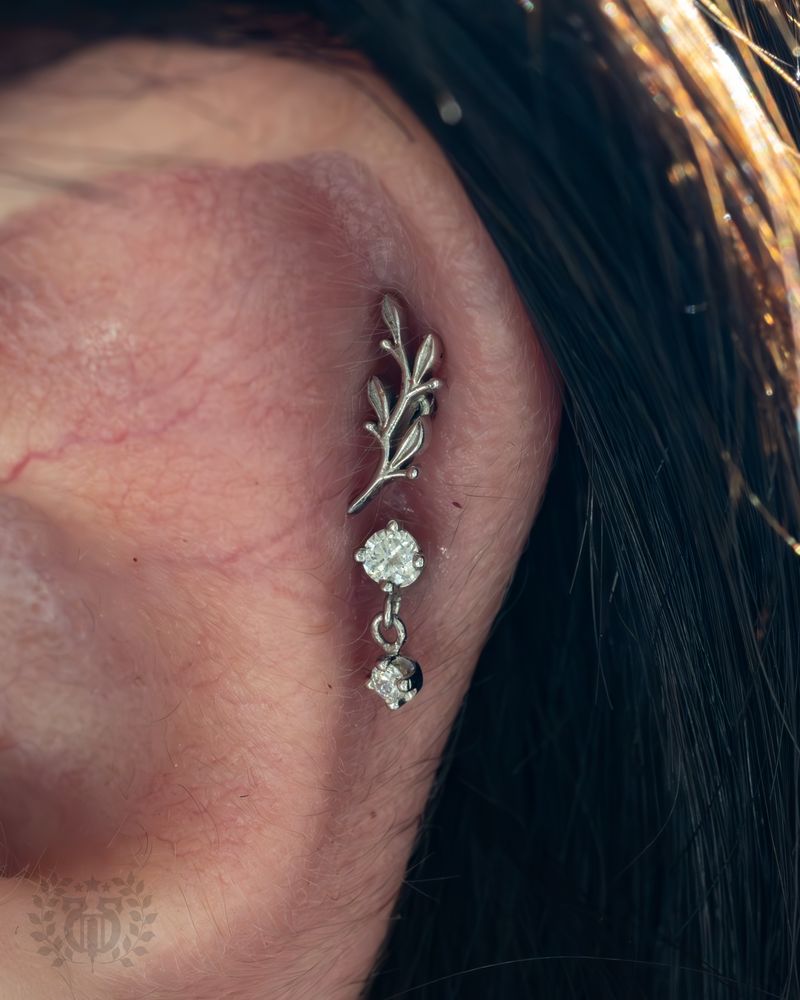
Helix
Outer upper rim of the ear
6–9 months typical
The standard starter cartilage for a teen. Accessible, familiar jewelry vocabulary, pairs cleanly with existing lobe work. Sleep on the opposite side is the single hardest part of aftercare for the first three months.
Tragus
Small flap in front of the ear canal
6–12 months typical
Harder to hit at the right angle — needs an experienced piercer and anatomy that actually supports it. Catches earbuds, phone speakers, and pillows. A cute placement, not a first-cartilage placement for most teens.
Daith
Innermost curve of the ear, the small ridge above the ear canal
6–12+ months typical
Very popular on social media, partly because of a migraine-relief claim that isn't supported by the evidence. Slow to heal, hard to clean, harder to see in a mirror. Addressed honestly below.
Conch (inner or outer)
The flat cartilage bowl of the ear
9–12+ months typical
Supports larger, sculptural jewelry than a helix. Slower healing and very specific sleep rules — a dedicated travel pillow or contoured pillow for the first several months is not optional for a side sleeper.
Rook
Ridge of cartilage above the daith, inside the upper ear
9–12+ months typical
Narrow tissue fold; a piercing only some ears actually support anatomically. Requires an experienced piercer. If the anatomy isn't there, the right answer is a different placement — not a forced rook.
Industrial
Two helix points joined by a single straight barbell
12–18+ months typical
Two cartilage piercings healing at once, connected by a long barbell that catches on hair, hats, and pillows. Adult-preferred for a reason — we'll talk through it carefully before saying yes to a teen.
Why cartilage complications run higher
Avascular tissue is the mechanism.
The biology of cartilage is the reason the aftercare is stricter and the timeline is longer. This is not a conservative piercer's opinion — it's how the tissue works.
Blood supply
Cartilage is avascular. Nutrients and immune cells diffuse in from surrounding perichondrium instead of arriving via direct blood vessels. Less blood flow means slower healing and lower capacity to clear infection before it takes hold.
Tissue density
Cartilage is structurally firm. A fistula through cartilage remodels more slowly and is more easily disrupted by mechanical trauma — bumping, snagging, sleeping on it — even after the surface looks closed.
Infection consequences
Cartilage infection (auricular perichondritis, in the worst cases chondritis) is harder to treat than soft-tissue infection and can leave visible structural deformity if unmanaged. Every cartilage piercing at Apollo is treated as a site where infection signs get checked seriously.
Timeline reality
A lobe is a six-to-eight-week project. Cartilage is a six-to-twelve-month project. The aftercare discipline required is not comparable between the two — and it's the single most underestimated factor in teens choosing their first cartilage piercing.
Keloid risk
Cartilage is the #1 keloid-risk placement on the body.
Keloids are raised scars that grow beyond the original wound. They're more common on cartilage than any other pierced site, and personal or family history meaningfully raises the risk.
A teen with a personal or family keloid history who wants a cartilage piercing gets a longer conversation at Apollo — often a dermatologist check before booking, sometimes a recommendation to choose a different placement, sometimes a wait. The full dive sits on the keloids and scarring risk guide .
Cartilage-specific aftercare
Eight rules the lobe protocol doesn't include.
Cartilage inherits every lobe aftercare rule and adds several of its own. Most teen cartilage problems are traceable to one of the eight below.
Sleep
No sleeping on the piercing side for at least the first three months — often longer. A dedicated travel pillow (U-shaped or donut-shaped with the middle cut out) lets side sleepers keep the piercing clear. The #1 cause of cartilage bumps is sleep pressure.
Hats and helmets
No hats, beanies, headphones pressing on the piercing, or helmet straps running over it for the first two weeks — minimum. After two weeks, only if the pressure is intermittent and the piercing isn't red, warm, or tender.
Cleaning
Sterile saline spray, 2x/day, directly onto the piercing. Let it air dry or pat with clean non-woven gauze. No alcohol, no peroxide, no Bactine, no tea tree oil. Never rotate the jewelry — rotation advice is twenty years out of date and damages healing tissue.
Earbuds and phones
Off the piercing side. AirPods press on the tragus. Over-ear headphones press on the helix and conch. Phone calls use speaker or the opposite ear for the first several months.
Swimming
No pools, ocean, lake, river, or hot tubs for the first 3–6 months. Showers are fine — let water run over the piercing, don't blast it with direct spray.
Hair and face products
Hairspray, dry shampoo, sunscreen, and makeup should all stay off the piercing. Wash hair with the head tipped forward so product drains away from the ear.
Downsize visit
Book the cartilage downsize at 3–4 months. Initial jewelry is longer to accommodate swelling; once swelling has dropped, a shorter post reduces snagging and speeds the remaining heal. This visit is standard, not optional.
Flare check-ins
Healing is not linear. Bumps, flare-ups, and setbacks happen in a piercing that was previously healing cleanly. If something changes, Apollo checks it in person rather than diagnosing by text.
Jewelry rules for a healing cartilage piercing
Flat-back post. Implant-grade material. Downsize at 3–4 months.
Jewelry choice is not a style decision during the initial heal — it's a healing decision. Style comes later.
- ·Labret (flat-back) post — not a loop, ring, or hoop — for initial healing. A flat inner backing sits flush against the skin and doesn't rotate or torque the fistula as the head moves.
- ·Implant-grade titanium (ASTM F-136) at minimum. Solid 14k or 18k gold is also appropriate. Niobium is acceptable. Plated, externally threaded, or costume-grade jewelry is never used for a healing cartilage piercing at Apollo.
- ·Internally threaded or threadless — so the post surface is smooth through the fistula during insertion and any downsize.
- ·Longer initial post to accommodate swelling, downsized at 3–4 months. The downsize is the difference between a piercing that heals clean and one that keeps catching, bumping, and flaring.
- ·Hoops and rings wait. They look beautiful once healed — and are punishing during the heal because every head movement torques the jewelry. The right sequence is post first, ring later.
Teen autonomy and parental consent
Three roles in the room.
At 13+, the consultation works only if the teen, the parent, and the piercer each play their own role. When one role is missing or collapsed into another, the conversation gets thinner — and so does the decision.
Teen voices the choice
At 13+, the teen sits in the consultation chair and answers the questions. Parent is present for consent, not as a spokesperson. If a teen can't describe what placement they want and why, that's useful information on readiness.
Wanting it is a valid reason
"My friend has it, I want one too" is a real reason, and we won't shame a teen for it. We also won't accept it as sufficient on its own. Valid reason plus informed understanding of the year-long aftercare — that's the full picture.
Parent consents; Apollo decides
Signed parental consent is the legal requirement. The piercer's final say is a separate layer — Apollo can decline a specific cartilage placement on anatomy, skin condition, or placement concerns even if consent is on the table.
The year-long commitment
Before the needle, the teen agrees out loud to the sleep change, the hat break, the downsize visit, the earbud swap, and the realistic possibility of a flare-up along the way. Informed consent on cartilage isn't a checkbox — it's a conversation.
Daith and migraines — honestly
The claim is popular. The evidence does not support it.
Addressed directly because it matters. If a family arrives asking for a daith specifically for migraine relief, we set the expectation before the needle rather than after.
The claim
Daith piercings reportedly relieve migraines by stimulating a pressure point similar to acupuncture. The claim spread through television segments, migraine forums, and social media starting in the mid-2010s.
The evidence
Peer-reviewed evaluations — including Roman 2015 (Otolaryngology) and Cascio Rizzo et al. 2017 (Journal of Neurological Sciences) — found no reproducible migraine benefit from daith piercing. Placebo and expectation effects explain the self-reported improvements that do appear. The American Migraine Foundation advises against piercing as a migraine treatment.
What Apollo tells families
If a family arrives asking for a daith specifically for migraine relief, we set the expectation clearly: the evidence does not support it. A daith is a fine aesthetic choice for a teen who understands the cartilage commitment. As migraine treatment, it's not supported — and we'll say so, respectfully, before the needle.
If you've read otherwise
We believe you. The claim has been repeated on national morning shows and shared by well-meaning friends. Our obligation is honesty, not agreement with whatever is trending. If the daith helps a specific person feel better, that's a placebo effect or expectation effect — both are real, neither is cartilage-specific, and neither is a clinical reason to pierce a teenager.
Sources: Roman 2015, Otolaryngology; Cascio Rizzo et al. 2017, Journal of Neurological Sciences; American Migraine Foundation position on piercing as migraine treatment. The cited peer-reviewed evaluations do not find a reproducible migraine benefit from daith piercing. A daith is a fine aesthetic choice for a teen who understands the cartilage commitment — it's the clinical migraine claim that Apollo doesn't stand behind.
When Apollo says no
Signed parental consent is not the only filter.
Consent is the legal requirement. The piercer's final say is a separate layer — and it exists specifically so that a cartilage piercing a teen shouldn't have doesn't happen just because the paperwork is in order.
Anatomy doesn't support it
The tissue fold is too thin, too tightly curled, too close to another piercing, or the placement the teen asked for is not where their ear's geometry actually allows. The right answer is a different placement, not a forced one.
Active healing or infection nearby
An earlobe still in its initial heal, an active bump or infection on another ear piercing, or recent trauma to the ear. New cartilage waits until neighboring tissue is settled.
Skin condition at the placement
Active eczema, psoriasis, or dermatitis at the site. A current breakout. Cartilage piercings need clear skin to start — we reschedule without hesitation.
Keloid history plus cartilage
Cartilage is the #1 keloid-risk site on the body. A teen with a personal or family keloid history gets a longer conversation, often a dermatologist check, and in some cases a recommendation to choose a different placement or wait.
Not-appropriate requests for a minor
Nipple, genital, oral tongue and most surface piercings are adult-only at Apollo. We will not perform these on a minor regardless of what the teen or parent asks for.
Readiness isn't there yet
If the teen can't articulate the aftercare commitment, if the conversation is being led by a parent speaking for the child, or if something feels off — we reschedule. Cartilage is a year-long choice. It's okay to take an extra week to arrive at it ready.
Cartilage is the #1 keloid-risk placement on the body. Keloid history plus cartilage gets a longer conversation — sometimes a different placement, sometimes a wait.
At 13+, the teen voices the choice. Parent consents. The piercer decides. Three different roles — all of them present in the room.
It is always cheaper to reschedule a cartilage piercing than to pierce before readiness is there.
FAQ
Seven questions families ask about teen cartilage piercings.
The short versions. The pillar sections above carry the full detail.
Why can't a kid get a cartilage piercing the same way they can get a lobe?
Cartilage and lobe are categorically different tissue. A lobe is fleshy and densely vascularized — surface heal in 6–8 weeks, full maturity around 6 months, very low complication rate. Cartilage is firm and avascular (nutrients diffuse in from surrounding tissue rather than arriving via direct blood vessels), so it heals slower (6–12+ months), has higher infection risk, and is the #1 keloid-risk site on the body. At Apollo, the minimum age for cartilage is higher than for lobes for exactly this reason. Under 12 is generally not a cartilage candidate. 12–13 is case-by-case. 13+ is where cartilage becomes appropriate, with the full year-long aftercare commitment on the table.
What's the best first cartilage piercing for a teen?
A standard outer helix on the upper ear rim is the right starter for most teens. It's accessible, pairs cleanly with existing lobe work, uses familiar jewelry, and heals in the 6–9 month range. Tragus, daith, conch, and rook are all legitimate placements but each adds complication — tragus is technically harder, daith is slow to heal and hard to clean, conch requires specific sleep rules, rook needs anatomy that not every ear supports. Industrial (two piercings joined by a single barbell) is adult-preferred and we'll talk through it carefully before saying yes to a teen. The right first cartilage is the one the anatomy supports, the teen understands, and the aftercare can survive.
Does a daith piercing actually help with migraines?
Peer-reviewed evaluations don't support the claim. Roman 2015 (Otolaryngology) and Cascio Rizzo et al. 2017 (Journal of Neurological Sciences) both looked at the daith-migraine claim and found no reproducible benefit; the American Migraine Foundation advises against piercing as a migraine treatment. Self-reported improvements are explained by placebo and expectation effects — both are real, neither is cartilage-specific. If a family arrives asking for a daith for migraine relief, Apollo will be honest about this up front. A daith is a fine aesthetic choice for a teen who understands the cartilage commitment. As a clinical migraine treatment, the evidence is not there.
What's the aftercare for a teen cartilage piercing?
Sterile saline spray 2x/day directly onto the piercing. No alcohol, no peroxide, no tea tree oil. Never rotate the jewelry. No sleeping on the piercing side for the first three months — a U-shaped or donut-shaped travel pillow is worth buying. No hats, beanies, or headphones pressing on the piercing for the first two weeks. No pools, ocean, or hot tubs for 3–6 months (showers are fine). AirPods and over-ear headphones stay on the opposite side. Hairspray, dry shampoo, sunscreen, and makeup stay off the piercing. Downsize visit at 3–4 months — initial jewelry is longer to accommodate swelling, and shortening it reduces snagging for the rest of the heal. Book the downsize before leaving the first appointment.
What jewelry should a teen start with in a cartilage piercing?
Labret (flat-back) post — not a ring or hoop — for initial healing. The flat inner backing sits flush against the skin and doesn't rotate or torque the fistula. Material must be implant-grade titanium (ASTM F-136) at minimum; solid 14k or 18k gold and niobium are also appropriate. Internally threaded or threadless so the post is smooth through the fistula during insertion. Initial post is longer to accommodate swelling, downsized at 3–4 months. Hoops and rings wait until the piercing is fully healed — they're beautiful later and punishing during the heal. Plated, externally threaded, or costume-grade jewelry is never used on a healing cartilage piercing at Apollo.
My teen wants a cartilage piercing because their friend has one. Is that a good reason?
It's a real reason and we won't shame them for it. It's also not sufficient on its own. The additional layer is informed understanding of the aftercare — that cartilage is a 6–12 month commitment, that sleep position will change for three months, that there's a downsize visit at 3–4 months, and that bumps and flare-ups can happen along the way. At 13+, the consultation happens with the teen voicing the choice and answering the questions; the parent is present for consent, not as a spokesperson. If the teen can articulate the commitment out loud and still wants it, wanting-it-because-their-friend-has-it is a perfectly valid underlying reason. If the conversation is being led entirely by the parent, we'll often reschedule.
When does Apollo say no to a teen cartilage piercing even with parental consent?
When the anatomy doesn't support the specific placement (tissue too thin, too curled, too close to another piercing). When there's an active infection or unhealed piercing nearby. When there's active eczema, psoriasis, or dermatitis at the site. When there's a personal or family keloid history combined with a cartilage request — cartilage is the #1 keloid-risk site on the body, so this gets a longer conversation, sometimes a dermatologist check, sometimes a different placement. When the request is a category Apollo doesn't perform on minors — nipple, genital, oral tongue, and most surface piercings are adult-only regardless of consent. And when readiness simply isn't there — if the teen can't articulate the aftercare or the conversation is being led by a parent. Rescheduling is always available and always cheaper than a piercing that shouldn't have happened.
Ready to talk through a teen cartilage piercing?
Bring the teen. Bring the questions. Apollo will bring the honesty.
Apollo teen cartilage consultations run the real conversation — the anatomy check, the placement honest take, the daith-migraine evidence review if it's on the table, the aftercare commitment the teen agrees to out loud, and a clear yes, not-yet, or different-placement answer at the end. Book the consultation and arrive ready.