Kids & Family Piercing
Jewelry Metals Safe For Kids
A parent's chemistry-first guide to jewelry that belongs in a child's healing piercing — ASTM F-136 implant-grade titani
Book a consultationWhy metal choice matters
A healing piercing is a chemistry experiment you didn’t sign up to run.
A fresh piercing is an open channel of wound fluid touching metal for weeks. The metal either sits there inertly or it releases ions — most importantly nickel — into tissue that is actively healing. Nickel-contact dermatitis is the single most common metal sensitivity in humans, and the healing window is exactly when a child sensitizes. Starting with the wrong metal is how a child who had no reaction becomes a child who reacts forever.
The short version. Three metals are documented safe for initial healing in children — implant-grade titanium (ASTM F-136 or F-1295), commercially pure niobium, and solid 14k/18k gold with a verified nickel-free alloy. Everything else is either controversial (surgical steel), conditionally safe only after healing (sterling silver, rose gold, platinum), or unsafe in a fresh piercing (plated, filled, vermeil, costume, pharmacy “hypoallergenic”). This page is the parent-shaped version of that short list.
Five decisions before buying
The questions that do most of the work at the counter.
Before the alloy, before the color, before the shape — five decisions carry most of the safety. A parent who runs these five filters can walk into any jewelry counter, online shop, or piercing studio and sort safe from unsafe in about a minute.
What is the metal, exactly?
Not a marketing word. A specific alloy with a specification. “Hypoallergenic,” “surgical grade,” and “nickel-safe” are unregulated phrases in the US and don’t name a material. If the jeweler can’t say the alloy, treat the jewelry as unknown.
Is it implant-grade?
For a healing piercing in a child, the standard is ASTM F-136 titanium (Ti-6Al-4V ELI), commercially pure niobium, or solid 14k/18k gold with no nickel in the alloy. “Implant-grade” means it has a documented specification for use inside the human body.
Is there a certificate (mill cert)?
Reputable initial-jewelry brands (NeoMetal, Anatometal, Industrial Strength, BVLA) can produce a mill certificate — a one-page chemical breakdown of the specific batch of metal. Studios that carry these brands keep them available on request.
How is it threaded?
Threadless or internally threaded only in a fresh piercing. Externally threaded posts drag the threads through the channel on insertion and removal — a mechanical injury layered on top of a chemical one. A rough thread through a healing channel is how otherwise clean jewelry still causes trouble.
Is there a cultural or religious requirement?
Some families have long traditions of gold-only earrings — South Asian, Latin American, Middle Eastern, and Jewish customs among them. Solid 14k or 18k gold with a verified alloy and nickel-free certification is fully compatible with initial healing. We talk through it openly; the tradition doesn’t have to be compromised to stay safe.
The safe short list
Twelve specific metals and alloys, named honestly.
Safe for a healing child’s piercing at the top, “fine after full healing” in the middle, and “not in a fresh channel” at the bottom. The list is specific on purpose. When the jeweler’s answer matches one of these exact names, the conversation gets easier.
ASTM F-136 titanium
Ti-6Al-4V ELI — the aerospace/orthopedic-implant spec. Apollo’s default for every initial piercing, including children. No nickel in the alloy, no ion release at body temperature, anodizes to a range of colors without coatings that can wear.
ASTM F-1295 titanium
Ti-6Al-7Nb — a second implant-grade titanium alloy that swaps vanadium for niobium. Equally accepted by the professional piercing industry for initial piercings. Slightly less common in the US market; meaningful in European manufacturing.
Commercially pure niobium
Elemental niobium, not an alloy. Biocompatible, heavier than titanium, takes anodized color beautifully. A favorite for clients who react to trace metals in titanium alloys (uncommon but real).
Solid 14k yellow gold (nickel-free)
Must be stamped, must name the alloy balance, must be documented nickel-free. BVLA is the US reference manufacturer. Gold is traditional for children in many cultures — safe for initial healing when the alloy is verified.
Solid 14k white gold (nickel-free)
Older white-gold alloys used nickel for the white color. Modern nickel-free white gold uses palladium. Verify. If the jeweler can’t confirm palladium-based, skip it — assume nickel.
Solid 18k gold (nickel-free)
Higher gold content (75%). Softer metal. Appropriate once the piercing is fully healed and the jewelry won’t take daily impact. The alloy still has to be verified nickel-free.
14k/18k rose gold (copper alloy)
Rose gold gets its color from copper, not nickel. A reasonable option for a truly healed piercing in a child with no copper sensitivity. Confirm the alloy balance with the jeweler.
Platinum (950)
Dense, expensive, biocompatible. Rarely used in piercing jewelry because it’s heavy and hard to machine for small threaded parts, but technically safe.
316L/316LVM surgical steel
The historical standard. Contains roughly 8% nickel. Industry consensus moved away from it for initial piercings because some clients react. The EU allows it under strict nickel-release limits; the US has no equivalent rule. Not our default for children.
“Hypoallergenic” base-metal studs
An unregulated marketing word. Pharmacy-aisle “hypoallergenic” ear studs are often nickel-plated base metal with a thin coating. Never for a healing piercing in a child.
Gold-plated / gold-filled / vermeil
Plating is a thin gold layer over a cheap base (usually brass or nickel alloy). Wears through. The underlying metal ends up in the healing channel. Vermeil is sterling silver dipped in gold — still silver underneath. None of these are safe for initial healing.
Sterling silver (.925)
Beautiful for finished jewelry, wrong for fresh piercings. Silver oxidizes in wound fluid and deposits dark silver sulfide into the channel — the staining is called argyria and it is often permanent. Safe for a fully healed lobe; never for a new one.
“Hypoallergenic” is a marketing word in the United States. It names nothing. Ask for the specification.
ASTM F-136 titanium, commercially pure niobium, and solid nickel-free 14k or 18k gold. That short list is the whole safe universe for a child’s fresh piercing.
Plating wears. Gold-plated studs become base-metal studs inside a healing channel — often within weeks.
Six metal categories
How the whole jewelry world sorts for a child’s first piercing.
Six categories — three we use, three we don’t — covering everything a parent is likely to find at a counter or in a drawer at home. Each category is defined by chemistry, not by price or appearance.
Implant titanium (ASTM F-136)
The baseline. Everything Apollo pierces with. If the parent takes only one fact home, it is this spec number. “ASTM F-136” on the packaging or the mill cert closes most of the safety question in one line.
Niobium (commercially pure)
The excellent alternative. Slightly heavier than titanium, anodizes to richer colors, genuinely inert. A good choice for the child who shows the very rare titanium response, or for the family that prefers the denser feel and deeper color palette.
Solid gold (14k / 18k, nickel-free, verified)
The tradition-compatible safe option. Requires verification — a stamp alone isn’t enough; the alloy balance needs to be on record. BVLA-level manufacturers carry the documentation. Many families have carried gold piercings across generations for good reasons; the reasons still work when the alloy is right.
316L surgical steel
The controversial middle ground. Legal, widely sold, industry-demoted for initial piercings. The nickel is alloyed (not free), but trace ions can leach — especially in a healing wound. We don’t use it on children. We won’t scold a parent who inherited a steel hoop, but we’d like to change out of it before it drives a reaction.
Costume / plated / fashion metals
Decorative jewelry for healed skin only. Brass, bronze, nickel-plated base metal, zinc alloy, mystery “silver-tone.” A category that doesn’t belong anywhere near a child’s healing channel. This is the category parents most often mistake for safe because it looks like real jewelry.
Sterling silver / silver-filled
Fine for a healed lobe. Wrong for a fresh one. The oxidation-into-wound-fluid problem is specific to silver; it doesn’t apply to titanium or gold. A sterling heirloom belongs in a healed piercing, not the starter jewelry.
By placement
Jewelry shape per body site, during healing.
Metal is half the answer. Shape is the other half. The jewelry that belongs in a first-lobe piercing isn’t the same shape as the jewelry that belongs in a nostril or a helix — even when the alloy is identical.
First lobe — flat-back stud
Implant-grade titanium flat-back labret stud or solid 14k gold equivalent. Flat disc sits against the back of the ear, the gem sits on the front, no sharp butterfly clasp to trap bacteria or dig during sleep. This is the Apollo default for a child’s first lobes.
Second/third lobe
Same standard as the first: titanium or solid gold flat-back. Matching jewelry keeps the stack visually clean and the metal profile consistent across all the healing sites.
Upper-ear cartilage (older kids/teens)
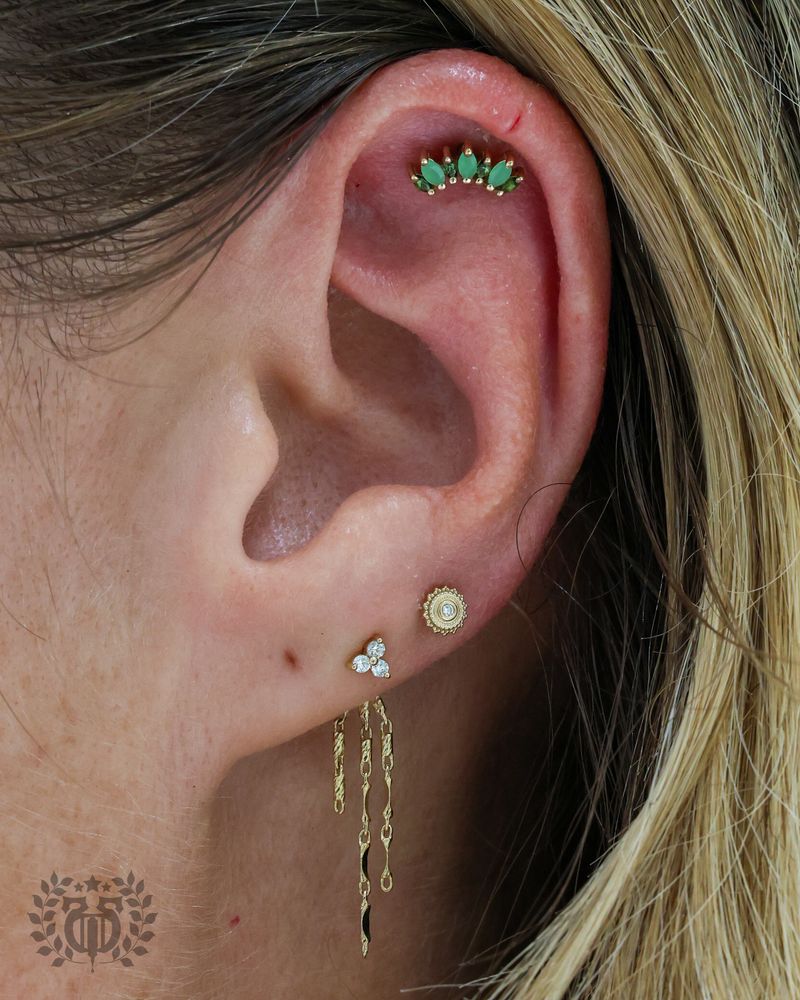
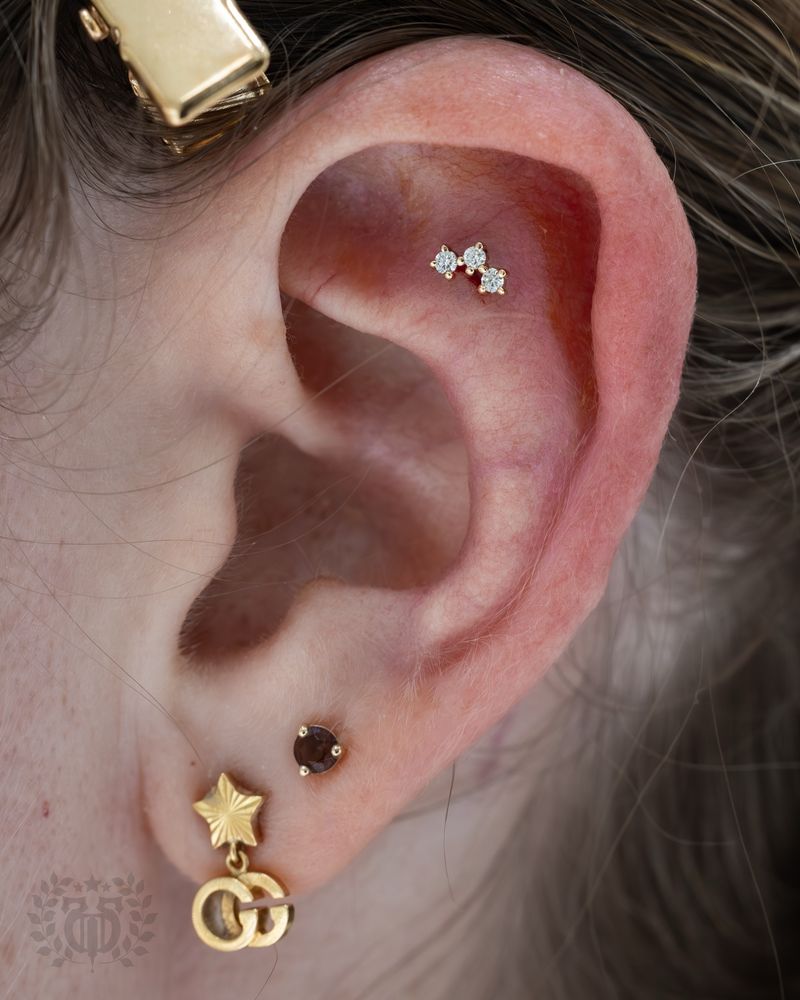
Titanium labret stud for a flat piercing, titanium seamless ring for a helix that wants a ring. Longer post during the swelling phase, a downsize appointment on the calendar before the child leaves the studio. Cartilage is not where costume jewelry gets to try its first experiment.
Nostril (older kids/teens)
Titanium L-bar or corkscrew post, or 14k solid gold equivalent. Nostril tissue is thin but active; the post has to handle daily face-washing and the occasional bumped sleeve without flexing.
Navel / other body sites
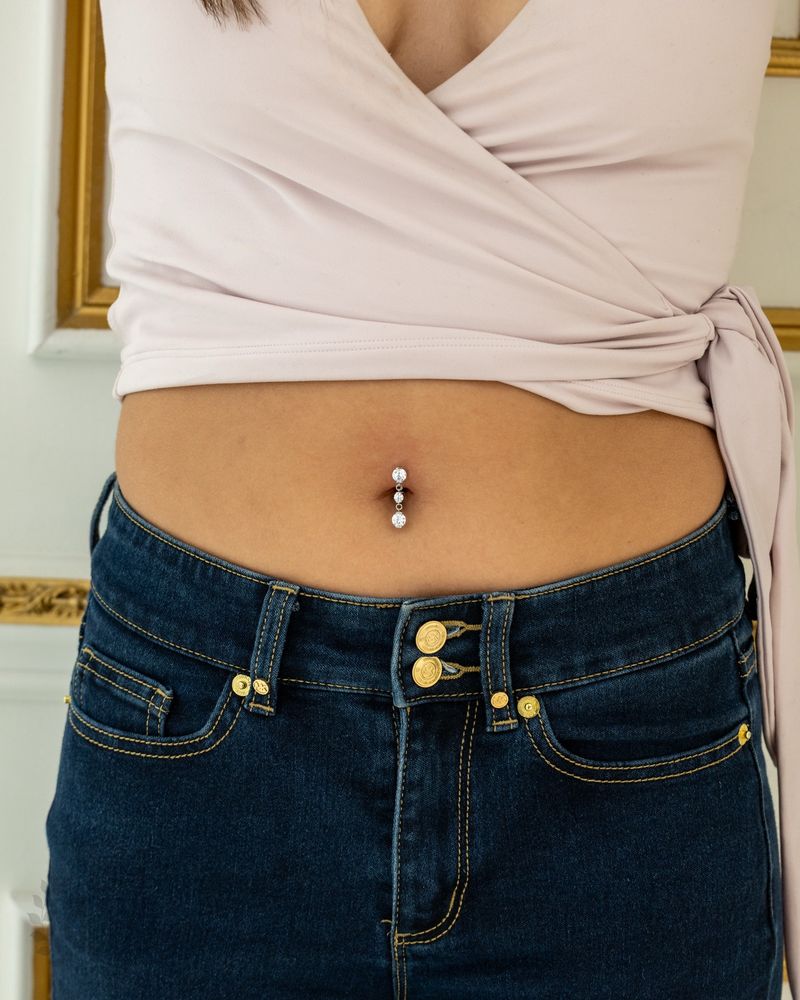
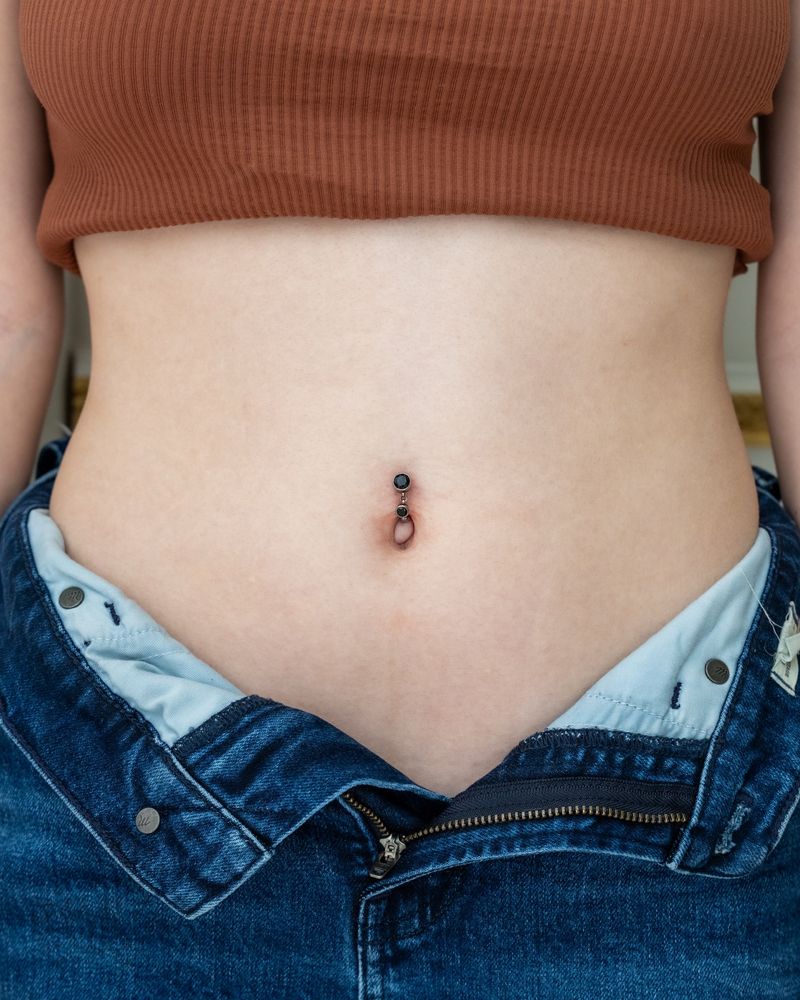
Not typical in the pediatric age range. Where a teen is old enough and the anatomy supports it, the standard is the same: ASTM F-136 titanium curved barbell, internally threaded, sized for swelling.
Four safety tiers
What belongs where in a child’s jewelry life.
Tier 1 is the initial-piercing universe. Tier 2 is post-healing everyday wear. Tier 3 is legal-but-demoted. Tier 4 is the category to keep out of healing channels entirely.
Tier 1 — Safe for initial healing in children
ASTM F-136 titanium, ASTM F-1295 titanium, commercially pure niobium, and solid 14k/18k gold with verified nickel-free alloy. These are the metals a fresh piercing on a kid should ever see. All four are documented implant-grade or equivalent, all four carry manufacturer records, and all four can be traced to a specific batch of metal.
Tier 2 — Safe only after full healing
Sterling silver (.925), rose gold, platinum, and high-quality gold-filled pieces from known jewelers. Fine for a fully healed lobe in a child who isn’t reactive. Not for a fresh channel. “Fully healed” means confirmed by a piercer or pediatrician, not a parent’s best guess.
Tier 3 — Controversial; avoid for children
316L and 316LVM surgical steel. Legal, cheap, widely sold, contains about 8% nickel. Industry consensus demoted it from initial-piercing status because of sensitization risk. Not Apollo’s choice for a child’s first piercing. A teen already comfortably wearing steel, uneventfully, for years is a different conversation — but we don’t start there.
Tier 4 — Never in a healing piercing
Nickel-plated studs, “hypoallergenic” pharmacy earrings, gold-plated or gold-filled or vermeil pieces, costume metals, mystery alloys from international marketplaces, sterling silver in a fresh channel, and any jewelry that can’t name its alloy. Category-defining risk for nickel-contact dermatitis and chronic channel irritation.
Pairings & sizing
Eight practical combinations for healing and beyond.
Real decisions parents make once the spec question is settled — backings, mixing metals, matching siblings, installing heirlooms later, and the school-dress-code question that comes up more often than expected.
Lobe stud + backing
Titanium flat-back labret stud: the threaded gem on the front, the smooth disc at the back. Replaces the classic butterfly-clasp stud, which traps skin oils, hair, and shampoo against the piercing.
Gold stud + titanium post
Some families want a solid-gold gem for a lobe. A solid-gold front-piece on a titanium post is a reasonable compromise for cultural preference when a fully gold threadless end is outside the budget — as long as the alloy is documented.
Two lobes, matched metals
Keep both lobes in the same metal during healing. Mixing titanium on one ear and gold on the other is fine chemically; matching them just makes jewelry swaps and downsizes simpler when the time comes.
Healed lobe + gifted heirloom
Once the channel is fully healed (~6 months for lobes in kids), a grandparent’s sterling-silver or gold-plated earring becomes an option for special-occasion wear. Not daily, not overnight, not during healing — but for a school photo or a family holiday, yes.
Anodized colors
Titanium and niobium both anodize to a spectrum — gold, rose, blue, purple, rainbow. The color is a surface oxide, not a coating, and does not chip into the healing channel. A safe way to offer a child color without risking plating.
Clear bioplastic (rare)
A few implant-grade polymers (PTFE, tygon) exist for MRI and adhesive-sensitivity edge cases. Not typical in kids; mentioned only so the parent recognizes the name if a pediatrician raises it.
Dangles, hoops, charms
Not for healing. A healed lobe (6+ months) can take a small, light, solid-gold or titanium hoop. Dangles are a snag risk for long hair and clothing; we hold them for teen years, not the first year.
School-compliant options
Some schools and sports programs ban dangles and hoops but allow flat studs. Titanium and solid-gold flat-backs clear both the safety and the dress-code bar at the same time.
Six questions for the piercer
The consultation is a two-way audit.
Six questions that a working kids-piercing studio answers without hesitation. A studio that reaches for a marketing word instead of a specification is telling a parent something important in its first sentence.
“What exact metal is in the jewelry you use for kids?”
Correct answer names a specification: ASTM F-136 titanium, ASTM F-1295 titanium, commercially pure niobium, solid 14k/18k nickel-free gold. Any answer that starts with a marketing word (“hypoallergenic,” “surgical,” “nickel-safe”) without a spec behind it is an incomplete answer.
“Who manufactures it, and can you show me the mill certificate?”
NeoMetal, Anatometal, Industrial Strength, BVLA — manufacturers with documentation. A studio carrying real implant-grade jewelry can produce the batch paperwork. A studio stocking unknown bulk imports cannot.
“Is the post internally threaded or threadless?”
Either answer is acceptable. “Externally threaded” is not. External threads pull through the channel on insertion and removal, which is a mechanical issue independent of the metal. In a child, we want the smoothest possible post.
“What size — gauge and length — fits a kid’s ear?”
Common answers: 16g or 18g post for a child’s lobe, with a post length that accommodates initial swelling (usually slightly longer than the finished piercing). A downsize gets scheduled 4–8 weeks later. A studio that sizes a child like an adult has missed something.
“When can we change the jewelry?”
Short version: not before the piercing is fully healed (roughly 6 months for a lobe in a child, longer for cartilage). Longer version: the first jewelry change should happen at the studio, by the piercer, with sterile technique — not at the kitchen table. The downsize appointment is where that first change happens.
“What if our family tradition is gold-only?”
Solid 14k or 18k gold from a verified nickel-free alloy is fully compatible with initial healing. The conversation worth having is about documentation (who made it, what’s in it) rather than tradition vs. safety — the two don’t have to be opposed.
Eight common mistakes
Each one with a fix.
Every one of these is easy to make and easy to correct. None of them ruins a piercing on its own; a few of them compound and do.
Buying “sterling silver” starter studs because they look classic.
Fix: Silver oxidizes in wound fluid and deposits dark silver sulfide into the healing channel. The staining is called argyria and can be permanent. Fix: titanium or solid gold for the initial jewelry; save the sterling heirloom for a fully healed piercing (~6 months later).
Trusting “hypoallergenic” on pharmacy-aisle earrings.
Fix: “Hypoallergenic” is not a regulated term in the US. Most pharmacy “hypoallergenic” studs are nickel-plated base metal with a thin coating that wears through. Fix: ignore the word entirely; ask what the metal actually is, by specification.
Using gold-plated or gold-filled jewelry for a fresh piercing.
Fix: Plating is a micro-thin gold layer over a cheap alloy base — usually brass or nickel-bearing metal. In a healing channel the plating wears, and the base metal touches the wound. Fix: solid 14k or 18k gold, stamped and verified nickel-free, or don’t buy gold yet.
Bringing grandma’s heirloom earrings to the appointment.
Fix: A gift with decades of family meaning is often exactly the wrong metal for an initial piercing. Fix: pierce with implant-grade titanium or solid gold; ceremonially put the heirloom in at the downsize or the one-year mark. The meaning is preserved; the channel isn’t stressed.
Buying a pack of costume studs for “backups” from an online marketplace.
Fix: International marketplace body jewelry is the category with the worst nickel-release track record in independent testing. Cheap, cute, risky. Fix: buy backup jewelry from the studio, from a US brand with a mill cert, or skip backups entirely — a child doesn’t need a jewelry rotation during healing.
Changing jewelry too early because a friend said it was healed.
Fix: Surface closure and deep healing are not the same thing. A lobe often looks healed at 6–8 weeks and is still channel-immature at 3–4 months. Fix: wait for the piercer’s clearance or the full healing window (see the healing-timeline page); change the first time at the studio, not at home.
Ignoring early allergy signs because “it’s just healing.”
Fix: Persistent itching, spreading redness that extends beyond the piercing, clear weeping that won’t stop, or eczema-like skin on the ear are contact-dermatitis signals, not routine healing. Fix: come back to the studio — changing metal (usually to niobium or verified gold) resolves most of these cases quickly.
Assuming titanium on the packaging means implant-grade titanium.
Fix: “Titanium” unadorned can mean commercially pure, Ti-6Al-4V (non-ELI), or a mystery alloy with titanium in the name. Fix: ask for the ASTM number. F-136 or F-1295. Anything without a spec isn’t implant-grade — even when it says titanium.
A parent’s shopping checklist
Eight items that close most of the safety question.
Fold this page, screenshot this section, hand it to the jeweler. If the answers line up, the jewelry is ready for a child. If they don’t, another piece is.
- ·Confirm the spec in writing before the appointment: ASTM F-136 titanium, ASTM F-1295 titanium, commercially pure niobium, or solid 14k/18k nickel-free gold. “Hypoallergenic” is not a spec.
- ·Ask the studio which manufacturer they use. NeoMetal, Anatometal, Industrial Strength, and BVLA are the US reference brands. A mill certificate should be available on request.
- ·Require internally threaded or threadless posts. External threads are a non-starter for a child’s fresh piercing.
- ·Check the sizing plan. Initial post length accommodates swelling; a downsize appointment is already on the calendar before the child leaves.
- ·Verify the gold alloy is nickel-free when choosing gold. Modern white gold should be palladium-based, not nickel-based. The stamp alone (14k, 18k) does not prove nickel absence.
- ·Skip sterling silver, silver-filled, gold-plated, gold-filled, and vermeil for the initial jewelry. All four have known incompatibilities with fresh channels.
- ·Skip anything from a pharmacy, big-box retailer, or international marketplace as starter jewelry — regardless of what the label claims.
- ·Write down what the jewelry is. When a pediatrician asks later, the answer “ASTM F-136 titanium from Anatometal” is the answer they want to hear, not “I think it was titanium?”
Culture, color, sensitivity
Three personalization layers the chemistry still supports.
Safety doesn’t have to erase personal meaning. Three recurring situations where a family’s preference shapes the choice — and where the correct metal still has a version that fits.
Religious and cultural preference
Some families carry a tradition of gold-only piercing — South Asian, Latin American, Middle Eastern, Jewish, and other customs include it. Solid 14k or 18k gold with a documented nickel-free alloy fulfills the tradition and the safety standard at the same time. The conversation at consult is about documentation, not compromise.
Color preference
Titanium and niobium both anodize to a wide color range — gold, rose, blue, purple, rainbow. The color is a surface oxide, not a coating, and doesn’t flake off into the healing channel. Children who want color can have color without the plating problem.
Sensitivity history
A child with a known nickel reaction (the jeans-button rash, the watch-back rash, the cheap-earring rash) should avoid even trace-nickel alloys. Niobium and verified nickel-free gold are the cleanest options. A child with a rare titanium sensitivity gets niobium. A child with a copper sensitivity skips rose gold.
Siblings, gifts, heirlooms
Four practical family notes.
Small decisions that recur — matched siblings, grandparent gifts, ceremony days, school-picture occasions. Each has a workable path that protects the healing channel and keeps the family meaning intact.
Sibling pairs
Sisters or brothers getting pierced together look best with matching metal across both sets of ears — same titanium, same gold, same finish. Easier to keep track of which jewelry belongs to which child, and easier to schedule matching downsize appointments.
Family gifts and grandparent heirlooms
The grandparent who brings gold earrings to the appointment is doing something lovely. The jewelry usually goes in later — at the downsize or the one-year mark — not in the initial piercing. Most grandparents, asked directly, prefer to protect the child’s healing over installing the gift on day one.
Cultural ceremony alignment
In traditions where the piercing is tied to a specific ritual or age (Karn Vedha, quinceañera, baby-blessing ceremonies), Apollo books accordingly. Implant-grade jewelry at the ceremony; a cultural or heirloom piece installed later, once the channel is ready to host it.
Photos and special occasions
School picture day, a family wedding, a religious holiday — all legitimate moments for a fancier jewelry change. Schedule the change at the studio, time it after healing, and plan the “everyday” jewelry that goes back in once the occasion is over.
Sterling silver is beautiful on a healed ear and wrong on a new one. Silver oxidizes in wound fluid and leaves dark staining that often doesn’t come back out.
A gold tradition and a nickel-free alloy are fully compatible. The conversation worth having is about documentation, not about whether the tradition is safe.
A studio that can’t produce the mill certificate for its jewelry is a studio that doesn’t know what’s in its jewelry.
FAQ
Nine questions every parent asks about jewelry metal.
The short versions. Deep dives live in the pillar sections above.
What jewelry metal is safest for a child’s first piercing?
ASTM F-136 implant-grade titanium (Ti-6Al-4V ELI) is the Apollo default and the professional-studio recommended standard for initial piercings in children. Commercially pure niobium and solid 14k/18k gold with a verified nickel-free alloy are the other two metals that belong in a fresh piercing. All three are biocompatible, none release nickel ions into healing tissue, and all three are available through reputable US manufacturers (NeoMetal, Anatometal, Industrial Strength, BVLA) with a batch-specific mill certificate on request. “Hypoallergenic,” “surgical grade,” and “nickel-safe” without a specification behind them are marketing words, not safety guarantees.
Is surgical steel safe for kids?
Controversial. 316L and 316LVM surgical steel contain roughly 8% nickel, alloyed into the metal. Professional studios moved away from recommending it for initial piercings because trace nickel ions can leach from the alloy — especially in a healing wound — and sensitize children who weren’t reactive at the start. The EU allows it under the strict nickel-release limits of the Nickel Directive; the US has no equivalent regulation. Apollo doesn’t use surgical steel for children’s initial piercings. A teen already wearing steel uneventfully for years is a different conversation, but we don’t start there.
Is sterling silver okay for a child’s first piercing?
No. Sterling silver (.925) is safe and beautiful on a fully healed ear, and wrong for a fresh one. Silver oxidizes when it contacts wound fluid and deposits silver sulfide into the healing channel — a dark permanent staining called argyria that often doesn’t come back out. Save the sterling heirloom for a piercing that’s been healed for six months or more. For the initial piercing, use titanium or solid nickel-free gold.
What about gold-plated or gold-filled earrings?
Not for initial healing. Gold-plated jewelry is a micro-thin layer of gold over a cheap alloy base (usually brass or nickel-bearing metal); the plating wears through, often within weeks in a healing channel, and the base metal ends up touching the wound. Gold-filled and vermeil have the same structural problem — they look gold but aren’t solid gold underneath. For a child’s first piercing, the correct choice is solid 14k or 18k gold with a stamped and verified nickel-free alloy, or implant-grade titanium.
Our family tradition is gold earrings for a child’s piercing. Is that safe?
Yes, when the gold is solid and the alloy is verified nickel-free. Gold-only traditions are strong in South Asian, Latin American, Middle Eastern, and Jewish families among others — and solid 14k or 18k gold from a reputable manufacturer is fully compatible with initial healing. The cautions are specific: stamped solid (not plated or filled), nickel-free alloy (older white-gold formulations used nickel; modern nickel-free white gold is palladium-based), and ideally an implant-jewelry brand like BVLA so a mill certificate is available. The tradition and the safety standard don’t have to compete.
My child has a nickel allergy — what jewelry should we use?
Avoid every alloy that contains nickel, which means avoiding surgical steel, nickel-plated fashion jewelry, older white gold, and any metal without a documented composition. Safe options: ASTM F-136 titanium (no nickel in the alloy), commercially pure niobium (elemental, no alloy), and solid 14k/18k gold with a verified nickel-free alloy. Rose gold is copper-alloyed (nickel-free), reasonable unless there’s also a copper sensitivity. A child with a known nickel reaction — the classic jeans-button rash, watch-back rash, or cheap-earring rash — should be pierced with niobium or verified gold from day one, not surgical steel.
When can my child change their jewelry?
Not before the piercing is fully healed, which is roughly six months for a child’s lobe and longer for cartilage. A lobe often looks healed at six to eight weeks and is still channel-immature through the three- to four-month window. The first jewelry change should happen at the studio, performed by the piercer with sterile technique, not at the kitchen table. Apollo books a downsize appointment before the child leaves the initial piercing — that’s when the longer post used during swelling comes out and a properly sized post goes in. See the kids healing-timeline page for the full windows.
How do I know if my child is reacting to the metal vs. just healing normally?
Normal healing: mild pinkness around the piercing, small amount of clear or straw-colored crust, tenderness for the first week or two, tapering over months. Possible metal reaction: persistent itching, spreading redness that extends beyond the piercing site, clear weeping that won’t resolve, eczema-like dry skin on the ear, or the channel that never settles. Any of those patterns, especially after week four to six, is worth a return visit. Changing the metal — usually to niobium or verified nickel-free gold — resolves most contact-dermatitis cases quickly. If the area is hot, swollen, producing thick yellow/green pus, or accompanied by fever, that’s a possible infection rather than an allergy, and pediatric review is the right next step.
What’s the difference between US and EU rules on body jewelry?
The European Union’s Nickel Directive (now under REACH regulation) limits how much nickel jewelry can release in contact with skin — measured in micrograms per square centimeter per week — and specifically covers body-piercing jewelry. The US has no equivalent federal nickel-release standard for body jewelry; the FDA regulates some body jewelry as medical devices but does not set an across-the-board nickel limit. The practical implication: a piece of surgical steel legally sold in both markets may be required to stay under a nickel-release threshold in Europe and not tested against any threshold in the US. For a child, the safer choice is to skip the regulatory gap entirely and use implant-grade titanium, niobium, or verified nickel-free solid gold.
The alloy, in writing.
Book the kids consultation. Bring the questions on this page.
Apollo uses ASTM F-136 implant-grade titanium by default and stocks commercially pure niobium and solid nickel-free 14k/18k gold for families who want them. Mill certificates are available on request, internally threaded and threadless posts only, and the downsize appointment is booked before you leave. Walk in with the specification in mind — we’ll show you the paperwork that matches it.