Kids & Family Piercing
Our Minimum Age Policy Explained
Apollo's full minimum-age policy for kids and teen piercings, explained placement by placement.
Book a consultationWhy the policy exists
Thresholds are architecture, not bureaucracy.
Every age threshold on Apollo's chart is a specific decision by a specific piercer, informed by specific clinical and developmental considerations for that specific placement. The architecture — published, consistent, three-gate — exists because the alternative (case-by-case judgment at the counter) produces inconsistency across families and worse outcomes for kids. The policy isn't gatekeeping; it's fairness.
The short version. Three gates: age threshold, anatomical exam, young-person willingness. Four categories of constraint: anatomical readiness, developmental consent, aftercare realism, California law. The chart is the surface; the reasons are the substance. Pricing is a consultation conversation.
Five policy decisions
The thinking behind the chart.
Five questions the chart answers, each one deciding a specific architectural feature of Apollo's age policy.
What does 'readiness' actually mean?
Three things: anatomical maturity (is the tissue ready?), aftercare capacity (will the child/teen follow the saline routine for months?), and developmental consent (does the young person understand what they're agreeing to?). Apollo's thresholds reflect where all three converge for each placement — not one of the three in isolation.
What does California law require?
Health & Safety Code §119302 requires parental consent and presence for any body-art procedure on a minor. Some municipalities add rules about specific placements; LA County's Body Art Program enforces the Safe Body Art Act. California's law doesn't set most minimum ages — it delegates that to studio policy, which is why Apollo's published thresholds matter.
What does studio policy add on top?
Apollo's policy is stricter than California law for good reasons: California allows most piercings with parental consent; Apollo adds placement-specific thresholds because the legal minimum isn't the same as the clinical minimum. The law protects the studio; the policy protects the child.
Why don't the thresholds flex for persuasive parents?
Because the reasons for the thresholds don't flex. A navel shelf doesn't mature because a parent wants it to. A septum sweet spot doesn't appear on demand. Apollo's policy is published, consistent, and applied the same way to every family — that consistency is what makes it fair, not bureaucratic.
What happens at the threshold age?
Meeting the age opens the door. The anatomical exam confirms whether this specific body is ready for this specific placement. Some fourteen-year-olds have navel anatomy; many don't. The age is a floor, the exam is the green light, and the teen's own willingness is the third piece. All three have to align.
Twelve age thresholds
Every placement, every minimum, every reason.
Twelve thresholds from the lobe at five to the 18+ category. Each card names the minimum age and the specific anatomical / developmental / aftercare reasoning behind it.
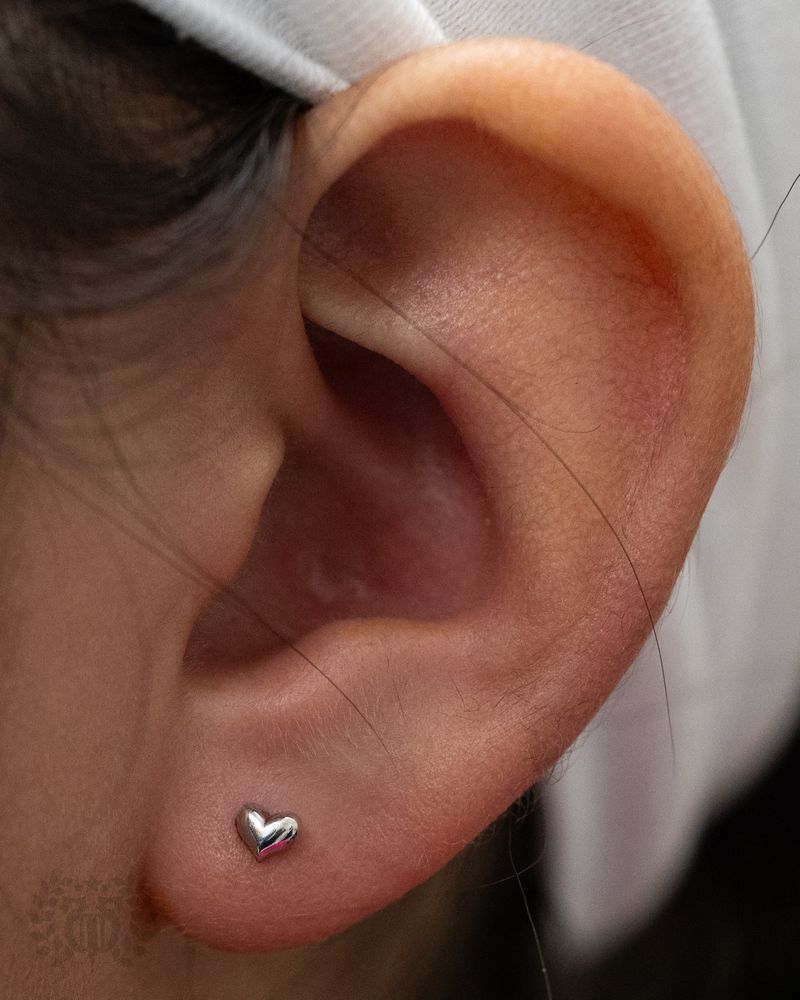
Earlobes — 5+
Apollo's earliest placement. A five-year-old can hold still, understand 'the pinch,' and follow saline aftercare with parent help. Under five, the conversation is about waiting — the child's ability to self-regulate the aftercare isn't there yet, and a tugged-at new piercing becomes a re-injured one.
Second lobes — 5+ (usually older)
Same threshold as first lobes. Most families wait until the child is seven or eight and the first lobes are fully healed before adding a second set, for aftercare simplicity. Apollo doesn't mandate the wait; it just observes that families who space the lobe rows have easier healing.
Simple cartilage / helix — 13+
The standard outer-ear rim piercing. Threshold reflects the slower healing cartilage demands (9–12 months to maturity) and the consistent saline aftercare a thirteen-year-old can self-manage. Younger cartilage piercings frequently set back from trauma the child can't self-regulate.
Complex cartilage (forward helix / conch / daith / rook / snug / tragus / industrial) — 14+
The anatomical-exam gate matters most here. Threshold reflects the maturity of specific ear-anatomy landmarks and the realistic aftercare demand (year of no sleeping on side, patience with downsize timing, no earbud-on-healing-cartilage). Many 14-year-olds are ready; some aren't.
Nostril — 14+
Nostril tissue is thin and active; the placement shape depends on the specific nose. Threshold reflects the point at which most noses have settled into adult-ish contour; 4–6 months of healing and the teen's willingness to follow cleaning protocol when cold season and allergies inevitably stress the site.
Navel — 14+ (anatomy-dependent)
The navel shelf is the make-or-break. Some 14-year-olds have it, some 16-year-olds don't. Threshold is the age at which a meaningful fraction of clients have the anatomy; the exam determines the individual case. 9–12 months of healing plus clothing friction throughout. Apollo won't pierce an inadequate shelf regardless of age.
Septum — 16+
The 'sweet spot' — thin tissue below the cartilaginous nasal septum — matures through adolescence. Threshold reflects the age at which most teens have clear sweet-spot anatomy and the judgment to commit to a visible-from-across-the-room piercing with 6–8 months of healing.
Eyebrow — 16+
Surface-oriented placement through the skin ridge of the brow. Higher migration rate than most; placement decisions benefit from later-adolescent judgment. Apollo's threshold is 16+ because the aesthetic commitment and the aftercare realism both matter; a shifted eyebrow piercing is a lesson we'd rather not teach the hard way.
Nipple — 18+ only
Not performed on minors at Apollo regardless of consent. Nipple tissue continues maturing through later adolescence; the placement carries specific anatomical, functional, and sexual-cultural implications that Apollo prefers the client evaluate as a legal adult. The threshold is consistent; no exceptions.
Genital — 18+ only
Not performed on minors at Apollo. Anatomical maturity, informed consent, and the explicit sexual-functional considerations make this a legal-adult-only placement. Parents occasionally ask; the answer stays the same.
Tongue / oral — 18+ only
Not performed on minors at Apollo. Oral anatomy has specific nerve-path, web, and dentition considerations; the placement's interaction with dental health benefits from mature anatomy and independent consent. The related surface piercings are also 18+.
Surface / transdermal / dermal — 18+ only
Not performed on minors at Apollo. Surface piercings and dermal anchors have distinct migration / rejection profiles that interact with continuing physical development; Apollo's line is 18+ across the whole surface-piercing family. A teen who asks at seventeen will be welcomed at eighteen.
Age is a floor. Anatomy is the gate. Teen willingness is the third piece. All three align, or the appointment reschedules.
California law is a minimum. Apollo’s policy is stricter because the legal minimum isn’t the clinical minimum.
A 'wait six months' answer is a real answer. The door isn’t closed — it’s held open.
Six policy categories
Readiness, law, and studio policy — named honestly.
Six categories of consideration that the chart compresses into specific numbers. Unpacking them makes the policy legible.
Readiness — anatomical
Is the tissue physically ready? Lobes are ready in most children by age five. Cartilage matures through adolescence. Navel shelves and septum sweet spots and industrial ear-compatibility all have individual variation; the exam reveals each. Age thresholds reflect the population-level readiness curve for each placement.
Readiness — developmental
Can the young person understand what they're agreeing to? A five-year-old can understand 'the pinch' with parent support. A thirteen-year-old can understand 'a year of careful aftercare.' A sixteen-year-old can evaluate a septum's visibility decision. An eighteen-year-old legal adult can consent to genital / nipple / tongue placements as their own informed choice.
Readiness — aftercare
Will the child or teen follow the saline routine for the full healing window? Lobe healing is relatively forgiving. Cartilage healing punishes non-compliance. Navel healing is vulnerable to clothing friction for nine to twelve months. Thresholds partly reflect the realistic self-management capacity at each age.
Law — California
HSC §119302 requires parental consent and presence. The law doesn't prescribe minimum ages for most placements; it sets the consent framework and lets studio policy fill in the detail. Apollo's published thresholds are compatible with California law; they add clinical standards on top.
Law — municipality and county
LA County's Body Art Program enforces the Safe Body Art Act. Some California municipalities have added specific rules for ear-lobe-only exceptions or specific placements. Apollo operates consistently with LA County regulation while applying its stricter placement-specific thresholds studio-wide.
Studio policy — Apollo
Published, consistent, non-negotiable. Thresholds don't flex for persuasive parents or eager teens. The policy exists because the three gates (age, anatomy, autonomy) produce better outcomes than any one of them alone — and because consistency across families is itself a form of fairness.
The three gates
How age, anatomy, and autonomy interact.
Three independent gates plus the parental-consent gate specific to minors. None overrides another; any one can delay the appointment. All four align or the appointment reschedules.
Gate 1 — Age threshold
The first gate. Meeting the age means Apollo is willing to have the consultation for the placement. A six-year-old meets the lobe gate; a thirteen-year-old meets the simple-cartilage gate; a sixteen-year-old meets the septum gate. Meeting the gate doesn't guarantee the piercing; it opens the conversation.
Gate 2 — Anatomical exam
The second gate. Even with the age threshold met, the individual body has to be ready for the individual placement. Navel shelves, septum sweet spots, industrial ear compatibility, cartilage health, nostril shape — each is a specific exam. The exam can redirect to a different placement or a later date.
Gate 3 — Young-person willingness
The third gate. The child or teen has to want the piercing. Apollo doesn't pierce reluctant children or pushed teens. An ambivalent young person gets a 'let's wait' conversation, not a 'let's hurry through it' appointment. The gate protects the relationship with body autonomy for years beyond the piercing itself.
Gate 4 — Parent consent and support
The fourth gate specific to minors. California law requires consent; Apollo requires presence. The parent signs, accompanies, and understands the aftercare they'll help manage at home. A parent who can't commit to the aftercare isn't ready to consent to the piercing.
All four gates simultaneous
Age + anatomy + willingness + consent. The piercing happens when all four align; it waits when any one of them doesn't. Apollo's policy is the architecture that keeps all four gates independent — none overrides another, and any one can legitimately delay the appointment.
Four decision tiers
Routine, case-by-case, wait, or not-at-Apollo.
Most teen and kid piercings at Apollo fall in Tiers 1 or 2. Tier 3 is a wait conversation. Tier 4 is the 18+ boundary.
Tier 1 — Apollo performs routinely on minors
Lobes 5+, simple cartilage 13+, nostril 14+, navel 14+ with anatomy, tragus / conch 14+, helix upgrade placements. The piercings that the three-gate system reliably clears when families come in prepared.
Tier 2 — Apollo performs with specific anatomy / readiness
Industrial 14+, rook / daith / snug 14+, navel 14+ when the shelf isn't ideal, septum 16+ when sweet-spot placement is borderline, eyebrow 16+. The placements where the exam and the conversation matter most.
Tier 3 — Wait or redirect
Placements below the age threshold, placements where anatomy isn't present, placements where the teen seems pushed rather than driven. Apollo's answer is the 'come back in X months' conversation, or the alternate placement that's currently viable.
Tier 4 — Not at Apollo for minors, any consent
Nipple, genital, tongue / oral, surface / transdermal / dermal microdermal. The 18+ category. Apollo's line stays consistent regardless of parental consent. The policy is published; parents occasionally ask; the answer stays the same.
Policy pairings
Eight combinations that show the policy at work.
Age plus anatomy, consent plus willingness, threshold plus aftercare. Real decisions the policy produces in practice.
Age + anatomy = placement decision
Both gates have to clear. A 14-year-old with the navel shelf gets the piercing; a 14-year-old without it gets a 'let's wait' conversation. Age alone doesn't green-light; anatomy alone doesn't override age; both clear together or the appointment reschedules.
Consent + teen willingness = go-ahead
California law requires parental consent. Apollo adds the requirement that the teen wants to be there. A parent with consent and a teen who's ambivalent is a pause-and-talk situation, not a sign-and-pierce one.
Threshold + exam + consultation
Reaching an age threshold doesn't mean skipping the consultation. Every teen or kid piercing at Apollo starts with a conversation, an anatomical check, and a realistic aftercare walkthrough — regardless of whether the age gate is a five or a sixteen.
Policy consistency + individual exam
Published thresholds apply to every family. Anatomical exams are individual. The pair — consistent policy, individual application — is what produces fair outcomes: the same chart, a different specific conversation per client.
Age policy + jewelry spec
Meeting the age and anatomy gates opens the jewelry decision. Apollo's spec list (implant titanium, niobium, solid nickel-free gold, internally threaded / threadless) applies regardless of the placement. Age doesn't change the chemistry; only the threshold at which the chemistry applies.
Threshold + aftercare reality
Age thresholds reflect realistic aftercare capacity. Lobes are forgiving; cartilage punishes missed cleanings; navel is vulnerable to clothing friction. Thresholds pair with the aftercare conversation — if the aftercare isn't realistic at this age in this household, the piercing waits.
Family consultation + decision pace
A family comes in, goes home, sleeps on it, comes back. Apollo welcomes multi-visit decisions. A consultation that leads to 'we're going to think about it' is a successful consultation. The piercing isn't a sales transaction; the consultation is worth the time regardless of whether the appointment books today.
Teen autonomy + parental support
The teen decides; the parent consents. Apollo's configuration lets the teen be the decision-maker within a legally valid consent structure. The teen leaves the appointment understanding both their own agency and the boundaries the age policy sets on it.
Six questions for the studio
The conversation the policy invites.
Six questions that test whether a studio's stated policy is actually a policy, or a marketing sentence. Apollo's answers are specific.
“What is your minimum age for [specific placement]?”
Apollo's answer is specific: lobe 5+, simple cartilage 13+, complex cartilage / nostril / navel 14+, septum / eyebrow 16+, nipple / genital / tongue / surface / dermal 18+. A studio whose answer is vague or 'depends' is a studio skipping the published-threshold expectation the Safe Body Art framework assumes.
“Do you ever make exceptions?”
Apollo: no. The consistency is the point. An exception for one persuasive family produces inconsistency across other families; inconsistency is how thresholds stop meaning anything. A studio that makes exceptions is a studio whose thresholds are negotiable, which is to say, not thresholds.
“What happens if my child meets the age but not the anatomy?”
Apollo recommends waiting, redirects to a placement the anatomy supports, or suggests a return visit in six months to re-check. The piercing doesn't happen unless both gates clear. The conversation is honest; the door isn't closed — it's held open for the moment the anatomy catches up.
“Why is your nipple / genital / tongue / surface policy 18+ when California law allows it with consent?”
Apollo's policy is stricter than the legal floor because the legal floor isn't the clinical floor. Anatomical maturity, informed-consent developmental readiness, and the specific cultural / functional implications of these placements all benefit from legal adulthood. The policy is Apollo's, and it's public.
“Does the anatomical exam cost extra?”
At Apollo, the consultation is part of the piercing visit — pricing is discussed at consultation and includes the exam. A studio that charges a separate anatomy fee then pierces regardless of what the exam reveals is a studio treating the exam as a formality.
“What paperwork does the consent require?”
Parent / legal-guardian photo ID. Proof of the parent-child relationship (birth certificate if last names differ). Guardianship or notarized consent paperwork if the consenting adult isn't the bio parent. California HSC §119302 requirements in practice. The paperwork is boring; its absence reschedules the appointment.
Eight policy mistakes
Each one with a fix.
Predictable pushback patterns; each has a workable response that protects both the child and the family's relationship with Apollo.
Assuming the age threshold is a suggestion.
Fix: Some studios treat minimum ages as flexible. Apollo doesn't. Fix: read the published threshold before booking; plan the conversation around what's actually available at the child's current age. A 'wait six months' answer is a specific, workable answer.
Pressuring the studio to pierce a reluctant teen.
Fix: Apollo's 'teen must want it' gate is as real as the age gate. A parent who tries to talk the studio into piercing an ambivalent teen is asking Apollo to skip an essential step. Fix: go home, have the conversation again in a few months, come back when the teen is actively asking.
Treating the 18+ placements as negotiable with consent.
Fix: Nipple, genital, tongue, surface / dermal — all 18+ at Apollo regardless of parental consent. Fix: acknowledge the line; plan to return when the young person reaches legal adulthood. The wait is a year or two; the commitment lasts decades.
Arriving without the consent paperwork.
Fix: Parent ID, proof of relationship, guardianship paperwork if applicable. Fix: sort the paperwork the week before. A missing document reschedules the appointment regardless of how eager the teen and how prepared the family otherwise are.
Skipping the anatomical exam because 'it's just a lobe.'
Fix: Even lobes get a quick check for skin condition, earring history, and any scar tissue that affects placement. Fix: allow the exam; it's what distinguishes a kids-piercing studio from a kiosk. A two-minute check prevents a six-month setback.
Comparing Apollo's policy to a studio with different thresholds.
Fix: Studios vary. Some pierce younger; some decline placements Apollo performs. Fix: Apollo's policy is Apollo's — it reflects our clinical standards and our observed outcomes. A different studio's different threshold isn't evidence that Apollo's is wrong; it's evidence that studios differ.
Arguing the septum or eyebrow age is too conservative.
Fix: Some studios pierce septums at fourteen; Apollo's line is sixteen. Fix: Apollo's threshold reflects the typical anatomical readiness curve plus the developmental-judgment curve for a visible placement. Waiting two years is almost never a regret; piercing too early sometimes is.
Not asking what 'consultation' actually includes.
Fix: A consultation at Apollo means conversation, anatomical exam, jewelry discussion, aftercare walkthrough. Fix: confirm at booking that the consultation is a conversation, not a sales step. A good consult produces either a confident piercing or a confident 'wait' — both are legitimate outcomes.
Readiness checklist
Eight lines that sort a ready family from a not-yet one.
Walk through these before booking. If every line clears, the consultation is green-lit; if one doesn't, the answer is usually a specific wait.
- ·Identify the placement and look up Apollo's threshold. The chart is published: lobe 5+, simple cartilage 13+, nostril / navel / complex cartilage 14+, septum / eyebrow 16+, nipple / genital / tongue / surface / dermal 18+.
- ·Check whether the child / teen meets the age gate. If not, note the wait window; plan the conversation around what's currently available instead.
- ·Assess the developmental-consent gate. Is the young person driving this, or is the parent driving it? An ambivalent teen gets the 'wait' answer even if the age is met.
- ·Plan for the anatomical exam. At the consult, Apollo checks the specific tissue for the specific placement. The exam can redirect to a different placement or a later date.
- ·Gather the consent paperwork. Parent ID, proof of relationship (birth certificate if needed), guardianship paperwork if the consenting adult isn't the bio parent.
- ·Talk through aftercare realism. Cartilage is 9–12 months; navel is 9–12 months; septum is 6–8 months; nostril is 4–6 months; lobe is 6 months to maturity. Can the household support it?
- ·Book the consult. At Apollo, the consultation includes the exam. Pricing is discussed at consultation after the placement and jewelry are decided.
- ·Plan the return visit if needed. A 'not yet' answer is a real answer; Apollo welcomes the follow-up appointment when the threshold is met or the anatomy has matured.
Across cultures and family shapes
Three ways the policy shows up at the appointment.
Cultural-tradition families, first-generation families, and teen-autonomy configurations. Three recurring shapes the policy meets.
Families where piercing is cultural / traditional
Apollo's age chart interacts respectfully with traditions. Early infant piercing traditions (South Asian Karn Vedha, Latin American lobe piercing in infancy) are not Apollo's practice — the 5+ lobe threshold applies to all families. The cultural and religious traditions page walks through this conversation in depth; the short version is that Apollo adapts timing and ceremony where possible, without compromising the safety threshold.
Families where piercing is uncommon
For families where no one has been pierced before, Apollo's published thresholds and consultation framework provide a clear starting point. The piercer walks through age, anatomy, and aftercare in plain language. The written threshold chart becomes a family reference; the consultation is the moment to ask 'naive' questions without embarrassment.
Teens navigating autonomy and parental consent
Apollo's structure honors both: the teen's decision within a legally valid parental consent. At 14–17, Apollo talks directly with the teen while the parent consents. The age threshold protects the teen from a rushed decision; the consent requirement protects the teen from an absent one. The architecture balances both.
Policy in context
Four comparisons that place Apollo's chart.
Compared to state law, compared to kiosks, compared to other studios, and applied across returning clients. Four ways to situate the policy.
Policy across California
California HSC §119300 et seq. (Safe Body Art Act) applies statewide. LA County DPH enforces it in Los Angeles. Apollo's studio-level thresholds are stricter than the state's minimum; a family moving from another California city will find Apollo's policy consistent with the state framework and more specific on placements.
Policy vs. kiosk / mall studios
Mall and kiosk ear-piercing operations pierce infants at weeks-old ages using piercing guns. Apollo's 5+ threshold, needle technique, and implant-grade jewelry are deliberate clinical choices. The mall-kiosk-vs-studio page compares the two models in depth; the threshold difference is one of several.
Policy vs. other body-art studios
Studios vary on thresholds. Some California piercing studios pierce septums at 14, navels at 12, or decline placements Apollo performs. Apollo's policy isn't the only legitimate one; it's the one we've arrived at after years of observed outcomes and consultation with professional-studio standards. Published consistency is part of what makes it legible to families.
Policy for returning clients
A child who had lobes pierced at Apollo at age six comes back at age eight for a second lobe — same family, same policy, different threshold conversation because the placement is different. A teen returning for a second piercing runs through the same three-gate framework for the new placement. The policy treats every appointment as its own decision.
Consistency across families is what makes the policy fair. An exception for one is an unfairness to the next.
Apollo doesn’t pierce nipples, genitals, tongues, or surface placements on minors — no matter the consent paperwork.
Apollo works with teens who want the piercing, not teens whose parents want them pierced.
FAQ
Nine questions parents and teens ask about the chart.
The short versions; the full reasoning lives upstairs in the pillar sections.
What is Apollo's complete minimum age chart?
Earlobes: 5+. Second / third lobes: 5+ (most families wait until at least seven for stacking). Simple cartilage (helix): 13+. Complex cartilage (forward helix, conch, daith, rook, snug, tragus, anti-tragus, industrial): 14+. Nostril: 14+. Navel: 14+ with anatomical exam. Septum: 16+. Eyebrow: 16+. Nipple: 18+. Genital: 18+. Tongue and oral: 18+. Surface / transdermal / dermal microdermal: 18+. The 18+ placements are not performed on minors at Apollo regardless of parental consent. Every threshold pairs with an anatomical exam; the age is a floor, not a green light. Pricing for any of these is discussed at consultation.
Why is Apollo's policy stricter than California law?
California Health & Safety Code §119302 requires parental consent and presence for minor body-art procedures but doesn't set most specific minimum ages — it delegates that to individual studio policy. The legal minimum and the clinical minimum aren't the same thing. California law protects the studio; studio policy protects the child. Apollo's placement-specific thresholds reflect anatomical readiness curves (cartilage maturing through adolescence, navel shelves developing through teen years, septum sweet spots present or not), developmental-consent considerations (the judgment required to commit to a visible piercing with months of aftercare), and aftercare-compliance realism at each age. The policy is published, consistent, and doesn't flex for individual families.
Why won't you pierce nipples, genitals, tongues, or surface piercings on minors?
Apollo's 18+ category reflects three converging considerations for these specific placements: continued anatomical maturation through later adolescence (nipple tissue, tongue / oral anatomy, surface-piercing migration patterns all interact with ongoing development), informed-consent developmental readiness (these placements carry functional, sexual-cultural, and long-term implications that Apollo believes benefit from legal-adult consent), and a cleaner legal-ethical line at the eighteen-year threshold. Some California studios will perform these on minors with parental consent; Apollo has chosen a stricter policy line that we apply consistently. Parents occasionally ask us to make an exception; the answer stays the same. A teen who asks at seventeen will be welcomed at eighteen.
What if my child is anatomically ready but below the age threshold?
The age gate still applies. Anatomical readiness alone doesn't open the door; the threshold exists because age reflects more than anatomy — it reflects developmental capacity for consent, aftercare compliance, and judgment about visible placements. A 12-year-old with 'mature-looking' earlobes still waits until 13 for simple cartilage at Apollo; a 13-year-old with a present navel shelf still waits until 14 for the navel placement. The single-gate scenario (anatomy but not age) is the easiest to get wrong; Apollo's answer is consistent.
What if my teen is at the age threshold but doesn't have the anatomy?
Apollo redirects: a different placement the anatomy supports, or a 'come back in six months' for a re-check. The age gate opens the conversation; the anatomical exam decides the specific placement. A 14-year-old asking for a navel piercing without the shelf gets an honest conversation about the anatomy, often paired with an alternate (a second lobe, a simple cartilage, a helix). The door isn't closed; it's redirected. Many teens accept the redirect and are glad they did.
Can my child get a piercing somewhere else for a placement Apollo won't do?
Studios vary, and some will perform placements Apollo won't at ages Apollo doesn't. Apollo doesn't editorialize about other studios' policies. What we'll say: the three-gate framework (age, anatomy, autonomy) produces better outcomes in Apollo's observation than any one gate alone. A family that decides to pierce elsewhere will want to verify the studio's sterility standards, jewelry spec, aftercare support, and consent process — the same checks that apply at any studio. The sterility-and-studio-safety page walks through what to look for.
Do the thresholds change if the family has a cultural tradition of early piercing?
No. Apollo's 5+ earlobe threshold applies to every family. The cultural-and-religious-ear-piercing-traditions page engages this question in depth: Apollo respects the cultural significance of traditions like Karn Vedha (South Asian) and early-infant lobe piercing (common in Latin American traditions), and where possible we can align ceremony timing to the 5+ appointment. What we don't do is pierce an infant in the studio. For families who prefer a very-early-age piercing to honor tradition, the honest conversation is about waiting for Apollo's threshold or choosing a different provider whose thresholds match the tradition's timing.
Do all professionally-apprenticed studios have the same age policy?
No. The professional piercing industry sets standards for sterility, jewelry, and procedure — it doesn't prescribe an across-the-board age policy for member studios. Professionally-apprenticed studios generally share the commitment to needle piercing over guns and implant-grade jewelry, but age thresholds vary by studio. Apollo's thresholds are our own, developed from clinical practice and aligned with the industry's anatomy-first, consent-first, aftercare-first approach. Another professional studio with a different threshold isn't violating those standards — it's applying them with a different specific policy.
What should I do if I disagree with Apollo's age threshold?
Call the studio, have the conversation. A good-faith discussion about the specific placement, the specific child, and the specific family context often clarifies where Apollo's reasoning sits and whether the disagreement is about timing (wait six months) or about the threshold itself (will Apollo ever perform this placement at this age — probably no). The published thresholds don't flex for disagreement; the conversation is worth having anyway because it usually produces a clear decision about what does and doesn't happen at Apollo, which helps the family make a next-step plan with or without us.
The chart is published. The conversation is personal.
Book the consultation. We’ll walk the chart and check the anatomy together.
Apollo's age policy is consistent across every family; the conversation about your specific child and specific placement is always individual. The consultation is where those two meet — a walk-through of the threshold, an anatomical exam, and a clear 'yes now,' 'yes in X months,' or 'different placement' answer. Pricing is discussed at consultation.