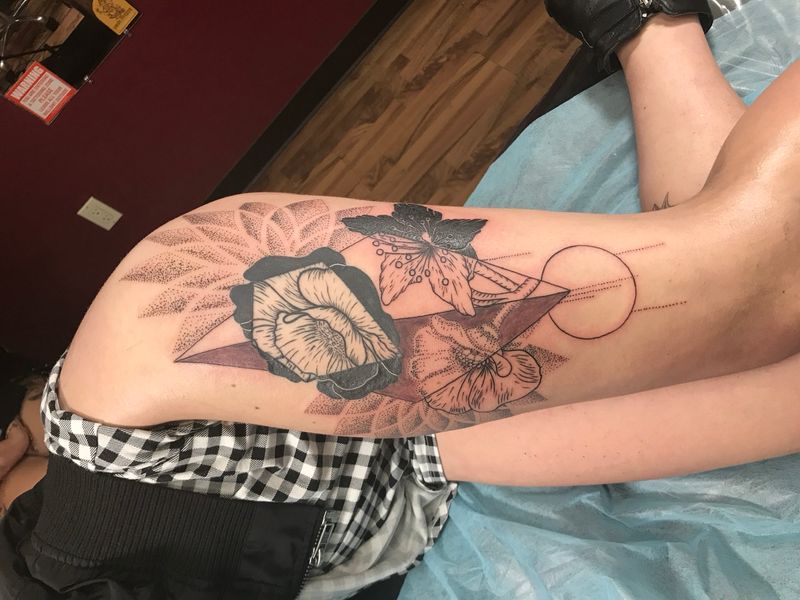
Tattoo Styles
Geometric
There is nowhere to hide an error. A line that drifts half a millimeter off parallel is visible to anyone who glances at it, and it has to be laid on a surface that curves, breathes and moves — that tension is both the difficulty and the appeal.
Book a consultationTolerances
Straight lines on a moving surface.
Geometric tattooing is defined first by its tolerance, then by its planning, then by its subject. Practically, that means the following.
Tolerance is zero. In a realism portrait, a tenth of a millimeter drift inside a shadow is invisible. In a geometric composition, a 1mm deviation in a long straight line is immediately visible, and a misaligned angle in a tessellation breaks the entire piece. There is nowhere to hide.
Nothing here is freehand. Artists working at the top of this style rely on rulers, flexible stencils, compass-drawn arcs, protractors, and digital pre-planning to map compositions before any needle touches skin. Stencil application must be near-perfect — a stencil placed 2mm off on a symmetrical chest piece will look wrong no matter how clean the linework is.
Machine choice matters almost as much as the needle itself. Modern rotary machines are overwhelmingly preferred because they deliver consistent line pressure across long pulls. Coil machines can produce subtle thickness variation that a long geometric line betrays. Tight round liners provide sharpest edge definition. Every parallel line in a piece must match — that is the non-negotiable fundamental.
The practitioners
The names behind the modern style.
Geometric tattooing has deep pre-modern roots and a sharp contemporary crystallization. The practitioners worth knowing about.
Centuries of tradition
Ancient precedents
Geometric marks on skin long predate the electric machine. Indian yantra diagrams, Islamic geometric ornament, Tibetan mandala painting, and Berber hand-poked patterning all contributed to what contemporary geometric artists cite today. The forms are ancient; the commercial style is new.
2000s – early 2010s
Chaim Machlev & DotsToLines
Chaim Machlev's Berlin studio DotsToLines became the most recognizable contemporary reference for geometric and sacred-geometry tattooing. His insistence on compass-drawn construction, perfect symmetry, and body-flow mapping set a template generations of artists now cite. The Instagram era amplified the aesthetic globally.
2010s onward
Mo Ganji & single-line
Mo Ganji popularized the continuous single-line approach — entire animals, faces, and botanicals rendered as one unbroken stroke. Minimal, elegant, and unforgiving; any wobble destroys the illusion. Opened a branch of geometric work distinct from pattern-based compositions.
Present
Ben Volt & the American branch
Ben Volt and a circle of American sacred- geometry specialists carried the tradition into US shops, often fusing geometric scaffolding with dotwork gradients and blackwork shapes. The contemporary style blends these branches freely — compass work, single-line, low-poly, and stipple all within the same style vocabulary.
Every serious geometric portfolio today traces through these names and the traditions that predate them. Asking your artist about their influences is one of the fastest ways to read whether they're a specialist or a generalist reaching.
Grid directions
Eight styles geometric works in.
The style is not monolithic. These eight styles cover the contemporary working vocabulary — pure pattern, figurative hybrids, and the spiritual branches.
Pure geometric
Compositions built entirely from shapes with no representational subject. A nested array of triangles, a sacred-geometry rosette, a tessellated sleeve, a Platonic solid rendered with precise line weight. The purest expression and the most demanding — there's nothing figurative to distract from a flawed angle.
Geometric + animal
The most recognizable gateway into geometric work. A deer, wolf, fox, bear, or lion rendered as a faceted polygonal form — the animal's head broken into planes like a low-poly 3D model. Often combined with a geometric halo behind the subject. Line weight and facet alignment carry the piece.
Geometric + ornamental
Mandalas and filigree built on a strict geometric skeleton. Ornamental flourishes (dots, paisleys, droplets) suspended inside a hexagonal, octagonal, or radial frame that enforces symmetry. Extremely popular for sternum, spine, forearm, and thigh placements.
Geometric + dotwork
Lines and angles supplying the architecture while stippled dotwork fills the shaded zones. The interplay produces gradients and tonal depth that pure linework cannot achieve. Heavy in sacred-geometry pieces and mandalas. Demands patience — dotwork is slow — and a steady hand for gradient consistency.
Single-line / continuous line
The Mo Ganji approach. An entire figure — animal, portrait, plant — rendered as one unbroken line that never lifts. Minimal, elegant, and unforgiving; any wobble or crossing error destroys the illusion of continuity. Small scale, high concept, portfolio-specific artist required.
Geometric + blackwork
Solid black fills in alternating polygonal cells create high-contrast pattern work that reads boldly from across a room. Strong for larger pieces where visual weight matters. Ages exceptionally well because dense black is less vulnerable to migration than fine linework.
Geometric + fine-line
Hair-thin botanical elements, script, or figurative drawing layered inside or around a geometric frame — think a low-poly stag with delicate fine-line antler branches. The density contrast is the point.
Sacred geometry
The spiritually-framed subcategory. Flower of Life, Metatron's Cube, Sri Yantra, Seed of Life, Vesica Piscis. Rooted in mathematical and religious traditions across cultures. Requires compass-drawn construction and perfect symmetry to honor the source material.
Ground for a grid
Where geometric ages best.
Geometric punishes flex and curvature. These five zones hold clean lines and grids over decades.
Ground that holds a line straight
- Inner & outer forearm. Long, flat, easy to photograph, and the wearer can admire the piece daily. Classic home for geometric work — consistent results, minimal stretch, wide style compatibility.
- Upper arm (outer deltoid). Handles medium-to-large compositions beautifully. Natural curvature is manageable, visibility is high in short sleeves, healing is predictable.
- Thigh (outer / front). Largest flat surface on most bodies. Accommodates full mandalas or sprawling sacred-geometry grids without compression. Ideal for extensive multi-session work.
- Chest plate & upper back. Works for symmetrical pieces anchored on the sternum or spine, where bilateral symmetry becomes part of the design language.
- Outer calf. Performs well for vertical compositions. Stable skin, good visibility, standard geometric placement option.
Surfaces that break a grid
- Joints — inner elbow, back of knee, armpit. Skin that bunches and stretches will warp grids over time.
- High-flex zones — wrist crease, webbing between fingers. Distortion is inevitable.
- Ribs for dense symmetrical work — curvature punishes precision; bearable but difficult.
- Tight small spaces for detailed mandalas — they need 4 inches minimum to breathe.
Four scales
Four scales, four different pieces.
Geometric scales cleanly from 2-inch minimalism to full back architecture. Each tier has its own subject fits and planning logic.
Clean dotwork triangles, small Platonic solids, minimalist single-line figures. The floor for anything geometric — smaller and the grid collapses once healed.
Detailed mandalas start breathing properly. Low-poly animal heads. Geometric + ornamental hybrids at a comfortable scale.
Full Sri Yantra or Flower of Life pieces. Most thigh and upper-arm compositions land here. Sweet spot for multi-element sacred geometry.
Chest plates, back panels, full sleeves. Multi-session builds where the grid becomes architectural.
Beside looser styles
Precision beside looser styles.
Geometric rarely lives alone in a sleeve. These are the cross-style combinations Apollo artists build in most often.
Geometric + dotwork
The classic marriage. Stippled gradients fill polygonal cells, softening the severity of hard lines and adding tonal depth.
Geometric + sacred geometry
The spiritually-framed subcategory. Mandalas, Flower of Life, Metatron's Cube, Sri Yantra.
Geometric + blackwork
High-contrast pattern work where solid fills in alternating shapes push pure shape to the foreground.
Geometric + fine-line
Hair-thin botanical or figurative drawing inside or around a geometric frame. Density contrast is the point.
Geometric + ornamental
Mandalas and filigree built on a strict geometric skeleton — decorative richness with structural confidence.
Mandala tattoo ideas
Every mandala format Apollo artists work in, cross-referenced by placement.
Precision questions
Eight questions about precision.
A geometric specialist will talk about stencil layering, body-contour mapping, and machine choice. Deflection is a signal.
- Which geometric pieces from your last two years still hold their line weight and angles?
- How do you handle stencil application for bilateral symmetry on a curved body surface?
- What needle configuration and machine do you prefer for long single-pull lines?
- How do you approach body-contour mapping before the stencil goes on?
- At this scale and placement, what size would you recommend I consider?
- How much session time goes into stencil alignment vs actual tattooing for a piece like this?
- Have you ever declined a geometric piece because the subject wasn't suited to the style?
- What's your touch-up window, and what falls inside vs outside it?
Pricing for geometric work is discussed at consultation once stencil complexity, scale, and placement are locked.
Geometric traps
Seven traps in a geometric brief.
The recurring missteps first-time geometric clients make, framed so the piece doesn't inherit them.
Hiring a generalist
The single most expensive mistake. A talented all-rounder will produce a geometric piece that looks acceptable on day one and visibly crooked within a year. Geometric requires dedicated practice.
Bad body placement
Putting a rigid grid across a rib cage that flexes with every breath, or a mandala on an inner bicep that folds constantly, guarantees distortion. Let the artist steer placement.
Going too small
Fine detail at small scale looks sharp while healing, then fills in over five years as the ink spreads. Size up 10–20% beyond your instinct.
Rushing the stencil stage
This is where geometric tattoos are actually made. If your artist spends 90 minutes aligning the transfer, that's a good sign. If they slap it on in five minutes, leave.
Demanding freehand for a full mandala
Anyone claiming to freehand a full mandala on a moving body without reference is either a master or a liability. Trust stencils.
Ignoring the expansion question
If you may add to the piece later, tell your artist at the first session. They will leave terminating edges rather than closed boundaries. Retrofit is hard.
Booking off fresh photos only
Fresh geometric always looks clean. Healed geometric separates specialists from generalists. Ask for 1–2 year photos.
First geometric guide
A route to your first precision piece.
The working path Apollo artists walk new geometric clients through, from style selection to settling review.
Pure pattern, low-poly animal, sacred geometry, single-line, or geometric hybrid. Each style has a specialist; the specialist's portfolio should be unambiguous.
Historically, black and gray dominate geometric work because contrast and precision read cleaner. Color geometry works with a restrained palette; ask for the healed color-geometry portfolio specifically.
Scroll past fresh shots. Hunt for pieces photographed 3 months to 2 years after the session. Consistent line weight, clean angles, true symmetry, uniform dotwork density — those are the four tells.
Geometric placement is half the artistry. Let the artist contour-map your body in person — the shoulder, the thigh, the ribs all curve differently and the composition must be planned for the canvas.
Expect significant time spent aligning the stencil on the day. Symmetrical pieces require laser-levelled placement. Rushing this step is where geometric tattoos fail.
Fresh geometric is vulnerable to scab displacement, which can migrate ink and break grid integrity. Your artist's aftercare protocol is part of the piece.
Six months out, check the piece with your artist. Any line or angle that needs a micro-pass is best caught before it becomes a longer conversation.
Geometric pieces work as systems. If you intend to add, the first piece sets the grammar — terminating edges, pattern logic, palette. Plan the second piece with the first.
Your variables
Three variables that are yours.
Beyond pattern selection, these three layers separate generic geometric from specific geometric.
Pattern tradition selection
Sacred geometry pulls from distinct traditions — Indian yantra, Islamic geometric ornament, Western sacred-geometry (Flower of Life, Metatron's Cube). Choose the tradition that resonates and ask your artist to honor its rules.
Body-contour flow
Rigid-looking geometry can be subtly shaped to follow the body's curves. The best artists map grids to anatomy so the piece flows; decide whether you want strict orthogonal or body-flowing grid early.
Density contrast & figure-ground
Alternating solid black, dotwork, and negative space creates figure-ground ambiguity. Specify how aggressive you want the contrast at design stage — it changes the piece's entire read.
FAQ
Precision questions, answered.
What people ask once they discover the body is not a flat drawing surface.
What's the difference between geometric and sacred geometry?
Geometric tattoos use any precise shape-based composition — grids, polygons, linework, repeating patterns. Sacred geometry is a specific subset rooted in spiritual and mathematical traditions: mandalas, Metatron's Cube, Flower of Life, Sri Yantra, Platonic solids. Every sacred geometry piece is geometric, but not every geometric piece carries sacred meaning. Tell your artist which direction matters to you during consultation.
Why is geometric so demanding on artists?
Because there is nowhere to hide. Realism forgives small shading drifts. Watercolor forgives loose edges. Geometric does not. A line that is one degree off, a dot that sits a millimeter outside the grid, or a circle that closes imperfectly — the human eye catches all of it instantly. The style exposes technique the way a blank canvas exposes a weak brushstroke.
How does geometric age?
Exceptionally well when executed correctly. Clean single-weight lines, crisp dotwork, and proper ink saturation age more gracefully than heavy color work. The enemy of geometric aging is blowout — ink bleeding past the line — which ruins symmetry permanently. Choose an artist whose healed portfolio shows tight lines after 1–3 years, not just fresh flash.
Can geometric be freehand?
Partially. Experienced artists freehand the body-mapping stage — tracing curves of ribs, shoulders, thighs — so the pattern flows with anatomy. But the actual grid, angles, and measurements are almost always stenciled and laser-leveled. Anyone claiming to freehand a full mandala on a moving body without reference is either a master or a liability. Trust stencils.
How does geometric combine with realism?
Beautifully, when balanced. Popular hybrids include geometric frames around realistic portraits, shattered-glass effects where linework breaks across a realistic subject, or sacred geometry halos behind animals and figures. The key is contrast: soft realism against hard geometry amplifies both. Artists working in blended styles will plan the seam between the two zones before any needle touches skin.
Can you cover an existing tattoo with geometric?
Sometimes, and sometimes it is the ideal cover-up style. Dense dotwork and blackwork geometry can absorb old ink that color cover-ups cannot. However, if the original piece has strong curves or faded scatter, forcing a grid over it may expose the underlying distortion. Bring the existing tattoo to a consultation — the artist will tell you honestly.
Does geometric look better in color or black?
Historically, black and gray dominate the style because contrast and precision read cleaner without chromatic distraction. Color geometry works when the palette is limited and intentional — think two or three complementary tones, not rainbow fills. If you want color, ask to see the artist's healed color-geometry portfolio specifically. Faded color in geometric work looks worse than faded realism.
What if my skin stretches over time?
Weight fluctuation, pregnancy, and aging all alter how geometric patterns sit on the body. Placement matters more here than in any other style. Ribs, inner thighs, lower stomach, and upper arms are higher-risk zones for distortion. Forearms, calves, shoulders, and upper back tend to hold geometric cleanly for decades. Your artist will advise accordingly.
How small can geometric go?
Smaller than most people think, but with limits. A clean dotwork triangle can sit comfortably at 2 inches. Detailed mandalas typically need 4 inches minimum to breathe. Anything smaller risks the ink filling in the negative space over years, turning high-detail work into a solid blob. Ask for the minimum viable size rather than the smallest possible size.
Can I add to a geometric piece over time?
Yes, if the original was designed with expansion in mind. Tell your artist at the first session that you may extend later. They will leave terminating edges — negative space, open linework, or anchor points — rather than closed boundaries. Retrofitting expansion onto a sealed piece is far harder and often requires restructuring the original design.
Before you book
Reference, subject, placement — and an artist whose lines survive being looked at closely.
Geometric is the style where specialist fit matters most because the technique is least forgiving. Share the pattern, a reference, and the part of your body it has to sit on. Then we check the placement against how that part of you actually moves, because a grid that reads perfectly standing still can buckle when you bend. We price it once the design is locked.