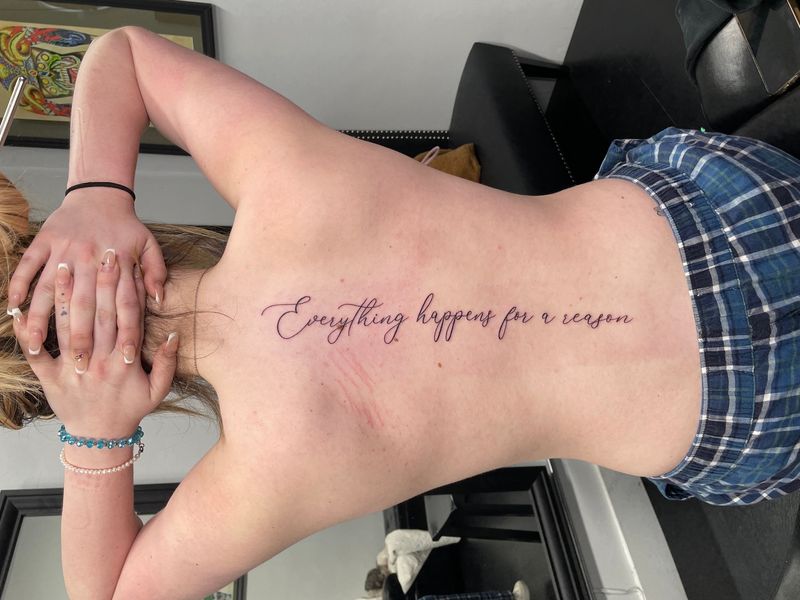
Tattoo Styles
Script Lettering
Letters do not blur. They close. The white space between strokes fills in first, and a phrase that looked elegant at year two reads as a dark smear at year fifteen if it was set too tight. Chicano script, blackletter and calligraphic hands, with the size floor for each.
Book a consultationLetterform mechanics
What script and lettering actually is.
Typography treated as designed object. A rose is forgiving; a letter is not. An \u201Ca\u201D that drifts half a millimeter toward an \u201Co\u201D stops being an \u201Ca.\u201D
This is why lettering sits in its own technical category: the tattooer is not decorating skin so much as manufacturing a designed object on a curved, moving substrate. At the needle, the craft breaks into a small set of hard decisions.
Needle configuration drives the entire look. Fine script — the thin, flowing word-on-forearm work most clients picture — is almost always executed with a 1RL (single liner) or 3RL grouping. A 1RL is the Chicano-script signature: one needle, one hairline, nowhere to hide. Bolder work — Old English blackletter across a chest or back — moves up to 5RL through 9RL groupings, sometimes with magnums packed behind the strokes for solid blacks. Single-needle work, the defining tool of LA Chicano script, is distinct from 1RL in its historical sense: traditionally a sewing needle lashed to a pencil or machine shaft, later standardized as the 1RL cartridge.
Weight variation is the craft. This is the single most diagnostic marker between pro and amateur lettering. Real script — Chicano, blackletter, or calligraphic — varies line weight on purpose: thin on the upstroke, thick on the downstroke, echoing the logic of a broad-edged pen or pointed nib. Flat-weight lettering, where every stroke is the same thickness because the machine never changed pressure, reads instantly as amateur regardless of how \u201Cneat\u201D the letters are. The eye learns this distinction in calligraphy before it ever learns it in tattooing.
Hand-drawn vs font-based stencils is the dividing line between a tattooer who does lettering and a tattooer who specializes in it. Specialists draw letters custom, by hand, at the exact size and curve of the body part being tattooed. Generalists pull a font from a computer, print it, and apply it as a stencil. The font-based approach almost always fails at scale because digital typefaces were designed for flat paper at a single size — not for the compound curve of a ribcage, the stretch of a bicep, or the distortion of a collarbone. Custom hand-lettering is not a luxury; it's the baseline.
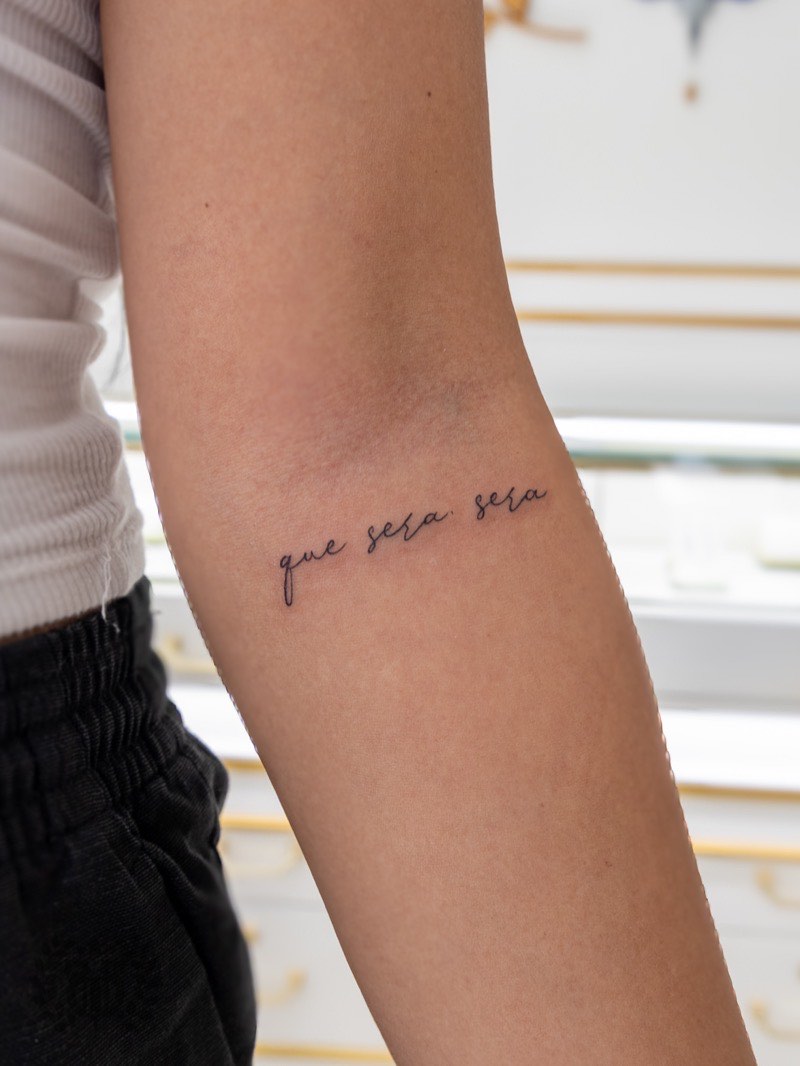
Three traditions
Chicano, Blackletter, Calligraphic — distinct lineages.
Script and lettering in tattooing is not one style. It is three distinct lineages that share a medium and almost nothing else. Knowing which tradition your piece belongs to is half the design work.
East LA · mid-20th century → now
Chicano script
Flowing, elongated, executed with a single needle and a feather-light hand. Emerged from East Los Angeles pachuco culture in the mid-20th century and was refined inside California's prison system, where improvised rigs and single sewing needles forced a minimalist vocabulary — hairline weights, long descenders, letterforms that prioritize rhythm over ornament. Carries the same lineage as fine-line and black-and-gray realism (Good Time Charlie's, Rudy, Negrete, Mahoney). Chicano script is not a font. It is a handwriting tradition.
Medieval Europe → biker/hardcore US
Old English blackletter
Heavy, angular, architectural. Blackletter — the family that includes Fraktur, Textura, and the form Americans call “Old English” — is rooted in medieval European manuscript tradition, where scribes used broad-nibbed quills to produce dense, vertically stacked pages of scripture. Heavy verticals, sharp diagonal feet, compressed counters, decorative terminations. Entered American tattoo vocabulary through mid-20th-century biker and hardcore subcultures. The default when a word needs to read as heavy.
Hand-lettering revival → tattoo
Modern calligraphic
The newest of the three. Pulls from the broader hand-lettering revival of the last fifteen years — brush lettering, pointed-pen copperplate, Spencerian script — and imports that vocabulary into skin. Cleaner than Chicano (less prison-rig economy, more design-school polish) and lighter than blackletter (thin upstrokes, generous negative space). Its practitioners tend to have a calligraphy practice on paper first and a tattoo practice second.
Genre-defining artists
The names specialists cite.
Every tradition has its reference library. These are the names that show up in specialist conversations, reference shelves, and the feeds serious lettering tattooers follow.
BJ Betts
American
Lettering specialist whose published lettering books became the de facto reference library for a generation of tattooers. When an apprentice is handed a book and told to copy alphabets until the hand learns the forms, it is very often a Betts book.
Big Meas (Meas Vong)
American Chicano script
One of the most influential contemporary Chicano script specialists. Known for long, elegant compositions that read as visual music — rhythm and negative space as core craft.
Norm Will Rise
Los Angeles
Chicano script master whose work bridges graffiti letterform and tattoo script, with a recognizable command of flow and spacing.
Freddy Negrete
Los Angeles
Cited consistently in the Chicano script lineage alongside Jack Rudy. A direct link from Good Time Charlie's era to present-day LA fine-line and script.
Dmitriy Samohin
Ukraine
Pushed script beyond the tattoo tradition entirely, integrating lettering into calligraphic illustration and color realism. A reference for what script can be when combined with other disciplines.
Luciano “Dark Side” Trabucco
Contemporary blackletter
Contemporary blackletter specialist whose work shows how far the Fraktur vocabulary can be pushed when a specialist is holding the machine — not a generalist.
Words it suits
The words lettering was built for.
Short, meaningful text outperforms long text at every size, every placement, every age of the tattoo. Eight categories where lettering consistently works.
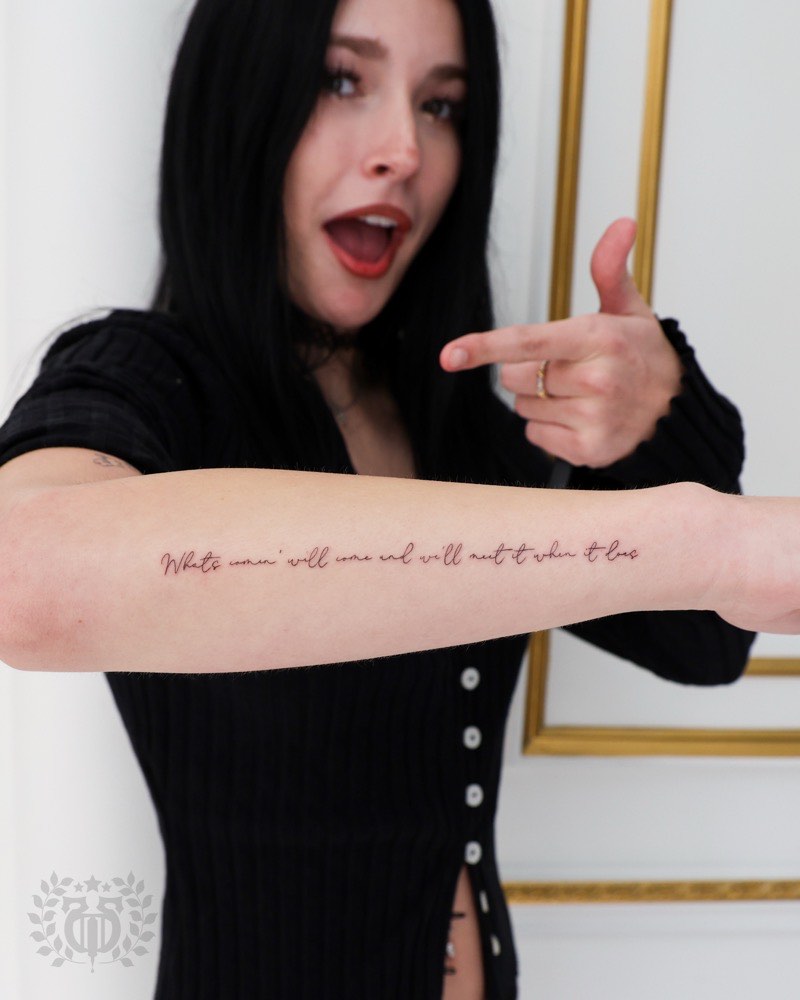
Memorial names
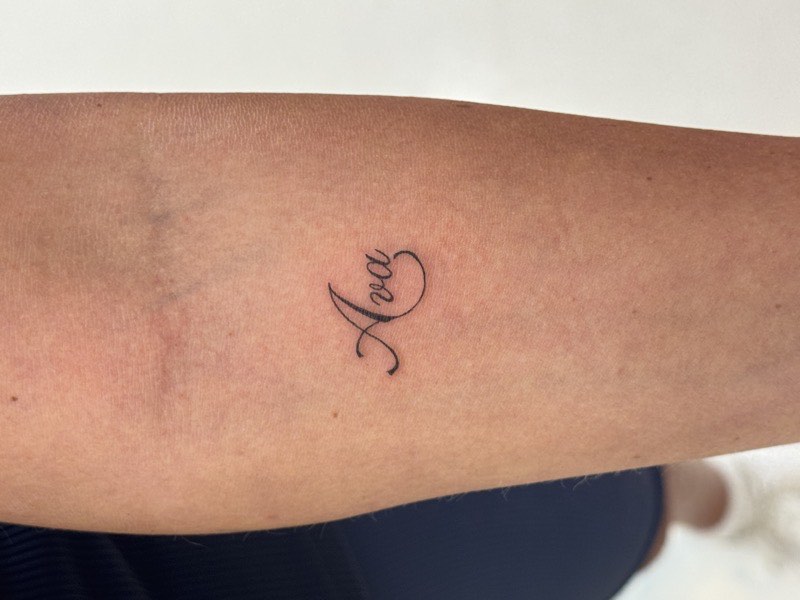
For deceased loved ones — parents, children, partners. The single most common script commissions and what has driven the style's traditions for over a century. Chicano script and modern calligraphic both carry memorial weight; blackletter when the name deserves iconic authority.
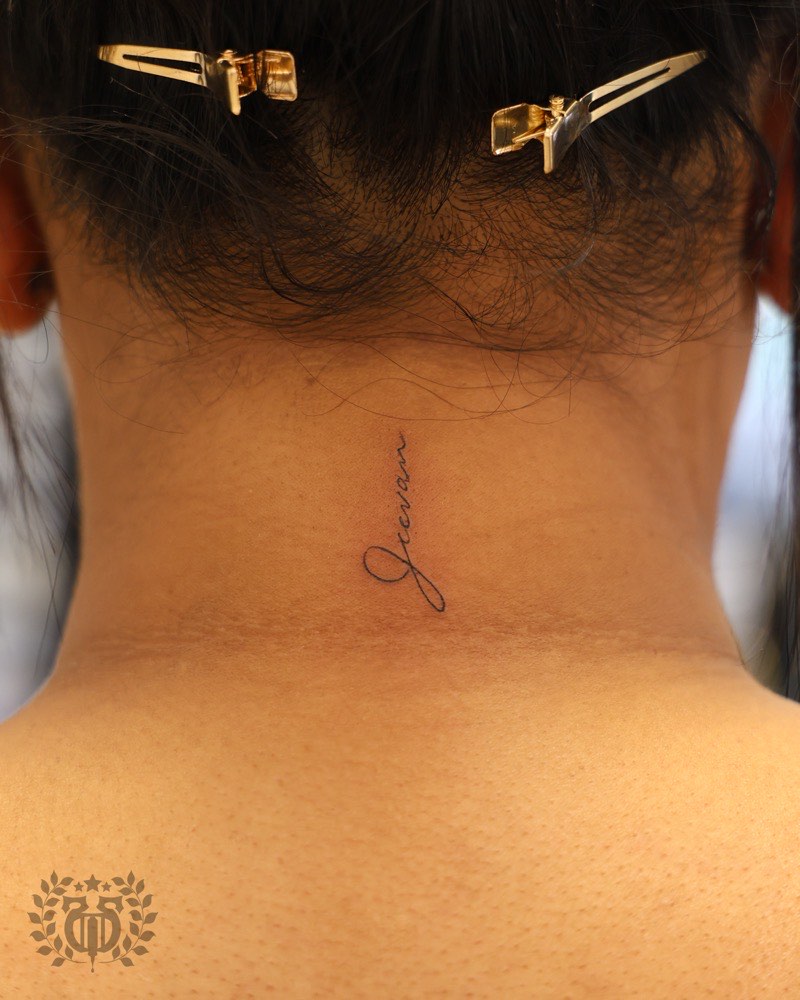
Short quotes & mantras
One-line philosophical statements, a line from a book or film, a phrase someone said that never left you. Short is the keyword — one line, readable at a glance, engineered for the ten-year read.
Song lyrics
One or two lines, not full verses. The good placements on the body simply do not have room for a stanza, and text that long collapses into unreadable gray rectangles within a decade regardless of execution quality.
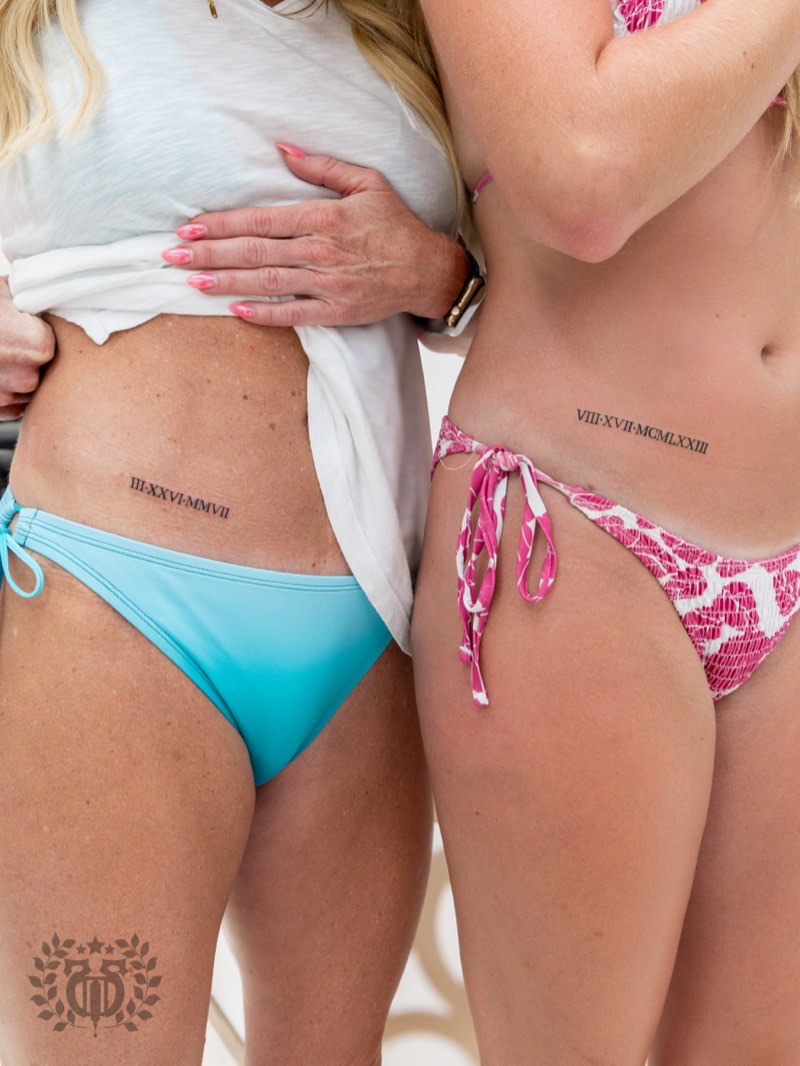
Dates & Roman numerals
Birthdays, anniversaries, the day someone was born or passed. Roman numerals have become the dominant treatment because they read as formal and age better than numeric digits — cleaner letterform geometry, fewer curves to collapse.
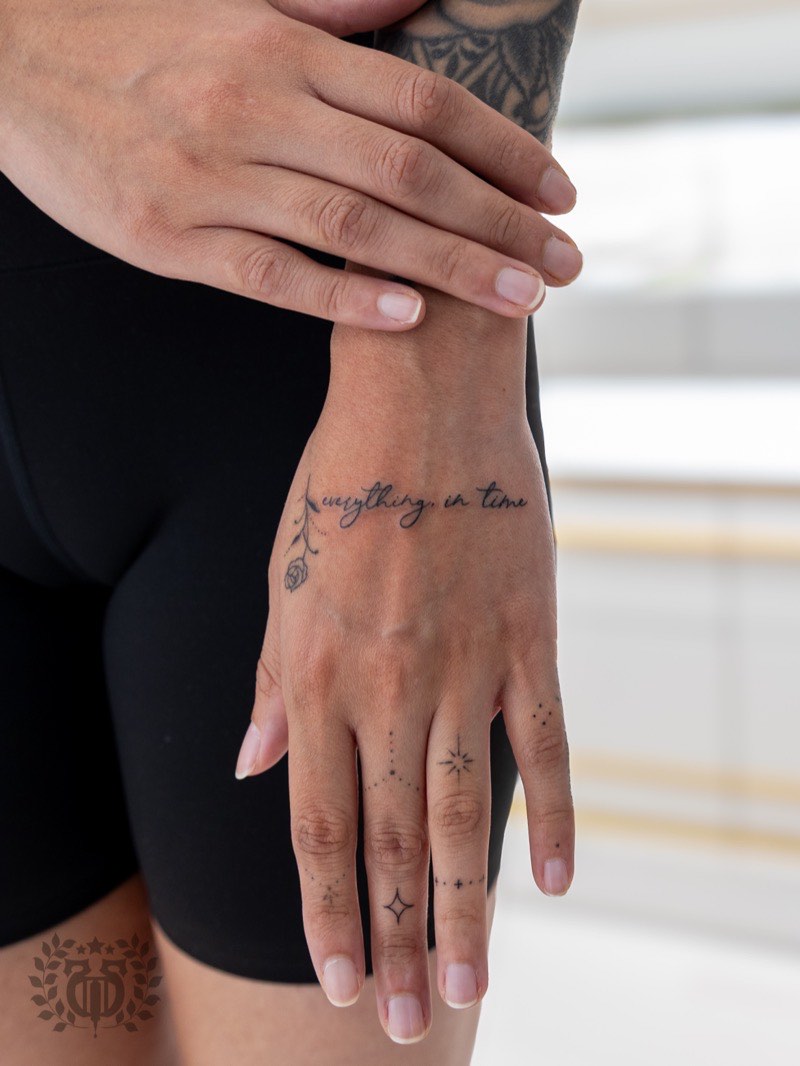
Single-word mantras
“Faith,” “hope,” “love,” “warrior,” “breathe,” “believe.” These accept the heaviest typographic treatments because they carry iconic weight. Single words work brilliantly in Old English blackletter — the weight matches the intent.
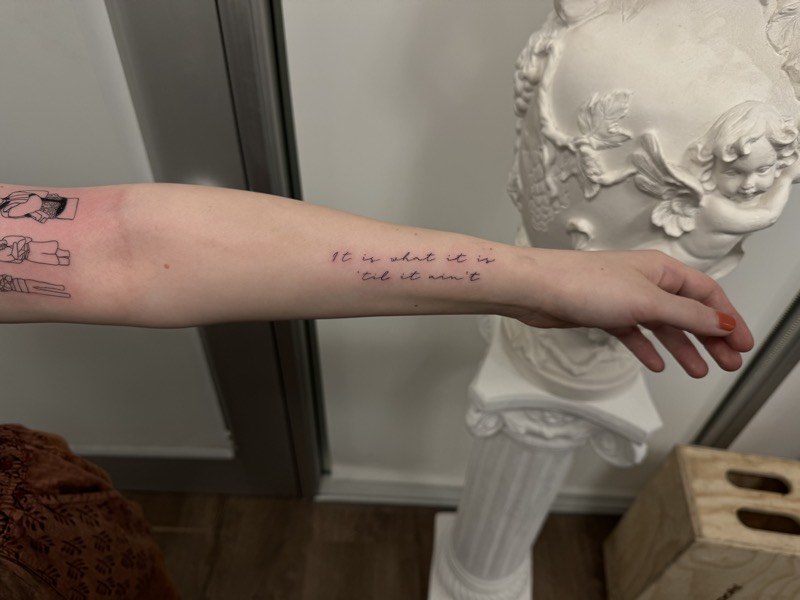
Family sayings
Inherited phrases, a grandparent's favorite expression, the line your mother always said. Chicano script and modern calligraphic carry the personal style best — the handwriting quality matches the intimate content.
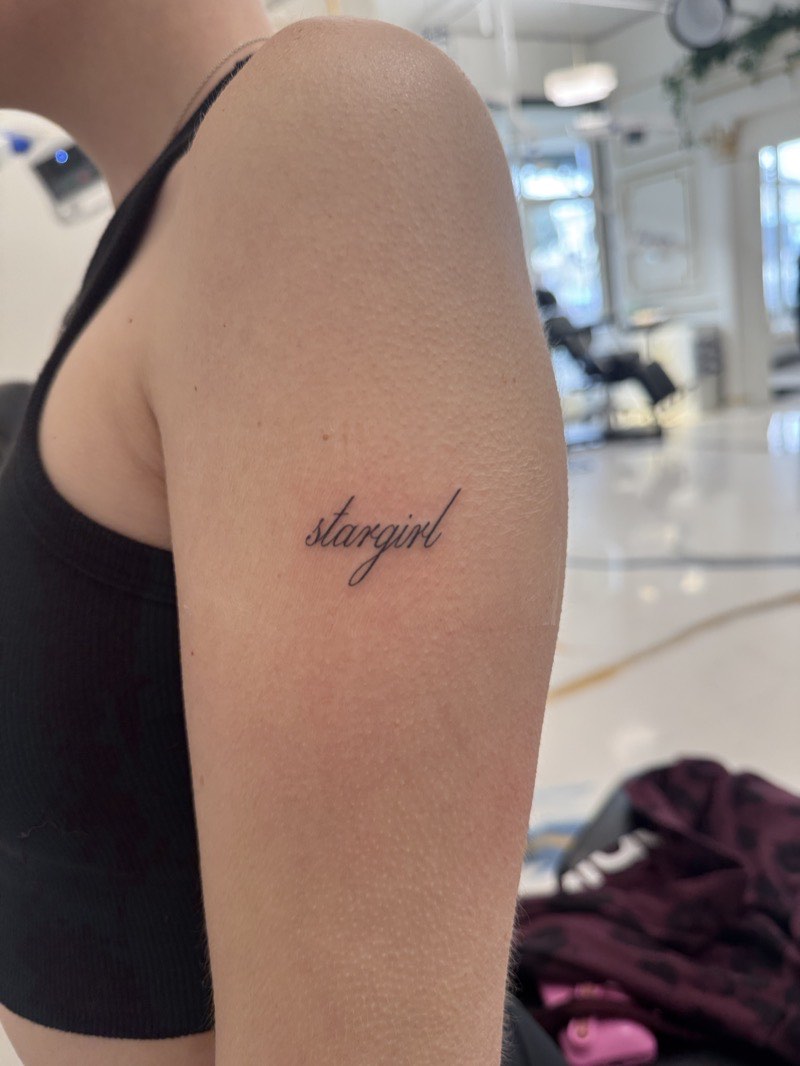
Coordinates
Latitude and longitude of a meaningful place. Often set in a clean sans or small monospace rather than script — the geographic precision reads best in typographic styles that mirror cartographic typography.
Religious & scriptural text
Verses, prayers, devotional phrases. Traditional banner-and-type work was designed specifically for this category. Blackletter also carries scripture well — its medieval manuscript roots are scriptural by origin.
What lettering can't fix
What lettering cannot rescue.
Some requests don't fit the medium no matter how skilled the artist. These are the configurations that fail the words you care about.
Long paragraphs or verses
Once a piece runs past roughly fifteen words, you're asking the viewer to read it the way they read a book, and skin is a terrible substrate for that. Ink spread over years closes the letter counters and a paragraph becomes a gray rectangle.
Text competing with a larger image
If the image is the story, the words should either be minimal (a banner with a name) or belong to a different piece entirely. Hierarchy matters. A quote wrapped around a realism portrait is almost always a mistake.
Very small cursive on wear zones
Small script under 5mm cap height on wrists, fingers, or feet is a 5-year regret piece. The scale fights the medium and the placement accelerates kerning collapse. Responsible specialists push back on this configuration.
Font copies without adaptation
Fonts were designed for paper. Letterforms designed for print have stress patterns, kerning tables, and flow characteristics built for flat paper at a single size. On skin's compound curves, they look stiff and mechanical and age terribly.
Non-Latin scripts without specialists
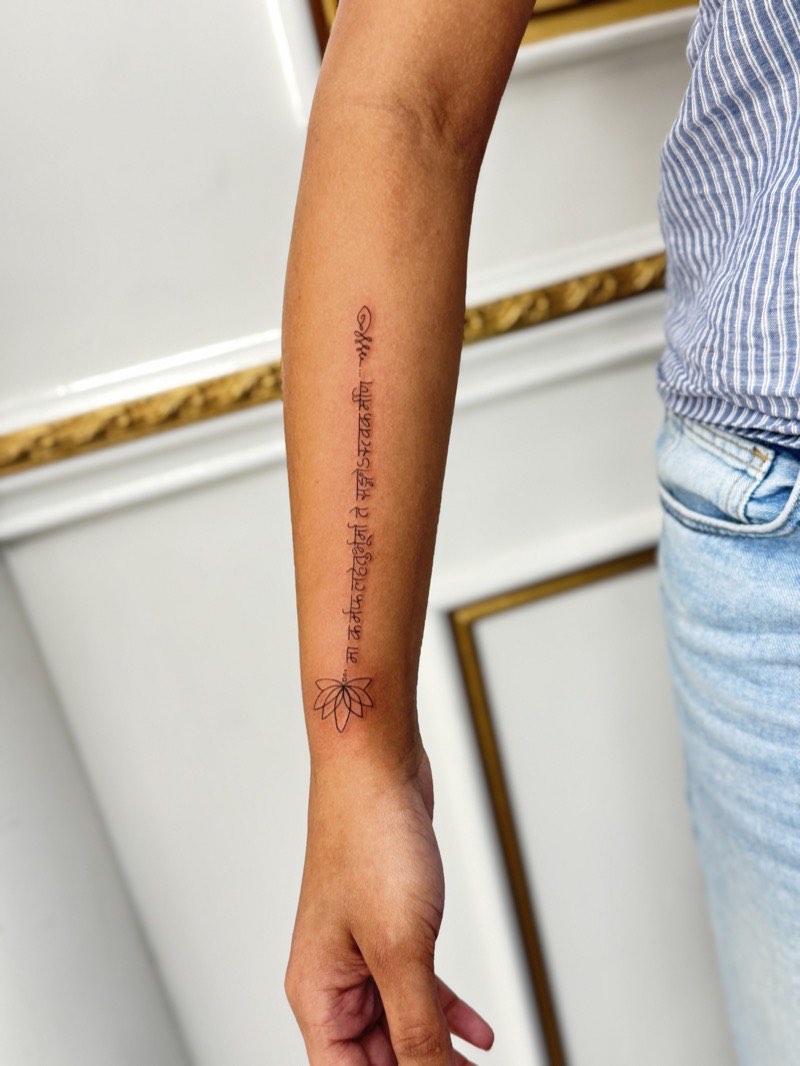
Hebrew, Arabic, Japanese, Sanskrit, Cyrillic — each has its own calligraphic tradition with centuries of formal style. A Western lettering tattooer drawing these by eye will produce letters that look wrong to any native reader.
Typography framework
Match the letterform to the emotional style.
The wrong typography pairing reads as tone-deaf even when the craft is flawless. Three styles; three tradition groups; clear reasoning for each pairing.
Emotional weight
Memorials · family · personal loss
Pair with: Chicano script · Modern calligraphic
Both carry handwritten intimacy. Chicano script adds identity and cultural lineage; modern calligraphic is less culturally specific but shares the personal style. Blackletter is the wrong call for a name — too authoritative, too cold.
Iconic presence
Single words · mantras · declarative statements
Pair with: Old English blackletter · Traditional banner-and-type
Heavy, authoritative — impossible to read quickly and that's the point. It forces attention. Blackletter's medieval gravity matches single-word intensity. Traditional banner-and-type carries the sailor-flash authority of nautical motto work.
Readable clarity
Quotes · longer phrases · lyrics
Pair with: Modern calligraphic brush script · Clean custom script
Variable stroke weight handles phrase-length text cleanly. Readable at conversational size, ages better than Chicano hairlines for multi-word work. NOT a font copy — hand-drawn at the scale and placement of the specific piece.
Size & readability
Every tradition has a floor.
Below certain cap heights, each tradition collapses. These are minimums from working lettering specialists, not ideals — the floor below which the style fails as it ages.
Minimum cap heights
Anything smaller and the hairlines disappear into ink spread within a few years. This is the floor; 5mm+ holds up much longer.
The style depends on heavy strokes and sharp terminals; shrink it and the characteristic angles round off. Bold but legible — blackletter is designed to carry scale.
For readable results on most body zones. Variable stroke weight needs room to express contrast between thick and thin.
With generous spacing between characters. Roman numerals age slightly better than mixed-case cursive because the letterform geometry is cleaner.
Placements lettering loves
- Ribs. Classic for longer phrases — enough linear real estate for a full line. Trade-off: one of the more painful zones to sit through.
- Collarbone. Short phrases and dates sit naturally along the clavicle line. High visibility, clean canvas.
- Inner bicep. Flat, protected from sun, excellent for script phrases that want to be private rather than visible.
- Forearm. Dates, short quotes, single words. High visibility, flat canvas, heals predictably.
- Chest banner. Memorial names in the Sacred Heart and traditional banner-and-type lineage — native territory for this placement.
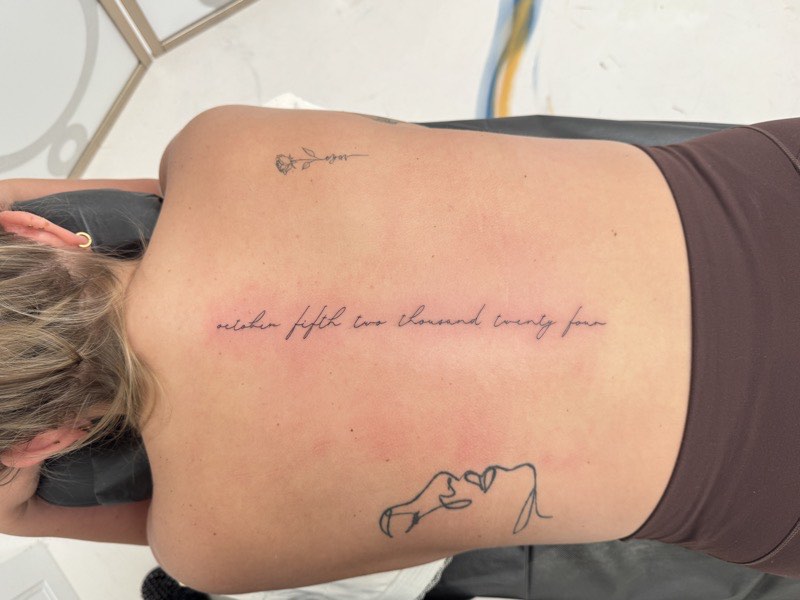
- Back (spine line, between shoulders). Longer phrases that don't fit anywhere else. Enough linear canvas for a full paragraph-length piece.
Where words go illegible fastest
- Fingers. Skin regenerates too fast and ink drops out. Finger script looks good for maybe two years before needing touch-ups that don't hold either.
- Palms & soles. Same problem as fingers, with bonus wear from daily use. Friction zones destroy kerning.
- Feet. Sock friction and ink rejection shred lettering faster than almost any other zone.
- Very curved placements. Side of wrist, inner ankle, anywhere the letter geometry gets distorted by tight curves. Script is linear by nature; it does not want to wrap.
Kerning collapse
Script fails between the letters, not at them.
The single most important thing to internalize before booking script: letters don't fail by blurring. They fail by kerning collapse — the space between letters closes up long before the letterforms themselves soften.
Every ink deposit in skin spreads slightly over time. That spread is small — a fraction of a millimeter across decades — but in script, the critical measurement isn't the width of a stroke. It's the width of the gap between strokes. A 0.2mm spread on a 2mm stroke is a 10% thickening, barely visible. That same 0.2mm spread across a 1mm gap between letters is a 20% closure, and gaps that were already tight disappear entirely.
This is why the word \u201Cfaith\u201D can become, over fifteen years, a shape that looks like \u201Cfaith\u201D to the person who got it but reads as a single connected mark to a stranger. The letters are still there. The space between them is gone.
Two factors accelerate this. Small cap heights mean every gap started tight, so any closure eats a meaningful fraction of it. Tight kerning — the intentionally close letter-spacing popular in some modern scripts — means the gap was already below the long-term threshold before healing even finished. Combined, small-and- tight is the fastest-collapsing script configuration. Bold blackletter with generous tracking is the slowest.
Experienced letterers track their letters wider than feels correct at the moment of tattooing. It looks \u201Ctoo loose\u201D when the tattoo is fresh — clients sometimes push back on this in the consultation — but those are the pieces that still read as individual words twenty years later. Tight spacing that looks perfect on day one is the single most reliable predictor of a tattoo that will need heavy rework before middle age. A specialist's job includes pushing back on scale and spacing, not just executing the request.
Legibility over time
When a word stops being readable.
Script is the most honest tattoo style in the long run. It either reads or it doesn't. There's no middle ground where a collapsed word looks \u201Cvintage\u201D — it just looks wrong. Five stages over a human lifetime.
Initial settling
Fresh letters soften very slightly as the ink finds its resting depth in the dermis. Anyone looking at the piece sees a clean, sharp word. Negative space between letters is still obvious. The honeymoon — and also the stage when most portfolios are photographed, which is part of why evaluating a script artist requires healed reference, not fresh.
First kerning hints
Letter-spacing starts to fill in subtly. If you put a year-one photo next to a year-five photo, you can see it. If you only have the year-five piece, you won't. Most clients don't notice the change at all. The word still reads cleanly.
Kerning collapse begins
This is the decade when tight-spaced script starts to pay its bill. Letters that were drawn too close together begin to merge at the baseline. Ascenders and descenders start touching adjacent letters. Hairlines in Chicano script, serifs in blackletter, and thin connectors in cursive are the first casualties. The spacing collapse is usually the dominant problem — not the letters themselves blurring.
Small script requires decisions
Lowercase script under roughly 5mm cap height often needs rework by now. Three options: touch up (re-darkening what's still legible), rework (redrawing the word at a larger scale, often as a cover-up of itself), or acceptance (it's a piece of personal history, not a billboard). Larger and bolder script from this era still reads cleanly.
Only well-spaced, larger script still reads
The script that survives is the script that was conservatively scaled from day one. Bold blackletter with generous spacing reads at twenty years. Delicate single-needle cursive at 4mm cap height often does not, regardless of artist quality. This isn't a failure of the style — it's the physical reality of ink in living skin.
Aging patterns by tradition: Chicano script is defined by single-needle hairlines and dramatic contrast — beautiful and fragile. Budget for touch-ups at 6–8 years. Blackletter ages better than any other script — bold strokes plus generous spacing hit 15–20+ years before major rework. Modern calligraphic sits between the two at 8–12 years. Touch-ups can re-darken letters but cannot re-open collapsed kerning; once the spacing is gone, you're in rework territory, not maintenance.
Lettering in the wild
Letterforms across three traditions.
Typography table
Word type → typography → placement → minimum size.
The typography table our letterers use. Sizes here are floors rather than targets. The phrase and the body area decide the rest.
Beliefs clients bring
Five lettering briefs we change.
The beliefs first-time lettering clients bring in. None of this is a judgment on lettering you already carry.
“Script is easy — just copy a font.”
Hand-drawn custom work is the baseline of the discipline. Fonts were designed for paper at a single size; they don't adapt to a forearm's curve, a rib's stretch, or the way ink spreads on skin across decades. Copy-paste font work is the fastest path to a tattoo that needs rework in five years.
“I want it small and delicate.”
Small script has the shortest lifespan of any tattoo style. Delicate hairlines are the first thing to go. The tattoo that looks perfect at the end of the session is not the tattoo you'll wear in a decade. A specialist is designing for year ten, not for the mirror on the way out.
“I can cram more words in.”
Tracking space and minimum cap heights are floors, not suggestions. If the phrase doesn't fit the placement at safe sizes, the phrase or the placement has to change. Forcing more words into a tight piece guarantees kerning collapse.
“Cursive is always pretty.”
Cursive depends entirely on letterform quality and composition. Bad cursive ages into illegible scribble. The test isn't “does it look pretty now?” — it's “will it still read as a word in ten years?”
“Old English is tough-looking.”
It carries specific biker and prison culture baggage. That reference is part of the style, for better or worse — be honest with yourself about whether you are signing up for that association. Blackletter has medieval manuscript origins but American tattoo vocabulary learned it through subcultures that carry their own identity.
Letterer, not tattooer
Choosing a letterer, not a tattooer.
Script is the single style where a generalist is most likely to look competent at fresh and fail at healed. The separation only shows up at year five, year ten, year fifteen.
What a letterer should be able to show
- Healed script at five or more years showing readable letter separation
- Hand-drawn stencils visible in process shots (pencil sketches before transfer)
- Range across script families — Chicano, blackletter, modern calligraphic — shows discipline mastery
- Explicit discussion of tracking, spacing, and aging philosophy
- Custom letterforms with subtle anomalies (lengthened descender, custom ligature) that couldn't come from a font
- Willingness to push scale bigger than client initially requests
Lettering warning signs
- Copy-paste font work — letterforms look typeface-literal without the subtle adjustments a hand-drawn stencil introduces
- Inconsistent letter spacing within a single word
- No healed work in the portfolio — every script photo is fresh-off-the-needle
- Small script only photographed large in portfolio (misleading scale impression)
- Kerning that already looks wrong at fresh (it only gets worse)
- “Any style” claim — script rewards specialization more than almost any other style
Six questions about size and tracking
- Can I see healed script of yours that's at least five years old?
- Is this going to be hand-drawn, or is it based on a font?
- What cap height do you recommend for this placement, and why?
- How do you approach kerning with aging in mind?
- What's your strongest script family — Chicano, blackletter, or modern calligraphic?
- When you show me reference, will it be your own work or typography examples?
The answers matter less than the comfort level with the questions. A specialist has opinions on all of these and enjoys discussing them. A generalist deflects. The specialist's job includes saying no — pushing back on scale, declining pieces the client wants too small in the wrong placement.
FAQ
Lettering questions we answer weekly.
Seven questions about words on skin, most of which turn out to be questions about size.
How do script and lettering tattoos actually age?
Script doesn't fail the way color fails. Color fades uniformly; script fails BETWEEN the letters. Ink migrates slowly over years, and in fine-line script that migration fills the space between letters before it visibly thickens the letters themselves. A phrase like “faith” legible at year one can become a dense, unreadable bar of ink by year ten — with the individual letters still technically intact, but the gaps gone. The word stops reading as a word. Bold blackletter with generous spacing reads at twenty years. Small, tight cursive often needs rework by year ten. That's the honest timeline.
What's the difference between Chicano script, Old English blackletter, and modern calligraphic?
Three distinct lineages that share a medium and almost nothing else. Chicano script is flowing, single-needle, elongated — emerged from East LA pachuco culture and California prison tattooing in the mid-20th century. Deeply personal, shares lineage with fine-line and black-and-gray realism. Old English blackletter is heavy, angular, architectural — rooted in medieval European manuscript tradition, entered American tattoo through mid-20th-century biker and hardcore subcultures. Modern calligraphic is the newest — pulls from the broader hand-lettering revival (brush lettering, pointed-pen copperplate, Spencerian script) and imports that vocabulary into skin. The three call for different subjects, different placements, and different artists.
Why do lettering artists draw custom rather than use fonts?
Because fonts were designed for paper. Digital typefaces have stress patterns, kerning tables, and flow characteristics built for flat paper at a single size. On skin's compound curves, those same letterforms look stiff and mechanical, and they age terribly because font designers don't design for ink spread. A specialist hand-draws every letter for the specific piece — sized to the placement, spaced for the body zone, with stroke weights calibrated for how that skin will age. “I just want Adobe script” sounds like it would be easier. It's actually the shortest path to a tattoo that needs rework in five years.
What's the smallest cap height that will age well?
Depends on the tradition. Chicano script single-needle: 3–4mm cap height is the absolute floor, and even that's aggressive for long-term readability — 5mm+ holds up much longer. Old English blackletter: 6–8mm minimum. The style depends on heavy strokes and sharp terminals; shrink it and the characteristic angles round off. Modern calligraphic: 5–6mm for readable results. Roman numerals: 3–4mm minimum with generous character spacing. These are floors, not ideals — an artist who pushes you to scale up isn't being greedy, they're designing for year fifteen.
Why does letter-spacing matter more than letterform at aging?
Because the critical measurement in script isn't the width of a stroke — it's the width of the gap between strokes. A 0.2mm spread on a 2mm stroke is a 10% thickening, barely visible. That same 0.2mm spread across a 1mm gap between letters is a 20% closure, and gaps that were already tight disappear entirely. Experienced letterers track their letters wider than feels correct at the moment of tattooing. It looks “too loose” when the tattoo is fresh — clients sometimes push back on this in the consultation — but those are the pieces that still read as individual words twenty years later. Tight spacing that looks perfect on day one is the single most reliable predictor of a tattoo that will need heavy rework before middle age.
Can I get lettering in a language other than English?
Yes — but the rule is non-negotiable: work with a specialist in that script tradition, not a generalist who's copying characters from an online translator. Hebrew and Arabic read right-to-left with entirely different calligraphic traditions; Arabic especially has centuries of formal styles (Naskh, Thuluth, Diwani, Kufic) that each carry different connotations. Japanese and Chinese characters need an artist who knows the meaning of what they're drawing — the internet is full of tattoos whose owners were told they read “strength” and actually read “kitchen.” Cyrillic, Greek, Sanskrit all have their own letterform conventions. The specialist consultation is not optional for non-Latin scripts.
How do I spot a generalist vs a script specialist?
Script is the single style where a generalist is most likely to look competent at fresh and fail at healed. The separation shows up at year five, year ten, year fifteen — not at day one. Ask for healed work at 5+ years. Ask if the work is hand-drawn or font-based. Ask what cap height they're recommending and why. A specialist has immediate, detailed answers to all three and enjoys the discussion. A generalist deflects or gives vague answers. The specialist's job also includes saying no — pushing back on scale, declining pieces the client wants too small in the wrong placement. A lettering artist who accepts “small and delicate on the wrist” without pushback is telling you they haven't internalized the ten-year problem yet.
Ready to design for year fifteen?
Bring the words, the tradition you're drawn to, and openness to larger scale.
Lettering is a specialist's craft where the compound skill set is sign-painter outline discipline plus calligrapher's weight theory plus a decade-scale kerning instinct. Bring the exact text, the feeling it should carry, and the placement. Then we set two numbers: the size, which is nearly always larger than the one you arrived with, and the tracking, which is what keeps the word legible fifteen years out.