Tattoo Styles
Chicano
Of every style in this library, one was invented about eight miles from our front door. East LA, the Pachuco era, the prison yard, then Good Time Charlie's on Whittier — how a sewing needle and a single bottle of black became a full gray-wash tradition.
Book a consultationThere is a version of this style's origin story that gets told badly — as folklore, with the hard parts sanded off. The plainer account is more useful. People with no access to professional equipment worked out how to make one bottle of black behave like a full range of tone, and the technique they invented turned out to be better than the one the industry was already using. Everything below follows from that: the needle, the dilution, the subjects, and the reason a Chicano piece fails when you shrink it.
One bottle of black, and what people did with it
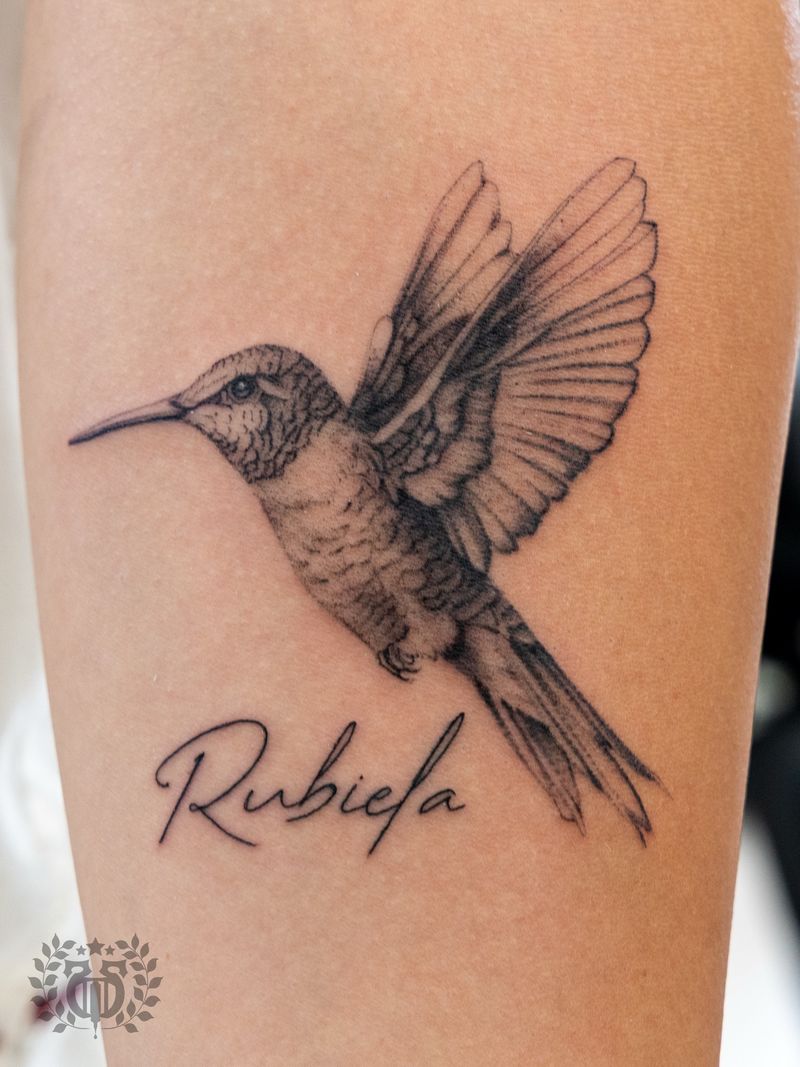
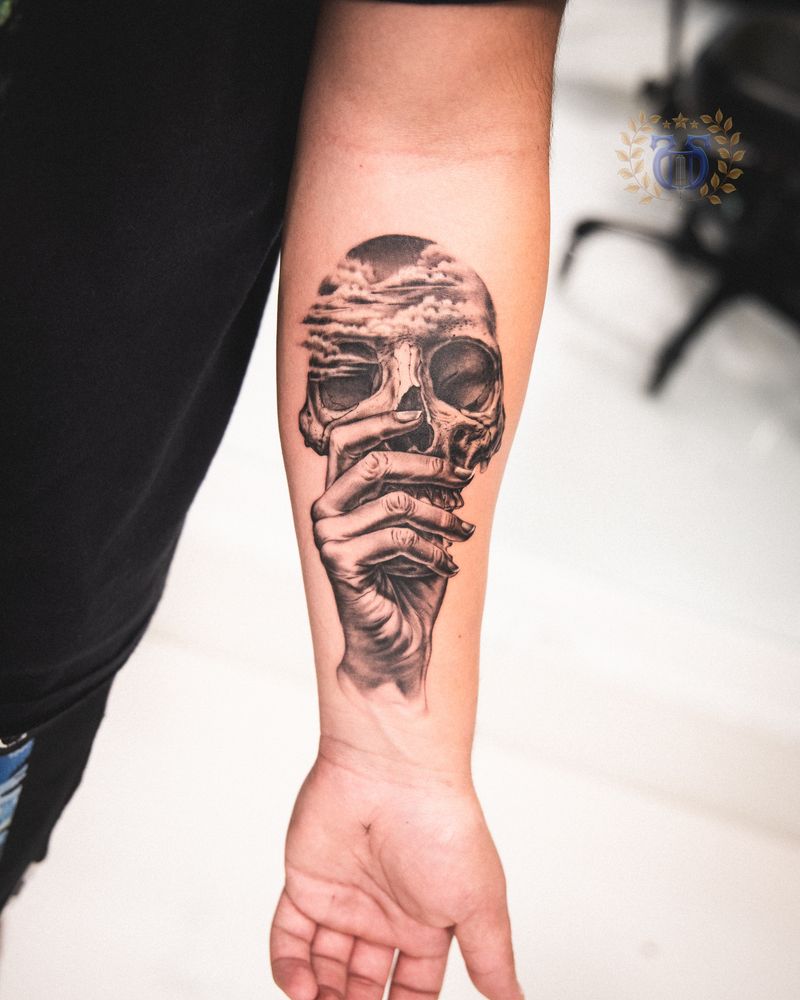
Chicano is a black-and-gray style, but that undersells the specific thing it does. Rather than laying a bold outline and filling it, the artist thins black ink into a graded set of washes and builds the image the way a pencil drawing gets built — light to dark, edge to edge, with no boundary line doing the structural work. The broader black-and-gray category contains several dialects; this is the one where the line is hairline and the shading is photographic.
The line work is fine, historically single-needle, and that is not a stylistic flourish. A single round liner deposits very little pigment per pass, which is what gives portraits and script their soft, drawn quality — and what makes the whole approach unforgiving. There is no heavy black anywhere to cover a wobble.
What actually separates Chicano from generic realism in gray is not technique at all. It is subject. This is a narrative style about faith, family, neighborhood and loss. The imagery is chosen because it means something to the person wearing it, not because it renders well.
East LA, the yard, and Whittier Boulevard
The look traces back to Pachuco culture in the 1940s — the zoot-suit generation of young Mexican-Americans who built a distinct visual identity out of clothing, script, and posture. Inside California's prison system, incarcerated artists worked with what was available: a sewing needle, an improvised machine, and black ink. Diluting that black into grays started as a workaround for having nothing else. It became the defining aesthetic.
The style crossed into professional shops through East Los Angeles in the 1970s. Charlie Cartwright and Jack Rudy, working out of Good Time Charlie's Tattooland, are widely credited with adapting single-needle black-and-gray for shop conditions, and Freddy Negrete became one of its most influential practitioners. That transition is worth naming precisely, because it is unusual: a technique developed under total constraint was adopted wholesale by an industry that had every resource, and the industry was right to adopt it.
Thing is, most tattoo styles arrive from somewhere else and get localized. This one went the other way. It is the only style in our whole styles library that Los Angeles exported rather than imported.
The vocabulary
A Chicano piece is assembled from a shared set of images. Knowing the vocabulary makes the consultation far more productive, because you can point at a tradition rather than describe a feeling.
- Religious imagery — La Virgen de Guadalupe, the Sacred Heart, Jesus and crosses, praying hands, rosaries.
- "Smile now, cry later" — the paired theatre masks, one of the most recognizable Chicano symbols, about enduring rather than escaping.
- Women — the fine-line lady, payasa (clown) girls, and Catrina figures drawn from Día de los Muertos.
- Lettering — fine-line script and Old English carry names, places, dates, and phrases that hold weight.
- Cultural and family themes — lowriders, roses, bandanas, Aztec figures, and portraits of people who are gone.
Why it is harder than it looks
Two things make this style a specialist's craft rather than a look any competent tattooer can produce on request.
The first is tonal control. A convincing gray-wash face needs a range of separable tones — not black and one gray, but a genuine gradient with mid-values that read as planes of a face rather than as smudge. Artists mix that range in the cap, and the proportions are personal. Watching a specialist work, the mixing is not a preliminary step; it happens continuously, adjusted to the area being shaded.
The second is that nothing is holding the design together. In American Traditional, a heavy outline carries the composition for forty years while everything inside it softens. Here there is no such insurance. If the values are wrong, the piece has nothing to fall back on. That is why we insist on healed photographs when someone is choosing an artist for this work — fresh single-needle gray photographs beautifully and tells you almost nothing.
How single-needle gray ages
Honest version: this style asks more of you over time than a bold one does. Very little pigment is going into the skin per pass, so what softens first is the lightest end of the range — the highlights and the faintest washes drift toward the mid-tones, and the image loses some of its separation. The overall picture usually stays readable; the crispness does not stay indefinitely.
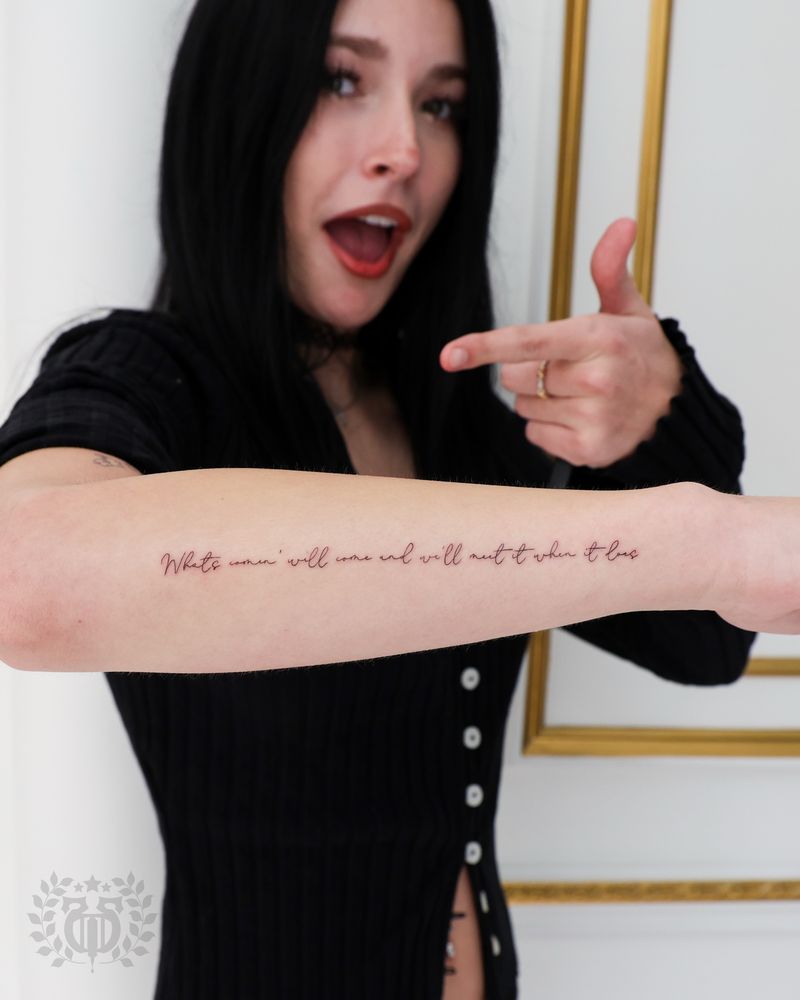
Lettering behaves differently again, and worse. Fine script does not blur so much as close: the white gaps between strokes fill in, and a name set too tightly becomes a dark shape long before any individual stroke gives out. This is the single most common regret we see on older Chicano work, and it is entirely preventable at the drawing stage by setting the letters further apart than looks necessary.
We used to think of touch-ups on this style as a failure of the original work. We do not any more. A piece built on light washes is closer to a relationship than a transaction — a small refresh every several years keeps the contrast where it should be, and a healed touch-up costs $100. Whether you want that relationship is a fair thing to decide before you start, not after.
Where it belongs on the body
Gradient needs area. Portraits, religious scenes, and detailed lettering want room — the chest, back, outer forearm, and upper arm all give the gray somewhere to develop and hold a stable, relatively flat plane while it does. Cramming single-needle detail into a small footprint is the most reliable way to make a Chicano piece fail, and it fails slowly enough that nobody notices for a few years.
Hands, fingers, feet and the ribs under the diaphragm are the hardest ground for this style. High turnover, constant flex, and thin skin all work against fine line and against light wash at the same time. We will tattoo them; we will also tell you what to expect.
What Chicano does badly
Every style has a set of briefs it should refuse, and being clear about them is more useful than being enthusiastic.
- Bright-palette subjects. An idea whose whole point is color — a macaw, a tropical flower, a piece of pop iconography built on saturation — loses its argument in gray. Take it to a color artist.
- Micro-scale portraiture. A face needs enough space for the features to separate. Below that threshold you get a shape that reads as a face for about three years.
- Cover-ups over dense color. A light gray wash has nowhere near the pigment load to mask saturated old work. Laser lightening first, then gray on top, is the honest path.
- Flat graphic design. Logos and hard-edged vector shapes want solid, crisp ink. Gray wash's advantage is subtlety, which is exactly the wrong tool.
What the imagery means, and who it belongs to
Some of this vocabulary is simply beautiful and open to anyone. Some of it is not neutral. A few motifs carry specific associations with place, affiliation and history, and wearing them without that context can read very differently to the people who recognize them than it does to you. We are not gatekeepers about this and we will not lecture anyone, but we would rather have a five-minute conversation about what an image says than have you find out later. Bring the reference and ask. That conversation is part of the consultation, which runs $100 and comes off the tattoo.
Planning a piece with us
Bring names, dates, photographs, and the reason behind them. Subject matters as much as execution in this style, and a good artist will build the composition around the meaning rather than dropping the meaning into a stock layout. We will also talk you out of arrangements that will lose legibility as the gray softens — usually by making something bigger, occasionally by cutting an element out.
Rates depend on the artist: sessions run $100 an hour with Blue, Hannah or Rick, and $350 an hour with Raa or David. Half, three-quarter and full-day bookings are $400, $500 and $600. Final cost always depends on the artist, the size, the design and the placement, so treat those as the frame rather than the quote — we will give you a real number once we have seen the reference. Apollo has been tattooing at 2625 Main Street in Santa Monica since Blue Mason founded the shop, and he has been tattooing since 2007.
Choosing the hand
Fine-line black-and-gray is a narrow specialty inside a broad category, and plenty of excellent tattooers do not work in it. Ask to see healed portraits and healed lettering, photographed at least a year out. Look at whether the mid-tones separate or collapse together. Look at whether the script still has daylight between the strokes. If a portfolio only shows fresh work, you are being shown the easy half. Our artists work in this tradition with modern machines and modern technique, and we will say plainly when a piece would be better served by black-and-gray realism or by a fine-line approach instead.
Chicano, asked and answered
What is the Chicano tattoo style?
A fine-line black-and-gray style rooted in Mexican-American culture in East Los Angeles. Black ink is diluted into smooth grays and laid with fine single-needle line work to build photographic portraits, religious imagery, and detailed lettering. The subject matter — faith, family, identity and neighborhood — is what distinguishes it from generic black-and-gray realism.
Where did Chicano tattooing come from?
It grew out of Pachuco culture in the 1940s and was refined inside California's prison system, where artists had a single needle and only black ink and diluted it into grays out of necessity. It entered professional shops in 1970s East LA, where Charlie Cartwright, Jack Rudy and Freddy Negrete are widely credited with bringing the approach into mainstream tattooing.
What images are common in Chicano tattoos?
Religious imagery (La Virgen de Guadalupe, the Sacred Heart, praying hands, rosaries), the "smile now, cry later" theatre masks, fine-line women and Catrina figures, fine-line script and Old English lettering, lowrider cars, roses, and Aztec imagery. The motifs are personal and narrative rather than decorative.
Why is Chicano work almost always black-and-gray?
The look began as a constraint — prison artists only had black ink, which they diluted into grays. That gray wash became the defining aesthetic and is now a deliberate choice, valued for soft, photographic shading rather than for what it lacks.
Where on the body does Chicano work best?
Because it relies on smooth gradients and fine detail, it rewards larger areas with room to breathe — chest, back, forearm and upper arm. Fine single-needle detail crammed into a small space tends to blur and lose legibility as it ages, so size and placement are planned to keep the piece readable over the years.
How do I choose an artist for a Chicano piece?
Look at healed work rather than fresh photographs, especially portraits and lettering. You want clean single-needle line, gray gradients whose mid-tones stay separate, and script that still has space between the strokes. Apollo's artists work in this tradition with professional machines and modern technique while respecting its visual grammar.