Tattoo Ideas
Rose
The most-tattooed image in the Western canon, and the one clients think needs the least planning. A Traditional rose is not observed from life. It is a spiral of stacked petals engineered to still read at forty years. Twelve directions, the thorns people add last and regret first, and honest scale from a single stem to a climbing panel.
Book a consultationNarrowing the flower
Nobody walks in wanting “a rose.” They want one specific rose and can’t name it yet.
When a client says I want a rose tattoo, the flower is the one word in the sentence carrying no usable information. The rose is the most-tattooed image in the Western repertoire, which means every possible answer already exists on somebody’s wall. Five questions get you from the genus to a stencil. They only work in order: skip the first and you’ll pick a style that argues with the reason you came in.
Love, loss, or nothing in particular?
Love, loss, survival, beauty, tradition, or pure aesthetic. You don’t need a manifesto — you need a sentence. “It’s for my mom.” “It’s the year I got sober.” “I just want something beautiful that’s mine.” Any of those is enough. “I saw one on Pinterest” is not.
Single or composition?
A single rose is a different design problem than a rose plus something else — a name, a banner, a skull, a dagger, a snake, a moth, a second rose. Adding a second element resets the size floor, the placement shortlist and the style at once. Settle it here or you’ll settle it twice.
Traditional lineage or modern style?
Sailor-Jerry-descended Traditional and Neo-Traditional sit in one lineage. Fine line, single-needle, and contemporary botanical sit in another. A flash rose is assembled from a formula. A fine-line rose is drawn from observation. Those are opposite habits of hand, and almost no artist is genuinely excellent at both.
Visible or private?
Forearm, neck, hand, and calf read as public. Ribcage, inner arm, upper back, and thigh read as private. Placement is where meaning meets audience. Decide who this piece is for before you decide where it lives.
How big can you realistically go?
Scale determines which styles work. Under 2 inches eliminates realism and most fine-line detail. Under 3 inches eliminates Neo-Traditional depth. Your honest scale sets your honest style — not the other way around.
You don’t need a manifesto. You need a sentence. “It’s for my mom.” “It’s the year I got sober.” That sentence is the tattoo.
A realism rose without a specific reference is an inventory rose, and it shows.
A single-stem rose is the most common first rose tattoo — and the hardest to do badly, because there’s nowhere to hide.
How the tattoo rose is built
The Traditional rose was never drawn from a rose.
There’s a reason the flash rose doesn’t look much like the thing in a florist’s bucket. It was never trying to. The tattoo rose is a construction: a set of stacked shapes an artist can lay down from memory, at any size, in any orientation, on a walk-in, and still have it read as a rose four decades later. Knowing how it’s built tells you which of the twelve directions below you’re actually asking for.
A spiral, drawn from a formula
Start with a coil at the center. Stack overlapping petal arcs around it, widening as they go. Fold two or three outer petals back and away so the bloom has a front and a back. Drop a serrated leaf either side of the stem. That sequence is the whole rose, and once an artist owns it they can produce one facing any direction without a reference in the room. Flash was drawn to be repeated at speed by hand. The formula is the feature.
Five petals or fifty: two different drawings
A wild or dog rose carries five flat petals around an open boss of stamens; in silhouette it sits closer to a cherry blossom than to anything sold in a shop. The hybrid tea rose is the other animal entirely, dozens of petals wound into a tight high center. One is a silhouette problem you can solve at two inches. The other is a study of the shadows where petals meet, which is why it wants size, and why it wants black-and-gray more than it wants color.
The center closes first
On a tea rose the tightest petal junctions all sit in the middle of the bloom, and that is exactly where ink migrates into a single dark mass as the tattoo settles. An artist who leaves more white between the inner petal edges than looks correct on paper is not being timid. They’re drawing for year ten, when those gaps will have narrowed on their own.
The leaves are where an artist gives themselves away
Rose foliage is pinnate and toothed, usually three, five or seven leaflets to a stem, with visibly serrated edges. Traditional flash flattens all of that into a chrome-green teardrop with one center vein and gets away with it, because the entire style is shorthand and announces itself as shorthand. A realism rose with a smooth-edged leaf does not get away with it, and the people who notice will keep noticing.
Thorns: added last, regretted first
Thorns come up at the end of nearly every consult, after the bloom and the stem are already settled. Two problems with that. At three inches they render as a row of dots along the stem and read as noise rather than menace. And they shove the meaning toward defensiveness, which is frequently not what the person came in for. If you want thorns, size up and give the artist room to draw them as shapes with a direction.
Rose-and-dagger, rose-and-skull: inherited, not commissioned
Both pairings were solved on flash sheets long before anyone reading this page. They circulated shop to shop through the middle of the last century. Norman Collins, working in Honolulu, is the name most people know from that period. They hold up because generations of artists tested where the blade crosses the stem and how far the bloom sits from the eye socket. Asking for one isn’t a failure of imagination. It’s buying a composition with a hundred years of proofing behind it.
Twelve roses
Twelve roses that come through the door, and what separates them.
The rose composes cleanly at almost any size, in every style American tattooing has invented, and that range is exactly the problem. A single-stem fine-line rose on the sternum and a rose-and-dagger on the forearm share a flower and nothing else: different construction, different line weight, different century of origin. Twelve of them below, roughly in the order people ask.
The single stem
One rose, one stem, minimal leaves
The default rose tattoo — the one most clients land on after browsing for an afternoon. Fine line or traditional single-needle, black or black-with-a-red-wash. Size runs 2–4 inches. Inner wrist, side of the forearm, sternum. Reads as restraint rather than absence. When clients tell us they want “just a rose,” this is almost always the one they mean.
The stemmed pair
Two blooms from one stem
Mirror-imaged or staggered in height. Paired meaning — mothers and daughters, siblings, partners, two children. Fine line keeps it delicate; neo-traditional gives each bloom weight and differentiation. Some clients add a third bud between the two full blooms. Handles sentiment without text, which is why it ages better than a name-and-date.
The climbing rose
A vine that follows the limb
Blooms at intervals with leaves and thorns between. Neo-traditional or illustrative works best — pure traditional gets crowded. The most scalable rose on the catalog: a 6-inch version wraps the forearm with three blooms, a full-leg version carries eight or more. Calf-to-thigh is the most requested long-form placement.
The single bloom with leaves
Classic Sailor Jerry traditional
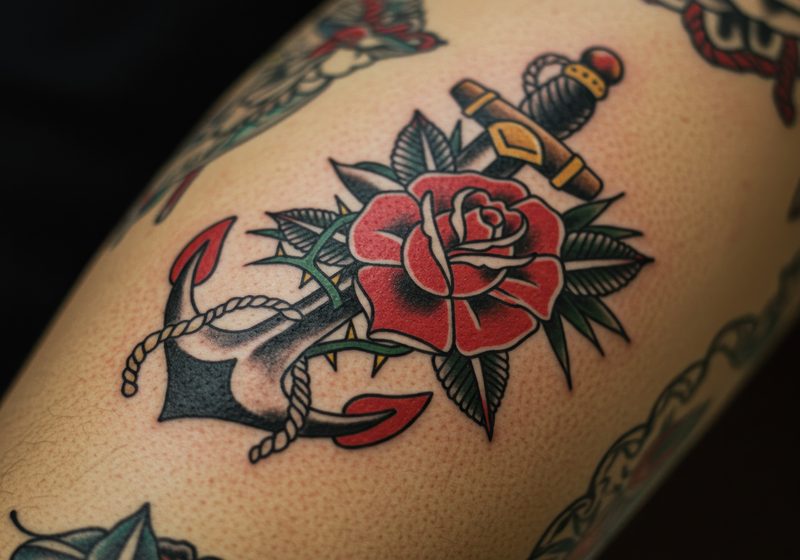
Bold black outlines, red petals, green leaves, yellow highlight at the center. The most-stencilled rose in American tattooing and the one traditional apprentices learn first. Holds color for decades when laid in properly. Clients who want a rose that will look right in 2055 usually end up here. The design has a century of evidence behind it.
The anatomical botanical
19th-century field-guide rendering
Full stem shown from root to bloom, leaves with visible veining, sometimes a dew drop or insect detail. Fine line with optional subtle color wash. Size runs 5–8 inches to hold the detail. Ages well on stable skin, poorly on high-flex zones because the fine internal linework blurs faster than bolder styles.
The rose-and-skull
Memento mori composition
Rose emerging from an eye socket or open jaw, or skull placed at the center of a rose with petals framing. Traditional Americana works, so does illustrative black-and-gray. Needs 6–10 inches because both elements need space to read clearly — undersize this and the skull becomes a smudge. From clients who want the rose to carry weight rather than soften the skull.
The rose-and-dagger, straight off the flash sheet
Traditional flash canon
Dagger piercing the bloom, or rose wrapped around the blade. If you’ve walked past a tattoo shop window in the last fifty years, you’ve seen one. Reads as temptation, defense, or the flower-and-weapon duality that gave the design its staying power. Traditional color palette holds up best — red rose, silver blade, black line.
The rose-and-snake
Eden-adjacent narrative composition
A snake wound through a rose, often with the bloom positioned at the snake’s head or tail. Needs 8–12 inches minimum for both elements to read as characters rather than decoration. One of the longer-sitting rose tattoos on the catalog — budget 4–6 hours for a well-rendered mid-size version. The composition that tells clients they need at least eight inches. Under that, the snake reads as a worm.
The blackout rose
Solid black, architectural
Rendered with negative-space petals and no internal color. Often sits inside a larger blackwork panel or serves as a cover-up for older work. Architectural rather than decorative — reads as shape and silhouette. Requires healthy skin and an artist who laminates saturation evenly; patchy blackout ages badly and is difficult to correct. Reads from across a room, not just arm’s length.
The microrealism rose at an inch
The newest fine-line direction
Ultra-small, 1–2 inches, rendered in miniature realism rather than simplified line. The fastest-growing request at Apollo over the past two years. Requires a specific fine-line machine and a steady hand — not every artist runs microrealism well. Ages faster than any other rose on this list because the line weight is at the limit of what skin holds. Expect noticeable softening at ten years.
The watercolor splash rose
Contemporary fine-art style
A rose with a trail of color or splash-pattern wash behind it — saturated pinks, purples, yellows, sometimes a scatter of deliberate ink drips. Photographs best on day one and ages fastest — watercolor effects lose vibrancy faster than line-based styles because color is doing the work instead of outline. Plan for a touch-up at five years. Best for clients who prioritize the current look over long-term stability.
The hand-holding-rose
Pin-up and neo-traditional style
A hand, often a woman’s, holding a single rose stem. The hand does most of the design work while the rose serves as focal point. Size runs 6–10 inches — anything smaller and the hand loses its gesture. Pulls from decades of flash and rewards an artist who draws hands well, which is a specific skill. Brings character without crowding the design with added symbols. Flash-book nostalgia done right.
Six styles
Six ways to build the same flower.
The rose survives more styles than any other subject in tattooing, which is precisely why the style decision has to come first. Choose one that fights your placement and the flower ages against you. Choose one that suits it and a rose is the most forgiving image in the medium.
American Traditional — a spiral, not a flower
Sailor Jerry flash lineage
Bold 3/0-liner outline, flat red petals, chrome-green leaves, yellow highlights at the center. The rose that has been tattooed continuously for more than 50 years and still looks correct at year 40 — the thick outline holds as the color drifts. Never been tattooed and want a rose? This is the default for a reason.
Neo-Traditional — Art Nouveau stems, muted palette
Expanded palette, dimensional bones
Burgundy, dusty rose, muted gold, sage — plus dimensional shading and Art Nouveau-style stem work. Where the majority of modern rose work lives in 2026, because neo-traditional gives you ornament and color without asking you to commit to photorealism. Two sessions is common for anything over four inches.
Fine line — hairline petal edges, and where they soften
The dominant 2020s style
Hairline work, botanical accuracy, often black-and-gray, sometimes with a single muted wash of color. Honest caveat: single-needle lines are thinner than traditional lines, which means they soften faster over skin that moves a lot — knuckles, feet, the outside of the hand. On a forearm or ribcage, they hold.
Black-and-gray realism — bring the actual rose
Photorealistic · specific reference required
Photorealistic rendering from a specific reference rose, often dewdrops, sometimes with a background wash. Realism doesn’t scale down — 5 inches is the floor. Bring the reference photo. A realism rose without a specific reference is an inventory rose, and it shows.
Botanical plate — engraved leaf, Redouté line
19th-century plate illustration
Detailed stem, labeled-looking leaves, deliberate line weight that mimics etching or engraving. Holds its shape for decades because every value in it is carried by a line rather than a wash. Pulls from Victorian botanical plates, Kate Greenaway, Redouté. Reads editorial.
Watercolor — no outline holding the bloom together
Splash, wash, bleed, drip
The contemporary fine-art style. Honest caveat: watercolor ages faster than line-based work because the splashes lack the scaffold of an outline. Most watercolor roses get a touch-up at year 7 to 10. If that’s a dealbreaker, pick a different category.
A rose at day one is swollen line and wet red. Ask what it looks like at year five.
The rose-and-snake is the composition that tells clients they need at least eight inches. Under that, the snake reads as a worm.
If this is your first rose, boring is the correct answer. Boring ages well.
Eight inherited pairings
The eight things people put next to a rose, and what each one does to it.
Most of these arrived on flash sheets decades before anyone reading this, which is why they compose so easily: somebody else already solved where the blade crosses the stem. What you put beside the flower changes its reading more than the size or the palette will.
Rose + lettered scroll
The memorial classic. Traditional or neo-traditional style. Banner holds a name, a date, or both; the rose softens it. Bicep, chest, outer forearm. Ages as well as the name does.
Rose + skull
Memento mori. The rose is the living thing, the skull is the reminder. Works in every style from Traditional to realism. Thigh, upper arm, back panel.
Rose + blade
Temptation and defense, the oldest Traditional pairing after rose-and-heart. Flash-book staple. Forearm or bicep, Traditional style.
Rose + snake
Narrative pairing — Eden-adjacent, but also just a good composition because the stem and the snake body echo each other. Thigh, ribcage, back panel. Neo-traditional through realism.
Rose + clock
Time plus love, or time plus loss. Often paired with a banner, often placed on the forearm or chest. Realism and neo-traditional carry it best.
Rose + heart
The Traditional Valentine’s style. Small, loud, honest. Forearm or chest. The oldest rose pairing in American tattooing.
Bouquet / multiple roses
Family pairings — one rose per child, per parent, per sibling. Often dated. Thigh, ribcage, back panel. Neo-traditional or illustrative.
Rose + moon
The modern witchcraft style. Fine line or single-needle, often with a crescent. Inner forearm, ribcage, sternum. Pairs cleanly with the 2020s fine-line style.
The petal-gap problem
How small can a rose get before the petals fuse?
A rose is mostly the shadow between one petal and the next. Shrink it and those gaps are the first thing to close. Four honest tiers.
Five placement styles
Where the rose sits decides who it’s talking to.
The same neo-traditional rose reads as an announcement on a bicep and as a private note on a sternum. Nothing about the drawing changed. Five placements cover nearly every rose that gets stencilled here, and each one hands the flower a different audience.
Draped against a curve — shoulder blade, hip, ankle
Shoulder blade · upper back · hip · inner thigh · ankle
The rose reads as ornament draped against a curve. No style-era shorthand, no announcement — it sits on the body the way a real flower sits on a branch.
Outer arm and chest — the inherited flash placement
Bicep · chest over heart · outer forearm · calf
The traditional placement and the traditional style. Reads as statement, reads at six feet, reads in a t-shirt. If someone in the family has a Traditional rose on the outside of their forearm, this is the lineage you’re inheriting from.
Inner forearm and sternum — the default 2020s rose
Inner forearm · ribcage · sternum · inside wrist · back of upper arm
These placements read as “tattoo of a rose” without locking in a style-era. Good for fine line, good for neo-traditional, good for illustrative. The inner forearm in particular is the default 2020s rose placement.
Under the shirt — the rose only you see
Inner bicep · underboob · inner thigh · behind ear · nape of neck
Private style — a tattoo for the wearer, not for the room. Often paired with fine line or single-needle because the style matches. The rose that lives mostly inside the wearer’s eyeline.
Anchor roses — drawn before anything else on the limb
Full back · full sleeve anchor · dual chest panel · full thigh
Not placements — compositional commitments. A statement rose is the anchor of a larger piece, planned from day one, often executed over four to eight sessions. The conversation starts with the artist before the drawing does.
Where rose work fails
Eight ways a rose goes wrong, and where each one starts.
Almost every rose we get asked to fix went wrong in one of these eight places. Seven of the eight went wrong before the machine was switched on.
The forty-seven-tab problem
47 saved images, bits picked from each, artist asked to combine. Result: a rose that belongs to no specific designer and reads as a compromise. Fix: three references, and for each one name the single thing you want out of it. This petal shape. That stem curve. That line weight, not that palette.
Photoreal petals at an inch and a half
Wanting a photorealistic, detailed, fully shaded rose at 1.5 inches. The detail doesn’t fit — blurs within 5 years. Fix: if you want that much detail, you need at least 4 inches. If you only have 1.5 inches, you need Traditional.
Full color on a hand that sees sun
Full color on a hand that sees sun daily. Fine line on a palm. Traditional ribcage at 2 inches. Every rose style has a placement that punishes it. Fix: ask the artist which placements THEIR version of this style has held up on, at ten-year marks.
Picked because it was the first flower that came to mind
Picking the rose because it’s the first flower that comes to mind, with no meaning behind the choice. A rose chosen by reflex reads as decoration forever. Fix: a rose chosen on purpose reads as yours. Name what it marks in one sentence before you pick the design.
The name booked in month three
A rose wrapping a partner’s name, booked in month 3 of the relationship. Fix: build the rose so it works as a single-element piece if the name ever needs to go — leaves, thorns, stem curve all working without the banner. Not cynicism — design hygiene.
Taking this week’s opening
Booking with whoever can get you in this week rather than matching a portfolio to your style. A rose is the most tattooed flower in the world — artists specialize. Fix: pick the specialist. Wait three weeks for the right portfolio match rather than settling for this week’s opening.
Judging by the just-wrapped photo
Choosing an artist based on the shiny, red, just-wrapped Instagram shots. Every rose photographs like a ten the day it’s wrapped, when the line is still swollen and the red is still wet. Fix: ask for the same rose at one year and at five. That is the tattoo you are paying for.
The memorial rose at month four
Booking a memorial rose within 6 months of the loss. Grief is still moving. What you want cut into your arm at month four is rarely what you’d choose at year two. Fix: wait. Roses aren’t going anywhere.
Before the consult
Six answers that skip the bad first sketch.
Turn up with these settled and the first drawing lands close. Turn up without them and the first hour goes to elimination.
Which reading leads?
Love, memorial, survival, tradition, beauty, tribute. Pick one primary. A rose can carry more than one reading, but the design has to be built around the one that matters most. Try to honor all six at once and you get a committee rose — technically a flower, emotionally nothing in particular.
Solo bloom, or a composition?
A name, a date, a second flower, a dagger, an initial, a moth. If composed, what’s the hierarchy — which element is the lead, which is the support? The rose is rarely the supporting element, but when it is, that changes the whole design math.
Which style lineage?
Traditional, Neo-Traditional, Fine Line, or Realism? If you don’t know, say so. Ask one artist to show you a healed Traditional rose and a healed fine-line rose from their own hand, both at five years. That single comparison settles the argument faster than any explanation of line weight.
Public arm, or private ribs?
Bold, classical, modern, intimate, or statement? Forearm and bicep read bold. Upper back and shoulder blade read classical. Sternum and inner arm read intimate. Full thigh and ribcage read as statement pieces. The style has to match the meaning.
How long can you sit?
A 3-inch Traditional rose is 1–2 hours. A 6-inch Neo-Traditional with color is 4–6. A half-sleeve with a rose as the anchor is two sessions minimum. Know your ceiling in time, budget, and sitting — before you fall in love with a design that lives above it.
Matching with someone?
If yes, is the other person in the room, in the text thread, or just in your head? Matching tattoos are their own design problem. Treat them as one. The other person should be in consultation if possible, or at minimum sign off on the final design before the stencil goes on.
The first-rose guide
If this is your first rose, boring is the correct answer.
Boring ages well. The honest starting recipe is Traditional at 3 inches on forearm or bicep. Eight decisions the first rose should make on purpose.
Personalization
Variety, color, and the part nobody else gets told.
A rose becomes yours in three layers, and they are not equally weighted. Nearly everyone arrives having thought hard about the first and not at all about the third, which is the one that stops the flower reading as decoration ten years out.
Bones: style, size, placement, palette
Style, size, placement, palette. These are the bones. They determine whether the piece reads as Traditional, Neo-Traditional, Fine Line, or Realism, and whether it reads as bold, classical, modern, or intimate. Most clients start and stop here — which is why most clients end up with roses that look like every other rose in their feed.
The variety, and why that one
A specific rose variety (Juliet, Black Baccara, Dog Rose, Tudor Rose). A color choice tied to a story. A companion element — a single leaf shape from a grandmother’s garden, a thorn pattern from a literary reference, a second flower paired for a sibling. Name a variety and the artist stops drawing the generic rose already in their hand and starts drawing yours.
The part strangers never get
The reason. Nobody else is owed it. The private layer is what keeps the piece from ever feeling generic — because even if the design itself reads as a standard rose to strangers, you know what’s underneath. That’s enough. That’s often the whole point.
Matching rose tattoos
Two roses, one stencil, one afternoon.
A matching rose has to keep working if the person you got it with stops speaking to you. That gets built in at the drawing stage or not at all.
Couples, siblings, and the parent-and-adult-child booking
Couples most commonly, then siblings, then best friends, occasionally parent-and-adult-child. Different relationships invite different composition decisions.
Same drawing, different leaf count
Same base design, small variation per person — different leaf count, different color, different placement — so each piece still belongs to the person wearing it.
Draw it so it still works as a solo bloom
If a breakup, an estrangement, or a death would destroy the piece, redesign it now so it works as a solo rose too. That isn’t pessimism. It’s the same planning you’d give any other permanent thing two people bought together.
One stencil, one hand, one sitting
Matching roses only match if one hand laid both of them. The same drawing given to two artists eight weeks apart produces two roses that resemble each other: line weight drifts, petal count drifts, and you notice it every time you stand side by side.
FAQ
Eight things people ask before they commit to a rose.
Eight questions covering design selection, first-tattoo guidance, aging, scale, placement, pricing, matching tattoos, and style pairing.
How do I know which rose tattoo design is right for me?
Take the five questions in order. First: what are you marking — love, loss, survival, beauty, tradition, or aesthetic? Second: single rose or composition (rose + name, skull, dagger, snake)? Third: Traditional lineage (Sailor Jerry, Neo-Traditional) or modern style (fine line, single-needle, contemporary botanical)? Fourth: visible or private placement? Fifth: what scale can you realistically commit to in time, budget, and sitting? A rose design that answers all five cleanly is the rose that’s actually yours. A rose that skips any of those steps is someone else’s tattoo.
What’s the best rose tattoo style for a first tattoo?
American Traditional at 3 inches on the forearm or outer bicep. Bold outline, flat fill, solid green leaves. The style survived a century because it ages better than any other tattoo style ever codified — a well-executed Traditional rose at age 20 still reads as a Traditional rose at age 50. Plan on 1–2 hours in the chair, one session, pricing discussed at consultation. Book with an artist whose HEALED Traditional portfolio at 1-year-plus is documented, not just their fresh-wrap Instagram feed. Boring is the correct answer for your first rose. Boring ages well.
Which rose tattoo ages the best?
American Traditional, hands down. Bold outline plus flat color fills means the piece holds its structure even as ink drifts over decades. Fine line softens faster because the hairline weight is at the limit of what skin holds — plan for a touch-up at 7–10 years. Neo-Traditional ages moderately well because the bold outline scaffolds the expanded palette. Realism ages well on placements with stable skin and poorly on high-flex zones. Watercolor ages fastest because it depends on saturation rather than outline. If you want a rose that will look right in 2055, pick Traditional. If you want current aesthetic over long-term stability, pick watercolor and plan for touch-ups.
How big should a rose tattoo be?
Depends on the style. Under 2 inches works for traditional outline silhouettes and fine-line minimalism only — anything with interior detail blurs within 5 years. 2–4 inches is the universal sweet spot where every style works. 4–8 inches is where neo-traditional and realism earn their keep — below 4 inches, realism compresses and stops reading. 8 inches and up is back pieces, chest panels, sleeve anchors — planned from day one as compositions, not sizing decisions. The rule that actually holds: the size you commit to decides which styles are available to you. If you want detail, commit to the scale that holds it.
What’s the difference between a rose tattoo on the forearm vs. ribcage?
Readings change with placement. Forearm reads bold and declarative — the traditional placement, visible daily to the wearer and to anyone in conversation. Ribcage reads private and intimate — a tattoo for the wearer, visible only when the wearer chooses. The same neo-traditional rose reads as statement on the forearm and as personal style on the ribcage. Placement also changes pain and session experience (ribcage is more painful), aging behavior (forearm holds color longer than skin that folds), and composition logic (vertical roses work on ribcage, vertical-stem roses work on forearms facing up or down). Pick placement based on who the tattoo is for.
How much does a rose tattoo cost in LA?
Rose pricing at Apollo scales with four factors: overall scale, style complexity, color vs. black-and-gray, and session count. Small Traditional or fine-line work is typically a single session at 2–4 inches. Mid-scale neo-traditional, botanical, illustrative, or watercolor with secondary elements usually spans one to two sessions. Realism and detailed illustrative pieces run two to four sessions. Back panels, full sleeves, and statement compositions planned from day one run four to eight sessions. Hourly is $100 with Blue, Hannah or Rick and $350 with Raa or David, and the final figure moves with artist, size, design and placement. We quote off the drawing, never off the description.
Should I get a matching rose tattoo with my partner?
It depends on the relationship stability and the design approach. Matching rose tattoos are one of the most-requested appointments in any working shop and one of the most under-planned. Working rules: match the rose, vary the detail (different leaf count, color, or placement so each piece still belongs to the wearer); plan for the piece to outlive the relationship — if a breakup would destroy the design, redesign it so it works as a solo rose; book the same artist, same day, same stencil, because matching across studios drifts in line weight and proportion. Not every matching piece needs to survive every relationship — but it should survive the decision you’d make today, without you.
Which rose tattoo style pairs best with other elements?
Traditional and Neo-Traditional pair most cleanly with other flash-lineage elements — skulls, daggers, banners, hearts, snakes, swallows. The bold outlines of both styles give the secondary element something to anchor against. Fine line pairs best with other fine-line elements (moons, constellations, botanical sprigs, single-word script) — it struggles when paired with heavier-line subjects because the weight mismatch reads as unfinished. Realism pairs with other realism pieces only. The cleanest composition rule: match style weight. A Traditional rose with a fine-line snake looks like two different tattoos sharing a frame. A Traditional rose with a Traditional snake looks like a single piece.
One flower, twelve answers
Bring the sentence, three references, and an honest number of hours.
Traditional, fine-line or realism, and thorns or no thorns. Those two answers cover most of a rose consultation. Bring the sentence you want it to say and we'll build the petals around it.