Tattoo Ideas
Octopus
Eight arms is a composition problem, not a detail problem. This is one of the few motifs where the animal picks the placement for you, because arms want a compound surface to wrap. Twelve directions across the Japanese tako, the kraken, and blue-ringed realism, plus the sucker rendering that closes up first.
Book a consultationTwo lineages, five decisions
Tako or kraken? That fork comes before everything else.
Two entirely separate traditions arrive at this animal from opposite directions. Japan has been drawing the tako for centuries as a subject with its own conventions and its own water. Europe and America arrived at it through sailors, who turned it into a monster. Neither is a variant of the other, and no artist we know runs both well. Five decisions, in this order.
Japanese style or Western style?
The octopus in Japanese tattooing (tako) is a major subject — centuries of Edo-period woodblock lineage, bold outlines, saturated color, the figure often paired with waves, abalone, or a diver. Western-style octopus pulls from realism, illustrative, sailor-tradition kraken, and microrealism. Different visual language, different sitting time, different artistic lineage. Pick the style before anything else.
Which reading are you actually buying?
Octopi carry multiple readings — intelligence and problem-solving, adaptability, sailor tradition (a warning against sea-serpents), Japanese mythology, sheer visual spectacle. “It’s the smartest invertebrate on Earth and I feel a kinship.” “My grandfather fished for a living.” “I love the movement of the tentacles.” Any of those is enough.
Full body or tentacle detail?
A full octopus showing mantle, eye, all eight arms reads as portrait composition — needs 8 inches minimum. An isolated tentacle wrapping an arm or climbing a calf reads as gesture — works at smaller scales. Tentacle-only designs are one of the fastest-growing octopus requests. Different problem.
Realism, illustrative, or stylized?
Realism delivers accurate cephalopod anatomy, suction-cup detail, eye rendering — demands specialist and 6 inches minimum. Illustrative uses deliberate line weight and stylized form. Stylized (Japanese, neo-traditional, blackwork) treats the octopus as design element rather than anatomical subject. Three different artistic languages.
How big can you honestly commit?
Scale sets the style. Under 4 inches compresses tentacle detail past legibility. Under 6 inches eliminates full-body realism. Japanese octopus at scale is a sleeve or back piece — plan for four to eight sessions. Your honest scale sets your honest octopus.
The octopus in Japanese tattooing is a major subject — centuries of Edo-period lineage. Pick the Japanese specialist or pick a Western style, not a mashup.
A realism octopus without a specific species reference is an inventory octopus, and it shows.
Generalist artists get cephalopod anatomy wrong. Ask for healed octopus portfolio specifically — not just realism portfolio.
Flash · ready to ink
Octopus flash designs
15 hand-drawn designs from our flash collection — book any one as-is, or use it as the starting point for a custom piece. Sizing, placement and linework dialed in at your consultation.
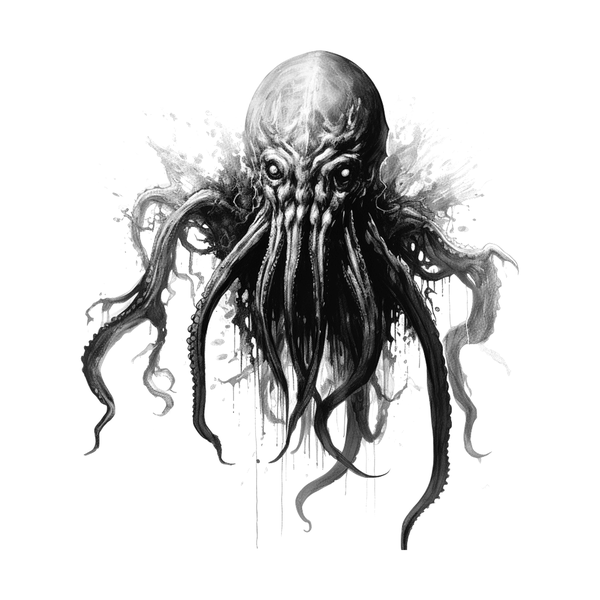
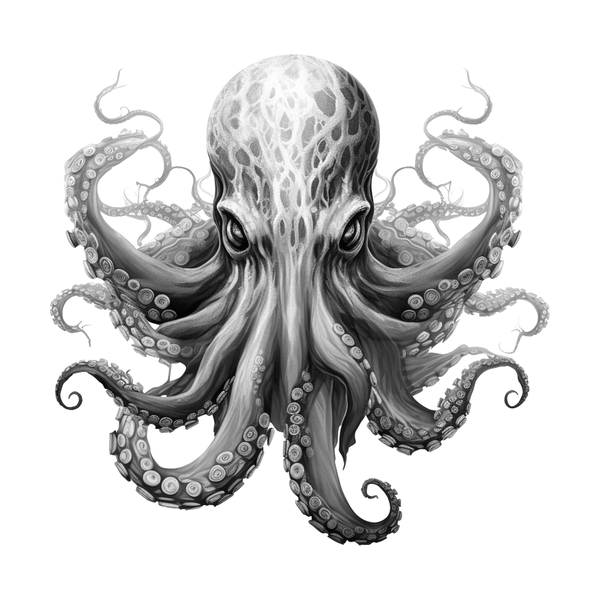
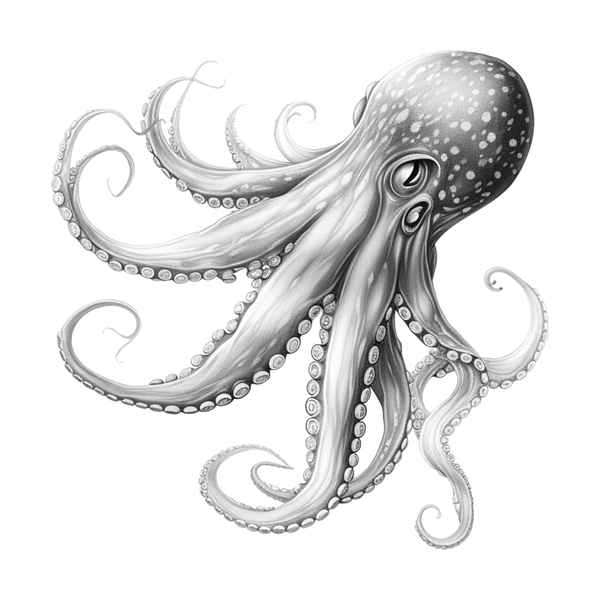
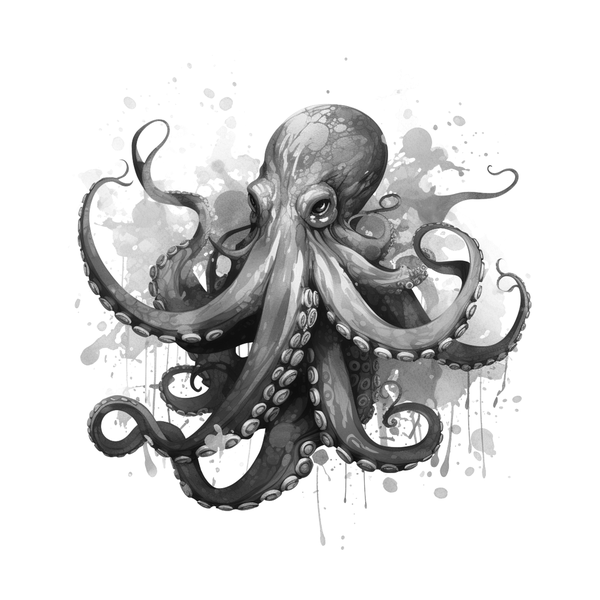
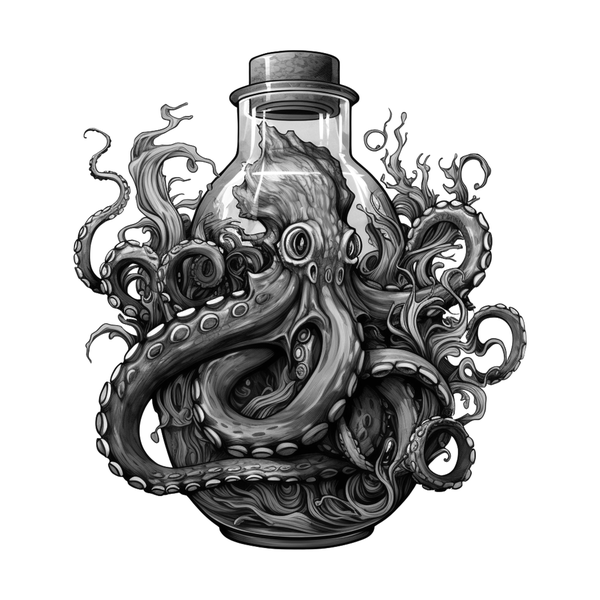
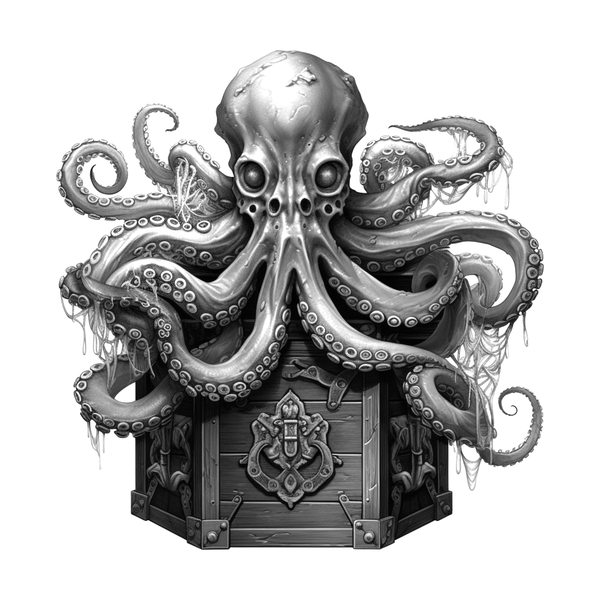
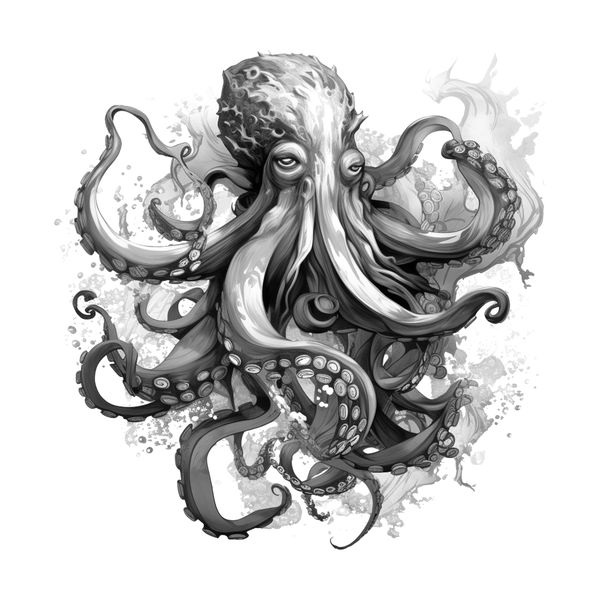
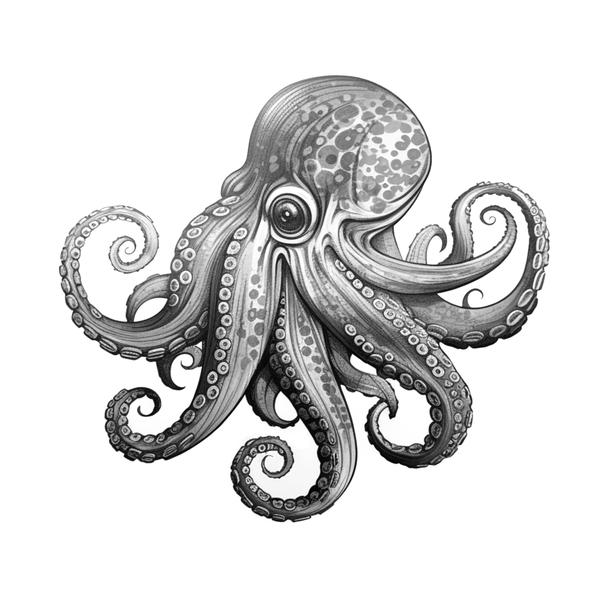
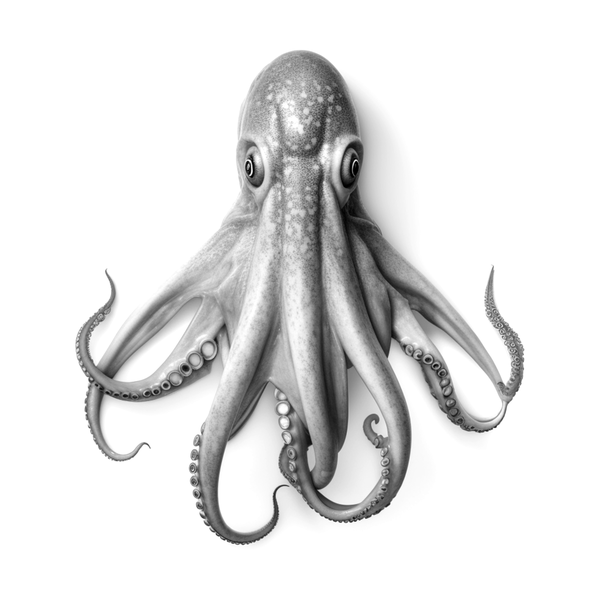
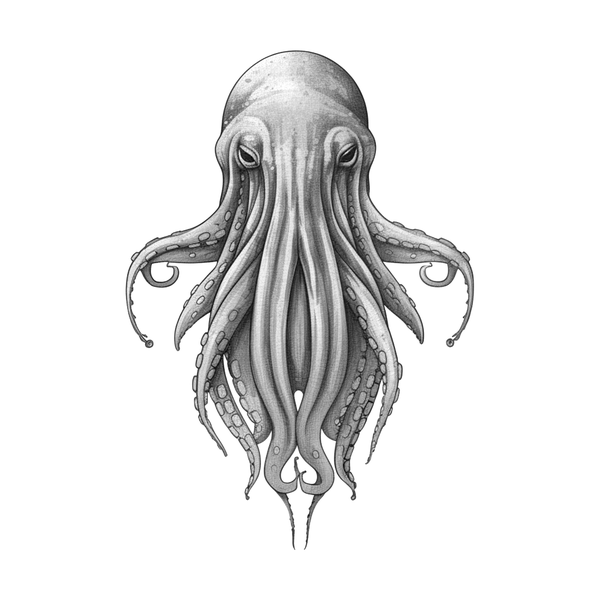
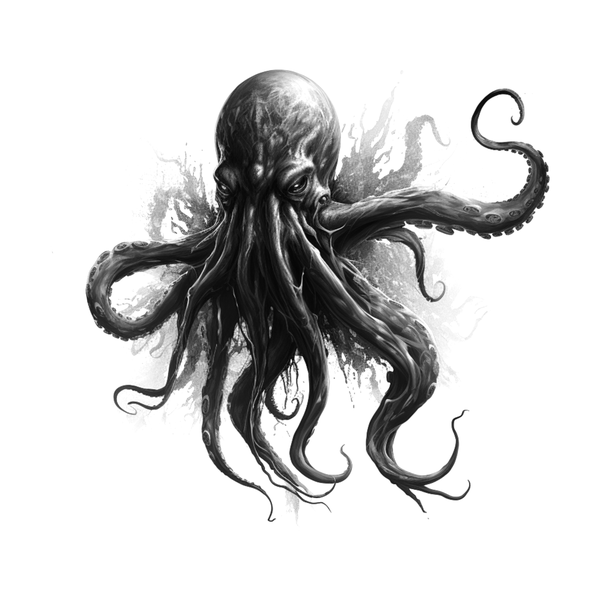
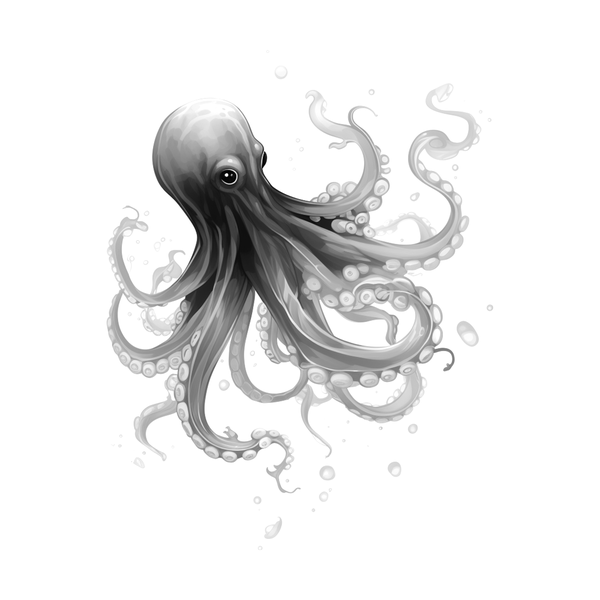
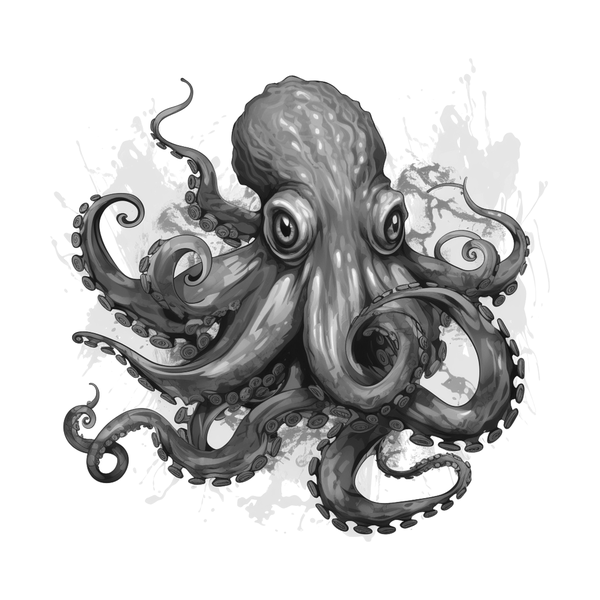
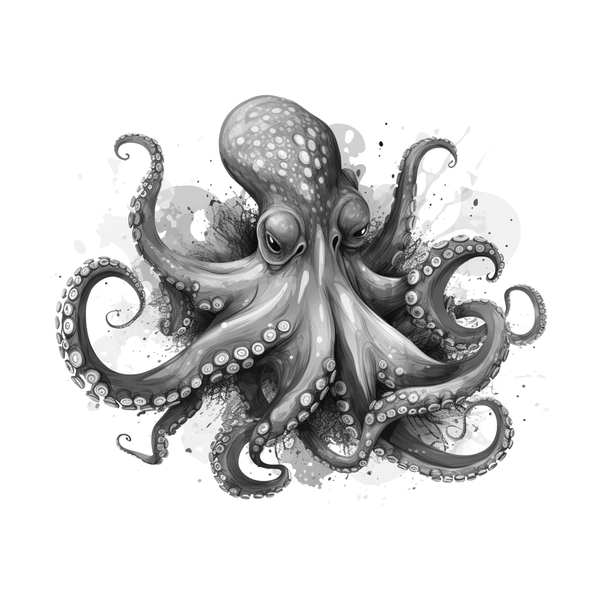
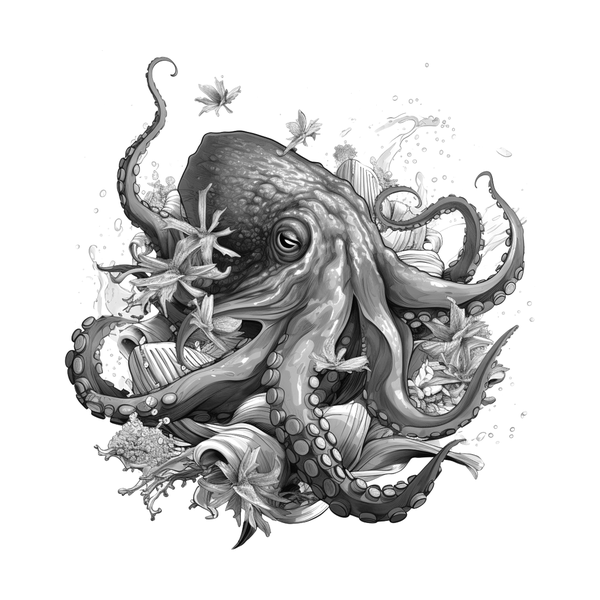
Twelve cephalopods
Twelve octopuses, sorted by how much arm each one needs.
Watch the scale line on each of these, because it is doing more work here than on any other subject in the catalog. A blue-ringed at three inches and a tako sleeve at eighteen are not the same idea at two sizes — they are two designs that happen to share an animal, and the number of arms you can afford to render is what separates them.
The Japanese tako
Edo-period woodblock lineage
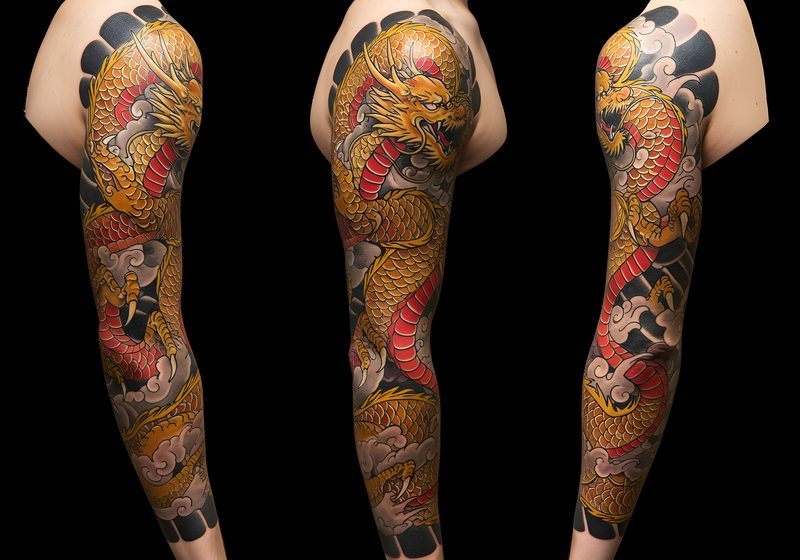
Traditional Japanese octopus — bold outlines, saturated red/indigo/gold palette, tentacles curling through wind bars or waves. Carries the Edo-period woodblock tradition and pairs with Japanese water, abalone, or sometimes the ama diver. Size runs 10–18 inches as a back or sleeve anchor. Specialist required. Plan for four to eight sessions. Cross-reference Japanese style pages.
The blue-ringed octopus
Small species, lethal reputation
One of the world’s most venomous animals — identified by the iridescent blue rings that pulse when threatened. Realism or neo-traditional color, 3–5 inches. Punches above its weight visually because the blue rings carry all the drama. Inner forearm, calf, shoulder, sternum. The marine-biology style octopus.
The kraken
Sailor-tradition sea monster
Mythological rendering — oversized octopus attacking a ship, emerging from stormy seas, or filling a sleeve with multiple-tentacle composition. Traditional Americana or illustrative black-and-gray. Size runs 8–16 inches. Back piece, full sleeve, chest panel. The Melville/Jules-Verne lineage. Pairs with ships, sailors, compass roses.
The realism octopus portrait
Photorealistic cephalopod rendering
Black-and-gray or color realism — accurate anatomy, suction-cup detail, eye rendering, skin-texture shading. Requires a realism specialist and a specific species reference. Size runs 6–12 inches. Outer thigh, upper arm, ribs, back panel. Ages well on stable skin, softens faster on high-flex zones.
The neo-traditional octopus
Expanded palette, dimensional bones
Bold outline, burgundy/teal/muted-gold palette, Art Nouveau stem work in the tentacle curls. Pairs with nautical objects — compass, anchor, lantern — or with flora (coral, anemone). Size runs 5–9 inches. Upper arm, outer thigh, chest cap, back panel. Where much contemporary octopus work lives in 2026.
The tentacle-wrap
Isolated tentacles as gesture
Tentacle or tentacles emerging from behind a placement, wrapping the limb or the body. Reads as design element rather than anatomical subject. Fine line, illustrative, or blackwork. Works at smaller scales (4–8 inches) because no full body is needed. Forearm wrap, calf climb, shoulder-over, chest climb. One of the fastest-growing octopus requests.
The octopus-and-ship
Nautical attack composition
Octopus attacking or emerging around a sailing ship. Traditional Americana or illustrative. Pulls from 19th-century maritime illustration and sailor-tattoo tradition. Size runs 8–14 inches. Outer thigh, back panel, chest. One of the older Western octopus compositions — documented in sailor-tattoo records from the 1890s.
The octopus-and-diver
Japanese ama composition, Hokusai reference
Classical Japanese composition — octopus entwining with a female pearl diver (ama). Hokusai’s 1814 woodblock is the most famous example. Requires a Japanese-style specialist and respectful framing. Size runs 10–18 inches. Back piece, thigh panel, large chest. Traditional Japanese style essential.
The blackwork octopus
Solid-fill architectural
Octopus rendered in solid black with negative-space tentacle highlights. Architectural rather than decorative. Cover-up friendly. Requires blackwork specialist. Size runs 6–12 inches. Outer forearm, shoulder, outer thigh, upper back. Ages well when laid in evenly.
The microrealism octopus
Ultra-detailed at 2–3 inches
Miniature realism rather than simplified line. Eye, suction-cup detail, mantle rendering all compressed into a small frame. Requires a microrealism specialist. Ages faster than larger work — plan for touch-up at seven to ten years. Inner wrist, inner forearm, behind ear, ankle.
The illustrative cephalopod plate
19th-century scientific illustration
Octopus rendered as a Victorian naturalist plate — deliberate line weight, labeled-looking anatomy, sometimes with pin or display-box context. Pulls from natural-history museum aesthetic. Fine line or black-and-gray illustrative. Size runs 5–9 inches. Inner forearm, spine, outer thigh, sternum.
The watercolor octopus
Contemporary fine-art style
Octopus with saturated color wash behind — teals, blues, purples, sometimes deliberate ink drips. Photographs best on day one and ages fastest of any octopus style — watercolor effects lose vibrancy faster than line-based work. Plan for a touch-up at five to seven years. Size runs 5–9 inches. Shoulder, upper arm, outer thigh.
Eight arms
The arms are a composition problem, not a detail problem.
Everything that makes an octopus tattoo good or bad happens in the arms — where they go, how they taper, and how much of the sucker row the artist tried to draw. Four things to look for before you book.
Why the animal picks its own placement
Eight arms leaving one central mass have to travel somewhere, and where they travel is the composition. That is the reason the shoulder-and-upper-arm half-sleeve keeps coming back as the natural home for this subject: it is one of the few regions of the body convex in two directions at once, so an arm can leave the mantle, follow the curve of the deltoid and disappear behind the limb without the artist ever having to draw an ending for it. Put the same design on a flat panel — a shoulder blade, a square of thigh — and the arms have nowhere to go but back into the composition, which is why so many flat-panel octopuses read as a pile rather than an animal. If you are set on a flat placement, ask for fewer arms in view and let the rest leave the frame.
Arms taper and twist. Tubes do not.
A real arm narrows continuously from a thick base to a tip finer than a pencil line, and it rotates along its length, so the sucker row turns in and out of view as it goes. Weak work draws tubes instead: even width most of the way down, every sucker facing the viewer, a tip that simply stops. This is the easiest thing in the world to check in a portfolio, and almost nobody checks it. Look at where the arms end. If every arm in every piece conveniently exits the frame or curls into a tidy circle, the artist is dodging the taper. You want to find at least one arm drawn all the way down to a hair.
Suckers are the first thing to close up
A sucker row is a field of small high-contrast circles spaced close together, which is precisely the geometry that fills in as ink settles. At six inches of arm you can render individual suckers along the near side and carry the rest with tone, and that still reads at fifteen years. At three inches, individually drawn suckers become a grey stripe inside a few years. The craft answer is to vary the sucker size along the arm — large at the base, fading toward the tip — and to fully render only the two or three arms nearest the viewer, letting the far arms go to shape. Evenly sized suckers marching down all eight arms is the single most common octopus-specific ageing failure, and it looks fine in the healing photo.
Blue rings only appear on an agitated animal
Worth knowing if the blue-ringed is what you came for, because the rings are the entire reason anyone wants that piece. On the living animal the iridescent rings run across the mantle and along the arms, not just around the head, and they are only that vivid when the animal is alarmed — at rest it is a drab beige-brown thing you would walk past in a tide pool. So there is a real decision hiding in the reference photo you bring: a blue-ringed at rest and a blue-ringed flaring are two different tattoos, and the flaring one is what almost everybody actually has in their head.
Where the arms can go
This is one of the few subjects that picks its own placement.
Most tattoos are a shape you put on a surface. This one is a shape that has to hold a surface, because eight arms leaving a central mass need somewhere to travel. Read these five as answers to that question rather than as a list of body parts.
Wrap — the animal’s own preferred geometry
Forearm wrap · calf climb · shoulder-over · thigh spiral
Tentacle-wrap compositions and Japanese sleeve pieces live here. The body’s limbs become paths for tentacle flow, and the octopus’s geometry agrees with the canvas. The default placement for Japanese tako and tentacle-only designs.
Bicep and chest — where the kraken has always lived
Bicep · chest over heart · outer forearm · calf
Traditional Americana kraken pieces, neo-traditional portraits, octopus-and-ship compositions. Reads as statement, reads at six feet, reads in a t-shirt. Where Western-style octopus work has lived for a century.
Centred portrait — eye contact and mantle symmetry
Outer thigh · upper arm · ribs · back panel
Realism octopus portraits and neo-traditional centerpieces. The octopus as portrait subject — eye contact, mantle symmetry, tentacles arranged around a central axis. Needs the surface area to read as portrait rather than gesture.
Sleeve and back — one composition, planned once
Full back · full sleeve · chest panel · thigh panel
Japanese tako sleeves, kraken back pieces, octopus-and-diver compositions. Not placements — compositional commitments. Planned from day one, executed over four to eight sessions. Specialist required.
Wrist and ankle — small enough that suckers are a suggestion
Inner wrist · inner forearm · behind ear · ankle · sternum center
Microrealism blue-ringed octopus, small fine-line cephalopod pieces. The piece that stays inside the wearer’s eyeline. Plan for touch-ups at seven to ten years because small-scale detail softens faster.
Measured at the suckers
Four tiers, and the sucker row sets the floor on each one.
An octopus is mostly small round shapes packed close together, and small round shapes packed close together are the first thing skin gives back. So the honest measurement is not the animal — it is the sucker row on the nearest arm.
Six disciplines
Almost nobody runs more than two of these six well.
Cephalopods punish generalists harder than most subjects, because each of these six solves the arm problem with a different tool — outline, tone, solid black, line weight. An artist who is genuinely fluent in two of them is doing well. Pick the discipline, then go find the person who lives in it, even if that means waiting.
Traditional Japanese — the tako carries its own wave grammar
Edo-period woodblock lineage
The octopus in Japanese tattooing is a major subject — centuries of Edo lineage, bold outlines, saturated color palette, wind bars and wave patterns filling negative space. Specialist-dependent. Four to eight sessions common for a sleeve or back piece. Cross-references Japanese style pages.
Neo-Japanese — same grammar, looser line, shorter sit
Contemporary Japanese style
The modern evolution of traditional Japanese — expanded palette, cleaner linework, compositional freedom that wasn’t available in Edo-period flash. Carries the same cultural weight but reads more contemporary. Cross-references Japanese modern style pages.
Black-and-grey realism — the suckers are the whole test
Photorealistic cephalopod rendering
Photorealistic octopus rendering — accurate anatomy, suction-cup detail, skin texture. Realism doesn’t scale down — 6 inches is the floor. Bring a specific species reference. A realism octopus without a specific reference is an inventory octopus, and it shows.
Neo-Traditional — an outline strong enough to hold eight arms
Expanded palette, dimensional bones
Bold outline, burgundy/teal/muted-gold palette, dimensional shading in the tentacle curls. Pairs with nautical objects and flora. Where much contemporary Western octopus work lives. Two sessions common for anything over five inches.
Traditional Americana — this is where the kraken lives
Sailor-tattoo lineage, kraken style
Bold outline, flat red/green/black palette. Pulls from 19th-century sailor tattoo tradition. The kraken-and-ship style lives here. Holds for decades because the thick outline scaffolds the flat color.
Illustrative and blackwork — arms as shape, not as texture
Line-based or solid-fill graphic
Two related Western styles. Illustrative uses deliberate line weight and 19th-century scientific-plate aesthetic. Blackwork renders the octopus in solid fill with negative-space highlights. Both age beautifully because both are built on structural decisions rather than color saturation.
Eight compositional pairings
The second element decides whether you are wearing a specimen or a monster.
Put the same animal beside a wave and it is Japanese. Beside a ship it is a nineteenth-century sea monster. Beside coral it is marine biology. The octopus is unusually easy to relocate this way, which is why the companion object deserves as much thought as the species.
Octopus + Japanese waves
Classical Japanese style. Tako entwined in wave pattern. 10–18 inches, sleeve or back piece. Traditional Japanese specialist required.
Octopus + ship
Sailor-tradition kraken. Traditional Americana or illustrative. 8–14 inches, back panel or outer thigh.
Octopus + diver
Japanese ama composition, Hokusai reference. 10–18 inches, back piece. Respectful framing required.
Octopus + anchor / compass
Nautical pairing. Neo-traditional or traditional. 5–9 inches, forearm or chest. Sailor-tradition style.
Octopus + coral / anemone
Tidal-pool composition. Neo-traditional color with saturated ornamental palette. 5–9 inches, outer thigh or shoulder.
Octopus + skull
Memento mori composition, often with tentacles threading through the eye sockets. Illustrative or traditional. 6–10 inches.
Octopus + lighthouse
Coastal pairing. Neo-traditional or illustrative. 6–10 inches, calf or outer thigh. Less common than kraken-and-ship but growing.
Octopus + lettering
Quote, name, or coordinates. Hand-lettered banner woven into tentacle arrangement. Neo-traditional or fine-line.
Before the drawing
Six answers, and the species one is not optional.
Five of these six are the usual: lineage, composition, style, placement, scale. The species question is the one people skip, and it is the one that decides whether the finished piece looks like an animal or like a shape with arms.
Japanese style or Western style?
Pick first — the two are different artistic lineages with different specialists, different sitting times, and different composition rules. Japanese style requires a Japanese specialist. Western style can run through several American traditions (realism, neo-traditional, illustrative).
Full body or tentacle detail?
Full-body needs 8 inches minimum. Tentacle-wrap works at smaller scales. Japanese tako pieces default to full-body compositions. Tentacle-only designs are one of the fastest-growing contemporary requests.
Which species?
Common octopus (Octopus vulgaris), blue-ringed, giant Pacific, mimic, dumbo, vampire squid (technically a cephalopod cousin). Different species for different readings. Realism requires a specific reference — bring one.
Which of the six disciplines?
Japanese traditional, Japanese modern, Western realism, neo-traditional, traditional Americana, illustrative/blackwork, watercolor. Each has different sitting time and specialist requirements. Pick before you pick the artist.
Which placement?
Flow/wrap (forearm, calf, shoulder-over) for Japanese and tentacle designs. Bold (bicep, forearm) for Western traditional. Portrait (outer thigh, upper arm) for realism. Statement (full back, sleeve) for Japanese or kraken commitments. Intimate (inner wrist, ankle) for microrealism.
How many sessions can you actually give it?
A 4-inch blue-ringed is a single session. A 9-inch neo-traditional is 2–3 sessions. A full Japanese tako sleeve is four to eight sessions. Know your ceiling in time, sitting, and budget before you fall in love with a design above it.
Where octopuses go wrong
Eight failures, and half of them are about the arms.
Two of these are lineage problems, two are reference problems, and the other four all trace back to the same thing: eight arms and not enough room to draw them. Every one is cheaper to catch on paper than to live with.
The Japanese-style drift
Wanting a Japanese tako but booking with a non-Japanese specialist. The result: a Japanese-style octopus rendered with Western linework, which looks like neither. Fix: if you want Japanese, find a Japanese specialist. Waiting weeks for the right artist is not optional for this category.
A full body at four inches
Wanting a full-body realism octopus with eye, mantle, and all eight tentacles at 4 inches. Anatomy blurs past legibility. Fix: if you want full-body realism, commit to 8 inches minimum. If you only have 4 inches, pick a tentacle-wrap or blue-ringed species instead.
The no-reference realism disaster
Booking a realism octopus without a specific species reference. The artist renders a generic octopus. Fix: bring a species photo. A realism octopus without a reference is an inventory octopus.
The anatomy-wrong problem
Generalist artists get cephalopod anatomy wrong — wrong number of arms, wrong suction-cup placement, wrong eye structure. Fix: ask specifically for their healed octopus or cephalopod portfolio. Anatomy errors are visible and permanent.
The style-placement drift
Japanese tako on a hand that sees sun daily. Fine-line tentacle wrap on a palm. Arms that wrap a joint move every time the joint does, and thin line on a moving surface is a short-term arrangement. Fix: ask which placements this artist’s own version of the style has held up on at ten years, and ask to see it.
The cultural-mashup
Japanese tako with American traditional banner and Sanskrit — three traditions in one piece, none of them honored. Fix: pick the lineage first, then build the design inside it.
Booking the calendar instead of the portfolio
Booking with whoever can get you in this week rather than matching a portfolio to the style. Cephalopod work is specialized. Fix: pick the specialist. Wait three weeks for the right portfolio rather than settling for this week’s opening.
Judging an artist by the wrap photo
Choosing an octopus artist based on the shiny, just-wrapped Instagram shots. Fresh suckers photograph beautifully and tell you nothing, because the whole question with this animal is whether that sucker row is still a sucker row in a decade. Fix: ask to see the same piece at one year and at five, and look at the arms rather than the eye.
Tentacle-wrap is one of the fastest-growing octopus requests because it works at scales where full-body realism doesn’t.
Japanese tako at scale is a four-to-eight-session commitment. Plan like a specialist plans.
The blue-ringed octopus punches above its weight visually — 3 inches of design carry all the drama because the rings do the work.
The first-octopus guide
If this is your first octopus, pick the style before the species.
Register is everything. The honest starting recipe is neo-traditional or illustrative at 5 inches on the outer forearm or upper arm. Eight decisions the first octopus should make on purpose.
Matching octopus tattoos
Sibling and partner pairs. Coastal-family lineage sets.
Octopus sets go wrong in a way that is specific to the animal: the arms end up pointing in unrelated directions, so two pieces that share a species still refuse to look related. Agree the arm flow before you agree anything else.
Who ends up matching cephalopods
Sibling sets bonded by a coastal childhood, partner pairs with shared marine-biology interest, occasional friend groups who travel-dive together. Nautical families sometimes match octopus pieces as lineage markers.
Match the species, vary the pose
Same species, one variation per person — different tentacle arrangement, different eye position, different placement — so each piece still belongs to its wearer.
Honor the same style across all pieces
If the set is Japanese, keep every piece Japanese-style. A mixed set of Japanese-for-one and Western-realism-for-another reads as careless rather than meaningful.
One artist, one stencil, one sitting
Matching octopus work across studios drifts badly — tentacle proportion and eye detail vary between artists. Match the execution or don’t call it matching.
Making it yours
Naming the species is the cheapest way to stop owning a stock octopus.
There are around three hundred described octopus species and most people commission the generic one. Picking a real animal with a real range costs nothing, changes the colour, the arm proportion and the mantle shape, and quietly answers the question of why this tattoo rather than any other octopus.
The bones — lineage, species, style, size
Register (Japanese or Western), species, style, size, placement. These are the bones. They decide whether the piece reads as Japanese tako or Western kraken or neo-traditional portrait. Most clients start and stop here.
A species with a coastline attached
A specific species tied to a region (Pacific Northwest giant Pacific octopus, Mediterranean common octopus). A companion element — a particular ship for the sailor-tradition composition, a specific wave pattern from a Hokusai print, coordinates of a coastline you actually swam. Any one of those changes the drawing; all three would be too many.
The kinship nobody has to be told about
Strangers see a cephalopod. That is fine, and it is most of the appeal — the reading you actually care about is not visible and does not need defending at parties. Kinship with the smartest invertebrate on Earth. Family fishing lineage. A year spent diving. That’s enough.
FAQ
What comes up once the lineage is settled.
Eight questions covering octopus symbolism, Japanese-vs-Western style, first-tattoo guidance, aging, scale, kraken meaning, placement, and non-nautical clients.
What does an octopus tattoo symbolize?
Octopi carry multiple readings across cultures. In Japanese tradition (tako), the octopus appears in centuries of Edo-period woodblock art and tattoo flash — intelligence, adaptability, supernatural power. In Western sailor-tattoo tradition, the octopus (often exaggerated into a kraken) represents the wildness and unpredictability of the sea. Contemporary Western clients often choose the octopus for its real-world biological reading: the most intelligent invertebrate on Earth, a problem-solver, a creature capable of startling adaptation. Different styles read differently — a Japanese tako is a lineage-aware composition, a kraken is a sailor-tradition nod, a realism blue-ringed is a marine-biology style. Pick which reading you want before you pick the style.
What’s the difference between a Japanese octopus tattoo and a Western octopus tattoo?
Japanese-style octopus (tako) follows centuries of Edo-period woodblock lineage — bold outlines, saturated red and indigo palette, wind bars and wave patterns filling negative space, tentacles curling through stylized composition. Specialist-dependent, four to eight sessions for a sleeve or back piece. Western-style octopus includes realism (photorealistic species portraits), neo-traditional (dimensional color, Art Nouveau tentacle curls), traditional Americana (sailor-tradition kraken), and illustrative (19th-century scientific plate). Different artistic lineages, different specialists, different sitting time. A Japanese tako rendered by a Western-realism artist looks like neither tradition — it looks wrong. Pick the style and find the specialist for it.
What’s the best octopus tattoo style for a first tattoo?
Neo-traditional or illustrative at 5 inches on the outer forearm or upper arm. Neo-traditional carries color well, ages well, and doesn’t require a Japanese or realism specialist. Illustrative (black-and-gray) is another legitimate first-octopus choice — fewer decisions, still a rich composition. Skip full-body realism and Japanese sleeves for a first tattoo; they’re multi-session commitments that reward experienced sitters. Plan on 3–5 hours in the chair, one session. Apollo charges $100 an hour with Blue, Hannah or Rick and $350 with Raa or David, with half days at $400 and full days at $600 — final price depends on artist, size, design and placement. Book with an artist whose HEALED octopus portfolio at 1-year-plus is documented — generic realism or generic Japanese portfolios don’t guarantee cephalopod competence.
Which octopus tattoo ages best?
Traditional Japanese and traditional Americana age best — bold outlines scaffold the color as ink drifts over decades. Blackwork ages well when laid in evenly. Neo-traditional ages moderately well because the bold outline holds even as the color palette softens. Black-and-gray realism ages well on stable placements and poorly on high-flex zones — suction-cup detail in particular blurs faster than the overall silhouette. Watercolor ages fastest because it depends on saturation rather than outline — plan for a touch-up at five to seven years. If you want an octopus that will look right in 2055, pick traditional Japanese or traditional Americana.
How big should an octopus tattoo be?
Depends on the style and composition. Under 3 inches works for microrealism only — tentacle detail and eye rendering are at the limit of what skin holds. 3–5 inches is blue-ringed octopus territory or tentacle-wrap starting size. 5–10 inches is the working sweet spot for neo-traditional, illustrative, and Western-realism portrait work. 10 inches and up is Japanese tako territory, back pieces, full sleeves, kraken compositions — planned from day one as compositions, not sizing decisions. The honest rule: full-body realism needs 8 inches minimum or the anatomy compresses past legibility.
What does a kraken tattoo mean?
The kraken is the mythological sea monster from Scandinavian folklore, depicted in 19th-century maritime illustration and cemented in Western pop culture by Melville, Jules Verne, and a century of sailor-tattoo tradition. A kraken tattoo reads as sailor-tradition — the wild unpredictability of the sea, the courage it takes to sail, the warning that deep water hides deep danger. Visually rendered as an oversized octopus attacking a ship, emerging from storm clouds, or filling a sleeve with multiple-tentacle composition. Traditional Americana and illustrative black-and-gray are the two styles that carry the composition best. If you’re drawn to the octopus as biological subject, pick realism or neo-traditional. If you’re drawn to sea mythology and sailor lineage, pick kraken.
Where is the best placement for an octopus tattoo?
Depends on the style and composition. Japanese tako pieces live on the upper back, full sleeve, or thigh panel — the body’s natural panels are where the Japanese composition rules were developed. Western realism portraits live on the outer thigh, upper arm, or ribs where the canvas is stable enough to hold the detail. Tentacle-wrap compositions follow the limb — forearm, calf, shoulder-over — because the body’s geometry agrees with the tentacle’s flow. Kraken compositions live on back pieces or outer thighs. Microrealism octopi live in intimate placements — inner wrist, behind ear, ankle. Pick placement based on which style and composition the piece is in.
Should I get an octopus tattoo if I don’t have nautical heritage?
Yes — the octopus is a legitimate subject across many styles that have nothing to do with sailor tradition. Japanese tako carries centuries of artistic lineage. Realism cephalopod work is a marine-biology style. Neo-traditional octopus pieces pair with flora or objects rather than ships. The octopus is the most intelligent invertebrate on Earth, capable of problem-solving, tool use, and genuinely startling behavior — that biological reading is reason enough. You don’t need fishing-boat lineage to wear an octopus. What you do need is to pick your style deliberately: if you want Japanese, find a Japanese specialist; if you want realism, bring a species reference; if you want kraken, know that you’re choosing sailor tradition as your lineage.
Ready to pick the species?
Bring the lineage. Bring the species photo. Bring the shoulder.
Tako or kraken. That fork decides the tradition, the artist and the whole composition, so we take it first. Then we plan the arms around the surface they have to wrap.