Kids & Family Piercing
Body Piercings For Older Teens
Apollo's age policy and anatomy-first approach to body piercings for older teens — nostril (14+), navel (14+), septum (1
Book a consultationWhy age policy matters
Thresholds aren’t bureaucratic — they’re biological.
Tissue, judgment, and consent all mature on their own timetables. Apollo’s age thresholds reflect where those timetables converge for each placement. A navel piercing wants a specific shelf of skin that often isn’t present at twelve; a septum wants a sweet-spot anatomy that often isn’t ready at fourteen. Underneath the age chart is a series of specific anatomical and developmental readings — not a moral judgment about teen bodies.
The short version. Lobe 5+, simple cartilage 13+, nostril/navel/complex cartilage 14+, septum/eyebrow 16+, nipple/genital/tongue/surface/dermal 18+ regardless of consent. Anatomy exam confirms the age threshold. The teen drives the decision; the parent consents. Pricing is a consultation conversation.
Five readiness decisions
Before the consult, before the paperwork.
Five filters that sort 'ready' from 'wait.' Age, anatomy, teen willingness, home environment, consent — each is independent; all four have to clear for the piercing to happen.
How old is the teen, exactly?
Apollo's thresholds run by placement: lobes 5+, simple cartilage 13+, complex cartilage and nostril and navel 14+, septum and eyebrow 16+, nipple/genital/tongue/surface/dermal 18+. The age isn't negotiable because tissue, anatomy, and aftercare compliance all mature on their own schedule.
Is the anatomy actually right for it?
Age is a floor, not a green light. Navel piercings want a specific shelf of skin above the navel that not every body has yet — many teens aren't anatomically ready even at fourteen. Septum piercings need a 'sweet spot' below the cartilage that's genuinely present or not. The piercer's exam is the second gate.
Is the teen the one asking?
Apollo works with teens who want the piercing, not teens whose parents want them pierced. At 14–17, the teen does the talking. If the teen is ambivalent, the answer is to wait. A parent dragging a reluctant teenager in is a red flag for Apollo regardless of which documents are in the folder.
Will the home environment support the healing?
Navel piercings heal for 9–12 months. Septums for 6–8. Industrial helixes for 9–12. A teen whose school has contact sports, whose home has a pet that jumps up, whose daily life involves a lot of clothing-against-jewelry friction needs a honest conversation before the piercing, not after.
What's the consent situation?
California requires parental consent and presence for any body-art procedure on a minor. A step-parent without adoption, a grandparent without legal custody, and a family friend cannot consent. Custody paperwork for divorced families. The rule is the rule; Apollo reschedules rather than bend it.
Twelve placements by age
Lobes through septums, and what Apollo won’t do on a minor.
Twelve placements named honestly, with the Apollo age threshold and the anatomical / aftercare context. The last card is the 18+ category we don’t perform on minors regardless of consent.
Lobe (5+) — the foundation
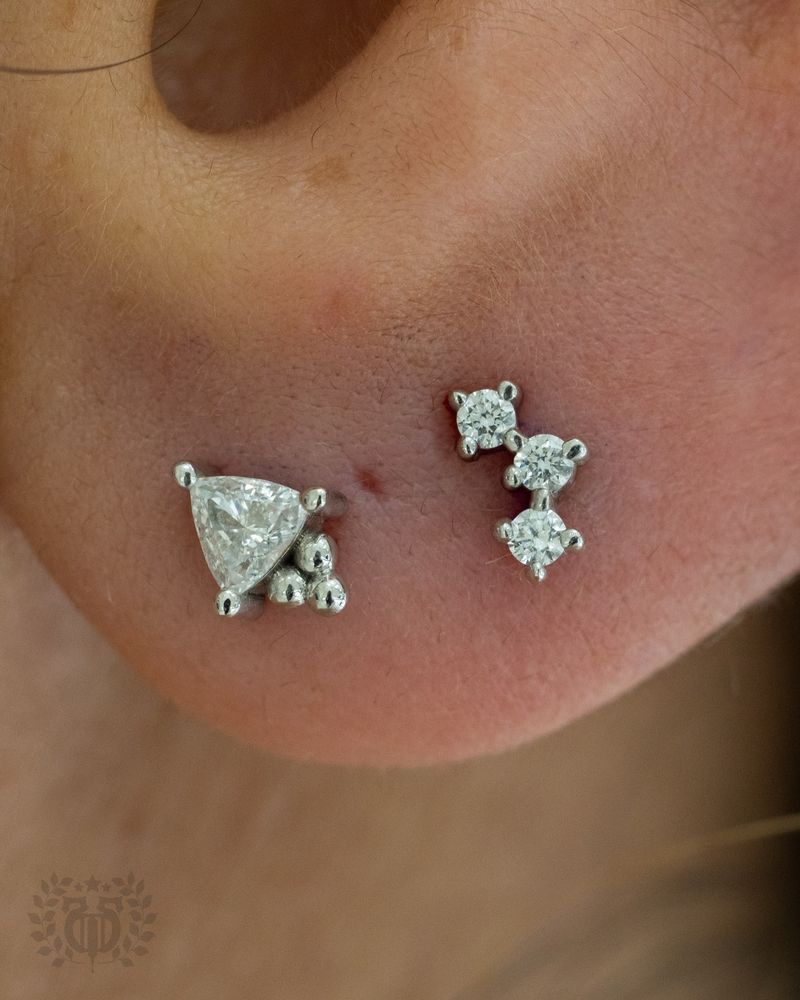
The classic kid-friendly starting point. Implant-grade titanium flat-back stud or solid nickel-free gold equivalent. Apollo's default first piercing for children; many teens already have lobes from childhood and come in for an upgrade or a second lobe.
Second/third lobe (5+ generally, teen-dependent)
Stacked lobe piercings. Same spec as the first; Apollo often pairs these in one or two sessions with adequate spacing so each channel heals independently. Teen-age clients often ask for these as their first autonomous piercing decision.
Helix / upper cartilage (13+)
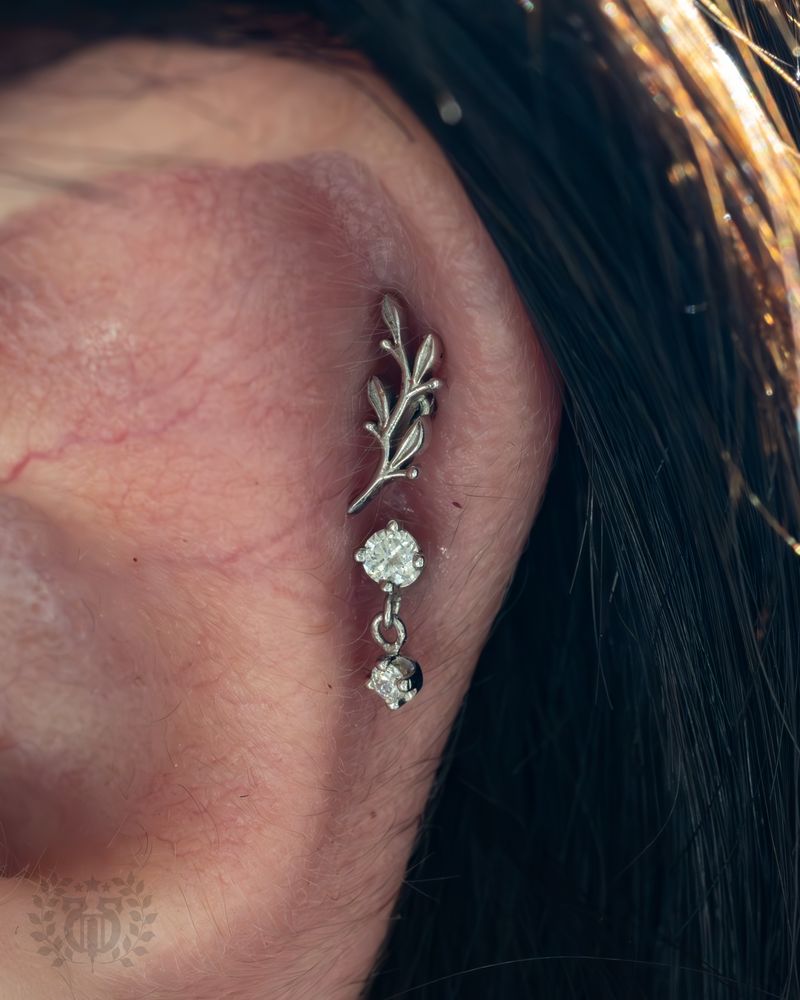
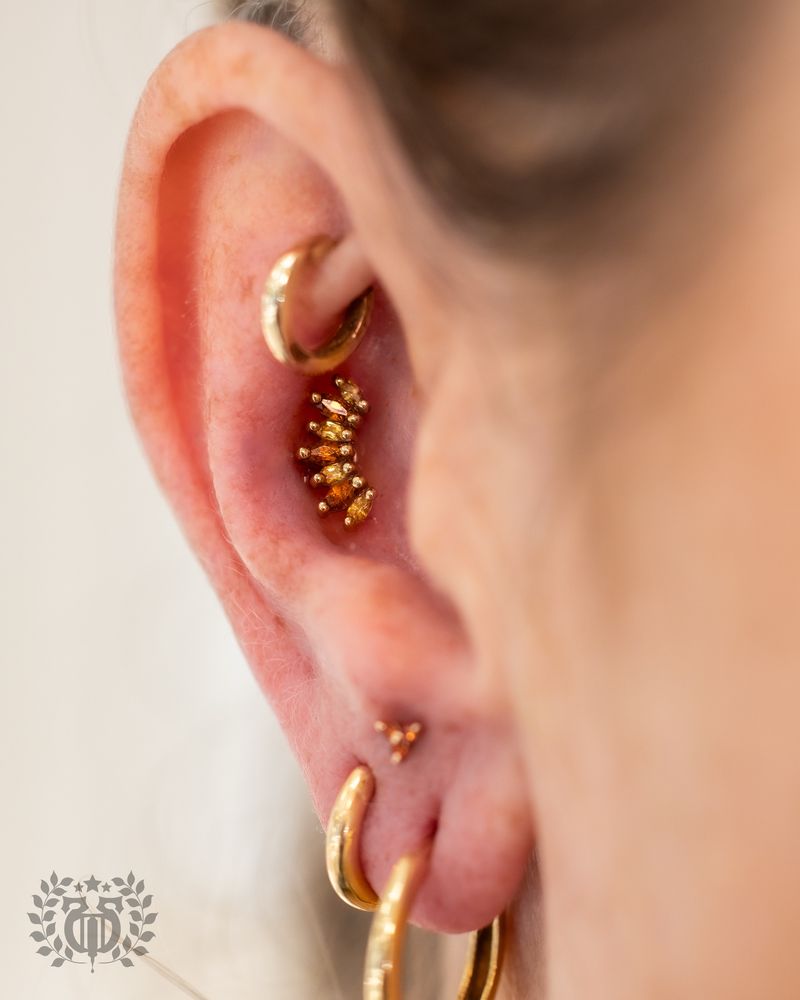
Simple cartilage piercing along the outer ear curl. Titanium labret stud during healing, downsize at 8–12 weeks, full upgrade at 12–18 months. Heals slower than lobe because cartilage is avascular; the teen signs on for a year-plus of clean aftercare.
Forward helix / conch / daith (14+)
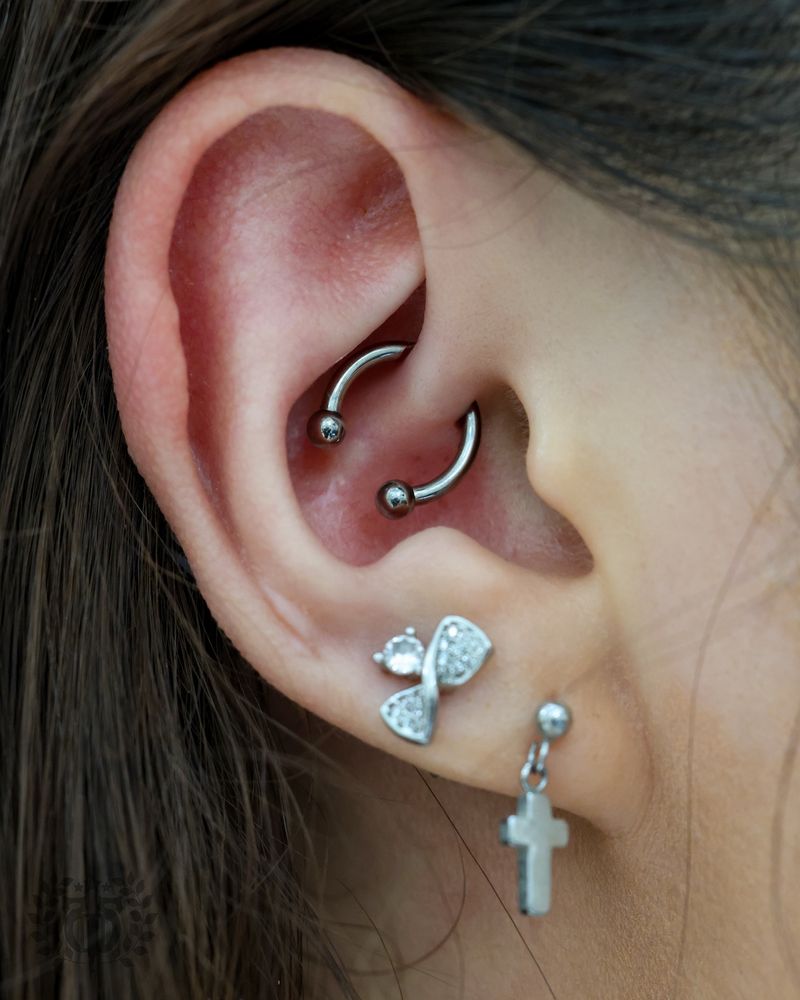
More complex cartilage placements. Require adequate ear anatomy (a forward-helix shelf, a conch bowl deep enough, a daith fold that exists), healthy tissue, and the willingness to sleep on the other side for months. Apollo won't pierce one if the anatomy isn't present.
Industrial (14+)
Two upper-ear cartilage piercings connected by a straight barbell. Long healing (9–12 months on both channels simultaneously), high migration risk, demands near-perfect aftercare. Apollo walks teens through the realistic picture before booking; plenty of teens choose a single helix instead.
Tragus / anti-tragus (14+)
Small cartilage shelf in front of / behind the ear canal. Titanium flat-back labret during healing. Teens who use earbuds daily often choose a side that doesn't interfere; the piercer helps decide at consult.
Rook / snug (14+)
Deep-fold cartilage piercings inside the ear. Not every ear has the anatomy; the piercer checks at consult and often redirects to a more suitable placement. Heals over 9–12 months; rewards patient aftercare.
Nostril (14+)
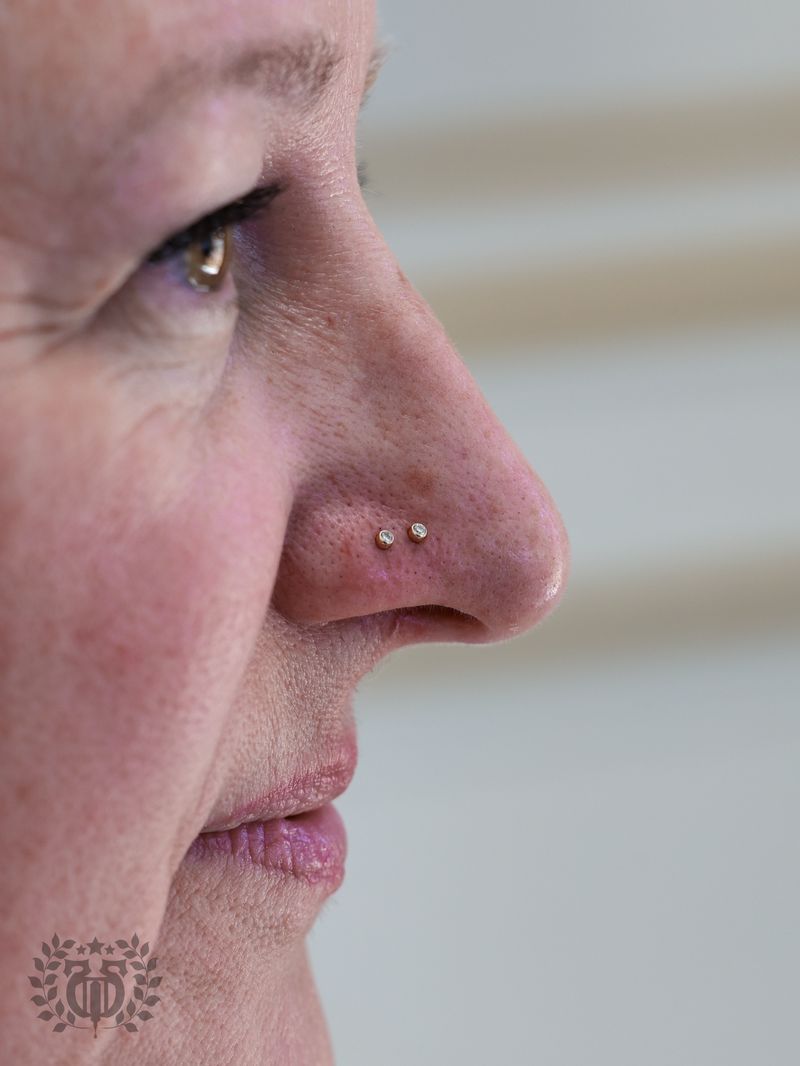
Side-of-nose piercing. Titanium L-bar, corkscrew post, or solid nickel-free gold equivalent. Heals over 4–6 months; upgrades to a hoop at 6+ months. A piercing many teens are ready for ahead of facial piercings that require more mature anatomy.
Navel (14+)
Upper-rim of the navel piercing. Requires a defined shelf of skin (not every teen has this yet), a curved barbell sized for swelling, and patience — navel piercings heal 9–12 months and are vulnerable to clothing friction throughout. Apollo's anatomical exam is the make-or-break step.
Septum (16+)
The 'sweet spot' through the thin tissue below the nasal cartilage. Implant-grade titanium circular barbell during healing. Heals 6–8 months; one of the more teen-popular piercings at Apollo. Requires 16+ because the cartilage shape and the sweet-spot anatomy mature through adolescence.
Eyebrow (16+)
Surface-oriented piercing through the skin ridge of the brow. Curved barbell; titanium. Higher migration risk than most; Apollo talks honestly about longevity. 16+ for Apollo because judgment about placement choices matures later in adolescence.
Placements Apollo does not perform on minors
Nipple, genital, tongue, web, frenum, surface/transdermal, dermal microdermal. All 18+ at Apollo regardless of parental consent. These placements carry distinct medical, developmental, and consent considerations that Apollo resolves by waiting for legal adulthood.
The age threshold is a floor, not a green light. Anatomy is the second gate, and the piercer’s exam is the decision.
Apollo works with teens who want the piercing, not teens whose parents want them pierced.
Some teens are ready at fourteen. Some aren’t. The policy stays the same; the honest conversation is where the decision lives.
Six policy categories
How the full age chart sorts.
Lobe family, simple cartilage, complex cartilage, facial and body, sweet-spot placements, and the 18+ category. Six groupings capture Apollo’s full teen policy.
Lobe family (5+)
The foundation category. Implant-grade titanium or solid nickel-free gold. Apollo's most common first-piercing placement for younger children and the most common autonomous-upgrade request from older teens.
Simple cartilage (13+)
Helix, flat, some conch placements. Slower healing than lobes; still relatively forgiving. Apollo's 13+ threshold gives the teen-aged client a placement to call their own without crossing into the more complex cartilage territory.
Complex cartilage (14+)
Forward helix, deep conch, daith, rook, snug, industrial. Require mature ear anatomy and a year of patient aftercare. Apollo's 14+ threshold pairs with an anatomical exam — the age opens the door, the anatomy confirms the placement.
Facial and body (14+)
Nostril, navel. The teen's first visible-from-across-the-room piercings. Apollo walks through school / sports / clothing-friction realities before booking; the healing environment matters more than the piercing technique.
Sweet-spot placements (16+)
Septum, eyebrow. Require maturation of specific anatomic landmarks (the septum 'sweet spot' of thin tissue; the eyebrow ridge as it settles with facial growth). Apollo's 16+ threshold reflects developmental readiness as much as legal age.
18+ only
Nipple, genital, tongue, surface/dermal. Not performed on minors at Apollo regardless of consent. The category line isn't about squeamishness; it's about informed consent, anatomical maturity, and legal adulthood converging before these specific placements happen.
Anatomy first
Five anatomical checks the age threshold depends on.
Navel shelf, septum sweet spot, industrial compatibility, general cartilage, nostril shape. Each is a specific exam the piercer performs; each can override the age threshold in either direction.
Anatomy check — navel
A navel piercing requires a defined upper-rim 'shelf' of skin that the curved barbell can sit under comfortably. Some teens have this at fourteen; others don't develop it for another year or two; a minority never do. The piercer checks with the client standing up, sitting, and bending — a shelf that disappears at certain angles isn't a shelf.
Anatomy check — septum
The 'sweet spot' is a specific thin-tissue region below the cartilaginous nasal septum and above the fleshy columella. Its presence is anatomic, not developmental alone. The piercer checks with a clamp-free visual exam; if the sweet spot is off-center or absent, Apollo recommends delay or a different placement.
Anatomy check — industrial
An industrial requires two compatible cartilage piercings — usually a forward helix and a helix — whose positions can be connected by a straight barbell without crossing excessively tight tissue. The ear has to have enough curvature depth. Many teen ears aren't industrial-ready even when they want the piercing.
Anatomy check — cartilage (general)
For any cartilage placement (helix, conch, tragus, rook, daith), the piercer evaluates cartilage thickness, blood supply adjacent to the site, scar history, and the specific shape of the child's ear. A placement that works on Instagram may not work on this teen's ear. The exam is the make-or-break.
Anatomy check — nostril
Nostril tissue is thin, active, and variable in shape. The piercer evaluates both the cartilage-to-skin transition and the expected jewelry angle once swelling resolves. Many teens have nostril-ready anatomy by fourteen; some need another year for the crease and shape to settle.
Four readiness tiers
Yes, case-by-case, wait, and not-at-Apollo.
Tier 1 is the comfortable-yes set. Tier 2 is the case-by-case set where anatomy or aftercare matter most. Tier 3 is the wait-or-redirect set. Tier 4 is the 18+ set.
Tier 1 — Comfortable yes at Apollo
Lobe (5+), simple cartilage helix (13+), nostril (14+), basic conch (14+), tragus (14+), septum (16+ with sweet spot). Age threshold met, anatomy confirmed, consent in place, aftercare environment realistic. Apollo books without hesitation.
Tier 2 — Case-by-case
Industrial (14+), rook (14+), daith (14+), snug (14+), navel (14+), eyebrow (16+). Age threshold met but anatomy or aftercare environment needs specific evaluation. Apollo often recommends a less demanding placement or a later date for these.
Tier 3 — Wait or redirect
A teen at fourteen asking for a placement Apollo's age policy opens at sixteen or eighteen. A teen at any age asking for a placement where the anatomy isn't present. A teen who seems pushed rather than driven. Apollo's answer is a conversation about waiting, an alternate placement, or a return visit.
Tier 4 — Not at Apollo for minors
Nipple, genital, tongue, web/frenum, surface/transdermal, dermal microdermal. All 18+ regardless of consent. Some parents ask; the answer stays consistent. Apollo refers families to continue the conversation once the teen reaches legal adulthood.
Pairings & siblings
Eight real combinations at the teen-appointment.
Dual-lobes, cartilage-plus-lobe, nostril-plus-upgrade, navel-solo, septum-consult-first, siblings, the teen-and-parent configuration, the upgrade combo.
Dual-lobe session
Both lobes at once is Apollo's standard — symmetrical marking, single recovery window. Applies to teens picking up lobes for the first time or adding a second row. One consent, two channels, one healing calendar.
Cartilage + lobe combo
A helix plus a second lobe in one session is a common teen ask. The piercer sequences them so neither channel is stressed by the next; the healing calendars stagger (cartilage is the longer of the two).
Nostril + lobe-upgrade combo
A fourteen-year-old who's had lobes since childhood often pairs a nostril piercing with a jewelry upgrade on the healed lobes. Two tasks, one visit. The nostril is the new channel; the lobes are the celebration.
Navel — solo appointment
Navel piercings benefit from a dedicated appointment with the teen (and parent) present for consent, the anatomical exam, the procedure, and the aftercare walkthrough. Not a pair-with combo; the 9–12 month healing window wants the full focus.
Septum — conversation first
Many septums start as a teen 'I want this' and end up as 'Apollo measured and recommended waiting another year.' The first visit is often a consult, not a piercing. The second visit — three months or a year later — is the procedure when anatomy confirms readiness.
Sibling teen sessions
Two siblings, same day, individual consents. Each teen is Apollo's client; each gets their own anatomy check; each makes their own placement decision. Matching jewelry across siblings is common and visually clean; not every set of siblings chooses the same placement.
Teen + single consenting parent
Apollo's preferred room configuration: the teen in the chair, one consenting parent present (ideally quietly). Not both parents, not siblings, not extended family. The piercing is calm; celebration happens at the meal afterward.
Second piercing + jewelry upgrade
A teen returning for their second or third piercing often uses the visit to upgrade the jewelry on the older ones. A sterling heirloom finally installed in a long-healed lobe, a titanium swap to solid gold in a teen-upgraded helix — efficient use of a studio visit.
Six questions teens and parents should ask
The consultation is a two-way audit.
Six questions a kids-and-teen piercing studio answers clearly. A studio that can’t answer them in simple sentences is telling you something important in its first minute.
“What’s your minimum age for this placement?”
The answer should be specific and consistent. Apollo: lobes 5+, simple cartilage 13+, nostril/navel/complex cartilage 14+, septum/eyebrow 16+, nipple/genital/tongue/surface 18+. A studio whose policy flexes down for a persuasive parent is skipping the threshold for a reason.
“Do you do an anatomical check before piercing?”
Yes is the only acceptable answer. Navels without shelves don't get pierced; septums without sweet spots don't; industrials without compatible ear shape don't. The exam is a gate, not a formality. A studio that pierces anyone who pays is a studio that produces migration and rejection.
“How long does this placement actually heal?”
Realistic numbers: lobe 6–8 weeks full + 6 months to maturity; simple cartilage 9–12 months to maturity; nostril 4–6 months; navel 9–12 months; septum 6–8 months; industrial 9–12 months on both channels. A teen who understands the timeline upfront commits to the aftercare differently than one who was told 'a few weeks.'
“What jewelry goes in initially?”
ASTM F-136 implant-grade titanium, or commercially pure niobium, or solid nickel-free 14k/18k gold. Internally threaded or threadless. A specific spec; a named manufacturer. Anything vaguer (surgical steel, hypoallergenic-something, mystery titanium) is incomplete.
“What’s your consent protocol for minors?”
California requires parental consent and presence. Apollo accepts named-parent ID plus birth certificate if needed, or guardianship paperwork. A studio that says 'a note from home' or takes a phone call is not following the law — and the consequences of that lack of documentation land on the family later.
“Can the teen come back for a downsize?”
Yes. Every Apollo kids-and-teen piercing comes with a planned downsize appointment — at 4–8 weeks for lobes, 8–12 for cartilage, longer for nostril and navel. The initial jewelry is sized for swelling; the downsize fits the healed-in channel. A studio that doesn't plan the downsize hasn't planned the aftercare.
Eight common mistakes
Each one with a fix.
Predictable missteps at the teen-piercing appointment. Easy to avoid; worth naming.
Pushing for a placement above the teen's age threshold.
Fix: A parent who argues the case for a 14-year-old septum, a 12-year-old industrial, or a 15-year-old nipple is asking Apollo to break policy. Fix: honor the thresholds; use the waiting time for a different placement or a later date. Thresholds exist because tissue, judgment, and consent all mature on their schedule.
Booking a navel piercing without the anatomical exam.
Fix: Not every fourteen-year-old has the shelf of skin a navel piercing requires. Migrating and rejecting navels are often navels pierced on anatomy that wasn't ready. Fix: anatomical check at consult, honest conversation, delay if the shelf isn't present. Try again in six months.
Treating cartilage like lobes for aftercare and upgrades.
Fix: Cartilage heals slower (avascular tissue), catches on pillows and earbuds, and responds to trauma differently than lobe tissue. Fix: specific cartilage aftercare (saline only, no sleeping on the side, patience with downsize timing), jewelry upgrades at 12+ months not 6.
Letting the teen skip the aftercare conversation because they're tired of listening.
Fix: The placement is the teen's; the aftercare is too. Fix: the walkthrough happens while the teen is awake and present. Apollo provides a written card; the parent's job is transportation, not aftercare. A healing channel is a teen-autonomy lesson in practice.
Buying replacement jewelry from an online marketplace.
Fix: Marketplace body jewelry often isn't implant-grade and often isn't the spec advertised. Fix: upgrade from Apollo's stock or a verified US manufacturer (BVLA, Anatometal, NeoMetal, Industrial Strength). A teen's teen years are not the moment to introduce unknown alloys.
Ignoring the contact-sports / school-dress-code question.
Fix: A soccer-playing teen with a fresh helix, a cheer squad with hoop restrictions, a swim team with chlorine exposure — each affects the healing calendar. Fix: talk through school and sport realities before booking. Sometimes the timing is a midsummer piercing instead of a midseason one.
Hiding medications from the piercer.
Fix: Isotretinoin (Accutane), anticoagulants, certain acne medications, some ADHD medications — all change the piercing plan. Fix: complete medical history on the inquiry form, not a selectively edited version. Apollo may delay or modify the procedure; the teen is safer for the honesty.
Skipping the downsize because the teen forgot to schedule it.
Fix: The long initial post catches and tugs. Fix: Apollo books the downsize at the initial appointment, puts it on the calendar before the teen leaves. Missing it is how a well-done piercing ends up setback. Re-book if the first date is missed; the appointment is the second half of the piercing.
Teen prep checklist
Eight steps from idea to appointment.
Walk through this the week before the consult. A teen who has worked through these steps comes in ready for the conversation, not surprised by it.
- ·Confirm the age threshold for the placement: lobe 5+, simple cartilage 13+, nostril/navel/complex cartilage 14+, septum/eyebrow 16+, nipple/genital/tongue/surface/dermal 18+.
- ·Book an anatomical consult before the piercing. The exam determines whether this specific body, this specific day, is ready for this specific placement.
- ·Walk through the realistic healing timeline. Cartilage and navel are 9–12 months; septum is 6–8; nostril is 4–6; lobe is 6 months to full maturity.
- ·Discuss school / sports / clothing-friction environment honestly. A contact-sports teen with a fresh navel piercing is on a harder timeline than one whose school season wraps next month.
- ·Choose implant-grade jewelry. ASTM F-136 titanium, commercially pure niobium, or solid nickel-free 14k/18k gold. Internally threaded or threadless posts only.
- ·Bring the consent paperwork: parent photo ID, birth certificate if last names differ, guardianship or notarized consent if the consenting adult isn't the bio parent.
- ·Plan the aftercare as the teen's responsibility. Saline-only cleaning twice daily; no sleeping on the piercing for cartilage; no pools or ocean for the first 6 weeks.
- ·Book the downsize before leaving the initial appointment — 4–8 weeks for lobes, 8–12 for cartilage, longer for complex placements. The first jewelry change happens at Apollo.
Autonomy, tradition, identity
Three ways the teen year shapes the piercing.
Self-chosen piercings, cultural timing, identity work. Three recurring threads at Apollo’s teen appointments.
Teen autonomy and self-chosen piercings
The teen years are often the first body-autonomy decision moment. Apollo treats 14–17-year-olds as the decision-maker: the teen does the consult, the teen approves the placement, the teen signs the aftercare commitment. The parent consents and accompanies. This framing produces better aftercare compliance and better long-term satisfaction than parent-driven piercings.
Cultural and family traditions in adolescence
Some families time the first nostril piercing to a cultural coming-of-age moment (quinceañera, bat mitzvah, cultural equivalents in many diaspora communities). Apollo adapts to these timelines without compromising anatomical readiness or aftercare reality. Tradition and safety run together.
Self-expression and identity exploration
For many teens, piercing is identity work: signaling a subculture, exploring gender expression, or marking a personal milestone. Apollo takes this seriously and doesn't editorialize. The piercer's job is spec, sterile technique, and aftercare — not the politics of the teen's expression.
Family configuration notes
Four practical consent situations.
Parent-teen conversation, custody, chosen-family, split-household aftercare. Each comes up; each has a workable pattern.
Parent and teen — conversation first
Before booking, a conversation at home: is this the teen's idea or the parent's? What does the healing actually look like? What's the aftercare routine? Apollo prefers teens whose parents have had this conversation already; the appointment runs smoother when the decision is settled.
Dual-parent consent and custody
California allows the parent with legal consent authority to sign. For split-custody families, Apollo welcomes the custody paperwork if there's any question. A second parent's phone call isn't a substitute for the paperwork; the named consenting parent has to be present in person.
LGBTQ+ and chosen-family considerations
Apollo welcomes all teens and families. Legal guardians with paperwork can consent; chosen-family members without legal guardianship cannot. For teens whose families of origin aren't supportive, Apollo provides a calm professional space and routes consent through the legal-guardian channel the teen's home uses.
Aftercare environment at home
For teens living in split-household situations, the aftercare routine has to work at both houses. Apollo's written card goes with the teen; Apollo recommends packing saline and the aftercare protocol at both homes. The channel doesn't care about the custody calendar; clean saline twice a day is clean saline twice a day.
Navel piercings heal 9–12 months. Industrial helixes heal 9–12. A teen signs on for a year, not a week.
Nipple, genital, tongue, surface. Eighteen and up at Apollo regardless of consent. The line is steady; the reasons are developmental.
Teen autonomy is real and worth honoring. The parent consents; the teen decides.
FAQ
Nine questions teens and parents ask at booking.
The short answers. Pillar sections above carry the depth.
What are Apollo's age thresholds for teen body piercings?
Apollo's thresholds run by placement: lobes 5+, simple cartilage (helix) 13+, nostril / navel / complex cartilage (forward helix, conch, daith, rook, snug, industrial, tragus) 14+, septum and eyebrow 16+, and nipple / genital / tongue / surface / dermal 18+ regardless of parental consent. The thresholds reflect a combination of tissue maturity, anatomical development, and the teen's capacity for the aftercare commitment the placement requires. They don't flex for persuasive parents or eager teens; the age is a floor, and the piercer's anatomical exam is the second gate after that floor is met. Pricing is discussed at consultation after the anatomy confirms the placement.
My teen wants a septum piercing — can they get one at fifteen?
Apollo's septum age is 16+. The threshold isn't arbitrary: the septum 'sweet spot' — the thin tissue region below the cartilaginous nasal septum where the jewelry rides safely — matures through adolescence, and at fifteen many teens don't have the clear sweet-spot anatomy that fourteen-year-olds lack more often than they have. We don't pierce cartilage instead of the sweet spot; the jewelry ends up too high, too visible, and prone to migration. The honest answer is to wait a year, use the time to think about the placement, and come back for the anatomical exam at sixteen. Most teens who wait are glad they did; very few regret the year.
What about navel piercings for teens — what's the right age?
Apollo's navel age is 14+ with an anatomical exam. The exam is the make-or-break step: a navel piercing requires a defined upper-rim shelf of skin that the curved barbell can sit under without tension. Some fourteen-year-olds have this anatomy; some don't develop it until later adolescence; a minority of adults never do. The piercer checks standing, sitting, and bending — a shelf that disappears at certain angles isn't a shelf. Healing is 9–12 months and vulnerable to clothing friction the entire time; a teen whose wardrobe or sport involves a lot of friction at the navel needs an honest aftercare conversation before booking. Pricing is discussed at consultation.
Why won't you pierce nipples or tongues on teens?
Apollo's 18+ policy for nipple, genital, tongue, surface, dermal, and transdermal piercings reflects three converging considerations: anatomical maturity (nipple tissue continues maturing through later adolescence, tongue anatomy has specific web/nerve-path considerations that benefit from full adult development), informed consent in the developmental sense (these placements carry risk profiles and sexual-cultural implications that Apollo prefers the client evaluate as a legal adult), and the California legal framework which is clearest for these categories when the client is eighteen. Some studios will pierce these on minors with parental consent; Apollo has chosen a cleaner policy line. The answer at seventeen is wait, and return.
What's the difference between simple and complex cartilage for age policy?
Simple cartilage at Apollo means the standard outer-ear helix piercing — the rim of the upper ear. It's 13+ because it heals in a predictable way given typical teen ear anatomy. Complex cartilage covers placements with tighter anatomical requirements: forward helix (a specific shelf at the ear's front edge), conch (the inner ear bowl), daith (the cartilage fold just above the ear canal), rook and snug (deep-fold placements), industrial (two cartilage points connected by a straight barbell), and tragus / anti-tragus (the cartilage shelves in front of and behind the ear canal). These are 14+ because they demand more specific ear anatomy; the piercer's exam confirms the tissue is ready regardless of age.
Does my teen need me there the whole time?
California law requires the consenting parent or legal guardian present during the minor's body-art procedure. At Apollo, that means in the studio for the consent signing and present during the piercing itself. The piercing-room configuration Apollo prefers is: the teen in the chair, one consenting parent in the room, no one else. Siblings, extended family, and a teen's friends are welcome in the waiting area. For older teens (16+), some parents prefer to sign the consent and then hand the appointment off to the piercer and the teen — that's welcome when the paperwork is done and the teen is comfortable; the parent stays reachable in the waiting area. A parent disappearing to run errands isn't compatible with minor consent requirements.
What if the teen changes their mind on the chair?
Apollo stops. A teen saying 'wait' or 'I'm not sure' or getting quiet and withdrawn is information; the piercer pauses and talks through what's happening. Sometimes the teen needs a minute and then continues. Sometimes the teen wants to leave and come back another day. Sometimes the teen decides the piercing isn't right for them. All three are acceptable. Apollo doesn't push through a hesitant teen for any reason. The 'if your child changes their mind' page goes deeper on this — it's a real pattern, not a rare one, and handling it well protects the teen's relationship with body autonomy for years.
What jewelry do you use for teen body piercings?
The same safe universe that applies to children's piercings applies to teens: ASTM F-136 implant-grade titanium (Ti-6Al-4V ELI) as the default, ASTM F-1295 titanium, commercially pure niobium, or solid 14k/18k gold with a verified nickel-free alloy. Internally threaded or threadless posts only — never externally threaded. Apollo stocks from BVLA, Anatometal, NeoMetal, and Industrial Strength; mill certificates available on request. Post length is sized for swelling at the initial piercing, then swapped for a shorter post at the downsize appointment 4–12 weeks later depending on placement. The jewelry-metals-safe-for-kids page has the full spec breakdown.
How much do teen body piercings cost?
Pricing is discussed at consultation based on the specific placement, the chosen jewelry, and whether the appointment pairs placements (two piercings in one session). The consultation itself is designed to be informational — the piercer does the anatomical exam, walks through the realistic healing timeline, answers the teen's and parent's questions, and then quotes the procedure with the jewelry factored in. Bringing jewelry from home that meets implant-grade spec changes the number; choosing solid gold over titanium changes it too. Apollo's goal is a predictable, walk-out-the-door total after the consult — not a surprise at the counter.
The teen decides. The parent consents.
Book the consultation. We’ll do the anatomy check and talk through the options.
Apollo's age policy is published, consistent, and non-negotiable. The anatomy exam is the second gate. The teen's own willingness is the third. Pricing is discussed at consultation after the placement and jewelry are decided. Bring the consent paperwork, the honest medical history, and a teen who wants to be there — we'll handle the rest.