Tattoo Styles
Dotwork
Priced by density, not by size. A four-inch stipple field can hold the chair longer than a twelve-inch panel because every tone is built one point at a time. The UK lineage behind the style, five dialects, and how to brief a piece measured in dots.
Book a consultationPoint by point
Tone built out of points.
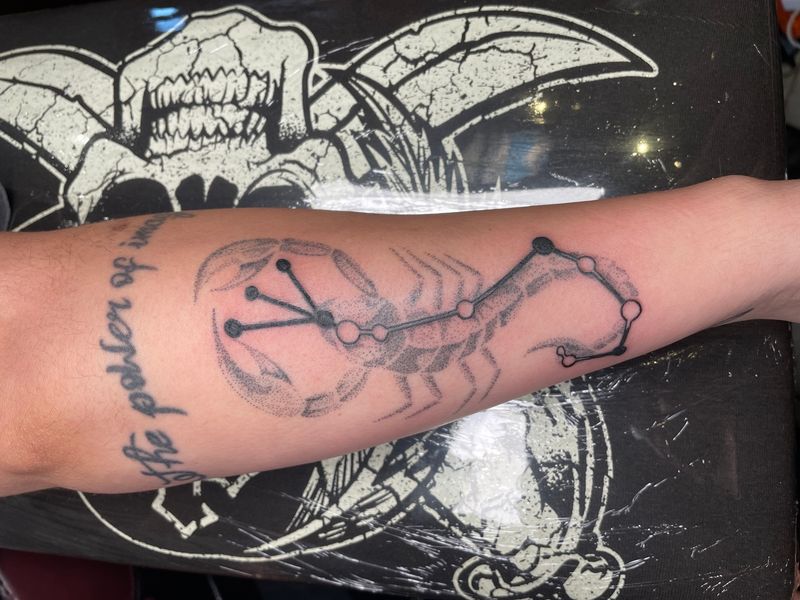
Dotwork is tattoo imagery built entirely from stippled dots rather than continuous lines or solid ink fills. At viewing distance, the eye blends the dots into a cohesive image; up close, the discrete stipple becomes visible and gives the work its signature texture.
Every dot is a single tap. Stippling is slow, meditative, and methodical. A medium-sized piece easily carries ten thousand individual dots; full sleeves climb into the hundreds of thousands. Part of why dotwork sessions run long, and why the craft rewards patience over speed.
Precision is the whole discipline. Uneven spacing, inconsistent depth, or rushed clusters break the optical illusion immediately — the eye is remarkably good at spotting a dot that sits in the wrong place. Most dotwork is executed with a single needle or a tight three-round grouping, giving the artist maximum control over each individual mark.
Because each dot is a discrete, isolated deposit rather than part of a connected line or saturated fill, there is nothing to migrate into a blur. Lines can thicken and solids can soften, but a field of well-placed dots holds its character. It may mellow slightly across twenty years, but the stipple texture itself survives — the quality that makes dotwork ageing so forgiving.
The UK lineage
Where modern dotwork came from.
Dotwork as a recognized contemporary tattoo genre crystallized in 1990s London. The names and the shops matter. Deeper stippling traditions run back centuries.
Centuries of hand-tap
The deeper roots
European dotwork practitioners openly drew from Indian yantra diagrams, Tibetan mandala painting, Islamic geometric ornament, and Christian devotional imagery — traditions where precise, symmetrical, repeating marks carry spiritual weight. Tribal and indigenous tattoo traditions across the Pacific, Southeast Asia, and North Africa have used hand-tapped stippling for centuries. The mechanics of placing individual dots long predate the electric machine.
1990s London
Xed Le Head & Into You
Xed Le Head is widely credited as the pioneer of modern large-scale dotwork, proving the style could carry major body coverage. The London scene around Into You — particularly Thomas Hooper and Tomas Tomas — pushed stipple into geometric, ornamental, and blackwork territory and established the visual vocabulary most contemporary dotwork artists still work from.
2000s onward
Global diffusion
The UK approach spread internationally through apprenticeships, guest spots, and convention circuits. Artists in Europe, North America, and Australia developed regional variations — denser realism-adjacent stipple in one scene, purer sacred-geometry work in another. The lineage remains traceable; the best artists today still cite Xed and Into You explicitly.
2012 – present
The contemporary style
Dotwork entered broader culture partly as reaction. As color realism and heavy photorealism dominated the 2000s and 2010s, dotwork offered a deliberate counterweight — quiet, graphic, monochrome, architectural. That contrast is part of why the style still reads as intentional and considered rather than trend-chasing.
The inheritance is visible in every serious dotwork portfolio today. Ornamental bands, sacred geometry, stippled mandalas, and blackwork hybrids all descend from that London-based circle. The tradition is a living one, carried forward by artists who explicitly name its sources.
Stipple directions
Eight styles the style works in.
Dotwork is a narrow but deep genre. These eight variations cover the working vocabulary — from pure stipple to hybrids that pull in linework, blackwork, and color.
Pure dotwork
The entire piece is built from dots. No outlines, no solid fills, no smooth shading. Form and edge are implied purely by density shifts. The most technically demanding variant because there is nowhere to hide a patchy field — but also the variant that ages most gracefully, since discrete ink deposits have nothing to migrate into.
Dotwork with linework
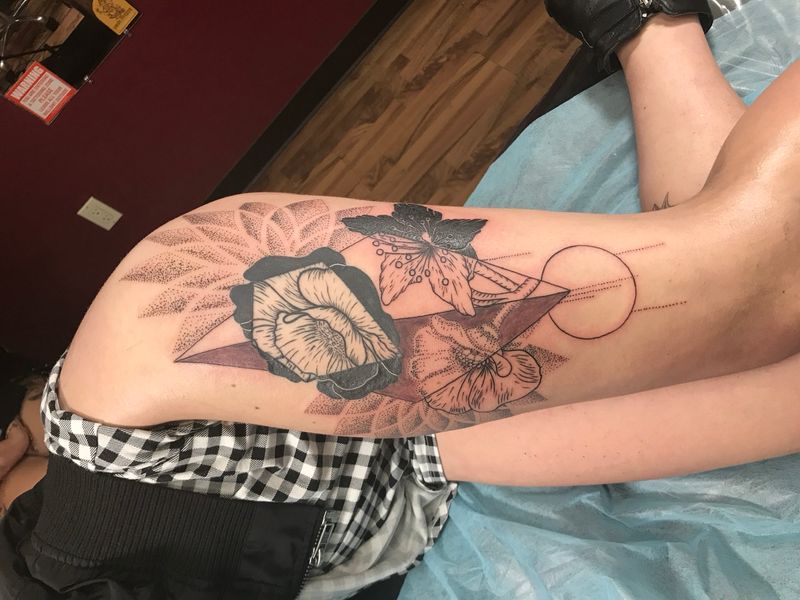
A hybrid where crisp lines define structure and silhouette, and stippling fills interior shading. The most common working format — linework gives the piece backbone, dotwork gives it atmosphere. Geometric and ornamental subjects live here most comfortably.
Dotwork mandala
Sacred geometry rendered in stippled precision. Circular, symmetrical, radiating patterns where every petal, ring, and segment is built from carefully graded dot fields. The meditative nature of stippling mirrors the meditative intent of the mandala itself.
Dotwork ornamental
Decorative, jewelry-like stippled filigree designed to flatter the body. Lace panels, stippled chandeliers, necklace-style chest pieces, and armband ornament. The dots read almost like engraving or etched metal, giving the piece a crafted, heirloom quality.
Dotwork realism
Portraits, animals, and figurative subjects built entirely from varied-density dots rather than smooth shading. Closer to an engraved plate or woodcut than to a photograph. Rewards viewing at both distance and close range, where the underlying stipple field becomes its own layer of detail.
Dotwork + blackwork
Solid saturated black fields set against softly stippled gradient zones. The contrast gives the eye both weight and air inside a single piece — one of the most reliable contemporary dotwork approaches for large-scale work.
Dotwork + fine-line
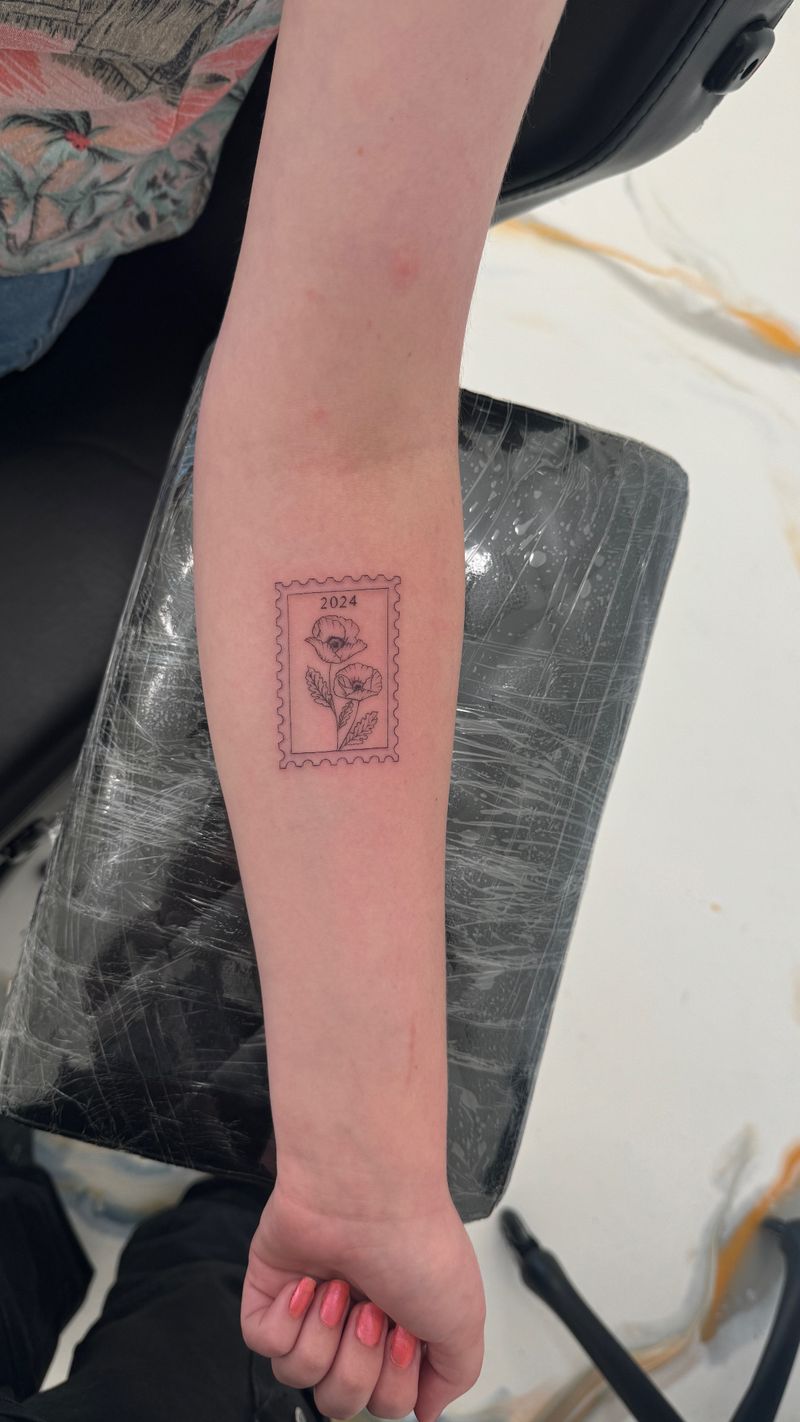
Delicate illustrative hybrids where thin linework defines edges and stippling handles all shading. Ideal for botanical, celestial, and ornamental subjects that want refinement over boldness.
Coloured dotwork
Less common but possible — stippled color fields that produce a pointillist effect reminiscent of Neo-Impressionist painting. Requires careful artist selection; fewer practitioners specialize in colored stipple and portfolios vary widely.
Where stipple sits
Where stipple ages best.
Dotwork needs flat, broad canvases and stable skin. These five zones carry the style most reliably across twenty years.
Where stipple lasts
- Chest plate & upper back. Flat, broad canvases where the grain resolves properly. Mandalas and ornamental compositions sit here beautifully.
- Outer & front thigh. Large flat canvas — natural home for mandala work, geometric dot hybrids, and larger ornamental filigree.
- Upper arm (bicep wrap). Strong secondary placement for medium pieces. Ornamental bands wrap beautifully; deltoid caps anchor sleeves.
- Forearm (outer). Moderate fit. Works well for geometric-dotwork hybrids and ornamental bands. Stable skin, steady visibility.
- Ribs & sternum (vertical bands). Works for vertical ornamental compositions that follow the body's line. Expect longer session discomfort.
Where stipple thins out
- Fingers and hands — high-friction zones drop dots faster than the piece settles.
- Palms and soles — friction destroys the stipple grain within months.
- Tiny areas (under 4 inches) — dots blur into a gray smear when healed.
- Inside of wrist for dense mandalas — thin skin shows density inconsistency fastest.
Sizing by density
Measured in dot count, not inches.
Dotwork doesn't price by square inch. It prices by hours, and the hours scale with density and subject. These four tiers frame the conversation.
Working minimum for any piece that includes gradient or tonal transition. Smaller and the stipple collapses into noise once healed.
Small ornamental bands, single-motif mandalas, and geometric-dotwork hybrids. Good sweet spot for forearm and calf placements.
Full mandalas, proper ornamental compositions, and dotwork portraits. Where the style does its most recognizable work.
Back panels, thigh-to-knee pieces, sleeve sections. Multi-session builds measured in dot count and hours, not square inches.
Combines with
What stipple combines with.
Dotwork rarely exists in total isolation. These are the cross-style combinations Apollo artists work in most often.
Dotwork + ornamental
Ornamental tattooing is effectively built on dotwork technique. Shared vocabulary of mandala and sacred geometry.
Dotwork + sacred geometry
The natural subject matter for dotwork — Flower of Life, Metatron's Cube, Sri Yantra.
Dotwork + blackwork
Solid black fields against softly stippled gradient — weight and air in one piece.
Dotwork + geometric
Crisp line-drawn shapes as scaffolding filled with graduated stipple — the modern hybrid signature.
Dotwork + fine-line
Delicate illustrative work with stippled interior shading. Botanical and celestial subjects benefit.
Mandala idea directory
Every mandala format Apollo artists work in, cross-referenced to subject and placement.
Density questions
Eight questions about density and time.
An artist comfortable in stippling answers each of these directly. Deflection or generality is a signal worth heeding.
- Do you have stipple work photographed at six months, one year and two years?
- How many individual dots is a piece of this scale, and how many sessions should I plan for?
- What needle configuration and machine do you prefer for this kind of stippled work?
- How do you handle the gradient transition from dense to sparse on a piece this size?
- Do you pace a single session, or do you usually split dotwork across multiple bookings?
- What placements would you recommend for this subject, and what would you talk me out of?
- Have you ever declined a dotwork piece because the subject didn't suit the technique?
- What's your touch-up window look like for stippled work specifically?
Pricing for dotwork is discussed at consultation once scale and density are locked, not quoted from a photo alone.
Stipple traps
Seven stipple briefs we adjust.
The assumptions stipple clients usually arrive with. Framing, not judgment.
Hiring a generalist
Dotwork requires specialization. A generalist attempting stippling produces muddy results regardless of other talents. Review portfolios specifically for dotwork, not just general skill.
Going too small
Dotwork needs physical space for dots to read as individual points. Undersized pieces lose the textural character that makes the style worth choosing over conventional shading.
Rushing sessions
Stippling cannot be hurried without visible consequences. Uneven density, inconsistent dot size, and fatigue-driven shortcuts all show up in the finished piece.
Underestimating total hours
Dotwork takes longer than equivalent shaded work. Planning around that reality prevents mid-project frustration and scheduling stress.
Mismatching subject to technique
The style suits contemplative, geometric, and textural concepts far better than dynamic or photorealistic ones. Match the subject to the technique.
Never asking to see healed stipple
Fresh stipple always looks sharp. Healed stipple reveals whether dots hold their spacing or bleed into fog — that's what separates specialists from dabblers.
Requesting dotwork on high-friction zones
Hands, fingers, feet, and palm edges drop dots quickly. Even strong technique won't save a piece placed where friction wears it daily.
First dotwork guide
How to commission your first piece.
The eight-step working path Apollo artists walk new dotwork clients through, from reference to settling review.
Pin dotwork you actually like — mandala, ornamental, hybrid, whatever draws you. The shared DNA tells you which subcategory fits your taste before you ever book.
Pure pattern, a dotwork animal, a mandala, ornamental filigree? Subject drives artist selection. A mandala specialist and an illustrative dotwork artist are not interchangeable.
Dotwork works at medium and above. Think forearm, thigh, chest, back. If your reference pieces are larger than the space you're considering, trust the reference — dotwork rewards canvas.
Request 6-month, 1-year, and 2-year healed photos. Density consistency after settling is the whole signal.
Most serious dotwork is split across at least two sessions. Budget calendar, not just hours — skin needs settling time between passes, particularly on dense mandala fills.
Dotwork pricing is hours-driven because each dot is a tap. Final pricing is discussed at consultation once scale and density are locked — never quoted from a photo alone.
Moisturize the area the way your artist specifies — over-lubricating blurs fresh stipple. Fine dotwork settles within the first 4–6 weeks and continues integrating across the next year.
A six-month check-in lets your artist assess density and flag any areas that need a micro-pass. Most specialists build this into their process.
Your layers
Three layers of your own.
Beyond scale and placement, these are the three design decisions that turn a generic mandala or ornamental piece into a specific one.
Sacred-geometry pattern selection
Mandala variants, Flower of Life, Metatron's Cube, Sri Yantra — each carries a different geometric and symbolic style. Choose the pattern that resonates, then collaborate on density.
Gradient direction & focal point
Radial fade, top-down fade, dense-center-sparse-edge — the direction of the gradient shapes how the eye enters the piece. Worth talking through at the design stage.
Ornamental motif vocabulary
Paisley, teardrop, lotus petal, filigree scroll — ornamental dotwork pulls from a wide decorative library. The specific motifs you pick become the piece's visual signature.
FAQ
Stipple work: the common questions.
What clients ask once they hear the piece is priced by density rather than by inches.
Does dotwork hurt more than line work?
Dotwork sensation differs from line work rather than being strictly worse. The repeated tapping creates a sustained vibration that some clients find more tolerable than continuous line drags, while others find the extended session length the harder part. Pain tolerance is individual. Artists pace sessions to manage skin fatigue and keep you comfortable through longer stippling passages.
How long does dotwork take?
Stippling is slow by nature because each dot is placed individually. A palm-sized geometric mandala can take four to six hours. Full sleeves span multiple sessions totaling twenty to forty hours or more. Detailed gradient work takes longer than equivalent shaded pieces, and realistic timelines are discussed at consultation so you can plan sessions accordingly. Cost is agreed once the dot count has been estimated.
Does dotwork age better than line work?
Well-executed dotwork often ages beautifully because each dot is a discrete unit of pigment rather than a continuous line that can blur at its edges. Dense stippling can soften over decades, but the overall composition tends to remain readable. Proper depth, spacing, and placement during the original tattoo are the determining factors for long-term appearance.
Can I mix dotwork with other styles?
Absolutely, and hybrid approaches are popular. Dotwork pairs naturally with fine line, blackwork, geometric, ornamental, and neo-traditional work. Many clients request fine line outlines with stippled shading, or blackwork shapes softened by dot gradients. The combination expands tonal range while keeping graphic clarity.
Is dotwork good for cover-ups?
Dotwork can work for cover-ups when the original tattoo is light or already faded, because dense stippling builds a new tonal field over old pigment. For darker cover-ups, dotwork alone often lacks the opacity needed, so artists may combine it with solid black elements. A consultation determines whether stippling is the right approach.
Can dotwork be in color?
Yes, though black ink is the traditional choice. Colored dotwork is possible and can produce painterly pointillist effects reminiscent of fine art movements. Color stippling requires careful planning because hues mix optically at viewing distance. Fewer artists specialize in colored dotwork, so portfolio review is especially important.
What's the difference between dotwork and stippling?
The terms overlap heavily and many artists use them interchangeably. Stippling technically describes the technique of building tone through individual dots, while dotwork often refers to the broader aesthetic category that includes stippling as its primary method. Some artists reserve dotwork for geometric and sacred geometry pieces and stippling for illustrative shading.
How small can dotwork go?
Dotwork has practical size limits because dots need space between them to read as distinct points rather than merging into solid fill. Pieces smaller than palm-sized often lose the textural quality that makes dotwork special. Micro-dotwork exists but requires machine settings and artist skill that few possess.
Does dotwork work on darker skin?
Dotwork translates well to all skin tones when artists understand how contrast reads on different complexions. On deeper skin, dot density and depth matter more than ink color, and gradients require slightly different planning. Experienced artists adapt stippling technique for the full range of skin tones.
Can I use dotwork for portraits?
Dotwork portraits are possible and produce a distinctive etched quality reminiscent of engravings or old botanical illustrations. The technique suits subjects where texture and mood matter more than photographic realism. Stippled portraits require a specialist because dot placement directly determines likeness accuracy.
Booking a stipple piece
Bring reference, subject, and placement — we'll route you to the right dotwork hand.
Dotwork is a specialist's craft. Share the subject, a rough reference, and the spot you are thinking about. Then we estimate the piece in dots rather than inches, which is usually the moment the session count starts to make sense. Cost gets worked out at consultation, by session count.