Kink & Ink
Reclamation & Survivor
A working-studio guide to reclamation and survivor tattoos — body autonomy through ink, scar-aware composition, trauma-i
Book a consultationRead this first
A note before reading, what Apollo is, and where the studio's role ends.
Three boundaries before the rest of the page. Holding all three lets the rest of the page be useful.
A note before reading
This page discusses trauma, survivorship, and body-marking after harm. If now isn't the right time to read it, that's a reasonable choice — bookmark and come back. The page does not describe specific events; it does discuss the practice of marking a body that holds history. RAINN's National Sexual Assault Hotline is 1-800-656-HOPE (chat at rainn.org), free and confidential, 24/7. The 988 Suicide & Crisis Lifeline is reachable by call or text at 988. Trans Lifeline is 1-877-565-8860.
What Apollo is
A working tattoo studio in Santa Monica. The artists here are tattooers — skilled at consent-centered consultation, weighted symbolic work, and quiet professionalism around emotional pieces. They are not therapists, and the studio does not market tattooing as treatment. A tattoo is not therapy. It cannot diagnose, treat, or replace care from a licensed clinician. Many clients have found body-autonomy work meaningful as one part of a larger practice; we hold it in that frame.
Where the studio's role ends
If you are in acute distress, in early recovery, or actively working through clinical issues, the most important practitioner in your life right now is the clinician you trust — not the tattoo artist. We are happy to be a small part of an integration that includes professional support; we are not a substitute for it. The page also speaks to readers who are not cis women — survivors include trans, nonbinary, and male clients, and trans survivors face documented elevated rates of violence (the 2015 U.S. Transgender Survey reports 47% lifetime sexual-assault prevalence, with higher rates among Black trans, disabled trans, and trans sex-worker populations). If you don't currently have a clinician and would like a referral pathway, your physician, RAINN, and Trans Lifeline can connect you with local resources.
The browsing framework
Five decisions narrow weight into one piece.
When a client walks in with a reclamation piece in mind, the question is rarely which image. It's a sequence of five narrowing decisions — and the image tends to arrive on its own once the other four are answered.
What are you marking?
Survival, agency, the closing of a chapter, or simply the decision to put something on your skin you chose. You don't owe anyone — including a tattoo artist — a survivor narrative to justify a piece. One sentence is enough, for yourself, in private. "This is mine now." "I made it through." "I get to decide what this body wears." The clarity of that sentence steers everything downstream.
Cover scar, mark zone, or somewhere else?
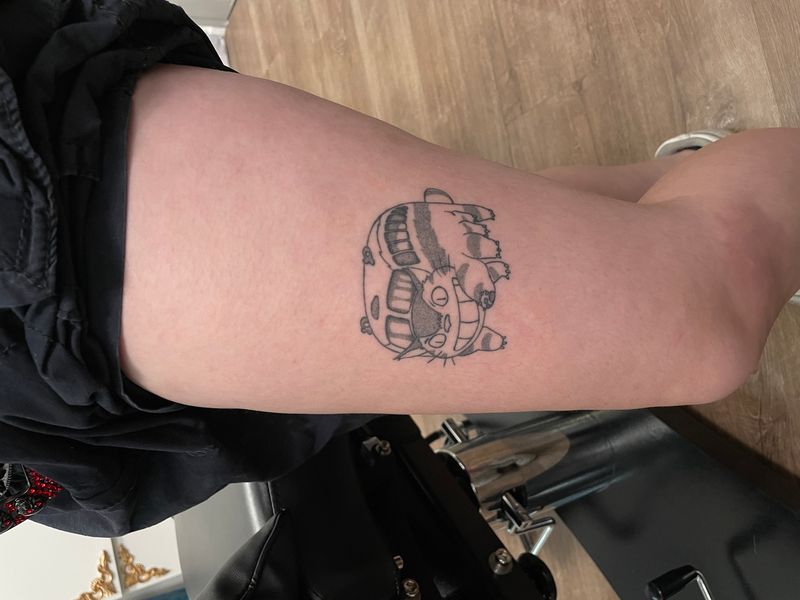
Three different design problems. A scar-cover piece works around healed tissue and asks the artist to plan ink density, line direction, and breathing space. A chosen-zone piece sits on a body region you have history with — placement is the meaning. A somewhere-else piece intentionally lives away from the story. Decide which one you're booking before you pick the design.
Symbolic figure or pure aesthetic?
Some clients want imagery that already carries a reclamation reading — Medusa, phoenix, snake-shedding, butterfly, mandala. Others want a piece chosen entirely for its beauty, meaning held privately. Both honor the work. The figure is not required.
Visible or private?
Visible placements (forearm, hand, neck) ask the wearer to greet strangers' eyes daily — sometimes that's the point, sometimes it isn't. Private placements (ribcage, inner bicep, sternum, upper thigh) keep the piece for the wearer. Walk through your week with the artist before deciding. There is no correct answer except the one that matches your life.
What scale and timing can you hold?
A small glyph is 30–60 minutes. A 6-inch botanical is 2–3 hours. A back panel is multi-session. Healing is several weeks; integration of a meaningful piece is longer. Know your ceiling in time, sitting, and life-circumstances before booking. If you're in an acute trauma response — recent assault, active flashbacks, recent diagnosis — most working artists will ask you to wait and check in with a clinician first. That's a feature, not a gatekeep. Survivors who rush a piece often want a different piece a year later.
You don't owe the artist a story. One sentence, for yourself, in private, is enough.
We are tattoo artists, not clinicians. We can hold the room while you sit for a piece. We can't do the rest of the work for you, and we won't pretend to.
The piece you need at month three is rarely the piece you need at year two. The decision will still be there.
12 design directions
The working catalog clients actually browse.
Twelve directions across symbolic figures, botanical, and placement-driven work. None of these are required. Many clients land somewhere between two of them. The list exists so the conversation has a vocabulary.
Medusa
A contested reclamation reading
Medusa as survivor rather than monster — the reclamation reading drawn from Ovid's Metamorphoses Book IV (Neptune's assault in Minerva's temple, Athena's punishment of the victim) that survivors began circulating widely online in the late 2010s. The reading is meaningful to many clients; it is also contested by some classics scholars who note older Greek sources present Medusa differently and that flattening her into a single survivor symbol can echo the racialized monstrification of women of color. Both can be true. The piece is yours either way. Fine-line single-needle, illustrative, or neo-traditional. We carry a longer treatment of this figure in our Medusa lore page.
Phoenix
The classical resurrection figure
Direct in its symbolism — burned, risen, claimed. Traditional and neo-traditional carry it best because the bird wants color and bold outline; fine-line phoenixes tend to read as small birds without context. Mid-to-large scale. The phoenix is the most unambiguously "I survived" image in the catalog, which is also the reason some clients route around it toward something less declarative.
Snake shedding
Skin left behind
A snake mid-shed, the discarded skin rendered in lighter tone or negative space. The metaphor is direct: the body has not been replaced — it has been continued. Black-and-gray realism and illustrative styles carry it well. The clearer the shed-skin detail, the more the piece reads as continuity rather than rebirth — which is often closer to how survivors describe the experience.
Butterfly / moth
Transformation that doesn't erase the caterpillar
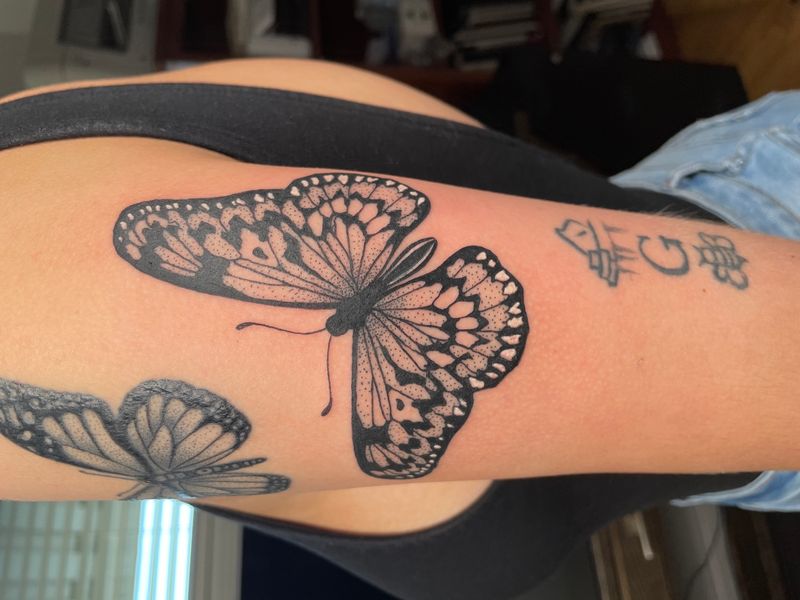
Butterflies and moths read transformation, but the design choice that matters is whether the piece honors the previous form or tries to make it disappear. A botanical-illustrative moth on the forearm reads differently than a small butterfly cover-up. Both are valid; they are different pieces. Talk through which version you're asking for.
Water and waves
What moves through and continues
Wave forms — Hokusai-adjacent or contemporary fine-line — as a quiet survivor image. Less declarative than phoenix, more personal than mandala. Often paired with a single small element (a moon, a single bloom, a date in Roman numerals) that anchors the meaning for the wearer alone. Reads as aesthetic to anyone outside the conversation.
Mandala / sacred geometry
Pattern as containment
Concentric pattern as a return to centeredness. Reads as ornamental decoration to outsiders; reads as the deliberate practice of holding the body's center to the wearer. Geometric, dotwork, and ornamental styles all carry it. Larger scale gives the pattern room to be complete — a fragmented mandala can read as anxious rather than centered.
Specific botanical
A named plant with a private history
A flower from a grandmother's garden, the herb planted on a balcony during the year of recovery, a tree from a meaningful place. The botanical is named — not generic. Fine-line illustrative or neo-traditional. The privacy of the choice is part of the design: a stranger sees a sprig of rosemary, the wearer sees a year. For clients who hold survivorship in collective or ancestral frames rather than individual confession, the botanical can mark a lineage — a plant tied to a culture of origin, a relative, or a place — without externalizing a story.
Single word or phrase
Lettering as the entire piece
A word, a name, a short phrase, sometimes a date. Often a word the wearer has been saying to themselves for a long time before it lands on skin. A dedicated letterer is the difference between a phrase that sits like carved marble and one that drifts. Inner forearm, inner wrist, sternum, ribs. Small to mid-scale.
Scar-aware floral cover
Composition built around healed tissue
A piece designed in collaboration with the scar — line direction, ink density, and breathing space planned around healed tissue. Your physician should clear the area first; after that, an experienced artist plans the composition so the scar reads as part of the piece's story rather than an accident inside it. Floral and botanical work most often.
Goddess / archetype figure
Public-domain figures from the wearer's own canon
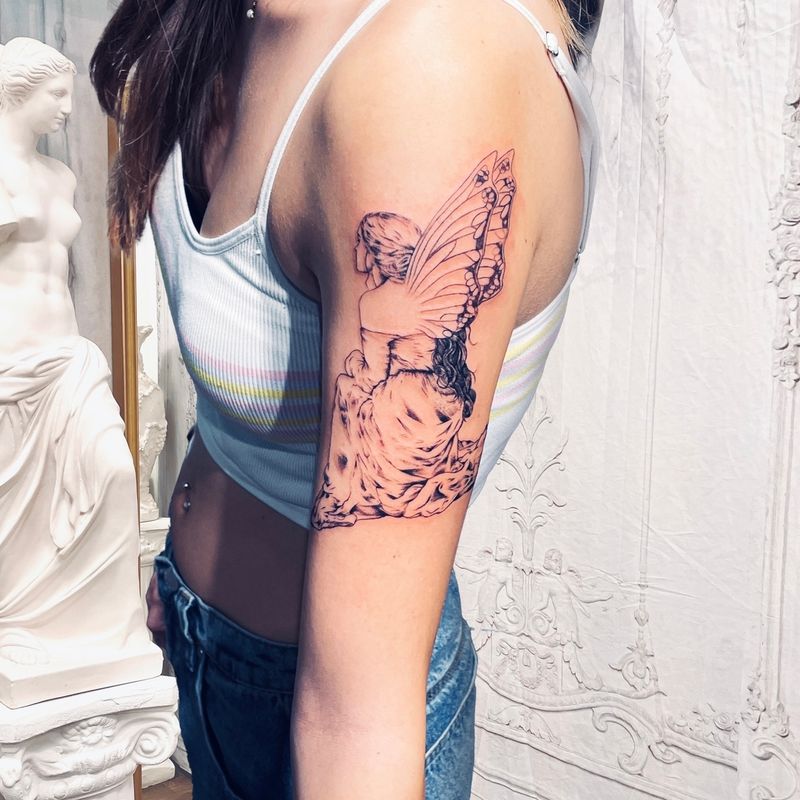
Figures from a literary or mythological canon the wearer relates to who hold reclamation readings — Persephone returning, Athena armed, Artemis sovereign. Illustrative realism or fine-line. Larger format. The wearer is not inventing the meaning; they are claiming a reading the figure has carried in their tradition. Important: we tattoo from public-domain canons the client knows; we do not source figures from closed cultural or religious practices the wearer is not part of.
Crescent / moon phase
Cyclical and quietly held
A crescent or full moon-phase strip as a quieter alternative to phoenix-and-rebirth imagery. The reading is cyclical, not triumphant: this body has been many things and will be many more. A useful direction for clients who hold survivorship in collective, ancestral, or non-disclosure frameworks — a private symbol only the wearer reads is a complete piece. There is no requirement to externalize a story. Fine-line, dotwork, or simple traditional. Inner forearm, behind ear, sternum. Reads as aesthetic to outsiders, as cycle to the wearer.
Body-zone reclamation
Placement as the entire meaning
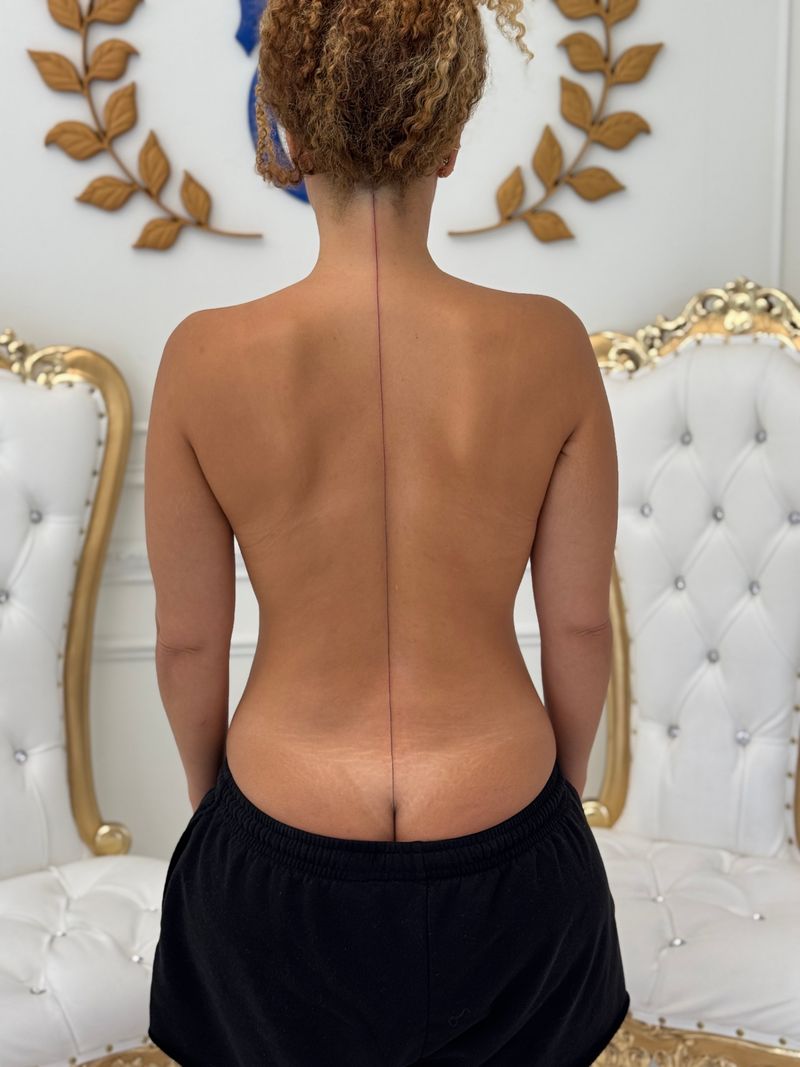
An ornamental piece — botanical, geometric, or pattern — placed deliberately on a body region the wearer has history with. The image itself can be entirely aesthetic. Placement is the work. This is the direction clients describe most often when they say "I just want this part of my body to feel like mine again."
Six styles
Pick the style before you pick the artist.
Style determines who the piece reads to and how it ages. Each style here carries reclamation work — but they carry it differently.
Fine-line / single-needle
Discretion and script
The dominant style for survivor-tattoo work in the last decade — quiet enough to live close to the wearer, detailed enough to carry specific botanical or lettering work. Fine-line ages faster than thicker styles, so plan for a touch-up at 7–10 years. The trade-off is intentional: a piece that reads as a private mark rather than a declaration.
Neo-traditional
Color, dimension, and flash lineage
The strongest carrier for phoenix, butterfly, and figural reclamation work where the wearer wants the piece to read clearly. Bold outline, expanded modern palette, dimensional shading. Ages well because the outline scaffolds the color. Mid-scale. Two sessions for anything past 4 inches.
Illustrative realism
Depth of source material
Carries Medusa, classical figures, and detailed botanical. Session-intensive, multi-visit for larger pieces. The style to book when the source material has its own depth — a Medusa rendering needs more than line; a goddess piece earns its art-historical reference through the rendering. Realism does not scale down: 5 inches is the floor.
Blackwork ornamental
Pattern as containment
Mandala panels, ornamental bands, geometric pattern work. Reads as architectural decoration. Holds saturation longer than any other ink. The choice for clients who want the piece to carry weight through composition rather than through subject matter — pattern that contains rather than declares.
Watercolor
Color without outline
Painterly, less defined silhouette, often layered with line. Honest caveat: watercolor ages faster than line-based work because the splashes lack outline scaffolding. A watercolor piece is a current-aesthetic choice that often needs a touch-up at the 7-year mark. Carries phoenix and floral well in fresh photos; budget for maintenance.
Dotwork / sacred geometry
Pattern built one dot at a time
Mandala work, geometric panels, halftone shading built from stipple. Slower in the chair than line-based work; ages beautifully because dots remain dots even as ink softens. The contemplative style — both the making of the piece and the wearing of it carry a meditative quality. Strong choice for clients who want the act of getting the tattoo to be part of the meaning.
Five placement intents
Placement carries more meaning than image does.
For reclamation pieces especially, where the tattoo lives on the body often does more symbolic work than what the tattoo depicts. Five placement families cover almost every choice.
Visible / declarative
Forearm · outer bicep · calf · hand · neck
The piece greets strangers daily. Some survivors want exactly that — the tattoo is part of how they show up now. Others find daily strangers' eyes draining. The choice is personal and the answer is whichever one you can hold for the rest of your life. Fine-line and neo-traditional both work here.
Modern / neutral
Inner forearm · ankle · back of upper arm · sternum-edge
Visible to the wearer in a mirror, less visible to strangers. The most-requested placement family for survivor work because the piece reads as a private mark with the option of revealing it. Inner forearm in particular has become the default 2020s placement for fine-line botanical and lettering work.
Private / intimate
Ribs · inner bicep · upper thigh · sternum · underboob
The tattoo lives mostly inside the wearer's eyeline. Often paired with fine-line or single-needle because the style matches the privacy. The piece is for the wearer; strangers may never see it. A category of survivor work that intentionally avoids the question of how others read the piece.
Reclaimed-zone
Wherever the body holds history
Placement is the meaning. The image can be ornamental — botanical, mandala, geometric — but the location does the symbolic work. The most-described intent in survivor consultations: "I want this part of my body to feel like mine." The artist plans line direction and scale around the zone's specific anatomy.
Statement
Full back · full thigh · sleeve anchor · chest panel
Not a placement choice — a compositional commitment. Statement reclamation pieces are planned from day one over four to eight sessions. The conversation begins long before pencil touches paper. For clients ready to live with a piece this size, the scale itself becomes part of the meaning.
Scale honesty
Four tiers. Your scale sets your style.
Smaller scale, simpler imagery, single session. Larger scale, more depth, multi-session. Match the scale to the time and care you can hold.
Eight compositional pairings
The figure plus one element does most of the carrying.
A single figure reads one way; a figure with one anchor element reads more specifically. Eight pairings, each landing the piece in a different category.
Figure + date
Medusa, phoenix, or goddess paired with a date in Roman numerals — the day a chapter closed, an anniversary, a private marker. Fine-line lettering near the figure. Carries the meaning without narrating it.
Botanical + word
A specific named plant with a single word — a private noun, a verb, a name. The most-requested reclamation pairing at Apollo. Inner forearm or sternum. Fine-line.
Snake + shed skin
Snake mid-shed with discarded skin rendered in lighter tone. The continuity reading rather than the rebirth reading. Black-and-gray realism. Mid-to-large scale on forearm or thigh.
Mandala + center anchor
Concentric pattern with a small central element — a single dot, a tiny flower, a Roman numeral. The pattern contains; the anchor names. Sternum or spine. Dotwork or blackwork.
Wave + moon
Wave form with crescent or full moon. The cyclical pairing — what moves through and what watches. Fine-line. Inner forearm, ribs, or sternum. Quiet, private, aesthetic to outsiders.
Phoenix + ash
Phoenix rising with deliberate ash or smoke at the base. The composition that names the burning rather than skipping over it. Neo-traditional or illustrative. Mid-to-large scale on back or thigh.
Goddess + attribute
A goddess figure with her classical attribute — Athena's owl, Artemis' bow, Persephone's pomegranate. Illustrative realism. Larger format. The attribute carries the reading.
Botanical + scar
A composition designed around healed tissue. Line direction, ink density, and breathing space planned with the scar. Floral or vine work most common. Requires physician clearance and an experienced artist.
Consultation
Seven questions to bring with you.
Bring answers to these and the consult moves directly to design. None of them require you to share more than you want.
What sentence are you bringing?
One sentence, for yourself, in private. "I made it through." "This body is mine now." "I get to decide what this skin wears." You don't owe the artist a story, and a good consult will not ask for one. The sentence is for you. The artist needs to know the piece has weight; not what the weight is.
Are you working with a clinician?
Apollo is a tattoo studio, not a therapy service. A tattoo is not therapy and does not replace care from a licensed clinician. Many survivors find this kind of work meaningful as one piece of a larger practice that includes a trusted clinician, support community, or both. If you're not currently working with someone and you'd find that useful, RAINN (1-800-656-HOPE; rainn.org), the 988 Suicide & Crisis Lifeline (call/text 988), and your physician can all make local referrals. The tattoo is not a substitute. The tattoo is what it is.
Which placement family?
Visible, modern-neutral, private, reclaimed-zone, or statement? Each carries different ongoing experience. Walk through your week with the artist — what you wear, who sees what, how often you'd want this piece visible. There is no correct answer except the one that matches your life.
Cover scar or work alongside it?
Scar tattoo decisions involve your scar's age, your skin's behavior, and — for medical, surgical, or self-harm scars — your surgeon, dermatologist, or therapist. Bring those answers to the consultation; don't expect the artist to clear medical readiness. The dermatology consensus most studios follow: the scar should be at least 12 months old (longer for surgical scars), flat, soft, and skin-toned. A history of keloids is a formal contraindication at most reputable studios and requires dermatology clearance first. If yes to all of that, an experienced artist plans the composition with the scar rather than around it.
What scale and timing?
Small glyph, mid-scale botanical, or larger figural piece? A first reclamation piece is often most-recommended at the 2–5 inch scale — meaningful, single session, easy to live with, easy to add to later. Larger compositions can come second.
Visible to whom?
Specific question for survivors who have specific people in mind — partners, family, employer, the person involved in what's being marked. The artist can help you choose placements that give you the most control over who sees the piece and when. "For me only" is a complete answer.
What about touch and the chair?
Tattooing involves sustained contact with the body. For some survivors that part is unremarkable; for others it isn't. Tell the artist if you have any preferences around how you're spoken to, what you'd like to hear before they start, whether you want music or silence, and whether you want a friend in the room. Good shops accommodate all of this without requiring explanation.
Some clients mark survival in a private symbol only they read. That's a complete piece. There's no requirement to externalize a story.
Reclamation is not always a phoenix. Sometimes it is a sprig of rosemary on the inner forearm.
There is no correct visibility answer except the one you can hold for the rest of your life.
Common mistakes
Eight patterns that produce regret a year later.
Most of the disappointments survivor clients describe fall into one of these eight categories. Catching them in consult prevents them in the chair.
The grief-rush mistake
Booking within the first few months of a recovery or disclosure. Grief and acute recovery are still moving. The piece you need at month three is rarely the piece you need at year two. Fix: wait. The decision will still be there. Most survivor pieces clients love long-term were booked at least a year out from the event being marked.
The committee-meaning trap
Trying to load every piece of the survival story into one tattoo — phoenix plus snake plus mandala plus three dates plus a phrase. Result: a piece that means everything and reads as nothing in particular. Fix: one primary reading per piece. Other elements can come later, on the same body, in their own time.
The narrate-to-the-artist mistake
Walking into a consult with the entire story. The artist does not need it; you do not owe it to them. A good consult can build the piece from "this is meaningful, here are images I respond to, here is the placement and scale I want." Fix: bring images, not narration.
The cover-up rush
Booking a scar cover-up before the scar has fully healed or a physician has cleared the area. The dermatology consensus most studios follow: at least 12 months since the scar formed, longer for surgical or hypertrophic scars; the scar should be flat, soft, and skin-toned (not pink, red, or purple — coloration indicates ongoing healing). A history of keloids is a formal contraindication at most reputable studios and requires dermatology clearance first. Self-harm scars are their own conversation: most studios want the self-harm to be in the wearer's past, not active, and ask about a stable healing window before designing — that's standard care, not judgment. Fix: physician or dermatologist sign-off, the right healing window, an artist who has worked over scars before. The wait is not optional.
The first-available-artist mistake
Booking with whoever can get you in this month. Reclamation pieces benefit from an artist whose portfolio shows the kind of weighted, careful work this piece is asking for. Fix: pick the specialist. Wait the extra weeks. The piece will outlast the wait by decades.
The visible-when-uncertain trap
Booking a hand or neck reclamation piece while still uncertain about visibility. Hand and neck pieces ask the wearer to greet strangers' eyes daily. Fix: if uncertain, pick a modern-neutral placement (inner forearm, ankle) for the first piece. A second piece can move outward later, with the certainty earned from the first.
The fresh-photo trap
Choosing an artist based on fresh-wrap Instagram shots. Every tattoo looks like a 10/10 at day one. Fix: ask for healed work at one-year and five-year marks. That's the work you're actually buying. Reclamation pieces especially deserve to be evaluated on aging.
The therapeutic-claim trap
Treating the tattoo as the treatment. Apollo is a tattoo studio. The piece can be meaningful, integrative, and part of a larger practice; it is not therapy and a good studio will not market it as such. Fix: hold the tattoo as one element of a larger practice that includes the people who do that work professionally.
The first-piece guide
If this is your first reclamation piece, start small and specific.
Smaller scale, specific botanical or single word, modern- neutral placement. The piece is meaningful without asking everything of you on day one.
Personalization
Three layers turn a stock image into a piece that's only yours.
Most clients only think about the first layer. The third is where the piece actually lives — and where most of the meaning is held over time.
The base piece
Style, size, placement, subject. These are the bones — they determine what a stranger sees. Most clients start and stop here. A piece that lives only at this layer is still a meaningful piece, but it's the layer most likely to read as generic if it's the only layer you build.
The personal element
A specific botanical with a private history. A date in Roman numerals nobody else can read at a glance. A color choice tied to a memory. A small element nested inside a larger piece. This layer is where the piece begins separating from the category — and where the wearer starts seeing themselves in it.
The private meaning
What the piece marks for you. Nobody else needs to know — not even the artist, not even your closest people. The private layer is what keeps the piece from ever feeling decorative. Even if a stranger reads the design as a standard botanical or a beautiful figure, you know what's underneath. That is enough. That is often the whole point.
Matching and chosen family
Survivors and chosen family sometimes share a piece.
Complementary pieces honor relationships that have done their own carrying. Design them so they survive any future the relationship takes.
Survivor pairs and chosen family
Survivors who have walked alongside each other sometimes book complementary pieces — the same botanical with different colors, mirrored figures, paired phrases. The piece honors the relationship as much as the individual histories. Treat the design as you would any matching piece: same artist, same day, same stencil for actual visual matching.
Plan for the piece to outlive the relationship
Friendships and chosen-family bonds change over decades. Design the piece so it works as a single-element piece if the relationship ever needs to. Not pessimism — the same respect any permanent decision earns.
Match the bones, vary the detail
Same base design, small variations per person — different leaf count, different small element, different placement — so each piece still belongs to the wearer. Identical tattoos on different bodies often read as someone else's idea; varied matched tattoos read as a shared idea each person made theirs.
Same artist, same day
The only way matching pieces actually match is identical execution. Booking the same design with two artists or two sessions months apart produces two related pieces, not a matched pair. If matching matters, schedule the back-to-back appointment and the same stencil.
FAQ
The questions reclamation consultations surface most.
Trigger-warning, therapy-versus-tattoo, timing after acute events, scar work, narration, artist selection, discretion, the contested Medusa reading, religious-and-cultural traditions, the #MeToo movement's actual founding, and the line between survivor and memorial work.
I'm a survivor of sexual trauma. Should I read this page?
This page is intended for survivors and people supporting survivors who are considering tattoo work as part of their own integration. Some readers find content like this resonant; others find it activating. There is no obligation to read on. If at any point this page is too much, RAINN's National Sexual Assault Hotline (1-800-656-HOPE, rainn.org) is reachable 24/7 and offers free, confidential support. A trusted therapist or clinician is the appropriate place for therapeutic work; this page is a tattoo-studio guide.
Is a tattoo a substitute for therapy or other support?
No. A tattoo is not therapy. It cannot diagnose, treat, or replace care from a licensed clinician. Apollo is a tattoo studio, not a clinical service. Many survivors find body-autonomy work, including tattooing, meaningful as one part of a larger practice that includes therapy, support community, somatic work, or all three. Qualitative researchers — Maxwell, Thomas, et al., publishing in Deviant Behavior in 2020 — interviewed survivors of sexual violence about why they got tattooed; the themes that emerged were personal narrative, cathartic release, regaining a sense of bodily control. The study documents motivations, not therapeutic outcomes. If you're not currently working with a clinician and would like to be, RAINN, the 988 Suicide & Crisis Lifeline, and your primary care physician can refer you to local resources.
How long after a traumatic event should I wait before booking?
There's no universal timeline, but the working baseline most studios recommend is at least a year from any acute event, and longer if you're in active clinical work that hasn't stabilized. The piece you want at month three is rarely the piece you want at year two — meaning shifts as integration moves. Survivors who book early often want a different piece a year later; survivors who wait often describe the eventual piece as more right than they could have planned. The decision will still be there. The wait is part of the work.
What if I want to cover a scar from past trauma?
Two threshold questions before any design: has your physician cleared the area for tattooing, and is the scar at least one year fully healed? If yes to both, an experienced artist can plan the composition in collaboration with the scar — line direction, ink density, and breathing space designed with the healed tissue rather than around it. If no, the conversation pauses until those answers exist. Tattooing across recently-healed tissue carries different healing dynamics than fresh skin, and some scar types take ink differently. Bring photos to consultation.
Do I have to tell the artist the story?
No. A good consult can build a meaningful piece from "this is weighted for me, here are images I respond to, here is the placement and scale I want." The artist needs to know the piece carries weight so they treat the consultation accordingly; they do not need the contents of the weight. Many survivors find that not narrating is a quiet relief — the piece gets built without performing the story. Bring images, references, and placement preferences. That is enough.
How do I find an artist who has done this kind of work before?
Look for artists with portfolios that show weighted symbolic work — Medusa, phoenix, goddess figures, specific botanical, scar-area compositions — done with care rather than as catalog items. At consultation, ask explicitly: have you done reclamation work before? You don't need stories about other clients; you need a yes and a portfolio that reflects it. A studio that handles consultations gracefully when this question is asked is showing you something useful about how they'll handle the rest of the work.
What if I need more discretion than usual — about the piece, the consult, the booking?
Ask the studio about discretion before the first session, not after. Apollo can keep consultations off the main calendar, keep work off the public portfolio, and limit what's noted in the booking system. Different studios have different practices; a good shop will have answers ready the moment you ask. Discretion does not require justification.
Are there pieces or placements you'd recommend against?
We're cautious about three patterns and we'll say so in consult: booking inside the first six to twelve months of acute recovery, designing a hand or neck piece while still uncertain about visibility, and trying to load an entire survival story into one composition. None of these are absolute rules — survivors make their own decisions about their own bodies. They are simply the patterns that produce the most "I would do this differently now" conversations a year later. The studio's job is to flag the pattern and let you decide.
Is the Medusa reading legitimate? What about people who say it's not?
The contemporary survivor-reclamation reading of Medusa — drawn from Ovid's Metamorphoses Book IV, where Medusa is assaulted by Neptune in Minerva's temple and then punished by the goddess — became widely circulated by survivors online roughly 2019–2022 and is the dominant 2020s tattoo meaning in English, Spanish, and Portuguese-speaking communities. It is meaningful to many clients. It is also contested by some classics scholars, who point out that older Greek sources present Medusa differently and that the survivor reading collapses a complex figure into one symbol. Both can be true. We tattoo Medusa routinely; we walk through the contested reading once at consult; the meaning the wearer attaches to the piece is the meaning the piece carries.
I have a religious or cultural tradition that's complicated about tattoos. Should I be here?
Some traditions prohibit tattooing; some have specific reclamation rituals that don't involve tattoos; some hold survivorship in collective or ancestral frames where a confessional body-marking would feel out of place. The studio's role is not to litigate your relationship to your tradition. Our role is to do skilled work for the clients who choose to be here. A private symbol only the wearer reads is a complete piece. If your tradition is a no, that's a complete answer too.
What about #MeToo and the broader survivor movement?
#MeToo as a phrase and movement was founded in 2006 by Tarana Burke through her nonprofit Just Be Inc. — well before the 2017 hashtag wave. Burke and the silence-breakers were named TIME Person of the Year 2017. We mention this because it matters: flattening the movement's history to 2017 erases the Black-women-led origin Burke has spoken about publicly. The cultural shift since 2017 is widely credited with the popular uptake of survivor-tattoo imagery (Medusa especially). When the movement comes up at consult, we credit Burke.
What if my piece is memorial or for pregnancy loss, not survivor work?
Some pieces this page touches are commemorative — a person lost, a pregnancy lost — rather than survivor pieces. The line is the client's to draw, not ours. Many bereaved clients do not identify as "survivors" of anything and find that framing diminishing. If your piece is memorial, our memorial-tattoo guide is a closer fit and the consultation tone shifts accordingly. Bring the piece you want; the right framing follows.
When you're ready
Bring the sentence you've been saying to yourself. Bring images. Leave the story at the door if you want to.
Apollo reclamation consultations are off-calendar by request, narration-optional, and built around the piece — not the history. Book the consult and walk out with a design that honors weight without asking you to perform it.