Tattoo Ideas
Snake
No motif on this site wraps a limb better. A snake's body is a line you can route around a forearm or a thigh instead of dropping onto it flat. Twelve directions from the Traditional rattler to the Japanese hebi in peonies, plus the scale-pattern rhythm that keeps dense work from filling in.
Book a consultationReading before species
“A snake” is six different tattoos wearing one animal.
Shedding, danger, wisdom, medicine, hebi, ouroboros. Six readings that share an animal and share almost nothing else, and a good drawing of the wrong one is still the wrong tattoo. Five decisions, in this order, because the reading narrows the tradition, the tradition narrows the species, and the species narrows the arm.
Which of the six readings?
Transformation (shedding skin), danger (fangs bared), wisdom (coiled still), medicine (single-snake Rod of Asclepius), Japanese hebi (coiled through peonies), or ouroboros (self-consuming). Most bad snake tattoos are good drawings of the wrong style. Name which is actually on the table before you pick a style.
Which tradition?
American Traditional, Japanese irezumi, neo-traditional, fine-line, or blackwork. Each carries a different composition grammar — Japanese hebi flows through peonies with wind bars, Traditional coils tight and bold, fine-line reduces to continuous line. Tradition is a style decision and a scale decision at once.
Which species?
A rattlesnake rendered in fine-line floral style reads as confused. A cobra in a Sailor Jerry flash sheet fights the tradition. Species travels with style. Cobra for hooded drama, viper for fangs, rattler for American Traditional, python for long wrapping bodies, coral snake for vivid color bands. Pick species and style together.
Coiled or extended?
Coiled snakes pack intense energy into a compact shape — great for chest, shoulder, calf, back of hand. Extended bodies wrap and flow — ideal for sleeves, ribs, thighs, spine. Coiled reads as poised and watchful. Extended reads as something already in motion, going somewhere. Two different design problems, and they want different limbs.
How much canvas can you commit?
A 2-inch fine-line serpent on the wrist is a valid piece. A full-thigh Japanese hebi with peonies is another valid piece. They are not scaled versions of each other. Your honest placement sets your honest style — and the snake should follow the muscle, not fight it.
Most bad snake tattoos are good drawings of the wrong style.
The design brief begins by naming which style is actually on the table.
A snake placed well becomes part of you. Placed wrong, it looks pasted on forever.
Flash · ready to ink
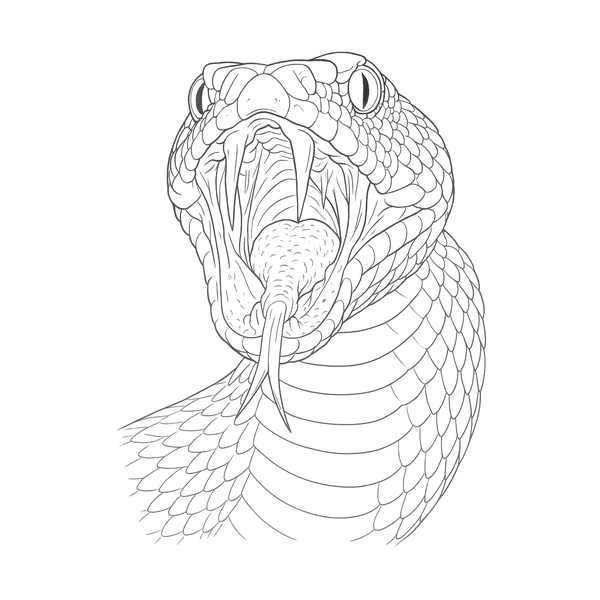
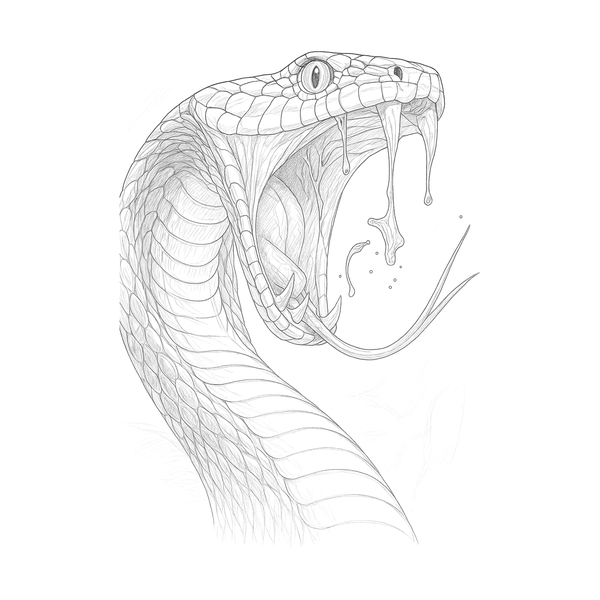
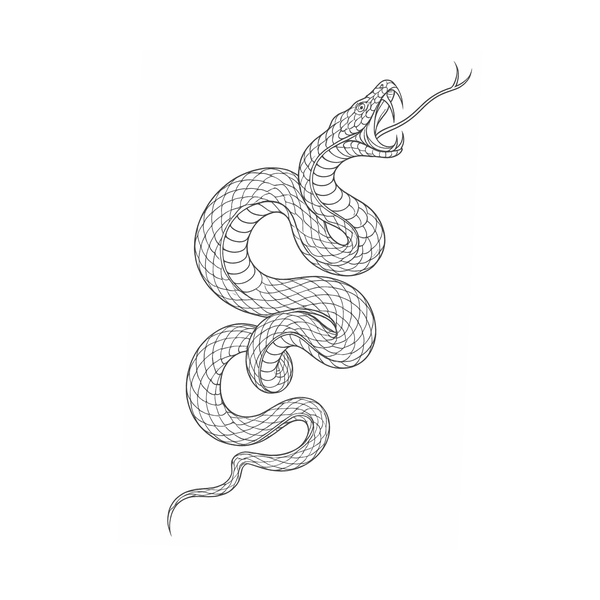
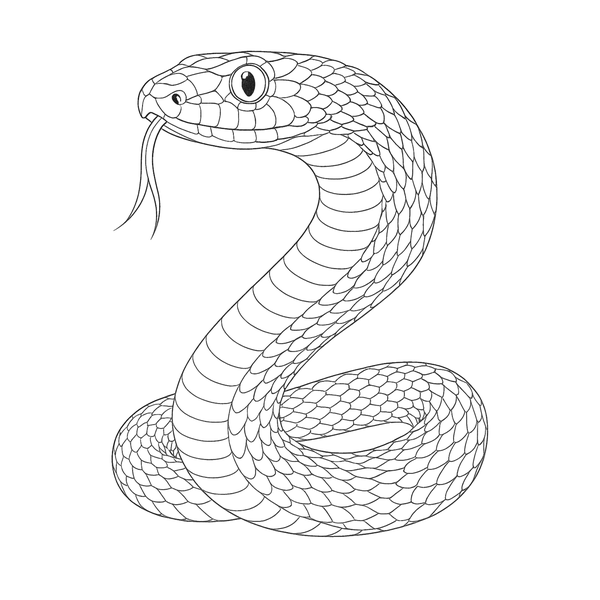
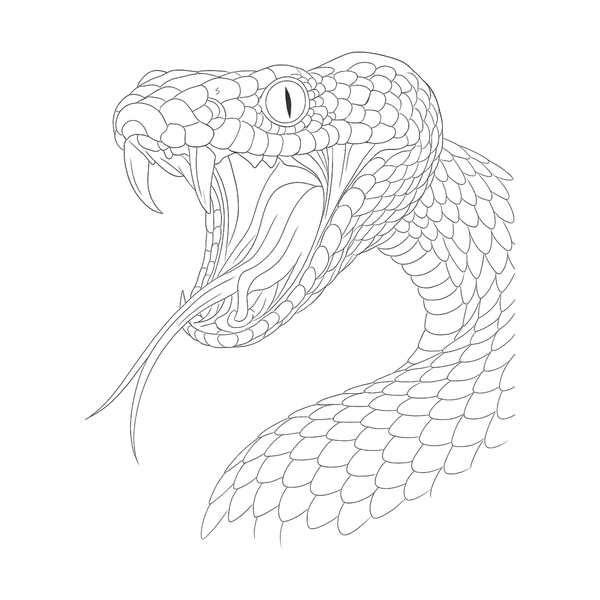
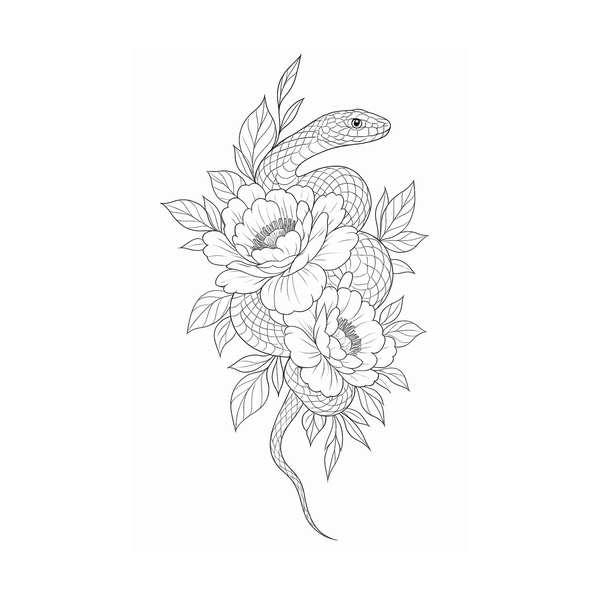
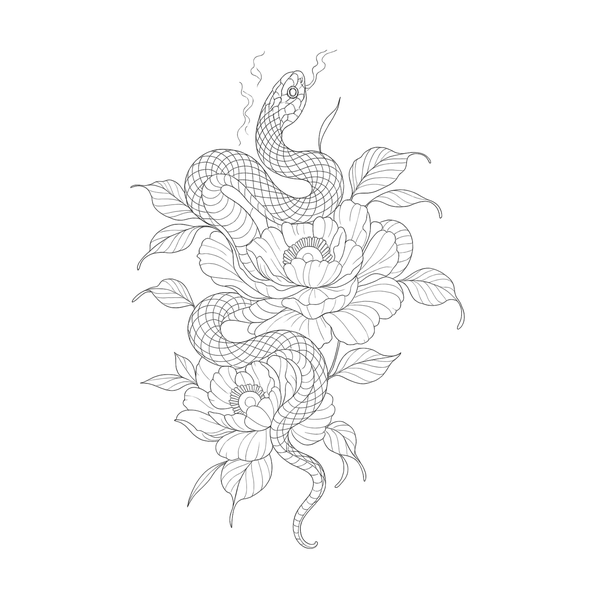
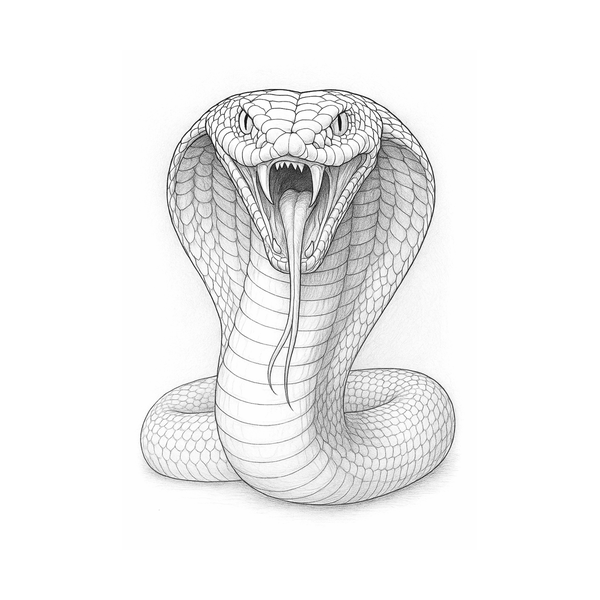
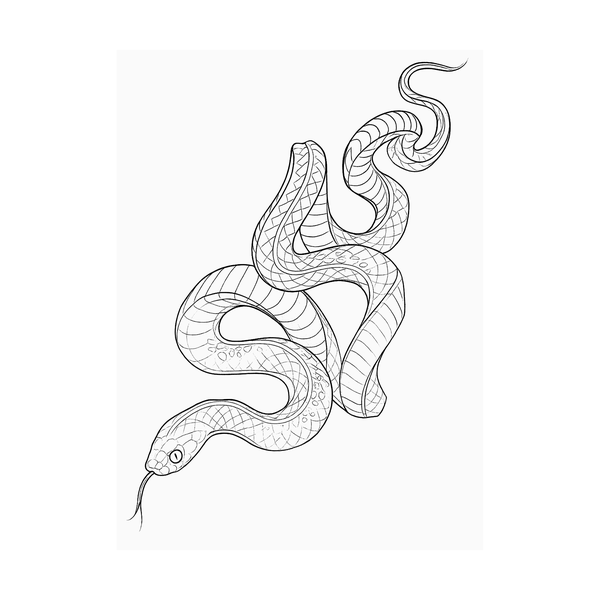
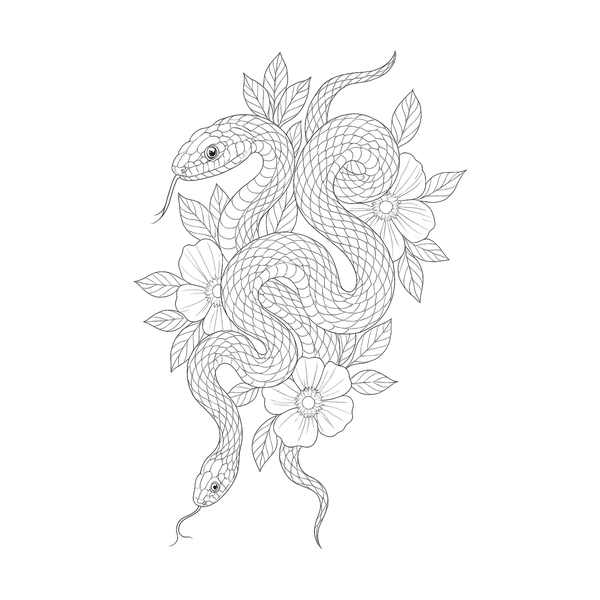
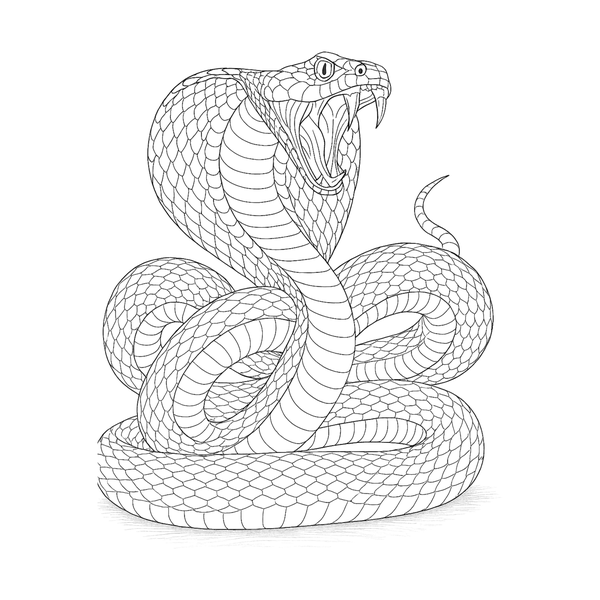
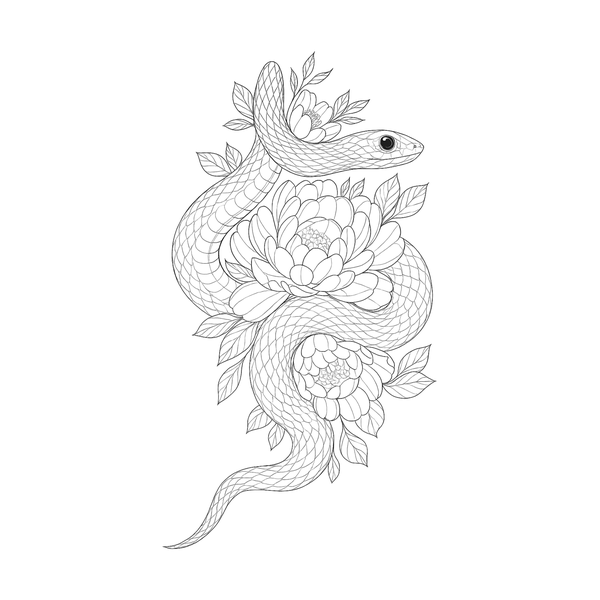
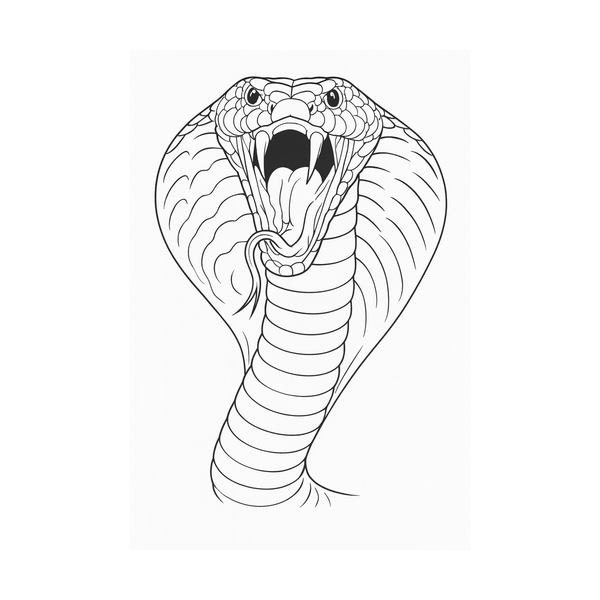
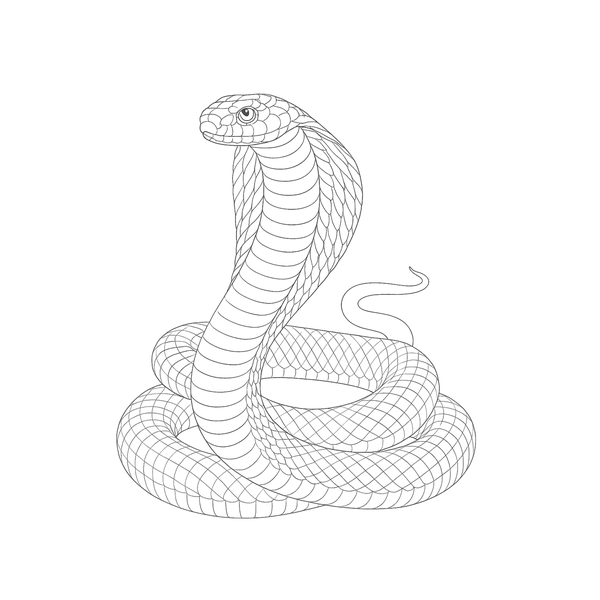
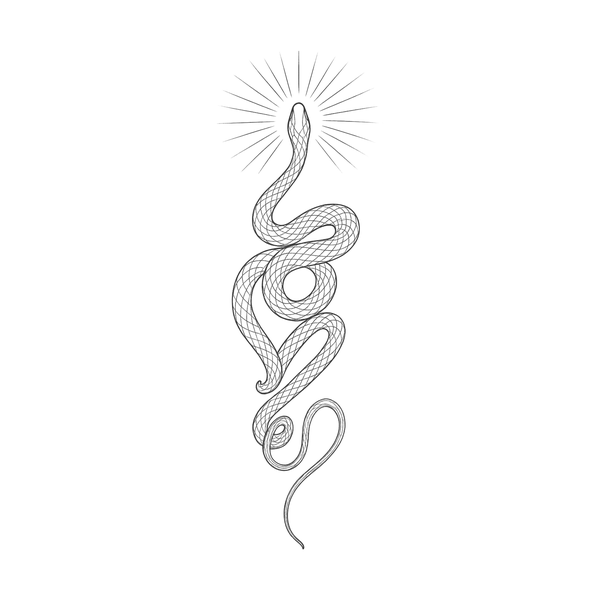
Snake flash designs
17 hand-drawn designs from our flash collection — book any one as-is, or use it as the starting point for a custom piece. Sizing, placement and linework dialed in at your consultation.
Twelve serpents
Twelve snakes, sorted roughly by how far each one wraps.
The snake composes in genuinely distinct ways across every tradition tattooing has codified. A Traditional rattler on a bicep and a Japanese hebi half-sleeve are not scaled versions of the same tattoo.
The Traditional American rattler
Sailor Jerry flash canon
Bold black outline, flat fills in the traditional four-color palette, scales rendered as repeating graphic marks rather than texture. Coiled rattler, fangs bared, tongue flicked, often paired with a rose, a dagger, or a banner scroll. Built to live on forearm, calf, or bicep at 4–8 inches. Ages better than almost any other snake style because the heavy outline does the structural work.
The Japanese hebi with peonies
Canonical irezumi pairing
The snake coils through peony blossoms and leaves, often with wind bars and a small patch of mist or cloud behind. Lives large by design — a half-sleeve, thigh panel, or ribcage composition — because the peonies need room to breathe alongside the coil. Heavy outline, saturated color, multi-session. Books only with a Japanese-tradition specialist; a generalist rendering reads as costume.
The neo-traditional dagger snake
Wrapped blade, fanged strike
The Traditional composition updated with dimensional shading, expanded palette, softer outlines. Snake wound around the blade, fang catching the hilt, blood-drop or rose at the point. Mid-scale (5–8 inches) on forearm, thigh, or upper arm. Carries the most composition pairings cleanly because neo-traditional makes room for gold, purple, teal, and other colors Traditional wouldn’t touch.
The realism coiled cobra
Species-specific black-and-gray
Black-and-gray or color realism rendering a specific species from reference — king cobra hooded, diamondback mid-coil, gaboon viper with leaf-litter patterning. Needs 6 inches minimum or the scale detail collapses. The client brings reference photos, ideally of the specific animal in the specific posture. Multi-session. The style for clients who want the animal itself, not the symbol.
The ouroboros
Self-consuming serpent
The serpent swallowing its tail — cyclical time, return, self-containment. The cleanest circle composition in tattooing, and one that works at almost any scale from a 2-inch wrist piece to a back-panel centerpiece. Renders in fine-line, blackwork, neo-traditional, or illustrative. Pairs readily with alchemical symbols, suns, moons, or a single word set inside the circle. Travels across cultures without appropriation risk.
The snake and rose
Softened style
Snake coiled through roses, peonies, wildflowers, or lotuses. The flowers offset the threat reading and open the piece to beauty, growth, and transformation conversations. Works in Traditional, neo-traditional, fine-line, and illustrative. The most-requested snake composition for clients who want the form without the danger style doing the loudest work.
The fine-line continuous serpent
One unbroken line
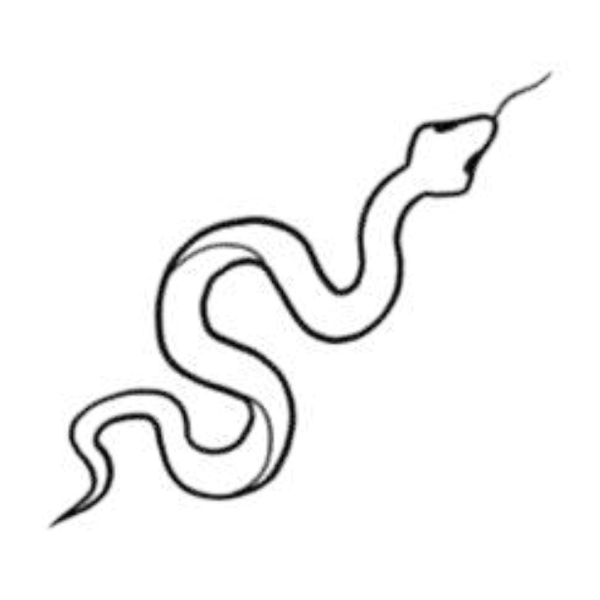
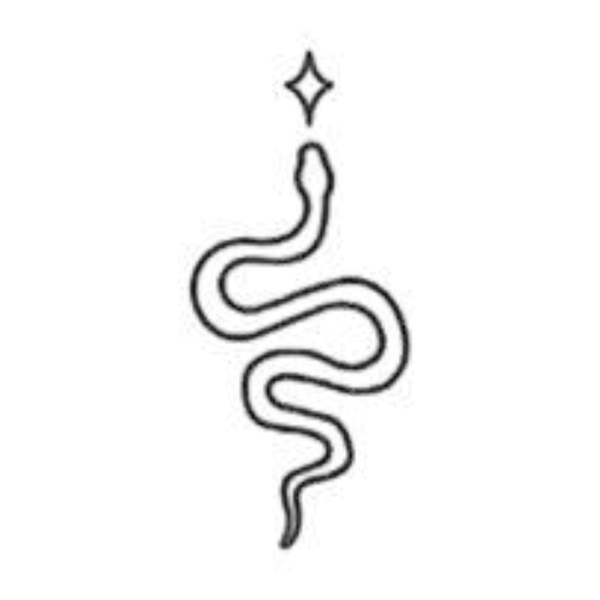
The entire snake drawn with one continuous line, no fill, no interior shading. Minimalist, contemporary, elegant. Perfect for first tattoos or clients wanting understated symbolism. Ages faster than heavier work because the line weight is at the limit of what skin holds — plan for a touch-up at 7–10 years.
The Eden serpent and apple
Biblical allegory
The biblical serpent coiled around an apple or a tree branch. Loaded with symbolism around temptation, knowledge, and original sin. Pairs beautifully with neo-traditional or fine-line approaches. The style for clients who want the allegorical weight, whether reverent, subversive, or somewhere in between.
The Rod of Asclepius
Medical lineage
Two serpents twisted around a central staff, or (more historically correct for medical symbolism) one serpent around a plain staff. Strong medical, healing, and balance symbolism. Vertical placements shine here. The style for medical and healthcare workers — and the fix (Asclepius, not Hermes’ commerce caduceus) happens in consultation, not after stencil.
The finger/wrist serpent wrap
Living jewelry
Delicate, jewelry-like placement where the snake becomes a living ring or bracelet. Usually fine-line or minimal black work. 2–3 inch single-line or fine-line snakes that turn the subject into living jewelry. Behind-the-ear, finger, wrist — the subtle style for clients who want the symbol without the visibility.
The blackwork serpent silhouette
Solid black, architectural
Bold black silhouette with negative-space eyes and scale patterning cut into the form. Polynesian-influenced or original blackwork design. High-contrast, ages exceptionally well, readable from across the room. Requires healthy skin and an artist who laminates saturation evenly. Reads as shape rather than illustration.
The cobra with ornamental hood
Mandala and pattern
The hood provides a dramatic focal point and a natural space for ornamental patterns, mandalas, or a single jewel. Works in realism, Traditional, or ornamental styles. The style for clients building an ornamental sleeve or wanting the snake to carry decorative weight as much as symbolic weight.
Six traditions
Six traditions, and every one of them draws a scale differently.
Watch what each of these does with scale texture, because that is where they genuinely part company. Traditional turns scales into a repeating graphic mark. Realism renders them. Fine line skips them entirely and admits it. Blackwork cuts them out of solid fill. Whichever answer you pick is the one you are living with in twenty years, so pick it consciously.
American Traditional — the rattler in the flash canon
Sailor Jerry flash canon
Bold black outline, flat fills in the traditional palette, coiled compositions, time-tested readability. The original pairing with the snake. A go-to for anyone wanting a tattoo that will still look sharp in 30 years. Scales cleanly with rose, dagger, banner, heart, skull companions.
Japanese hebi — the peonies are not decoration
Hebi with peonies and wind bars
The hebi is central to Japanese tattoo tradition, almost always paired with peonies (botan), flowing water, wind bars, or cherry blossoms. Demands a larger canvas and an artist fluent in Japanese composition rules. Multi-session commitment. The richest composition grammar available.
Neo-Traditional — the home of snake-and-dagger
Expanded palette, dimensional bones
Richer color palettes, more painterly shading, ornamental details. Great for designs that want traditional boldness with modern flourishes like jewels, filigree, or stylized backgrounds. Where a lot of modern snake work lives — especially snake-and-dagger, snake-and-rose, and Eden-serpent compositions.
Black-and-grey realism — name the species or skip it
Species-specific photoreal
Photoreal rendering of a specific species — king cobra hooded, diamondback mid-coil, gaboon viper. Needs 6 inches minimum or scale detail collapses. Bring species-specific reference. A realism snake without a specific species reference is an inventory snake, and it shows.
Fine line — one continuous line, no scale texture
Minimalist and continuous-line
Minimalist, delicate, often single-needle work. The snake becomes elegant and ornamental rather than menacing. Best for smaller placements and clients drawn to understated designs. Continuous-line serpents and ouroboros compositions are the strongest fits.
Blackwork — scales cut out of solid black
Silhouette, negative space
Solid black silhouette with negative-space eyes and scale patterning cut into the form. High-contrast, ages exceptionally well, reads across the room. Requires an artist who laminates saturation evenly. The style for clients building a blackwork sleeve or wanting architectural presence.
The wrap
No other motif on this site goes all the way around a limb as well as this one.
Which sounds like a compliment and is actually a set of constraints. Four things that follow from the fact that a snake is a body of even width running through a curve.
Why the wrap works, and what it costs you
Almost every tattoo subject has a front — a face, a hull, a bloom — and a front means there is one correct angle to view it from. A snake has no front. A body of even width running through a curve reads correctly from any side, which is why it can travel the whole way around a forearm or a calf and still be one coherent image from every direction. That is a genuinely different design job. In practice it means the stencil has to go onto a cylinder, so it gets cut and re-laid in sections and the artist works with the limb rotating in the chair, which takes longer than clients expect. It also means nobody will ever see the whole tattoo at once, including you. So decide in advance which single view is the one that matters — usually arm hanging at your side — and make sure the head lands inside it. A wrap whose head only appears when you raise your arm over your head is a tattoo you commissioned for other people.
Suggest the scales. Do not draw them all.
Scale texture is what keeps the animal from reading as a painted hose, and it is also the detail most likely to vanish. Individually outlined scales are small closed shapes packed edge to edge; over fifteen or twenty years the ink creeps a fraction of a millimetre in every direction and those shapes merge into a flat grey field. The work that survives does something smarter than drawing more. It varies. Belly plates go in as clean, wide, confident bands. Dorsal scaling gets suggested — broken dot-shading, a few rows of outlined scales riding the top of the curve, then plain tone as the body turns into shadow. Rhythm rather than inventory. American Traditional pushes the same logic further and turns the scale into a repeating graphic mark, four or five to a band, which is exactly why rattlers tattooed in the 1950s still read as snakes today. Ask your artist how many scales they actually intend to draw. A small number is the good answer.
The ouroboros is older, and separate
Worth pulling out of the general snake vocabulary, because it is not a variant of anything else on this page. The serpent swallowing its own tail appears in ancient Egyptian funerary imagery — the earliest known example is in the shrines of Tutankhamun — and was later taken up in Greek alchemical writing, where it acquired the “all is one” reading it still carries. It is not the shedding-skin symbol and it is not the Eden serpent. It is a closed circle about cycles and self-containment, and it is a different drawing problem too: a circle has no head-and-tail hierarchy, so there is no obvious focal point to build a composition around. Fine line and blackwork both handle that well. American Traditional mostly does not, because Traditional wants somewhere for the eye to land.
What shedding actually looks like
For anyone commissioning the transformation reading. A snake sheds its skin in one continuous piece, eye caps included, and for several days beforehand it goes cloudy — the eyes turn milky blue and the animal is effectively half-blind while the new layer separates underneath. That detail is more useful in a tattoo than the shed skin itself, because it says something the standard version doesn’t: the part before the change is the part where you cannot see. Artists render it as a pale desaturated eye, or a faint opaque wash across the head. Tiny change. Completely different piece.
Five placement styles
Snakes love curves. Follow the muscle.
Snakes are one of the most placement-versatile subjects in tattooing because their sinuous form naturally conforms to the body’s curves. The flow rule: follow the muscle, don’t fight it.
Forearm wrap (signature)
Outer forearm · inner forearm
The snake coils around the arm with the head resting at the wrist or inner elbow. Creates a dynamic piece that reveals itself as the viewer walks around you. The most iconic snake placement. Works in every style from Traditional to fine-line.
Thigh wrap / panel
Outer thigh · inner thigh · full thigh
Larger canvas for detailed Japanese or neo-traditional work, letting the snake spiral from hip to knee with room for supporting elements like peonies or waves. The home of the full hebi composition.
Ribs / torso vertical
Ribcage · side · underboob
Mirrors the snake’s natural slither, ideal for pieces running from underarm to hip. Lengthens the figure and creates striking visual drama. Skin is sensitive and demands an experienced hand — ideal for Japanese-influenced work where the wave follows the body’s curve.
Spine / back vertical
Spine · full back · shoulder blade
Full vertical runway where a snake can coil down the backbone. Ambitious, long-form composition. Back skin ages exceptionally well — covered, minimal sun, low stretch — which is why collectors commit serious scale here.
Micro / jewelry
Finger · wrist · behind ear · ankle
Subtle statements — 2–3 inch single-line or fine-line snakes that turn the subject into living jewelry. Behind-the-ear is the most common. Keep detail minimal; at this scale, you’re committing to silhouette with suggestion of scale, not rendered detail.
Eight compositional pairings
The companion object decides whether this reads as a threat or a promise.
A snake around a dagger is danger. A snake through peonies is a Japanese piece about renewal. A snake on a plain staff is a profession. Same animal, three unrelated statements, and the object is doing all the work. Eight that come up constantly.
Snake + rose
The softened style — the rose offsets the snake’s threat reading and opens the piece to beauty and transformation. Traditional, neo-traditional, fine-line, and illustrative all carry it well.
Snake + dagger
The classic “snake wrapped around a dagger” motif reads as protection, betrayal, or triumph over temptation. Traditional and neo-traditional styles both nail this one. Forearm or bicep.
Snake + peonies (hebi)
The canonical irezumi pairing. Snake coils through peony blossoms with wind bars behind. Demands a Japanese-tradition specialist and at least half-sleeve real estate. Multi-session.
Snake + skull
Memento mori pairing. Snake coiled through an eye socket or emerging from a jaw. Traditional and realism styles both work. Forearm, thigh, or back panel.
Snake + apple / Eden tree
The biblical serpent with apple or tree branch. Loaded with symbolism around temptation, knowledge, original sin. Neo-traditional or fine-line works best.
Snake + staff (Asclepius)
The single-snake Rod of Asclepius — the historically correct medical symbol. Vertical placement, forearm or spine. Popular with medical and healthcare workers.
Snake + moon
Snake coiled beneath a crescent or full moon. Witchcraft-adjacent style. Fine-line or neo-traditional. Inner forearm, ribcage, sternum.
Snake + flowers (non-rose)
Lotus, wildflowers, lily — opens the piece beyond the rose-pairing default. Softens the danger style. Works across neo-traditional and fine-line.
Scale honesty
Scale texture needs room, and that sets every floor on this list.
Everything else about a snake shrinks gracefully. The body is a curve, the head is a wedge, the eye is a dot — all of that survives being small. Scale texture does not, and scale texture is the thing that stops the whole animal reading as a length of painted hose.
Before the stencil
Six answers, and species travels with tradition whether you like it or not.
The recurring problem on this subject is not that clients fail to answer these — it is that they answer them in the wrong order, pick a species first, and then discover it fights the tradition they wanted. Take them as written.
Say the reading out loud
Transformation, danger, wisdom, medicine, Japanese hebi, or ouroboros. Name which is actually on the table. Most bad snake tattoos are good drawings of the wrong style. Saying “shedding” or “hebi” out loud at consultation changes the whole design brief.
Which tradition?
American Traditional, Japanese irezumi, neo-traditional, fine-line, or blackwork. If you don’t know, say so — it is a normal answer, and the traditions are genuinely hard to tell apart in fresh photos. Ask to see healed work in each, at five years and older, and look specifically at whether the scale texture is still there.
Which species?
Cobra, viper, rattler, python, coral, king cobra, diamondback. Each species has a body type that matches a different placement and a different tradition. Bring reference. A species-generic snake reads as inventory.
Coiled or extended?
Coiled snakes pack energy into chest, shoulder, calf, back-of-hand compositions. Extended bodies wrap and flow across sleeves, ribs, thighs, spine. Two different compositional problems. Decide before you pick the artist.
What is the snake standing in for?
Transformation through hard change, shedding a past self, intuition, medical lineage, mythology, aesthetics. Name it in one sentence. A snake chosen by reflex reads as decoration forever. A snake chosen on purpose reads as yours.
Which artist type?
Snake work splits into flow specialists (Japanese hebi sleeves, wrapping python backpieces) and Traditional specialists (flash-style tight coils). Knowing which you want sharpens your artist search.
Where snakes go wrong
Eight failures, and three of them happen at the stencil stage.
Three of these are drawing problems, two are symbol problems, and three happen in the ten minutes when the stencil is being positioned on your arm — which is the part of the appointment clients are least prepared to slow down.
Fighting the anatomy
A snake should wrap the limb, not sit on top of it. Cheap designs run the body in a straight rigid line across a bicep; strong designs curl around the arm so the viewer’s eye travels the whole piece.
Generic coil syndrome
Stock-reference coils — copied straight from clip art — read as lifeless. A real coiled snake has tension, overlap logic, and a believable head position relative to the body. Fix: custom thumbnails beat traced references every time.
Missing scale texture
A snake without scale work looks like a painted hose. Even stylized traditional snakes want belly plates, dorsal scaling, or dot-shading that signals the texture. Skipping this is the single fastest way to date the piece.
Wrong species for the style
A rattlesnake rendered in fine-line floral style reads as confused. A cobra in a Sailor Jerry flash sheet fights the tradition. Fix: match species to style — the two choices travel together.
Caduceus for medical
The two-snake caduceus is Hermes (commerce), not medical. The historically correct medical symbol is the Rod of Asclepius — one snake, plain staff. Fix: this happens in consultation, not after stencil.
Register mismatch
Good drawing of the wrong style. A striking cobra where the client wanted transformation. A peaceful ouroboros where the client wanted danger. Fix: name the style in one sentence before you brief the artist.
Stencil settled too fast
A snake placed well becomes part of you. Placed wrong, it looks pasted on forever. Fix: expect the artist to revise the stencil multiple times before committing — the head placement alone usually needs 2–3 positions.
Style mismatch on companion elements
A Traditional snake with a fine-line rose. A realism snake with a flat-color dagger. Fix: match style weight across all elements. A Traditional snake wants a Traditional rose; a neo-traditional snake wants a neo-traditional dagger.
A snake without scale work looks like a painted hose.
Pick your tradition first. Species and composition narrow quickly from there.
Snakes reward commitment — give the design room to breathe and the artist room to compose.
The first-snake guide
If this is your first snake, go Traditional and give it room to coil.
The honest starting recipe is a Traditional American rattler at 5–6 inches on the forearm or bicep. Eight decisions the first snake should make on purpose.
Making it yours
Species and coil are bones. The layer that matters is invisible.
Snakes are among the easiest subjects to make specific, because there are thousands of real species with real ranges and real patterning, and almost every client commissions the generic one. Naming a real animal costs nothing and changes the whole drawing.
The bones — species, tradition, pose, placement
Species, style, pose, size, placement, palette. These are the bones. They determine whether the piece reads as Traditional, Japanese, realism, fine-line, or blackwork, and whether it reads as danger, wisdom, transformation, or ornament. Most clients start and stop here — which is why most clients end up with snakes that look like every other snake in flash.
A named species, a date worked into the coil
A specific species from a region that matters. A companion element — specific flower, a banner word, a date worked into the coil. A specific mythology (Eden, Asclepius, Jörmungandr). A small secondary subject — skull, dagger, rose. Pick one of these, not four; a snake carrying four personal references is carrying none of them clearly.
The shed nobody else witnessed
Strangers read a rattler. You read a specific year you got out of. Nothing about the drawing has to signal that, and the fact it says nothing out loud is usually why it keeps holding up.
Matching snake tattoos
Common among recovery peers and medical cohorts. Often under-planned.
Snake sets have one advantage most subjects don’t: two snakes can be built to face each other, or to mirror a coil, so the pair reads as a pair even on two separate bodies in two separate rooms. Design that relationship deliberately rather than copying one drawing twice.
Who ends up matching serpents
Couples who share a shedding moment, siblings who grew up with the same mythology, recovery-program peers, medical-school cohort. Different relationships invite different compositions — Asclepius for medical pairs, ouroboros for recovery.
Match the species, vary the coil
Same species, different coil direction or head position — one facing left, one facing right; one striking, one still. The species is the shared language; the coil is the individual voice.
Plan for the piece to outlive the bond
If a falling-out, an estrangement or a death would make the piece unwearable, redraw it until it stands alone. The test is simple: with the other person out of the room, is this still a snake you would have chosen?
One stencil, one artist, one afternoon
Coil geometry is redrawn by hand every time, so two artists working from one reference will give you two differently balanced snakes. Book the pair into a single afternoon with one artist, or accept that what you have is a themed set.
FAQ
What comes up once the tradition is picked.
Ten questions covering design selection, meaning, species choice, coiled vs. extended, Japanese vs. Traditional, ouroboros, scale, dark style, and pricing.
How do I know which snake tattoo design is right for me?
Take the five questions above in order and do not jump ahead to the picture. First: which reading — transformation, danger, wisdom, medicine, hebi, or ouroboros? Second: which tradition — American Traditional, Japanese irezumi, neo-traditional, fine-line, or blackwork? Third: which species — cobra, viper, rattler, python, coral? Fourth: coiled or extended? Fifth: how much canvas can you realistically commit to in time, budget, and sitting? A snake that answers all five cleanly is the snake that’s actually yours.
What does a snake tattoo mean?
Snake tattoos carry layered meaning across cultures. Western traditions often tie the snake to transformation, rebirth, and shedding the past — a nod to how snakes molt their skin. Others read protection, wisdom, fertility, or duality (healing and danger in one creature). Your placement, style, and companion elements ultimately shape the personal story you’re telling. See our Snake Mythology & Meanings page for the deep-dive across Asclepius, Nāga, Quetzalcoatl, Jörmungandr, Rainbow Serpent, and Eden.
What kind of snake should I get?
Popular picks include cobras (hooded drama), vipers (fangs and strike poses), rattlesnakes (American Traditional staple), pythons and boas (long, wrapping bodies), and coral snakes (vivid color bands). Mythic options like ouroboros, Quetzalcoatl, or the Eden serpent pull symbolic weight. Pick a species whose body type matches the placement you have in mind — species and style travel together.
Should the snake be coiled or extended?
Coiled snakes pack intense energy into a compact shape — great for chest pieces, shoulders, calves, and back-of-hand panels. Extended bodies wrap and flow, making them ideal for sleeves, ribs, thighs, and spine work. Coiled reads as poised and watchful. Extended reads as something already in motion. Two different compositional problems.
Can I get just a snake without the flowers or objects?
Absolutely. A standalone snake — especially rendered with strong scale texture and deliberate line weight — stands on its own. Traditional flash sheets include plenty of solo snakes. That said, companion elements like roses, daggers, skulls, or peonies do help frame the composition and anchor it stylistically.
Japanese vs. American Traditional snake — how do I choose?
American Traditional leans bold, chunky, high-contrast, with tight compositions and saturated primary colors. Japanese irezumi snakes flow larger, incorporate wind bars, peonies, and waves, and typically cover more real estate. Choose American Traditional for smaller standalone pieces and Japanese for long-form sleeves, back pieces, or thigh panels. Japanese hebi demands half-sleeve minimum.
What does ouroboros mean for a tattoo?
The ouroboros — a snake consuming its own tail — represents cyclical renewal, eternity, and wholeness. It appears across Egyptian, Greek, Norse, and alchemical traditions. As a tattoo, it reads as personal transformation, recovery, or the unity of opposites. Fine-line circular renderings sit beautifully on forearms, behind the ear, or around the ankle. It travels across cultures without appropriation risk.
Is snake considered dark or sinister?
Only if you render it that way. Snakes span the full emotional range — sinister strikers with bared fangs on one end, serene coiled guardians on the other. Warm tones, floral pairings, and soft linework pull the design toward graceful, while heavy black, skulls, and aggressive posing push it toward menacing. The style is a rendering decision, not an inherent property of the subject.
How big should my snake tattoo be?
Snakes reward scale. Small fine-line snakes work on wrists, fingers, and behind the ear (2–4 inches). Mid-size Traditional snakes live happily on forearms, calves, and upper arms (6–10 inches). Full Japanese hebi compositions want sleeve, thigh, back, or ribs real estate (10 inches and up). Go as large as placement allows — tight detail on scales needs room to breathe.
How much does a snake tattoo cost in LA?
Snake pricing at Apollo scales with four factors: overall scale, style complexity, color vs. black-and-gray, and session count. Small fine-line continuous-line serpents are typically a single session at 2–4 inches. Mid-scale Traditional or neo-traditional compositions usually span one to two sessions. Realism king cobras and detailed species-specific pieces run two to three sessions. Japanese hebi sleeves, back panels and full-thigh compositions run four to eight sessions. Apollo’s hourly is $100 with Blue, Hannah or Rick and $350 with Raa or David, with half days at $400 and full days at $600 — and the honest number depends on artist, size, design and placement, because we quote off the finished sketch.
Ready to name the species?
Bring the reading. Bring the species. Bring the limb it wraps.
Where it wraps decides most of it. Forearm, thigh or spine, coiled or extended, and then which species and which of the six readings you actually mean. We plan the scale rhythm for how it'll look at year ten, not day one.