Tattoo Ideas
Mermaid
The sirens Homer wrote about were birds. The fish-tailed version is a medieval mix-up that stuck, and it is why the pin-up mermaid and the drowning-omen siren are two opposite traditions wearing one silhouette. Twelve directions, the waist-to-tail transition that defeats most amateur work, and how to pick the reading you actually mean.
Book a consultationTwo traditions
The pin-up is a good-luck charm. The siren is a drowning omen.
Both are mermaids. They come out of different centuries and they mean opposite things, and most people who walk in asking for one have never been told the other exists. Sorting that out is the first ten minutes of the consult.
Homer’s sirens had feathers
In Book XII of the Odyssey the sirens sing from an island and Odysseus has himself lashed to the mast to survive them. In the Greek art of that world they are drawn as birds with women’s heads — not fish. The fish tail belongs to a separate figure, and the two were welded together in medieval Europe, where bestiaries and church carvings show a fish-tailed woman labelled siren. That merger is why the two words are used interchangeably now. It is also why the first question in a mermaid consult is which of them you actually mean, because one has teeth and one does not.
Sailor Jerry’s mermaid is a charm, not a threat
Norman Collins tattooed out of Honolulu’s Chinatown through the 1940s and ’50s, largely on Navy men on liberty, and his mermaid belongs to that flash tradition alongside the anchor, the swallow and the homeward-bound banner. She winks. She is cheerful on purpose. The heavy outline was not a look — it was what still read on a forearm after twenty years of Pacific sun. If this is the mermaid you inherited from a grandfather, you inherited the charm, not the warning, and drawing her dark misreads the whole object.
The Ningyo is a different animal
Japan’s ningyo — literally “human fish” — is described in older accounts as a fish carrying a human face rather than a woman carrying a fish tail, and sightings were read as portents. Eating its flesh was supposed to buy unnatural long life. Contemporary Japanese-style tattooing usually draws something closer to the Western mermaid riding Hokusai-lineage waves, which is a legitimate modern hybrid and a beautiful one. But if the ningyo itself is what you want, say the word out loud, because you are commissioning a different creature and it needs a different reference pile.
The choice changes the whole drawing, not just the face
A pin-up wants four colours, a heavy outline, an anchor or a banner, and a placement that shows. A siren wants value instead of colour, wet hair instead of styled hair, wreckage somewhere in the frame, and very often a placement nobody sees. Ask an artist for both at once and you get a winking woman standing in a shipwreck, which reads as neither. Pick the tradition, then pick everything else downstream of it.
Which creature is she
“A mermaid” names three different creatures. Rule out two.
Say I want a mermaid to five different artists and you will get five different animals back. The pin-up, the siren and the ocean avatar are not sizes of one idea. They come from different centuries, they carry opposite meanings, and they are drawn with different tools. So the consult starts by ruling things out. Five questions, in this order, because each answer closes off options for the next.
Whose ocean is this?
A pin-up tradition, a folklore shadow, feminine sovereignty, an ocean life, a Disney-era formative memory, or a heritage water-spirit. “It’s for my Navy grandfather.” “It’s my open-water chapter.” “It’s the siren — the dangerous one.” Any sentence that lands in one breath is enough. “I love the ocean” is not specific enough to start a design.
Pin-up, siren, or ocean avatar?
These are three different subjects that happen to share a tail. Pin-up is Traditional Americana — cheerful, winking, anchor-adjacent. Siren is Homeric folklore — teeth, wet hair, drowned sailors. Ocean avatar is the free-diver’s mermaid — accurate kelp, real fish, realistic water. Pick before you pick style.
Traditional lineage or modern style?
Sailor Jerry Traditional and Neo-Traditional sit in one lineage. Japanese Ningyo sits in another. Fine line, black-and-grey realism, watercolor, and Art Nouveau are separate modern styles. They are different visual languages and they age differently. The two lineages do not blend — pick one and stay inside it.
Visible or private?
Forearm, calf, and upper arm read public. Ribcage, thigh, and back read private. A pin-up wants visibility — half the point is the flash-lineage signal. A dark siren often wants privacy — a piece that surprises in the locker room rather than announces at the café. Meaning meets audience at placement.
How big can you realistically go?
A full-figure mermaid with a readable face needs at least 6–8 inches along the longest axis. Below that, the face collapses within a few years. Under 4 inches, switch to silhouette, tail-only, or profile. Your honest scale sets your honest style — not the other way around.
A mermaid floating on bare skin reads as a half-fish. The water is what signals that you’re looking at a creature in her element.
The waistline transition is where mediocre mermaid tattoos give themselves away.
Any asymmetry in the eyes reads instantly as “off,” which is why luxury studios sketch the face four or five times before needle touches skin.
Twelve she arrives as
Twelve mermaids that share a tail and almost nothing else.
Every major style tattooing has invented has taken a run at this subject, which is unusual — most motifs sit comfortably in two or three. A winking Sailor Jerry pin-up on a forearm and a bioluminescent siren from the abyssal zone on a thigh are not two sizes of the same tattoo. One is a charm. The other is a warning. Read the twelve below for what each one is saying, not just for what it looks like, and notice how much the water changes between them.
The Sailor Jerry pin-up
Traditional American flash-lineage siren
The founding mermaid of American tattooing — Norman “Sailor Jerry” Collins codified her in Hawaii in the 1940s and ’50s as a rite-of-passage piece for Navy men. Saucy, often winking, paired with anchor, banner, or “Homeward Bound” scroll. Bold 3/0-liner outline, limited palette (red, green, gold, black). Ages better than any other style codified for the subject — a well-executed Traditional pin-up at age 20 still reads correctly at 50.
The dark folklore siren
Homeric · drowned-sailor style
The Homeric siren of Book XII of the Odyssey was a bird-woman whose voice drove sailors onto the rocks — that hybrid fused with the fish-tailed mermaid during the medieval period. The result is the creature collectors ask for when they want gravity rather than whimsy. Expect teeth, wet hair across the face, splintered ship timbers, muted bruised-sea palette. Black-and-grey realism carries this best.
The Japanese Ningyo
Irezumi-style with Hokusai waves
The Ningyo of Japanese folklore is closer to a fish with a human face than a European mermaid, but contemporary Japanese-style tattoo work often blends the two into a figure riding Hokusai-style waves. Bold black outlines, saturated red and indigo, finger waves, windbar conventions. Demands an artist fluent in Japanese composition. Best as a full back or body-side piece — architectural scale, multi-session irezumi architecture.
The fine-line silhouette
Single-needle minimalism
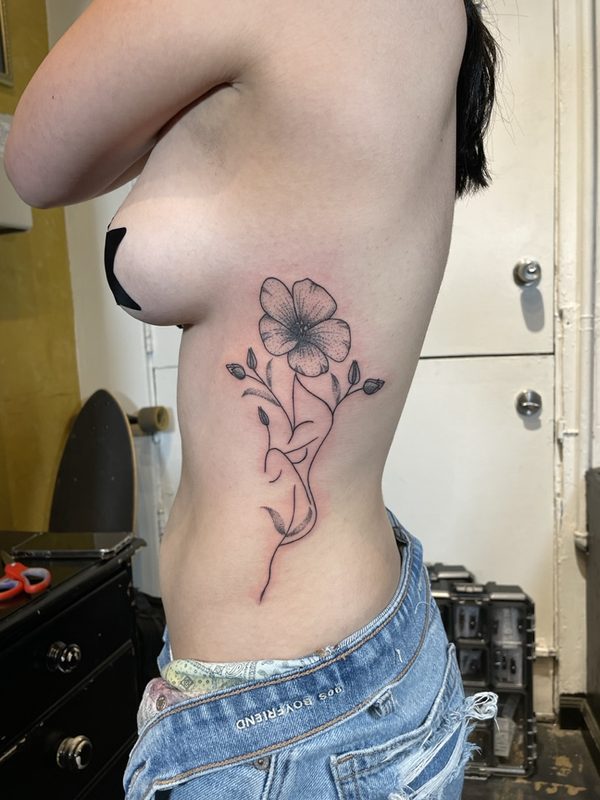
A single-weight line drawing of a mermaid form, often mid-dive or tail-curled. Ribcage, forearm, spine. The line doesn’t get to hide behind color — every wobble shows. Elegant, modern, photographs beautifully. Reads across a room, subtle up close. Excellent first-mermaid entry point into a style you may later expand.
The watercolor with coral reef
Contemporary fine-art style
Soft bleeds of coral pink, teal, and gold surround a loosely rendered mermaid figure, with fine-line anchor work holding the composition together. Best on thigh or upper arm where the color field has room to breathe. Honest caveat: watercolor ages faster than line-based work — the splashes lack the scaffold of an outline. Plan for a touch-up at year seven.
The Art Nouveau Mucha mermaid
Ornamental · fine-art style
Flowing hair as decorative border, ornamental background arch, muted gold and sage palette, strong outline with delicate interior linework. Pulls from Alphonse Mucha and the belle-époque poster tradition. Reads as fine art rather than flash. Thigh or back placement, 10–14 inches. Rewards an artist with portrait and ornamental chops both.
The black-and-grey realism
Portrait-caliber figure work
Photorealistic rendering in smoked greys, letting value and texture carry what color usually does. Trailing kelp and seaweed wrap the figure, small fish accent the negative space. Back piece or full thigh, session-heavy — a showpiece tattoo for a serious collector. Portrait-caliber face work, soft shading, tonal control over decades.
The bioluminescent deep-sea siren
Abyssal zone · stranger style
A darker, stranger siren from the abyssal zone: pale skin, anglerfish-style glow lure, translucent fins, surrounded by points of cold blue light. A standout piece for clients who want something genuinely unusual. Heavy black background, selective color accents. Thigh or calf placement, usually 10–14 inches to carry the atmospheric detail.
The pearl-crown queen
Neo-traditional ornamental
A regal mermaid bust wearing a crown of strung pearls and branching coral, rendered in Neo-Traditional with jewel-tone saturation. The crown moves her from sea creature to sea royalty in one object. Flattering on clients who want ornate, feminine iconography with the neo-trad palette and outline weight. Upper arm or thigh, 6–8 inches.
The tail-only piece
Compact · fine-line or dotwork
A single curled fluke breaching the skin, 2–3 inches, fine-line or dotwork. For clients who want the mermaid reference without the full figure — also an excellent cover or companion piece for existing ocean work. The tail carries the whole subject when composed well; the curl direction and scale texture are the entire design problem.
The memento mori siren
Mermaid with a skull
The mermaid cradling a barnacle-encrusted human skull, underwater vines trailing through the eye sockets. Black-and-grey realism, forearm or calf — a modern memento mori that leans into the siren’s original lethality. Reads as literary and weighty rather than pin-up cheerful. Pairs with daggers, sextants, or nautical stars in composition.
The selkie / heritage water-spirit
Celtic, Slavic, West African, Filipino
The mermaid has cousins — the Scottish and Irish selkie who sheds a sealskin, the Slavic rusalka, the West African Mami Wata, the Japanese ningyo, the Filipino sirena. Clients with heritage connections often request one of these specifically rather than the generic European mermaid. Requires research from the artist — a Mami Wata is not interchangeable with an Ariel. Treat as a research commission.
The hard parts
Three drawing problems decide whether she looks amateur.
Not the style. Not the palette. Three specific passages that separate a mermaid you keep looking at from one you stop noticing after a year — and the first of them is the one nobody thinks to ask about.
The three inches where skin becomes scale
This is the hardest passage in the subject and it is where weak work gives itself away instantly. A hard line ruled straight across the hips reads as a costume seam. A smear of grey wash reads as a bruise. What actually works is a transition with real depth to it — call it two to three inches on a ten-inch figure — where scales begin as faint, small, widely spaced suggestions across the lower belly and hip, then tighten, gain edge and gain contrast as they run down into the tail. Traditional solves the same problem a different way, with a decorative band: a belt of shells, a run of solid black, a shape that gives the eye a stated reason for the change. Either answer is fine. No answer is not. When you look at an artist’s portfolio, look at this passage specifically, and look at it healed rather than fresh — fresh contrast flatters a flat transition, and two years of settling does not. If every mermaid in the book happens to be posed at an angle that hides the hips, you have learned something.
The face costs more room than anyone expects
Below roughly the width of a credit card, features stop behaving like features. The eye goes first: a pupil is a couple of millimetres of solid black sitting beside a couple of millimetres of light, and once the surrounding line softens with age the two run together and the eye goes dead. The nostril and the lip line merge next. That is the entire reason the honest floor for a full figure with a readable face sits somewhere around six to eight inches on the long axis, and the reason a three-inch mermaid should be a silhouette, a profile or a tail. Faces are also unforgiving in a way a rose is not — people read faces automatically, and a millimetre of asymmetry registers as “wrong” to a viewer who could not tell you why. There is no shame in the smaller answer. There is a lot of regret in the small detailed one.
Hair is the only moving thing in the picture
A mermaid is a still image of a creature in a moving medium, and hair is what has to carry the movement. Drawn as a hairstyle — parted, settled, obeying gravity — it kills an otherwise competent piece, because it quietly announces that the figure is standing in air. Drawn as current, it does the opposite: it fills the negative space, it tells you which way the water runs, it echoes the wave line, and it gives the composition an edge to end on. Clients who feel their mermaid looks flat almost always blame the face. Check the hair first.
Where she swims
She needs a direction to swim in, and your body picks it.
A mermaid is a long diagonal shape with a heavy end. Put her on a flat wide surface and she sits still. Put her on a curve that runs the same way she does — the ribs, the outside of a thigh, the slope of a shoulder blade — and the body supplies the current for free. That is the real placement question here, and it is not the same as asking where the tattoo will show.
Back and thigh — the full figure fits without cropping
Shoulder blade · upper back · outer thigh · inner bicep
The anatomical sweet spot for a full-figure pose. The back and thigh hold a full mermaid at 9–14 inches without cropping; the shoulder blade carries a contained 7–10 inch composition. Back skin ages exceptionally well — thick, protected from UV, rarely stretches. The top choice for heirloom-grade detailed work.
Outer arm and chest — the flash-lineage placement
Outer forearm · upper arm · chest panel · calf
The Traditional placement. Reads at six feet, carries pin-up flash and the anchor-and-banner lineage. If someone in the family has a Traditional mermaid on the outside of their forearm, this is the lineage you’re inheriting from. Outer forearm handles 6–9 inches — enough for a recognizable face, tight enough to avoid wrapping distortion.
Ribs and inner forearm — the curve supplies the current
Inner forearm · ribcage · sternum · back of upper arm
These placements read as “mermaid tattoo” without locking in a style-era. Good for fine line, neo-traditional, watercolor. Ribcage in particular turns the mermaid into water itself — the natural curve allows the figure to flow diagonally from under-bust to hip, 8–12 inches.
Underbust and inner thigh — the siren nobody meets
Inner bicep · underbust · inner thigh · behind ear
Private style — a tattoo for the wearer, not for the room. Often paired with fine-line silhouette or tail-only compositions because the style matches. The mermaid that lives mostly inside the wearer’s eyeline. Dark-siren clients often prefer this category.
Back, side, sleeve — a multi-session commitment, not a spot
Full back · full sleeve · body side · full thigh
Not placements — compositional commitments. A statement mermaid anchors a larger piece (Japanese Ningyo, Mucha-frame, bioluminescent deep-sea), planned from day one, often executed over four to six sessions. The conversation starts with the artist before the drawing does.
Six ways to draw her
Two old lineages, four modern styles, and they disagree about her.
Traditional and irezumi are inherited languages with conventions you either work inside or break on purpose. Fine line, realism, watercolor and Art Nouveau are modern approaches with no such rulebook and no such safety net. The gap matters most on this subject, because a mermaid has a face, and a face is where a style either holds or gives out. Pick the one whose failure mode you can live with.
American Traditional — the pin-up that still reads at fifty
Sailor Jerry flash lineage
Bold 3/0-liner outline, limited palette (red, green, gold, black), classic pin-up posture. The style that has been tattooed continuously since the 1920s and still reads correctly at year forty — the thick outline holds as the color drifts. Ages better than any other style codified for the subject. First mermaid? This is the default for a reason.
Japanese irezumi — the wave carries her, not the pose
Hokusai waves, windbar, Ningyo
Bold black outline, saturated red and indigo, finger waves, negative-space flow. Demands an artist with formal Japanese training and a body of wave-and-figure work. Best as a full back, body-side, or sleeve — the composition asks for architectural scale. Multi-session commitment. Ages beautifully when executed correctly.
Neo-Traditional — crown and palette without the portrait risk
Expanded palette, ornamental framing
Burgundy, dusty rose, muted gold, sage — plus dimensional shading and Art Nouveau-inspired frame work. Where modern ornamental mermaid work lives in 2026, because neo-trad gives you palette and ornament without asking for photorealism. Two sessions is common for anything over seven inches.
Fine line — where the tail alone can be the tattoo
The dominant 2020s style
Hairline work, anatomical accuracy, usually black. Honest caveat: single-needle lines are thinner than Traditional lines, which means they soften faster on skin that moves a lot — knuckles, feet, hand. On forearm, ribcage, or sternum, they hold. Best for silhouette and tail-only work.
Black-and-grey realism — the face is the whole gamble
Photorealistic · portrait-caliber
Photorealistic rendering from specific reference; soft shading, underwater light diffusion, kelp and seaweed as context. Realism doesn’t scale down — 6 inches is the floor. Demands portrait chops: small errors in face proportion read as “off” even to untrained viewers. A realism mermaid without a specific reference is an inventory mermaid.
Watercolor — reef colour with no outline holding it
Splash, bleed, soft edge
The contemporary fine-art style. Teals, sea-greens, coral pinks, aquamarines bleeding into soft edges. Honest caveat: watercolor ages faster than line-based work because the splashes lack the scaffold of an outline. Most watercolor mermaids get a touch-up at year seven to ten. If that’s a dealbreaker, pick neo-traditional.
Measured at the face
Four tiers, and the face sets the floor on every one.
Everything else on a mermaid can shrink. The tail reads at any size, the hair reads at any size, water reads at any size. The face does not, and the face is what people look at. So measure from there down.
Eight compositional pairings
What she holds decides whether she is a charm or a warning.
An anchor makes her a sailor’s luck. A skull makes her the thing that drowned him. Same figure, same pose, opposite reading — which is why the second object in the composition deserves more thought than the first. Eight pairings that come up constantly, and what each one does to the meaning.
Mermaid + waves / water
The most load-bearing pairing. Water gives the figure context, fills negative space with motion, lets the artist build depth. Hokusai-style finger waves, realistic whitewater, or abstract dotwork currents all work. Non-negotiable for any mermaid above silhouette scale.
Mermaid + anchor
The Traditional American pairing dating to 1930s sailor flash. Anchor grounds the composition literally and visually, adds bold black mass to balance the figure’s curves, carries sailor-superstition meaning (stability, returning home). Pin-up style home base.
Mermaid + skull
The memento mori siren. The skull reminds that sirens drowned sailors before they seduced them. Black-and-grey realism, forearm or calf. A modern memento mori that leans into the folklore style.
Mermaid + octopus
The narrative pairing. Octopus tangled in the tail suggests drama and scale — both literally (the octopus is massive) and symbolically (entanglement, consciousness, the abyss). Thigh or back panel, black-and-grey or muted color.
Mermaid + pearl / coral
Jewelry for the composition. Pearls and branching coral add ornamental detail, a pop of warm color against the cool palette, and scale references that make the mermaid feel inhabited in her world rather than floating in void.
Mermaid + rose
The Traditional flash pairing — bold layered rose petals beside a winking pin-up, limited palette, 3/0-liner outline. The classic “Homeward Bound” flash-sheet composition. Forearm or upper arm.
Mermaid + ship / wreck
The dark-siren composition. Splintered ship timbers, sails in tatters, drowned sailors on rocks. Lean into the mythological danger rather than the Disney reinvention. Thigh or back composition, 10–14 inches.
Mermaid + moon
The tidal-feminine pairing. Crescent moon behind the figure, full moon above wet rocks. Pairs cleanly with fine-line or neo-traditional style. Ribcage or back of shoulder.
Where mermaids go wrong
Eight failures, and the moment in the design where each one starts.
Almost none of these are needle problems. Seven of the eight are decisions made weeks before the appointment, in a conversation that either happened or didn’t. That is good news: they are cheap to fix on paper and expensive to fix in skin.
The Pinterest stack
47 saved images, bits picked from each, artist asked to combine. Result: a mermaid that belongs to no specific designer and reads as a compromise. Fix: cut it to three images, and next to each one write the single thing you want from it — her expression, that tail curl, that wave. Three annotated references beat forty unannotated ones every time.
The too-small face
Cramming facial detail into a face smaller than roughly a credit-card width guarantees the features will blur and collapse within a few years. Fix: if you want small, go silhouette, profile, or tail-only instead of a detailed portrait face.
The no-water mistake
Skipping waves, bubbles, or any environmental cue leaves the mermaid looking stranded on the skin rather than inhabiting a scene. A mermaid without water reads as a half-fish. Fix: even a suggestion of foam or a negative-space current transforms the piece.
The awkward waist transition
Treating the skin-to-scale join as an afterthought — a flat line, a smudge of shading — is the fastest way to make an otherwise strong piece read as amateur. Fix: design the transition first. A gradient zone of fading scales, a decorative belt of shells, or a dotwork fade, over two to three inches.
The fantasy-art reference trap
Pulling reference from digital fantasy illustration rather than tattoo-native design produces pieces that look like stickers. Fix: use tattoo-native flash, photo reference of real sea life, and healed portfolio pieces. Tattoos need tattoo logic — line weight, contrast, readable silhouette.
The over-packed composition
Stuffing a mermaid, ship, waves, anchor, and skull into a four-inch space guarantees every element loses impact. Fix: scale the concept to the real estate, or scale the real estate to the concept. Don’t fight the canvas.
The stiff-hair problem
Ignoring hair as a compositional tool flattens the figure. Flowing hair that echoes the wave motion is what makes a mermaid feel alive on the skin. Fix: artists who draw hair like a helmet are missing the whole point of the subject. Ask to see healed mermaid hair in their portfolio.
Booking the calendar instead of the portfolio
Booking with whoever can get you in this week rather than matching a portfolio to your style. Sailor Jerry pin-up and dark-siren realism are different artists. Fix: pick the specialist. Wait three weeks for the right portfolio match rather than settling for this week’s opening.
Stiff hair signals a dead piece before you even look at the face.
The idea that mermaids are gendered as a subject is a modern misread of a historically universal piece.
Scale the concept to the real estate, or scale the real estate to the concept. Don’t fight the canvas.
Before the first sketch
Six answers that spare you a wasted drawing.
None of these are trick questions. They are the six things an artist has to guess at if you do not say them out loud — and a guessed mermaid comes back as a mermaid you have to politely reject.
Which meaning cluster?
Pin-up Americana, folklore siren, feminine sovereignty, ocean avatar, pop-culture homage, or heritage water-spirit. Pick one primary. A mermaid can carry more than one reading, but the design has to be built around the one that matters most. Try to honor all six at once and you get a committee mermaid — technically a figure, emotionally nothing in particular.
Full figure, bust, or tail-only?
Three different subjects. Full figure needs 7+ inches and a horizontal canvas (thigh, ribs, back). Bust can live at 4–6 inches on upper arm or shoulder. Tail-only works at 2–4 inches anywhere. The choice drives placement, scale, and the skin-to-scale transition problem.
Which style lineage?
Traditional, Japanese Ningyo, neo-traditional, fine line, black-and-grey realism, or watercolor? If you don’t know, say so — that is a normal answer. Ask to see healed mermaids in each style you are weighing, at a year or more. A fresh watercolor tail and a fresh Traditional tail both look excellent in a wrap photo. At year eight they are not the same tattoo.
Which water context?
Hokusai finger waves, realistic whitewater, dotwork current, negative-space foam, or a full shipwreck scene. A mermaid without water reads as a half-fish floating on skin — the context isn’t decoration, it’s the reason the piece works. Decide the water before you decide the pose.
How long can you actually sit?
A 5-inch Traditional pin-up is 3–4 hours. A 10-inch neo-traditional is two sessions. A full-back Ningyo is four to six sessions over several months. Know your ceiling in time, tolerance, and sitting before you fall in love with a design that lives above it.
Matching with someone?
Mermaid matching is rare but increasingly requested — sailor-family descendants, open-water partners, memorial pairs. If yes, is the other person in the room, in the text thread, or just in your head? Treat matching as its own design problem. The other person should be in consultation if possible, or at minimum sign off on the final design before the stencil goes on.
The first-mermaid guide
Your first mermaid should be the one Sailor Jerry already solved.
There is a version of this tattoo that was worked out on Navy men in Honolulu eighty years ago and has been stress-tested on skin ever since: a five-inch Traditional pin-up on the forearm or upper arm, anchor and banner, four colours. It is not the most interesting mermaid on this page. It is the one least likely to disappoint you in 2050. Eight decisions, made on purpose.
Matching mermaid tattoos
Sailor-family descendants, open-water partners, memorial pairs.
Matching mermaids are rarer than matching roses and they go wrong in a specific way: people match the figure and forget that a mermaid is mostly water, so the two pieces end up swimming in unrelated seas. Match the water first.
Who actually asks for a pair
Sailor-family descendants with matching Traditional pin-ups most commonly, then open-water partners (free-divers, surfers, marine biologists), then memorial pairs honoring a shared loss at sea. Each subset has its own composition logic.
Match the figure, vary the detail
Same base mermaid, small variation per person — different anchor inscription, different bloom, different fish companion — so each piece still belongs to the person wearing it while the mermaids stay visibly a set.
Plan for the piece to outlive the relationship
If a breakup, an estrangement or a death would make the piece unwearable, redesign it until it stands alone. Ask the plain question: does this still read as a good mermaid with the other one out of the room?
One stencil, one artist, one afternoon
Two artists drawing from one reference will give you two different faces, and a face is exactly where the eye checks for a match. Book the pair into the same afternoon off one stencil, or accept that you are getting a themed set rather than a matched one.
Making her yours
Style is the least personal decision you will make about her.
Two people can order the same neo-traditional pearl-crown mermaid from the same artist and end up with two tattoos that feel nothing alike. The difference is not in the style card. It is in the two layers most clients never get asked about.
The bones — style, scale, placement, palette
Style, size, placement, palette. These are the bones. They determine whether the piece reads as Traditional, Japanese, neo-traditional, fine line, realism, or watercolor, and whether it reads bold, classical, modern, intimate, or statement. Most clients start and stop here — which is why most end up with mermaids that look like every other mermaid in their feed.
The named detail — a real beach, a real face
A specific kelp species from a home beach. A particular color from a grandmother’s jewelry. A face modeled on the client rather than a stock reference. A Mami Wata or selkie rather than the generic European mermaid. A specific shipwreck, a specific lighthouse, a specific tide chart. Named things are what stop a mermaid from being a mermaid. Bring one.
What only you know she marks
Nobody looking at your arm needs to know, and most of the time nobody will ask. The private layer keeps the piece from feeling generic — even if the design reads as a standard mermaid to strangers, you know what’s underneath. That’s enough. That’s often the whole point.
FAQ
What clients ask once the tail is settled.
Eight questions covering design selection, first-tattoo guidance, aging, scale, gender considerations, siren vs. mermaid distinction, session time, and heritage water-spirits.
How do I know which mermaid tattoo design is right for me?
Take the five questions above in order and do not skip forward. First: whose ocean is it — what are you marking — pin-up tradition, folklore siren, feminine sovereignty, ocean life, pop-culture homage, or heritage water-spirit? Second: pin-up, siren, or ocean avatar — three different subjects that happen to share a tail? Third: Traditional lineage (Sailor Jerry, Neo-Traditional) or modern style (Japanese Ningyo, fine line, black-and-grey realism, watercolor, Art Nouveau)? Fourth: visible or private placement? Fifth: what scale can you realistically commit to in time, sitting, and budget? A mermaid that answers all five cleanly is the one that’s actually yours.
What’s the best mermaid style for a first tattoo?
American Traditional pin-up at 5 inches on the outer forearm or upper arm, with anchor and short banner. Bold 3/0-liner outline, limited palette (red, green, gold, black), flat fill. This style survived a century because it ages better than anything else codified for the subject — a well-executed Traditional mermaid at age 20 still reads correctly at 50. Plan on 3–4 hours in the chair, one session, pricing discussed at consultation. Book an artist whose HEALED Traditional portfolio at one-year-plus is documented. Watercolor and photoreal realism are not first-tattoo styles.
Which mermaid style ages the best?
American Traditional, hands down. Bold outline plus flat color fills means the piece holds structure even as ink drifts over decades. Japanese irezumi ages exceptionally well when executed by a trained artist — the windbar and wave conventions scaffold the figure. Neo-traditional ages moderately well because the bold outline scaffolds the expanded palette. Black-and-grey realism ages well on stable skin and poorly on high-flex zones. Watercolor ages fastest — plan a touch-up at year seven to ten. If you want a mermaid that still reads at age 50, pick Traditional.
How big does a full-figure mermaid need to be?
For a full figure with a readable face, expect a minimum of roughly 6–8 inches along the longest axis, with most detailed pieces running 10 inches or larger. Thigh, ribcage, back, and upper arm placements give artists the canvas the subject actually needs. Below 6 inches, face detail will collapse within a few years. For smaller placements (wrist, ankle, sternum), switch to silhouette, profile, or tail-only — those compositions carry at 2–4 inches where a full-figure face would not.
Can a man get a mermaid tattoo?
Absolutely — mermaids have been a staple of Traditional men’s tattooing since the sailor-era origins of the craft. The subject reads as classic Americana on any wearer, and merman variants are increasingly requested. The idea that mermaids are gendered as a subject is a modern misread of a historically universal piece. The Sailor Jerry pin-up lineage was specifically a Navy-men’s tradition — the style was built around male wearers for roughly sixty years before it became read as feminine in contemporary consumer tattooing.
Mermaid vs. siren — is there a difference?
Mythologically, sirens in Greek tradition were bird-women whose voices drove sailors onto the rocks — the fish-tailed figure is specifically the mermaid. Those two hybrids fused during the medieval period, and contemporary tattoo language uses “siren” to signal a darker, more seductive or dangerous rendering of the mermaid archetype. The distinction is mostly about tone and styling rather than strict iconography — a “siren” tattoo almost always implies teeth, wet hair, ship wreckage, and a muted palette, while a “mermaid” tattoo leans cheerful, ornamental, or ocean-avatar.
How long does a detailed mermaid tattoo take?
A Traditional pin-up at 5 inches is 3–4 hours, one session. A neo-traditional ornamental piece at 8 inches is two sessions, six to eight hours total. A black-and-grey realism mermaid with waves and sea life at 10–12 inches runs two to three sessions, twelve to eighteen hours. Full-back Ningyo or Mucha-frame Art Nouveau pieces extend to four to six sessions across several months. Apollo’s hourly rate is $100 with Blue, Hannah or Rick and $350 with Raa or David, with half days at $400 and full days at $600 — but the honest number depends on artist, size, design and placement, and we quote off the finished sketch.
Are heritage water-spirits (Mami Wata, selkie, rusalka) different subjects?
Yes — treat them as distinct commissions, not decorative variants. A Mami Wata is a West African water divinity with specific iconography (often a python, mirror, or comb), not a mermaid with a different palette. A selkie is a Scottish/Irish seal-woman who sheds a sealskin; the skin itself is usually part of the design. A rusalka is a Slavic water spirit tied to drowned women and riverbanks, rendered very differently from a sea mermaid. If you’re drawn to one of these and share the heritage, research the specific iconography and bring that reference to consultation. If you don’t share the heritage, a thoughtful conversation with your artist about a naturalistic European mermaid is usually the respectful move.
Ready to name her?
Bring the water. Bring the face. Bring the hours you can sit.
Pin-up, siren or Ningyo. Three creatures share one silhouette and we'll rule out two of them in the first ten minutes. After that it's the waist transition and how much water the composition needs to sit in.