Tattoo Styles
Sacred Geometry
Perfect symmetry, imperfect surface. Each of these patterns is drawn on a flat grid and then laid onto a ribcage that curves, breathes and is not identical on both sides. Resolving that conflict is the craft. Flower of Life, Sri Yantra, Metatron's Cube, mandala.
Book a consultationConstruction
The patterns, and where they come from.
Sacred-geometry tattooing is a branch of geometric tattooing that references patterns with specific cultural, philosophical, or spiritual history. Every sacred-geometry piece is geometric; not every geometric tattoo qualifies.
Sacred-geometry tattooing is built on compass-drawn precision. A specialist works with physical compasses, rulers, digital layout tools, and frequent re-measures throughout a session. Nothing is freehanded that should be measured. The technique is usually fine line with selective dotwork shading; both demand consistent line weight and saturation because any variation reads immediately as a flaw in the pattern rather than as artistic license.
The patterns themselves carry different traditions. The Flower of Life appears in the Temple of Osiris at Abydos, Egypt (dated over 6,000 years old) and in Chinese Forbidden City architecture, Leonardo da Vinci's notebooks, and Kabbalistic texts. The Sri Yantra is central to Shri Vidya, a Hindu tantric tradition. Metatron's Cube is derived from Kabbalistic mysticism and contains the five Platonic solids Plato associated with the classical elements. Mandalas are central to Hindu and Buddhist practice, with Tibetan Vajrayana monks constructing and then destroying sand mandalas to teach impermanence.
Informed choice is the baseline of respect. Clients don't have to believe the metaphysics to wear these patterns — the patterns have traveled widely and been shared widely for centuries. But we walk clients through what each pattern carries at consultation, so the piece is worn with awareness rather than as decoration. A good sacred-geometry artist names the origin and intent before the stencil goes on.
Longevity favors this style when placement and scale are chosen correctly. Solid line geometry on stable skin (sternum, forearm, upper back) holds for 15–20 years with minor outer-line refreshes. Placement on high-flex regions (elbow, wrist crease, ribs under the diaphragm) breaks the geometry because skin stretches asymmetrically, distorting the pattern. Precision work is priced by hours and complexity rather than coverage.
Origins & lineage
Older than tattooing by a long way.
Each pattern in the sacred-geometry canon carries centuries of tradition. The names, places, and dates matter for anyone wearing this work.
~4000 BCE · Egypt
The Flower of Life at Abydos
Carved into the limestone walls of the Temple of Osiris at Abydos, Egypt. The pattern also appears in the Chinese Forbidden City, Leonardo da Vinci's notebooks, and Kabbalistic texts. Treated across traditions as a blueprint of creation — every other sacred-geometry pattern can be traced inside its overlapping arcs.
~900 CE · India
Sri Yantra & Shri Vidya
Central to Shri Vidya, a Hindu tantric tradition at least 1,000 years old and likely older. Nine interlocking triangles surrounding a central bindu represent the cosmos and the union of Shiva and Shakti. Traditionally used for meditation and worship, not decoration. The pattern is codified precisely — misalignment reads immediately as error to those trained in it.
~1200 CE · Kabbalah
Metatron's Cube & Platonic solids
Derived from Jewish mystical (Kabbalistic) tradition, named for the archangel Metatron. Contains within it the five Platonic solids — the building blocks Plato associated with the classical elements. The cube encodes every fundamental 3D form in a single flat figure, functioning as a protective glyph in the tradition it comes from.
Ongoing · Hindu / Buddhist
Mandala tradition
Sanskrit for “circle.” Central to Hindu and Buddhist practice, particularly Tibetan Vajrayana, where monks construct sand mandalas over days and then destroy them to teach impermanence. As tattoos, mandalas carry wholeness, integration, and the idea that everything radiates from and returns to a central point.
These patterns have traveled widely — across continents, across centuries, across traditions. They are not closed to outsiders the way some cultural practices are. But they carry weight. A good sacred-geometry artist names what the pattern has meant to its origin traditions at consultation, so the wearer knows what they are carrying.

Pattern variations
Eight patterns sacred geometry builds from.
The core vocabulary of the style. Each carries distinct origins and lends itself to specific placements and scales.
Mandala
A radial composition built from a single center outward. The word mandala is Sanskrit for “circle.” Central to Hindu and Buddhist meditative practice as a focusing device. Scales from 3-inch wrist pieces to full-back compositions. Radial symmetry adapts to shoulder caps, knees, and chests.
Flower of Life
Nineteen interlocking circles arranged on a hexagonal grid, bounded by an outer circle. Found carved into temple walls from Egypt (Abydos) to Asia. Treated across traditions as a blueprint of creation — every other sacred geometry pattern can be traced inside its overlapping arcs.

Metatron's Cube
Derived from the Flower of Life by connecting the centers of its 13 innermost circles. Contains the 2D projections of all five Platonic solids. Named for the archangel Metatron in Kabbalistic tradition. A protective glyph encoding every fundamental 3D form in a single flat figure.
Sri Yantra
A Tantric meditation diagram of nine interlocking triangles surrounding a central point (bindu). Represents the union of divine feminine (downward triangles) and divine masculine (upward triangles). Among the oldest and most mathematically exact sacred diagrams. Demands precision — misaligned intersections read immediately as error.
Seed of Life
Seven overlapping circles — one central, six around. The foundational motif from which the Flower of Life grows. Associated with the seven days of creation across multiple cosmologies. Speaks to beginnings, fertility, and the first unfolding of form from unity.

Vesica Piscis
The almond-shaped intersection of two equal circles whose centers lie on each other's circumference. Appears across Pythagorean geometry, early Christian iconography, and Gothic cathedral architecture. Represents duality, union of opposites, threshold between worlds.
Merkaba (star tetrahedron)
Two interlocking tetrahedra forming a three-dimensional Star of David. The rendering challenge is conveying depth in flat line work through careful line weight variation and strategic shadow. In esoteric tradition, represents the light-body vehicle. Chest, upper back, or outer forearm at 5–7 inches.

Platonic solids series
Tetrahedron, cube, octahedron, dodecahedron, icosahedron — the five regular convex polyhedra Plato associated with fire, earth, air, universe, and water. Arranged as a series down the forearm, along the ribs, or across the upper back. Fine line with selective shading to convey dimensionality.
What sacred geometry can't carry
Where the pattern breaks.
Where the style breaks — regardless of the artist's skill. Precision craft has recognizable failure modes.
Freehanded / approximate geometry
Sacred geometry lives or dies on precision. A mandala with uneven petal spacing reads as broken, not meditative. Every curve should be compass-drawn; every intersection measured. Freehand is not a legitimate approach in this style.
Tiny-scale compound patterns
A 2-inch Metatron's Cube cannot hold the 13 circles plus the interconnecting lines with legibility. Compound patterns need room — typically 5 inches minimum, often more. Below that, the pattern reads as a muddy geometric blob.
High-movement placements
Elbow ditch, inner bicep crease, ribs near the diaphragm, top of the foot. Any placement where skin folds or stretches asymmetrically will break the line geometry and compromise the precision the style depends on.
Unplanned hybridization
Stacking Sri Yantra + Celtic knotwork + mehndi filigree without a design logic produces visual noise rather than meaningful layering. Compound sacred-geometry pieces work when the patterns suggest each other (Seed → Flower → Fruit → Metatron's Cube). Random pattern stacking does not.
Cover-ups over dense existing work
Sacred geometry's strength is its clean line geometry — disrupt that with old ink showing through and the piece loses coherence. Laser-fade first, then build the pattern into the cleared area.
Sacred imagery adopted without care
Patterns like Sri Yantra and the Tree of Life carry specific meaning in living traditions. Wearing them is not off-limits, but informed choice matters. A good sacred-geometry artist will name the origin and intent at consultation rather than rendering the pattern as decorative.
Pattern size
The numbers and the real estate.
Sacred geometry ages on a narrow precision margin. These rules are where pieces hold integrity at year 10.
Sizing a repeating pattern
Metatron's Cube, Sri Yantra, and full Flower of Life need room for their interior geometry to read without blurring.
A Seed of Life or single mandala holds legibility down to about 5cm. Smaller loses the radial-symmetry read.
Large compound pieces — layered sacred geometry with ornamental framing — need full-back canvas to breathe.
Sacred geometry is defined by the uniformity of the lines. Variation that would be invisible in other styles reads as error here.
Placement styles that carry the geometry
- Sternum. The natural axis of symmetry for Sri Yantra and full mandalas.
- Center back (spine-anchored). Gives the largest flat plane for compound patterns.
- Chest panels (mirrored). Bilateral symmetry across the chest is itself a sacred-geometric statement.
- Inner forearm. A staple for mid-sized work — flat surface, stable skin, daily meditative view.
- Outer thigh / shoulder blade. Great canvases for larger geometry without committing to sternum or full back.
- Back of calf. Strong vertical frame for Tree of Life or Platonic solid series.
Curves that defeat symmetry
- Elbow ditch. Skin folds break the line geometry immediately.
- Inner bicep crease. Constant bending distorts lines and intersections.
- Ribs near the diaphragm. Breathing movement stretches and compresses the pattern.
- Top of foot. Shoe friction degrades precision lines faster than almost anywhere else.
- Hand web / between fingers. Skin thickness varies sharply; saturation inconsistency is unavoidable.
- Wrist crease. Flexion point — fine geometric lines warp over time.
Sacred geometry in the wild
Patterns on curved ground.


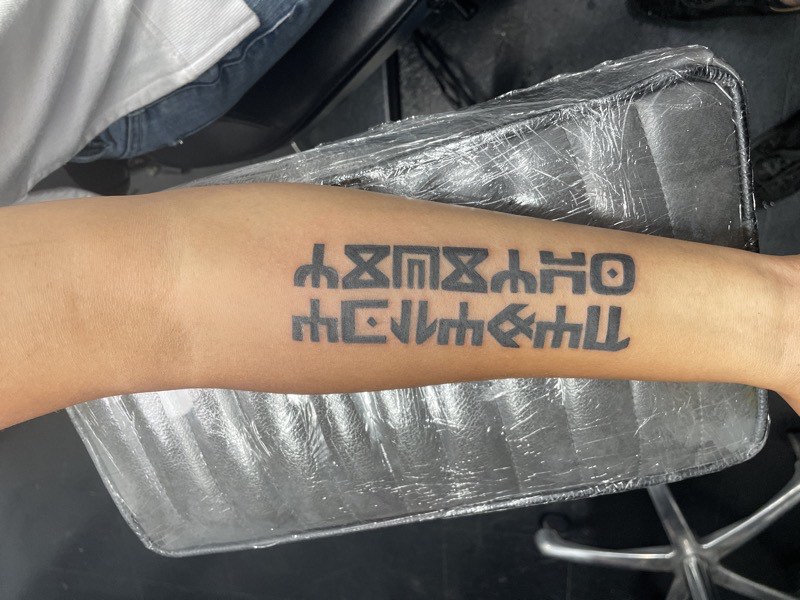
Precision over time
Precision, measured in decades.
Precision craft ages like architecture — form holds even as details soften. Here's the year-by-year read.
Settling, not fading
A healed sacred-geometry piece at one year reads with slightly softer edges than the day-three photo. Dotwork shading deepens as the skin regenerates. Line weight uniformity holds — the geometry stays legible.
The clean-geometry window
Most sacred-geometry pieces read crisp through this window with no intervention. Dotwork tends to hold better than linework because the gaps between dots absorb skin movement. Fine lines at consistent weight age gracefully.
When precision needs restoring
Outer linework — the anchor lines of a mandala, the boundary of a Flower of Life — may ask for a refresh. Interior dotwork shading typically holds. Compound pieces with many layers often need staged touch-ups over a few sessions rather than a single pass.
Graceful softening
Sacred geometry ages more like architecture than like realism — the form remains recognizable even as the details soften. Pieces at larger scale hold better than small ones because the geometric logic carries through softened lines.
The honest long read
Well-executed sacred-geometry pieces at 20 years still read as what they are — mandala, Flower of Life, Sri Yantra. Specialist execution on correct placement is what makes the difference between “still a sacred-geometry piece” and “used to be a sacred-geometry piece.”
Three variables dominate sacred-geometry longevity: line weight consistency at execution, placement stability, and UV exposure. The specialist choice is decisive — variation invisible in realism is fatal in geometric work. Pricing discussed at consultation; the craft costs hours, not inches.
Pattern sizing
Pattern → scale → placement.
Pattern-by-pattern sizing, at a glance.
Relatives and myths
Six pattern briefs we adjust.
Repeated patterns from first-time sacred-geometry clients. Not judgments — framing for the next conversation.
“I'll take a mandala from Instagram and scale it up.”
Stencil quality is a design decision. A printed-online mandala usually has line-weight artifacts that an experienced sacred-geometry artist will redraw from scratch. The stencil phase is where the piece is actually made.
“My artist can freehand the geometry.”
No legitimate sacred-geometry artist works freehand. Compasses, rulers, digital layout, and frequent re-measuring through the session are the craft. If the artist isn't using those tools, they're not in the tradition.
“Smaller just means the design reads subtle.”
Below the legibility floor, compound patterns don't read at all. A 3-inch Metatron's Cube is 13 circles pressed into an unreadable blob. Scale is not a preference in sacred geometry — it's a precision requirement.
“I don't need to know the meaning.”
Informed choice is the baseline of respect for patterns with living cultural traditions. You don't have to believe in the metaphysics, but you should know what the pattern carries before you wear it. A good artist walks you through the source.
“I want to mix Sri Yantra with Celtic knotwork.”
Cross-tradition stacking without a design logic produces a piece that belongs to neither tradition. Coherent compound work follows the geometry itself — Seed → Flower → Fruit → Metatron's Cube — not arbitrary pattern mixing.
“Color is optional for sacred geometry.”
Both black-and-grey and color work authentically in the tradition. Traditional Sri Yantra uses red, black, and gold; Tibetan mandalas use saturated primaries. The choice is aesthetic and cultural, not a shortcut.
A first pattern piece
Eight steps for a first sacred-geometry piece.
Apollo's path from pattern selection through the first session.
Pick a pattern that resonates
Start with what you're drawn to — visually, conceptually, or spiritually. Flower of Life for unity, Sri Yantra for focus, Metatron's Cube for structure, mandala for integration.
Learn what it means
Spend an evening reading the origins. You don't have to believe the metaphysics, but you should know the lineage of the pattern you'll wear for 40 years.
Find a specialist with compass work
Look at their portfolio specifically for healed mandalas or compound geometry. Zoom in. Are parallel lines parallel? Are petals evenly spaced? Does dotwork form clean gradients?
Plan scale honestly
Compound patterns need room. A full Sri Yantra below 12cm loses internal detail; a mandala below 8cm can't breathe. Trust the artist's scale recommendation.
Choose placement with flow in mind
Avoid high-flex regions. Sternum, forearm, upper back, outer thigh, shoulder blade all carry precision geometry without distorting it.
Expect multi-session work for compound pieces
A detailed Sri Yantra or compound mandala runs 6–15 hours. Most specialists split it across two sessions to protect accuracy on tired skin.
Accept the tool-heavy process
Expect stencils, rulers, compasses, frequent re-measures, and adjustments during the session. This is the craft — not a delay.
Plan additions logically
If additions are likely, map the full footprint at consultation so later layers fit the geometry instead of fighting it. Seed grows into Flower grows into Fruit grows into Metatron's Cube.
Your pattern
Three layers that make the piece yours.
Sacred geometry is closed in form but open in expression. Three layered choices turn a pattern into a specific piece.
Pattern choice tied to your framework
Sri Yantra for clients drawn to meditative focus; Tree of Life for those working with Kabbalistic or arboreal metaphors; mandala for clients seeking integration. The pattern picked deliberately carries more weight.
Shading style (linework only vs. dotwork gradients)
A pure linework Flower of Life reads as architecture; the same pattern with dotwork shading reads as meditative. Both are legitimate — the choice is where you want the piece to sit tonally.
Optional mantra or personal layer
A short mantra in fine script along the perimeter, a birth-date-aligned geometric accent, or Hebrew letters along the Tree of Life's sephirot. The layer that makes the piece specifically yours without breaking the geometry.
Briefs we adjust
Eight patterns clients ask for.
The repeated failure modes of first-time sacred-geometry commissions.
- —Choosing a generalist who “has done some mandalas” for a Sri Yantra
- —Picking a placement with high flex (elbow, wrist crease, ribs)
- —Going below the legibility floor for compound patterns
- —Freehanding the geometry rather than measuring
- —Wearing a pattern without knowing its origin tradition
- —Stacking unrelated sacred traditions in a single piece
- —Skipping the stencil-editing conversation
- —Forgetting that sacred geometry is compass-drawn, not drawn from vibes
Pattern questions
Eight questions about pattern and fit.
Questions that separate sacred-geometry specialists from generalists who occasionally take on geometric work.
- Do you have mandala work that is five years old or more?
- What tools do you use for layout — compasses, digital, ruler work?
- At this scale and placement, what accuracy guarantee can you give me?
- Which sacred pattern would you talk me out of at this size? Why?
- Can you explain the origin of the pattern I'm considering?
- How do you handle symmetry on a region of the body that isn't symmetrical (e.g. shoulder vs. sternum)?
- What's your touch-up window for outer linework?
- Do you adjust patterns for body flow, or keep them strictly grid-aligned?
A specialist names tools, layout methods and tradition origins without being prompted. Vague answers are a signal. Ask for the hourly and the estimate in the same conversation.
FAQ
Symmetry and meaning: your questions.
Eight questions about symmetry, meaning, and drawing a flat grid onto a body that curves.
Do I need to believe in the spiritual meaning?
No. Many clients are drawn to these patterns for their mathematical elegance, visual symmetry, or aesthetic weight alone. The geometry itself remains beautiful regardless of belief. That said, we encourage clients to learn what a pattern has represented historically — understanding the weight of a symbol tends to deepen the connection to the finished piece, even for secular wearers.
Is sacred geometry the same as geometric tattooing?
Related but distinct. Geometric tattoos use shapes, lines, and symmetry for purely visual reasons. Sacred geometry specifically references patterns that carry cultural, philosophical, or spiritual history — Metatron's Cube, the Flower of Life, Sri Yantra, the Vesica Piscis. Every sacred-geometry piece is geometric; not every geometric tattoo qualifies as sacred geometry.
Which sacred-geometry pattern should I choose?
Start with what resonates — visually and conceptually. Flower of Life suits clients wanting a balanced, unified statement. Sri Yantra fits those drawn to focus and manifestation. Metatron's Cube appeals to structural thinkers. Mandalas offer the most customization. During consultation, we talk through meaning, placement, and size to narrow the field down to one pattern that fits you.
Can I combine multiple sacred-geometry patterns?
Yes, when it's done thoughtfully. The Seed of Life nests inside the Flower of Life, which nests inside the Fruit of Life — these layer naturally. Mandalas can incorporate the Vesica Piscis or Metatron's Cube as interior elements. What we avoid is stacking unrelated traditions randomly. The strongest compound pieces follow a logic the patterns themselves suggest.
Is it appropriation to get these if I'm not from the origin tradition?
Wearing these patterns is not off-limits — they have traveled widely and been shared widely — but clients should know what they are carrying and where it came from. We walk you through the source of any motif. If a pattern has specific ritual use we'll say so. Informed choice is the baseline of respect.
How long does a sacred-geometry piece take?
Small single-pattern work (palm-sized Seed of Life, simple mandala) runs 3–4 hours. Forearm or chest-scale mandalas land between 6 and 10 hours, often split across two sessions. Large back pieces or sleeves with layered geometry can require 15–30 hours total. Precision work is slow, and rushing compass lines shows immediately.
Can sacred-geometry tattoos be in color?
Absolutely. Dotwork shading, watercolor washes behind line structures, and bold color fills inside mandala petals all work beautifully. Traditional Sri Yantra uses red, black, and gold. Tibetan mandalas lean on saturated primary hues. We'll discuss whether color strengthens your concept or whether crisp blackwork serves it better.
Will the tattoo still look right if the geometry is slightly off?
The honest answer: no. Sacred geometry lives or dies on precision. A mandala with uneven petal spacing reads as broken rather than meditative. This is why we only assign these pieces to artists with demonstrated compass work and mathematical accuracy. We use stencils, digital layout, and ruler work at every stage — nothing freehanded that should be measured.
Getting the pattern right
Start with pattern, scale, and placement — we'll build the piece around precision.
Sacred geometry is a specialist's craft. Bring two or three reference images, the pattern you're drawn to, and the placement you're considering. Then we resolve the symmetry against your actual anatomy, which is the part no stencil solves on its own. We price by hours, and you hear the number at consultation.