Kids & Family Piercing
Both Ears At Once Or One At A Time
The both-at-once vs one-at-a-time decision for a child's first lobe piercings — how Apollo runs each version, when we su
Book a consultationThe decision, plainly
Two good answers. One belongs to this child.
The both-at-once vs one-at-a-time question is one of the most common ones kids-piercing families arrive with. Neither is universally better. Both are standard. Both are offered at Apollo. The work of the consultation is to match the plan to the specific child — their age, their temperament, their sensory profile, their history, what they already believe the piercing is going to feel like.
The decision belongs to the family. We offer both, describe both honestly, and run the plan the child actually agreed to in consultation. We will gently push back if a chosen plan does not fit the child in front of us — but we do not override the family, and we do not bait-and-switch in the chair.
The case for both at once
One summoned moment. Symmetry from day one.
The most common choice, the cultural default in many traditions, and the easier finish line for many young children. Four honest reasons families choose it.
Tradition
The overwhelming majority of first lobe appointments are done simultaneously. It is the default in Western studios and in many cultural traditions, particularly for infants and toddlers. The child walks in with one set of ears and walks out with another — one story, not two.
Symmetry from day one
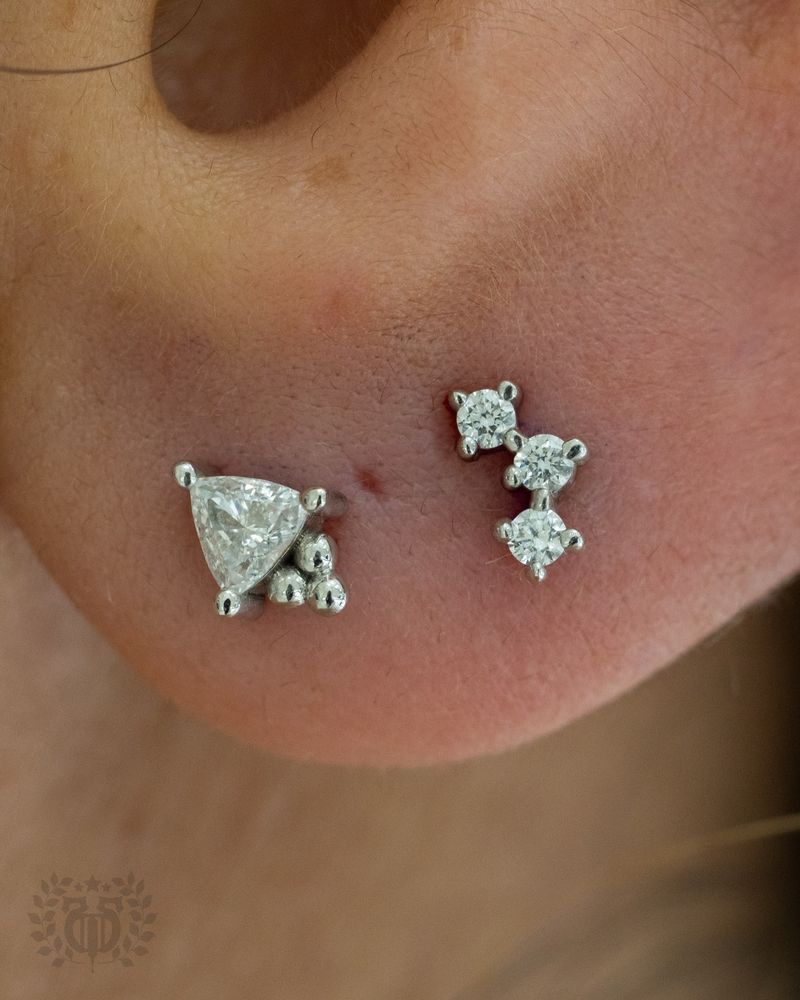
Both ears heal on the same calendar. Jewelry can be rotated, downsized, and styled in matching pairs from the start. For a child who is symmetry-motivated, the finished look lands immediately and there is no in-between week of one earring.
One brave moment
Many families describe the appointment as a single summoned act of courage. Splitting it into two means summoning that courage twice. For some children, the second appointment is harder than the first because the surprise is gone and the anticipation sits on top of memory.
Quicker emotional recovery
Pediatric procedural-prep literature broadly supports the idea that paired, brief, predictable stimuli can be easier to process than two separated ones for young children. Both-at-once often means one short cry, one hug, one cookie, one car ride home — not two.
The case for one at a time
Informed second yes. Paced stimulus.
For the right child, splitting the appointment into two yeses — with real data between them — is the kinder version. Four reasons families and piercers choose it.
Informed second decision
After the first side, the child has real data — a memory of the actual sensation rather than the imagined one. The second ear becomes a choice made with lived information. For an older child, that matters.
Less trauma if they hate it
If the first side is harder than expected, the child has not been committed to a second. Stopping at one is not a failure. A single healed lobe is also a piercing, and the second can happen in a month, a year, or never.
Restored sense of agency
Some children — particularly older ones, anxious ones, or children with histories of medical procedures — benefit from being the one who says yes to each side. The ability to pause is part of the ability to consent.
Paced dosing of stimulus
For a sensory-sensitive child, one discrete event can be easier to regulate around than two simultaneous ones. Splitting lets the nervous system settle before the second ask.
The decision belongs to the family. We offer both, describe both, and run the plan the child actually agreed to.
If the child wants to stop after the first side, we stop. One ear is a piercing. The second is not owed.
Symmetry is a preference, not a rule. A single pierced lobe ages into a style, not a mistake.
How we run both-at-once
Two piercers. Two trays. One shared count.
The staging that makes the simultaneous version safe and predictable. Nothing about the procedure is rushed — the coordination is where the speed lives.
Consult
Consent and check-in
Caregiver signs. Child is asked, in their own words, whether they understand that both ears will be done at the same time. If the answer is not a clean yes, we stop and talk through it — the appointment does not start until the child is in.
Marking
Placement review
Both ears are marked. The child sees both dots in the mirror. Both marks get the child's yes before anything else happens. If one side looks wrong to them, we re-mark. No piercing begins until both sides are accepted.
Setup
Two piercers, two trays
Two professional piercers set up side-by-side. Two sets of sterile gloves, two sealed needles, two sealed implant-grade pieces of jewelry opened in front of the family. Each piercer is responsible for one ear and does not cross.
The count
One shared count
One piercer leads the count — usually a slow three — while both needles are positioned and ready. Both piercings happen on the same exhale. From the child's perspective, it is one event, not two.
Aftercare
Debrief together
Both earrings seated, sterile saline, mirror, a beat for the child to see both earrings at once. Aftercare sheet reviewed with caregiver. Downsize appointment booked before they leave.
How we run one-at-a-time
Same-day split, or a second visit. Either is fine.
Two pacing options inside the split plan. The aftercare, protocol, and downsize booking are identical to the both-at-once version.
Consult
Plan the pacing
We discuss pacing at the start — same day with a rest between, or two separate visits. The child is part of this conversation. Some children pick a plan in consult; some want to decide in the moment.
First side
One ear pierced
The chosen side — often the one the child points to — is marked, approved, and pierced. Saline, mirror, breath. The child has the first real data point.
Reset
A real pause
Water, snack, a short walk, or a full appointment on another day. This is not a stalling tactic. The reset is the point. The child is asked, plainly, whether they want the second side now, later, or not at all.
Second side
Informed second yes
If the answer is yes, the second ear is marked, confirmed in the mirror against the first, and pierced. Same saline, same protocol, same breath. The second piercing usually styles as easier because the unknown is gone.
Aftercare
Same finish line
Whether the gap is thirty minutes or thirty days, the aftercare review, the downsize booking, and the follow-up are identical to the both-at-once version.
Age as an input, not a rule
Different ages land differently on the same question.
Attention windows, language skills, and the capacity for an informed second decision all shift with age. None of this is deterministic. It is a starting point, not a verdict.
Temperament and history
The child's wiring often picks the pacing for us.
Age is one input. Temperament, sensory profile, and medical history are equally real inputs — sometimes the decisive ones.
Risk-tolerant child
Curious, front-of-the-rollercoaster, asks for the scary thing first. Often thrives on both-at-once — they would rather do the event than anticipate it.
Risk-averse child
Reads the menu first, wants the plan, prefers small steps over one big one. Often does better with one-at-a-time, not because the piercing is worse but because the pacing fits the child.
High-anxiety child
Pre-visit nerves are loud. One side gives them real information to replace the imagined version. Often the anxiety drops sharply after the first ear, and the second lands easier.
Sensory-sensitive child
Two simultaneous stimuli can overwhelm a sensory profile that processes one input at a time. Splitting is often kinder to the nervous system. We defer to the child's caregiver and care team on what fits.
History of medical procedures
A child with memories of shots, blood draws, or other medical events may need more agency than a first-time kid. One-at-a-time returns the pacing to them.
Symmetry-motivated child
Cares that it matches, cares that it matches now, plans to wear two earrings out of the studio. Often both-at-once lands the finished look they came for.
If the child taps out after the first
We stop. No shame. We re-book the second.
The plan agreed in consultation is the plan we run — and the yes the child gave before the first side is not a contract for the second. Consent is live.
We stop immediately
If the child wants to stop after the first side, we stop. There is no coaxing, no deal-making, and no adult voice talking them back into the chair.
No shame, no framing
We do not treat a stop as a failure. One ear pierced is a piercing. The child was brave enough to do one. That is not less.
Seat the first earring properly
The first side receives the same aftercare review, saline, mirror, and downsize booking as any other piercing. It is not a half-job because it is half the plan.
We re-book the second
If the child wants the second side later, we hold space. It can be the next week, the next month, or the next year. The second visit runs the same consent process from scratch.
We follow up with the caregiver
A quick check-in the next day — how the first side is settling, how the child is feeling about the decision, whether they want to talk about the second.
No pressure on the rebook
The second ear is optional forever. Many clients eventually do it. Some never do. Neither outcome is the wrong one.
One ear is a piercing. The first side gets the same aftercare review, saline, mirror, and downsize booking as any other piercing. The second ear is optional — today, next month, next year, or never.
Unfinished as style, not mistake
A single pierced lobe ages into a choice.
The honest answer to "but won't one ear look weird?" Most of the adult piercing world is asymmetric already.
Single lobe as a finished look
A single pierced lobe is a real placement. Worn with intention, it does not read as half-finished. The client wears the jewelry; the jewelry does not wear the client.
Asymmetric stacks are common
Many adults wear 3 lobes on one ear and 1 on the other, or a helix on the right and nothing on the left. Matching is a preference, not a rule.
It ages into a style
If the second ear is never done, the single lobe does not stay as a memory of the appointment that stopped. Over months, it becomes the earring the child wears. Style, not a mistake.
The second is always open
The first side does not lock the second out. If the child chooses symmetry a year later, the piercer re-marks the second ear against the healed first side. The timeline does not compound.
When we suggest which
Signals we use to gently nudge a plan.
We do not override the family. These are the signals that make us mention one path over the other in consultation. The final call is always the family's.
When we suggest both-at-once
- Strong pre-visit enthusiasm — the child has been asking about it for weeks or months
- Symmetry-motivated child — explicitly wants them to match, now
- Family-celebration context — birthday, milestone, a planned event
- Short attention and regulation window — splitting would land the second side after fatigue sets in
- The child prefers one summoned act of courage to two
- Caregiver and child are aligned on the both-at-once plan going in
When we suggest one-at-a-time
- High anxiety that imagined piercings much worse than the event will actually be
- Sensory sensitivity — two simultaneous stimuli are harder than one at a time
- History of medical trauma — pacing and agency matter more than efficiency
- Child explicitly asks for the choice between sides
- Older child / teen who wants the informed second decision
- Uneven certainty — child wants it, but is not sure, and needs a checkpoint
How we hold the decision
We carry the procedure. We don't carry the verdict.
Six ground rules Apollo piercers use so the decision lands with the family, not the studio — and so the plan stays intact from consult to chair.
- ·We do not pressure either way. We offer both, describe both, and let the family pick.
- ·We will gently push back if the plan does not fit the child in front of us — but the decision is the family's.
- ·We never bait-and-switch in the chair. The plan agreed in consultation is the plan we run.
- ·If the child's yes becomes a no mid-appointment, that is still consent doing its job.
- ·A split appointment is not a premium service. It is the same work, paced differently.
- ·We do not use dollar amounts to push a family one way or the other. The decision is about the child, not the invoice.
The mall-kiosk twenty-second question
Parents aren't wrong to ask. They're asking in the wrong room.
The honest version of a question we hear in almost every kids-piercing consult — answered without defensiveness.
- ·Mall kiosks typically use spring-loaded piercing guns, which are blunt-force instruments not needle-sharp ones — the professional piercing industry and most pediatric-care voices have advised against them for decades.
- ·"Both at once in 20 seconds" is usually one gun on each ear, fired simultaneously by two operators — similar in staging to our simultaneous appointment, but using equipment a needle piercer would not use on a child.
- ·The speed is not the win. The procedure, the jewelry, the sterility, and the aftercare are the win.
- ·A both-at-once needle piercing with two professional piercers is a different event than a both-at-once gun piercing at a mall. Same outcome visually, different procedure entirely.
- ·Parents coming in with the 20-second mall framing are not wrong to ask — they are asking the right question in the wrong room.
Two professional piercers, two sterile trays, one shared count. From the child's perspective, it is one event — not two.
The pacing should fit the child. The child does not fit the pacing.
The speed of a mall kiosk is not the win. The needle, the jewelry, the sterility, and the aftercare are the win.
FAQ
Eight questions families bring to this decision.
Short versions. The deeper versions sit in the pillar sections above.
Is it better to pierce both ears at once or one at a time?
Neither is universally better. Both-at-once is the most common choice — one summoned act of courage, symmetry from day one, a quicker overall emotional recovery for many young children. One-at-a-time respects the child's ability to consent after real information, reduces the risk if they hate it, and paces stimulus for sensory-sensitive kids. Apollo offers both. The family and the child decide after consultation. Our job is to describe both honestly, match the plan to the child in front of us, and run whatever was agreed in consult without bait-and-switch in the chair.
How does Apollo pierce both ears at the same time?
Two professional piercers set up side-by-side with separate sterile trays, separate sealed needles, and separate sealed implant-grade pieces of jewelry opened in front of the family. Both ears are marked and the child approves both in a mirror before anything starts. One piercer leads a shared count — usually a slow three — while both needles are positioned on the exhale. Both piercings happen on the same breath. Aftercare, saline, and the downsize booking run the same as any lobe piercing, just for two earrings instead of one.
How does Apollo do a split double piercing?
Two versions. Same-day split: the first side is pierced, the child gets water, a snack, a short walk, or roughly thirty minutes of rest, then the second side is pierced if the child still wants it. Separate-visit split: the second side is booked as its own appointment — can be the next week, the next month, or longer. Either way, the aftercare, saline protocol, and downsize follow-up are identical to a both-at-once appointment. The second visit runs the full consent process from scratch; it is not a shortened version because the first side is already done.
What if my child wants to stop after the first ear?
We stop. There is no coaxing, no deal-making, and no adult voice talking them back into the chair. The first side receives the same aftercare review, saline, mirror, and downsize booking as any other piercing — it is not a half-job because it is half the plan. We re-book the second ear whenever the family wants, or not at all. A single pierced lobe is a real placement. Worn with intention, it reads as a style, not as the appointment that stopped. Many clients eventually come back for the second; some do not. Both outcomes are fine.
Does my child's age change which option is better?
It is a real input, not a rule. Younger children (3–6) often do better with both-at-once because their attention and regulation windows are short — splitting often lands the second side after fatigue or hunger sets in. Middle-age children (7–9) can meaningfully choose, and we usually let them pick the plan in consultation. Older children (10–12) more often prefer the informed second decision — they want to feel the first side before committing to the second. Teens decide for themselves. Age is an input; temperament, sensory profile, and medical history matter just as much.
We were told at a mall kiosk they can do both in 20 seconds — why wouldn't we do that?
Mall kiosks typically use spring-loaded piercing guns — blunt-force instruments that push a stud through the ear without the cleanly sharpened bevel of a piercing needle. The professional piercing industry and most pediatric-care voices have advised against them for decades. "Both at once in 20 seconds" is usually one gun on each ear, fired simultaneously — similar in staging to a two-piercer needle appointment, but using equipment and jewelry we would not use on a child. The speed is not the win. The procedure, the sterile single-use needle, the implant-grade jewelry, the saline aftercare, and the downsize follow-up are the win. Parents asking about the 20-second framing are not wrong to ask — they are asking the right question in the wrong room.
When do you suggest one-at-a-time specifically?
Specific indicators: high anxiety where the imagined piercing is much worse than the event will actually be, sensory sensitivity where two simultaneous stimuli are harder than one at a time, history of medical procedures where pacing and agency matter more than efficiency, a child who explicitly asks for the choice between sides, and older children or teens who want the informed second decision. When we suggest both-at-once: strong pre-visit enthusiasm, symmetry-motivated child, family-celebration context, short attention window where splitting would land the second side after fatigue. We describe both honestly and let the family decide.
Will one lobe look weird if we never do the second?
No. A single pierced lobe is a real placement and ages into a style, not a mistake. Many adults wear asymmetric lobes, a helix on one side and nothing on the other, or three stacks on one ear and one on the other. Matching is a preference, not a rule. If the child wears the earring with intention, it reads as their choice — not as the appointment that stopped. The second ear is always an option later; the first side does not lock the second out, and the timeline does not compound when the second piercing eventually happens.
When you're ready, we offer both.
Book the consult first. The plan is picked there, not in the chair.
Apollo kids-piercing consultations are where the both-at-once vs one-at-a-time decision actually gets made — with the child in the room, described in language they can hold, and held to without bait-and-switch on the appointment day. Two professional piercers, implant-grade jewelry, sterile saline aftercare, and a downsize booking before you leave — whichever pacing you choose.