Tattoo Styles
Japanese
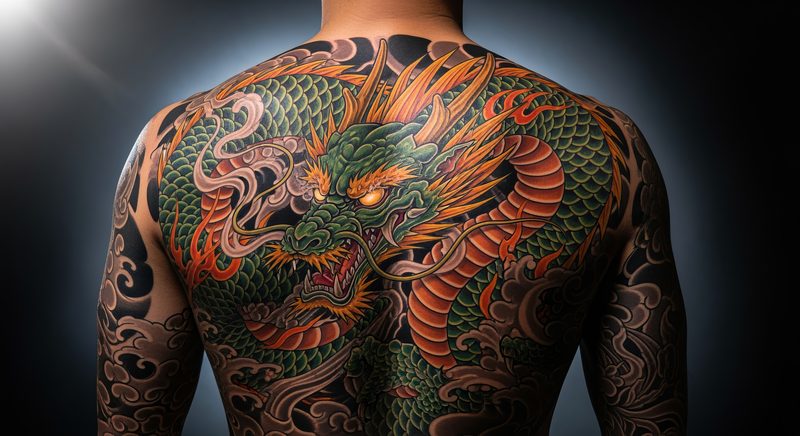
A dragon on a forearm is not a tattoo of a dragon. It is one fragment of a body plan that already assumes wind bars, water and a background it may not receive for a decade — and that assumption is what makes irezumi different from everything else here.
Book a consultationThe grammar
What irezumi actually is.
Japanese traditional tattooing is defined by grammar as much as by technique. Subject, pairing, scale, and background all follow rules that the tradition codified across centuries.
Irezumi (literally “inserting ink”) names the broader Japanese tradition; horimono (“carved thing”) names the full-body composition most people picture — back piece, chest panels, both sleeves, thighs, connected across a single plan. The roots sit in the Edo period (1603–1868), when ukiyo-e woodblock print artists — most famously Utagawa Kuniyoshi — illustrated the Suikoden legend in tattooed form on the heroes' bodies. Firefighters, laborers, and courtesans wore the earliest pieces; the yakuza association came later.
Tebori is the hand-poke technique specific to the tradition: a hafted bundle of needles, tapped into skin by a practitioner's wrist action. The sound is metallic and steady — no motor, no buzz. Tebori still exists under recognized masters (Horiyoshi III, Horitoshi, Horimatsu, their certified disciples internationally). Machine work in the same grammar dominates the modern commercial branch of the style and has been produced by practitioners in the tradition for over half a century.
The grammar is what separates Japanese work that reads correctly from Japanese work that just looks busy. Subjects pair with specific backgrounds: dragons with clouds and wind bars, koi with water and maple leaves (autumn) or cherry blossoms (spring), peonies with foo dogs, hannya with spider lilies or maple leaves. Around 40% of a finished piece is background — the wind bars, finger waves (nami), cloud banks, and filler florals that unify the subject into the body flow. Strip the background out and the subject reads as a sticker.
One note that comes up at every consultation: machine Japanese is not “inauthentic” by default. Horiyoshi III himself uses electric machines alongside tebori. Authenticity lives in lineage, grammar, and composition — not the tool. What Apollo offers is machine-executed Japanese-style work that respects the grammar; tebori under a master is a separate path we will help clients find when it's the right call.

Lineage
Where irezumi came from.
The modern version of this tradition traces through specific shops, specific families, specific decades. The names matter.
1603 – 1868 · Edo period
Ukiyo-e origins
Tattooing in the modern grammatical sense emerges alongside the woodblock-print tradition. Utagawa Kuniyoshi illustrates the Suikoden heroes with full-body tattooing (c. 1827), seeding the iconography — dragons, tigers, warriors — that will become horimono's vocabulary. Firefighters, laborers, and courtesans are the earliest wearers; practitioners work in tebori with brass and bone tools.
1868 – 1948 · Suppression
Meiji era & the underground
The Meiji government bans tattooing in 1872, driving the tradition underground even as foreign visitors — British sailors and royalty among them — commission work from masters in Tokyo and Yokohama. The ban codifies a complicated public perception inside Japan that persists into the modern era, while the international collector base that keeps the tradition alive begins forming.
1948 – present · Modern masters
The Horiyoshi lineage
Tattooing is re-legalized post-war. Horiyoshi III (Yoshihito Nakano) opens his Yokohama studio in the 1970s and becomes the tradition's most internationally recognized master. His disciples — who carry the Hori prefix — now practice across Japan, the US, Europe, and Australia. The Horitoshi and Horimatsu lineages run parallel.
1990s – present · Western branch
Machine Japanese abroad
Artists including Chris Garver, Filip Leu, Chris O'Donnell, and Shige (Yellow Blaze, Yokohama) build the international machine-Japanese canon. Their work respects the grammar — pairings, scale, flow — while operating in electric rotary. Modern Japanese work at Apollo and peer studios descends from this branch: cousin of tebori irezumi, not a replacement for it.
The international collector base is a major reason the tradition survived periods of suppression at home. Contemporary Japanese work in studios from Yokohama to Brooklyn to Los Angeles all traces back to the Edo woodblock grammar, passed through the Horiyoshi and Horitoshi lineages, and rebuilt in the machine era. Apollo sits in that extended family: honoring the grammar, deferring to lineage holders where the work asks for it.
Subjects & pairings
Eight subjects irezumi was built for.
The core subjects of the tradition, with the specific backgrounds and pairings that make each one read correctly.
Dragon (ryu) with clouds
The central subject of irezumi. The dragon coils through clouds and wind bars, descending or ascending the body with the mane and claws carrying the heaviest line weight. Traditional pairings: water below, cloud above, a jewel (tama) in the forefoot. Never rendered with European-dragon wings and never standing alone — the weather around the dragon is as much the subject as the figure itself.

Koi with water & maple
The perseverance fish, swimming upstream against a waterfall toward the Dragon Gate. Seasonal pairings carry meaning: maple leaves (momiji) for autumn koi, cherry blossoms for spring, chrysanthemums for longevity. Upstream koi read as endurance; downstream koi read as acceptance. The direction matters. Never paired with wind bars alone — koi live in water.

Phoenix (ho-o) & peonies
The mythic bird of rebirth and imperial authority. Tail feathers unfurl across the shoulders or back; the body rises through peonies and paulownia. Color reads bright by tradition — reds, oranges, golds — laid against black cloud banks. Rendered black-and-grey it sacrifices part of its visual grammar but ages beautifully; the decision is a consultation, not a default.
Hannya & spider lily
The jealous female demon mask from Noh theatre. Horns, gold eyes, curled mouth. Traditional pairings: spider lilies (higanbana), maple leaves, or a coiled snake. Reads as a study in possessive love, not a generic villain. The best hannya are rendered with the Noh mask's specific proportions — narrow chin, high cheekbones — not as a generic oni.
Tiger with bamboo (tora)
The tiger is always in motion — crouched to pounce, mid-leap, or snarling through a bamboo grove. Stripes run against the body's curves for visual tension. Bamboo leaves and wind bars complete the field. Tigers carry protective and courageous symbolism; pair them with dragons on the same body (tiger on one side, dragon on the other) for the classic yin-yang arrangement.

Foo dog (karajishi) & peony
The Chinese-origin guardian lion with curled mane and bared teeth. One paw on a brocade ball; peony petals (botan) around the feet. Chest or back panel, frequently mirrored across the munewari — male on one pectoral, female on the other. A compact subject for clients who want irezumi grammar without committing to a dragon-scale piece.

Snake (hebi) with chrysanthemum
The serpent coils through chrysanthemum blooms, symbol of longevity and imperial court. The winding body wraps a sleeve or thigh; the flower heads mark rhythm along the coil. Reads as transformation and protection. One of the subjects where machine work and tebori produce comparably beautiful results because the long scales carry saturation either way.
Cherry blossom (sakura) fillers
Not a standalone subject but the connective tissue of countless compositions. Petals drift through wind bars, cluster on branches, or fall across water — the universal sign of mono no aware, the bittersweet awareness of transience. Sakura can be rendered in soft pink, pale cream, or pure black; the latter reads as most archival on the 30-year timeline.
Where tradition says no
Where the tradition says no.
The requests where the grammar breaks — no matter the artist or the execution.
Cherry-picked Western anime references
Naruto, One Piece, and Studio Ghibli imagery render as Japanese-styled fan art, not irezumi. They lack the seasonal and iconographic grammar that makes traditional work cohere. If anime is the subject, neo-traditional or illustrative styles serve it better than a misapplied irezumi frame.
Micro-scale irezumi
The grammar requires room — wind bars, clouds, water, and subject must breathe across a panel. A 3-inch dragon on the forearm reads as a sticker, not a piece. The smallest viable single-subject irezumi panel is a half-sleeve; below that, the conventions break.
Mixed-tradition mash-ups
Dragon-plus-Celtic-knotwork or koi-plus-sacred-geometry fights itself. Irezumi is a closed grammar — backgrounds, pairings, and subjects were codified across centuries. Pulling a subject out and dropping it into another style's composition usually reads as incoherent on both sides.
Off-season subject pairings
Cherry blossoms with chrysanthemums. Autumn koi with spring maples. Any pairing that collapses the seasonal calendar reads as uninformed to anyone versed in the tradition. A good Japanese-style artist will gently re-pair your references rather than execute a mismatched request.
Fine-line irezumi
The style was built for bold outlines and saturated color fills. Hairline dragons are a different aesthetic choice entirely — not wrong, but not irezumi. Clients wanting the subject in a lighter style are better served by illustrative or neo-traditional interpretations framed as what they are.
Cover-ups into partial irezumi
Traditional Japanese backgrounds rely on continuous flow. A cover-up patch dropped into a background disrupts the wind-bar or water rhythm and tells on itself. Successful cover-ups either use a large Japanese subject to absorb the old piece or commit to rebuilding the surrounding field.
Region and size
The body as composition.
Irezumi is built for scale. The following rules are where clients usually land after a full consultation — not preferences, but the structural requirements of the grammar.
Panel sizes, by region
Below a half-sleeve, there isn't room for the subject plus the wind-bar / cloud / water field the grammar requires.
The classic full back. Dragon, phoenix, hannya, and Fudo Myoo are all scaled to this canvas by tradition.
The complete donburi — back, chest panels, both sleeves, and upper legs — with the munewari strip unbroken down the center chest and stomach.
Around 40% of a Japanese piece is background — wind bars, water, clouds. Cut the background and the subject lifts off the skin.
Placement styles that carry the work
- Full back. The primary canvas of irezumi. Dragons, phoenixes, Fudo Myoo — all built for this field.
- Full sleeve (shoulder to wrist). Koi, dragon-arm, tiger sleeves. Wraps the arm with the subject flowing along the muscle.
- Chest panel (munewari-ready). Foo dogs, peonies, hannya panels. Leave the central strip open if future body-suit is on the table.
- Outer thigh. Great for hannya, snake, or koi thigh panels — large continuous surface with minimal friction.
- Rib-to-hip panel. Connective tissue for body-suit work; koi and water read beautifully across the oblique.
- Upper arm cap (half-sleeve). The most accessible entry point for a single irezumi subject.
Regions that fight the flow
- Forearm-only with no upper sleeve planned. The subject gets stranded without a complete field around it.
- Inside of wrist. Too small for the grammar, too high-friction for saturated black.
- Fingers and hands (in isolation). Traditionally hands are the last to be tattooed in a body suit, not the first piece.
- Neck without shoulder work. Disconnects from the continuous flow the style depends on.
- Inner bicep alone. Works as part of a sleeve; does not hold as a solo panel.
- Tiny standalone florals. Sakura and peony scale to their host subject — rarely read correctly on their own.
Irezumi in the wild
Panels, and how they connect.

The long arc
How irezumi ages on real skin.
Japanese traditional work is the longest-arc style in tattooing. The arc, told decade by decade.
Settle, not fade
A healed Japanese piece at one year reads quieter than the fresh-ink photo, and that's correct. Saturated black fills deepen as the epidermis regenerates. Colors settle into their final style — reds calm, greens soften — over roughly 6–12 months. This is the medium setting into the skin, not aging.
The background conversation
If any section of the piece is going to need attention, it's the background. Wind bars and water outlines are the first places where a machine-laid Japanese piece might ask for a light touch-up. The main subject — dragon, koi, hannya — almost always holds beautifully through this window with no intervention.
The black-re-saturation window
Saturated black fields (cloud banks, shadow areas) can lift by a single shade over this span. A skilled Japanese-style artist will re-pack those specific fields in a single touch-up session rather than re-lining the outline work. This is where irezumi's tradition of a sustained relationship with one artist pays off — they know what they laid and what to refresh.
Reading as a traditional Japanese piece
By 15–20 years, a well-executed Japanese piece reads exactly as its century-old tebori ancestors do — subjects intact, backgrounds slightly softer, the whole composition breathing as a continuous whole. This is the payoff of the style's willingness to commit to scale and composition from the start.
The honest long read
Century-old tebori pieces survive in museum collections and family lineages. Modern machine-executed irezumi with correct dermal depth and saturation should follow the same arc. Counter-intuitively, a Japanese piece at 40 often reads as more authoritative than it did at 5 — the medium and the grammar are built for long time.
Three variables dominate how irezumi ages: saturation density (black backgrounds that are packed fully will hold longer than patchy fills), UV exposure (color ages faster than black; traditional pieces that live under clothing outperform equivalent pieces on exposed forearms), and the relationship with the artist (pieces that see the same hand for a year-10 re-pack hold indefinitely). We price irezumi by scope, hours and artist, and you get the number at consultation. What we commit to is the long arc.
Scoping table
Motif, region, and pacing.
The scoping table for a long-arc piece. Scope and pacing both get adjusted in the room, once the artist has seen the region.
Before the first sitting
Six things we straighten out early.
What people believe about irezumi before the first sitting. Aimed at what you book next.
“I want a small Japanese dragon on my forearm.”
The grammar doesn't support it. A dragon needs clouds, wind bars, and room to coil. A 4-inch dragon reads as a sticker. Commit to a half-sleeve minimum or pick a different style for the subject.
“I'll start with a forearm piece and extend later.”
Often workable — but only if the first piece is designed as the lower section of a future sleeve, with the background clearly pointing outward. Ask the artist to plan the full sleeve on paper before the first session.
“Black-and-grey will age better than color.”
Partially true, but the tradition uses color for a reason. Reds, oranges, and greens are part of the iconographic system. Removing color simplifies the aesthetic — it doesn't automatically improve longevity. Choose based on the subject, not a blanket rule.
“I can mix irezumi with sacred geometry / Celtic / realism.”
Irezumi is a closed grammar. Hybrid requests usually produce a piece that belongs to neither tradition. Better path: commit to one system on one body region and honor the other on a different placement.
“Machine irezumi is inauthentic.”
Machine Japanese work has been produced in the tradition for over half a century. Horiyoshi III himself used electric machines alongside tebori. Authenticity lives in lineage, grammar, and composition — not the tool. Tebori is a specific choice, not a requirement.
“I'll pick an artist known for fine-line and ask them to do Japanese.”
Irezumi is a specialist's craft with its own saturation, line weight, and composition logic. A fine-line artist branching into Japanese produces a fine-line-ified version, not irezumi. Book an artist whose portfolio is deep in the tradition.
First piece guide
Eight steps to a first irezumi panel.
The path Apollo walks clients through for a first piece in the tradition — whether it becomes a half-sleeve, a sleeve, or the first pass of a future back piece.
Study the grammar before you book
Spend a month looking at Horiyoshi III, Horitoshi, Shige, Chris Garver, Filip Leu, Chris O'Donnell. You don't need to become an expert — but knowing the difference between a dragon with clouds and a dragon with wind bars shortens every consultation.
Pick a body region, not a single piece
Decide whether you're starting a back piece, a sleeve, or a thigh — the regional commitment determines the rest. A full sleeve client talks to a different artist than a chest-panel client.
Find a Japanese-style specialist
Not a generalist who does 'some Japanese.' Their portfolio should be 70%+ irezumi or modern Japanese, with multi-year healed examples at the scale you're considering.
Request a paper plan
Before the first session, ask for a hand-drawn plan of the full region — even if you're only committing to the first pass. This single step prevents the most common long-term regret in the style.
Agree on pacing
A sleeve typically runs 4–8 sessions across a year. A back piece can run 8–20 sessions across 1–3 years. Agree on the cadence at consultation so the build doesn't fragment.
Commit to one artist
Japanese pieces lose visual coherence when multiple hands work the same region. The exceptions are rare and planned. Default assumption: one artist, one region.
Let the background happen last
The first session usually lays the main subject. Wind bars, water, and cloud banks get laid in later sessions — they connect the piece into a continuous field, and rushing them flattens the composition.
Plan your year-10 conversation
A piece built for long time deserves an artist you can call in year 10 for a background re-pack. Book the relationship, not just the session.
Your input
Three layers that make the piece yours.
Irezumi is a closed grammar, but not a closed identity. The piece becomes specifically yours through three layered choices.
Subject choice reflecting your story
The koi for perseverance, the dragon for wisdom, the hannya for a grief that transformed you. Clients who pick subjects that map to their lives end up with pieces that feel inevitable rather than stylistic.
Seasonal pairing choices
Which season's florals and weather you pair with your subject. A summer peony-with-foo-dog reads differently than an autumn momiji-with-koi. The seasonal layer is where the piece becomes specifically yours.
Background style (color vs. black-and-grey vs. selective color)
Full color, full black-and-grey, or the middle path where the subject holds color and the background stays black. Each reads as a different relationship to the tradition.
What we straighten out
The eight briefs we see most.
What keeps good irezumi ideas from becoming coherent pieces — not judgments, just the repeated failure modes.
- —Asking for a dragon without clouds, wind bars, or water — stripping the subject out of its grammar
- —Pairing cherry blossoms with chrysanthemums (spring with autumn) in a single piece
- —Booking sessions with different Japanese-style artists for the same body region
- —Picking a forearm-only footprint when the subject is built for a half-sleeve or sleeve
- —Requesting a Western-dragon winged version while labeling it irezumi
- —Pre-designing the whole piece in photo-manipulation software before consulting the artist
- —Skipping the munewari when the long-term vision might include a full suit
- —Treating the background as decorative filler rather than a structural composition element
Long-arc questions
Eight questions for a long commitment.
Questions that separate Japanese-style specialists from generalists who occasionally touch the tradition.
- How many full sleeves and back pieces in this tradition have you completed?
- What Japanese work of yours is five years old or more, and how has it settled?
- What subjects do you decline to tattoo, and why?
- How do you handle the munewari — do you leave it open even on clients not committing to a full suit?
- What's your pacing for a full back piece in sessions and months?
- Which modern masters — or lineages — do you study from?
- How do you pair subjects and fillers if the client's references mix seasons?
- What's your touch-up rhythm for background re-saturation?
An artist comfortable in the tradition can take all eight without hedging. A generalist will hedge on at least three of these. We give you the number once the scope is clear.
FAQ
Eight questions about a commitment measured in years.
What clients ask when the thing they are booking is measured in years rather than sittings.
What's the difference between irezumi and modern Japanese tattooing?
Irezumi refers to traditional Japanese tattooing with centuries of lineage, formal apprenticeship, and often hand-poked (tebori) technique. Modern Japanese uses the same visual grammar — dragons, koi, tigers, wind bars, finger waves — but applied with coil or rotary machines. Modern Japanese is widely available worldwide. True irezumi under a lineage master is rare and governed by strict tradition.
Can I get tebori at Apollo?
No. Tebori is a hand-poking technique using a hafted bundle of needles, taught only through formal apprenticeship under a recognized Japanese master. Apollo does not offer tebori. Our artists execute Japanese-style work with professional machines, respecting the traditional rules of composition, flow, and subject pairing without misrepresenting the lineage.
Should I go to Japan for authentic irezumi?
If your goal is a tebori bodysuit under a lineage master, yes — authenticity lives with the practitioner, not the city. Some certified disciples of Japanese masters now practice internationally, which is a more accessible path. Going to Japan requires multi-year waiting lists, cultural preparation, and often a formal written introduction from an existing client.
How long does a full body suit (horimono) take?
A full munewari suit typically takes 3–7 years of regular sessions under a single artist. Tebori sessions are shorter per hour but cover less ground than machine work. Machine-executed full suits can finish faster, but the standard expectation for traditional horimono is measured in years, not months. The commitment is part of what the tradition asks of its wearers.
What does the munewari opening mean?
Munewari is the unpainted strip running down the center of the chest and stomach in a traditional body suit, about a hand's width wide. It allows the wearer to leave the suit concealed beneath a partially open shirt or yukata. It's a structural rule of horimono composition, not a stylistic choice — and even clients starting with a single chest panel should consider leaving room for it.
Are there rules about what subjects I can get?
Yes. Traditional pairings govern the work — dragons with clouds, koi with water, peonies with lions, cherry blossoms with specific seasons, tigers against bamboo. Mixing subjects that clash seasonally or symbolically reads as uninformed to anyone versed in the tradition. A good Japanese-style artist will guide you away from incorrect combinations rather than execute them.
Can non-Japanese clients get irezumi?
Yes. Masters including Horiyoshi III have tattooed foreign clients for decades, and the international collector base is a major reason the tradition survived periods of suppression at home. Respect for the grammar matters more than ethnicity — understanding subject pairings, seasonal rules, and composition flow is what the tradition asks of its wearers.
Is there a dress code or social context in Japan for irezumi?
Yes. Many Japanese onsen, sento, public pools, and gyms still prohibit visible tattoos. Some tourist-friendly facilities have relaxed rules. Tattooed travelers should research specific venues, carry cover-up sleeves, and expect to be turned away from some establishments — pricing discussed at consultation if you'd like help identifying irezumi-welcoming facilities.
Starting a long arc
Start with subject, region, and pacing — and we'll match the right Japanese-style fit at Apollo.
Japanese traditional work is a long-arc commitment. Bring three or four reference images, the subject you're drawn to, and the region (sleeve, back, chest) you're thinking about. Then we map the region before the motif, because a sleeve that may become a bodysuit has to be drawn as one from the first sitting — and we will send you elsewhere where the work calls for a lineage holder.