Piercings
Daith Piercing
Where the daith sits, how much it hurts, healing time, jewelry, and an honest word on the migraine question — from the piercers at Apollo.
Book a piercingPlacement
Innermost cartilage fold, above the ear canal
Pain level
4–6 / 10
Healing
6–9 months
Jewelry
Hoop, clicker or heart ring
Min. age
14+
The basics
What is a daith piercing?
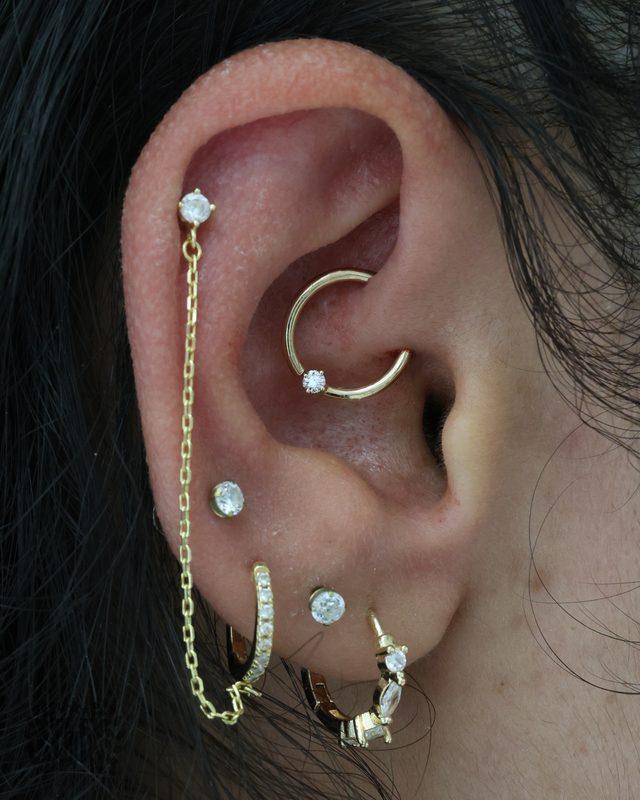
The daith is the small fold of cartilage that curves just above the opening of your ear canal (the crus of the helix). Its tucked-in placement is exactly why a hoop or clicker appears to wrap out of the center of the ear — and why the heart-shaped daith ring is so popular, since the curve forms a heart when seated correctly. It sits just below the rook and pairs well with a conch in a layered ear.
The basics
Anatomy & placement
The daith is deep and narrow, so it takes an experienced hand and the right tool to pierce cleanly. Your Fakir-certified piercer threads a receiving tube behind the fold and passes a single-use needle at the precise angle your anatomy allows, so the finished hoop follows the natural curve of the crus rather than fighting it. A well-placed daith looks effortless; a rushed one sits at an awkward angle and is harder to fit jewelry to later.
How it feels
Does a daith piercing hurt?
Because it's tucked deep in the ear, the daith sounds intimidating, but most clients rate it 4–6 out of 10 — a firm pinch that's over quickly. We pierce it with a single-use needle and receiving tube for a clean, accurate pass; we never use a gun, which cannot reach or safely pierce this fold. You'll feel a deep throb for the rest of the day and some tenderness when chewing for a day or two.
Healing
How long does it take to heal?
Plan for 6–9 months, sometimes up to a year. Like all cartilage, it heals from the outside in, so it needs to be left alone well past the point where it looks healed. A downsize visit keeps the jewelry seated as swelling resolves and stops an oversized starter hoop from moving around inside the fold.
An honest answer
Do daith piercings help migraines?
You may have read that a daith piercing relieves migraines. We want to be straight with you: there is no clinical evidence that it does, and we won't promise a medical benefit. The claim is based on anecdote, not controlled studies. If you'd like a daith for how it looks, we're glad to do it — but for migraine treatment, please talk to your doctor.
Jewelry
Jewelry for a daith piercing
We start a daith with a hoop, clicker, or heart-shaped ring in implant-grade titanium or solid 14k gold, sized to your anatomy. A correctly sized heart clicker can be the install jewelry, but it has to fit the fold precisely so the shape seats without pressing on fresh tissue. We fit every piece in-studio rather than guessing a diameter.
Hoop, clicker or heart: which daith jewelry?
A seamless or captive hoop is the simplest daith jewelry and the most forgiving to heal in, because there's no hinge and nothing to open. A clicker has a hinged segment that snaps shut, and it's what most people picture: a front-facing decorative face, gems or a cluster sitting in the fold. The heart-shaped daith ring is its own category. The heart only reads as a heart if the piercing was placed at the right angle and the ring is the right size for that particular fold, which is why we size it on the day rather than letting you bring one in. A heart ring that's too big tilts and points the wrong way; one that's too small pinches.
Daith jewelry sizing
Daith jewelry is usually 16g, and the measurement that matters is the inner diameter of the ring. The fold is deep and narrow, so a ring has to clear the crus without pressing on it, and that clearance changes once the swelling goes down. That's the daith version of a downsize: a starter ring that was correctly roomy at week one may be visibly loose at month three, and swapping it then keeps the ring from rocking in the channel. If you're shopping online for daith jewelry after you've healed, bring us the piece first. We'd rather check the diameter in thirty seconds than watch you heal around a ring that doesn't fit.
Materials for a daith
Implant-grade titanium or solid gold only, through the whole healing period. The daith is tucked in and doesn't get much air, so it's less tolerant of cheap metal than an exposed lobe. Hinged clickers are where cheap jewelry fails first: the hinge loosens, the segment won't stay shut, and a soft spring in the hinge can open overnight. If you've had reactions before, our sensitive-skin jewelry guide covers what to choose. Healed daiths can wear the gold rings and clickers in our cartilage earrings collection, fitted in-studio.
At Apollo
Bumps, migration & common problems
The daith's biggest advantage is that it's protected — tucked inside the ear, it gets knocked far less than an exposed helix. The most common issue is still an irritation bump from sleeping on that side, an oversized starter hoop, or fiddling with the jewelry; it's not an infection and clears once the pressure stops and you keep up with saline. Daith piercings rarely migrate because they pass through a substantial fold, but a hoop that's too tight can pinch and delay healing. Spreading redness, heat or pus is a sign of infection and means seeing a doctor.
Aftercare
Aftercare
Aftercare is sterile saline twice a day, no sleeping on that ear, and hands off the jewelry — full routine on our piercing aftercare guide. If you're weighing a daith against a rook or conch, our ear piercing chart shows how they layer together.
Our standards
Why get pierced at Apollo
Every piercing at our Santa Monica studio is done with a single-use sterile needle — never a piercing gun, which can't be sterilized and crushes cartilage. We install only implant-grade titanium (ASTM F-136), solid 14k/18k gold, or niobium, placed and checked by a Fakir-certified senior piercer. Your fresh jewelry is sized long for swelling, and a downsize follow-up is built into every piercing so it settles cleanly.
For what this runs, see our piercing prices guide — daith cost by jewelry grade, plus Apollo's published rates.
If you are weighing the daith against another placement, our adult ear piercing guide compares all of them side by side, including healing time and pain level.
Questions
Frequently asked questions
Do daith piercings actually help migraines?
There is no scientific evidence that a daith piercing treats migraines. We're happy to do the piercing for its appearance, but we won't promise a medical benefit — see your doctor for migraine care.
How badly does a daith piercing hurt?
Most people rate it 4–6 out of 10. It's tucked deep so it feels intimidating, but it's a quick, firm pinch rather than a lasting pain.
How long does a daith piercing take to heal?
Generally 6–9 months, sometimes up to a year. Don't change the jewelry until your piercer confirms it's healed at the follow-up.
Can I get a heart-shaped ring in my daith right away?
Yes — a correctly sized heart-shaped clicker or ring can be the install jewelry. We fit it to your anatomy so the heart shape seats properly without pressure on the piercing.
What size is daith jewelry?
Daith jewelry is usually 16g, and the inner diameter is fitted to your fold. A starter ring is often swapped for a snugger one once swelling settles, so the ring stops rocking in the channel.
Can I buy my own daith jewelry online?
Once you're healed, yes, but bring it in first. Diameters vary by a few millimeters between ears, and cheap clicker hinges loosen. We'd rather check fit and metal before it goes in.
Studio portfolio
Daith Piercings at Apollo
Real work from our piercing chairs — implant-grade titanium and gold, placed freehand by our Fakir-certified piercers.