Tattoo Ideas
Koi Fish
Swimming up means still climbing. Swimming down means you got there. Clients get that backwards more than any other convention we deal with, so this guide starts with the Dragon Gate story the whole motif rests on, then works through twelve directions, six styles, and the placements a curved body actually needs.
Book a consultationFive readings
Pick one before you pick a design.
A koi tattoo has five honest readings, and most clients arrive with two or three of them tangled together. The design gets built around one. Try to honor all five at once and you get a committee koi.
Perseverance / Dragon Gate
Longmen legend · canonical Western reading
Drawn from the Longmen legend: the koi swims upstream against the Yellow River current, leaps the Dragon Gate waterfall, and becomes a dragon. Perseverance as transformation — not grit for its own sake, but the specific reward of finishing the climb. Carries sobriety, long recoveries, immigration stories, terminal-degree finishes, anything that asked years.
Masculinity (Japanese tradition)
Tango no sekku · Boys’ Day lineage
In Japan, koi streamers (koinobori) fly on Children’s Day, historically Boys’ Day, as a wish for the strength the fish embodies — holding steady in moving water, climbing against force. A koi worn for this reading descends from that specific civic tradition. Sons wearing the piece for fathers, fathers for sons, or men marking their own version of that inheritance.
Family & generations
Multi-koi · contemporary composition
Two, three, four, or five koi in a single composition — one per family member, sometimes differentiated by variety (kohaku for one child, sanke for another). The reading is newer than the tradition and unapologetically Western. Works best on thigh, back panel, or shoulder-to-ribcage. Naming which koi is which at consultation is the whole point.
Yin-yang duality
Two koi · taijitu composition
The taijitu: two koi circling head-to-tail, one light, one dark, often kohaku-and-black. Reads as balance, partnership, the held tension between opposites rather than their resolution. A legitimate reading but frequently the algorithm default — verify the meaning before you commit to the shape.
Memorial
Named koi · growing subset
A single koi in the variety the person loved, or a koi joining the living koi already on skin. Name integrated into a wind bar or water splash, not captioned below. Ascending if the person finished their climb, descending if the piece marks their return. Wait six to twelve months after a loss. Grief keeps rewriting what the fish is for, and a koi commissioned in the fourth month is very often added to or covered before the second year.
A koi in Japanese-inspired hands is a decorative fusion piece. A koi in Japanese-tradition hands is irezumi. Name the difference honestly.
Direction is the first decision. A koi swimming up and a koi swimming down are two different tattoos that happen to share a body.
A koi ascending a waterfall reads across 14 inches of skin, not across 4. Plan the placement to the style, not the other way around.
Flash · ready to ink
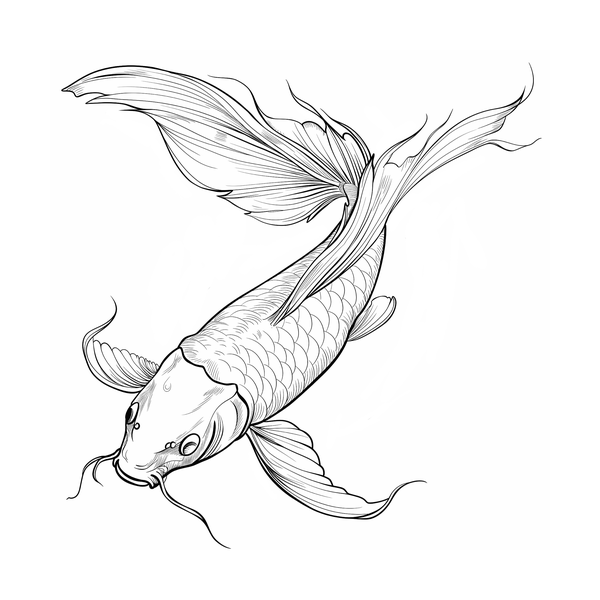
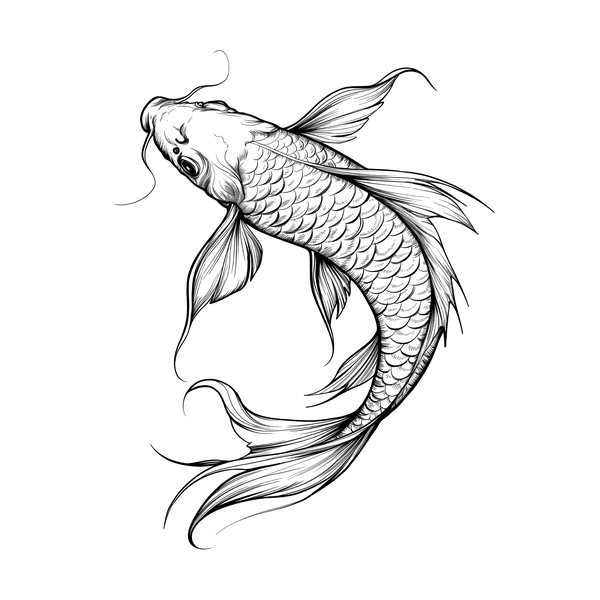
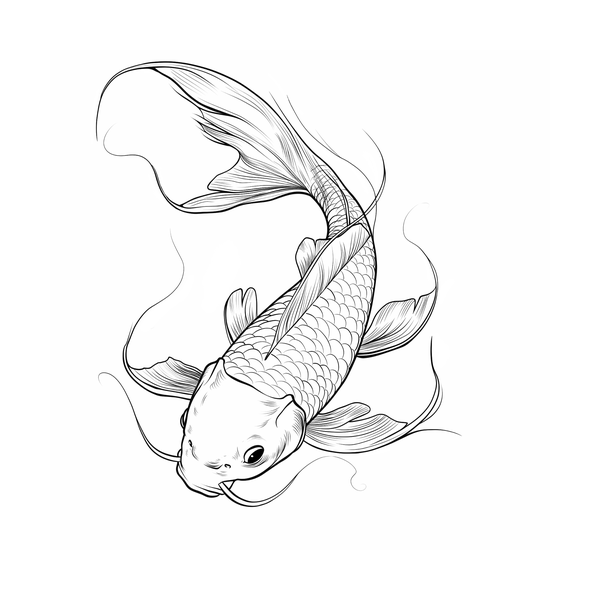
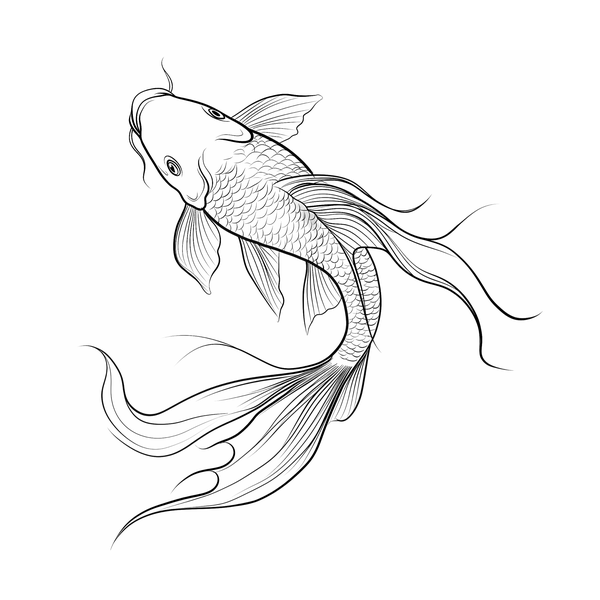
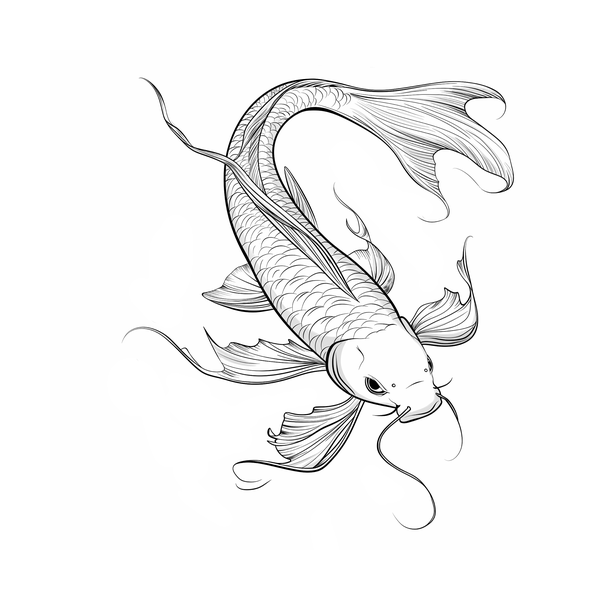
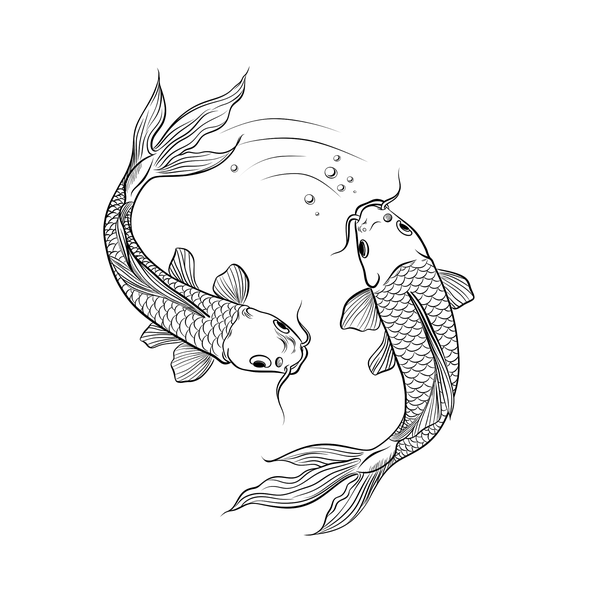
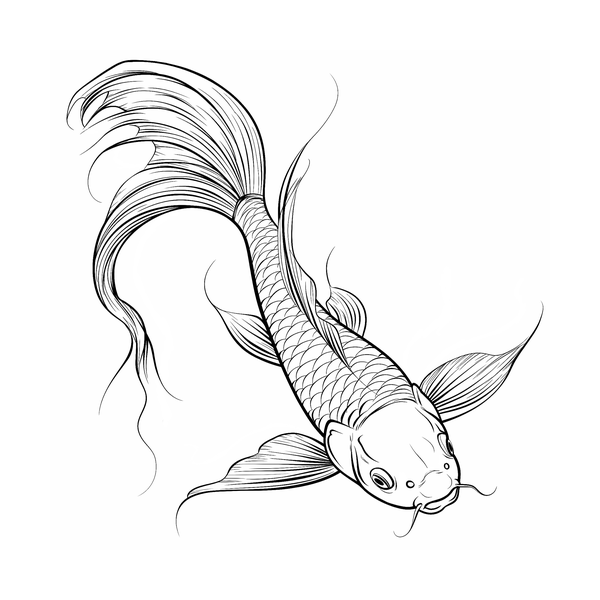
Koi fish flash designs
15 hand-drawn designs from our flash collection — book any one as-is, or use it as the starting point for a custom piece. Sizing, placement and linework dialed in at your consultation.
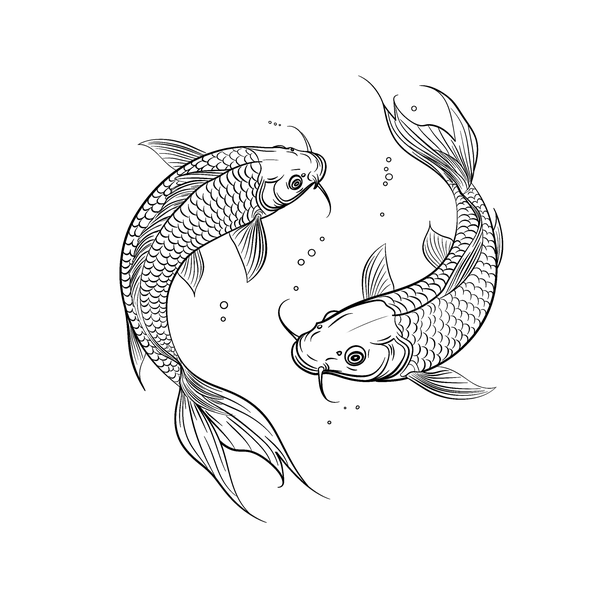
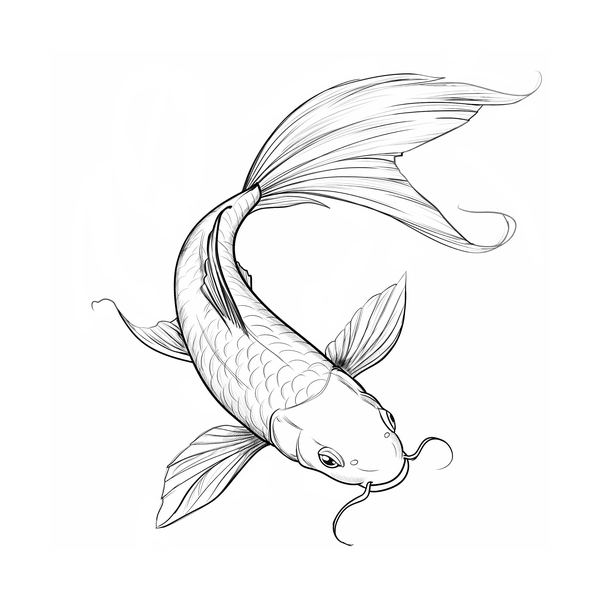
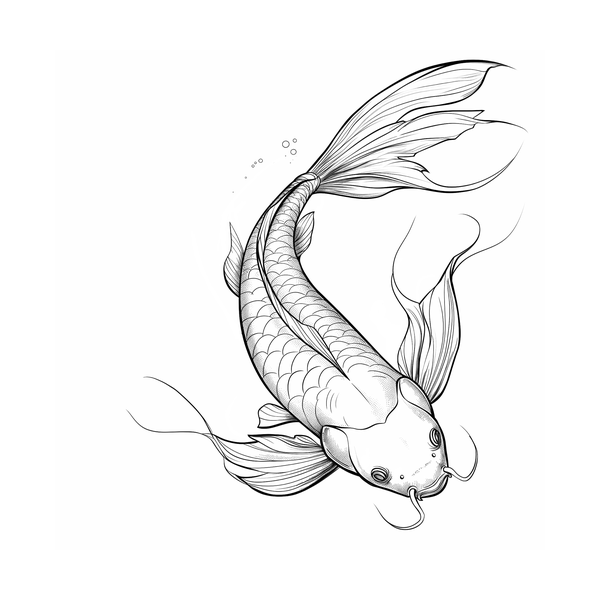
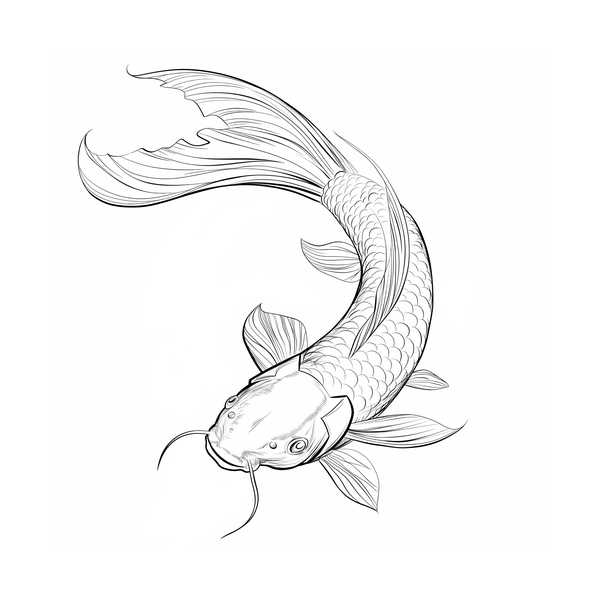
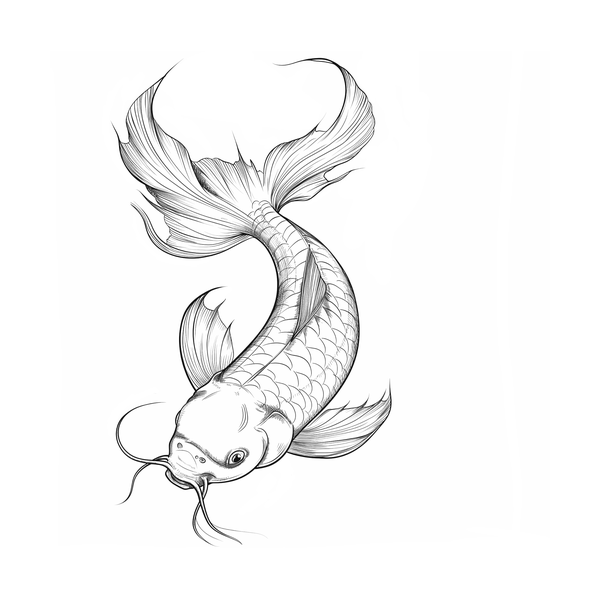
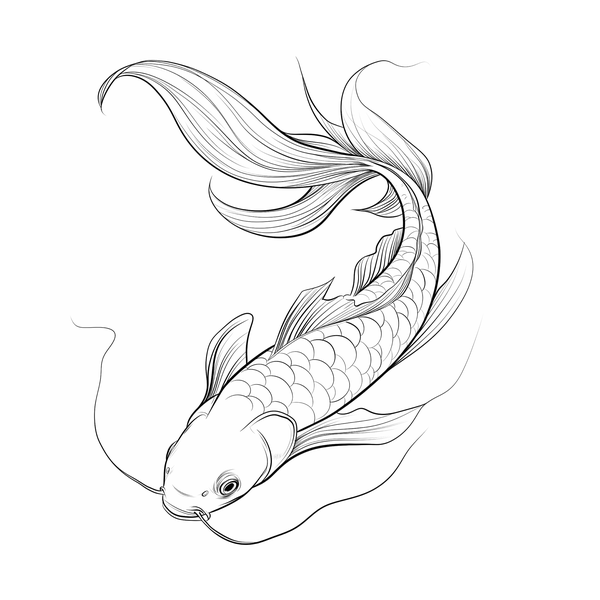
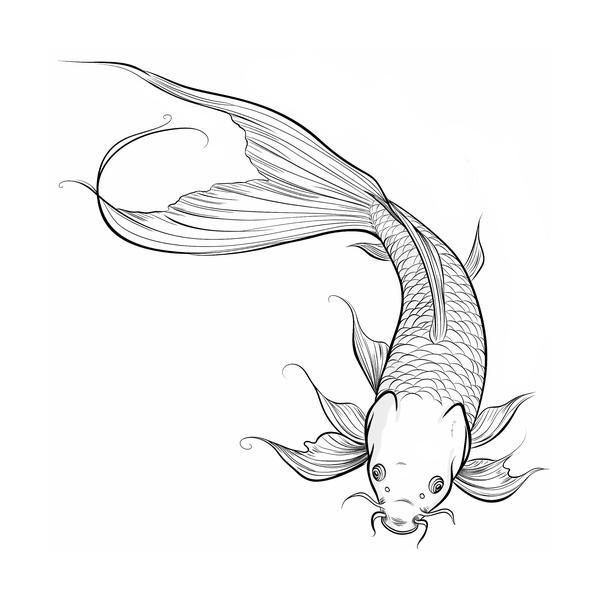
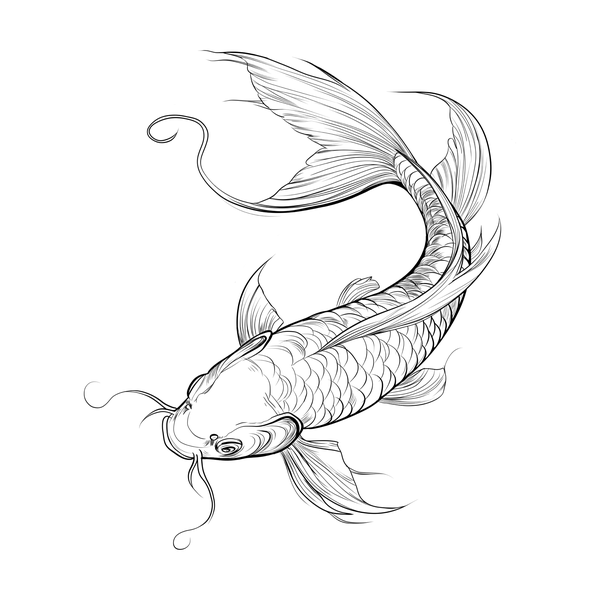
Up or down
Swimming up means still climbing. Swimming down means it is finished.
This is the first decision on a koi and the one clients most often get backwards. It cannot be reversed later without redrawing the fish, so it belongs at the top of the page rather than buried in the consultation checklist.
The Longmen rule, in one line
The legend supplies the whole grammar. A carp fights its way up the Yellow River, leaps the falls at the Dragon Gate and becomes a dragon. So a koi drawn swimming upward is still in the fight — the climb is unfinished, the reward is ahead. A koi drawn swimming downward has already made the leap and come back down the river. That is the entire convention, and it gets reversed constantly, because “downstream” feels like struggle to a Western ear and “upstream” feels like arrival. It reads as exactly the opposite. If the piece is marking a thing you are still in the middle of, the fish points up.
Your forearm will decide it if you let it
In practice, direction gets settled by anatomy far more often than by meaning, because a koi wants a long axis and a limb offers exactly two ways to run along one. There is a wrinkle worth naming out loud: on an outer forearm, a fish drawn head-toward-the-wrist reads as descending to the room and ascending to you looking down at your own arm. Both readings are real. Neither is wrong. But somebody has to decide which audience the tattoo is for, and if nobody decides, the stencil decides — usually in favour of whatever sat flattest on the skin that morning. Ask your artist to show you both orientations on the arm before anything is transferred.
Two koi are two statements
With a pair, the question doubles and gets more delicate. Two koi both ascending reads as a shared climb, which is usually what a couple or a sibling set actually means. One ascending and one descending reads as one person still going and one already arrived — a specific thing to say about a family, and not always a thing anyone intended to say. The head-to-tail circling pair dodges the problem entirely by turning the composition into a circle, which has no direction at all. That is a real part of why it is the most requested two-koi arrangement.
Koi are a bred fish, and the colour has rules
Worth knowing before you choose a variety. Koi are domesticated carp, and the coloured varieties were developed by rice farmers in the Niigata region of Japan in the nineteenth century, then standardised into named types. Kohaku, showa, sanke, tancho and the rest are breed standards with rules about where the colour sits on the body — not moods you can mix. That is why an invented pattern reads as wrong to anybody who keeps fish, and why bringing a photograph of one real koi of one named variety is the single cheapest upgrade available anywhere on this page.
Twelve koi
Twelve koi, and the first two are the same fish facing opposite ways.
A single koi climbing the inside of a forearm is not the same commission as a koi-and-dragon Dragon Gate piece running hip to shoulder. Scale, direction, and pairing come first. Color variety and style come second.
Single koi ascending
The canonical composition
One fish swimming upward along a forearm, calf, or outer thigh. Most-requested koi on the catalog. Traditional Japanese irezumi style — heavy black outline, saturated scale work, water lines breaking around the body. The upward reading carries the Dragon Gate story in shorthand. Kohaku (white with red) is the default palette; showa reads heavier; tancho works when the composition wants a single focal mark.
Single koi descending
The returned · opposite reading
Same fish, opposite reading. A koi swimming downward — back toward the river, toward origin — carries a different sentiment than the one climbing upward. Japanese tradition reads the descending koi as the fish that has already transformed, already returned, already completed the story. Clients who come in after a major chapter closes often land here.
Koi + dragon (ryu-koi)
Dragon Gate mid-transformation
The Dragon Gate moment itself — half-koi, half-dragon, rendered mid-transformation. The most narratively loaded koi composition. Needs 8–15 inches minimum because both creatures need room to read as characters. Head-and-claws of the dragon emerging from the tail of the koi is the canonical rendering. A multi-session commitment — plan for 3–6 sittings.
Koi in water with waves
Full Japanese composition
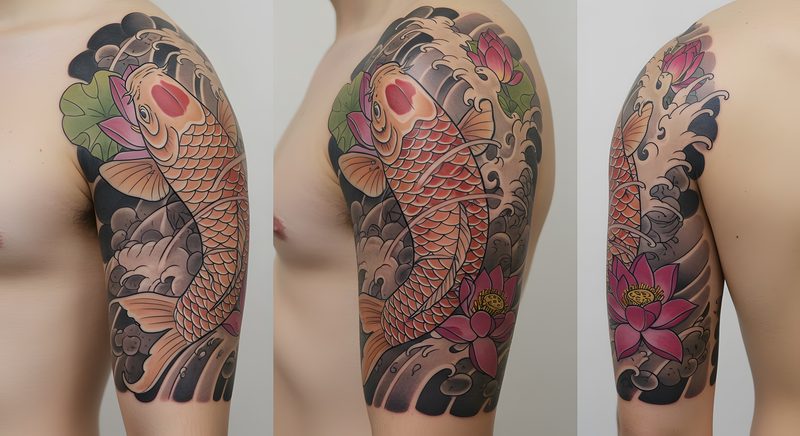
The full Japanese compositional frame: koi, finger-wave water, wind bars, and negative space that reads as sky or mist. The koi tattoo that looks like the Japanese woodblock print it descends from. Background is structural, not decorative, and wind bars need space to breathe. Kohaku or sanke palette holds up best against blue-black water.
Two koi (yin-yang)
Circular composition · balance
One ascending, one descending, arranged in a round composition that echoes the tomoe symbol. The paired reading — balance, masculine and feminine, striving and return — makes this a common couples commission, though plenty of clients take it solo. Color contrast does the compositional work: kohaku paired with a black-and-gray koi, or showa paired with tancho.
Koi + cherry blossom (koi to sakura)
The classic pairing
Cherry blossoms falling across or around a koi in motion. Blossoms carry impermanence, koi carries perseverance — together a full sentence from the Japanese tradition. Neo-traditional and traditional Japanese styles both handle this well. The blossom work is often where the artist’s hand shows most clearly — ask to see a koi-and-sakura piece specifically, not just koi alone.
Koi + peony (koi to botan)
Alternative floral · nobility reading
Heavier than cherry blossom and carrying a different reading — peony as nobility and prosperity rather than impermanence. The peony itself wants space. Showa or sanke palette on the koi, deep red or pink on the peony. Works as a thigh panel, half-sleeve anchor, or the lower half of a back piece.
Fine line koi
Modern single-needle · minimalist
Hair-thin single-needle, koi reduced to silhouette and suggested scale texture. Often black-and-gray with one muted color wash. Honest caveat: fine-line koi lose the structural weight that makes the traditional version hold for 50 years. Line work is thinner and softens faster, especially on skin that flexes. Best for clients who want the fish more than the full tradition.
Realism koi
Specific variety · portrait style
Photorealistic rendering from a specific reference. Often a particular koi from a particular pond — a family pond, temple pond, fish the client has actually fed. Realism doesn’t scale down; 6 inches is the working floor. Black-and-gray or full color. Bring the reference photograph. A realism koi without a specific fish is generic.
Watercolor koi
Splash and flow style
Saturated washes trailing the body, deliberate drips, ink scatter behind the fins. Reads painterly and contemporary rather than traditional. Caveat: watercolor ages faster than line-based work because color does the structural job outline usually does. Plan a touch-up around year 7. Clients who prioritize the day-one photograph over the 40-year hold are often happy here.
Blackwork koi
Solid black · architectural
Solid black, architectural, negative-space scales. The koi rendered as silhouette and shape rather than pattern. Reads from across a room, not just arm’s length. Often inside a larger blackwork panel or as cover-up anchor. Requires even saturation — patchy blackout ages badly and is hard to correct.
Memorial koi
Named · dated · consultation-heavy
A named and dated koi composition, carrying a specific person or chapter. Scale and style follow the style the client is already working in. Tancho variety (the single red head spot) is common for memorial because the mark reads as a seal. Named pieces typically include a small banner, a date worked into the water, or a family mon (crest). Consultation-heavy — plan for more conversation than the others.
A note on the tradition
Koi live inside irezumi. That tradition has rules.
Irezumi is a specific craft with specific rules. A koi is one of its most central motifs. If you want a koi rendered inside that tradition, the tradition matters — and who tattoos you matters.
The compositional grammar
Irezumi koi live inside a defined visual language: wind bars, finger waves, clouds, water spray, cherry-blossom drift, maple leaves. Outline weight is heavier than Western black-and-gray. Palette is specific — indigo water, red and black fish, gold accents, white negative space. The koi rarely stands alone.
Scale and panel
Irezumi is built for sleeve, back panel, thigh panel, or chest panel. A traditional koi asks for 10 inches minimum, usually more. At 3 inches on a wrist, a koi is not irezumi — it’s a fine-line reference to a koi. Different and legitimate as long as it’s named honestly.
Neo-Japanese and American Japanese
A koi drawn by a Western artist outside the tradition is not irezumi. It’s neo-Japanese or American Japanese — a legitimate style with its own American lineage, honest about what it is and what it isn’t. Don’t ask a fine-line artist to do irezumi. Don’t ask an irezumi specialist to do a 2-inch minimalist koi.
Japan, yakuza, and heritage clients
In Japan, tattoos remain partly taboo — many onsens, gyms, and public baths still refuse entry. The association with yakuza is not ancient history; it’s living context. Japanese-heritage clients often have specific feelings about wearing irezumi in or outside Japan. Apollo’s job is to name the context, not project onto it.
Six styles
The style picks the artist — not the other way around.
Koi belong to Japanese tattooing the way waves belong to Hokusai. The irezumi style isn’t a style choice on top of a koi — it’s the grammar the koi was built for.
Irezumi — the grammar the fish was drawn for
The native style
Wind bars across the background, finger-waves and foam where the fish meets water, a classical S-curve body, compositional flow that reads across a panel of skin. The grammar the koi was built for. Only lives with artists trained inside the Japanese tradition. A “Japanese-style koi” from a generalist is a decorative fusion piece — beautiful, but not irezumi. Name it honestly.
Neo-Japanese — the vocabulary without the two-year build
Japanese motifs · contemporary palette
Japanese motifs translated through a contemporary palette — desaturated reds, muted teals, more graphic outline, background stripped back from full wind-bar weather to a few placed elements. Where most mid-career Apollo collectors land when they want the Japanese vocabulary without committing to the full sleeve timeline.
Black-and-grey realism — a named fish, or none at all
Specific variety · photorealistic
The koi rendered photorealistically with reference-accurate scale patterning and fin geometry, translated into value rather than color. Any koi keeper will spot a faked scale pattern from across the room. Bring the reference fish — your fish, if you have one, or a specific koi from a specific breeder. Generic realism reads as AI output. Specific realism reads as a portrait.
Fine line — a koi-shaped tattoo, honestly labelled
Hair-thin single-needle
Koi reduced to silhouette and suggested scale texture. Honest caveat: fine-line koi loses the Japanese style entirely. This is a koi-shaped tattoo, not a koi in the tradition. Which can be exactly right — for clients who want the symbol without the cultural weight, or a small commemorative piece that reads as personal rather than declarative.
Watercolor — the one style the water actually argues for
Splash · flow · painterly
Splash and flow behind the koi, color bleeding outside any outline, pigment pooling where water would. The subject suits the style — koi live in water, water behaves like watercolor. Caveat: watercolor ages faster than any other style because the wash carries the work without outline scaffolding. Plan touch-up at year 7–10.
Neo-Traditional — ornamental scales inside a hard outline
Hybrid style · bold outline
Japanese compositional echo without full irezumi commitment. Dusty teals, burgundies, muted golds inside a confident black outline. Ornamental internal patterning on scales. Where most clients land when they want color and confidence but don’t want to name an irezumi specialist or schedule a two-year build.
Scales & fins
Five details that separate good koi work from bad.
Scale pattern fidelity, fin proportion, the S-curve, water integration, color placement. Each is small. Together they decide whether your koi reads as koi or as generic fish.
Scale pattern fidelity
A showa is not a sanke is not a kohaku. Each variety has specific color placement, and the scale pattern reads differently up close. A koi tattooed with invented color placement reads as generic; a koi with correct variety patterning reads as a portrait.
Fin proportion
Trailing butterfly fins (long, flowing, ornamental) are a specific genetic variety, not a default. Standard koi have shorter, more structured fins. Picking the wrong fin type changes the entire reading of the fish.
Body curve (the S-curve)
The classical S-curve — head turned toward the tail, body flexed into an S — is the pose the tradition was built around. A koi rendered straight-swim reads as flat. The curve is not decorative; it’s load-bearing.
Water integration
Wind bars in the background, finger waves at the surface, foam where the koi breaks through. Japanese style demands all three. Neo-Japanese can strip to one. Fine line skips water entirely — and that’s the trade-off.
Color placement accuracy
On kohaku, red should crown the head and break along the body in specific zones. On tancho, red is on the head and alone. On showa, black wraps the face. Getting it wrong is the single most common koi tattoo mistake.
Scale honesty
Under four inches the scales collapse. Everything else follows.
A koi needs scales, fins, water movement, and context. Under 4 inches the scales collapse.
Five placement styles
Plan the placement to the style, not the other way around.
A koi is a long curved shape that needs somewhere to swim to, so placement here is really a question about axis and length. A koi ascending a waterfall reads across fourteen inches of skin and not across four. Five options, ordered from the scale the tradition assumes down to the scale most people actually book.
Large statement
Full sleeve · back piece · thigh panel
The Japanese style’s native home. Koi ascending a waterfall reads across 14+ inches of skin, not across 4. If the reading is Japanese, plan for this placement.
Mid-scale solo
Forearm · calf · upper arm
Solo koi compositions in neo-Japanese or black-and-gray realism. 6–10 inches. The 2026 sweet spot for clients who want a koi that reads as a koi without a full sleeve commitment.
Solo statement
Bicep · outer forearm
Single American Japanese koi, 5–8 inches, neo-traditional palette. Reads in a t-shirt. Declarative rather than contemplative.
Classical round
Shoulder blade · upper back
The round composition — koi curved into a circle, chasing its own tail, or framed by lotus and wave. Black-and-gray realism or Japanese style. 6–10 inches, framed by the natural anatomy of the shoulder blade.
Intimate
Inner forearm · ribcage · inner bicep
Fine-line territory. The koi as personal symbol rather than declaration. 3–5 inches. For clients who want the meaning without the announcement.
Pricing, honestly
Four realistic ranges at LA-senior pricing.
Apollo bills by the hour: $100 with Blue, Hannah or Rick, $350 with Raa or David, half days at $400 and full days at $600. What a koi costs is therefore a question about session count, and session count is a question about scale. Every piece is quoted from the finished sketch, and the final number moves with artist, size, design and placement.
Eight compositional pairings
The pairing changes the reading more than the rendering.
Almost every one of these comes out of the same body of Japanese imagery, so they are not interchangeable decorations — a peony and a maple leaf are saying different things about the season and the weight of the piece. Eight that come up constantly, roughly in order of how often clients ask.
Koi + dragon (Dragon Gate)
The legend: a koi swims upstream and leaps the Dragon Gate falls, transforming into a dragon. Tattoo version pairs the koi at the base with the dragon emerging above. Full Japanese style only. Sleeve or back piece. 14+ inches.
Koi + cherry blossom (sakura)
Impermanence and perseverance. Sakura falling across or around the koi. Works in Japanese, neo-Japanese, and black-and-gray. The most-requested koi pairing in the shop.
Koi + peony (botan)
The king of flowers alongside the king of the pond. Japanese style default. Peony carries the color; koi anchors the composition.
Koi + chrysanthemum (kiku)
Imperial autumn style. Traditional Japanese, inside a larger panel. Longer-bloom symbolism pairs with koi perseverance.
Koi + lotus
Rising from the mud. Both motifs share the transformation-from-struggle reading; paired, the symbolism doubles. Japanese or neo-Japanese, not fine line — lotus needs outline to read.
Two koi (yin-yang)
A red and a black koi circling head-to-tail. Classical round composition, shoulder blade or upper back, 6–10 inches. Balance, duality, partnership.
Koi + waves and water
The full Japanese style. Wind bars, finger waves, foam, the koi inside weather. Sleeve, back piece, thigh panel. 14+ inches.
Koi + specific variety
The portrait style. A kohaku (red and white), a showa (black, red, white), a tancho (white with single red head spot). The koi keeper’s tattoo.
Common mistakes
Seven patterns to watch for.
Four of these are about the tradition and three are about the fish itself. Notice how many come down to the same root cause: not naming which style you actually want before you book somebody.
The “Japanese-inspired” confusion
The phrase covers two different pieces: traditional irezumi and Western fusion work. Both are legitimate. Neither is the other one. Fix: name the style before you book. “I want neo-Japanese” and “I want irezumi” are different assignments.
The wrong-artist mistake
A fine-line artist doing their first koi is not doing irezumi — they’re doing a fine-line reference to a koi inside a tradition they haven’t trained in. Lines thin, water stylized, wind bars absent. Fix: portfolio-match on three healed koi at 1–5 years in the exact style you want.
The scale-too-small mistake
A koi needs scales, fins, water movement, and context. Under 4 inches the scales collapse. Under 3, fins lose flow. A 2-inch koi is a fish-shaped line drawing. Fix: 6 inches minimum for neo-Japanese, 10 for irezumi. Under 4 inches, accept you’re asking for a stylized reference.
The single-koi-without-context default
A koi floating alone on pale skin with no water reads as static and cut-out. The tradition asks for environment because koi are water animals. Fix: unless you’ve deliberately chosen minimalist style, include water — splash, wave, finger-wave, or river section.
The wrong-direction mistake
Ascending and descending koi carry different meanings. Ascending is Dragon Gate. Descending is returned, settled, or memorial. Fix: decide direction at design stage and say it out loud. A koi stencilled sideways because that is how it fits the forearm is a shrugged koi, and the shrug is permanent.
The color-variety confusion
Kohaku, showa, tancho, sanke, asagi — each variety has its own color logic. A “koi in red and black” is not showa unless the pattern rules match. Fix: look up the variety, or bring a reference photo. “Any kind of koi” is a request the artist ends up answering for you.
The watercolor-style mismatch
Watercolor doesn’t carry irezumi grammar and shouldn’t pretend to. Fix: if you want watercolor, commit to a touch-up at year 5–7. If you want long-term irezumi, pick irezumi. Don’t mix styles hoping for both.
The S-curve is not a pose choice. It’s the load-bearing posture the whole tradition was built around.
The Dragon Gate pairing is where every koi tattoo is headed symbolically — whether or not the dragon ever gets inked.
A koi you can describe in one clean sentence is a koi ready to be tattooed. Anything longer is still research.
Before the sketch
Six answers, and one of them cannot be changed afterwards.
Direction is the one that locks. Variety can be adjusted in the sketch, scale can be negotiated, style can be talked through — but a koi drawn ascending cannot be turned around later without redrawing the fish. Settle that one first.
Which of the five readings?
Perseverance, masculinity, family, duality, or memorial. One reading drives the design. Secondary readings can inform details.
Ascending or descending?
Ascending koi climb toward the dragon. Descending koi have climbed, or are returning home. The direction is not neutral — don’t let the forearm decide it for you.
Which variety?
Kohaku (white with red), showa (black, red, white), tancho (white with single red head spot), sanke (white with red and black), asagi (blue-gray scales). Variety carries meaning in Japan and visual style in the West.
Japanese style or Western interpretation?
Irezumi, neo-Japanese, or fine-line/watercolor. This picks the artist, not the other way around.
Scale you can actually commit to?
Irezumi asks for 10+ inches. Neo-Japanese starts at 6. Fine-line reference pieces run 3–5. Be honest about time, budget, and sitting tolerance.
Matching or solo?
If two family members are getting koi, design the set at once. A matched pair added a year apart rarely matches.
When to wait
Four signals the tattoo isn’t ready yet.
If any of these apply, go home, think, come back.
You haven’t picked a reading
If none of the five readings fits cleanly — or if three feel equally true — the koi isn’t designed yet. Wait until one reading clarifies. Two weeks, two months, a year. The koi will still be there.
You’re inside the grief window
If the memorial koi is for a loss within the last 6 months, wait. Grief is still moving in the first year. Memorial pieces booked at month 3 or 4 often get covered or added to inside 24 months. Wait 12 months minimum.
You want irezumi but can’t commit to scale
Irezumi is not a 4-inch piece. If the panel you want asks for a full back or sleeve and you’re not ready for that time and cost commitment, wait. A 4-inch “irezumi-style” koi is not irezumi — book neo-Japanese instead.
You can’t describe it in one sentence
“A kohaku ascending, 8 inches, outer forearm, neo-Japanese, for the year I finished school” is ready. “A koi, Japanese-ish, with some color, somewhere on my arm, maybe a dragon” is still research.
Your first koi
Neo-Japanese, 6–8 inches, outer forearm, ascending.
The Apollo baseline. Eight decisions the first koi should make on purpose.
Three layers
Variety and direction are bones. The third layer is the one nobody sees.
Almost every koi conversation stops at layer one, which is why so many of them look related. The second layer is cheap and the third costs nothing at all.
The bones — variety, direction, scale, water
Variety, direction, scale, style (irezumi / neo-Japanese / fine-line), water treatment, placement, palette. These are the bones. They determine whether the piece reads as perseverance, family, duality, or memorial. Most clients start and stop here — which is why most koi tattoos look like the same koi.
The named detail worked into the water
The specific reading made visible. A dragon-gate waterfall behind an ascending koi. A second koi in your child’s favorite variety. A peony your grandmother grew tucked into the water. A wind bar carrying a name or date, integrated not captioned. A maple leaf for the year it happened.
The climb you have not finished yet
Strangers read decoration. You read the year you finished treatment, the father you buried, the promise you kept, the climb you haven’t finished yet but are still making. That’s enough. That’s the point.
FAQ
What clients ask once the reading is picked.
Eight questions covering meaning, Japanese tradition, scale, varieties, direction, pricing, small-scale work, and first-koi guidance.
What does a koi fish tattoo mean?
Five primary readings. Perseverance / Dragon Gate — the Longmen legend of the koi climbing the Yellow River and becoming a dragon; perseverance as transformation. Masculinity — Japanese Boys’ Day (tango no sekku) lineage; strength, courage, holding steady in moving water. Family / generations — contemporary Western multi-koi compositions, one per family member. Yin-yang duality — two koi circling head-to-tail, balance made visible. Memorial — named koi for a loved one, ascending if they finished their climb, descending if the piece marks their return. Pick one reading as primary. A koi without a chosen reading is a decorative fish.
Is a koi tattoo a Japanese tradition?
Yes — specifically within irezumi (Japanese traditional tattooing). Irezumi has a defined visual grammar: wind bars, finger waves, clouds, water spray, cherry-blossom drift, specific palette (indigo water, red and black fish, gold accents), heavier outline weight than Western work. The koi rarely stands alone — it lives inside a larger panel. A koi drawn by a Western artist outside the tradition is not irezumi; it’s neo-Japanese or American Japanese, a legitimate style with its own lineage, honest about what it is. A fine-line koi is different again — a koi-shaped reference to the tradition, not the tradition itself. Name what you want.
How big does a koi tattoo need to be?
Depends on style. Under 4 inches: fine line only — the Japanese style collapses, you cannot render wind bars, foam, finger waves, and a legible fish inside that space. 4–6 inches: fine line or simplified neo-Japanese, solo koi with minimal background. 6–10 inches: neo-Japanese and black-and-gray realism sweet spot — scale patterning reads, fin proportion holds, modest background composes cleanly. 10+ inches: Japanese irezumi style, the scale the tradition was built for, full background and compositional flow. The honest rule: a koi needs scales, fins, water movement, and context. Commit to the scale that holds the detail.
What are kohaku, showa, tancho, sanke, and asagi?
The five main koi varieties, each with distinct color patterning. Kohaku — white body with red (hi) pattern, the default and most-requested. Showa — black body with red and white pattern; heavier reading, works well against water backgrounds. Tancho — white body with a single red spot on the head like a rising sun; ceremonial, often chosen for memorial work because the mark reads as a seal. Sanke — white body with red and black pattern in that order of dominance; balanced reading between kohaku and showa. Asagi — blue-gray scaled back with red belly and fins; less common, reads traditional-scholarly. Variety matters: a showa is not a sanke is not a kohaku. Each variety has specific color placement. Look up the variety or bring reference photos.
What’s the difference between ascending and descending koi?
Direction is not neutral. Ascending koi (head up the limb, climbing toward the shoulder or neck) carries the Dragon Gate reading — the fish still climbing, still in the middle of the transformation. Descending koi (head down, flowing toward the hand or foot) carries the returned reading — the fish that has transformed, that has come back, that has completed the story. Ascending for perseverance pieces, memorial pieces marking someone who finished their climb, and sobriety/recovery pieces in progress. Descending for pieces marking return, settlement, or a memorial for someone who has already come home. Decide at design stage — a koi stenciled sideways because “that’s how it fits the forearm” is a shrugged koi.
How much does a koi tattoo cost?
Apollo charges by the hour, so the answer is really a session count. The rate is $100 an hour with Blue, Hannah or Rick and $350 an hour with Raa or David, with half days at $400 and full days at $600. A small fine-line koi at 3–6 inches is one sitting of two to four hours. A mid-scale neo-Japanese or black-and-grey koi at 6–10 inches is one to two sittings, and that is where most Apollo koi work lands. A large realism or Japanese-adjacent composition at 10–14 inches with the water built in runs two to four sittings. A full irezumi sleeve or back piece at 18 inches and up is priced sitting by sitting across a year or more, because nobody can honestly quote a build that long from a first sketch. Every piece is quoted from the finished sketch, and the number moves with artist, size, design and placement.
Can a koi tattoo work as a small piece?
Yes — in fine-line style only, and accepting the trade-off. Under 4 inches you’re working with a fine-line reference to a koi, not a koi inside the Japanese tradition. Line work is thinner, water is stylized or absent, scale patterning reduces to suggestion. The piece reads as personal symbol rather than declarative composition. Honest caveat: fine-line koi softens faster than bolder work; plan for a touch-up at year 7–10. Inner forearm, ribs, sternum, inner bicep all hold fine-line work well. Finger, foot, outside of hand fuzz faster. If you want a small koi with the full tradition, you’re asking for something the medium can’t deliver — commit to larger scale or accept fine-line’s terms.
What style koi should I get for my first tattoo?
Neo-Japanese or American Japanese at 6–8 inches, outer forearm or outer calf, kohaku or tancho variety, ascending direction. Expect 2–3 sessions totalling four to eight hours, billed at Apollo’s hourly rate — $100 with Blue, Hannah or Rick, $350 with Raa or David — with the final figure depending on artist, size, design and placement. Irezumi is a lifetime commitment to scale and is the wrong first venue — save that for your third or fourth tattoo once you know you’re in. Fine-line koi is legitimate but loses the Japanese style entirely; know what you’re choosing. Portfolio-match your artist on three healed neo-Japanese koi at the 1–5 year mark, not fresh-wrap Instagram photos. Fresh-wrap flatters everyone. Healed work tells the truth.
Ready to pick a direction?
Bring the reading. Bring the variety. Bring the direction. Commit to the scale the tradition asks for.
Direction first. Ascending if you're still climbing, descending if you got there. Then variety, then scale, then how much water it needs around it, because a koi with no current reads as a fish in a vacuum.