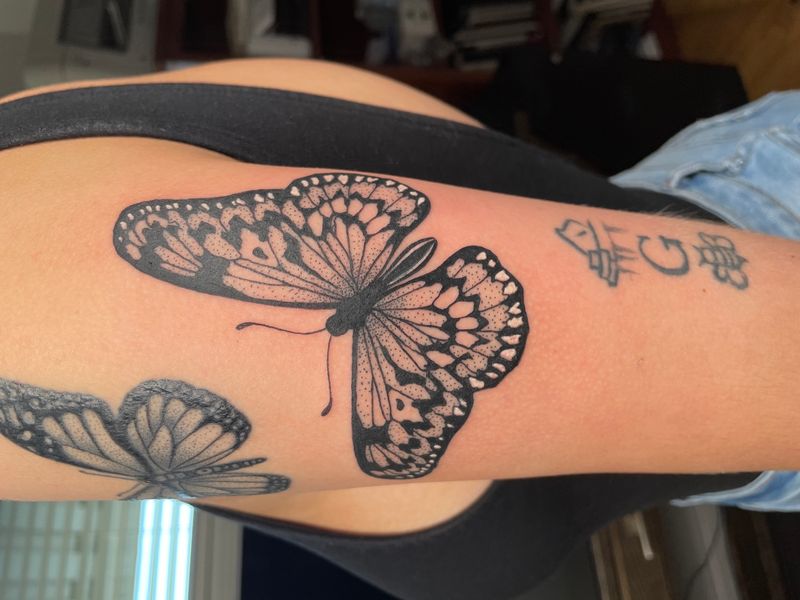
Tattoo Styles
Ornamental Tattoos
The body draws this one. Ornamental work follows the deltoid, the sternum line, the taper of a forearm; the pattern gets chosen after the anatomy rather than before it. That is the reverse of how most tattoos are planned, and a large part of why it ages so well.
Book a consultationPattern logic
Pattern that answers to anatomy.
An ornamental tattoo is defined less by subject matter than by a design logic: repetition, radial symmetry, motif, and border. The body as surface to be decorated — not pictured.
Where realism asks the skin to pretend it's a photograph and traditional asks it to read as a woodblock, ornamental treats the body as a surface to be decorated — closer in spirit to a wrought gate or an illuminated page than a picture. The category is defined by design logic rather than subject matter: repetition, radial symmetry, motif, and border.
At the needle, two tools dominate. Tight round liners — 1RL, 3RL, sometimes a 5RL for heavier boundary work — handle the linework spine: the mandala's axes, the band's outer edges, the interior petal contours. Shading is built almost entirely through dotwork (stippling) — thousands of individual needle hits whose density is modulated to create tone. A clean gradient from black to skin in dotwork is not shaded with a magnum; it's drawn one dot at a time, often with a 1RL or tight 3RL. The dotwork-plus-linework marriage is the technical signature of the genre.
Rotary machines dominate the modern ornamental bench because their consistent stroke and quiet hand are well-suited to long sessions of repetitive precision, though a number of European dotwork specialists still prefer coil machines tuned soft for stippling. Pigment is overwhelmingly black, sometimes cut to a \u201Ctinted black\u201D — a deep brown or muted burgundy — to warm the piece against skin tone. Occasional accent color exists but remains the exception, not the rule.
One principle governs everything downstream: in ornamental, negative space is the composition. The un-tattooed skin is not leftover — it's compositional breathing room, and it is what separates a mature ornamental piece from a muddy one. The two-distance test is how the work is judged: a strong ornamental piece resolves into a clear shape from across a room AND rewards close inspection.
The design traditions
Six lineages, one modern synthesis.
Ornamental is not a single cultural lineage. It's a careful synthesis of six — and knowing which tradition your piece draws from is part of the consultation.
South Asian henna
Mehndi pattern vocabulary
Paisley, floral-geometric fields, cuff-and-band compositions around wrist and foot. Arguably the single largest donor to contemporary ornamental — the motif library most artists unconsciously draw from.
Islamic geometric ornament
Tessellation & girih tiles
Eight- and twelve-fold stars, interlaced strapwork, mathematical infinite-repetition. This is where the genre gets its mathematical spine and its fascination with geometry that never resolves.
European decorative arts
Nouveau, Gothic, Rococo
Mucha's whiplash florals, Gothic tracery and rose windows, Rococo cartouches, the filigree logic of fine jewelry — all show up as direct quotations in ornamental work when the artist's visual library includes them.
Mandala traditions
Radial diagrams from Hinduism & Buddhism
The compositional template most clients recognize: a center, concentric rings, directional petals, a closed perimeter. Ornamental treats mandala not as decoration but as an inherited form with spiritual origin.
Sacred geometry
Flower of Life, Metatron's Cube, platonic solids
Where spirituality and mathematics meet. An entire sub-genre of ornamental is built around these forms — mathematically precise designs where any asymmetry is a failure rather than a feature.
Polynesian & Marquesan
Density and body-following — carefully
Ornamental borrows two ideas from these living cultural traditions: density (the blackwork field) and body-following design. But specific Polynesian and Marquesan motifs carry cultural meaning and protocol — quoting surface look is one thing; copying specific tribal designs is another. Serious ornamental artists draw that line deliberately.
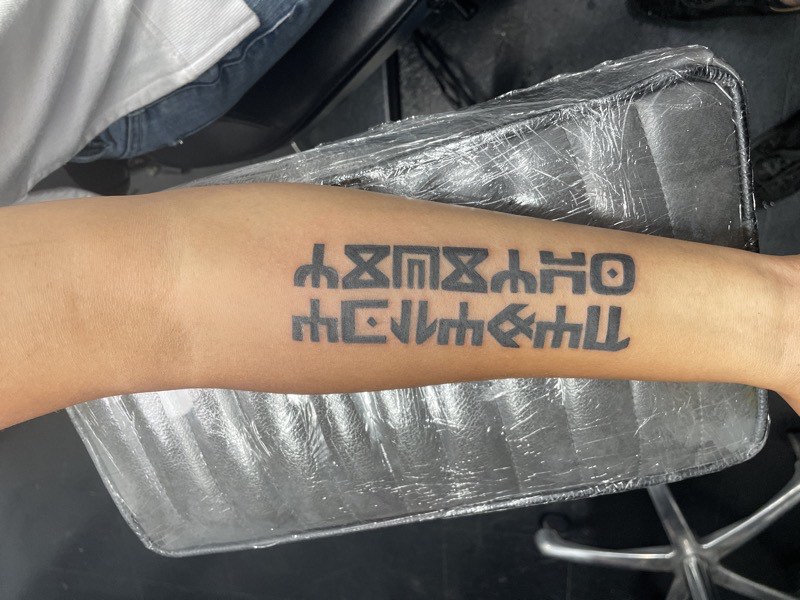
Genre-defining artists
The names the craft converged around.
Modern ornamental is young enough that its canon is still being written, but a handful of names recur across every serious publication in the genre.
Thomas Hooper
Austin · formerly NYC / Saved Tattoo
Widely cited as a formative figure in the modern ornamental and mandala revival. Published monograph work and precise geometric compositions are a standard reference.
Guy Le Tatooer
France
A pioneer of the European dotwork-ornamental revival. Early work helped establish stippled tone as a legitimate alternative to whip-shading.
Xoil (Loïc Lavenu)
Needles Side Tattoo · Thonon-les-Bains, France
Abstract, collage-like ornamental compositions that pushed the genre toward graphic design rather than pure symmetry.
Kenji Alucky
Japan
Blackwork and ornamental specialist known for dense, highly detailed pattern work that fuses dotwork with a Japanese sensibility.
Roxx
2Spirit Tattoo · San Francisco
Blackwork-ornamental specialist bridging bold-black tribal-influenced geometry with fine-line ornamental.
Curly (Daniel Formentin)
Italy
Dotwork and ornamental specialist within the European stippling school. Rigor with the dot as the unit of composition.
What pattern is for
What pattern work is for.
Ornamental has a native territory — subjects and placements the style was literally designed around. These are where nothing else comes close.

Mandala compositions
Radial symmetry is ornamental's home turf. The style's repeating geometry, dotwork gradients, and line-weight hierarchy deliver the contemplative read mandalas ask for. The form rewards scale — larger fields let the eye travel inward, which is the point.
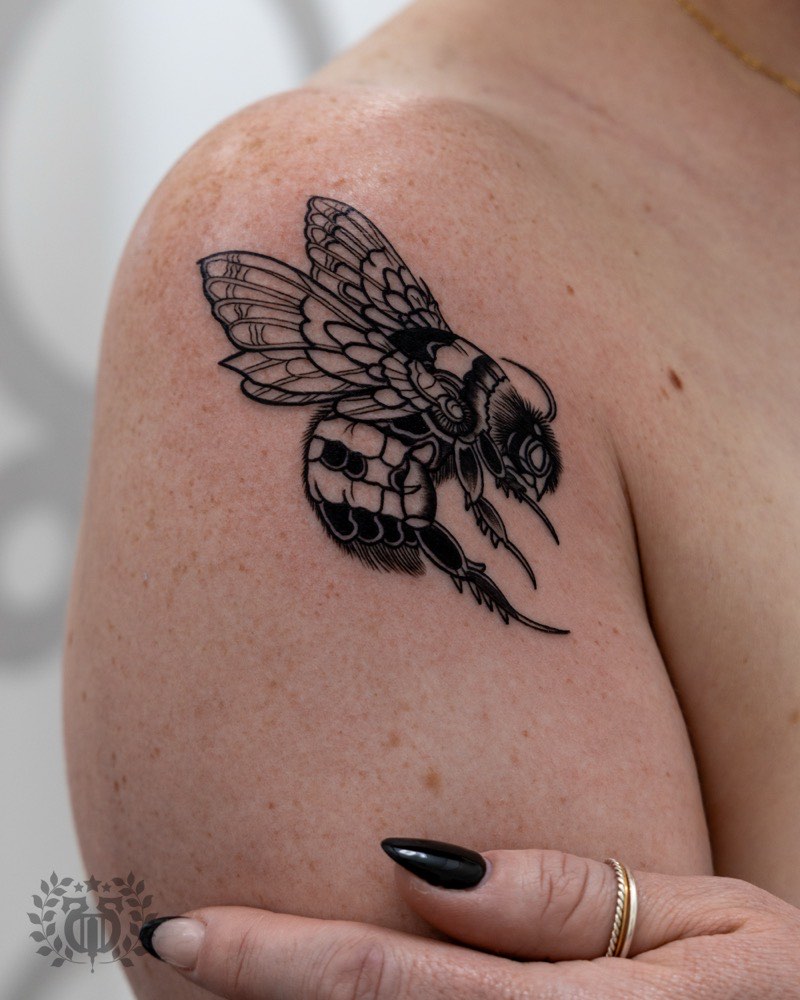
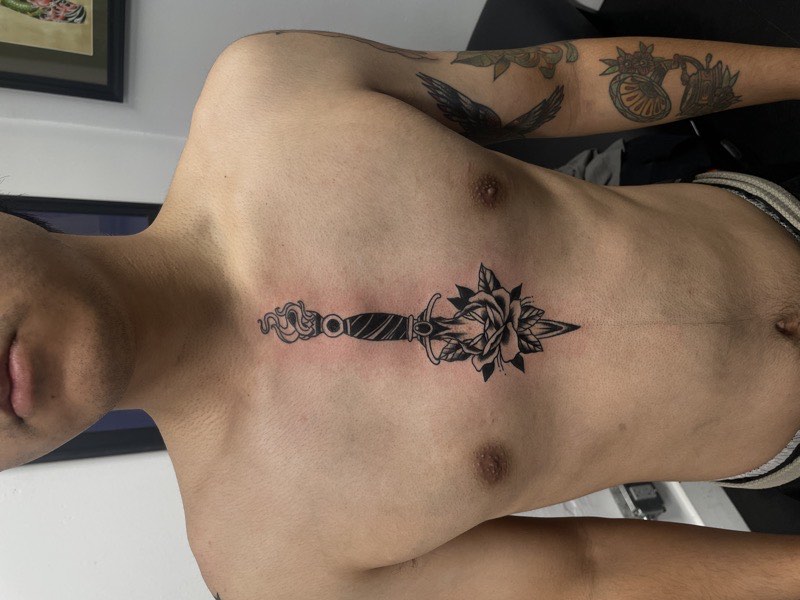
Sternum & chest-cavity pieces
The flagship ornamental placement. The chest cavity has a natural bilateral axis and compound curves; a jewelry-mimicking design that wraps the ribs (rather than sitting flat like a decal) is where ornamental outperforms every other style.
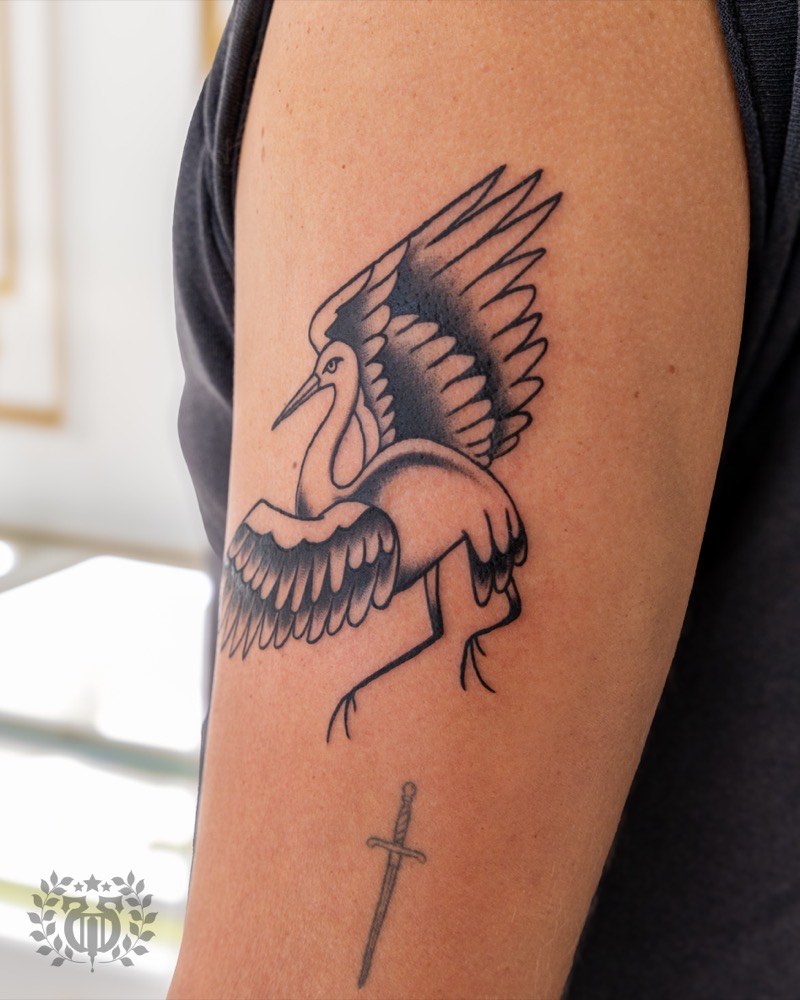
Forearm bands
Solid circumferential bands of pattern — a modern descendant of neo-tribal — read cleanly because the forearm is roughly cylindrical. Ornamental thrives where geometry has a predictable canvas.

Spinal compositions
Vertical compositions that follow vertebral rhythm, often incorporating chakra or meditation symbolism. The spine is a built-in centerline, which ornamental uses as a compositional spine for symmetry.
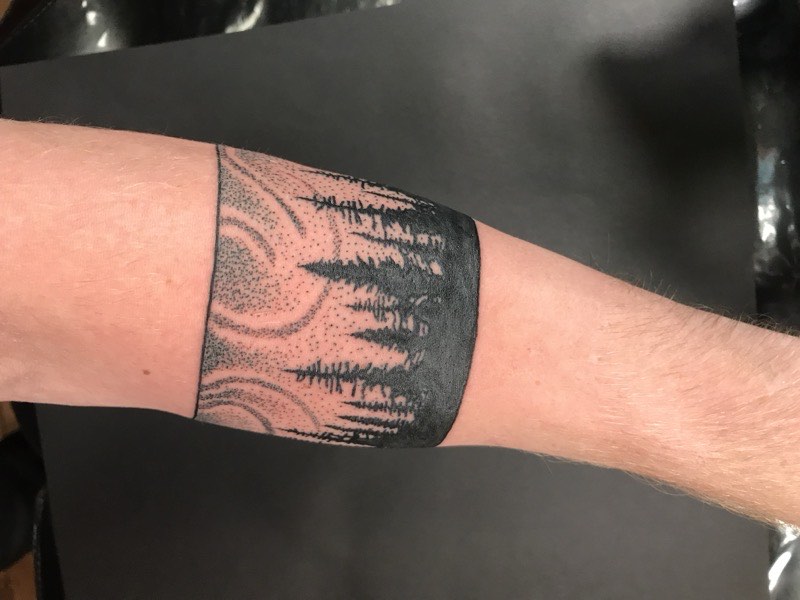
Crown & tiara motifs
Hairline ornament, nape pieces, earring and necklace extensions that mimic metalwork. The scale is small but the read is strong because they reference recognizable jewelry silhouettes. Permanent jewelry with the discipline of decorative arts.
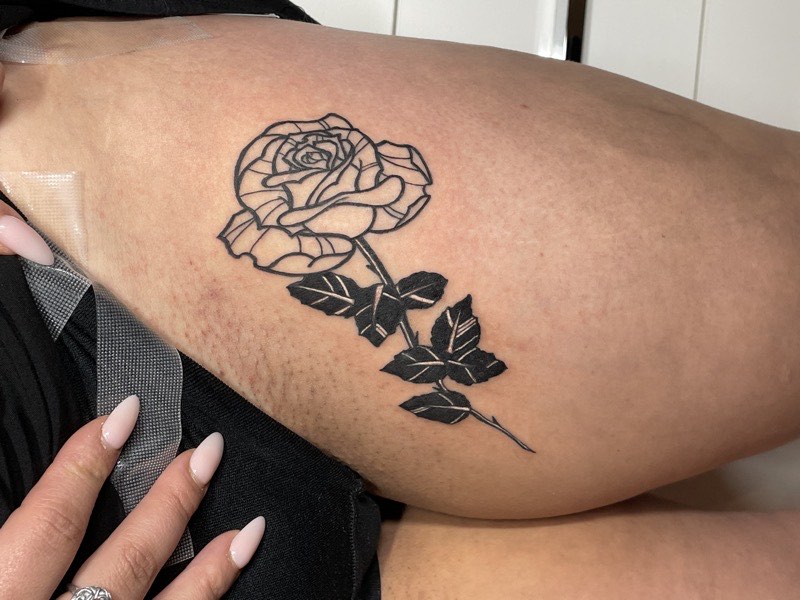
Thigh panels
Large-scale ornamental reads like engraved plate. The outer thigh is a broad, relatively flat canvas that holds compositional rhythm over ten inches and up. Often the first piece clients commit to when they want ornamental as a significant body investment.

Bracelet & bangle wrists
Ornamental wrist bands function as permanent jewelry — replacing or referencing bangles — and sit well because the wrist is anatomically band-shaped. Pattern density adjusts for the thin skin and high-movement reality of the placement.
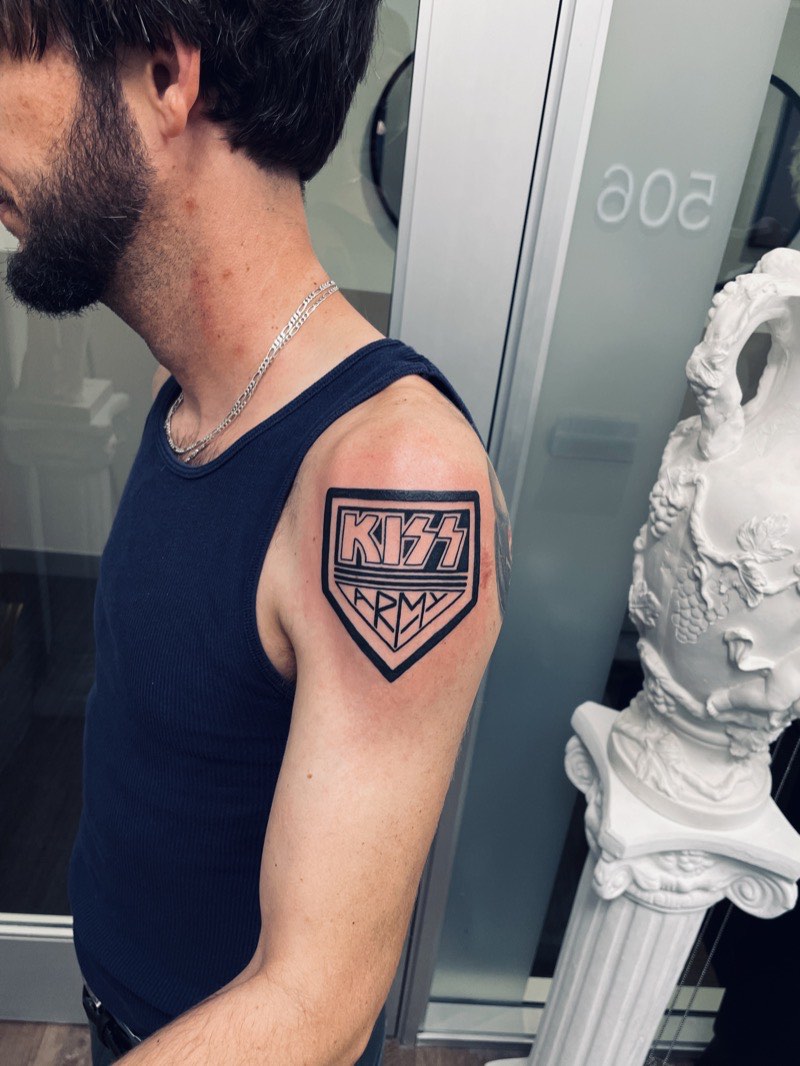
Filigree & lace overlay
Decorative patterns that behave like clothing lace sitting on skin. Thrives on shoulders, upper back, and thigh where the draped-fabric illusion is plausible. The trick is making the pattern read as fabric, not as tattoo — density and negative space decide the effect.
Where pattern fails
Where pattern work falls apart.
Some briefs fight the pattern language no matter who is holding the machine. Ornamental is pattern — not picture — and the honest limits follow from that.
Realistic portraits
Ornamental is pattern, not image. Faces require tonal modeling the style refuses. A portrait rendered in ornamental vocabulary usually ends up as neither a recognizable face nor a functioning pattern.
Narrative storytelling
Scenes, characters, and sequential imagery need representational subjects ornamental can't render without abandoning its grammar. The style is decorative, not descriptive.
Cover-ups over lightly-inked work
Ornamental is line-based with generous negative space. Without saturation, the old ink ghosts through the gaps between patterns. Cover-up work typically needs the density of blackwork or neo-traditional instead.
Dense text or script
Letterforms fight pattern fields — they compete for the same visual real estate. Short script accents can work if composed in; a quotation rendered inside ornamental usually reads as two tattoos colliding.
Watercolor-adjacent concepts
Ornamental is about edge precision; watercolor is about edge dissolution. They are philosophical opposites, and attempting to fuse them usually produces a piece that fails at both.
Small-scale pieces (under minimums)
Below readable thresholds, ornamental reads as chaotic dots rather than intentional pattern. The style needs scale to carry its compositional ideas — miniature ornamental is an oxymoron more often than a success.
Body-contour design
The principle that separates serious ornamental work.
Everything about ornamental flows from one idea: the design is drawn for the body it's going on, not placed onto it.
A mandala that looks perfectly symmetrical on flat paper will read visibly crooked once it's wrapped over a sternum, a shoulder cap, or a thigh — because the chest is not a plane. It's two compound curves meeting at a bony ridge. Competent ornamental artists therefore redraw — sometimes substantially — the finished stencil directly on the client's skin to compensate for the curve. Flat-transferred work is the easiest tell of an inexperienced artist in this genre.
The goal is anatomy-following composition: designs that trace muscle groups, follow bone prominence, and respect natural skin folds rather than ignoring them. A chest- cavity wrap — a sternum piece that actually wraps the rib cage — reads dimensionally. A flat-decal sternum piece, drawn without that wrap, reads like a sticker.
Some ornamental specialists go further and deliberately use the body's natural asymmetry as a design element. A piece that is geometrically symmetrical on paper and then subtly broken on skin to honor the client's actual anatomy often reads more balanced than a forced-perfect mirror. This is the subtle move that separates decade-long specialists from pattern-copying generalists — and it's why serious artists spend significant chair time drawing, erasing, and redrawing on the body itself before the first needle touches skin.
Density and area
Scale sets the composition.
Ornamental has minimum viable sizes because its compositional language collapses below certain thresholds. The rules below are where the style starts reading as designed rather than accidental.
Density against size
Smaller and the radial composition reads as chaotic dots rather than intentional pattern.
Below three inches a circumferential band reads as a stripe rather than ornament. Band pieces need vertical canvas to carry pattern.
Sternum work needs canvas to wrap the rib cage. Below six inches it becomes a flat-decal piece rather than a body-contour composition.
Spinal compositions need rhythm — enough vertical canvas to establish a repeating motif along the vertebral line. Below a foot, the piece reads as an isolated element.
For full ornamental pieces to carry their compositional breathing room. Tight scale collapses the negative space the style depends on.
Anatomy this style was made for
- Sternum (chest-cavity wrap). Ornamental's flagship placement — bilateral axis, compound curves, reward for body-following design.
- Upper back between shoulder blades. Broad uninterrupted canvas; perfect for medallion or large mandala compositions.
- Spine (vertebral column). Built-in centerline for symmetry; vertebral rhythm offers structural rhythm to the composition.
- Outer forearm. Cylindrical canvas — ornamental thrives on predictable geometry. Great for band and full-coverage pieces.
- Outer thigh. Broad, relatively flat, low friction — holds compositional rhythm over 10+ inches.
- Collarbone & shoulder cap. Ornamental uses clavicle curvature and deltoid prominence as compositional hinges.
- Upper arm & bicep. Flows well into chest or shoulder compositions; visible canvas with consistent skin.
Anatomy that resists pattern
- Fingers & hands. Pattern complexity fights small canvas; high turnover loses detail fast.
- Feet. Shoe friction destroys pattern integrity within a few years.
- Neck front. Skin movement distorts symmetry on every swallow.
- Inner arms. Bending across the elbow/bicep crease breaks bilateral reads; symmetry fights anatomy here.
- Palmar wrist. Palm-side wrist fades faster than any other ornamental placement.
Why it lasts
Why pattern work outlives most styles.
Ornamental is, alongside traditional blackwork, one of the longest-reading styles in tattooing. The year-by-year reality reflects that — and it's worth knowing before you choose.
Minimal settling
Bold black linework and densely-packed dotwork show little visible change once the initial heal completes. The piece you walk out with at the four-week mark is, substantively, the piece you'll be living with for the next several years.
Still largely unchanged
The finest dotwork may soften a touch — edges fractionally less crisp at close inspection — but overall pattern composition holds intact. At conversational viewing distance, most people cannot tell a five-year-old ornamental piece from a fresh one.
Prime readability
Edges of the thinnest lines may begin to soften, the tightest stippling may lose a fraction of its granular precision. This is still within prime readability for most ornamental work. Bold pattern, solid fills, and structural geometry remain sharp.
Hairline softening, bold holds
Noticeable softening appears on the thinnest elements — single isolated dots, hairline decorative flourishes, the filigree at a mandala's outermost ring. Bold pattern and solid fills still look essentially current. Most pieces continue to read exactly as intended to anyone not holding a magnifying glass to them.
Architecture ages better than picture
This is where ornamental separates from nearly every other style. Carbon-based black pigment is the most photostable commercial tattoo pigment in use, and well-executed ornamental work at the thirty-year mark can still read as the original composition. Softer, yes. Patinated, absolutely. But structurally legible — which is more than most tattoo styles promise.
Five reinforcing factors stack in ornamental's favor: carbon-based black pigment is the most photostable commercial tattoo ink; bold pattern structure carries the piece as fine detail softens; dotwork redundancy distributes pigment across thousands of deposits so individual loss doesn't destroy composition; negative space preservation — un-tattooed skin can't fade because there's nothing there to fade; and no gradient dependence unlike realism means there are no fragile halftone transitions to be the first casualty of time. Where ornamental CAN still age poorly: isolated hairline elements, unusually fine stippling, and sun-exposed placements. Bold structural work does not.
Ornamental in the wild
Pattern following the body.


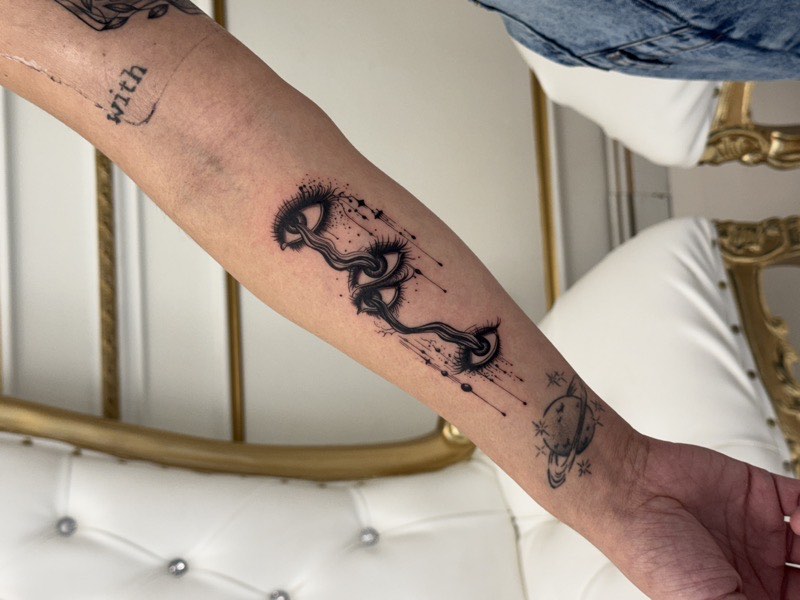
Density table
Subject → scale → placement → density.
The density reference for pattern work. The Density column is ornamental-specific: patterns need different saturation choices based on composition and body canvas.
Recurring assumptions
Five pattern ideas we rework.
Assumptions that show up in nearly every ornamental brief. Guidance for what comes next.
“Dotwork is slower so it's cheaper.”
Dotwork is more time-intensive per square centimeter, not less. A medium mandala commonly runs six to eight hours; a full sternum piece is usually multiple sessions. Pricing reflects hours in the chair, not style premium.
“I'll pick a Pinterest mandala and copy it.”
Pinterest mandalas are 2D flat art. Your ribcage is not. Specialist ornamental artists will adapt — redrawing symmetry to follow your specific anatomy. Artists who copy line-for-line are telling you they haven't developed the body-contour eye yet.
“Symmetry matters more than composition.”
Actually the opposite. Composition plus body-following geometry beats perfect symmetry every time. A piece that's geometrically symmetrical on paper and subtly broken on skin to honor real anatomy often reads more balanced than a forced-perfect mirror.
“I want color in my ornamental piece.”
Ornamental is fundamentally black plus negative space. Color can enhance at the margins — a single red dot, a gold accent — but typically dilutes the style's architectural clarity. The un-tattooed skin is part of the composition.
“I want it Instagram-style.”
That phrase signals a generalist client. Ornamental specialists plan compositions for twenty-year aging, not feed optimization. The pieces that look best at year ten often look slightly understated at day one.
The specialist test
How to choose an ornamental specialist.
Ornamental is a specialist's genre because pattern composition requires its own trained eye. The body-contour adjustment specifically separates specialists from generalists — and it's what you want to verify before booking.
Marks of an ornamental specialist
- Healed work at five years or more showing pattern integrity
- Variety across body placements — sternum, spine, forearm band, thigh panel
- Explicit, comfortable discussion of body-contour adjustment
- Visible evidence of custom composition rather than repeated flash templates
- Intentional line-weight variation that serves composition, not mistake
- Dotwork consistency across long sessions — thousands of hits at the same depth
Portfolio warnings
- Portfolio shows only flat Photoshop mandala drawings and not tattooed skin
- Dotwork that reads uneven or bunched even in fresh, well-lit photos
- Line weights that vary without compositional justification
- No healed examples — ornamental photographs poorly when fresh-only
- “I do any style” framing — ornamental is a specialist's genre
- Finished pieces that sit flat on skin like a sticker instead of wrapping anatomy
Six questions about pattern fit
- Can I see healed ornamental pieces from at least five years ago?
- How do you approach redrawing a symmetrical design on a curved body area?
- What's your dotwork-versus-linework preference, and why for this piece specifically?
- At this scale and placement, what anatomical considerations are you thinking about?
- Is this a fully custom composition or adapted from a reference? Either is fine — I want to understand the process.
- How do you think about pattern closure at the edges of this piece?
You are not hiring a tattooer. You are hiring a pattern composer who tattoos. Specialists welcome these questions; generalists deflect on them.
FAQ
Pattern work: what actually gets asked.
What clients ask about pattern work that gets redrawn onto their own anatomy before the needle starts.
What is an ornamental tattoo?
An ornamental tattoo is a decorative, pattern-based style — defined by repetition, radial symmetry, motif, and border rather than by any pictured subject. It treats the body as a surface to be adorned, closer to jewelry or an illuminated page than a picture. The genre draws on mandala, filigree, lace, baroque and rococo scrollwork, henna and mehndi pattern, geometric tessellation, and dotwork shading, and it's built almost entirely from black linework and stippled dots. See how it sits against every other approach in our tattoo styles library.
What's the difference between ornamental and geometric tattoos?
Geometric tattooing is about precise shapes, grids, and mathematical forms; ornamental is a broader decorative genre that uses geometry as one of several tools alongside floral, filigree, and lace motifs. Every geometric piece can be ornamental, but not every ornamental piece is strictly geometric — many are organic pattern. The most mathematical corner of the genre overlaps with sacred geometry, where any asymmetry reads as a failure rather than a feature.
Where do ornamental tattoos look best?
Ornamental favors placements with a built-in axis or predictable curve: the sternum and chest cavity (its flagship placement), the spine, the upper back between the shoulder blades, forearm and wrist bands, and outer-thigh panels. Hands, feet, and the front of the neck are the placements to reconsider, because friction and skin movement break pattern integrity. Bring your placement instinct to a consultation and we'll map the composition to your anatomy.
How long does an ornamental tattoo take?
It depends on scale and density, but ornamental is time-intensive because dotwork is built one needle hit at a time. A medium mandala commonly runs six to eight hours; a full sternum or spinal piece is usually multiple sessions. Pricing reflects hours in the chair rather than a style premium — and because the style ages for decades, that chair time is a long-term investment.
How long do ornamental tattoos last?
Ornamental is one of the two longest-aging styles in tattooing, alongside traditional blackwork. Well-executed pieces read essentially intact at ten years, show hairline softening at fifteen, and still carry their composition at thirty. Carbon-based black pigment is the most photostable commercial tattoo pigment; bold pattern structure carries the piece as fine detail patinas; and negative space — a huge portion of any ornamental composition — can't fade because there's nothing there to fade. That's why ornamental's touch-up cycles are measured in decades rather than years.
What's the difference between ornamental, blackwork, and dotwork?
These categories overlap but aren't identical. Blackwork is defined by saturated black coverage — solid fills, dense fields, negative space as compositional tool. Dotwork is a technique where tone is built through stippled dots rather than whip-shading; it's used inside ornamental, realism, and blackwork. Ornamental is a pattern-based genre — decorative, rhythmic, body-following — that uses both linework and dotwork as its primary tools. A piece can be ornamental and blackwork (dense pattern fields), ornamental and dotwork (stippled mandala), or ornamental with light blackwork accents.
Why does my ornamental artist want to redraw the design directly on my skin?
Because paper is flat and your body isn't. A mandala that's geometrically perfect on paper will read visibly crooked on a curved sternum, because the chest is two compound curves meeting at a bony ridge. Experienced ornamental artists redraw — sometimes substantially — the finished stencil directly on your skin to compensate for curve, rib flare, clavicle angle, and muscle topography. Artists who skip this step are either very experienced (they've internalized it) or generalists who don't know it's the step. Ask any ornamental specialist to walk you through their drawing process before the first needle.
Can ornamental work on darker skin tones?
Yes, and often beautifully. Ornamental's reliance on black pigment and high-contrast pattern actually favors Fitzpatrick IV–VI skin — carbon black reads strongly at every skin tone. The adjustments specialists typically make are about line weight (slightly bolder for higher contrast) and dotwork density (denser stippling to maintain pattern readability). A specialist's portfolio showing work across multiple skin tones is the best signal they've trained for this range, not just the ranges the style originally favored.
How do I find a specialist in ornamental?
Ask to see healed pieces at five years or older, across multiple placements — sternum, spine, forearm band, thigh panel. Ask how they approach redrawing a symmetrical design on a curved body area; specialists will describe the process in detail, generalists will deflect. Ask whether the composition will be custom or adapted from a reference. Look at dotwork consistency in fresh work, at line-weight intentionality in long curves, and at whether pieces wrap anatomy or sit flat like decals. You are hiring a pattern composer who tattoos, not a tattooer who does patterns.
Is ornamental appropriate to borrow from cultures it originates in?
Ornamental synthesizes traditions — South Asian henna, Islamic geometric ornament, European decorative arts, Hindu and Buddhist mandala — and those traditions are living cultural practices with meaning attached to specific motifs. Working in the genre's shared vocabulary (geometric pattern, radial composition, decorative rhythm) is different from copying specific culturally-owned designs (particular Marquesan or Polynesian tribal patterns, particular religious iconography). Good specialists draw that line deliberately, and a consultation about cultural motifs is a conversation worth having openly — not skipping.
How often will my ornamental piece need touch-ups?
The longest touch-up cycle of any major tattoo style. Most pieces need only a small settling touch-up at six to twelve months — often just addressing a spot or two that didn't take fully. After that, the major touch-up typically falls at ten to fifteen years, and what gets refreshed is usually the hairline detail rather than the bold pattern. SPF still matters for sun-exposed placements, but the pigment itself is less vulnerable to UV than any colored ink. Ornamental is the style where you can reasonably plan on a decade between maintenance conversations.
Ready to design a piece that wraps your body?
Bring the reference, the placement instinct, and openness to redrawing on skin.
Ornamental is a specialist's craft and a decade-long investment. Bring a loose reference, the region you want it to follow, and an expectation that the design gets redrawn freehand on your skin first. Then we draw it onto you rather than onto paper. Ornamental work is adjusted on the skin, and the pattern bends to the anatomy in front of us.