Tattoo Ideas
Geometric Tattoo Ideas
Geometric tattooing is the least forgiving work we do. A wobble in a portrait reads as texture, but a wobble in a straight line reads as a mistake, and the same is true a decade later when that line has softened and the skin underneath has moved. What follows is how we actually think about geometric designs at our Main Street studio in Santa Monica: which shapes hold up, where on the body they hold up, and what to expect from them at year one and year fifteen.
Book a consultationWhat "Geometric" Actually Covers
"Geometric" is a bucket that holds several distinct approaches, and they age very differently. Being precise about which one you want changes the placement conversation, the price, and the healing.
Fine-Line Geometry
Thin, evenly weighted lines forming triangles, arcs, orbital rings, or minimal constellations. It is the most requested version and the most fragile. Single-needle and 3RL work at small scale gives you a crisp, drawn-on look for the first couple of years, then gradually softens. This is not a flaw in the work; it is what thin ink does in living skin.
Sacred Geometry and Mandalas
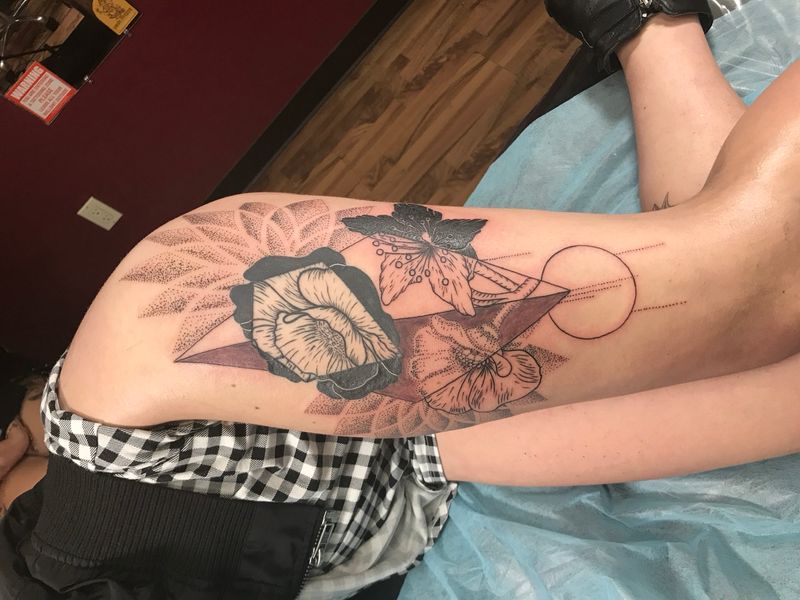
Flower of Life grids, Metatron's Cube, Sri Yantra, dotwork mandalas. These are repetition-based, so the eye reads the pattern rather than any single line. That redundancy makes them age better than isolated fine lines, because a slightly blurred petal in a field of forty petals disappears into the whole.
Geometric Blackwork
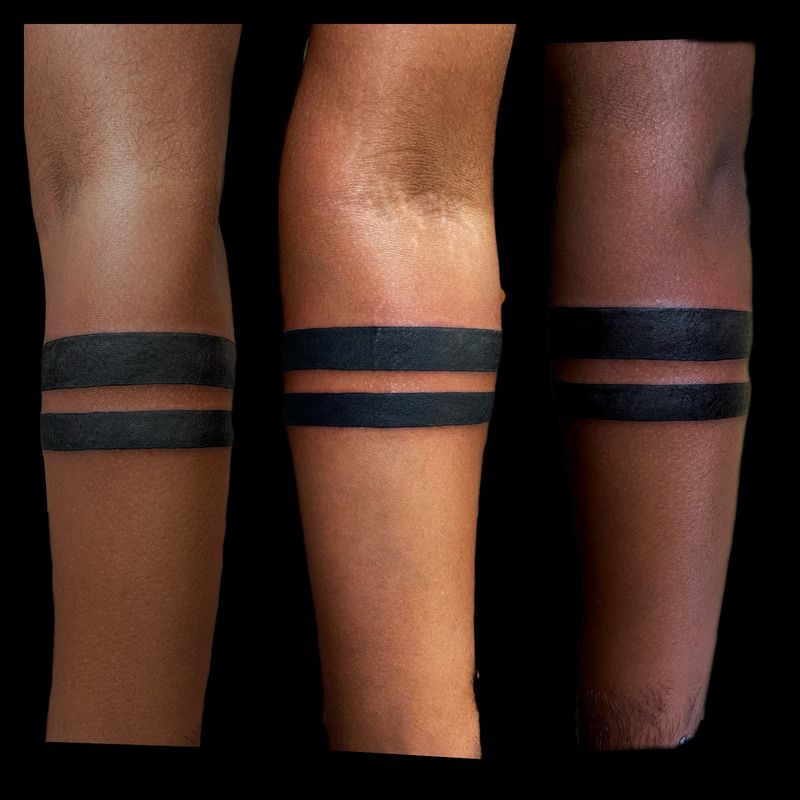
Heavy solid fills, thick borders, negative-space shapes carved out of black. This is the most durable geometric style by a wide margin. Solid black holds its edge for decades, and the design still reads from across a room in year twenty. The trade-off is commitment: bold blackwork is difficult to cover or revise later.
Geometric Hybrids
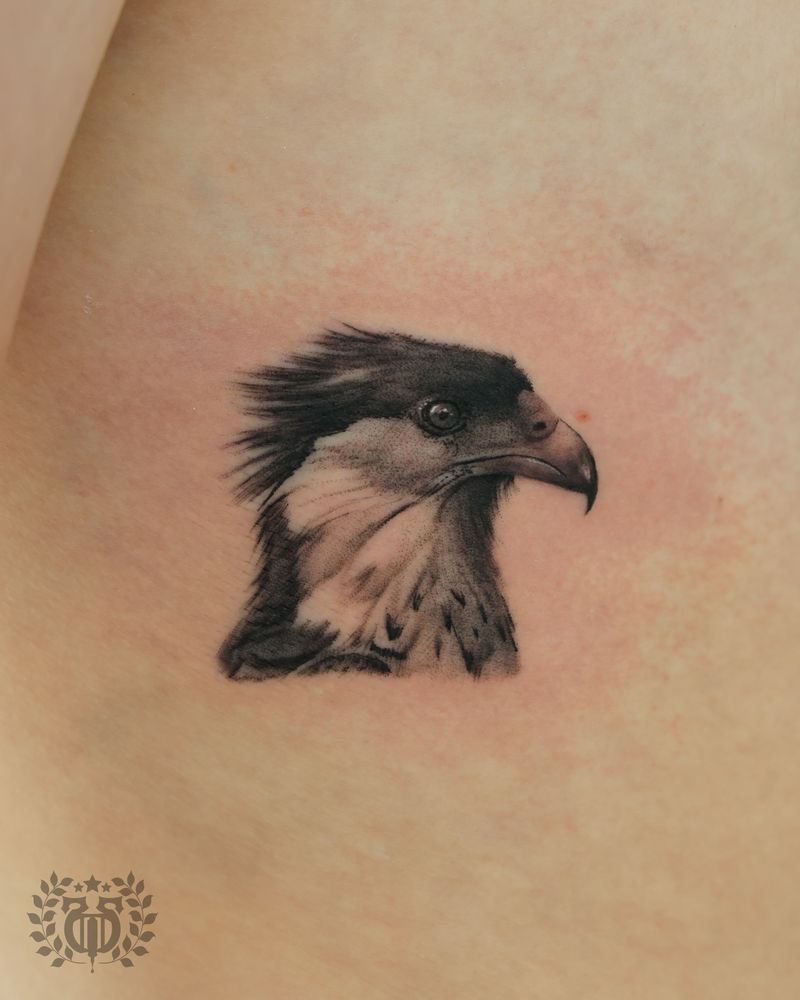
A realistic animal contained inside a hexagon, a botanical illustration with a dotwork halo, an ornamental sleeve panel built on a geometric skeleton. The geometry becomes structure rather than subject. If you are still browsing directions, our broader tattoo ideas collection is a useful place to see how geometric framing changes an illustrative piece.
Placement: Where Straight Lines Survive
The core problem with geometric work is that human bodies are made of compound curves, and straight lines are a flat-surface idea. Every placement is a negotiation between the design on paper and the shape it will actually wrap.
Placements That Hold Up Well
- Outer forearm. Relatively flat, low friction, moderate sun exposure if you cover it. The single best home for a first geometric piece.
- Outer and rear calf. Big, stable surface with gentle curvature that a good stencil can compensate for. Excellent for mandalas and larger grids.
- Upper back and between the shoulder blades. Broad, symmetrical, and largely shielded from sun. Ideal for anything that needs to read as centered.
- Outer thigh. Forgiving, roomy, and easy to keep covered while healing in an LA summer.
Placements That Fight You
- Inner wrist and finger. Constant flexion and rapid cell turnover. Fine geometric lines here can blur or drop out within a year or two, and finger work frequently needs touch-ups.
- Ribs and the side of the torso. The surface changes shape with every breath and with weight fluctuation. A perfect grid tattooed while you are lying flat can look subtly skewed when you stand up.
- Elbow, knee, and ankle. Beautiful for mandalas built around the joint, punishing for straight lines that cross it. Lines that cross a joint get stretched thousands of times a day.
- Shoulder cap and upper chest. Compound curves in two directions at once. Doable, but the design has to be drawn on you, not adapted from a flat file.
The Honest Truth About How Fine Lines Age
Every tattoo spreads a little. Ink migrates microscopically within the dermis over years, so a 0.3mm line does not stay 0.3mm forever. In practice:
- Years 0-2: Crisp. This is the look you saw on Instagram.
- Years 3-7: Lines soften slightly. Gaps under roughly 1mm between parallel lines start to close. Dotwork shading looks smoother and slightly grayer.
- Years 8-15+: The design reads as an overall shape rather than a set of individual lines. Well-spaced work still looks intentional. Overly dense work can turn into a gray mass.
This is why we push back on cramming detail into a small footprint. If a design needs four parallel lines inside a two-inch square, we will usually recommend either two lines or a four-inch square. Sun is the other accelerant, and in Santa Monica it matters more than most places. Daily SPF on exposed geometric work is genuinely the difference between a ten-year piece and a twenty-five-year piece.
Symmetry, and Why Perfect Symmetry Is a Trap
Nobody is symmetrical. Shoulders sit at different heights, spines curve, one calf is larger than the other. A design that is mathematically perfect on paper will often look subtly wrong once it is on an asymmetrical body, because your eye compares it to the body's own centerline rather than to the design's.
The fix is stencil work done standing, in a mirror, with the client in a neutral posture, and freehand adjustments to the drawing so the piece is symmetrical relative to you. Expect to spend real time on stencil placement for any centered geometric design. If an artist slaps a stencil on and starts within five minutes, that is a warning sign for this style specifically. You can see how this plays out across finished work in our tattoos portfolio.
Sizing and Spacing Rules We Actually Use
- Keep negative gaps between parallel lines at 1.5mm or wider for anything you want legible in fifteen years.
- Scale up before you add detail. A mandala at four inches and a mandala at eight inches are different tattoos, not the same tattoo at different sizes.
- Vary line weight. All-uniform thin line reads flat; a heavier outer contour with lighter interior detail creates depth and gives the piece a structure that survives softening.
- Anchor the design to an anatomical line, such as the length of the forearm or the curve of the deltoid, rather than to an abstract axis.
- Plan for expansion. Geometric work is modular by nature, so leave a logical edge if a half-sleeve is on your five-year horizon.
Sessions, Cost, and What to Expect
Geometric work is slower than it looks. Straight lines are pulled in one confident pass, which means more stencil prep, more rest, and more repositioning of your limb than a comparable illustrative piece. A palm-sized fine-line design is usually a single short session. A full dotwork mandala on the thigh is commonly two to four sessions, with healing time between them so we can register the pattern against fully settled skin.
Bring reference images, but bring them as a direction rather than a spec. The most common consultation outcome for geometric requests is a design that keeps the concept and changes the proportions to fit your body. When you are ready to talk it through, book a consultation and we will map it on you before anything is finalized.
Geometric tattoo questions we hear at the consultation table
Do fine-line geometric tattoos really blur that badly?
Blurring is usually overstated online but it is real. Expect thin lines to soften noticeably somewhere between years three and seven, especially in high-movement areas. Good spacing, correct depth, and sun protection keep a fine-line geometric piece looking intentional for decades rather than turning it into a smudge.
Where is the best place for a first geometric tattoo?
The outer forearm or outer calf. Both are relatively flat, heal predictably, are easy to keep out of the sun while healing, and let you see the piece daily so you learn how you feel about the style before committing to a larger placement.
Will a straight line across my ribs stay straight?
It will be straight in the position you were tattooed in. Because the ribcage changes shape with breathing and posture, a line that is level while you are lying down can appear slightly angled when you stand. We plan rib geometry around the body's own contour lines rather than fighting them.
Can geometric tattoos be symmetrical if my body is not?
Yes, but the symmetry is built relative to your body, not to a ruler. We set the stencil while you are standing in a natural posture and freehand adjustments so the finished piece reads as centered to the eye. A design that is mathematically perfect on paper often looks off once it is on skin.
How much does a geometric tattoo cost in Los Angeles?
It depends on size, density, and session count rather than on the style label. Small fine-line pieces are typically a single short session, while a detailed dotwork mandala on a thigh or back panel usually runs multiple sessions. We quote at consultation once we know the actual footprint on your body.
Does dotwork hurt more than line work?
Most clients describe dotwork as less sharp but more tiring. Line work is a series of brief, intense passes; dotwork and stippling is a lower-level sensation sustained over a longer period. Neither is dramatically worse, but dotwork sessions tend to feel longer.
Do geometric tattoos need touch-ups?
Fine-line work on high-friction areas such as fingers, wrists, and feet often needs a touch-up within the first year. Solid blackwork and well-spaced dotwork on stable placements frequently never need one. We check healed work and advise honestly rather than pushing unnecessary sessions.
Can a geometric tattoo be covered up or added to later?
Adding to geometric work is easy because the style is modular, and it is one of the best styles for building outward into a sleeve or back piece. Covering heavy blackwork is much harder, so treat solid black shapes as permanent commitments and discuss expansion plans at consultation.