Tattoo Ideas
Zodiac Tattoo Ideas
Which sign you are matters far less than which of four approaches you take to drawing it: glyph, constellation, mythological figure, or ornamental composition. Each one ages in its own way and each one wants a different scale. Here is the part reference photos never cover.
Book a consultationFour Ways to Tattoo a Sign
Almost every zodiac tattoo we do falls into one of four camps: the glyph, the constellation, the animal or figure, and the ruling planet or element. They look like variations on a theme. They're actually four different tattoos with four different lifespans, and picking the wrong one for the placement you want is the single most common regret we hear about in this category.
1. The Glyph
The glyph is the shorthand symbol — the Aries ram horns, the Leo lion's tail curl, the Scorpio arrow tail. It's the simplest option and, honestly, the most reliable. A clean glyph is a handful of confident strokes, which is exactly what a tattoo needs to survive twenty years of skin turnover. Ink spreads slightly over time no matter who puts it in you; a design built from few, well-spaced lines has room to spread and still read.
Glyphs are the one zodiac option that genuinely works tiny. A one-inch Sagittarius arrow behind the ear or on the inner wrist is a legitimate tattoo, not a compromise. The trap is going smaller than the line weight can support — if the strokes are drawn thinner than roughly a millimeter, they'll blur toward each other as the piece settles. We'd rather do a clean two-inch glyph than a mushy one-inch one, and we'll say so.
2. The Constellation
This is the dot-and-line star map: Orion-style points connected by hairline strokes. It's the most-searched zodiac tattoo style right now and the one that needs the most honesty from an artist.
Here's the problem. Isolated small dots are the least stable mark in tattooing. A single dot has no surrounding structure to hold its shape, so it spreads outward from its own center as it heals and keeps drifting for years. Under about 1.5 mm, a dot can fade to a gray smudge or, if it was packed hard to compensate, blow into a soft blob roughly twice its intended size. On a constellation where stars sit 4-5 mm apart, two blown dots can quietly merge into one shape and the pattern stops being readable.
Our working floors: dots no smaller than 1.5 mm for the minor stars, 2-3 mm for the anchor stars, and at least 8 mm of clean skin between adjacent points. That usually pushes a real constellation to a minimum of about four to five inches across. Compressing Scorpius — a genuinely long, sprawling constellation — into a two-inch wrist piece is asking fifteen stars to live in the space that comfortably holds five.
The connecting lines go first. Those whisper-thin hairlines between stars are the most fragile element in the whole design. They're single-pass, low-saturation strokes, and they're usually the first thing to disappear — sometimes within a couple of years, faster on hands, feet, and anywhere that gets daily sun. This isn't a failure of the tattoo; it's physics. If you want a constellation that still connects in a decade, the lines need real weight, or you skip them entirely and let the dots imply the shape. We often recommend the second option. A field of well-placed stars with no lines is a cleaner tattoo at year ten than a lined version that's lost half its structure.
3. The Animal or Figure
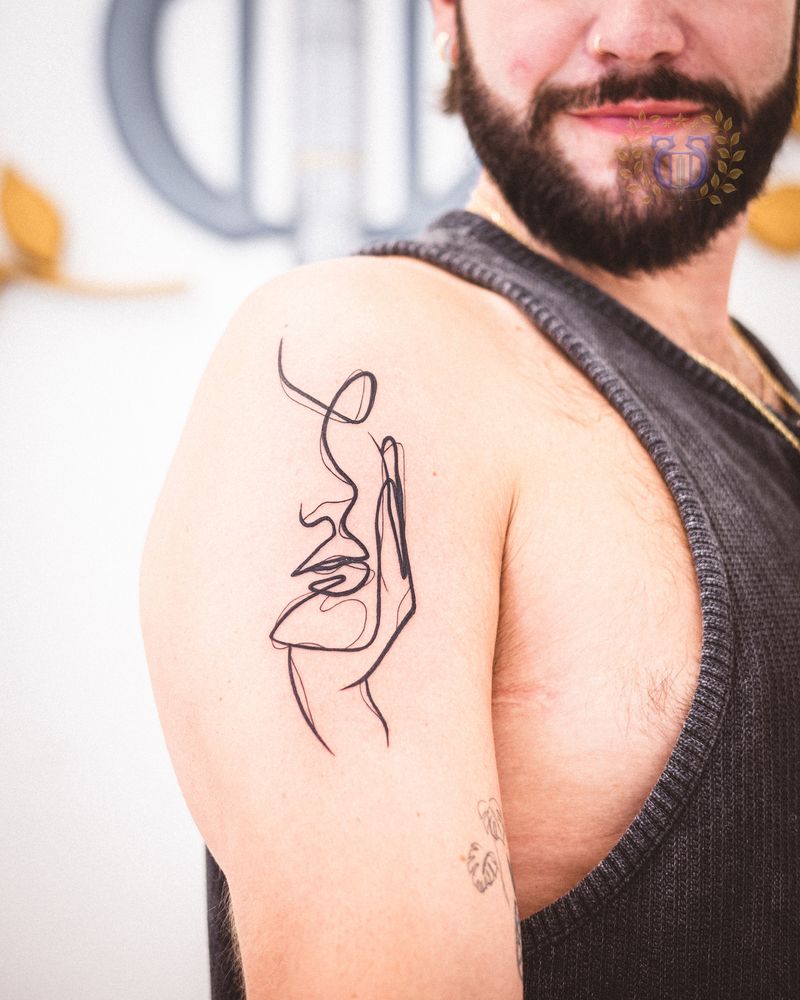
The illustrative route: an actual ram, bull, crab, lion, scorpion, archer, or the twins, fish, goat, water bearer, maiden, scales. This is where a zodiac tattoo gets to be a real tattoo rather than a symbol. It has shading, depth, composition, and personality, and it's the only approach where your artist's hand is visible in the result.
It's also the approach with the most room to differentiate. Two people with the same Leo glyph have the same tattoo. Two people with a Leo lion can have a fine-line neoclassical study and a bold traditional roaring head — nothing alike. If you care about the tattoo being yours specifically, this is the direction. Bring us the mood, not just the sign: regal and still, or in motion, or half-hidden in botanicals. Browse our tattoos and wider tattoo ideas to find the rendering style that pulls at you before you worry about the subject.
Size expectations are different here. An illustrative animal with real shading needs about four inches minimum, and five to seven inches gives it room to breathe. Below that you're compressing detail that will fill in over time.
4. The Ruling Planet or Element
The least literal and often the most elegant option. Every sign has a ruling planet and an element, and building the tattoo around those gives you something that carries the meaning without announcing your birthday to strangers. A ringed Saturn for Capricorn or Aquarius, a small Mars glyph for Aries or Scorpio, Venus for Taurus and Libra, a crescent moon for Cancer. Element-driven designs work the same way — a flame, a wave, a mountain line, a wisp.
These read as ornamental first and astrological second, which suits people who want the reference private. Planetary symbols are also structurally similar to glyphs: simple, geometric, ages well, works small.
Notes by Element
Grouping by element is more useful than going sign by sign, because signs in the same element tend to share the same design problems.
- Fire — Aries, Leo, Sagittarius. The glyphs are the strongest in the zodiac: the Aries horns and the Sagittarius arrow are near-perfect small tattoos, clean and instantly legible. Leo's glyph has a long looping tail that needs consistent thickness or it thins out at the curve. All three animals suit bold, dynamic illustrative work. Ruling planets: Mars, the Sun, Jupiter.
- Earth — Taurus, Virgo, Capricorn. Taurus has the cleanest glyph of the three — a circle and two horns, essentially bulletproof. Virgo's M with the crossed loop is the fussiest glyph in the zodiac and the one we most often see done too small; give it at least two inches so the inner loop doesn't close up. Capricorn's sea-goat is a gift for illustrative work, since the goat-to-fish transition gives a composition natural flow. Ruling planets: Venus, Mercury, Saturn.
- Air — Gemini, Libra, Aquarius. All three glyphs are built from parallel lines, which is the specific thing that fails when a tattoo spreads. Parallel strokes closer than about 3 mm can bleed toward each other and read as one thick band. Scale these up or ask for wider spacing. Libra's scales and Aquarius's water-bearer vessel are lovely illustrative subjects. Gemini as twin faces or twin figures is one of the most compositionally interesting pieces in the zodiac. Ruling planets: Mercury, Venus, Uranus & Saturn.
- Water — Cancer, Scorpio, Pisces. Pisces has the friendliest glyph here — two arcs and a bar, and it scales down beautifully. Cancer's double-spiral needs open centers or the spirals fill in solid within a few years. Scorpio's constellation is the longest in the zodiac and the one we most often steer toward a longer placement like the spine or the outside of the forearm rather than a compact spot. Illustratively, water signs pair naturally with flowing linework and negative-space waves. Ruling planets: the Moon, Mars & Pluto, Jupiter & Neptune.
Placement
Constellations want length, and the body offers a few places that give it. The spine is the best canvas for a vertical star map — it's long, flat, relatively low-movement, and gets very little sun, which matters for fine lines. The sternum suits symmetrical constellations and centered glyphs. Ribs take long horizontal designs well but are a demanding sit and the skin there stretches, so we keep dot spacing generous.
The upper arm is the most forgiving placement in this whole category: stable skin, easy to shade, easy to cover, and it holds a four-to-six-inch illustrative animal comfortably. Behind the ear is glyph-only territory — the area is small and gets sun and friction, so a constellation there will lose its lines fast. The ankle is popular for small zodiac work and we'll do it, but be honest with yourself about touch-ups: ankles rub against socks and shoes daily and fine linework there fades noticeably faster than an arm.
Combining Signs
A lot of zodiac work we do isn't about the wearer at all — it's a partner's sign, a child's, a parent who's gone. There are a few ways to combine them that don't just look like two tattoos next to each other.
- Merged constellations — place two star maps in one shared field so they read as a single night sky rather than a diptych. Works best on the spine or across the back.
- Glyph pairing — two small glyphs, one under the other or mirrored on either side of a spot, with matching line weight. Quiet and clean.
- One animal, one glyph — an illustrative lion with a small partner glyph worked into the composition. Gives one sign the spotlight and the other a place to live.
- Birth-date coordinates — for a child, some people prefer the actual sky as it looked that night rather than the stylized constellation. It's a different, more personal image.
One caution on family groupings: leave room. People plan a two-sign piece and come back three years later wanting a third, and a design that was composed tight has nowhere to grow. We plan for that up front when you tell us it's a possibility.
Bringing It to Us
Come in with your sign, your rough size, and the placement you have in mind, and let the approach be the conversation. If you want a constellation on a spot that can't support one, we'll tell you and show you what will work there instead. Our studio is on Main Street in Santa Monica, and if you're anywhere in LA it's worth coming in to see the space and talk it through in person. Book a consultation and we'll figure out which of the four directions actually fits what you're picturing.
What clients ask about zodiac tattoos
How small can a zodiac tattoo be?
It depends entirely on the approach. A simple glyph works down to about an inch, and a planetary symbol about the same. A constellation realistically needs four to five inches to keep its dots properly spaced, and an illustrative animal with shading needs at least four inches to hold detail.
Do constellation tattoos really fade faster than other tattoos?
The dots and the lines fade differently, which is the real issue. Very small isolated dots spread and lose definition, and the hairline strokes connecting them are the first element to disappear — often within a few years on high-sun or high-friction placements. The tattoo doesn't vanish, but it can stop reading as a recognizable pattern.
Should I skip the connecting lines on a constellation?
We often suggest it. A well-spaced field of dots implies the shape on its own and looks noticeably cleaner at the ten-year mark than a lined version that's lost half its connections. If you want the lines, they need enough weight to survive, which means a slightly bolder look than most reference photos show.
Which zodiac signs are hardest to tattoo small?
Virgo, Gemini, Libra, and Aquarius. Virgo's glyph has an inner loop that closes up when scaled down, and the other three are built from parallel lines that can bleed together as the ink spreads. All of them are fine at a slightly larger size.
Can I combine my sign with my partner's or my child's?
Yes, and it's one of the most common requests we get. Merged constellations in one shared star field, paired glyphs with matching line weight, or one illustrative animal with a small second glyph worked into the composition all work well. Tell us up front if you might add a third sign later so we compose with room.
Where does a zodiac tattoo last longest?
The upper arm and the spine. Both have stable skin, get relatively little direct sun, and hold fine detail well. Ankles, hands, and feet see the most friction and sun, so fine linework there fades faster and needs touch-ups sooner.
Is the ruling-planet version still a zodiac tattoo?
It is, just a quieter one. Every sign has a ruling planet and an element, so a Saturn ring, a Mars glyph, or a simple flame carries the same meaning without being obvious to anyone who doesn't already know. It's a good option if you want the reference to stay private.
Do you do consultations before booking a zodiac piece?
Yes. Zodiac work benefits more than most subjects from a conversation about size and placement before anything is drawn, because the approach you want and the spot you want it often need to be reconciled. Come by the studio in Santa Monica or book a consultation and we'll work it out together.