Tattoo Ideas
Birth Flower Tattoo Ideas
Birth flower tattoos have quietly overtaken birth-month numerals and zodiac glyphs as the most requested personal marker we see at the counter. The appeal is obvious: it is a date rendered as something beautiful instead of something literal. What most people do not realize walking in is that the twelve birth flowers are wildly unequal as tattoo subjects — a few are practically built for skin, and two or three are genuinely difficult to keep readable past the first decade.
Book a consultationThe Twelve Birth Flowers, and What Each One Is Actually Like to Tattoo
Every month has a traditional flower, most have two. Below is the standard list with an honest note on how each behaves as a tattoo rather than a drawing. Paper holds detail forever; skin does not.
- January — carnation & snowdrop. The carnation is a gift: ruffled layered petals give natural line breaks and obvious places for shadow, so it reads clearly at two inches. The snowdrop is the opposite — a pale drooping bell with no internal structure that needs a strong stem and leaf or it reads as a blank teardrop.
- February — violet & primrose. Both are five-petal flat-faced blooms, the easiest shape in floral tattooing: clean silhouette, obvious center, holds up small. Among the safest choices here.
- March — daffodil. The trumpet center gives a three-dimensional form to shade against the flat petals behind it, so a daffodil reads as an object rather than a shape. Beautiful in black and gray.
- April — daisy & sweet pea. The daisy is the most beginner-proof flower in tattooing: radial petals, dark center, unmistakable at any size. Sweet pea is trickier — thin papery petals with curled edges that flatten into a ribbon without careful line weight.
- May — lily of the valley & hawthorn. Lily of the valley is the hardest flower here: tiny nodding bells on an arching stem, no dark interior to give them shape. Hawthorn is easier — clustered blossoms with visible stamens and thorny stems that add structure.
- June — rose & honeysuckle. The rose is the most tattooed flower in history for a reason — the spiral of overlapping petals creates its own contrast and survives spreading better than almost anything. Honeysuckle is more delicate: long tubular flowers with curling stamens that need room.
- July — larkspur & water lily. Larkspur suits vertical placements like the spine or forearm; the spike of blooms creates rhythm down the piece. Water lily is broad and open with a heavy petal count — it needs size, but the petal layering finally reads at four inches up.
- August — gladiolus & poppy. The gladiolus is the tallest flower here and a natural for long, narrow placements. The poppy is superb in black and gray — dark center, crinkled petals with strong shadows, a seed pod that reads instantly.
- September — aster & morning glory. Asters are radial like daisies but with far more petals, so they need size or deliberate simplifying. Morning glory is a wide trumpet on a twining vine — ideal for wrapping an arm or rib line.
- October — marigold & cosmos. The marigold is dense, layered and high contrast; it holds detail for decades and looks powerful in solid black. Cosmos is a simple eight-petal bloom on a wiry stem — delicate but sound.
- November — chrysanthemum. A specialist's flower: hundreds of thin curved petals mean it needs real size or deliberate stylization. Japanese traditional solved this centuries ago with bold outlines and simplified petal groups, and that still works.
- December — narcissus & holly. Narcissus behaves like the daffodil — strong trumpet, easy to read. Holly is the most tattoo-friendly plant here: sharp glossy leaves and solid berries, high contrast and bulletproof over time.
Which Blooms Read Small, and Which Turn to Mush
The rule underneath this is simple. A flower reads small when it has an interior anchor — a dark center, a deep throat, a shadowed cup — plus a clear silhouette. Daisies, poppies, violets, marigolds, daffodils, holly and roses all have it. They will still look like themselves at two inches, twenty years from now.
Flowers without an anchor rely on outline and delicate shading, which is exactly what softens as ink spreads. Lily of the valley is the classic problem: pale bells, no interior, no contrast, clustered shapes that merge into one gray smudge. Baby's breath, often used as filler, is the same trap smaller — dozens of tiny dots that become a haze. Neither is impossible, but both need an artist willing to cheat: heavier stems, cast shadows under each bell, negative space held open, and more size than you think.
Style: Fine Line, Black and Gray, or Watercolor
Fine line is the default request for birth flowers and it suits them, keeping the botanical, sketched quality people are after. The trade-off is real: single-needle work holds less pigment and blows out more easily on soft skin like the inner arm or ankle. Expect a refresh in the five-to-ten-year range. Black and gray with a light outline lasts longest and flatters these subjects most, because contrast is what keeps a flower legible and gray wash delivers contrast fine line alone cannot.
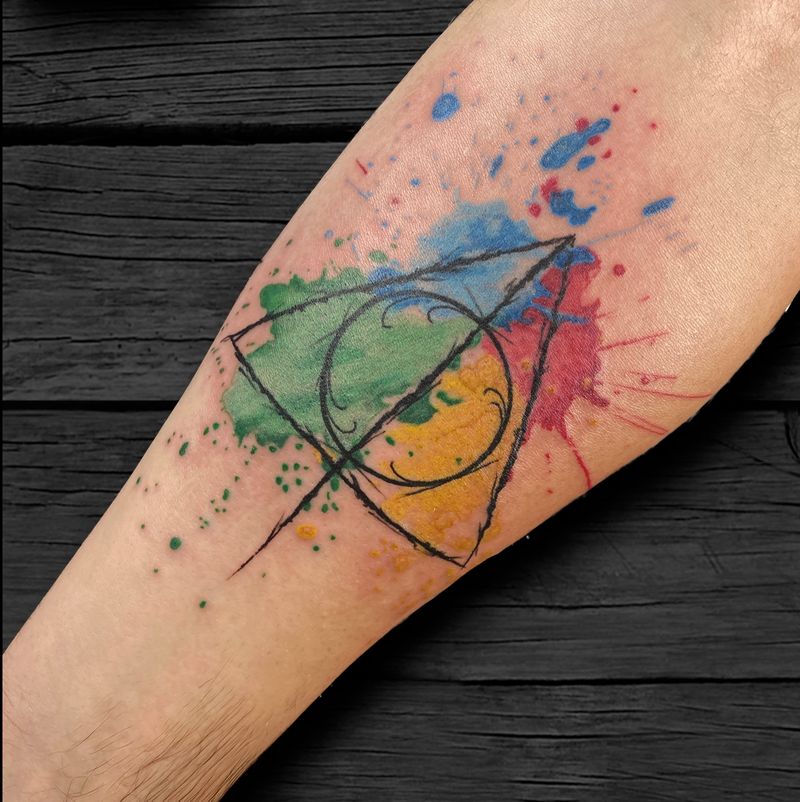
Watercolor deserves a straight warning. Without a line anchor underneath, watercolor florals soften faster than any other style — color migrates, edges lose definition, and within a few years you have a bruise-colored shape rather than a flower. If you love the look, ask for a structural line under the color; it reads almost identically fresh and holds far longer. This is true of all tattoos, but soft florals show it fastest.
Bouquets for Multiple Birthdays — and How to Keep Them From Becoming a Blob
The most common version is a bouquet with one flower per family member. Three works easily, four is manageable, five or more is where good ideas go wrong.
These pieces fail on equal weighting — five same-sized blooms at one depth, all competing, none dominant. They work on hierarchy. Pick one hero flower at full size and detail, put one or two mid-ground with lighter linework, and let the rest sit behind as partial silhouettes or buds. Overlapping is your friend: a petal disappearing behind another creates depth and buys space.
The other fix is arrangement. Instead of a bunch, run the flowers along a single stem line — up a spine or down a forearm — spaced so each has breathing room. It kills the crowding and leaves space to add a flower when the family grows.
Placement
Forearm is the workhorse: flat, visible, forgiving, and it takes a vertical stem arrangement. Spine is the most striking placement for a multi-month piece and gives a long stem somewhere to go, though it is a sharper sit. Ribs suit trailing arrangements like morning glory or honeysuckle, at the cost of an uncomfortable session. Thigh is the best canvas here — flat space, low pain, low sun exposure, ages slowest of anywhere. Ankle is beautiful and the most demanding: thin skin, friction from shoes, highest touch-up rate of the group.
Green and Pastel Inks Across Skin Tones
Green is the color clients ask about most, because leaves are half of any floral piece. Muted and olive greens hold reasonably well on light to medium skin. On deeper skin tones, green and most pastels lose against the surrounding melanin — not because they cannot be tattooed, but because the contrast is too low to read at normal distance. On rich skin tones, solid black and heavy black-and-gray shading are the reliable route, with color as an accent inside black-defined boundaries rather than the structure.
Pastels are the fastest-fading inks anywhere, and Los Angeles accelerates it. If you spend weekends on the beach in Santa Monica or Venice, a pastel-heavy floral will look noticeably softer in three years than the same piece on someone in Seattle. Daily SPF on healed work is the cheapest maintenance in tattooing.
If you are still gathering references, look at how a flower is constructed rather than how pretty the photo is — the ones with obvious light and shadow survive. Our tattoo ideas pages are organized by subject for exactly this. Once you know your months and roughly where the piece is going, book a consultation.
What clients ask about birth-flower tattoos
What is my birth flower?
Each month has one or two traditional flowers — January is carnation and snowdrop, June is rose and honeysuckle, November is chrysanthemum, and so on through the full list above. Most months give you two options, which is useful because one is often a much better tattoo subject than the other.
Which birth flowers are hardest to tattoo well?
Lily of the valley (May) and chrysanthemum (November) are the two most demanding. Lily of the valley has no dark interior to give it shape, so the bells tend to merge into a gray smudge over time. Chrysanthemums have so many thin petals that they need either real size or a deliberate stylized approach.
How small can a birth flower tattoo be?
Flowers with a strong dark center — daisy, poppy, violet, marigold, daffodil — read cleanly down to about two inches. Clustered or pale flowers like lily of the valley and baby's breath need considerably more room, or they blur as the ink spreads over the years.
Can I get one flower for each family member?
Yes, and it is one of the most requested versions. The key is hierarchy rather than equal weighting — one hero flower at full detail, one or two in mid-ground, and the rest as partial silhouettes behind. Running them along a single stem instead of bunching them also keeps a five-flower piece readable.
Is watercolor a good choice for a birth flower tattoo?
It is beautiful fresh and the fastest-softening style long-term. Watercolor without a line anchor loses its edges within a few years and reads as a colored smudge. If you want the look, ask for black or deep-toned structural linework underneath the color — it holds the shape together as the color settles.
Where is the best placement for a birth flower tattoo?
Forearm and thigh are the most forgiving. Thigh in particular has generous flat space, moderate pain and low sun exposure, so it ages slower than anywhere else. Spine suits long stem arrangements and looks striking; ankle is beautiful but has the highest touch-up rate because of friction and thin skin.
Do green and pastel inks work on darker skin tones?
They can be tattooed, but the contrast against surrounding skin is often too low for the design to read from a normal distance. On deeper skin tones, black-heavy work and strong black-and-gray shading give you the clearest, longest-lasting result, with color used as an accent inside black-defined boundaries.
How long will a birth flower tattoo last before it needs a touch-up?
Bold black-and-gray florals can go decades with sun protection. Fine line and delicate botanical work generally wants a refresh somewhere in the five-to-ten-year range, sooner on high-friction spots like the ankle or inner wrist. Los Angeles sun exposure is the single biggest variable — daily SPF makes a measurable difference.