Lore & Meanings
Ouroboros Tattoo Meaning
The ouroboros — a serpent or dragon swallowing its own tail — is one of the oldest symbols still in regular circulation on skin, and one of the most frequently flattened into a single line about "infinity." The real history is stranger and more useful: it shows up in Egyptian funerary texts, Greek alchemical manuscripts, Norse cosmology, and Gnostic and Jungian writing, and each of those readings changes what your tattoo is saying. It's also, structurally, one of the harder shapes to tattoo well, because a closed loop has to sit correctly on a curved, moving body.
Book a consultationWhere the ouroboros actually comes from
The earliest known version isn't Greek. It appears in Egyptian funerary material — the Enigmatic Book of the Netherworld found in Tutankhamun's tomb, roughly the 14th century BCE, shows a serpent encircling a figure, tail in mouth. In that context the coiled snake marks the boundary of the ordered world and the chaos outside it, and the nightly journey of the sun through the underworld to be reborn at dawn. It's a symbol about the world being continually remade, not simply about "forever."
The name itself is Greek — oura (tail) plus boros (eating) — and the symbol was absorbed into Hellenistic Alexandria, where it became a fixture of alchemical manuscripts. The most-reproduced example comes from the Chrysopoeia of Cleopatra, a drawing of a half-light, half-dark serpent circling the phrase hen to pan, "the all is one." That's the alchemical reading: matter is not created or destroyed, it's transmuted; the thing that consumes itself is also the thing that sustains itself.
Norse myth gives it a body and a name. Jormungandr, the Midgard Serpent, is thrown into the ocean by Odin and grows until it encircles the world and grips its own tail. When it lets go, Ragnarok begins. That's a meaningfully different flavor from the alchemical version — Jormungandr's loop isn't serene equilibrium, it's tension held under pressure, an ending deferred rather than avoided. Clients who want a Norse ouroboros are usually after that: containment, not comfort.
Gnostic texts read the serpent more ambivalently, sometimes as the boundary of the material world that the soul has to see past. Carl Jung, centuries later, took the alchemical ouroboros as an image of the psyche integrating its own shadow — the self feeding on the self, dying and being reborn as one process. Most modern meanings people bring us are downstream of Jung whether they know it or not.
What people actually mean by it today
- Cycles and eternal return — seasons, grief, addiction and recovery, generational patterns. Often chosen after coming out the other side of something.
- Self-renewal — the alchemical reading. Destroying a version of yourself to make the next one.
- Wholeness / unity — hen to pan, everything as one continuous thing.
- Self-consumption as a warning — a smaller but real group reads it as a caution about self-destructive loops. Same image, opposite emotional charge.
- Mortality accepted rather than feared — the Egyptian reading: the end feeding directly into the beginning.
None of these are wrong. But they should change the drawing. A serene unity ouroboros and a Ragnarok-tension ouroboros want different linework, different serpent anatomy, different amounts of negative space inside the ring. If you can tell us which reading you're carrying, the design gets better. Browse more of our meanings & symbolism writeups if you're still narrowing it down.
The design problem: a closed loop has nowhere to hide
Most tattoo compositions have an escape hatch — a tail of smoke, a wisp of foliage, a line that fades out where the design meets awkward anatomy. A closed loop has none. The eye travels the whole circuit, so every part of the circle carries equal weight, and any wobble in the outer contour reads instantly. This is why an ouroboros is a harder piece than its apparent simplicity suggests.
The related trap is the head-meets-tail junction. That's where the composition either resolves or falls apart. It needs enough room for the jaw to open convincingly over the tail, and enough contrast — usually a value shift or a break in scale texture — that the two ends read as separate objects rather than a snake that vanishes into a smudge. On a small piece, that junction is often the first place to argue for going bigger.
Why the circle has to be drawn on the body, not on paper
A perfect circle on flat paper is not a circle on an arm. Wrap a true circle around a forearm and it distorts into an oval that leans; the top of the loop foreshortens and the sides bow. We draw or heavily adjust ouroboros stencils on the body for exactly this reason, then walk you around and check it from the angles other people see — which are never the angle you see in the mirror. Expect the stencil stage of an ouroboros appointment to take longer than usual. That's the work paying for itself.
Placement, and what each one asks of the design
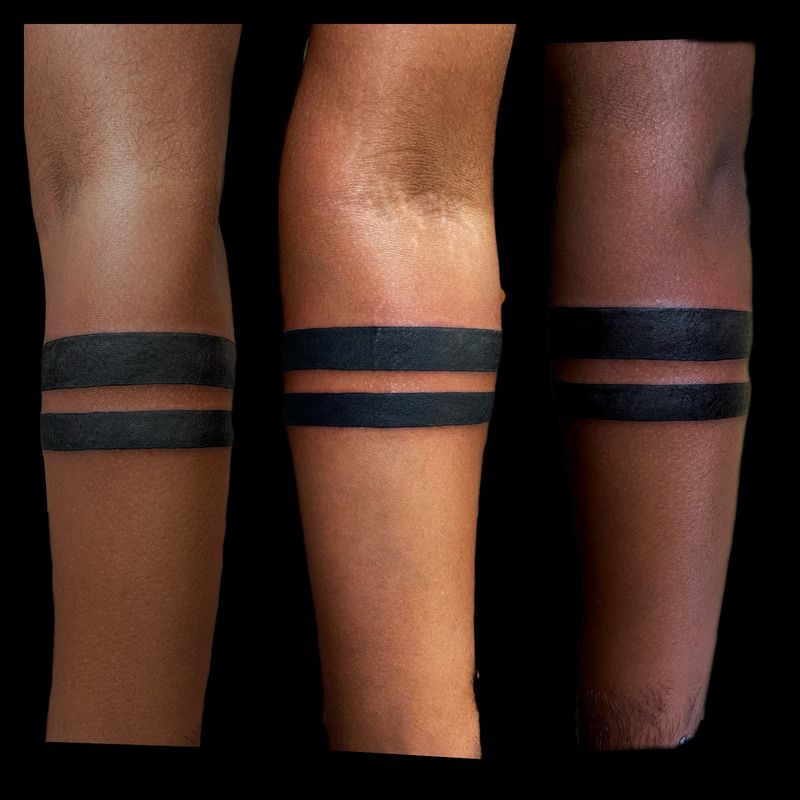
- Armband — the loop closes around the limb rather than sitting on it, so the join is only ever half-visible from any one angle. Forgiving compositionally, demanding on stencil alignment: the band must be perpendicular to the limb's axis, not to the floor.
- Around the elbow — dramatic, and the skin there stretches and folds more than anywhere else on the arm. Interior detail gets compressed when the arm bends. Keep the inner space open and the scale texture bolder than you'd think.
- Forearm circle — the classic. Sits flat enough to read as a ring, curved enough to need on-body layout. Usually the best balance of visibility and healing behavior.
- Sternum — a symmetrical field that suits a symmetrical symbol, and the loop can echo the ribcage. Tender, and chest skin moves with breathing, so the layout has to be checked seated and standing.
- Back of hand, ankle, behind the ear — possible, but these are small-diameter loops, which is where interior detail becomes a long-term risk. See below.
Style: blackwork, fine line, neo-traditional
Blackwork is the most durable answer. Solid black fills, bold contours, scale texture cut as negative space rather than drawn as thin positive lines. A blackwork ouroboros at four inches will still read as an ouroboros in twenty years. It's also the closest match to the woodcut and manuscript sources, if the alchemical lineage is what you're after.
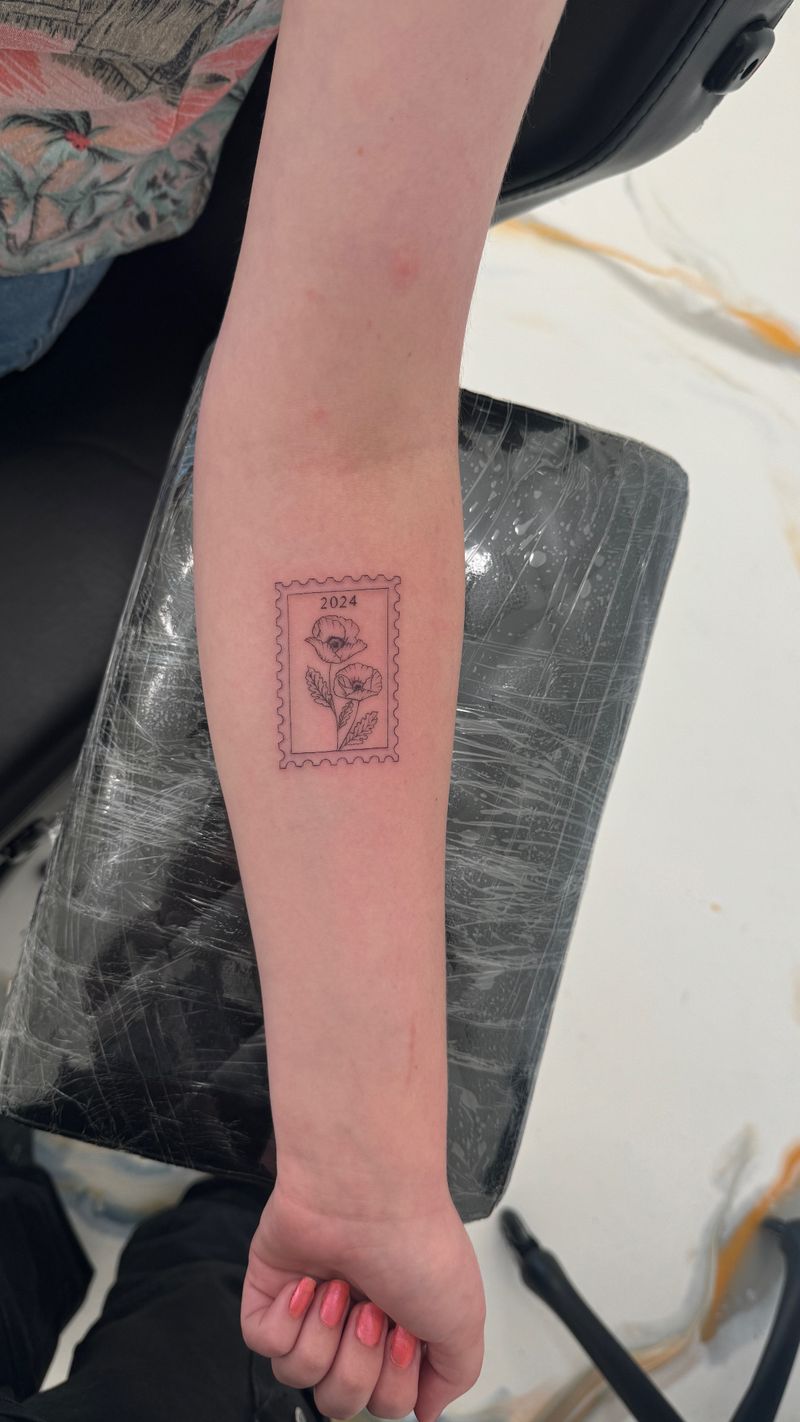
Fine line gives you the delicate, illustrative look a lot of people have in their heads from Pinterest. It's a legitimate choice with an honest caveat: fine line ages by softening, and on a closed loop that softening is uniform around the whole circuit, so the piece doesn't fall apart so much as slowly lose crispness. Keep it larger than feels necessary, keep interior scales sparse, and plan on it reading as a suggestion of scales rather than a count of them at year ten.
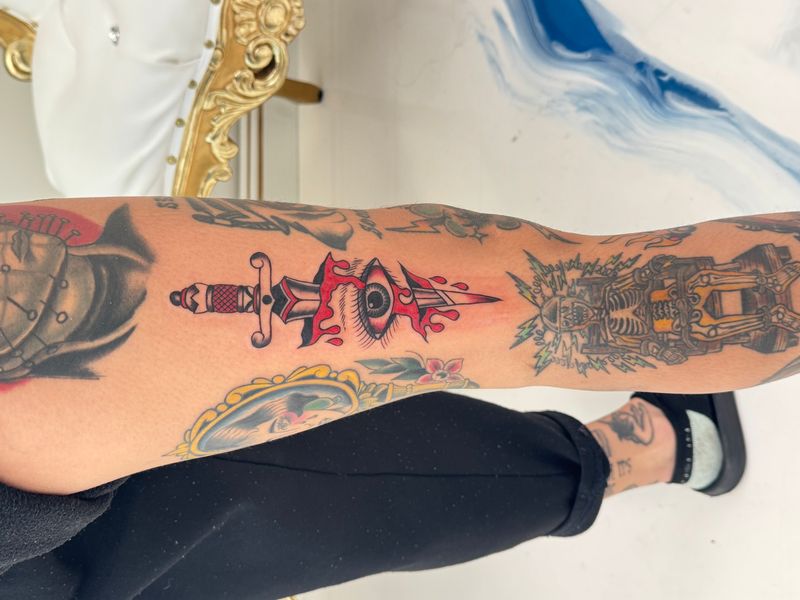
Neo-traditional splits the difference — a heavier outline carrying the loop, saturated color or rich black-and-gray inside, scales rendered with weight variation instead of hairlines. It handles the head-meets-tail junction well because you have contrast tools available beyond line thickness alone.
How scale texture actually ages
This is the single most useful thing to know before committing. Ink spreads slightly in the dermis over decades — the effect is small, but it's the same amount of spread whether your lines are a millimeter apart or three. So tight interior detail closes up first. Densely packed scales at a small scale will migrate toward a solid gray-black mass; the loop survives, the texture doesn't. The fix isn't more skill, it's more space: fewer, larger scales with real gaps between them, and detail concentrated where the eye lands (head, junction, a section of the belly) rather than distributed evenly around the ring. A well-planned ouroboros looks slightly under-detailed on day one. That's intentional.
Scale is the other half of it. A three-inch ouroboros with full scaling is a piece that will need attention in a decade. The same design at five or six inches ages cleanly with no change in style. When we push back on size, this is why — see our tattoos overview for how we approach sizing across styles, or book a consultation and show us what you've collected, including the ones you don't like. Knowing what you're rejecting narrows a symbol this loaded faster than anything else.
Things worth knowing before your ouroboros tattoo
Does an ouroboros tattoo mean something negative?
Not inherently. The dominant historical readings are renewal, cyclical time, and unity — the Egyptian and alchemical sources are about the world being continually remade. A minority of people deliberately use it to mark a self-destructive pattern they've recognized, which is a valid personal meaning but not what the symbol traditionally carries.
What's the difference between an ouroboros and Jormungandr?
Jormungandr is a specific ouroboros — the Norse Midgard Serpent, big enough to circle the world and bite its own tail. The general ouroboros suggests balance and continuity; Jormungandr adds apocalyptic tension, since Ragnarok starts when it releases. If you want the Norse reading, we typically build a heavier, more muscular serpent with visible strain in the coil.
How big should an ouroboros tattoo be?
Bigger than most people initially want, if it includes scale texture. Around four inches is a reasonable floor for a detailed piece; five to six ages considerably better. Below three inches, we'd steer you toward a simplified blackwork treatment with minimal interior detail rather than shrinking a detailed design.
Can it be done as a fine line tattoo?
Yes, and it's a popular choice. Just size it generously and keep interior scaling sparse, since fine line softens as it ages and a closed loop shows that uniformly. A fine line ouroboros will read as elegant and slightly softer at year ten, not broken — provided the spacing was planned for it from the start.
Which placement works best?
Forearm circle and armband are the most reliable — good visibility, predictable healing, and the loop's geometry suits a limb. Sternum works beautifully for symmetry. Around the elbow is striking but demands bolder detail because of skin movement, and small placements like behind the ear limit how much texture you can include.
Why does the stencil take so long for a circular design?
Because a circle drawn flat doesn't stay a circle on a curved limb. We lay out and adjust the loop directly on the body, then check it from the angles other people actually see you from. Rushing this is the main reason circular tattoos end up looking subtly tilted or egg-shaped.
Should the serpent be a snake or a dragon?
Both are historically supported — the alchemical manuscripts show winged, legged, and plain serpent forms. A dragon reads as more ornamental and gives you more visual anchors at the head; a plain serpent is cleaner and closer to the Egyptian and Greek sources. Which one you choose should follow the meaning you're after rather than the other way around.
Does it pair well with other symbols?
It can, but the loop wants to be the frame rather than a background element. The most successful pairings put a second element inside the ring — a phrase, a moon phase, a sigil — which is exactly what the Chrysopoeia of Cleopatra does with <em>hen to pan</em>. Crowding the ring from outside tends to fight the composition.