Tattoo Ideas
Elbow Tattoo Ideas
Skin over the elbow point folds like a paper bag when you bend your arm, then flattens to almost nothing when you straighten it. That one fact drives every decision about an elbow tattoo: which motifs hold up, how much it hurts, and why healing needs more attention here than almost anywhere else on the arm. Here's what we've learned putting elbow pieces on people at our Santa Monica shop.
Book a consultationBend your arm and watch the skin at the point of your elbow. It gathers into thick folds. Straighten it and those folds vanish into a stretched, shiny surface half again as wide as it was a second earlier. No other patch of skin on the body cycles through that much distortion dozens of times an hour, and that is the whole reason elbow tattoos behave differently from everything else you'll sit for.
What elbow skin does to ink
Two very different surfaces meet at the elbow, and artists treat them as two separate jobs. Over the point, skin is thick, dry, often calloused from years of leaning on desks and car doors, and it sits almost directly on bone with barely any fat underneath. Ink there tends to settle a little heavier and a little rougher. The folded texture means a needle can skip if the arm isn't held in exactly the right position, so the arm gets straightened to work on and bent again to check, over and over.
The ditch is the opposite surface. Thin, loose, soft, packed with nerve endings, and it sits over veins and the tendon that comes down off the bicep. It takes ink easily and holds it poorly. Bold work with open spacing survives in the ditch. Hairline detail and delicate grey wash frequently doesn't.
Here's the catch with stencils. A design that looks perfectly placed on a straight arm can land crooked the moment the arm bends, because the skin it's printed on has moved. Elbow stencils get wiped off and repositioned more than anywhere else on the limb. If your artist applies one, has you bend your arm, stares at it for a while and then peels it back off to start again, that's the process working the way it should.
Elbow tattoo ideas that suit the geometry
Over the point: rosettes, mandalas, sunbursts
Anything radial. The point of the elbow is a natural centre, and a design that radiates outward from that centre reads correctly bent or straight, because the stretch happens symmetrically around it. There's a practical reason mandalas and rosettes dominate the elbow tattoo ideas people bring in: a circle pulled into a slight oval still looks like a circle you chose, while a portrait or a block of lettering turns into something you didn't. Sunbursts, compass roses, ship's wheels, spirals, dahlias and dense flower heads all work off that principle.
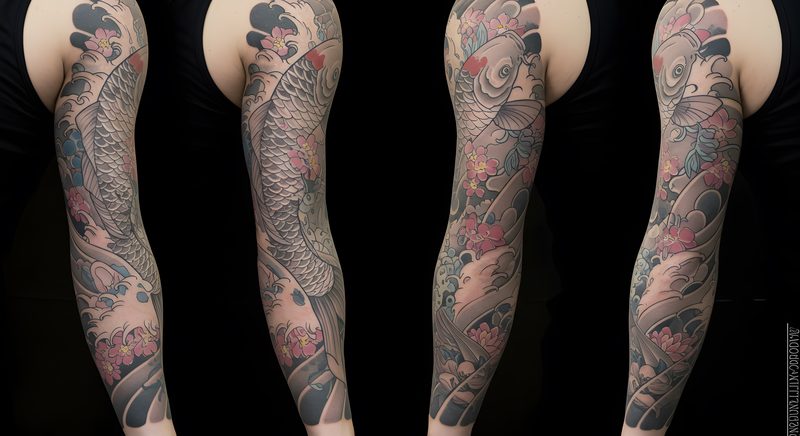
The chrysanthemum deserves its own note. It came into Western tattooing through Japanese work, where kiku turn up across sleeves as both filler and focal point, and its packed layers of petals happen to be close to ideal for an elbow. No long unbroken line to snap at a crease. A strong dark centre to sit over the bone. Petal tips that can shrink as they run out onto the softer skin either side. If you want one motif that has held up on elbows for roughly a century, it's a big flower head.
The spiderweb
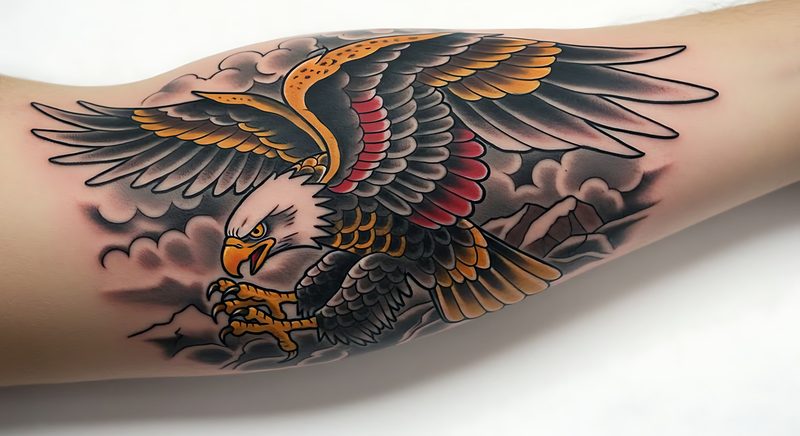
Still the most recognisable elbow tattoo there is, and it fits for the same radial reason a mandala does. Heavy black, wide spacing, nothing small enough to blur. Worth knowing before you sit: in parts of American prison culture an elbow web has carried associations with time served, and some people will read it that way regardless of what you meant by it. Plenty of others wear one with no such intent and never think about it again. We break down what a spider web tattoo means on each placement separately. If the versions you're drawn to are the old bold-line ones, that vocabulary comes out of American traditional tattooing, and looking at that work first will tell you a lot about the line weight an elbow needs.
In the ditch
Snakes are the standby, and for good reason. A snake can follow the tendon line and wrap the joint without fighting the way the skin folds. Moths, bats, ornamental daggers, roses and heavy background filler all show up in ditches in sleeve work because they hold space without depending on small detail to do it. Script in the ditch is a gamble. Thin skin plus constant stretch widens lines over the years, and a word that reads cleanly at six weeks can look furry at six years.
Across the joint rather than on it
Some of the best elbow work isn't really an elbow tattoo. Ornamental bands, cuffs and geometric strips that cross the joint treat the elbow as one section of a longer design instead of a standalone piece. That's usually the right call for anyone already building an arm, and it's a better conversation to have before the first elbow session than after it.
How much an elbow tattoo hurts
Near the top of the arm. Not the worst place on the body, but nobody finishes an elbow and calls it easy.
Split the two zones, because people conflate them constantly when they ask. Over the point, it's bone pain: hard, hollow, rattling, with almost nothing there to absorb the vibration, and you feel it carry up into the joint itself. Sharp rather than burning. Most people find it manageable in bursts and wearing over a long sitting. The funny bone question comes up in the chair nearly every time, so, for the record: the ulnar nerve runs around the inside of the elbow, not over the tip, which is why the electric zap people brace for usually never arrives when you're being tattooed on the point.
The ditch is worse. Ask anybody who's had both. It's a hot dragging burn instead of a clean scratch, there's no bone to brace against, and the nerve supply is dense. Clients who sat a whole outer forearm without moving a muscle will start negotiating twenty minutes into a ditch. Of all the sessions that go into a sleeve, the ditch and the inner upper arm are the two people still talk about a year later.
Things that genuinely change how the session goes:
- Session length. Your arm gets held in an awkward position and it fatigues on its own, separately from the pain. Two to three hours over the point is a sensible block. Full-day elbow sessions are uncommon for a reason.
- Food. Low blood sugar and bone pain are a miserable combination. Eat a real meal a couple of hours before, and bring something sweet for hour two.
- Sleep and alcohol. A short night makes an elbow noticeably harder to sit. Drinking the night before thins your blood, which makes the skin harder to work and the appointment longer.
- Where you are in the piece. Outlining over the point is the sharp part. Packing solid black into an elbow that's already been worked for three hours is where most people find their ceiling.
We changed how we schedule these, and it's worth saying so. Elbows used to get tacked onto the end of a long forearm session, an extra hour or two while the client was already sitting and already numb-ish. We stopped doing that. By hour five there's nothing left in the tank, the elbow is the most demanding surface on the arm, and everybody ends up rushing the part that tolerates rushing least. Elbows get their own appointment now.
Healing an elbow tattoo, which is the part people underestimate
The phases are the same as any tattoo. The elbow just refuses to hold still through any of them.
The first two or three days look ordinary enough. Plasma, some swelling, tenderness that spikes every time you bend the arm. Sleep is the first thing that catches people out, because most of us sleep with our arms folded up, and a fresh elbow will wake you at three in the morning for the first couple of nights. Getting the arm to stay relatively straight overnight helps more than any product will.
Days four through eight are where the elbow goes its own way. Scabs and flaking form over a joint you're bending several hundred times a day, so they split along the crease lines rather than lifting away evenly. The cracking itself is fine and expected. The problem is that flakes on an elbow catch on sleeves, sit in your line of sight all day long, and get picked at without the person really registering that they're doing it. A cracked scab plus a fingernail is the standard route to a patchy elbow and an extra appointment.
Then week two, which is where most elbow aftercare quietly falls apart. People moisturise religiously while the tattoo still looks new and stop the day it stops looking new. An elbow is drier than the rest of the arm before anybody tattoos it, and the skin there gets scraped and stripped every time you lean on a desk or a table or a car window. Keep a light unscented lotion going for a full month rather than ten days. Thin coats, several times a day. A thick greasy layer on a joint that's about to bend mostly ends up inside your sleeve.
Week three brings the messages. The tattoo looks dull, cloudy, oddly patchy along the crease, and the client is certain something has gone wrong. Almost always it's the silvery layer of new skin sitting over a joint that's been flexing nonstop since day one, and it settles down on its own. Judge nothing about an elbow before six weeks, and don't book a touch-up before then either, because tattooing skin that's still resolving wastes the appointment and your money both.
Two more practical points that only really apply here. Wrapping is fiddlier on a joint, and a film dressing pulled tight across a bent elbow will lift or split the first time you straighten the arm, so it wants to go on with some slack in it. And the gym: pushing, pulling and anything loading the triceps drags the healing skin around, plus a bar or a bench pad is not a surface you want that skin pressed into. Lower-body work is usually fine quickly. Give arm training a week or so.
How an elbow tattoo ages
Better than its reputation, provided it was built for the spot. Bold line weight, generous spacing and real contrast are what survive on an elbow, and artists who work them often design with a heavier hand than they would for the outer arm. Detail too fine to read from three feet away won't be there in ten years.
The crease over the point does lose a little crispness with time. That's the trade for putting a tattoo on a hinge. Touch-ups on elbows are routine and are not evidence that anything went wrong. The ditch softens faster than the point does, so anything down there should be designed to still read once it has spread a bit.
Thing is, sun matters more here than people expect. The outer elbow catches roughly the same daily exposure as the back of your forearm, and in this part of California that adds up quickly. Sunscreen on a healed elbow is dull advice, and it's still the habit that keeps one looking sharp.
The elbow as the anchor of a sleeve
Compositionally, the elbow is the hinge of a sleeve. Arms built piece by piece with no overall plan tend to stall right here, because the elbow is the join between two sections drawn at different times, at different sizes, sometimes by different artists. People turn up with a healed forearm piece they love, a clear idea for the upper arm, and nothing at all for the six inches in between.
A radial elbow motif fixes that more easily than anything else, because it has no top and no bottom. It reads as the junction between two sections instead of a third unrelated tattoo, and it gives the eye somewhere to land as it travels up the arm. Ornamental banding around the elbow does the same job in a different accent.
So if a half sleeve is where you're heading, plan the elbow early even if you tattoo it late. Deciding what happens at the joint after both neighbouring sections are healed is how people end up with a filler flower nobody ever wanted.
Getting an elbow tattoo in Santa Monica
Apollo Tattoo is at 2625 Main St in Santa Monica, and we're rated 4.9 stars from 623 Google reviews. Tattoo rates are $100 an hour with Blue, Hannah or Rick, and $350 an hour with Raa or David. If you'd rather work the design out properly before committing to a session, consultations are a $100 fee.
Bring references. Bring photos of your own arm bent as well as straight, because that second view is what decides whether an idea actually works on an elbow. Tell your artist whether this is a standalone piece or the middle of a sleeve you haven't started yet, since those two get drawn very differently. When you're ready, book your appointment here.