How to browse this portfolio
Five reading notes before you scroll the gallery.
A portfolio is not a feed. It's a working catalog. Five reading notes below tell you how to read Blue's book for the style, scale, and placement math that matters to your piece — before you land in the consultation.
Read the portfolio, not the feed.
Instagram favors fresh wraps. This portfolio mixes healed and fresh work on purpose — the healed tiles tell you how the piece settles at 1 year, 5 years, 10 years. Fresh tiles show the day-one read. Both matter; neither alone is the whole picture.
Sort by style, not by motif.
A rose can be traditional, fine line, or realism — three completely different pieces with three completely different aging curves. Before you scroll for motifs, pick a style category. The style is the first design decision, not the motif.
Look at scale honestly.
Blue's portfolio clusters at 3 – 10 inches. Micro pieces under 2 inches are rare because that's not his category. If you scroll and every tile looks bigger than what you want, that's information — your piece may belong on a different bench.
Note the placements that repeat.
Forearm, upper arm, thigh, back panel, ribs. Those five placements anchor 80% of the portfolio. If your placement idea doesn't show up here, the consultation is the conversation — sometimes the placement shifts the piece, sometimes it just needs the right bench.
Pull three tiles into the consultation.
Not thirty. Pick three pieces from the gallery that come closest to the style, scale, and placement feel you want. Bring those three into the consult — Blue will use them as a reference for the design math, not as a template to copy.
Fresh work flatters every artist. Healed work tells the truth. This portfolio shows both on purpose.
Pick three tiles, not thirty. The consultation works best with a tight reference set.
The portfolio is a catalog of pieces that have been lived with — not a feed of what photographed well yesterday.
12 pieces from the portfolio
Each tile, annotated.
Twelve specific pieces from Blue's working book. Each notes the style, the scale, the placement, and the sitting history. Use this catalog alongside the gallery below.
Piece 1 · Fine-line botanical forearm
Single-needle, restrained palette
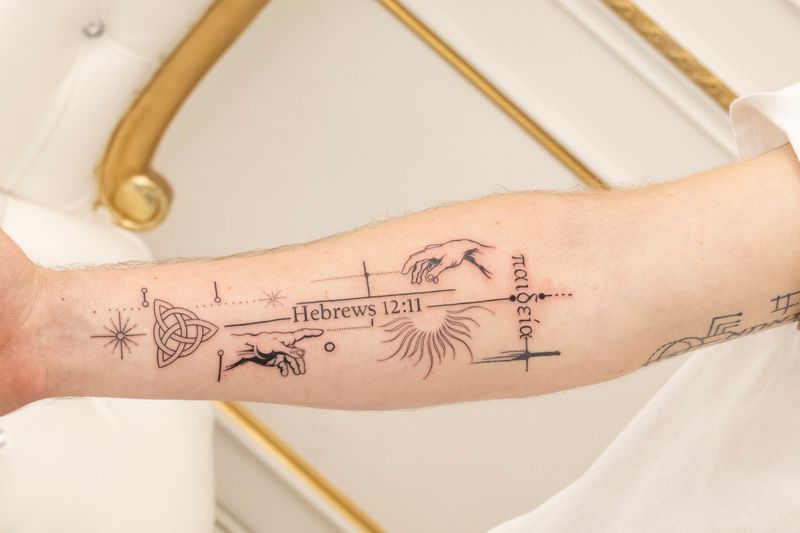
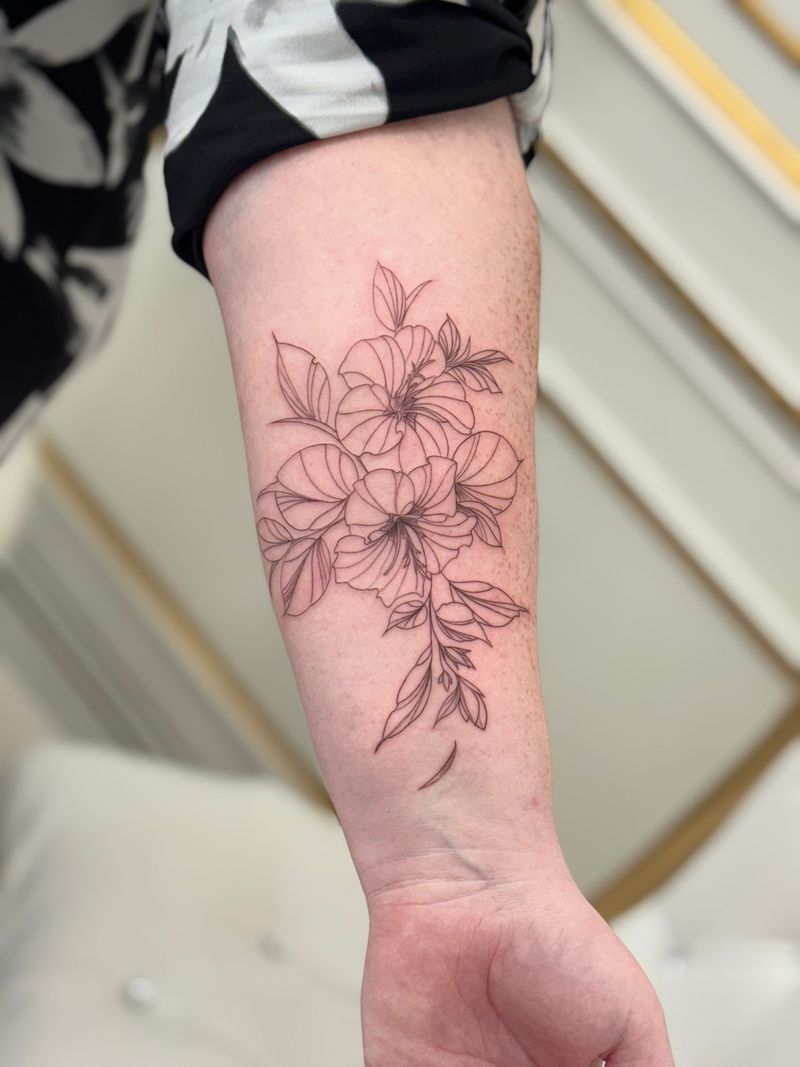
A hairline botanical panel on the inner forearm — the category that anchors Blue's fine-line book. Single-needle work, two passes for depth, no fills. The interior detail reads at arm's length. Healed 2 years at photograph.
Piece 2 · Realism portrait panel
Black-and-gray, specific reference
A grayscale portrait built from a client's family photo. The work Blue's memorial bench is known for. Rendered across 3 sessions; shown here healed at the 6-month mark after the final pass.
Piece 3 · Traditional rose-and-dagger
Sailor-Jerry canon, classical palette
Red, silver, black — the three-color flash palette the style was codified around. Bold outline, flat fill, built to age 40 years. Single session; this tile shows the piece at the 3-year mark.
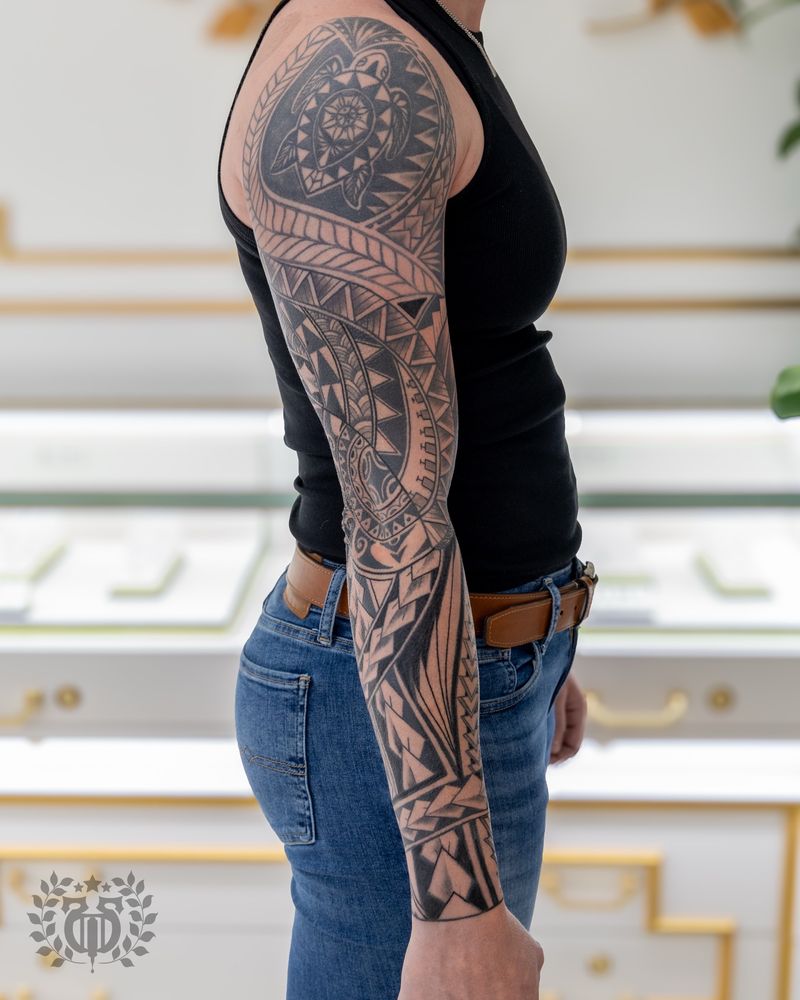
Piece 4 · Tribal shoulder panel
Polynesian-descended negative space
Architectural black-fill work with designed negative space. Reads as silhouette rather than figure. Two sessions; the second session was a saturation pass four weeks after the first. Shown healed.
Piece 5 · Cover-up in traditional
Over existing script, daylight-reviewed
A cover-up where the existing piece was a 10-year-old script tattoo. Route was traditional rose-and-banner, saturation-heavy. No laser needed — the existing ink was light enough to cover directly. One session.
Piece 6 · Black-and-gray thigh statement
Grayscale realism, long-timeline
A thigh-scale realism panel — architectural subject matter, no color. Grayscale ages better than color realism because there's no pigment shift to watch. Four sessions across 6 months. Shown at the 1-year mark.
Piece 7 · Botanical illustration on spine
19th-century plate style
Line-weight that mimics engraving, labeled-looking leaves running along the spine. Different animal from fine line — built for long aging because the whole piece is line-based. Two sessions; shown healed at 14 months.
Piece 8 · Half-sleeve anchor
Planned composition, session one
The anchor piece of a planned half-sleeve — a portrait flanked by traditional flash elements. Shown here at the end of the first session; subsequent sessions filled outward toward the elbow and shoulder.
Piece 9 · Memorial portrait
Black-and-gray, chest-over-heart
A grayscale memorial portrait placed over the heart. Blue's memorial consultation is the longest he books because the design math is different when the subject isn't here to see it. Three sessions; healed 8 months at photograph.
Piece 10 · Traditional full back start
Six-session commitment, session one
The first session of a full-back statement piece. Shown here as outline-plus-anchor — the remaining sessions will fill outward across 6 months. The full composition was sketched before the stencil went on.
Piece 11 · Fine-line script and florals
Hairline script with botanical accents
A fine-line script panel with botanical accents running the length of the ribcage. Single-needle throughout; two passes on the script to stabilize the weight. Shown healed at the 2-year mark.
Piece 12 · Black-and-gray nature scene
Grayscale, upper-arm panel
A nature-scene grayscale piece — mountains, water, architectural elements — built as a single upper-arm panel. Two sessions; this tile shows the piece healed at 1 year after the saturation pass.
Six styles represented
Fine line, realism, traditional, tribal, cover-up, black-and-gray.
The portfolio clusters around six style categories. Pick the one your piece wants to live in. The style is the first design decision, not the last.
Fine Line
Hairline, single-needle, botanical
The dominant LA style of the last decade. Blue's fine-line book sits in botanical, script, and delicate-figurative directions. Honest caveat: single-needle lines age faster than traditional lines. On stable skin — forearm, ribs, sternum — it holds. On high-flex skin, plan for a touch-up at year 7 to 10.
Realism
Photorealistic rendering from specific reference
Portrait, object, or scene realism in black-and-gray or color. Specific reference required — Blue does not freelance realism from memory or a mood board. Realism ages well on stable skin and poorly on high-flex zones. The placement decision is a longevity decision.
Traditional
Sailor-Jerry-descended American canon
Bold outline, flat color fill, the original flash vocabulary. Blue's traditional work favors the original canon. A century of evidence behind the style. If you want a tattoo that will look right in 2055, this is the style that does it.
Tribal
Geometric, architectural, negative-space
Solid black with designed negative-space openings. Blue runs this in Polynesian-descended and geometric-ornamental directions. Reads as shape and silhouette rather than figurative work. Requires healthy skin and even saturation.
Cover-up
Design over existing ink
A design constraint more than a style. Cover-ups work best in traditional or black-and-gray because the line weight and saturation handle the coverage math. Fine-line cover-ups almost never work. The consultation decides whether it's direct coverage, laser-lighten first, or a hybrid.
Black-and-Gray
No color, full dimension
A sub-style of realism, and also its own thing. Photorealism, portraits, architecture, botanical — all rendered in grayscale. Ages longer than color realism because there's no pigment shift over decades. Many of Blue's back-panel and half-sleeve pieces live in this category.
Selected work
Healed work, chronological.
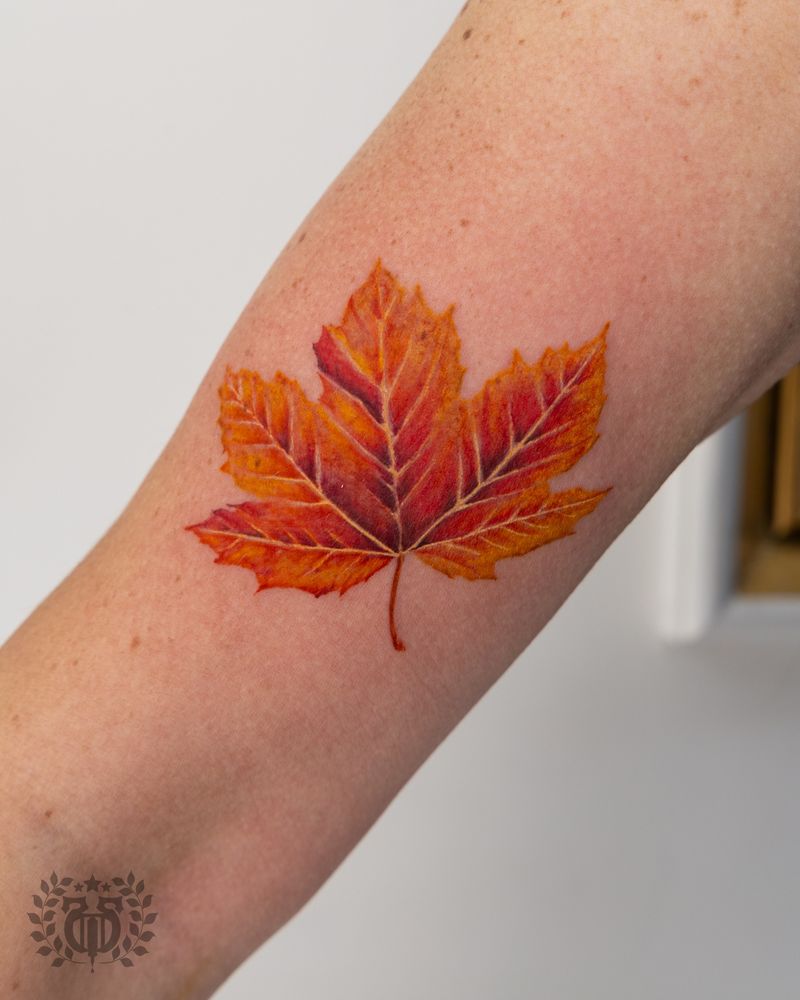
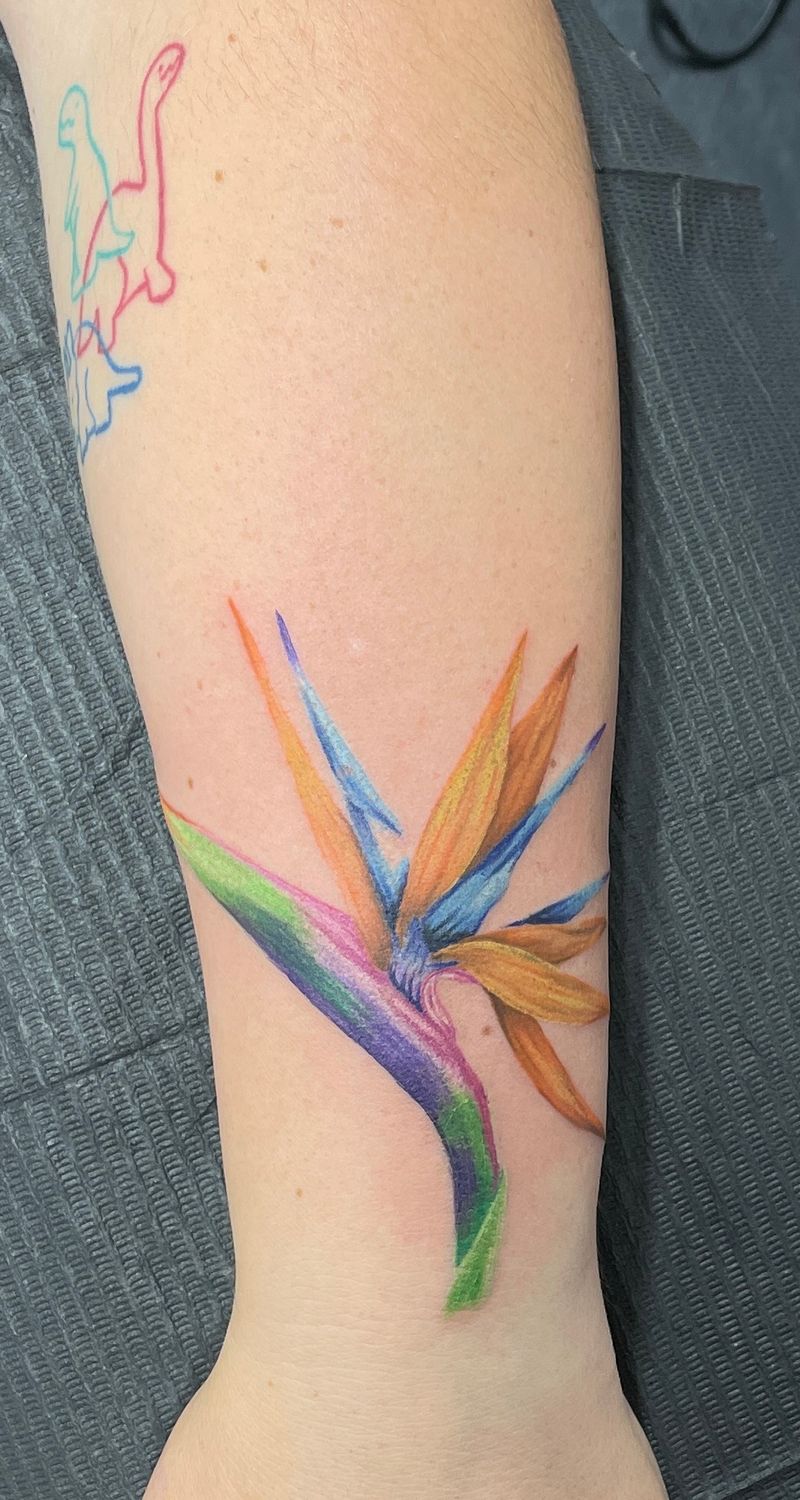
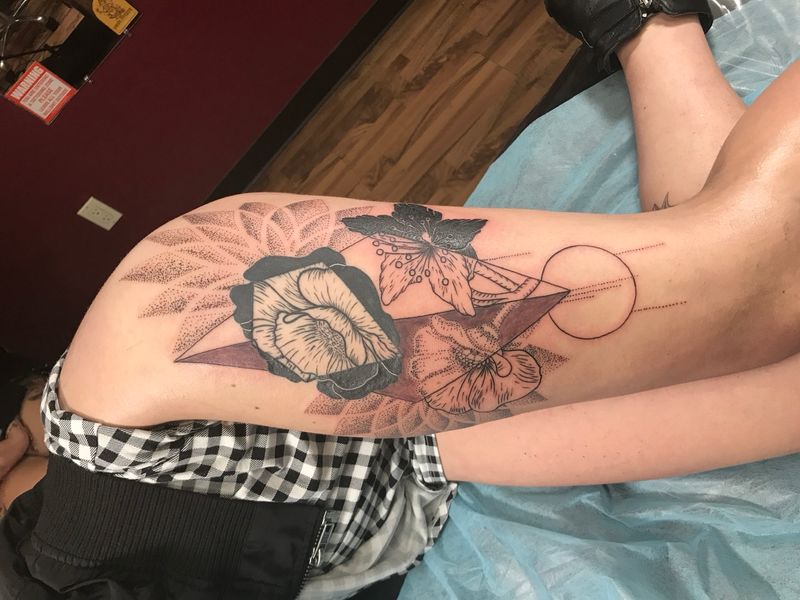
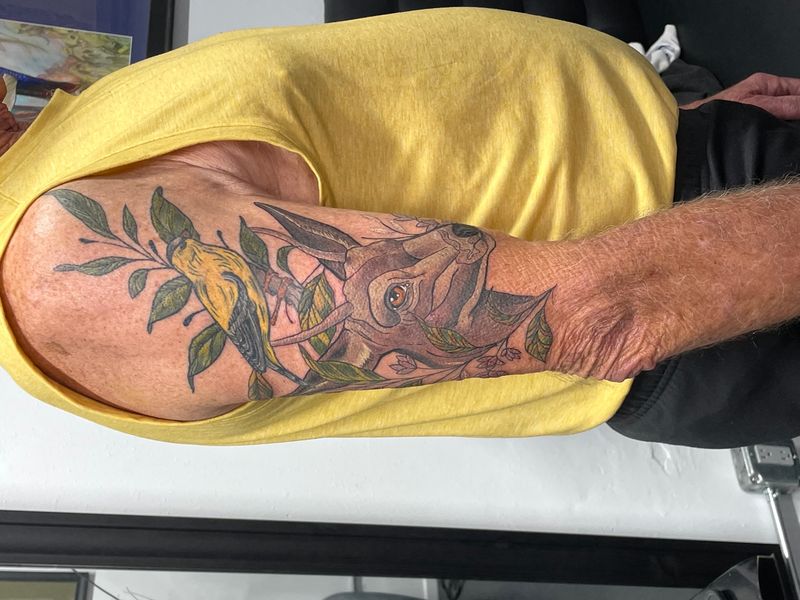
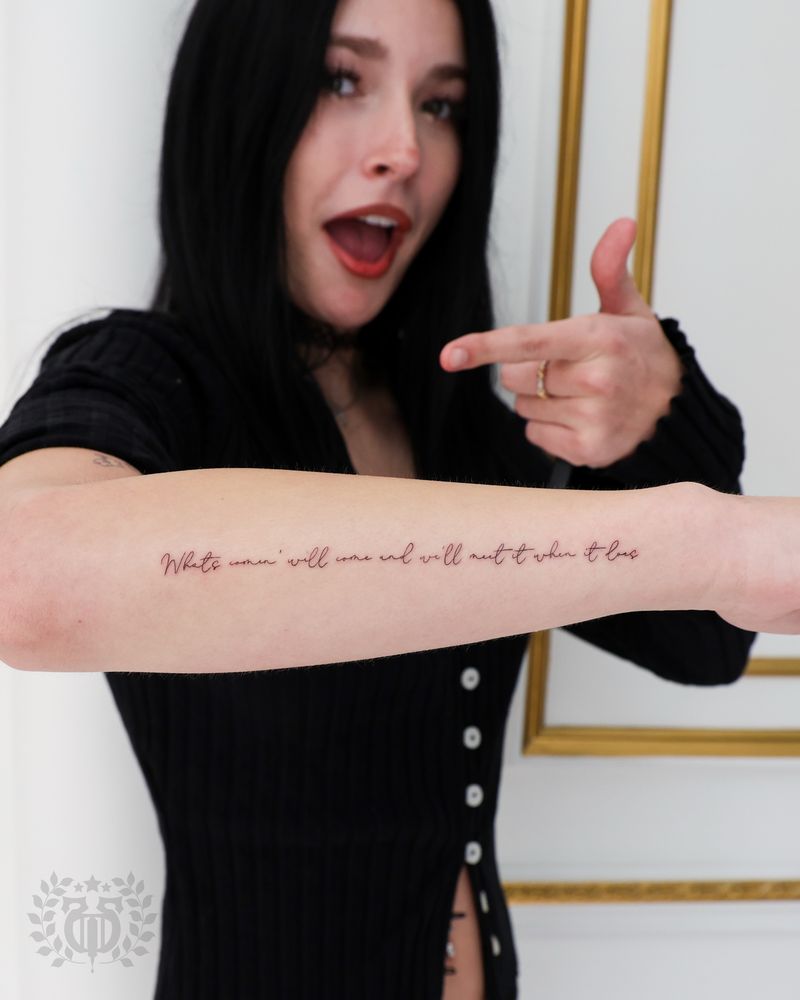
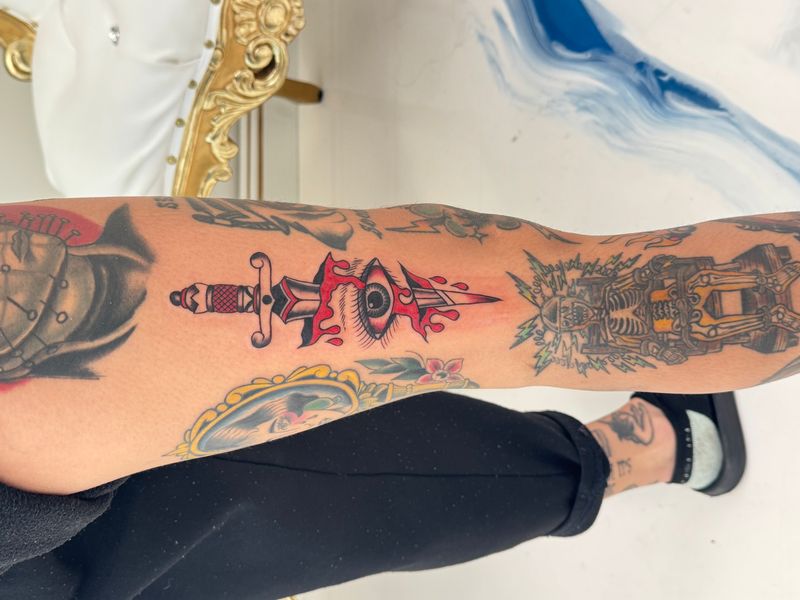
Each piece is a specific appointment — real placement, real healing, real scale. Tiles are sized to preserve the photograph's aspect ratio; see the 12-piece catalog above for exact scale notes.
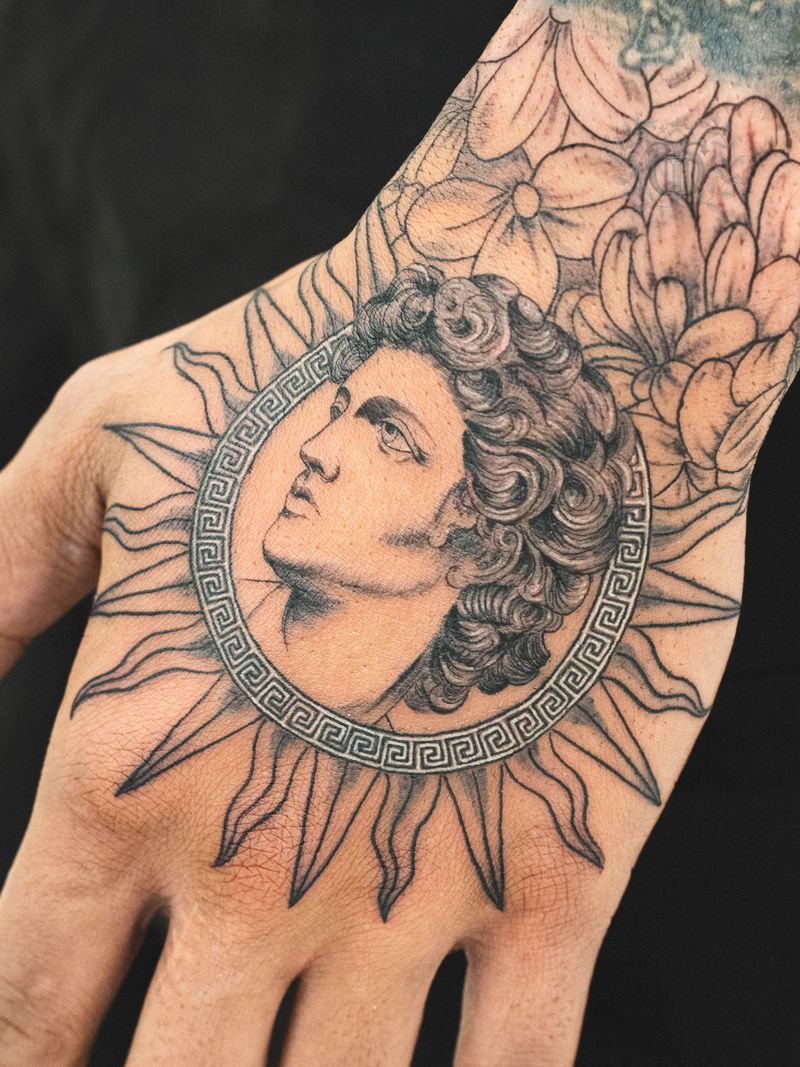
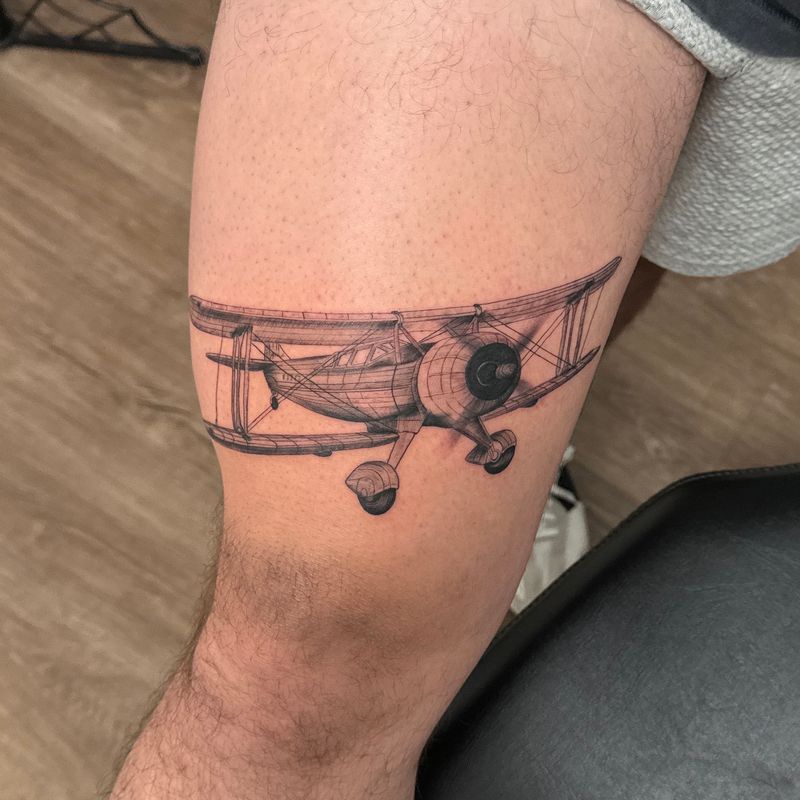
Five placements the portfolio clusters around
Where Blue's work actually lives on the body.
Every portfolio has placements that repeat. Blue's cluster around five body zones. Placement changes the style, the scale, and the healing math.
Forearm
Inner · outer · wrist-to-elbow
Blue's most-booked placement, and the one that shows up most in this portfolio. Every style lands cleanly on the forearm — traditional on the outer, fine line on the inner, realism on either face. Holds color, ages predictably.
Upper arm / bicep
Bicep · outer upper arm · shoulder cap
Traditional and realism territory. Bicep is the classical traditional placement — where the flash canon was meant to sit. Upper arm holds color and detail better than forearm because it moves less. Anchor placement for half-sleeves.
Thigh
Outer · front · inner · full thigh
Blue's long-timeline placement. Thigh handles scale the arms don't — 8-to-14-inch realism, full-composition pairings, botanical panels. Private style, which shifts the design math toward the wearer.
Back / chest panel
Full back · upper back · chest over heart · full chest
Statement work. Back pieces are six to twelve sessions, planned from day one. Chest-over-heart holds memorial style well. Full chest is a career-piece commitment.
Ribs / sternum
Ribcage · sternum · underbust
Private style. Fine-line botanical, script, and delicate illustrative live here. More painful than forearm or thigh, but the placement suits the style — these are pieces for the wearer, not the room.
Scale tiers represented
Four sitting lengths cover everything in the gallery.
The gallery spans one-afternoon sittings through multi-session back panels. Four tiers cover the working math of every piece in the book.
Eight pairing notes
Who this portfolio fits — and where to route when it doesn't.
Blue's bench is not a catch-all. Eight notes below describe who this portfolio is built for and where the studio routes when another bench is the better match.
If photorealism is the priority
Route to Raa, Apollo's dedicated photorealism specialist. The match matters more than the bench — compare his portfolio side-by-side with this one.
If classical portrait is the priority
Route to David DaVinci for fine-arts-trained likeness work. Both Blue and David do portraits; both do them differently. See David's portfolio to compare.
If small fine-line is the priority
Route to Hannah Newman, Apollo's junior artist, whose book is built around small-scale fine line under two inches. Faster calendar, Blue oversees.
Traditional-first clientele
Clients who want a first tattoo that will age 40 years. Steered toward traditional by default because a century of evidence backs the style.
Memorial clientele
Portraits, objects, symbols, script tied to a person lost. Blue's memorial bench is the longest-running at the studio. Unhurried consultations.
Cover-up clientele
Apollo's cover-up clients book Blue by default. Most route into traditional or black-and-gray because those styles handle coverage math.
Half-sleeve / full-sleeve clientele
Clients planning multi-session arm pieces. Blue anchors the sleeve and fills outward across 4–8 sessions. Most pull from realism or fine line.
Returning clientele
Clients who booked with Blue in 2007 and are still booking. Second, third, fourth pieces layered into a career-long collection. The longest relationships in the studio.
Consultation
Six questions to answer before you bring the portfolio into the consult.
The consultation works best when the portfolio is already annotated. Six questions below help you pick the tiles and frame the design math before you walk in.
Which tile from this portfolio is closest?
Scroll the gallery and pick three tiles that come closest to what you want — style, scale, placement feel. Bring those three into the consult. They're a starting reference for the design math, not a template to copy.
What's the sentence?
Describe the piece in one sentence. "It's for my mom." "It's the year I got sober." "It's a cover-up of a name I regret." The sentence is the tattoo. If it takes three paragraphs, the consultation takes three hours.
What's your honest scale ceiling?
How big are you willing to go? How many sessions can you commit to? These numbers set the design math. Blue will not oversell the scale — undersizing a design makes it fail faster than oversizing.
Where does it live?
Placement decision before design decision. A piece for the wearer sits differently than a piece for the room. Visible daily, intimate, statement — placement changes the style, scale, and healing.
What references are you bringing?
Three, not thirty. A good reference set shows the style (not the exact design), the scale, and the placement feel. Blue does not copy other artists' designs.
What's your timeline?
New-client bookings with Blue run 6–12 weeks out. If your timeline is under a month, another Apollo bench often has the window. Memorial or deadline pieces sometimes flex the calendar.
Two decades at the Santa Monica chair. The returning clientele is the proof.
Style before motif. A rose is three different pieces depending on the style it lives in.
The match matters more than the bench. If the portfolio says elsewhere, the studio routes elsewhere.
Common misconceptions
Eight patterns that mismatch a client to this portfolio.
Most mis-bookings with Blue trace to one of these eight patterns. Catching them before the consultation routes the booking correctly on the first try.
"I'll book whoever can get me in this week."
The first-available approach. Apollo has five benches for a reason — portfolios differ. Booking the wrong match is the most common misstep. Fix: pick the bench by portfolio, then wait for the calendar.
"I want a micro-realism piece with Blue."
Under 2 inches is not where Blue's portfolio sits. Micro-realism belongs on a different bench. Fix: scale the piece up to 4+ inches, or route to the right bench for micro work.
"I saved forty Pinterest images."
Forty images, bits from each, asking the artist to combine. Result: a piece that belongs to no specific designer. Fix: three references, not thirty. Say which single element in each is the one you actually want.
"Cover-ups are easy."
Cover-ups are the hardest design problem in tattooing. The existing piece dictates half the math. Fix: come in with daylight photos of the existing work and an open style.
"The fresh-wrap feed is the portfolio."
Fresh work flatters every artist. Every tattoo is a 10/10 at day 1. Fix: ask for healed work at 1-year, 5-year, 10-year. This portfolio shows both on purpose — look at the healed tiles.
"Let's freestyle it in the chair."
Not with Blue, not at Apollo. Every piece gets consulted, sketched, stenciled, approved. Fix: come in with the sentence and the references. The design gets built in pencil before it goes to skin.
"Can you finish a half-sleeve today?"
Large pieces are not one-day jobs. A half-sleeve is 4–8 sessions. A back piece is 6–12. Fix: plan the timeline for the piece, not the piece for the timeline.
"Matching on different days is fine."
Matching pieces drift in line weight and proportion when booked on separate days. Fix: same artist, same day, same stencil. That's the only way matching tattoos actually match.
First-session recipe
If the portfolio matches and this is your first piece, here's the honest recipe.
Eight decisions a first session should make on purpose. Built around a first-time booking with Blue, drawing from the style and scale tiers shown above.
Personalization
Three layers make a Blue piece actually yours.
A style is not a tattoo. A tattoo is a style plus a specific plus a private. Use the gallery to lock the style; the specific and the private get built at consultation.
The style layer
The base design — fine line, realism, traditional, tribal, cover-up. This is the visible layer. It's what a stranger sees. Most clients start and stop at this layer, which is why most pieces end up looking like the style rather than the wearer.
The specific layer
A particular flower from a grandmother's garden, a specific portrait, a dagger shaped like one from a family heirloom, a palette tied to a place. This layer separates the piece from the category. Blue builds this at consultation — it's the work you can't pull from a reference board.
The private layer
What it marks for you. Nobody else needs to know. The private layer is what keeps a piece from feeling generic — even if the design reads as a standard style to strangers, you know what's underneath. Blue respects this layer without asking to see it.
Matching pieces
Family, partners, crews, memorials — matching is its own problem.
Matching pieces are one of the most-requested Apollo bookings. Four notes below cover what Blue asks of matching groups before the stencil goes on.
Family matching
Parents and adult children, siblings, multi-generation pieces. Blue has booked several family groupings. The principle is the same as partner matching — same base, small variation per person, same artist, same stencil.
Partner matching
Couples booking together. Working rule: build the piece so it survives the relationship that inspired it. Not pessimism — design hygiene. A piece that fails if the relationship fails was under-planned.
Crew / team matching
Bands, crews, families of choice. Five-plus people matching is its own problem — the stencil has to hold across differently-sized bodies. Booked as multi-session days, not one-off drop-ins.
Memorial matching
Siblings matching a memorial piece for a lost parent, children matching for a lost sibling. The longest-sitting consultations Blue runs. Unhurried, because the piece has to be right for everyone.
FAQ
The questions every portfolio visit surfaces.
Eight questions covering how to book, which styles the gallery shows, healed vs fresh, palette, scale, whether pieces can be duplicated, what to do when the portfolio doesn't match, and how to bring the gallery into consultation.
How do I book a consultation with Blue after seeing the portfolio?
Apollo consultations with Blue are booked through the studio's consultation form — describe the piece in a sentence, upload 2–3 reference images (ideally including two or three tiles from this portfolio you want the design math to sit near), note your placement and honest scale, and the studio routes the booking to Blue's calendar. New-client consultations run 6–12 weeks out. Come to the consult with the sentence, the references, and the honest scale ceiling. One hour of consultation does a month of design work.
What styles does this portfolio cover?
Fine line, realism, traditional, tribal, and cover-ups — plus black-and-gray as a sub-category of realism. The gallery spans botanical fine line on forearms and ribs, photorealistic portraits and memorial pieces, Sailor-Jerry-descended traditional flash, Polynesian-lineage and geometric tribal, and cover-up work routed into traditional or black-and-gray styles. If your piece is a watercolor splash or a micro-script sleeve, another Apollo bench is the better match. The portfolio is honest about the categories it doesn't serve.
Are these pieces healed or fresh?
Both, on purpose. Fresh work shows the day-one read — the saturation, the line weight, the composition as the piece leaves the chair. Healed work shows the 1-year, 5-year, 10-year read — how the style actually ages on skin. The portfolio mixes both so you can see the full lifecycle of a piece, not just the Instagram moment. Ask Blue at consultation which tiles are healed at what intervals; every piece has a year-and-a-month history.
Does Blue tattoo in color or only black-and-gray?
Both. The portfolio includes classical traditional work (red, silver, black — the flash palette) and grayscale realism, black-and-gray portrait work, and tribal. Color realism is available but less-often booked because grayscale ages longer — there's no pigment shift to watch across decades. At consultation Blue will walk you through which palette the style asks for. For most first-time clients, the style decision comes before the palette decision.
Why are some tiles larger than others in the gallery?
The layout preserves the aspect ratio of the original photograph, which varies piece to piece. A full-back statement photographed vertically looks different in a grid than a forearm panel photographed horizontally. The scale ratio in the gallery is not 1:1 — refer to the scale notes on each piece in the 12-piece catalog above, and ask Blue at consultation for the exact inches. Photos flatter scale; the catalog is honest about size.
Can I book any of these exact pieces?
No. Blue does not duplicate his own portfolio — every piece is designed for the wearer. You can reference a tile for the style, scale, placement, or composition feel, and Blue will build a design that lives in the same neighborhood as the reference. Tattooing the same piece twice on two different bodies is not something Blue does; the work loses its specificity. The portfolio is a catalog of what his hand has made, not a menu of what's available.
What if my piece doesn't match any of these styles?
The studio routes you to the right bench. Apollo has Raa for hyper-realistic portrait work, David DaVinci for classical portraits and color realism, Hannah Newman for small fine-line and script, and two piercers for body work. If your piece is outside Blue's categories, Blue will tell you at consultation and route the booking. The match matters more than the bench — that's the studio's working rule.
How do I bring this portfolio into my consultation?
Screenshot or bookmark three tiles from this gallery that come closest to what you want — ideally covering style, scale, and placement. Note which element of each tile is the one you're referencing ("the palette here", "the line weight there", "this placement feel"). Blue will use those three tiles as a starting point for the design sketch. Three tiles does more work than thirty — the tight reference set forces the design math to converge instead of drifting.
Ready to bring the portfolio into a consultation?
Pick three tiles. Describe the piece in a sentence. Walk in prepared.
Apollo consultations with Blue Mason work best when the portfolio is already annotated. If three tiles from this gallery line up with the style, scale, and placement you want, his bench is the match. If they don't, the studio routes the booking to the right bench.