
Tattoo Lore
Apollo Tattoo Meaning: The God Behind Our Name
What an Apollo tattoo means, from the lyre and laurel to the plague arrows and the myths nobody puts on a postcard, plus how to design one that ages well. Written by the Santa Monica studio that took his name.
People ask about the name all the time. "Why Apollo?" usually comes up while a stencil is going on, and the honest answer is longer than a sentence. So this page does two jobs. It explains what an Apollo tattoo actually means, symbol by symbol and myth by myth, including the parts of his story that are a lot darker than the gift-shop version. And it explains why a tattoo studio on Main Street in Santa Monica decided to borrow his name.
What does an Apollo tattoo mean?
At its simplest, an Apollo tattoo stands for discipline in the service of beauty. Apollo was the Greek god of music, poetry, prophecy, healing, archery and, in later centuries, the sun. What ties all of that together is order. His music was the measured music of the lyre, not the drunken pipes. His prophecy came from a single sanctioned oracle at Delphi. His arrows never missed. Where other Olympians stand for appetite or chaos, Apollo stands for getting it exactly right.
That is why the people who come in asking for him tend to fall into a few recognizable groups:
- Musicians and writers, who want the lyre or the laurel because Apollo led the nine Muses.
- People in medicine, because Apollo was a healing god and the father of Asclepius, whose snake-wrapped staff is still on ambulances.
- Athletes and anyone training for something, because the laurel wreath was the prize at the Pythian Games held in his honor at Delphi.
- Classics people, who usually want a specific statue and can tell you which museum it's in.
- People marking a recovery or a hard reset, who connect with Apollo as the god of light after darkness and of cleansing.
None of those readings is more "correct" than another. Ancient Greeks prayed to Apollo for completely different things depending on where they lived. A sailor, a poet and a city struck by plague would each have described a different god. Your tattoo gets to be specific in the same way.
The symbols, and what each one carries
Most Apollo tattoos are built from a short list of attributes. Knowing what each one means lets you pick the reading you want instead of stacking everything into one crowded design.
The lyre
The lyre is the most Apollo of all his symbols. In the myth, the infant Hermes stole Apollo's cattle, built the first lyre from a tortoise shell and gut strings, and then gave it to Apollo to make peace. So the lyre means music, but it also means a quarrel settled by giving away the thing you made. That second layer is a lovely detail for anyone tattooing it to mark a reconciliation. Practically, a lyre is a good tattoo shape: a strong U-frame with straight vertical strings, readable at three inches and still clean in ten years if the strings aren't drawn hair-thin.
The laurel wreath
The laurel comes from the story of Daphne, a nymph who fled Apollo and was turned into a laurel tree by her father to escape him. Apollo took the laurel as his sacred plant afterward, and victors at Delphi were crowned with it. That gives the laurel a double meaning that is worth knowing before you commit: on the surface it is triumph and achievement, but underneath it is a story about refusal and escape. Some clients pick it precisely for that underside. A laurel is also one of the most forgiving botanical tattoos there is, because the leaves are simple almond shapes that hold up well even at small sizes.
The bow and arrows
Apollo's silver bow means precision. It also means plague. In the opening book of the Iliad, Apollo walks down from Olympus and shoots arrows of sickness into the Greek camp for nine days because his priest was insulted. The god of healing is also the god who sends disease, and the Greeks did not see a contradiction there. If you want arrows in the design, it helps to decide which side you mean. A single arrow loosed upward reads as aim and intent. A quiver or a volley reads more like the Iliad. We have a separate page on three arrow tattoo meaning and another on arrowhead tattoos if the arrow is the part you care about most.
The sun
Here is where a lot of reference images go wrong. In Homer and in early Greek religion, the sun was a separate god, Helios, who drove the sun chariot across the sky. Apollo was identified with the sun later, mostly from the Hellenistic period onward and especially by Roman writers. So an Apollo tattoo with a radiant sun-crown is not wrong, it's just the later, more Roman version of him. If you want the older Greek god, lead with the lyre and laurel and keep the sun as a halo or a background disc. Our sun tattoo meaning page covers the wider sun symbolism if that's the direction you're leaning.
The raven
Ravens were Apollo's messengers. In one version of the story, a white raven brought Apollo the news that his lover Coronis had been unfaithful, and Apollo in his anger scorched the bird black. Every raven since has been black because of it. That makes the raven a very particular Apollo symbol: it is about bad news, truth told at a cost, and anger that you regret. It pairs well with the lyre for people who want the bright and dark sides side by side. Our raven tattoo meaning page goes deeper on the bird itself.
The python and the tripod
Apollo claimed Delphi by killing the Python, a great serpent that guarded the site. The priestess who spoke his prophecies there was called the Pythia, and she sat on a bronze tripod over a crack in the rock. A tripod is an unusual tattoo element, which is exactly why a few classics-minded clients ask for it. A slain serpent beneath Apollo's foot or arrow reads as overcoming something old and monstrous. If the serpent is the part that interests you, read our snake mythology page first, because snakes carry very different meanings once you leave Greece.
Swans
Swans pulled Apollo's chariot to the land of the Hyperboreans, where he spent the winters. They are less common in Apollo tattoos, but they are a soft, elegant alternative to the sun chariot for someone who wants a gentler piece, and they work beautifully in fine line.
The darker myths most people don't know
This is the section that most often changes someone's design, so it gets more room here. Apollo is often sold as the "nice" god: handsome, musical, sunny. The actual myths are rough. Knowing them matters because the person who sees your tattoo and knows the stories will read them into it.
Marsyas. A satyr named Marsyas challenged Apollo to a music contest, pipes against lyre. Apollo won, partly by playing his lyre upside down and singing at the same time, which the pipes couldn't do. Then he had Marsyas flayed alive for daring to compete. Renaissance painters loved this scene. As a tattoo it is a statement about the cost of hubris, and also about the cruelty of perfection. Nobody asks for it casually.
Daphne. Covered above, but worth repeating: the laurel is the trace of a woman who chose to stop being human rather than be caught. Bernini's marble of the moment she turns, with bark climbing her legs and leaves sprouting from her fingers, is one of the most requested classical references there is. It is a gorgeous design. It is not a love story.
Cassandra. Apollo gave the Trojan princess Cassandra the gift of prophecy, and when she refused him, he cursed her so that no one would ever believe her. People who have spent years not being listened to sometimes want her, and sometimes want Apollo's eye or laurel as a quieter nod to the same story.
Niobe. When Queen Niobe boasted that she had more children than Leto, Apollo and his twin sister Artemis killed her children with arrows. It's the story behind the phrase "weeping like Niobe." Rarely tattooed, but it explains why the Greeks saw the twins' bows as something to fear as well as admire.
Hyacinthus. Apollo's beloved Hyacinthus was killed by a discus during a game, and the hyacinth flower grew from his blood. This one comes up with clients who want an Apollo piece about grief and love together. A hyacinth stem in fine line, maybe with a small discus or laurel sprig, is a quiet and very personal memorial design.
Thing is, all of these stories are the same story told different ways. Apollo is perfect, and perfection has edges. That tension is the real meaning of the god, and it's why his tattoos can carry more weight than they first look like they should.
Apollonian and Dionysian: the paired-sleeve idea
In 1872 the philosopher Friedrich Nietzsche wrote The Birth of Tragedy, which set Apollo against Dionysus as two forces in art. The Apollonian is form, clarity, restraint, the single sharp image. The Dionysian is intoxication, music that dissolves you, the crowd losing itself. Nietzsche thought the best art needed both.
That framework turns into a strong tattoo concept, and it's one of the few mythological ideas that actually dictates the composition. One arm or one side carries Apollo: a calm statue head, laurel, lyre, clean geometry, lots of open skin. The other carries Dionysus: grapes and ivy, a theater mask, denser and looser shading. The contrast does the storytelling. If you're planning a full or half sleeve, this gives you a built-in reason for every choice about density and negative space, which is more than most sleeve themes give you.
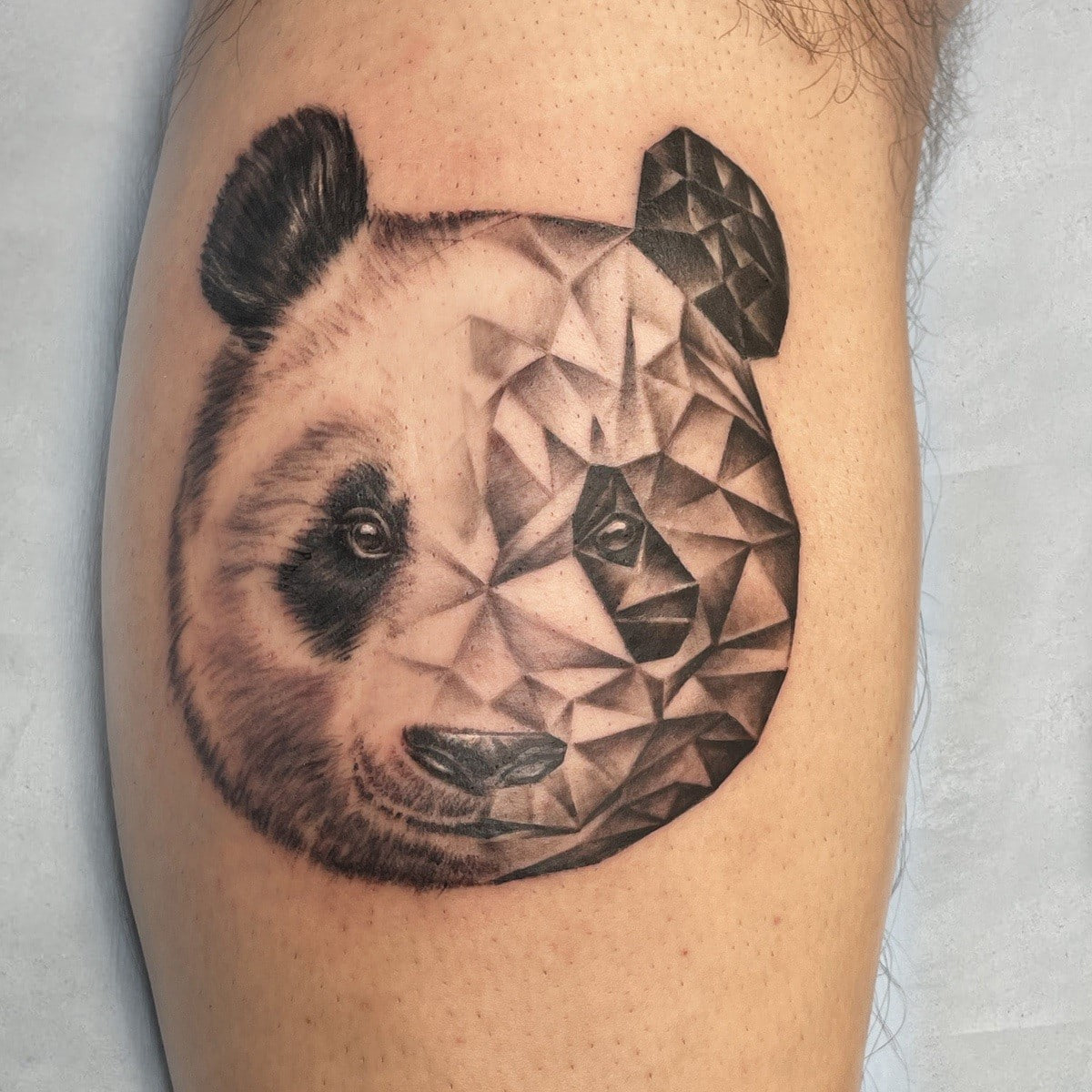
The black and grey panda below isn't Apollo, but it shows the same principle working on skin. One half is soft realism with fur direction; the other half is broken into hard geometric facets. Same subject, two temperaments. That split-down-the-middle idea is how a lot of Apollo and Dionysus pairings get resolved on a single placement when a client only wants one tattoo.
Apollo and Artemis: matching tattoos for twins and siblings
Apollo and Artemis were twins, born to Leto on the island of Delos. He is linked with the sun and the lyre; she is linked with the moon and the hunt. That makes them an unusually tidy pair for matching tattoos: a sun and a crescent moon, a bow for each, or a laurel for one and a cypress or deer for the other. Twins ask for this more than you'd guess, and so do brother-and-sister pairs. Our advice is to give the two pieces the same line weight and roughly the same size so they read as a set, even if the subjects differ.
Design directions that work
Apollo shows up in roughly six visual languages in our consults. Each one changes what the tattoo needs from you in size, time and placement.
Classical statue realism
This is the most common request. Most people bring the Apollo Belvedere, the Roman marble copy in the Vatican Museums, or a crop of Bernini's Apollo and Daphne from the Galleria Borghese in Rome. Statue work lives in black and grey realism, and it rewards size. A face needs room for soft gradients across the cheek and brow, and marble is all about those subtle transitions. Shrink it down and the shading collapses into a gray smudge within a few years. A sensible floor for a recognizable statue face is about palm size, and a half-figure really wants a forearm or larger. Outer forearm, upper arm, calf and the shoulder blade all suit it.
Side note: weathered marble is your friend. Asking for a broken nose or a chipped laurel gives the artist natural places for hard black contrast, which helps the piece hold its read as it ages. Perfectly smooth, perfectly lit marble is the version that softens fastest.
Fine line symbols
A small lyre, a laurel sprig, a sun disc or a single arrow, done in fine line. These are the quiet Apollo tattoos: inner wrist, behind the ear, along the collarbone, the ankle. The meaning is private unless you explain it. The trade-off is that very thin lines spread over the years, so the cleanest results keep each element simple. A lyre with six strings ages better than one with twelve.
Greek pottery style
Black-figure and red-figure vase painting gives you flat silhouettes, profile faces and meander (Greek key) borders. It's a genuinely underused style, and it reads as Greek from across a room. It also ages well, because it's built from solid black shapes rather than fine gradients. A meander band around the forearm or calf, with a figure of Apollo playing the lyre above it, is one of the best ways to do this god.
Neo-traditional
Neo-traditional takes the god and gives him bolder outlines, a framed composition and a richer palette: gold laurel, a warm sun halo, deep blues behind him. It's the most colorful way to do Apollo, and the strong outlines keep it legible for decades.
Geometric and sacred geometry
Because Apollo stands for order and proportion, he suits geometry better than almost any other god. Sun rays become precise linework, the lyre becomes a study in symmetry, and a statue face can sit inside a circle or a hexagon. This style lives or dies on straight lines and true symmetry, so placement matters. Flat, stable areas like the sternum, the upper back and the outer thigh are easier to keep true than a twisting forearm.
Mythic scene work
Full narrative scenes, like Apollo in the sun chariot, the contest with Marsyas, or Daphne mid-transformation, belong on big canvases: a back piece, a thigh, a full sleeve. These are multi-session projects, and the planning conversation is half the work. Bring every reference you've collected, including the ones you think are too much. It's easier to cut back from a full picture than to guess at one.
Placement: where Apollo sits well
- Outer forearm: the default for a statue head or a lyre. Visible, flat enough for shading, easy to heal.
- Upper arm and shoulder: good for a half-figure, and natural for anything with a sun halo since the shoulder cap rounds like a disc.
- Sternum: symmetric designs only. A lyre or a sun with laurel arms spreading toward the chest works well here.
- Back: the only place a full mythic scene truly fits.
- Calf: underrated for statue work. Lots of flat area and a long vertical line for a standing figure.
- Behind the ear, wrist, ankle: single fine-line symbols only.
Before you book: three questions to answer
First, which Apollo do you mean? The Greek lyre-and-laurel god, the Roman sun god, the Delphic oracle, the healer or the archer of the Iliad? Picking one gives the design a center.
Second, how much of the story do you want visible? A laurel sprig on its own is beautiful and almost nobody will read the Daphne myth into it. A statue of Apollo with Daphne turning into a tree tells the whole story to anyone who knows it.
Third, how much space are you willing to give it? Most disappointing statue tattoos aren't badly drawn. They're just too small for the amount of shading marble needs. If you want the face, plan for the face.
Our page on preparing for a tattoo consultation walks through what to bring. Bring the reference you keep going back to, not the one you think we want to see.
Why our studio is named Apollo
We chose the name because of what Apollo actually stood for in the ancient world: a craft taken seriously enough to be sacred. Apollo was the patron of the Muses and of healing at the same time, and a good tattoo studio lives exactly in that overlap. On one side is the art: drawing, composition, knowing how a design will move with the body. On the other is a medical procedure, where clean technique and aftercare decide how the skin heals. The god covered both. So should a studio.
Then there's the discipline. Apollo was the god of "know thyself," the phrase carved at his temple at Delphi, and of measure and restraint. In tattooing that turns into very practical habits: telling a client that their design is too small for the detail they want, redrawing a stencil that's half a degree off, saying no to a placement that won't age well. That's the version of Apollo we try to bring to the chair, and it's also why we back our work with a tattoo guarantee.
And yes, the NASA moon program is named after him too. Abe Silverstein picked the name in 1960 because he liked the image of Apollo riding his chariot across the sun. We'll take the company.
We're at 2625 Main St in Santa Monica, serving clients from across Los Angeles. One client, Cobb R., described us as "Quite literally the nicest tattoo shop I've ever stepped foot in," and the team works hard to keep that true, from the cleanliness of the room to how long we spend on the drawing. If you want an Apollo tattoo, or any piece built from Greek myth, browse our artists and then book a consultation. Bring your references, the myth you're drawn to and the space you're willing to give it, and we'll take it from there.
Apollo tattoo questions we get asked
Is an Apollo tattoo a sun tattoo?
Sometimes. The earliest Greek Apollo was not the sun god; that was Helios. The two merged later, especially in Roman times. A sun halo makes your Apollo more Roman. A lyre and laurel make him more Greek.
What does a laurel wreath tattoo mean?
Victory and achievement on the surface, since laurel crowns were given at the Pythian Games. Underneath, it carries the story of Daphne escaping Apollo by turning into a laurel tree. Many people like having both meanings in one simple design.
What does a lyre tattoo mean?
Music, poetry and harmony. In the myth, Hermes made the first lyre and gave it to Apollo to settle a quarrel, so it can also mean a peace made through a gift.
What is the difference between Apollo and Helios?
Helios was the original Greek personification of the sun who drove its chariot. Apollo was the god of music, prophecy, healing and archery. Later writers blended them, which is why modern reference images often show Apollo with a sun crown.
Can an Apollo tattoo mean healing?
Yes. Apollo was a healing god and the father of Asclepius, the god of medicine. Nurses, doctors and people marking a recovery choose Apollo for exactly that reason.
What does an Apollo and Daphne tattoo mean?
It is usually based on Bernini's sculpture of the moment Daphne turns into a laurel to escape Apollo. It can stand for transformation, escape, unrequited desire or the cost of pursuing something too hard. It isn't a romantic image in the original story.
How big should an Apollo statue tattoo be?
For a recognizable face with real marble shading, think palm size at minimum, and larger for a half or full figure. Small statue faces lose their gradients as the skin ages.
Do you tattoo Greek mythology pieces at Apollo?
Yes. Statue realism, Greek-key borders, fine-line symbols and full mythic scenes are all on the table, and pieces like Medusa tattoos fall in the same family. Book a consultation and bring your references.
