Tattoo Ideas
Matching & Couple Tattoo Ideas
Matching tattoos work best when they're built like a single design split in two, not two copies of the same thing. Here are couple tattoo ideas, placements, and the honest commitment talk before you book.
Book a consultationThere's a reason matching tattoos endure: they turn a private bond into something you both carry, and a good pair reads as a quiet inside joke that strangers don't fully get. The appeal is real and we're not going to talk you out of it. But we will talk you into doing it well, because the gap between a matching tattoo that ages into a story and one that ages into a regret is mostly about how it was planned, not how much you loved each other on the day.
The honest part first. A tattoo is permanent and the relationship status it commemorates may not be. We're not superstitious about it, and "what if we break up" is a worse reason to get a flat, generic design than to get something meaningful you'd still appreciate as an object. The smartest couple and matching tattoo ideas tend to lean on the shared experience (a place, a date, a line you both love) rather than each other's faces or names, because the former keeps its meaning even if life changes. Best-friend and sibling versions sidestep this entirely, which is part of why they've gotten so popular.
The way you avoid cheesy is restraint and intention. Pick one idea and execute it cleanly. Match the line weight, the style, and the scale across both pieces so they look like a set. Resist adding hearts and infinity symbols on top of an already-meaningful design. Below are the directions we reach for most in the studio, with practical notes on what actually holds up.
Complementary halves and two-part designs
Sun and moon
The classic for a reason. One person wears the sun, the other the moon, ideally drawn by the same artist in the same line style so they're obviously a pair. Keep them simple and graphic rather than overloaded with rays and faces, and they still read at twenty years. Works beautifully small on the forearm, ankle, or behind the ear.
Lock and key
A little more literal, which means it lives or dies on the rendering. Go fine-line and antique rather than cartoonish, and skip the heart-shaped padlock unless you genuinely want it. A vintage skeleton key paired with an ornate lock plate reads as jewelry on skin.
Two halves of one image
Split a single drawing down the middle so each person carries half, and the full picture only exists when you're together. A mountain range, a wave, a botanical, a constellation. This is one of the strongest matching concepts because it's structurally about partnership rather than just decorated to look like it.
Two-part scenes that complete when arms touch
A step beyond the split image: design the pieces so they line up into one continuous scene when you press your forearms or wrists together. A horizon, a vine, a circuit, a bridge. Plan placement carefully so the seam meets at a natural resting position, and budget for doing both arms in the same session so the join is exact.
Symbols, words, and coordinates
Matching symbols
A single shared glyph on both of you. A tiny anchor, a mountain, a wave, a paper plane, a specific flower. The power is in choosing something that already means something to the two of you, not pulling a symbol off a chart. One small motif, identical on both, is hard to make cheesy.
Coordinates of a meaningful place
The latitude and longitude of where you met, got engaged, or grew up, set in a clean typeface. Discreet, deeply personal, and unreadable to anyone who doesn't ask. Keep the font small and well-kerned, and have your artist confirm spacing so the numbers don't blur together as it heals and settles.
A split lyric or quote
Take a line that matters to both of you and split it: one person gets the first half, the other gets the second, so the sentence only completes side by side. It's more interesting than each of you wearing the whole quote. Choose a phrase short enough to set in a generous size, because small script is the first thing to fade.
Matching dates and initials in script
An anniversary, a birthday, or each other's initials in a consistent hand. The trick is committing to one lettering style and one size for both. Roman numerals photograph well and avoid the "is that a date or a phone number" problem of plain digits.
Style-led duos
Fine-line line-art duos
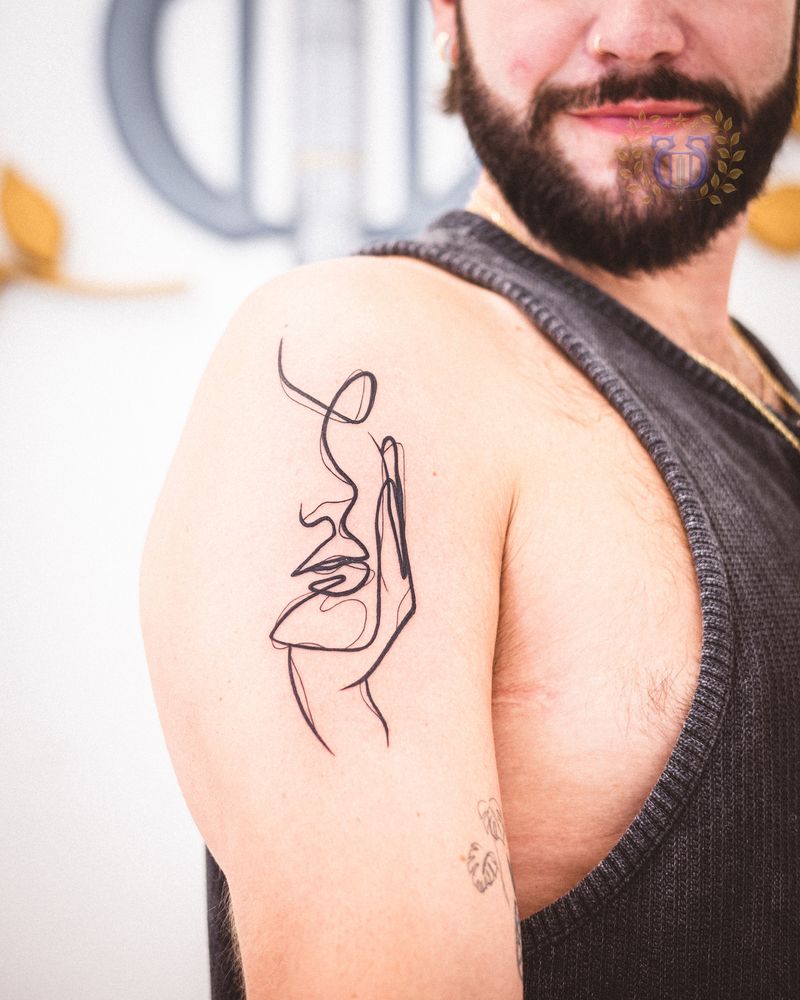
Two single-needle illustrations that share a visual language: matching florals, a pair of birds, two hands, two halves of a heart drawn as continuous line work. Fine-line is elegant and reads as intentional, but be honest with yourselves: very delicate lines soften over years, so go slightly bolder than the reference if you want it crisp at a decade.
His-and-hers (or his-and-his, hers-and-hers) variations
Same core concept, personalized to each person. Same flower in two different blooms, the same animal in two poses, one piece colored and one in blackwork. You keep the obvious link while letting each tattoo suit the wearer. This is often the most satisfying route for couples with different taste.
Colorway coordination
Instead of matching the image, match the palette. Two different designs that share the same two or three ink colors quietly tie together across your bodies. A good option when you each want something distinct but still want a visible thread. Note that colored ink behaves differently on different skin tones, so review the palette with your artist before committing.
Friends, siblings, and micro pieces
Best-friend and sibling versions
Everything above works for platonic pairs, and friendship and sibling tattoos carry less of the "what if it ends" weight. Inside jokes, a shared hometown symbol, a date you both remember, matching tiny objects. Groups of three or more can do a set where each piece is one element of a larger whole.
Micro matching tattoos
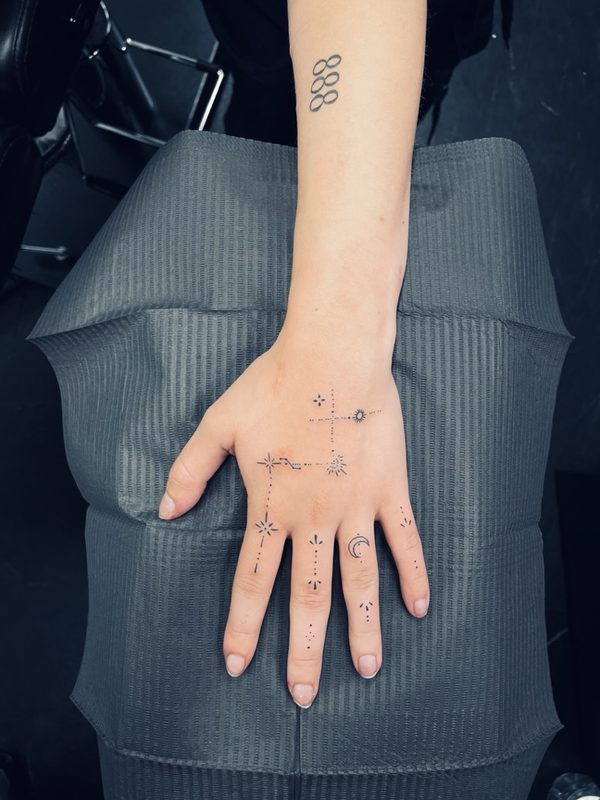
Tiny is having a long moment, and a pair of small, matching symbols is a low-commitment entry point. Keep micro designs simple, because dense detail at small scale blurs as it heals. A clean little shape ages far better than a dense miniature.
Placement, sizing, and aging
Where you put matching pieces matters as much as what they are. Choose placements that "read together" when you're standing or sitting side by side, mirrored inner forearms, matching wrists, the same spot on each ankle. Finger and wrist tattoos are popular for couples and they're genuinely high-maintenance: fingers fade fast and often need touch-ups within a year or two because of constant hand use, so go in knowing that. Inner forearm, ribs, and ankle hold detail much longer.
A few practical notes from the chair. Do both pieces in the same session when you can, with the same artist, so line weight, ink, and scale match exactly; matching tattoos done months apart by different hands rarely look like a true set. Size up rather than down if you're unsure, since fine detail and tiny lettering are the first things to soften over the years. And think about how the two designs sit relative to each other long-term, not just on day one.
If you're in the Santa Monica or greater Los Angeles area and want help turning a concept into two pieces that genuinely belong together, book a consultation with us at Apollo and we'll plan placement, scale, and style across both of you before any needle touches skin. You can also browse our tattoos to see how we handle line work and lettering, or dig into more tattoo ideas if you're still narrowing things down.
Matching pieces are almost always small pieces, and the reason complementary designs outlast identical ones is partly a sizing and aging story. That side of it is covered in our small tattoo ideas guide.
The matching tattoo questions that come up most
Are matching couple tattoos a bad idea if we might break up?
They're only a bad idea if the design depends entirely on the relationship lasting. Choose something rooted in a shared experience, place, or quote you'd still value as a piece of art, and skip names or portraits. That way it ages as a memory rather than a regret.
Should we get matching tattoos in the same session?
Whenever possible, yes. Doing both pieces with the same artist back-to-back keeps the line weight, ink, scale, and style consistent so they actually look like a set. Matching tattoos done weeks or months apart by different artists almost never match as cleanly.
How do we make a matching tattoo look intentional instead of cheesy?
Pick one strong idea and execute it with restraint. Match the style and scale across both pieces, avoid piling on extra hearts and infinity symbols, and lean toward split designs or shared symbols that mean something specific to you rather than generic clip-art.
Do finger and wrist tattoos work for couples?
They look great and are a popular placement, but fingers in particular fade quickly and often need touch-ups within a year or two because of constant hand use. If you want low-maintenance, inner forearm or ankle holds detail much longer while still reading as a matching pair.
What are good matching tattoo ideas that aren't too obvious?
Coordinates of a meaningful place, a split lyric where each person carries half a line, two halves of one image that only complete when you're together, or a shared color palette across two different designs. These read as personal and intentional rather than off-the-shelf.
Do matching tattoos have to be identical?
Not at all. His-and-hers variations, where you keep the same concept but personalize each piece, are often more satisfying, especially if you have different taste. Same flower in two blooms, same animal in two poses, or one in color and one in blackwork all keep the visible link.
How small can a matching tattoo be?
Micro matching tattoos work well as a low-commitment option, but keep the design simple. Dense detail at tiny scale blurs as it heals and settles, so a clean little shape ages far better than a dense miniature. We'll advise on the smallest size your specific design can hold.
Can friends or siblings get matching tattoos too?
Absolutely, and they carry less of the "what if it ends" weight than romantic ones. Inside jokes, a shared hometown symbol, or a date you both remember all work, and groups of three or more can split one larger design into matching elements.