Tattoo Ideas
Traditional Tattoo Ideas
American traditional is the style that gets copied the most and understood the least. The bold outline, the tight color palette, and the flat graphic shapes were not stylistic quirks — they were solutions to the problem of how a tattoo behaves in skin over thirty years. If you want a piece that still reads clearly when you are sixty, this is the vocabulary worth learning.
Book a consultationWhy Traditional Ages Better Than Almost Anything Else
Skin is not paper. Ink migrates slightly, lines soften, and sun exposure fades pigment unevenly over decades. Traditional was built by artists who watched their own work age on sailors and dock workers and adjusted accordingly. Three design decisions do the heavy lifting.
- Heavy outline. A bold black line holds the shape even after the interior blurs. It is the fence that keeps everything else from spilling.
- Limited palette. Black, red, yellow, green, and a bit of blue. Fewer colors means fewer color relationships that can drift apart as each pigment fades at its own rate.
- Flat, high-contrast shapes. No delicate gradients to lose. Value is carried by black shading and open skin, both of which are stable.
The honest trade-off: traditional does not do photorealism, subtle likeness, or fine detail. If you want your dog's exact face, this is the wrong style. What you get instead is a piece that is still legible from across a room in 2050.
The Classic Flash Vocabulary — and What Each Motif Is Actually For
Traditional imagery is a language, not a mood board. Most of these designs carried meaning among the people who first wore them, and knowing the original intent helps you pick something that fits your story instead of just your aesthetic.
Swallow
Historically tied to distance traveled and safe return — a bird that always finds land. It works beautifully as a small first piece because the silhouette is instantly readable at two or three inches, and it looks natural in pairs across the chest or on either side of a forearm.
Panther
The crawling panther, usually snarling and clawed, is about forward motion and aggression. Because it is a long horizontal shape, it wants a long horizontal surface: the outer forearm, the calf, or the outside of the thigh. Panthers crammed into a small square lose the crawl and become a cat blob.
Rose
The most versatile piece in the entire canon. Roses fill awkward gaps, soften a heavy sleeve, and pair with almost every other motif. A traditional rose is built from a few big petal shapes rather than dozens of small ones, which is exactly why it holds up.
Dagger
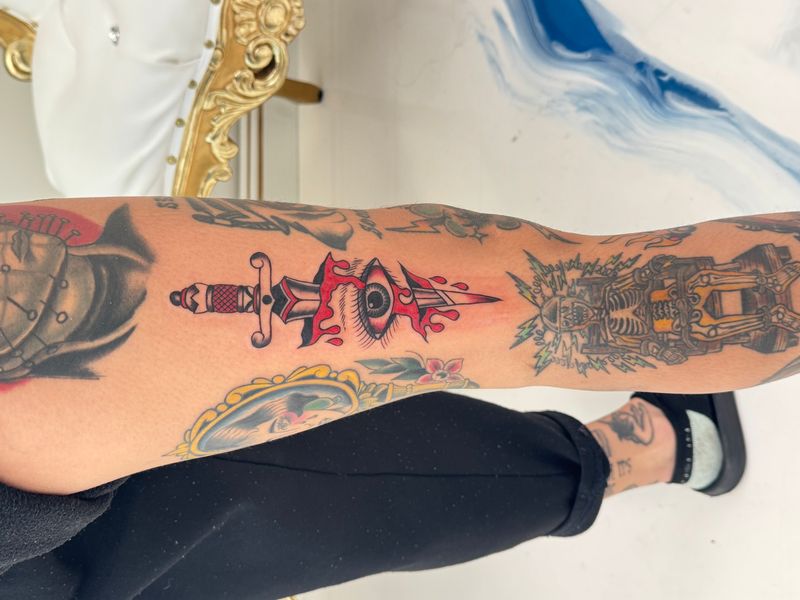
Sacrifice, betrayal, decisiveness — depending on what it is piercing. Daggers are naturally vertical and narrow, so they are made for the inner forearm, the shin, or alongside the spine. A dagger through a rose or a snake is the most common combination for a reason: the straight line needs an organic shape to play against.
Eagle
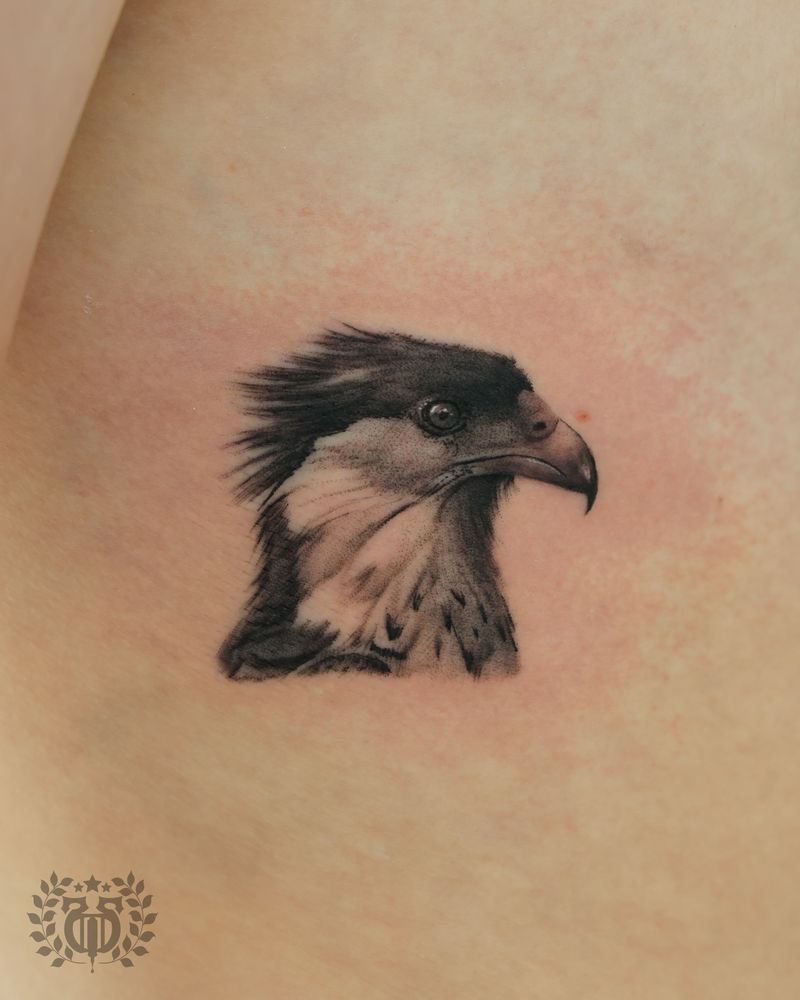
Freedom and patriotism in the original usage, and structurally the biggest commitment on this list. A spread-wing eagle is a chest piece or an upper-back piece. Shrunk down to fit a wrist, the feather work collapses into mush inside a decade.
Anchor
Stability and staying grounded. It is a forgiving design — heavy in the middle, symmetrical, and readable at almost any size — which makes it one of the better small traditional tattoo ideas for someone starting out.
Ship
A ship under full sail means the voyage itself, and it is the most detail-hungry motif in traditional. Rigging, hull, and waves all need room. Plan for a half-sleeve panel, an upper back, or a full thigh, not a forearm patch.
Sizing Rules That Keep a Design Readable
Most disappointing traditional tattoos are not badly drawn. They are correctly drawn and then printed too small. Some working guidelines from the floor:
- Give a bold outline its space. Traditional linework is thick by design. Below roughly three inches, thick lines start eating the interior of the design, and every year of line spread makes it worse.
- Count the elements. A single swallow at three inches is fine. A swallow holding a banner with a name plus a rose at three inches is three designs fighting over the same square.
- Lettering needs more room than you think. Traditional banner script closes up fast. Short words, few of them, large.
- Blow it up, then shrink it. A good artist will show you the stencil at size on your skin before anything permanent happens. If it looks tight on paper, it will look worse in five years.
Placement That Suits Traditional's Flat-Graphic Logic
Traditional designs are flat and frontal. They do not wrap or morph to follow anatomy the way a realism piece can, so the best placements are the ones that give a design a clean, relatively flat plane to sit on.
- Outer forearm and outer upper arm. The classic home. Broad, flat, easy to see, and it ages well because there is less friction and stretching than joints.
- Calf and outer thigh. Excellent for vertical or long horizontal motifs, and easy to keep out of the sun in Los Angeles, which matters more here than most places.
- Chest and upper back. The only honest home for eagles, ships, and large spread compositions.
- Hands, feet, inner wrist, and ribs. Doable, but be clear-eyed: high-friction and high-stretch areas fade and blur faster, and hands especially often need touch-ups. Traditional's bold line survives there better than fine line does, which is exactly why old-school hand tattoos still read.
One more placement note specific to Southern California: sun is the single biggest enemy of color saturation. If a piece will live on a surface that sees daily beach and driving exposure, sunscreen after healing is not optional, and it is worth discussing color choices with your artist up front.
Neo-Traditional: The Color-Expanded Cousin
Neo-traditional keeps the structural discipline — the bold outline, the strong silhouette, the graphic read — and opens up everything else. More colors, varied line weight, deeper rendering, and subject matter that ranges far past the original flash canon: portraits of animals in ornate frames, art nouveau florals, decorative jewelry and drapery.
The trade-off is real. Neo-traditional gives you far more expressive range and usually a more personal design, but the extra rendering and subtler color transitions mean it is less bulletproof over forty years than a five-color classic. It also generally takes longer and costs more, because there is simply more work in it.
A practical way to decide: if the appeal of traditional is the imagery, neo-traditional will probably make you happier. If the appeal is the graphic punch and the longevity, stay with straight traditional and let the simplicity do its job. Plenty of collectors run both, keeping bold classics on high-visibility spots and richer neo-traditional work on larger, more protected panels.
Building a Traditional Collection
Traditional is designed to accumulate. Individual pieces sit side by side with breathing room between them, which is why an old-school arm reads as a collection rather than a single mural. If a full sleeve is the eventual goal, tell your artist at the first piece so placement leaves room for filler — stars, moons, small roses, and black shading that ties everything together later.
Bring reference, but bring the right reference: classic flash sheets rather than a screenshot of someone else's finished tattoo. A good artist will draw you your own version within the tradition. If you want to talk through motif, size, and placement for your own piece, browse our tattoos work or book a consultation at the studio on Main Street and we will map it out on your skin before any needle comes out.
Common traditional tattoo questions, answered
What makes a tattoo "American traditional"?
Bold black outlines, a limited palette of black, red, yellow, green, and blue, flat graphic shapes, and a defined set of classic motifs like swallows, roses, daggers, and anchors. It came out of early 20th-century American shop culture. The style is defined as much by what it leaves out — gradients, fine detail, realism — as by what it includes.
Do traditional tattoos really age better than other styles?
Generally, yes. Thick outlines hold the design's shape as ink spreads over decades, and solid flat color has no delicate transitions to lose. No tattoo is immune to fading, especially with sun exposure, but a traditional piece at forty years old is usually still fully legible where fine-line work of the same age often is not.
How small can a traditional tattoo be?
About two to three inches is a practical floor for a simple single-element design like a swallow, small anchor, or single rose. Below that, the bold outline starts consuming the interior of the design. Multi-element compositions with banners or lettering need considerably more room.
What is the difference between traditional and neo-traditional?
Neo-traditional keeps the bold outline and strong silhouette but expands the color range, varies line weight, adds deeper rendering, and pulls subject matter well beyond the classic flash canon. It is more expressive and more personal, but slightly less bulletproof over the very long term and usually takes more sessions.
Where does a traditional tattoo look best on the body?
Flat, broad planes suit the style's graphic logic best — outer forearm, outer upper arm, calf, outer thigh, chest, and upper back. Large motifs like eagles and ships need chest, back, or thigh space. Hands, feet, and ribs are possible but fade and blur faster, so plan for touch-ups.
Can I get a traditional tattoo in black and gray only?
Yes, and blackwork traditional is a legitimate and very durable approach. You lose the color contrast that separates elements, so the design needs to lean harder on line weight and black shading for its structure. Talk it through in the design stage rather than deciding to drop the color at the last minute.
Do the traditional symbols still carry their original meanings?
The historical meanings are real and worth knowing, but most wearers today choose motifs for personal reasons rather than the sailor-era code. Nobody will assume you crossed the Atlantic because you have a swallow. Knowing the original intent simply gives you a better starting point for picking imagery that actually fits your story.
How do I keep a traditional tattoo looking bold in Los Angeles sun?
Once fully healed, sunscreen on exposed pieces is the single most effective thing you can do — UV breaks down color pigment faster than anything else. Keep the tattoo moisturized, avoid long unprotected beach and pool exposure, and expect that a well-loved piece on a forearm may want a touch-up eventually.