Kink & Ink
Shibari Tattoo Meaning & Designs
What shibari tattoos mean — trust, surrender, and connection — and the rope designs clients ask for most.
Book a consultationMeaning & symbolism
What a shibari tattoo means — and how that meaning becomes a design.
A shibari tattoo takes its meaning from kinbaku (綔緢), the Japanese art of tying, and from the aesthetic ideal the tradition calls kinbaku-bi — the beauty of tight binding. For most wearers the imagery signals some braid of three things: trust (the rope only works when it is given, not taken), surrender (a chosen letting-go, held safely in tension), and connection (the rope as a line between two people, or between a person and a part of themselves). Some clients arrive as practitioners — riggers, rope bottoms, or both — and want a discreet emblem of a practice they study; others are drawn to the geometry first and read up on the lineage before they book. Both are legitimate, and the design choices follow from which conversation you are in.
This page is about tattoo art that references rope — it is not a guide to the practice itself. If you want the full history (the Edo-period hojojutsu roots, the 20th-century kinbaku lineage, the pattern vocabulary and how each ages), read our in-depth rope and shibari tattoos reference. Below is the shorter path: what a shibari tattoo means, the designs clients ask for most, and how to keep the piece exactly as private as you want it.
What does a shibari tattoo mean?
Rendered as ornament, a single rope knot, a diamond hishi lattice, or a body-harness karada reads as decorative geometry to an outside viewer and as a specific rope reference to anyone who recognises the practice. The meaning is not fixed by the symbol — it is set by the wearer. The same futomomo leg-wrap can be a private tribute to a relationship, a mark of a personal aesthetic, or simply a beautiful pattern; naming yours before the consultation is the single most useful thing you can do.
Popular shibari tattoo designs
Seven shibari tattoo designs, and the meaning each one carries.
The rope vocabulary composes across nearly every modern tattoo style, but the variations are genuinely distinct — a single knot and a full-back lattice share a source and almost nothing else. These are the shibari tattoo designs clients ask for most.
The single rope knot
Ornament · the cleanest entry point
One precisely rendered knot — a square knot or a finishing rosette — read as ornament rather than as part of a tie. Carries trust and intention in the smallest possible mark. Two to four inches, fine line or blackwork, at home on the inner forearm, sternum, or behind the ear.
The hishi diamond lattice
Ornament · hishi (菱) means diamond
A geometric grid of rope diamonds with knot rosettes at the intersections and no body underneath — structure and repetition as the whole meaning. Six inches and up; below that the geometry compresses to noise. Chest, sternum-to-navel, or a back panel.
The karada body harness
Trompe-l'oeil · the ‘rope dress’
The karada (体) diamond harness drawn onto the torso as if worn — the design that most directly speaks to surrender and being held. Frames the lumbar curve or stretches across the back. Multi-session at full scale; the lattice rewards being seen at full size.
The futomomo thigh wrap
Trompe-l'oeil · single-leg pattern
The futomomo (太臣) leg tie rendered as a decorative wrap that follows the thigh's curve, ending in a terminating rosette. Reads as ornament; carries the intimacy of the tie for those who know it. Five to eight inches, fine line or blackwork.
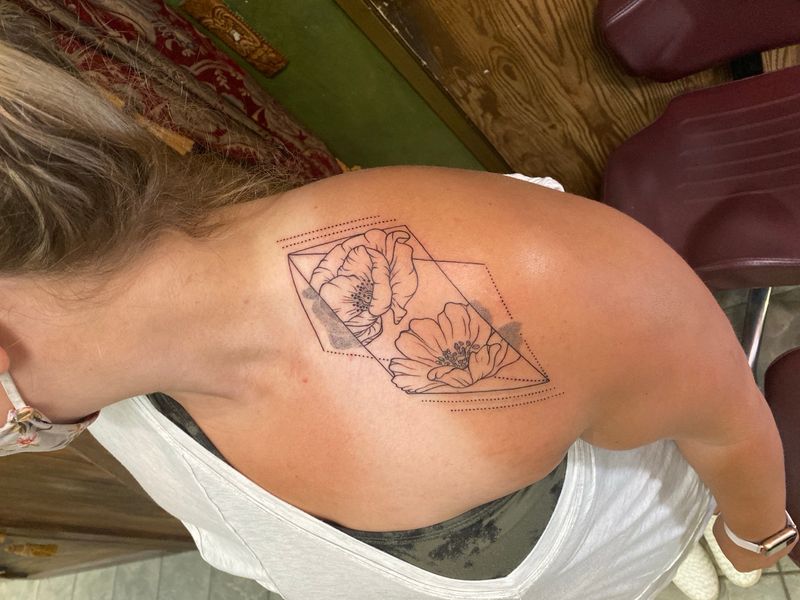
Rope and peony
Ornament · the Japanese-canon pairing
Rope geometry paired with a peony, chrysanthemum, or cherry blossom — the flower softens the pattern and lets the rope read as composition rather than harness. Neo-traditional or Japanese-influenced. If the piece leans into the Japanese-traditional canon, book an artist who specialises in irezumi.
The minimal rope line
Ornament · the most discreet option
A single curving line that references rope without an explicit knot — reads as abstract drawing to everyone except those who know the practice. The quietest way to carry the meaning daily. Fine line, two to four inches, on the inner forearm, ribcage, or inner thigh.
The matched knot pair
Ornament · same knot, two wearers
Two identical rope knots on partners — same artist, same day, same stencil — often on mirrored placements. Here the matching is the meaning: connection made execution-identical. See matching and commemorative kink tattoos.
Want the full working catalog — twelve design directions, six style approaches, scale honesty, and how each ages on the body? Our rope and shibari tattoos reference goes deeper on every option above.
Choosing a style
Which tattoo style suits a shibari design?
Rope geometry is unforgiving of line wobble, so the style you choose does as much work as the pattern. Three approaches cover most shibari tattoos.
Fine line / single-needle
The dominant contemporary choice for single-knot and small pattern work — hairline clarity, no fill. Cleanest on stable skin (forearm, ribcage, sternum). Parallel rope lines drift toward each other as ink settles, so touch-ups every several years are normal.
Blackwork
Solid black rope and full-fill knots — the readability winner for hishi lattices and karada panels, where intersecting line work needs bold weight to stay legible over time. Ages slowly because there is no thin outline to soften.
Neo-traditional & Japanese-influenced
Heavier outline, dimensional shading, and botanical pairings (peony, chrysanthemum, koi) that let the rope read as ornament. For a piece that genuinely sits in the Japanese-traditional canon, book an irezumi specialist rather than a generalist.
Placement & discretion
Where to place a discreet shibari tattoo.
Placement decides two things at once: whether the geometry holds, and who gets to read the piece. Rope pattern work asks for surfaces that hold the pattern — flat-ish, stable skin like the forearm, ribcage, upper back, and thigh, rather than high-flex zones. For discretion, the inner forearm, ribs, sternum, upper thigh, and the back of the neck under hair all sit inside what a shirt or collar covers, so a small knot or minimal rope line stays private by default and reveals only on your terms. A full-back karada lattice is unmistakable to a knowledgeable viewer; a two-inch inner-forearm knot reads as ornament to everyone else. Walk through your week — what you wear, who sees what — with the artist before committing. Our guide to placement and visibility control covers coverable zones and sizing in depth, and every consult here is private and judgment-free — see what a kink-affirming consultation contains. The subject matter is 18+; mention any discretion preferences early.
Shibari tattoo FAQ
Common questions about shibari tattoo meaning and designs.
What does a shibari tattoo symbolise? Most often trust, surrender, and connection, together with kinbaku-bi — the beauty of tight binding. The precise meaning is set by the wearer, not the symbol; the same design can be a relationship tribute, a personal aesthetic, or simply beautiful geometry.
What is the difference between shibari and kinbaku? Shibari (締り) means “to tie” in general; kinbaku (綔緢) means “tight binding” and is the term most used in Japan for the erotic rope-art tradition. English-speaking communities adopted “shibari” in the 1990s and now use the two words interchangeably. Our rope and shibari tattoos guide unpacks the history in full.
Can a shibari tattoo be subtle? Yes. A single rope knot or a minimal rope line at two to four inches, placed on the inner forearm, ribs, or behind the ear, reads as ornament to an outside glance while carrying specific meaning to you. Fine-line and blackwork styles keep it quiet.
How big does a shibari tattoo need to be? A single knot works at two to four inches. A futomomo wrap needs at least five; a hishi lattice needs at least six before the repeating geometry reads clearly. A full karada or back panel runs twelve to sixteen inches. Your scale sets your design, not the other way around.
Do I have to practise rope to get a shibari tattoo? No. We tattoo the design you bring and walk you through the lineage so the choice is informed — whether the imagery fits your own relationship to the practice is genuinely yours to decide. Most clients drawn to the form aesthetically choose pattern-only renders that read as ornamental geometry.
Ready to plan yours? Book a consultation or explore the full Kink-n-Ink series. You can also call the studio directly at (310) 331-0605.