
From the Studio
Best Hypoallergenic Earrings for Kids
What a child's fresh ear piercing really needs: the right metal, the right back, the right post, and when it's finally safe to switch to fun earrings.
Most parents who ask us about "hypoallergenic earrings for kids" have already bought a pack online, or they're holding one up at the counter and asking if it's okay. Sometimes it is. Often it isn't, and the reason usually has less to do with the metal than with the back, the post length, or the timing of the swap. This guide covers all of it: what a fresh piercing actually needs, what the labels on earring cards really mean, and when your child can finally wear the sparkly pair grandma sent.
One scope note before we start. This page is about a child's first earrings in a new lobe piercing and the first few changes after it. If you're an adult with reactive skin, or your child's ears are long healed and you're troubleshooting a reaction, our guide to jewelry for sensitive skin goes deeper on alloys and testing.
The Short Answer for Busy Parents
If you only read one section, read this one. For a fresh piercing in a child's earlobe, the safest setup is:
- Metal: implant-grade titanium certified to ASTM F-136 (the international equivalent is ISO 5832-3), or solid 14k or 18k gold that's specifically nickel-free. Not plated, not filled, not "surgical steel."
- Back: a flat-back labret stud, where a smooth disc sits against the back of the lobe. Not a butterfly (pinch) back.
- Post: slightly long at first, to leave room for swelling, then shortened at a downsize visit around week 6 to 8.
- Top: small and low-profile, with a bezel (metal rim) setting rather than claw prongs if there's a gem.
- Shape: a stud. No hoops, huggies, or dangles until the piercing has fully healed.
The rest of this guide explains why.
"Hypoallergenic" Is a Marketing Word
Here's the thing most parents don't know: in the US there's no legal standard for calling jewelry "hypoallergenic." No agency tests it, and no minimum material requirement comes with the word. A card of earrings can say hypoallergenic, nickel-safe, or sensitive-ears-friendly and still be plated base metal. The word describes an intention, not a material.
So swap the word for questions that have checkable answers:
- What exactly is it made of? "Titanium" isn't enough. Ask for the grade: ASTM F-136 (sometimes written Ti-6Al-4V ELI) is the implant specification. A seller who knows the material will name it without hesitating.
- Is there a mill certificate? Reputable body-jewelry manufacturers buy their raw metal with documentation from the mill that produced it, and professional studios can show you that paperwork or the manufacturer's spec sheet. Ask to see it. A good studio won't be offended.
- If it's gold, is it solid, what karat, and is the alloy nickel-free? White gold in particular has historically been whitened with nickel. Modern nickel-free white gold uses palladium or platinum instead, but you have to ask.
- Is the whole piece the same metal? A titanium post with a decorative top that's glued, plated, or made of something else isn't a titanium earring where it matters most, which is wherever the metal touches skin.
If the answer to any of these is a shrug, treat the jewelry as unknown metal. Unknown metal doesn't belong in a fresh wound.
Nickel Allergy in Kids: What Parents Should Know
Nickel is the metal behind most jewelry reactions. A nickel reaction isn't the instant, dramatic kind of allergy people picture. It's a delayed contact dermatitis: the immune system learns to recognize nickel bound to skin proteins, and the itchy, red, weepy reaction shows up hours to days after contact, right where the metal sits.
Two things about it matter for parents.
First, sensitivity is usually acquired. A child isn't simply born with or without it. Repeated contact with nickel can sensitize the skin, and once that happens it tends to stick around for life. A fresh piercing is about the most direct contact skin ever has with metal, because the jewelry sits inside an open wound bathed in fluid. That's exactly why the first earring is the one worth getting right. You're not just healing a hole; you may be preventing a sensitivity your child would otherwise carry into adulthood.
Second, because the reaction is delayed and local, it's easy to misread. A lobe that turns red and itchy a few days after a new pair goes in gets blamed on "healing," on shampoo, or on the child touching it. The earring is often the last suspect anyone checks. If your child has ever reacted to a belt buckle, jeans snap, or watch back, mention it before the appointment and stick to titanium.
We're a piercing studio, not a medical office. If you suspect a true allergy, your pediatrician or a dermatologist can confirm it with patch testing.
The Materials, Ranked for a Fresh Piercing
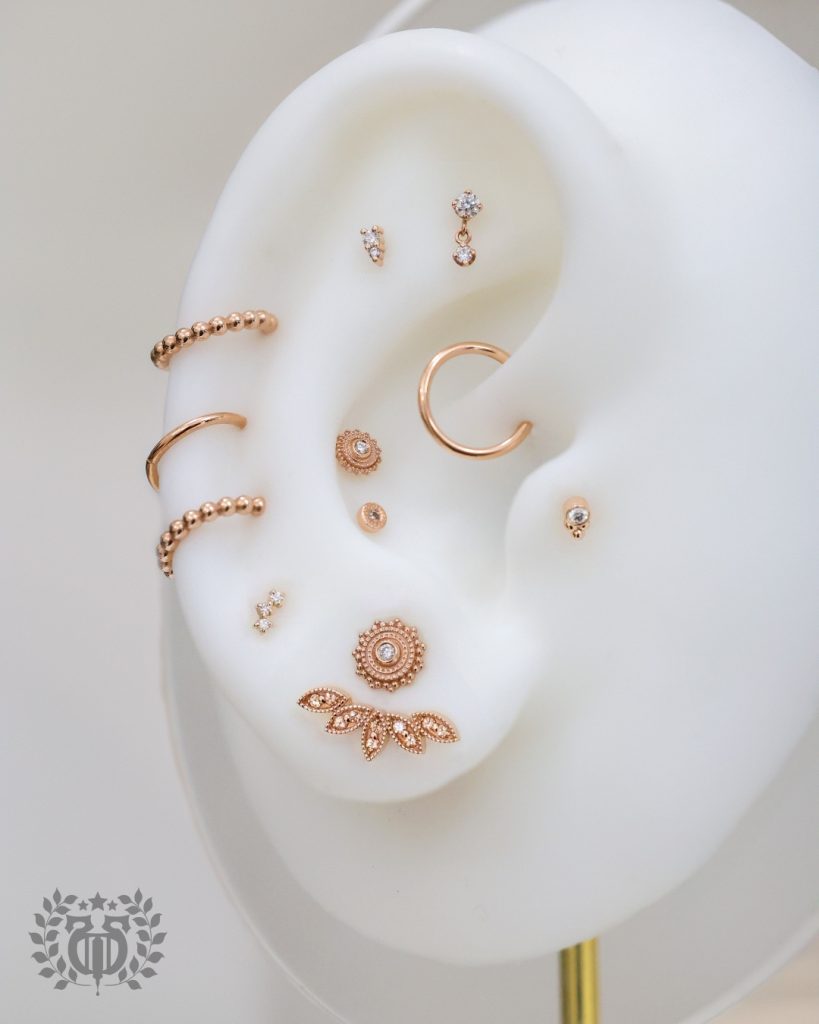
The display ear above is a good example of where kids' jewelry can end up, years from now, once everything has healed. A first piercing is much plainer. Here's how the metals line up when the hole is brand new.
| Material | Fresh piercing? | Honest trade-offs |
|---|---|---|
| Implant-grade titanium (ASTM F-136 / ISO 5832-3) | Yes, the default | Very light, nickel-free in practice, and it can be anodized to gold, rose, blue, or purple with no coating to wear off. Plain silver-gray unless anodized; some kids want "real gold" and that's a fair preference. |
| Solid 14k or 18k nickel-free gold | Yes, when the alloy is confirmed | Looks like the earrings kids have seen on grown-ups. Heavier and softer than titanium, and the alloy has to be specifically nickel-free. Higher cost. |
| Niobium | A specialist option | Very inert and colorful when anodized. Denser than titanium, and fewer children's styles are made in it. Most useful for kids who've reacted to other metals. |
| Gold-plated, gold-filled, vermeil | No | A thin gold layer over another metal. The layer wears, and whatever's underneath ends up in the wound. |
| "Surgical steel" (unspecified) | No | Not a regulated term. Many steels contain nickel; even the true implant steel (ASTM F-138) does. |
| Sterling silver (.925) | No (fine later) | Tarnishes and oxidizes in body fluid. Fine for occasional wear in fully healed ears. |
| Acrylic, plastic, "bioplast" fashion studs | No | Porous surfaces hold bacteria, and they can't take the sterilization a fresh piercing calls for. |
Implant-grade titanium
Titanium is what we install for most kids, and it's what we'd pick for our own children. The F-136 alloy is the same specification used for surgical implants. It's extremely corrosion-resistant in the body, it weighs almost nothing, and it doesn't rely on a coating. When titanium is anodized to a color, the color is a thin oxide layer grown from the metal itself, not paint, so there's nothing to chip off into the piercing.
The catch is that "titanium" on a retail listing doesn't always mean implant-grade titanium, and counterfeit titanium is common on big marketplace sites. The metal you can't verify is the metal you should assume isn't there.
Solid nickel-free gold
Solid 14k or 18k gold is a perfectly good first earring when the alloy is right, and plenty of families choose it because a gold stud is what the child has been dreaming about. At Apollo, gold goes in on request; titanium stays the default. Higher karat means less alloy metal mixed in, so 18k is the slightly safer choice for a child with a history of reactions. Gold is softer than titanium, though, so a tiny 18k piece on a busy seven-year-old will pick up scratches faster.
Watch the wording. "Gold" alone, "14k GP," "gold filled," "vermeil," and "gold tone" all mean some other metal is doing the structural work. For a fresh piercing you want solid gold all the way through the post.
Niobium
Niobium is a solid choice that rarely comes up in kids' jewelry conversations because so few children's styles are made in it. It's essentially inert and anodizes into bright colors kids love. It's denser than titanium, so a same-size piece feels a touch heavier. We see it most with children who've already had a reaction and need a metal with a clean track record on their skin.
The ones that look safe but aren't
Plated, filled, and vermeil gold. These are the most common "nice" earrings in gift boxes. The gold layer is thin, and a healing piercing is a wet, warm, moving environment that wears plating faster than a healed ear ever would. Once the base metal is exposed, it's sitting in the wound. That base metal is very often brass or a nickel-containing alloy.
"Surgical steel." This label is the one we most want parents to stop trusting. It isn't a defined standard; it's a phrase. Many stainless steels contain a meaningful amount of nickel. Even ASTM F-138, the legitimate implant-grade steel, contains nickel bound in the alloy. That's acceptable for some adults without sensitivity, but it's not what we'd put in a child's first piercing when titanium is available. The small stud-and-butterfly sets used at mall kiosks are typically steel of this kind, which is one reason we don't install them at any age.
Sterling silver. If an older version of a guide you've read suggested 925 sterling for new piercings, here's the correction: sterling is lovely in healed ears and a poor match for fresh ones. Silver tarnishes when it meets body fluids, the oxidation products can irritate an open channel, and long-term silver contact inside an unhealed piercing can leave dark staining in the skin. Save the sterling studs for later. We'll cover when "later" is.
The Backing Matters as Much as the Metal
Parents spend a lot of time on the metal question and almost none on the back. In our experience, the back causes just as many problems, especially with kids.
Flat-back labret studs (what we install)
A flat-back stud has a smooth disc on the back of the lobe and a decorative top on the front. Nothing pinches the tissue, nothing sharp points toward the neck, and the disc sits flush when your child sleeps on a pillow or pulls a shirt over their head. Every Apollo kids' lobe piercing goes in with one.
Flat-backs come in two main styles. Threadless (also called push-pin) tops have a tiny pin that's slightly bent and held in the post by tension. Internally threaded tops screw into threads inside the post, so the threads never pass through the piercing. Both are professional standards. Ask your piercer which one your child has, because it changes how you check that the top is secure, and you'll want to know before you ever try to remove it.
Butterfly (push) backs
These are the little friction backs on most store-bought earrings, and on kiosk starter studs. They're the ones we'd steer you away from for a new piercing, for very practical reasons:
- They pinch. Kids and parents push them up the post "to be safe," and the lobe gets squeezed. Swelling plus a tight back is how earrings start to sink into the tissue.
- They trap crust and moisture in the tight space between back and skin, which is the last place you want gunk sitting.
- The post end sticks out behind the ear. That's what pokes into the neck at night and catches on hair, car-seat straps, and sweaters.
- Kids fiddle with them, and they come off.
Screw backs
Traditional screw-back earrings, where a back threads onto grooves on the outside of the post, are often sold to parents of toddlers because they rarely fall off. They are secure. But those exterior threads pass through the piercing every time the earring goes in or out, the grooves hold debris, and they're slow to remove if a doctor or a sports official needs them out fast. For a fresh piercing, an internally threaded or threadless flat-back gives you the same security without the threads in the channel. After healing, screw backs are a reasonable option for a child who keeps losing earrings.
Leverbacks, hoops, and huggies
Any style that hinges, swings, or wraps around the lobe moves inside the piercing every time your child turns their head. That movement is the enemy of a healing channel. They're fine choices once the ear is fully healed; see the timeline below.
Size, Shape, and Setting for Small Lobes
Post length. A fresh piercing swells for the first days and sometimes weeks. That's why the first post is intentionally a little long. A post that fits perfectly on day one will be too tight on day three. Once the swelling settles, the extra length becomes a problem in the other direction: the stud wobbles, catches more, and can angle the piercing. That's the reason for the downsize visit, where the piercer swaps to a shorter post that matches the settled lobe. It's not an upsell; it's the second half of the job.
Gauge. Professional piercing studs are often a bit thicker than typical fashion earrings. Ask what gauge your child's piercing was done at and write it down. It tells you whether a store-bought earring will fit comfortably later, and it saves a lot of guessing in the earring aisle.
Top size and shape. Kids' lobes are small and often thin. A big top looks out of proportion, sits heavy, and gives fingers and sweaters more to grab. Choose a small top that sits close to the skin. Rounded shapes like a ball, dot, or smooth disc are the easiest to live with. Little stars, hearts, and flowers are fine as long as the edges are smooth.
Prong vs. bezel. A prong setting holds a gem with small metal claws. It's pretty, and it catches everything: hair, knit hats, the inside of a hoodie, a pillowcase. Each snag yanks the stud in a healing hole. A bezel setting wraps the stone in a smooth metal rim, so nothing sticks up. For a first earring, bezel-set gems or plain metal tops are the way to go.
No hoops or dangles yet. Hoops, huggies, and drops move constantly and can catch with real force. Wait until the piercing is fully healed.
Where Parents Usually Go Wrong
We've seen every version of these at the counter, so they get the most space here. None of them make you a bad parent. They're just the places where well-meant choices cause most of the irritation we end up helping with.
Buying a "hypoallergenic" multipack online
The listing says hypoallergenic, surgical steel, nickel-free, and titanium all at once. That combination is a red flag on its own; a single earring can't be all of those. With no grade and no documentation, you have no way to know what's in it. Keep the multipack for after healing if you like, and test it then.
Swapping early for an occasion
Birthday parties, school pictures, a wedding, a holiday. The pressure to change into "the special earrings" usually lands a few weeks after the piercing, which is exactly when the lobe looks calm on the outside but is still fragile underneath. Taking a stud out at that stage can make the hole shrink fast, and forcing a new post back in reopens the wound. If there's an event coming, pick the first earring with the event in mind.
Skipping the downsize
Families get busy, the ears look fine, and the downsize appointment slides. Skipping it is the single most common cause of migration we see in kids' lobe piercings, where the hole shifts or angles because a too-long post kept rocking. It's a short visit, and it's why we book it before your family leaves the studio.
Tightening the back "so it won't fall out"
With butterfly backs especially, parents push the back right up against the lobe. A piercing needs a little air and a little room for normal swelling. If you can't see any space between the back and the skin, it's too tight.
Twisting, turning, and cleaning the earring with alcohol
Old advice said to rotate earrings so they don't "stick." Rotating tears the fragile new tissue lining the channel. Alcohol, hydrogen peroxide, and ointments dry out or irritate healing skin. Sterile saline, clean hands, and leaving it alone work better. Our piercing aftercare guide walks through the routine step by step.
Assuming a reaction is an infection (or the other way around)
Redness and itch from cheap metal, irritation from a snag, and a real infection can look similar at first glance. They need different responses, so we've put them side by side further down.
After Healing: Downsize, First Change, and Fashion Jewelry
Kids heal at their own pace, so treat this as the general order of things rather than a countdown. Your piercer looking at the actual ear beats any calendar. For a fuller week-by-week picture, see how long kids' ear piercings take to heal.
| Stage | What changes | What to wear |
|---|---|---|
| Day 1 to week 6 | Swelling settles, light crusting, the child stops noticing the jewelry | The original stud, untouched |
| Week 6 to 8 | Downsize visit: the post is shortened to the settled lobe | Same top, shorter post |
| Month 3 to 6 | Full surface healing; the inside of the channel is still maturing | Titanium or solid gold studs; an in-studio change around month 6 if all looks calm |
| Fully healed and calm | No redness, tenderness, discharge, or itch, even after a full day of play | Small hoops, huggies, sterling, and well-made fashion pieces, daytime first |
The first style change. Make it a titanium or solid gold stud, ideally in the studio. Lobes can tighten quickly when a stud comes out, and a piercer can taper the new post in without forcing it.
When sterling silver and fashion jewelry are okay. Once the ear is fully healed and stays calm, sterling silver is fine for regular daytime wear. Fashion earrings are fine for short stretches, like a party or a recital, and then back into the everyday pair. Don't let them sleep in fashion pieces; hours of pillow pressure and warmth is the hardest test an earring faces. If an earring causes itch, redness, or a dark mark within a day or two, that's your answer about that pair. Go back to titanium and let the ear calm down before trying anything else.
Hoops. Small, smooth, closed hoops can be great on healed ears. Pick a diameter that doesn't hang far below the lobe, and keep them out for sports, swimming, and sleep.
The "forever" pair. Many families eventually want something a child can keep wearing for years. Apollo carries solid gold jewelry from BVLA, the Los Angeles fine body-jewelry maker, and a healed lobe is a good home for a small bezel-set piece. You can browse the range on our body jewelry page or look at pieces in person at the studio.
Irritation, Infection, or Allergy?
These are general patterns to help you decide what to do next, not a diagnosis. Some redness, light crusting, and tenderness in the first days are normal parts of healing.
| Irritation | Metal reaction | Possible infection | |
|---|---|---|---|
| Usual trigger | A snag, sleeping on it, tight back, twisting, harsh cleaning products | Nickel or other reactive metal, often a new or plated pair | Bacteria getting into the wound |
| What you see | Redness and tenderness after a known bump; sometimes a small bump | Itch, redness that spreads around the earring, weepy clear fluid, flaky skin, sometimes a dark or greenish mark | Spreading redness, heat, swelling that worsens, thick yellow or green discharge, pain that escalates |
| Timing | Shortly after the trigger, improves within days once removed | Often hours to a couple of days after a new pair goes in | Gets worse over days instead of better |
| First step | Remove the cause, keep up saline, call your piercer | Call your piercer about switching to titanium; don't just pull the earring and leave the hole empty | Call your pediatrician |
See a doctor promptly if your child has a fever, redness that keeps spreading, red streaks, worsening pain after the first few days, or a lobe they won't let you touch for cleaning. We don't diagnose medical conditions; we refer to a physician, every time. For the in-between moments when something just looks a little off, a quick photo and a phone call to your piercer is a perfectly good first step.
Why the Piercing Method and the Jewelry Go Together
You can't pick the best earring in isolation from how it goes in. Piercing guns, the kind used at mall kiosks, push a blunt-backed stud through the lobe with force. That stud is a fixed design, usually steel with a butterfly back, and it can't be swapped for an implant-grade flat-back at the time of piercing.
Apollo pierces children with a single-use sterile hollow needle, never a gun. The needle removes a clean core of tissue, and the jewelry is seated right behind it. That's what makes it possible to install implant-grade titanium or solid gold with a flat back and a post sized for swelling from the first minute. Every needle and every piece of jewelry comes out of a sealed sterile package at the chair, in front of the family.
For kids, we also book two piercers so both lobes are done at the same moment, in one breath. You can read more about how those appointments run on our kids' piercing hub.
Choosing Earrings by Age and Stage
Apollo pierces children from age five and up. We don't pierce infants. Five is roughly when a child can understand what's about to happen, sit through it, and help with aftercare. If you're still weighing timing, our article on what age to pierce a child's ears lays out the trade-offs at each stage.
Ages 5 to 7. Titanium flat-backs with a small round or bezel-gem top. These kids sleep hard, pull sweaters over their heads without a second thought, and touch their ears constantly at first. Low profile beats everything. Anodized colors give them a fun choice without compromising the material.
Ages 8 to 12. The same rules for the fresh piercing, with more interest in matching outfits and friends. This is the age where the early-swap pressure peaks. A solid gold stud they chose themselves can take the edge off. After healing, small hoops and a rotation of two or three good pairs works well.
Teens. Many teens come in for a second lobe hole or their first cartilage piercing. At Apollo, simple cartilage like a helix starts at 13, and more complex cartilage starts at 14. Cartilage heals much more slowly than lobes and is far less forgiving of cheap metal, so implant-grade material isn't optional there. If your teen is planning a whole ear, the ear piercing chart is a good place to plan placement before the appointment.
For any minor, California law requires a custodial parent or legal guardian to be present with government ID. A grandparent or older sibling, however willing, can't sign for them.
Parent Checklist: Before, During, and After
- Ask for the material grade (ASTM F-136 titanium, or the karat and nickel-free alloy for gold), not just "hypoallergenic."
- Confirm it's a flat-back stud, not a butterfly back.
- Pick a small, smooth top; bezel-set if there's a gem.
- Choose with upcoming events in mind, so there's no pressure to swap early.
- Write down the gauge and the style of top (threadless or internally threaded).
- Book the downsize at week 6 to 8 before you leave, and keep it.
- Saline, clean hands, no twisting, no alcohol or ointments.
- Keep a space between the back and the skin.
- Make the first style change a titanium or gold stud, ideally in-studio.
- Introduce sterling and fashion pieces only once the ear is fully healed, daytime first.
- Call your piercer for anything that looks off; call your pediatrician for fever or spreading redness.
Frequently Asked Questions
What are the best hypoallergenic earrings for kids with new piercings?
Implant-grade titanium certified to ASTM F-136, in a flat-back labret stud with a small, smooth top. Solid 14k or 18k nickel-free gold is a good alternative when the alloy is confirmed. Avoid anything plated, filled, or labeled only "surgical steel."
Is 925 sterling silver safe for a newly pierced ear?
Not for a fresh piercing. Sterling tarnishes and oxidizes when it meets body fluids, which can irritate a healing channel and stain the skin. It's fine for daytime wear in ears that are fully healed and calm.
Are butterfly backs or screw backs better for kids?
For a new piercing, neither is ideal. Butterfly backs pinch and trap crust, and the post end pokes the neck at night. Traditional screw backs are secure, but their threads pass through the piercing. A flat-back labret stud, threadless or internally threaded, is the better choice. Screw backs can be useful after healing for kids who keep losing earrings.
Does "hypoallergenic" on the label mean the earrings are safe?
No. There's no legal standard for the word on jewelry in the US. Ask for the specific material and grade, and whether the seller has a mill certificate or manufacturer spec sheet.
When can my child change their earrings for the first time?
The first change is the downsize at about week 6 to 8, when the piercer swaps to a shorter post. A style change usually waits until the lobe has fully healed, often around month 6. Do it in the studio if you can, because lobes can tighten quickly once the stud comes out.
Can kids wear hoops after an ear piercing?
Only once the piercing is fully healed. Hoops move every time your child turns their head and can catch with real force, which delays healing. When the time comes, pick small, smooth, closed hoops and keep them out for sports and sleep.
My child's ear is red and itchy after new earrings. Is it an allergy?
It might be. A metal reaction often shows up hours to a couple of days after a new pair goes in, with itch and redness spreading around the earring. Call your piercer about switching to titanium rather than leaving the hole empty. If there's fever, heat, thick colored discharge, or redness that keeps spreading, see your pediatrician.
Is titanium or gold better for my child's first earrings?
Both work when they're the right grade. Titanium is lighter and the safest bet for a child with any history of reactions, which is why it's our default. Solid nickel-free gold is a good choice when your child has their heart set on it; 18k has less alloy than 14k.
Getting Your Child's First Earrings Right in Santa Monica
The best first earring is a boring one: implant-grade metal, flat back, small top, left alone until the downsize. The fun pairs come later, and they'll be much easier to enjoy in a healthy, well-healed ear.
If you'd like help choosing, bring your child by the studio at 2625 Main Street in Santa Monica. We'll show you the jewelry options, talk through the materials, and answer the questions you've been saving up. When you're ready, you can book on our kids' ear piercing page, which covers what the appointment looks like from check-in to the downsize visit.
