Tattoo Styles
Blackwork
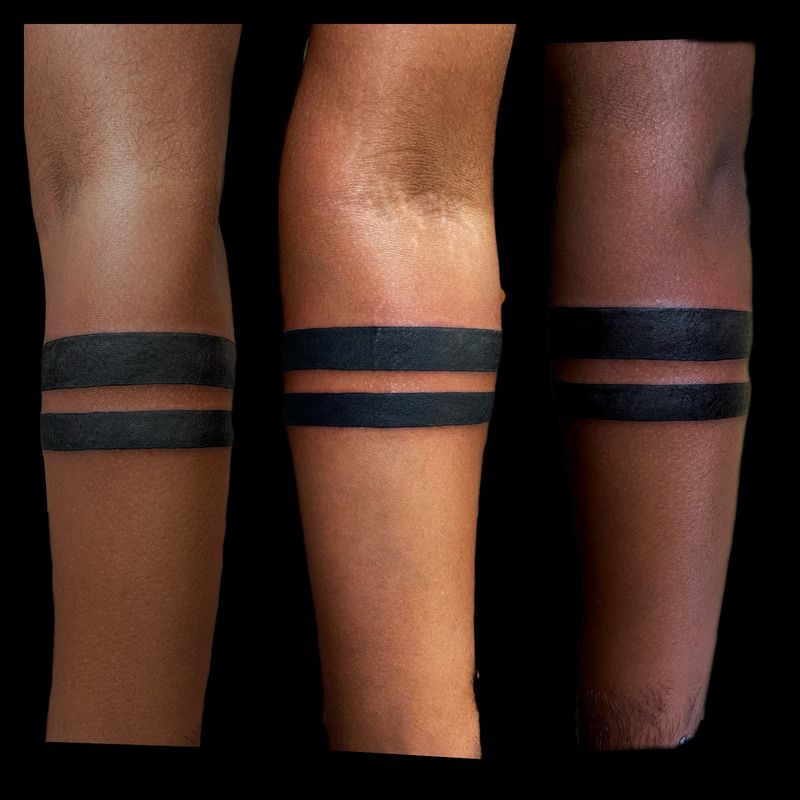
Nothing is shaded here. A shape is either solid black or it is bare skin, and that binary is why the style still reads cleanly on a forearm at year thirty — and why the negative space has to be designed as carefully as the ink that surrounds it.
Book a consultationOne pigment
One pigment, two possible states.
Single-pigment discipline. Everything else — scale, pattern, negative space, tonal gradation — is engineered from one bottle.
At the machine, blackwork artists run three needle families in rotation. Large curved magnums — commonly 15M, 19M, and 25M configurations — do the heavy lifting on solid fills, laying ink across wide surface area with minimal skin trauma per pass. Round liners (usually 7RL through 14RL) cut the boundaries that separate black mass from bare skin. Round shaders and smaller mags handle tonal transitions where a pattern softens into a gradient. Both rotary and coil machines are used; high-output specialists tend to prefer rotaries for long saturation sessions; traditional- leaning artists often stay on coils for tactile line control.
The technical signature of the style is the solid black fill. A large area of opaque, even, unscarred black is the hardest thing to produce in tattooing — harder than a portrait, harder than a fine-line cursive. It demands multi-pass saturation across two to three sessions, because forcing full density in one sitting blows out the dermis and leaves scarring or patchy heal. Artists working in straight black often use pigments chosen specifically for dense deposition — Solid Ink's black, Eternal's Triple Black, Dynamic, Fusion's Pitch Black — because consumer-grade gray wash does not hold uniform saturation at scale.
The diagnostic flaw of weak blackwork is what practitioners call the \u201Ccloud under strong light\u201D problem: under flash or direct sun, uneven pigment density in a large solid reveals itself as mottling — lighter patches surrounded by darker ones, a cloudy rather than monolithic black. Avoiding it requires consistent needle depth (too shallow heals patchy, too deep scars), consistent machine voltage, consistent hand speed, and the patience to work in stages.
Negative space is the second half of the craft. Blackwork is as much about what is not tattooed as what is. A Marquesan panel reads because the bare-skin shapes between the black are as deliberate as the black itself. Modern blackwork sleeves often use unmarked skin as a compositional element — a deliberate stripe of natural flesh running through a solid field — to articulate form.
Living traditions
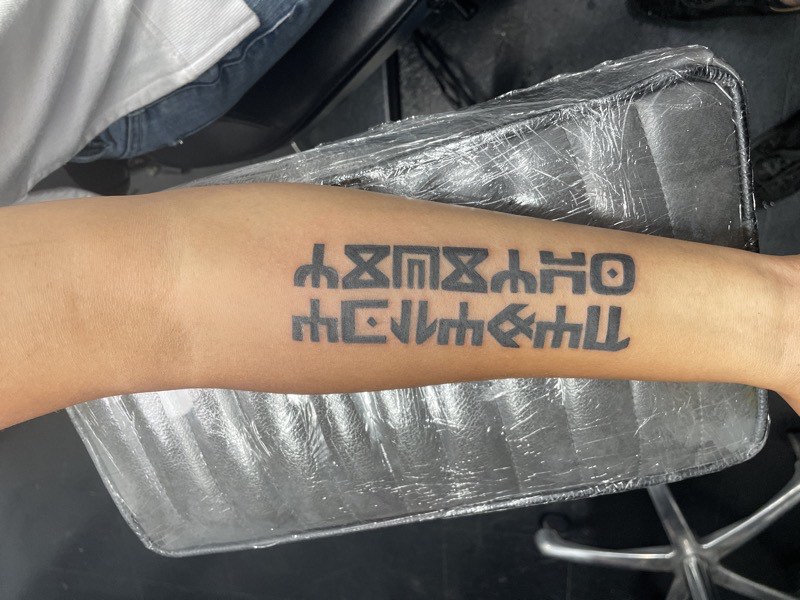
Five lineages blackwork draws from.
These traditions are not source material to be freely appropriated. They are ongoing practices with their own custodians, protocols, and meaning. Blackwork owes them a debt it should not pretend it has already paid.
Polynesian · Samoan · Marquesan
tatau · tatu
The Samoan pe'a — the male body suit tattooed from mid-torso to knee — is a living practice administered by tufuga ta tatau master practitioners. The Marquesan tradition, nearly eradicated under colonial missionary pressure in the 19th century, has been actively revived since the 1980s. Both use dense geometric blackwork drawn from ancestral, genealogical, and status vocabularies. Neither is a design library; elements carry specific meaning and, in many cases, earned rights.
Bornean Iban & Dayak
Handpoked craft
Handpoked tattooing using a two-stick hand tool, with motifs including the bunga terung (eggplant flower) marking coming of age on the shoulders, and the kelingai or ukir rekong throat pieces. The tradition is actively practiced by Iban artists today and has influenced the contemporary handpoke revival.
Berber · North African
Protective geometric marks
A less-documented but real tradition of facial and hand tattooing among Berber women across the Maghreb — geometric protective marks applied over generations, now largely interrupted by 20th-century religious prohibition but preserved in the historical record.
Celtic & Pictish
Documented warrior tradition
Roman-era accounts describe heavily tattooed northern British peoples — the name “Picti” itself referencing painted or marked bodies. The specific motif vocabulary is partly reconstructive (there is no surviving Pictish tattoo canon) but the warrior-mark tradition is documented.
Japanese horimono
Black backgrounds, color foreground
Irezumi is primarily associated with color, but the dense black background work — the negative-space gaku framing dragons, koi, and deities — is pure blackwork technique. Japanese backgrounds set the standard for saturated black across large areas and remain the benchmark for body-suit-scale solid fill.
The modern revival
The artists who shaped contemporary blackwork.
The contemporary Western blackwork movement coalesced in the late 1990s and 2000s, led by artists who treated pure black as a design language rather than a default.
Xed LeHead
Divine Canvas · London
Figurehead of ornamental-geometric blackwork in the UK, building precise linework patterns that bridge sacred geometry and tribal-influenced fill.
Roxx
2Spirit Tattoo · San Francisco
Pioneered a bold California blackwork idiom drawing on Marquesan and Iban-adjacent forms with explicit acknowledgement of lineage.
Thomas Hooper
Austin · formerly NYC
Moves between ornamental dotwork and large-scale black panels, teaching a generation of apprentices in the process.
Guy Le Tatooer
France
Anchors the European dotwork-blackwork crossover with layered stippled compositions.
Valerie Vargas
Frith Street Tattoo · London
Bridges traditional American and blackwork sensibilities with disciplined pattern work.
Kenji Alucky
Japan
The Japanese branch of contemporary dense blackwork — pattern and solid fill at scale, with dotwork rigor.
Sub-genres
Five branches of the black-ink tradition.
Blackwork isn't monolithic. Five distinct sub-genres live under the same single-pigment constraint, each with its own compositional priorities.
Solid fill blackwork
Large pure-black coverage, often full sleeves, panels, or entire limbs. The most technically demanding sub-genre — uniform saturation at scale is the hardest thing to produce in tattooing.
Geometric blackwork
Precise mathematical patterns using solid, outlined, or dotwork black. Mandalas, tessellations, sacred geometry — the intersection with ornamental lives here.
Illustrative blackwork
Representational imagery executed only in black, often drawing from woodcut, engraving, or scratchboard aesthetics. Narrative storytelling without color — hatching instead of gray wash.
Dotwork blackwork
Stippled compositions that build tone through density of dots rather than solid fills. Overlaps with ornamental; requires a true dotwork specialist.
Neo-tribal
Modern interpretation of tribal-influenced patterns. Always carries a cultural-context conversation before booking — lineage patterns you are not entitled to wear are not a style choice.
What black carries
What solid black carries best.
Eight subject categories where blackwork earns its reputation — from bold geometric fields through cover-up work that out-values existing ink.

Bold geometric fields
Tessellation, sacred geometry, repeating pattern, and geometric abstraction — the style's bread and butter. The eye wants rhythm, and blackwork with clean repetition delivers it. Linework stays crisp because there is no tone fighting the geometry for attention.
Solid silhouettes
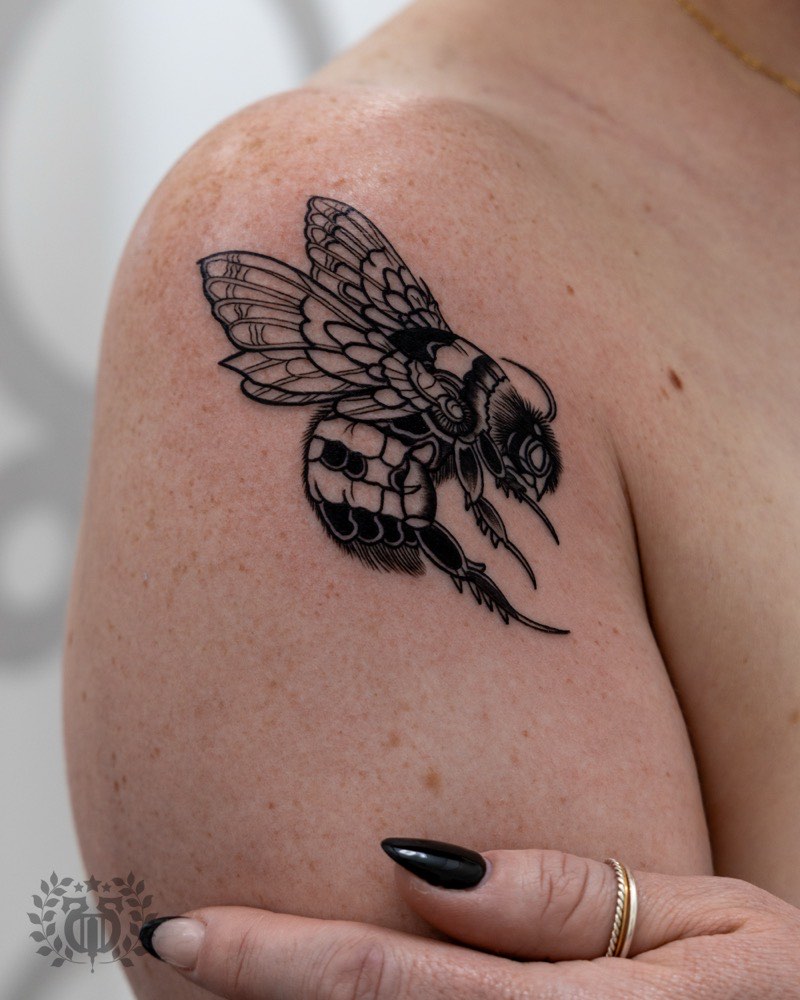
Animals, plants, human figures, objects rendered as pure black shape against bare skin. A crow in solid black silhouette will always out-age the same crow rendered in thin color. Where blackwork earns its longevity reputation — nothing subtle to fade.
Illustrative narrative
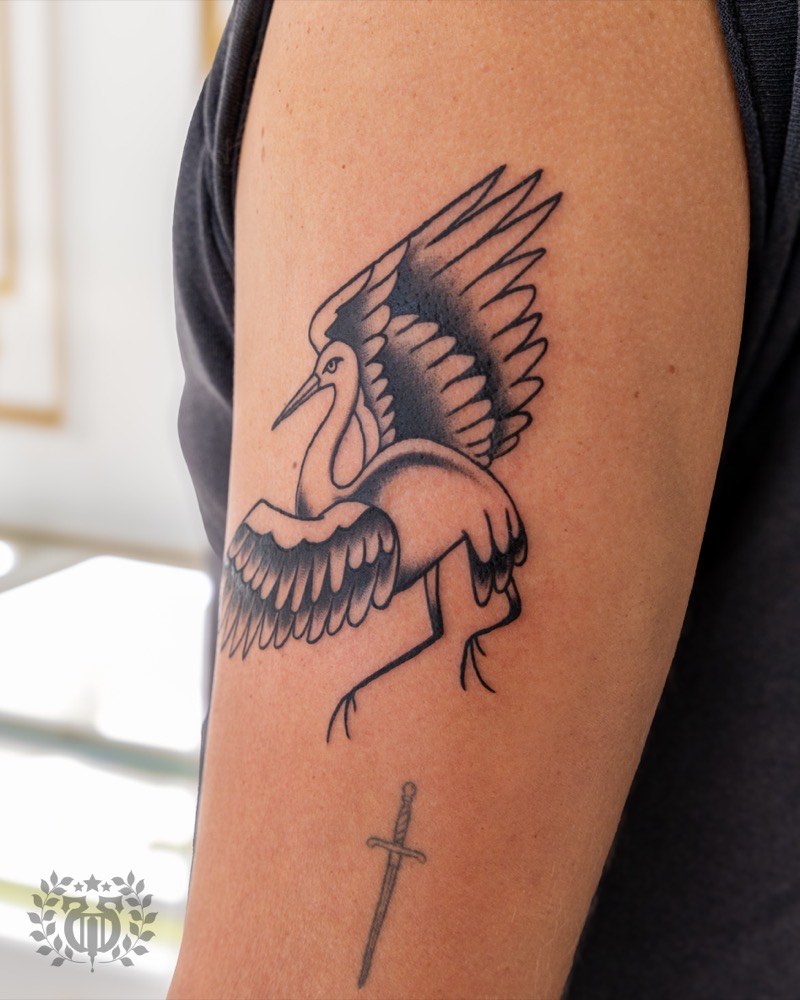
Dark-fantasy, horror, occult imagery, woodcut-style storytelling. Translates naturally because printmaking is the conceptual ancestor: hatching instead of gray wash, negative space instead of highlight. Reads like a graphic novel panel carved into the arm.

Body suits & large-scale work
Full sleeves, leggings, torso panels, back pieces, body suits — blackwork's cathedral. At this scale, negative space becomes an explicit compositional element, and the piece gets to breathe across an entire limb rather than cramming a concept into three inches.
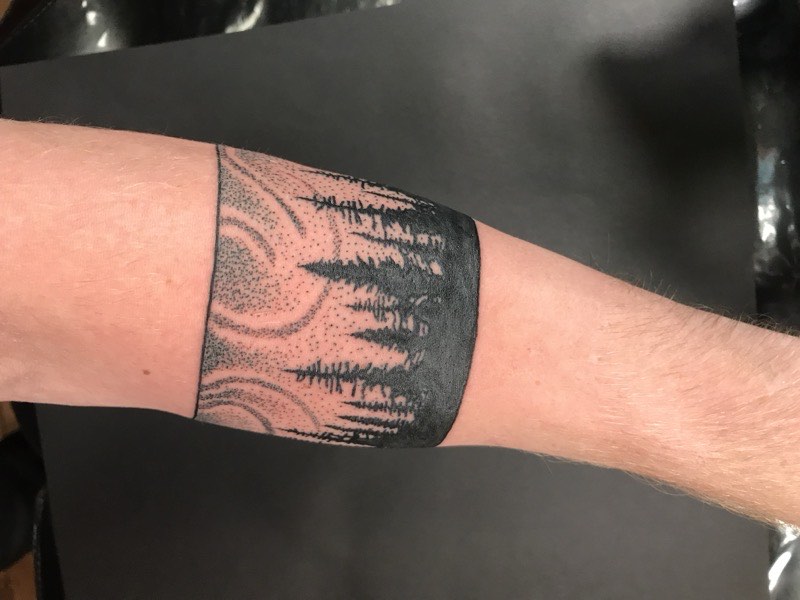
Mandalas & sacred geometry
Pure-black mandalas, compass-precise geometric compositions, symmetrical pattern work — the intersection with ornamental. Rotational symmetry hides minor linework variance; radial compositions forgive body curvature better than rectilinear grids.
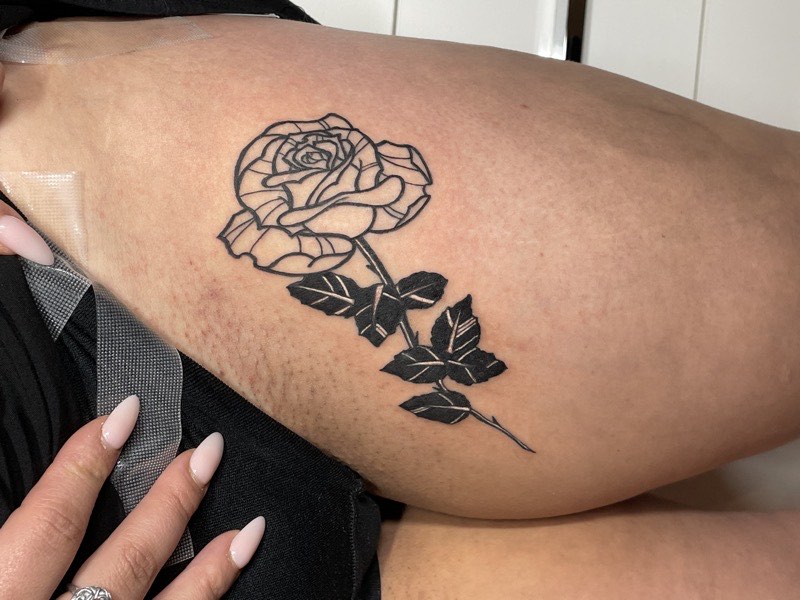
Heavy flora silhouettes
Monstera, ferns, nightshade, roses stripped to their graphic shape. Black leaves, vines, thorns rendered as silhouette rather than realism. Ages like woodcut botanical illustrations — only gets richer as skin settles around them.

Blackletter & bold script
Dense, bold, high-contrast lettering — blackletter, gothic script, brush-heavy display text. Native blackwork vocabulary. The chunky, authoritative kind that survives decades without thinning into illegibility, not fine-line script.
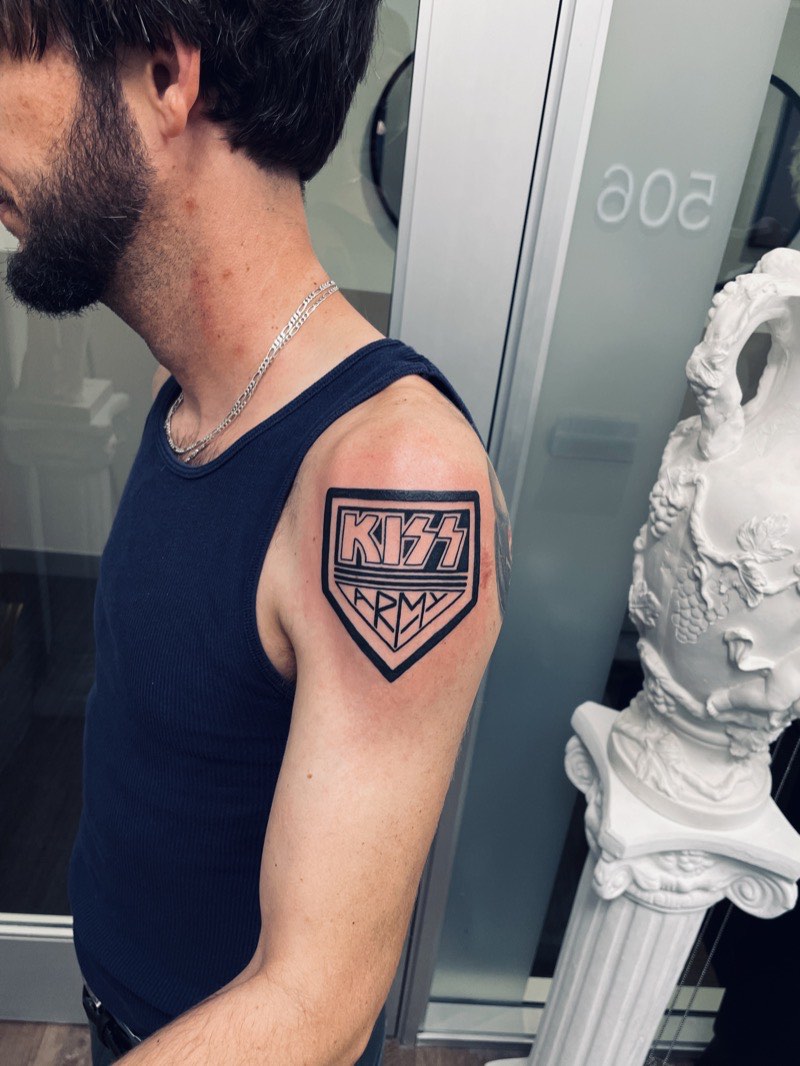
Cover-up work
Blackwork is the dominant cover-up style. Pigment density can out-value existing ink underneath. When the cover design goes darker than the existing tattoo at every point, the old piece disappears visually beneath the new one. That is the core mechanic.
Where black stops
Where solid black stops working.
Blackwork is binary contrast. Subjects that depend on gradient tone — realism, color, watercolor diffusion — sit outside the style's vocabulary.
Photorealism
Realism lives in gradient tone — the slow transition from highlight to shadow is the entire technique — and blackwork's binary logic erases that language. Black-and-grey realism is a different vocabulary with washes and midtones, not blackwork.
Color-dependent pieces
Out by definition. Any subject whose meaning depends on hue — a rose's red, a watercolor diffusion, a color portrait — sits outside the style.
Watercolor concepts
Watercolor leans on edge dissolution and diffuse color bleeds; blackwork leans on edge clarity and binary contrast. Opposite aesthetic philosophies.
Subtle tonal transitions
Subjects where meaning depends on soft midtones — a portrait's eye shadow, a landscape's atmospheric perspective, graduated fabric folds — will fight blackwork rather than use it. The binary contrast flattens those cues.
Micro-detail in small scale
Solid fills below certain sizes blur at the edges as ink migrates slightly under skin across years. A 2-inch solid square drifts into a 2.2-inch soft-edge blob. What was sharp becomes muddy.
Negative space
The principle that separates specialists.
In blackwork, the untattooed skin is part of the composition. The tattooed-skin-to-bare-skin ratio is a compositional variable specialists tune the way a painter tunes value.
A strong blackwork piece reserves specific skin reveals inside otherwise solid fields — a thin negative-space line describing a wing through an all-black bird, a skin- bright mandala center held open inside a dense dotwork ring, a pattern that shifts from 90% black on one side to 10% black on the other so the eye follows the density gradient across the body. That is design.
The \u201Cread at distance\u201D test. Walk five steps back from a reference photo and squint. If the piece still resolves into a clear silhouette and you can identify the subject, the negative space is doing its job. If it blurs into an indistinct dark shape, the composition is under-designed no matter how technically clean the linework is.
Maximalist vs minimalist blackwork. The maximalist end — dense all-over patterning, heavy solid fields, body-suit coverage — is the blackwork people picture first. The minimalist end — a single bold silhouette with generous skin around it, a sparse geometric mark, a short line of blackletter — is equally legitimate and sometimes ages better because the surrounding skin frames the work indefinitely. Collectors often assume blackwork means maximum ink. It doesn't. It means maximum contrast.
Cover-up power
Why blackwork is the default cover-up vocabulary.
Pigment density can out-value existing ink underneath. That's the entire mechanic. But the execution requires honest conversation about two distinct approaches — and sometimes a laser session first.
When the new blackwork design goes darker than the existing tattoo at every point, the old piece disappears visually beneath the new one. That is the core mechanic. There are two distinct approaches:
Blast-over. The new blackwork design runs straight across the old tattoo without trying to hide it — the old piece shows through as texture, and the new piece treats it as background. A legitimate compositional choice when done deliberately; a messy accident when it's damage control on a cover-up that didn't quite work.
True cover-up. The new piece is redesigned so the dark values of the new tattoo sit exactly where the old ink is brightest, erasing the read of the old work. More design work, more planning, cleaner result.
When to laser first. If the existing tattoo is dark and dense — a solid black piece, a heavy tribal band, a thick traditional piece — a specialist will often recommend a few laser sessions to lighten the old ink before the blackwork cover. Lasering doesn't need to remove the old piece fully; it only needs to drop the density enough that the new blackwork design has room to out-value it. Patient collectors who laser- lighten first get cleaner covers than collectors who push straight into a blast-over.
Real estate
Blackwork wants real estate.
When a client says \u201CI want blackwork, somewhere small and hidden,\u201D the correct consult move is usually to steer toward a different vocabulary rather than shrink blackwork into a size that fights the style.
How small solid fill can go
Pattern needs room to establish its own rhythm before the skin curves it away. Below this, geometric rhythm collapses before the eye can lock onto it.
Scales up beautifully and often looks better at 8+. Below four inches, solid fills blur at the edges across years as pigment migrates slightly under skin.
Body suits, sleeves, major panels. At this scale, negative space becomes explicit compositional vocabulary — the piece needs room to breathe.
Flexible based on text and line count. Generous letter spacing is the rule — air reads better than density in bold script.
Placements blackwork loves
- Sleeves (full or half). Blackwork's native territory — the canvas the style was built for.
- Chest panels. Broad flat-ish canvas for solid fields and symmetrical compositions.
- Back pieces. The single largest uninterrupted blackwork canvas the body offers.
- Thigh panels. The modern large-scale placement — great for ornamental and illustrative alike.
- Forearm bands. Encircling bands and cuffs read cleanly on the forearm's roughly cylindrical canvas.
- Calf. Silhouettes and patterns both work, with enough muscle to avoid bone-distortion.
Areas that fight solid fill
- Hands & fingers (large solid). High wear, friction from washing, ink-migration compound — solid-black rings and finger panels need heavier touch-ups than the same design elsewhere.
- Feet & ankles. Similar wear issues plus shoe friction.
- Faces & neck. A commitment-level decision, not a style decision. Talk to an artist who does face work specifically.
- Palms & soles. Friction-skin. Ink rarely holds at full density regardless of style.
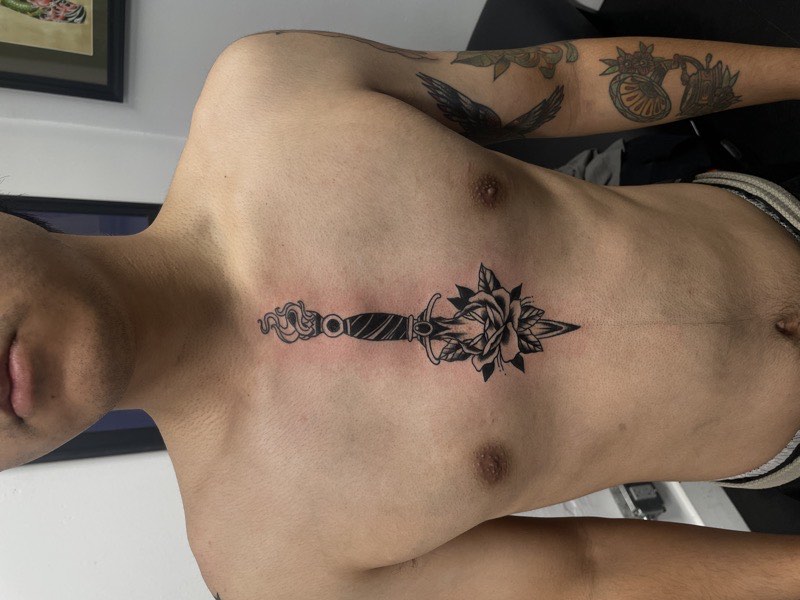
Decade scale
Best-in-class aging on real skin.
Alongside Traditional and ornamental, blackwork sits at the top of the tattoo longevity curve. What follows is the decade-by-decade read, including the blue-heal window every first-timer should know about.
Settling — and why it looks blue
The most surprising stretch for first-time blackwork clients. Fresh blackwork often reads visibly blue or blue-gray through the first two to six weeks — the Tyndall effect on freshly packed black: light refraction through still-settling dermal tissue. As the skin fully settles between week four and month six, the piece deepens into true, dense black. A minor settling touch-up at 6–12 months is standard for larger solid fills.
Virtually unchanged
A well-done blackwork piece looks, photographically, nearly identical to the month-six healed photo. Solid fills hold their edge. Pattern work retains line weight. Clients returning for other work in this window rarely ask about the original blackwork — it's still reading exactly as designed.
Minor edge softening
Edges of solid fills pick up a faint haze measured in fractions of a millimeter. Inside the fill, the black itself is unchanged. If the piece was designed with appropriate negative space and line weight for body placement, the softening reads as patina rather than degradation.
Best-in-class aging
This is where blackwork, American Traditional, and ornamental linework pull ahead of every other modern style. Carbon black is the most photostable pigment tattooers use. A densely saturated solid fill at year fifteen will still read as solid black. Pattern work will still show its geometry. Fine micro-detail will have softened or merged — which is why thoughtful blackwork design avoids micro-detail in the first place.
Still legible as designed
Long-term aged blackwork, especially on well-chosen placements, continues to read as the piece the client committed to. Edges are softer, the black may feel slightly less crisp against aged surrounding skin, but the composition holds. The softening becomes part of the piece rather than a failure of it.
Four reasons compound in blackwork's favor: carbon-based black is the most photostable pigment tattooers use (organic colored pigments break down under UV and immune activity, carbon black is essentially inert); high saturation creates pigment depth that resists long-term fade; negative space preserves itself (un-tattooed skin can't fade because there's nothing there to fade); and binary contrast doesn't collapse with subtle density loss the way gradient tone does. Where blackwork can still fail: poor saturation (patchy heal), ghost pre-existing ink through weak cover-ups, sun exposure on low-saturation areas, friction placements, and over-worked sessions that cause scarring.
Blackwork in the wild
Fill and negative space, side by side.


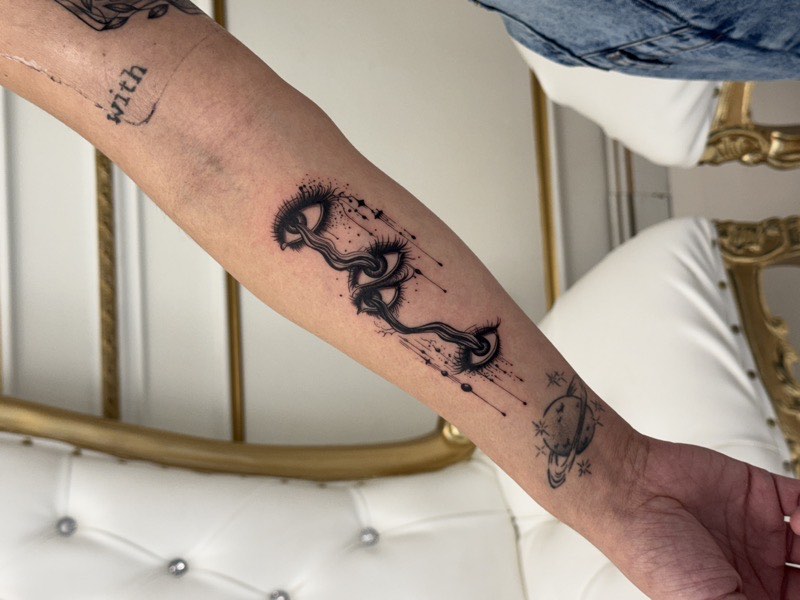
Fill planner
Subject → scale → placement → density.
What we check before committing to a fill plan. Density is blackwork-specific — patterns need different saturation decisions based on composition and body canvas.
Beliefs on arrival
Five things we redraw before starting.
Beliefs first-time blackwork clients turn up with. About the next commission rather than the last one.
“Blackwork is cheaper because there's no color.”
Backwards. Blackwork sessions are among the longest sittings in the studio because solid fill is slow, demanding work. What you save on color, you pay in time-under-needle. A large solid sleeve often costs more than the same-scale color piece.
“Blackwork is always aggressive or masculine.”
Outdated. Modern blackwork spans delicate ornamental dotwork, fine-grained botanical silhouettes, illustrative storytelling, and bold solid sleeves equally. The subject and composition set the tone — the pigment is value-neutral on mood.
“I just want it solid black, no design.”
Specialists will still design it. Edge geometry, silhouette shape, relationship to body contour, negative-space reveals all apply even to a “just solid black” piece. The difference between a thoughtful solid-black shape and an unthought-out one is enormous at year one.
“Fresh blackwork looks blue — something's wrong.”
Nothing's wrong. The Tyndall effect: light scattering through settling dermal tissue makes heavy-black photograph blue for weeks. Resolves to true black at month two and beyond. Judge blackwork at the healed check, never the fresh photo.
“I can put small blackwork anywhere.”
Scale fights placement below the minimums. A 1.5-inch solid black animal on a wrist will not read the way a reference photo of a 6-inch version on a forearm reads. If you love a specific reference, match the scale as much as the subject.
Who packs it
Who should be packing your fill.
Solid black consistency is surprisingly hard to fake. The "cloud under light" test at year five separates specialists from generalists — and that outcome is locked in the moment the original session ends.
What a strong blackwork book shows
- Multi-year healed blackwork at 3, 5, 10 years showing solid coverage
- Range from delicate pattern to solid fill — shows technical modulation
- Cover-up portfolio with visible out-valuing of old work, not just dark-over-dark
- Willingness to discuss pigment brand and session pacing with specifics
- Healed black that reads as TRUE BLACK, not blue-gray
- Clear walk-through of consultation intent — blast-over vs cover-up, sessions vs single sitting
Reasons to keep looking
- No healed work in the portfolio — every photo is fresh-off-the-needle
- Patchy solid fills in “finished” portfolio photos — lighter veins or hot spots visible inside the black
- Inconsistent saturation within a single piece
- Cover-up work that shows the ghost of old ink at any angle
- “Blast over” work passed as deliberate cover-up when it's actually damage control
- Healed photos still reading blue-gray at year one — pigment didn't settle fully
Six questions about fill and pacing
- Can I see healed blackwork at five-plus years old?
- How do you pace sessions on a solid fill this size?
- What's your approach to cover-up versus blast-over — and which are you proposing here?
- Which pigment brand or line do you use for solid black, and why?
- At this scale, how many sessions do you estimate?
- How do you handle uneven healing — settling touch-ups, hot spots, and re-packing?
Specialists have real answers to all six without defensiveness. The willingness to stop a session early to protect a decade- scale outcome is a specialist signal that generalists rarely display.
FAQ
The solid-black questions we actually get.
Seven questions about solid black — pacing, pain, cover-ups, and what the piece looks like at thirty years.
Why does my fresh blackwork look blue?
The Tyndall effect. Fresh blackwork often reads visibly blue or blue-gray through the first two to six weeks — light refraction scatters shorter wavelengths (blue) off the still-settling dermal tissue above the heavy black pigment deposit. It's not a mistake, not a bad batch of ink, not a healing problem. As the skin fully settles between week four and month six, the piece deepens into true, dense black. Judge blackwork at the healed check at month two or later — never at the fresh photo.
How long does blackwork actually last?
Alongside Traditional and ornamental, blackwork is one of the longest-aging styles in tattooing. Well-executed pieces read essentially unchanged at ten years, show minor edge softening at fifteen, and still read as designed at thirty-plus. Four reasons compound: carbon black is the most photostable pigment tattooers use; high saturation creates pigment depth that resists fade; negative space can't fade because there's nothing there to fade; and binary contrast doesn't collapse with subtle density loss the way gradient tone does. Touch-up windows are among the longest in tattooing — 10–20 years for well-saturated work.
What's the difference between blackwork and black-and-gray?
Two different vocabularies. Blackwork uses solid black pigment — no dilutions, no gray wash — often in large fills with negative space as compositional tool. Black-and-gray realism uses black pigment diluted to multiple tonal values (a “gray wash” ladder from 100% black to whisper gray) to build photographic depth. Black-and-gray is realism technique executed only in gray tones. Blackwork is a design language built on binary contrast. A piece can include elements of both, but the core logic is opposite: blackwork is pattern and silhouette, black-and-gray is tone and gradient.
Why is blackwork the best style for cover-ups?
Pigment density can out-value existing ink underneath. When the new blackwork design goes darker than the existing tattoo at every point, the old piece disappears visually beneath the new one. That's the core cover-up mechanic. Two approaches: a “blast over” runs the new blackwork design straight across the old tattoo without hiding it — the old piece shows through as texture. A true cover-up redesigns so the dark values of the new piece sit exactly where the old ink is brightest, erasing the read of the old work. Both are legitimate; the consultation must be explicit about which you want. For dense old ink, a specialist often recommends laser-lightening first.
How much does a large blackwork piece hurt?
Worth stating plainly: large solid fills are among the most physically demanding tattoo sessions that exist. Packing black over large surface areas generates sustained skin trauma in a way that outline or traditional work does not. Clients who have sat cleanly for five-hour color sessions are sometimes surprised by how much harder a three-hour solid-fill session feels. Specialists pace accordingly — three to four hours is a common session cap, and many will end early if skin texture starts degrading. That's optimization for the decade-scale outcome, not the session-scale one.
How many sessions does a blackwork sleeve take?
Large-scale blackwork — sleeves, back pieces, body suits executed primarily in black — is typically planned across six to twenty sessions spaced weeks apart. The specific number depends on scale, density, and client heal profile. A specialist will map the plan at consultation, not improvise session to session. Session pacing is deliberate: dense black packed too hard in a single pass blows out the dermis and leaves scarring or patchy heal. The willingness to work in stages is a signal of an artist optimizing for longevity rather than speed.
Is it appropriate to get a tribal-influenced blackwork piece?
It depends on the specific tradition and how you approach it. Samoan pe'a, Marquesan body suits, Bornean Iban pieces, and other living cultural traditions are not design libraries open to anyone. Elements carry specific meaning and, in many cases, earned rights — they're administered by tradition-trained practitioners, not freelance tattooers. Generic “neo-tribal” abstraction is its own thing and doesn't require that lineage, but even then the best work reads as intentional composition rather than borrowed shapes. If you're drawn to a specific cultural tradition, seek artists trained inside it — or commission neo-tribal-inspired work that doesn't claim to be ceremonial. Ask your artist explicitly at consultation; a specialist will walk you through the line honestly.
Ready to commit the real estate?
Bring the reference, the scale instinct, and openness to multi-session pacing.
Blackwork is a specialist's craft and often a multi-session commitment. Bring a rough reference, the region you want covered, and an understanding that big fill gets paced across sittings rather than crammed into one. Then we plan the pacing. Large fill is booked as a series, and knowing that up front changes how the negative space gets drawn in the first place.