An industrial piercing is two cartilage piercings that have been chained together. Either one on its own would be an ordinary helix, healing in its own time and forgiving the occasional knock. Joined by a single straight bar, they stop being independent: twist the bar and both channels turn, and a snag at the front end is felt at the back end just as hard. Nothing else we pierce in an ear works like that.
Which is why the assessment is about a line rather than two dots. One straight bar has to reach two points on a rim that curves in three directions, meeting the cartilage squarely at both ends. On some ears that line exists. On others the rim rolls in too sharply, or the anti-helix rises into the path, and there is no arrangement of dots that fixes it. The fee is $125 including both piercings, at 2625 Main Street in Santa Monica, needle only, implant-grade titanium, open 8am to 8pm seven days. Expect 12 to 18 months of healing, and expect us to say no if the geometry isn't there.
Book Your Industrial Piercing 5000+ clients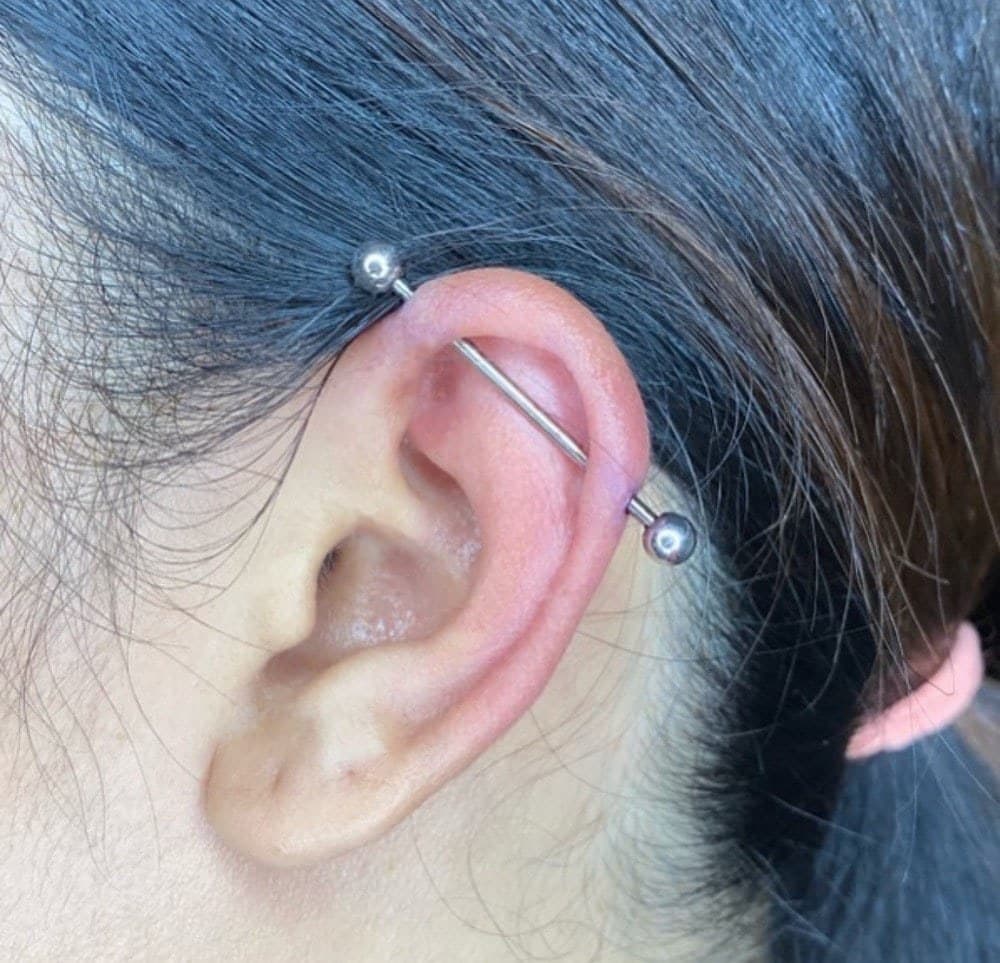
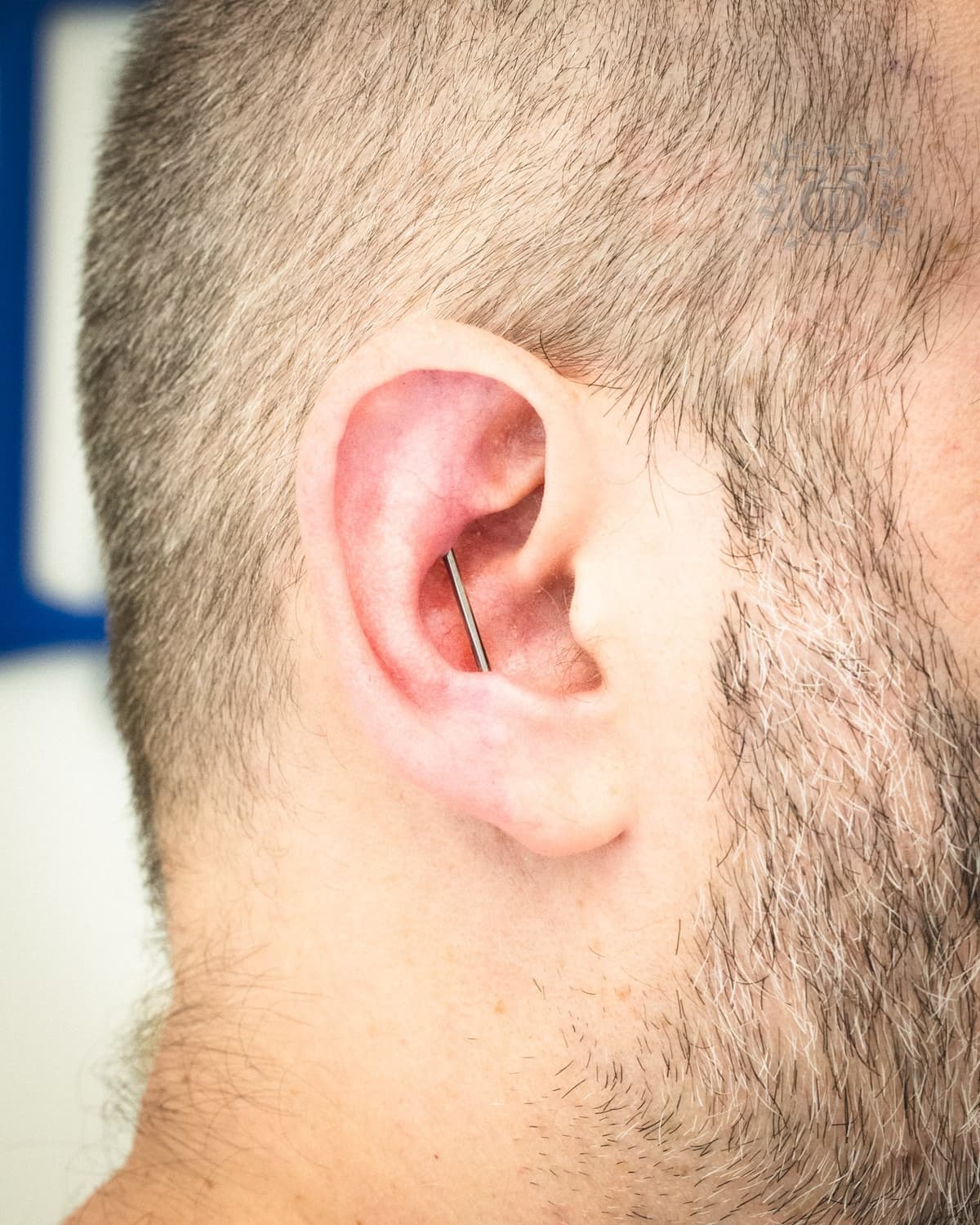
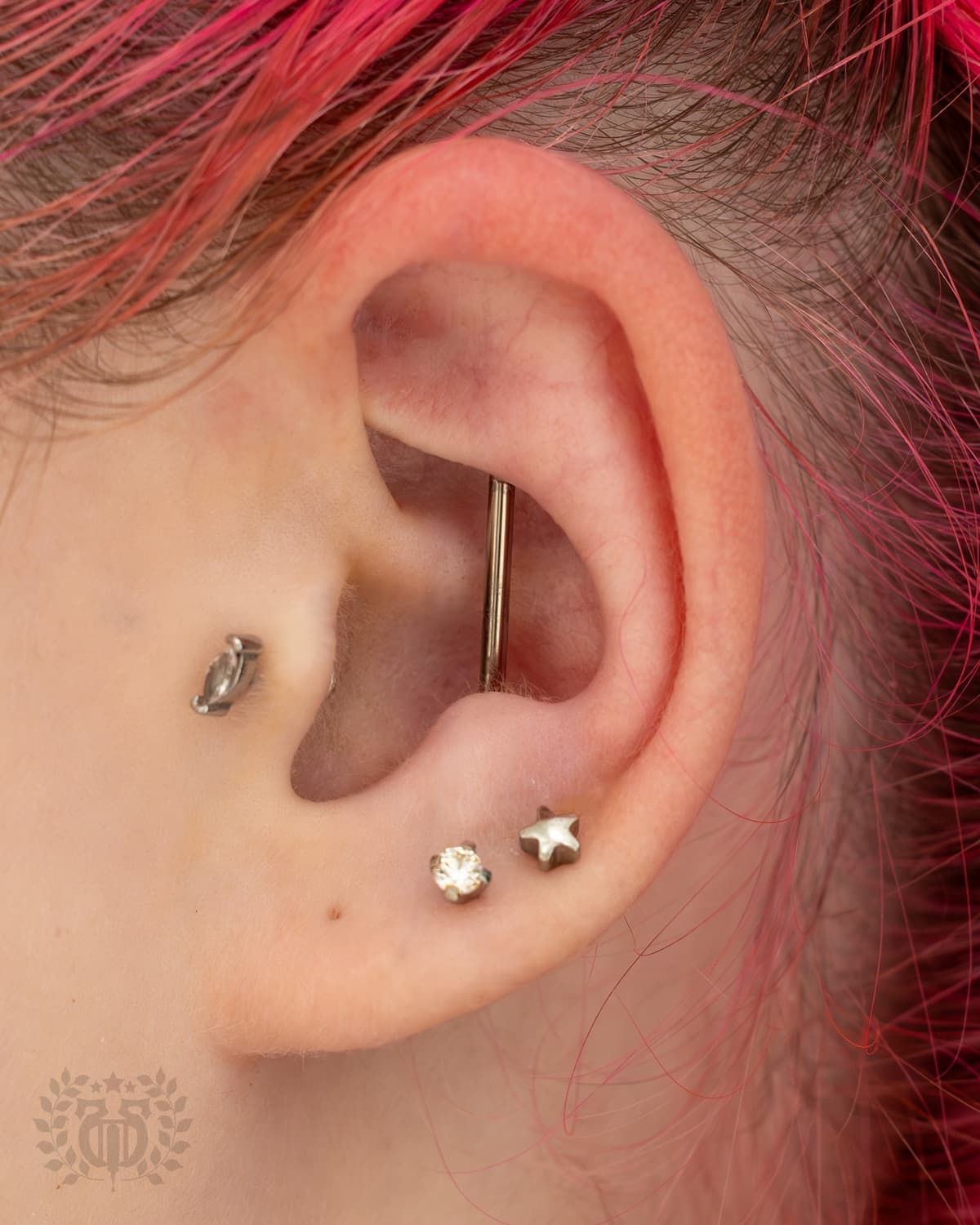
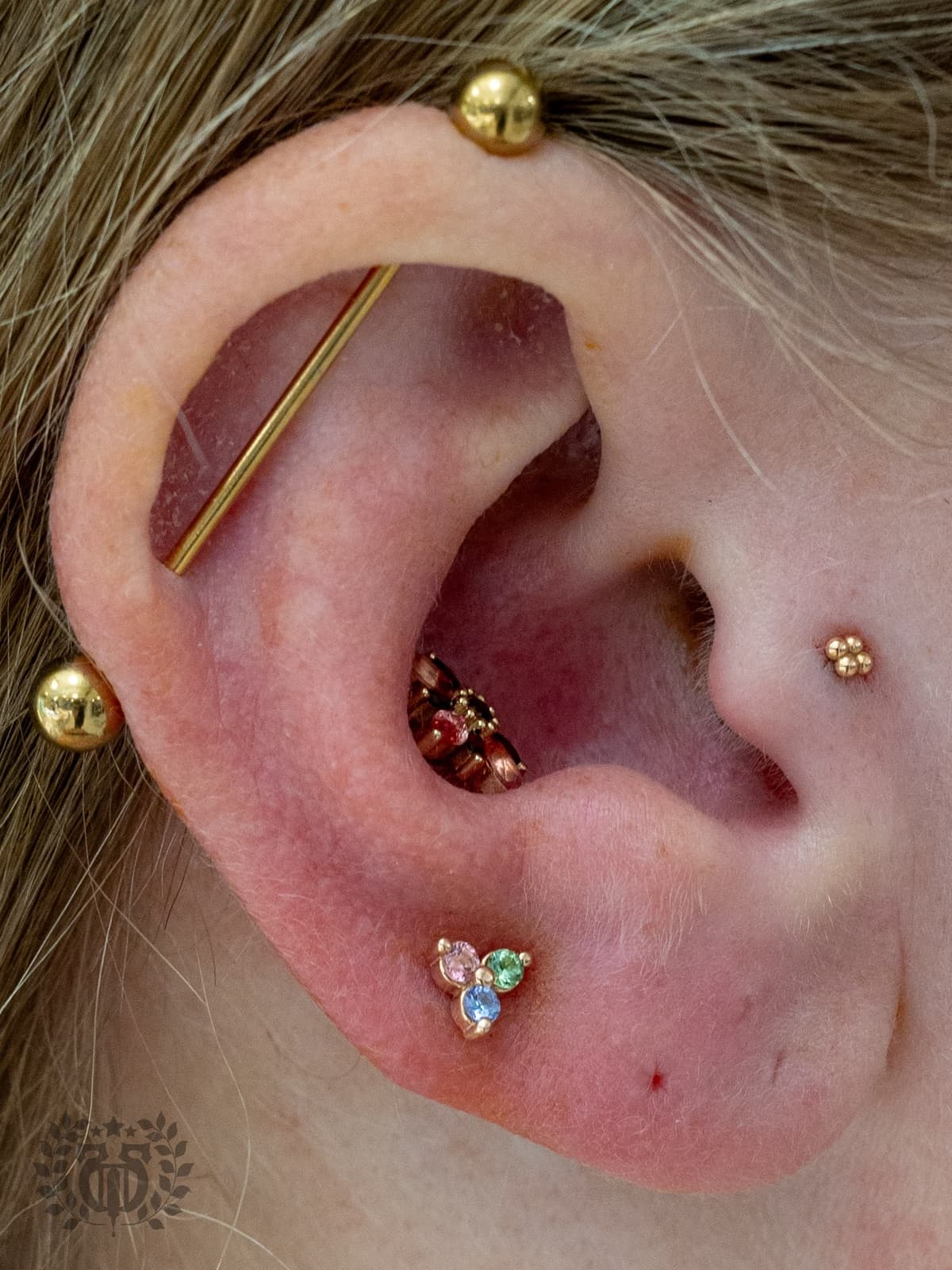
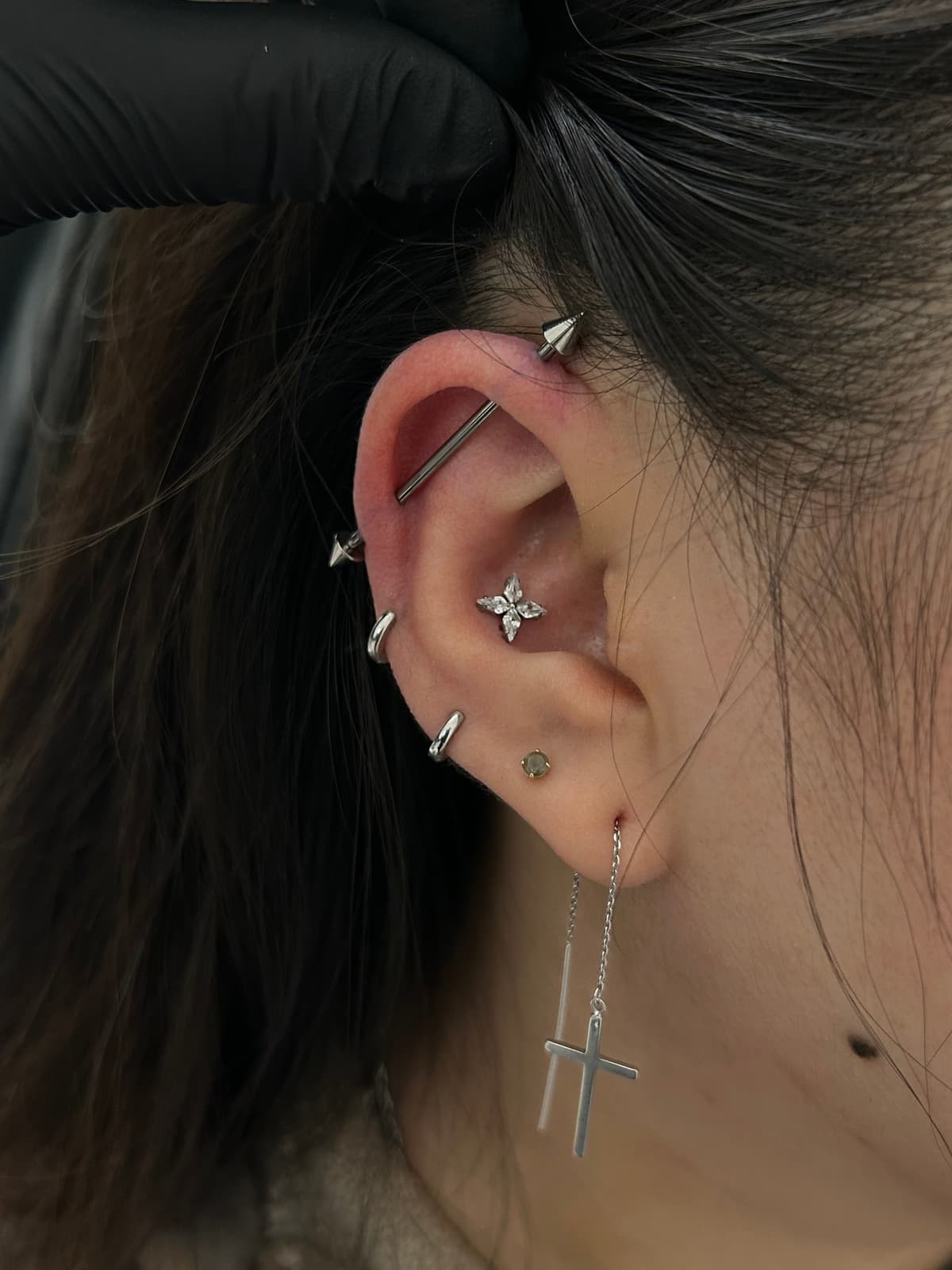
Everything unusual about an industrial follows from the fact that the two piercings are not independent of each other.
Take two ordinary helix piercings, sitting an inch or so apart on the same rim. Each has its own small stud, each heals at its own pace, and if one gets caught on a jumper the other never knows about it. Both are done in a few months. Now run one rigid bar through both of them and almost every one of those statements stops being true.
The two channels are now mechanically coupled. Any force applied anywhere along that bar is transmitted to both openings at once. That's the whole difference, and it explains the rest: why the healing time roughly triples, why a single bad night can set back a piercing that felt fine, why the marking takes so much longer, and why we turn people away for this more often than for a helix.
It also changes what a piercer is looking at. On a helix, the question is a position: does this dot look right, and is there enough cartilage there. On an industrial, position isn't sufficient. Both dots can sit exactly where you want them and the piercing can still be wrong, because each hole opens a short tunnel with a direction of its own, and one straight bar has to satisfy both directions at once. If the two tunnels disagree, the bar spends the next year levering against the wall of whichever one it fits worse.
That's why the first thing that happens is a straight edge held against your ear, checked from the front and then from the side. We're looking for a line that can reach two workable points while arriving roughly perpendicular to the cartilage at each end. A helix rim that rolls inward sharply won't give you that. Neither will an ear where the anti-helix rises into the path the bar would take.
None of which is a reason not to want one. It is a reason to have the geometry checked before you plan around it, and a reason to be suspicious of any studio that marks an industrial in thirty seconds. The marking is the piercing. The needles are the easy part.
An industrial is not one piercing. It is two cartilage piercings that happen to be joined, and the joining is what makes it hard. Each hole would heal fine alone. Chained together, neither gets to heal alone.
The bar has to meet both surfaces at a sensible angle while travelling in a straight line across an ear that curves in three directions. Whether such a line exists on your ear is a fact about your ear, not a preference.
Knock the front hole and the back hole feels it. There is no isolating one end from the other, which is why a single bad night affects the whole piercing rather than half of it.
Two dots can sit in exactly the right places and still be wrong, if the channels they open run in directions a single bar can't satisfy. Getting the angles to agree is most of the marking.
12 to 18 months, sometimes two years, because a setback at either end restarts the clock for both. A lobe is six weeks. This is a different order of commitment and worth knowing up front.
Two single-use needles opened in front of you, hospital-grade autoclave for anything reusable, EPA-registered surface disinfectant, bloodborne-pathogen-certified piercers, licensed and inspected by LA County.

Apollo's Premium Jewelry Partner
Handmade in Los Angeles since 1996. Lifetime guarantee. Implant-grade gold, platinum, and titanium. Over 3,000 original designs in our case — ask your piercer for a tour.
See the BVLA story →One piece of metal has to satisfy two channels and survive a year of being caught on things. Almost every decision here is about reducing what can twist it.
The first bar is noticeably longer than the finished one needs to be, because two ends swell and both need somewhere to go. A fresh industrial stands off the ear more than the healed photos you've seen. That is correct and it is temporary.
Once the swelling has genuinely gone, the long bar becomes a liability rather than an allowance. Extra length is a longer lever, and that is exactly what a jumper sleeve grabs. Shortening it is a two-minute appointment and it is the single most useful thing you can do for an industrial.
Some ears need a shallow bend so the bar can meet both surfaces squarely instead of levering on one. That is a fitting decision taken against your ear, not a style. It is also the opposite of putting curved jewelry through an industrial, which forces both channels rather than following them.
Spikes and cones look sharp and behave badly, because every fibre they snag turns the bar. Smooth low-profile ends are what we start people on. Decorative ends are a reasonable ambition for a healed industrial, once torque stops being the thing that will undo it.
Implant-grade ASTM F136 titanium for the whole heal. Titanium is lighter than gold, and on a bar this long, weight is one more force working on both channels. Solid gold ends from BVLA or Anatometal are a conversation for after the eighteen-month mark, not before it.
Clear next step
A straight edge against your ear, viewed from two angles, tells us whether an industrial is possible at all. Free, and it sometimes ends in a no.
Recommended first step
Book lobes, cartilage, or a styled ear appointment with Apollo.
Two coupled wounds on one bar, against a placement that only has to heal one.
| Piercing Type | Location | Initial Healing | Full Healing | Pain Level |
|---|---|---|---|---|
| Industrial | Two holes connected by barbell | 4-6 months | 9-12+ months | 6-7/10 |
| Orbital | Two holes connected by ring | 4-6 months | 9-12+ months | 6-7/10 |
 5000+ clients
The marking is the piercing. The needles are the straightforward part.
Before any dot is drawn, the piercer is checking whether one straight line can reach two workable points on your rim. Held against the ear, viewed from the front and then from the side. Plenty of assessments end here.
Both entry points get marked together, never one and then the other. They are judged as a pair, from three angles, because two dots that look aligned head-on can be visibly crooked in profile.
Position is only half of it. Each hole opens a short tunnel with its own direction, and both tunnels have to accept the same bar. This is where a marking gets moved a millimetre for reasons that have nothing to do with how it looks.
Two separate needles, two separate passes, done in an order that keeps the second one aligned with the first. Neither hurts more than a standard helix. The difference is that you get two of them on one ear.
The long titanium bar goes through both channels and the ends go on. Then the part that matters most: which side to sleep on, what happens to your headphones for the next year, and a date to come back and have the bar shortened.
If you only take one thing from this page, take this one.
Torque is twisting force. It is what you apply to a doorknob, and it is what a jumper sleeve applies to your ear every time it catches the end of an industrial bar. Because both of your piercings are locked to that one rigid piece of metal, the twist doesn't stay where it started. It travels the length of the bar and turns both channels at once.
Picture the difference. On a single helix stud, catching the end tugs one small hole and the tissue springs back. On an industrial, catching one end rotates a lever roughly an inch and a half long, and the far hole gets wrenched by tissue it never touched. The person feels it at the front and finds the bump at the back a week later, which is why the cause so often goes unidentified.
What generates torque, in rough order of how much trouble each one causes: sleeping on that side, which grinds and rotates the bar for hours at a time. Over-ear headphones, which clamp across the exact line the bar runs along and then twist it every time they're adjusted. Pulling clothing over your head. Long hair, and more specifically brushing it. Hats and helmets. Towelling your hair dry after a shower, which is probably the single most common one-off cause we hear about.
Three things reduce it. Smooth low-profile ends rather than spikes and cones, so there is less for anything to catch. Getting the bar shortened once swelling has gone, because the excess length is the lever arm and shortening it directly reduces the force any snag can generate. And a genuine change of habits for the better part of a year, which is the part people underestimate when they book.
So when an industrial turns sore, red or bumpy, the first question is not what you have been cleaning it with. It's what has been pulling, catching or resting on that bar. Bring it in and we'll work through the list. Nine times out of ten the answer is on it, and it is fixable without touching the jewelry.
Three requirements the metal has to meet, and none of them are about how it looks
$125 covers the geometry check and both piercings. Jewelry is separate, and the downsize visit afterwards is part of the service rather than an extra.
Jewelry sold separately
Jewelry sold separately
Jewelry sold separately
Jewelry sold separately
Jewelry sold separately
Jewelry sold separately
Jewelry sold separately
Jewelry sold separately
On jewelry: titanium for the whole heal, because weight on a bar this long is one more force acting on both channels. Solid gold and BVLA ends are priced per piece and confirmed at consultation, and on an industrial they are an eighteen-month ambition rather than a starting point. If your ear turns out not to suit an industrial, the separate helix and forward-helix fees above are what you would be looking at instead.
 Founder
 Master Piercer
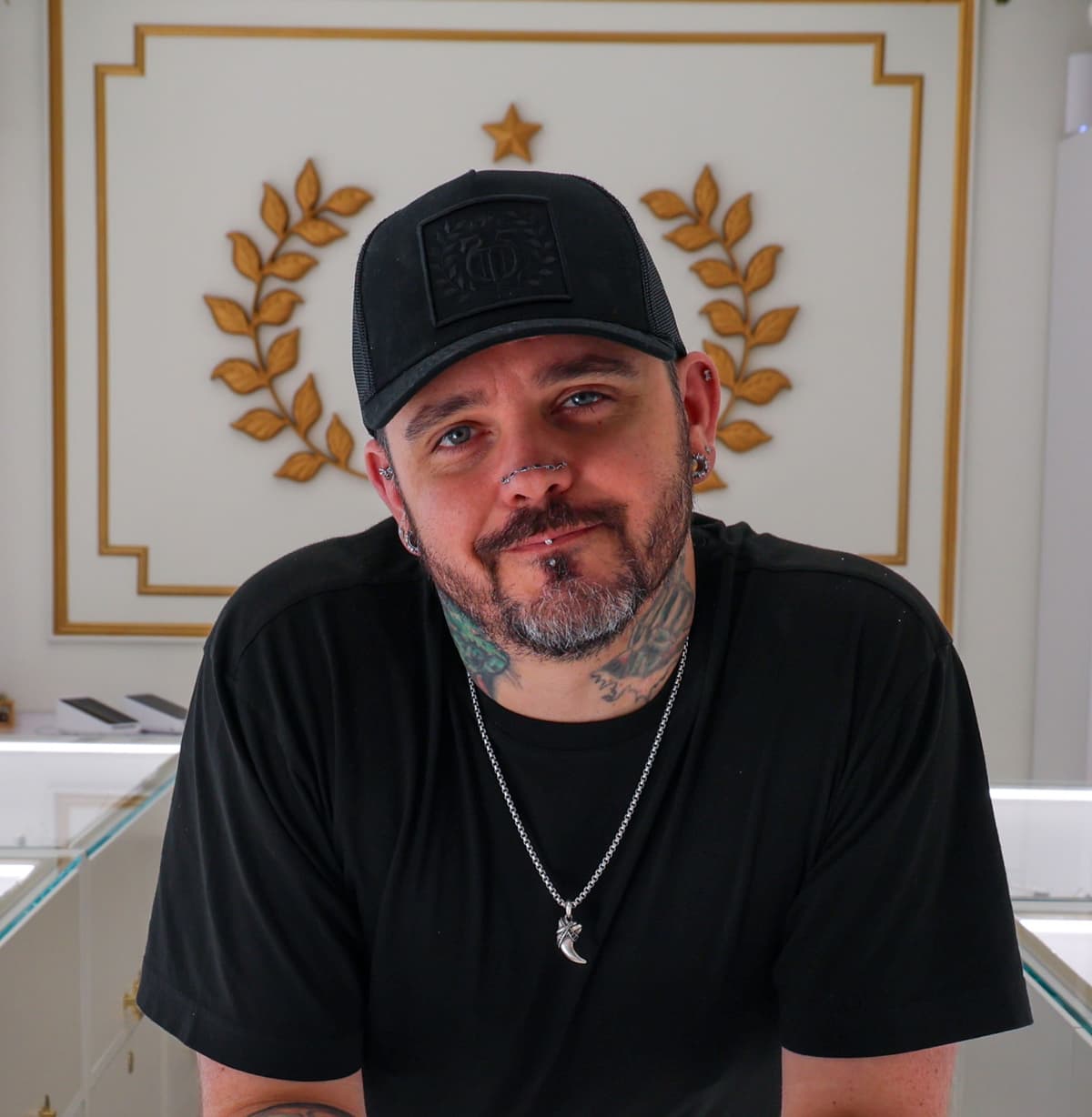
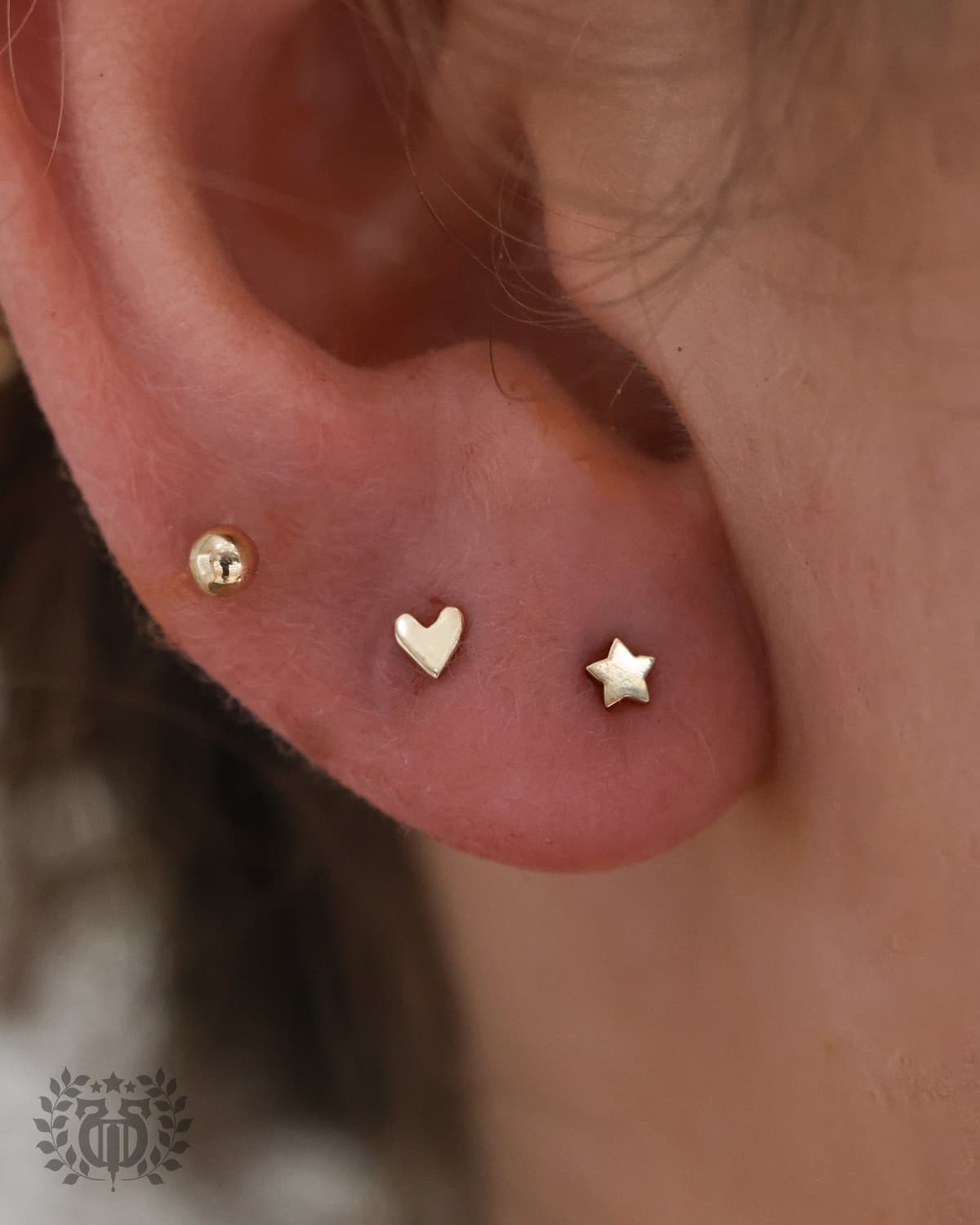
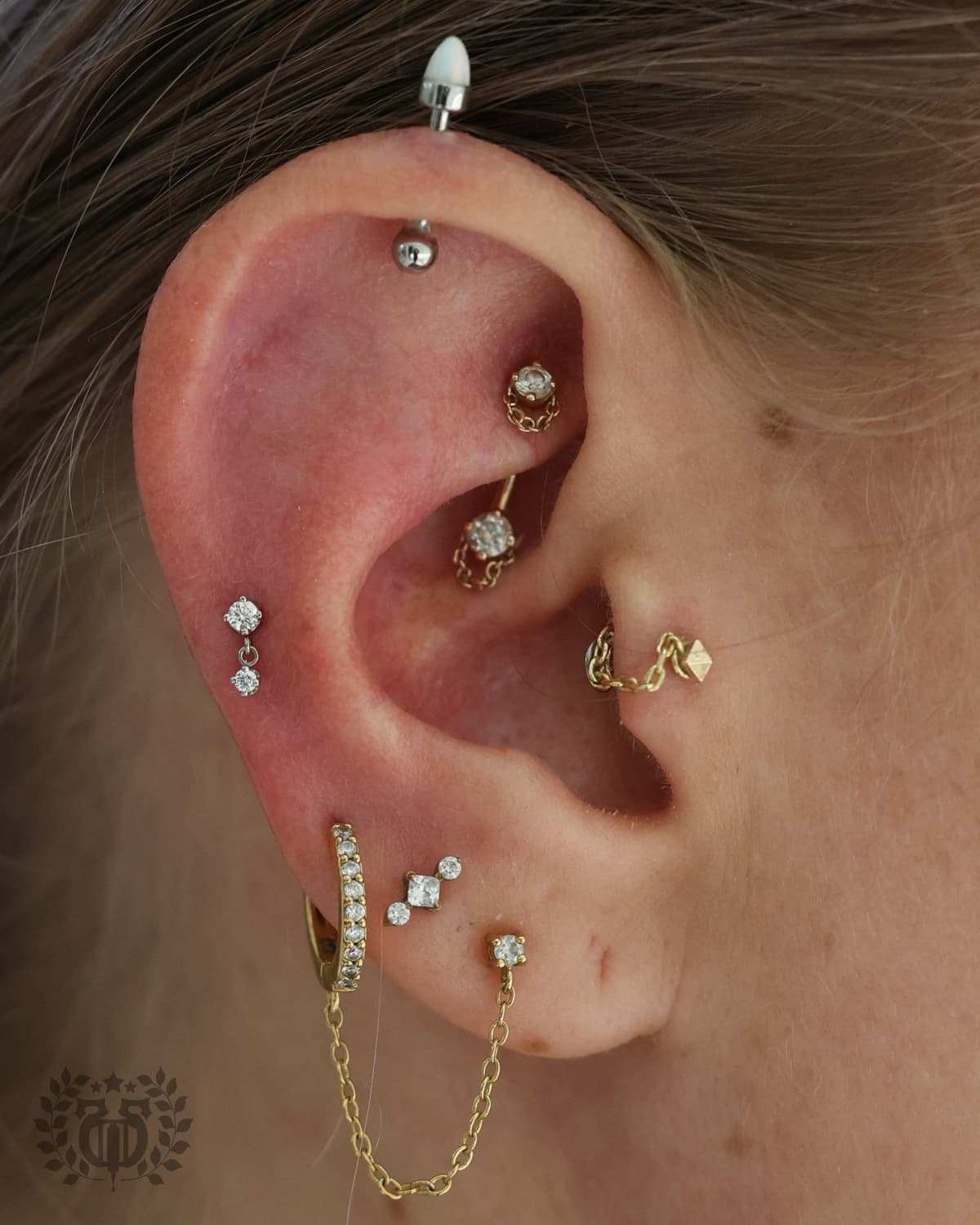
Blue Mason founded the studio and is Fakir-certified. On industrials his job is mostly geometry: deciding whether a single straight line can meet two points on your rim at sensible angles, and saying so plainly when it can't. He also does the fittings for ears that need a bar bent to their curve.
 Senior Piercer
 Senior Piercer
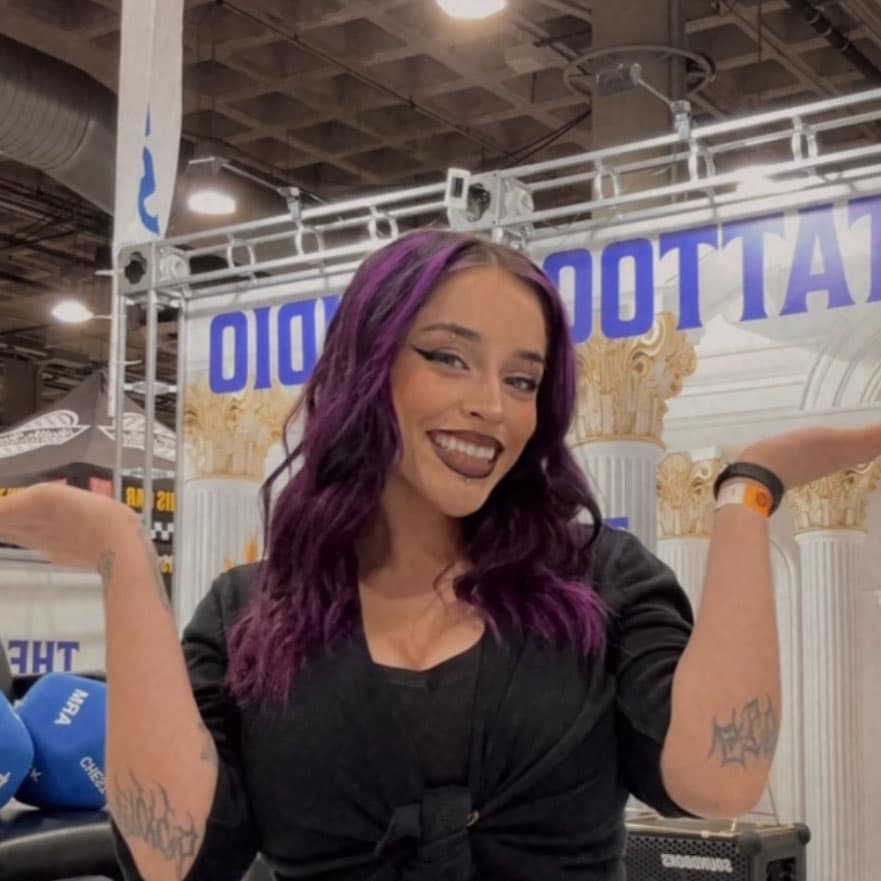
Bunny Vogt has been a Senior Piercer here since 2019. Industrials are where her marking is worth watching: two dots that have to survive being viewed from three angles, because a pair that looks aligned head-on can be visibly off once the ear is seen in profile.
Six things get looked at, and any one of them can end the conversation. It takes a couple of minutes and costs nothing, which is the point of doing it before you have your heart set on this.

Both ends get sterile saline, twice a day, and the back end is the one that gets forgotten. Spray each opening, let it air-dry, and resist working at either with a towel or a cotton bud. That is the cleaning half, and it is the smaller half.
The larger half is that these two wounds share a bar, so they share every setback. A knock at one end is felt at both. That's why the rules are stricter here than on a single helix: sleep on the other side without exception, keep clamping headphones off entirely, be careful pulling clothes over your head, and dry your hair by patting rather than rubbing. Long hair wants tying back for the first few months, because a hairbrush catching the bar does more damage in one stroke than a week of forgotten saline.
Two other things worth planning for. First, one end will probably behave worse than the other, usually the one through thicker cartilage, and that's normal rather than a sign of failure. Second, come back when the swelling has settled so the bar can be shortened. Skipping that visit leaves a long lever sticking out of your ear for another year, and it is the reason plenty of industrials that started well end up in trouble around month eight.
Book AppointmentThe whole ear throbs rather than one spot aching, because two cartilage wounds are swelling simultaneously. This is when the oversized bar earns its place. Saline both openings twice a day, tie long hair back, and sort out your sleeping side on night one rather than discovering the problem at 3am.
Swelling goes and the long bar turns from an allowance into a lever. Come in and have it shortened. Expect one end to be grumpier than the other for a while, usually the one through thicker cartilage. If a bump shows up, the question is what has been catching the bar, not what you've been cleaning it with.
Twelve to eighteen months, sometimes two years, and both channels have to get there before either counts as done. Now smaller fitted bars, decorative ends and solid gold are reasonable. Headphones remain worth a thought forever, because the bar still sits exactly where a headband lands.
We take walk-ins every day from 8am to 8pm, and you're welcome to turn up. But an industrial needs more chair time than anything else on the ear menu, so here is the honest guidance.
Verbatim reviews from Apollo's Google Business Profile
"I got a belly button piercing. I was very satisfied. The shop is clean, Bunny explained everything about the procedure and aftercare in detail, and I felt well taken care of. After a few months, they even checked in on the healing process. I thought that was very thoughtful. I would definitely recommend this shop."
"Just got two piercings from Steph. Had a great experience with her…fantastic touch and lovely human being! Would recommend her to anyone who is a first timer or someone who just loves getting pierced. Thank you so much Steph and to the entire Apollo team for working with me to find the right jewelry!!!"
Reviews from Google · Read all 623 on Google
5000+ clients2625 Main Street, Santa Monica, open 8am to 8pm seven days a week. Allow more time than you would for a lobe: the geometry check and the marking take a while, and you'll want a few unhurried minutes to look at the two dots before anything is opened.
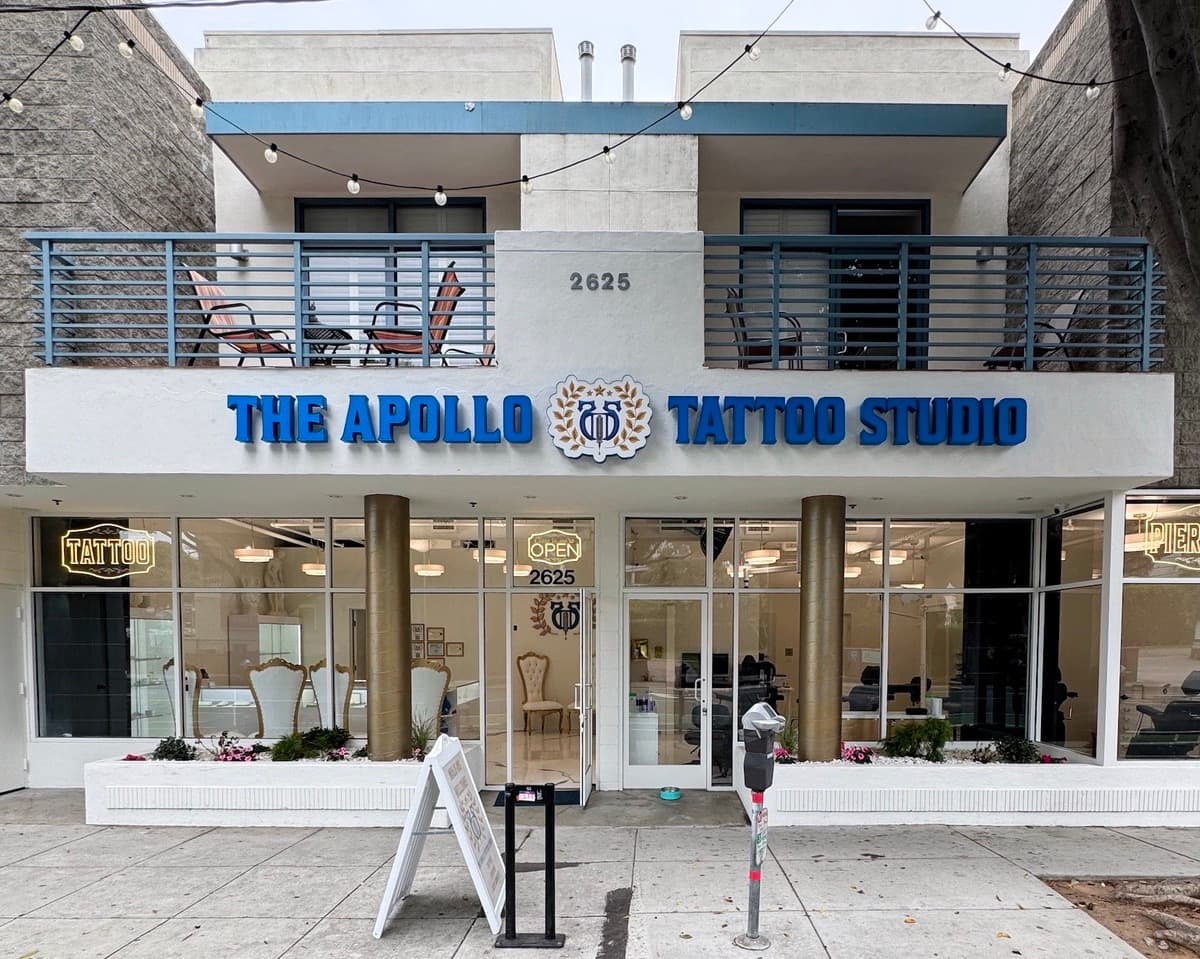
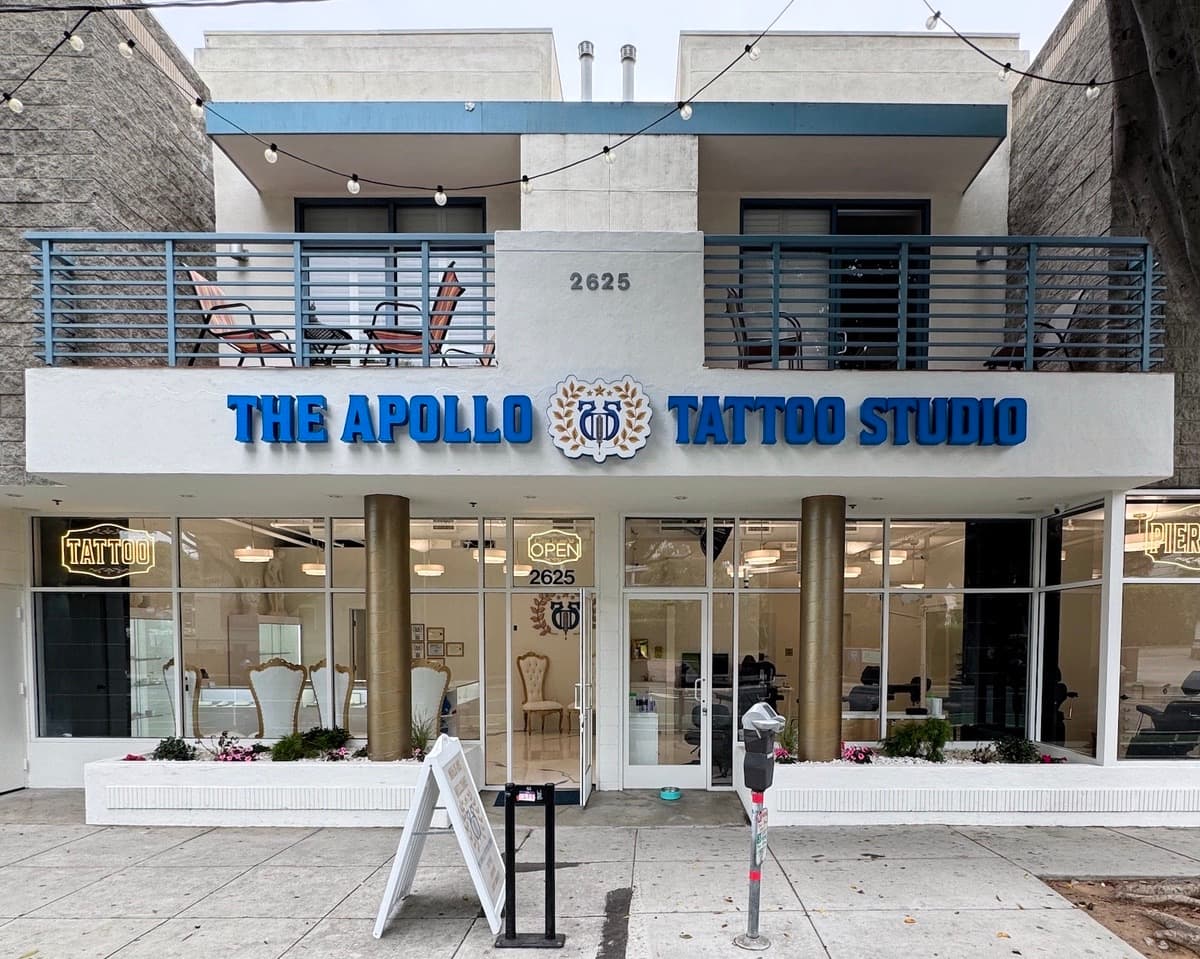
Santa Monica, CA
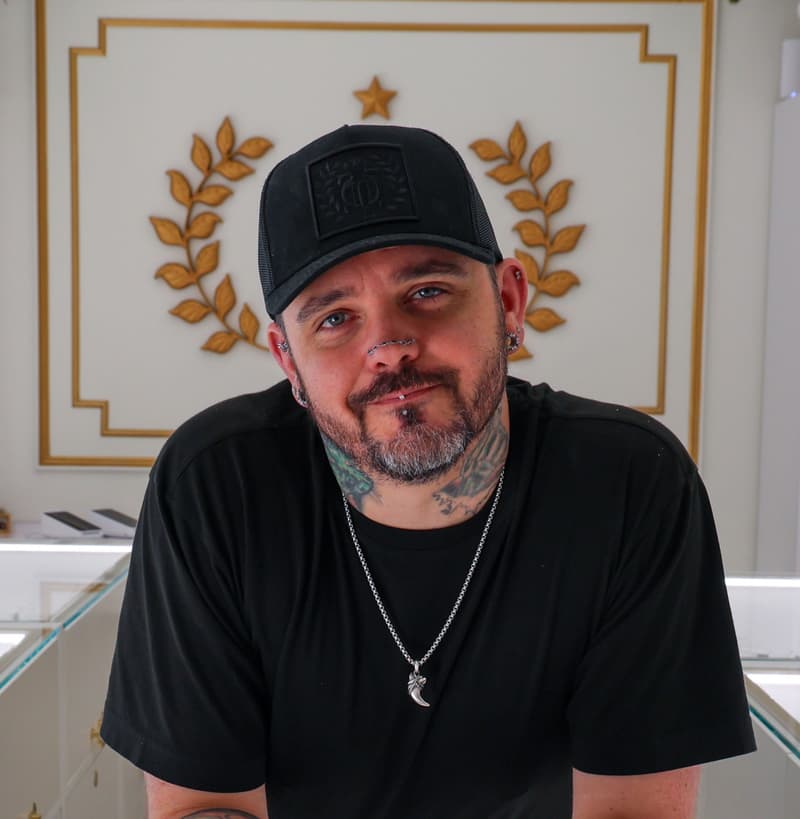
Apollo was founded by Blue Mason in 2007. With 20+ years of body art experience, Blue brings master-level expertise to every piece. Read Blue's story →
Mostly about anatomy, bar length and the year of changed habits nobody mentions.
Torque is twisting force. Because both of your holes are locked to one rigid bar, anything that turns or tilts that bar has to turn both channels with it. Snag the bar on a jumper and the far hole rotates too, even though nothing touched it. That is the mechanism behind nearly every angry industrial, and it is the reason this placement behaves so differently from two separate helix piercings sitting in the same positions.
We're looking for two points, usually forward helix and upper helix, that a single straight line can pass through while staying roughly perpendicular to the cartilage at both ends. That needs a helix rim with enough length and a particular relationship between the rim and the anti-helix beneath it. Ears that curl in sharply, or that have a shallow flat rim, won't give you a line that meets both surfaces squarely. It's an honest no fairly often.
Because the holes are straight. Each channel is a short tunnel through cartilage with a direction of its own, and a bar that doesn't follow both directions is levering on the walls of at least one of them, permanently. Curved jewelry in an industrial doesn't look adventurous; it just applies constant force in the one place that can't tolerate it. There is a use for a gentle bend, but it is a fitting decision made against your ear, not a style choice.
Two separate cartilage passes, so two distinct moments rather than one long one. Neither is worse than a standard helix. What people underestimate is afterwards: two fresh cartilage wounds on the same ear, swelling at once, and an ear that throbs for a couple of days rather than aches quietly.
Both ends swell, so both ends need clearance, and the bar has to accommodate two lots of it. That's why a fresh industrial stands off the ear more than the healed photos you have seen. Once the swelling has genuinely settled, come back and it gets shortened. Leaving a long bar in past that point is asking for torque, because the extra length is a lever arm that anything can grab.
Sometimes, and it's worth asking rather than assuming. The existing channel has to sit in the right position and, crucially, run in the right direction. A helix pierced at a slightly different angle from what the industrial line needs will fight the bar forever. We'd rather add a second fresh hole in the correct place than force a bar through an old one that doesn't line up.
Longer than any other ear placement we do. Reckon on 12 to 18 months, occasionally two years. Two wounds heal on one bar, so a setback at either end resets the whole thing. Compare that with a single helix at a few months and you can see why we ask people to be sure before booking.
This is the placement where they matter most. An industrial bar crosses the top of the ear, exactly where a headphone band, a beanie or a helmet lands. Over-ear cups are the worst offender because they clamp and then twist the bar every time you adjust them. In-ear buds are fine. Expect to change your headphone habits for the better part of a year.
Usually at one end rather than both. The skin over one hole thins, the opening widens or looks stretched, and the bar starts to sit closer to the surface on that side. Come in as soon as you notice, because at that stage the fix is often removing the bar and letting one end recover rather than losing both. Left alone it scars.
$125, which covers the assessment and both piercings. Jewelry is separate. If the assessment says your ear can't take a straight line through two points, you've paid nothing and we'll show you what your rim will carry instead.
Apollo sits at 2625 Main St in Santa Monica, a block from the beach and easy to reach from anywhere on the Westside. Here's roughly how long it takes to get to us for tattoos and piercings:
There's metered street parking on Main Street and Ocean Park Blvd, plus a public lot on 2nd Street a short walk away. We recommend giving yourself an extra 10 minutes to park on weekends — Main Street gets busy with the farmers market and beach traffic. If you're running late, text us at the studio and we'll hold your appointment.
We check the line before we mark the dots, and we say so when it isn't there.
Recognized in Santa Monica's Most Loved 2025 & 2026


We'll respond within 24 hours
Or reach us directly:
We use cookies to run this site, remember your preferences, and understand how it's used. Read our Privacy Policy for full details.