Ten placements sit on the cartilage of one ear, and the interesting question is almost never "can this be pierced". It's the order. Which one opens the sequence, how far apart the next two go, which of them your anatomy will refuse outright, and how long each has to settle before the one beside it can be added. Get that wrong and you end up with two piercings fighting over the same square centimetre for a year.
This page is the planning version rather than the brochure version: a map of the ear by region, a comparison of healing times across placements, the arithmetic of one sitting versus several, and the real fee for each. Needle only — a gun fractures cartilage rather than cutting it, so one has never been used here. Come in with a photo, leave with an order of operations.
Book Your Cartilage Piercing 5000+ clients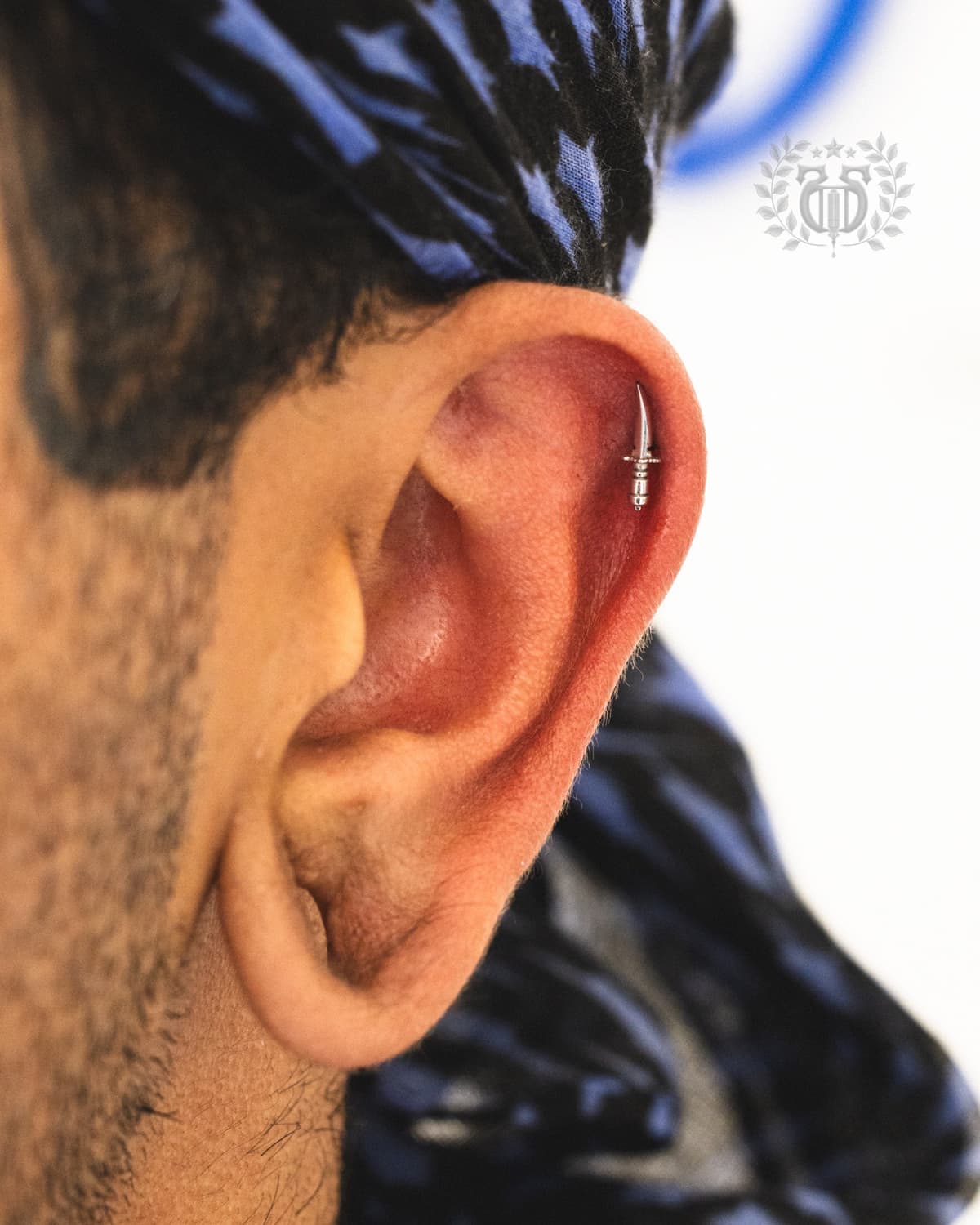
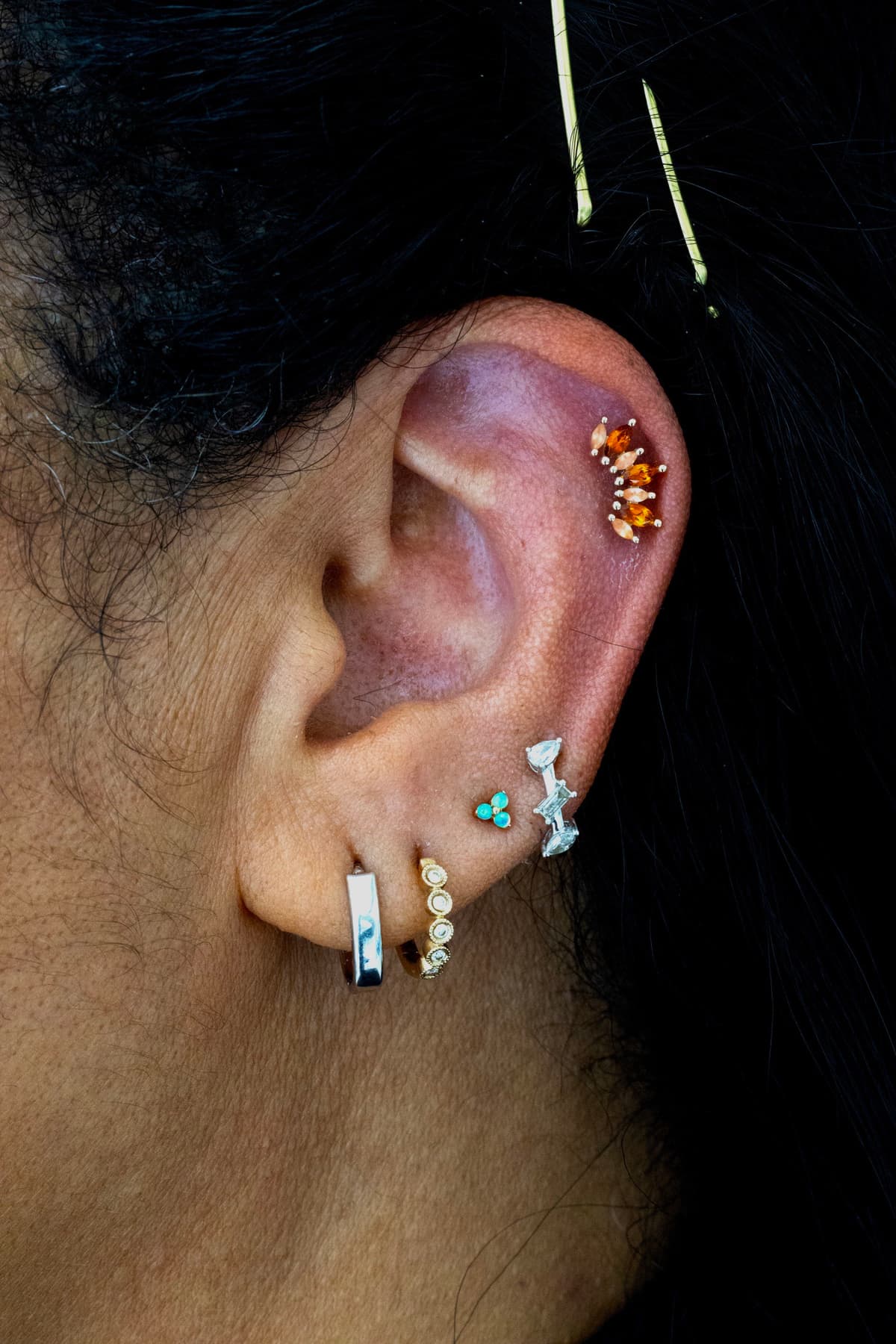
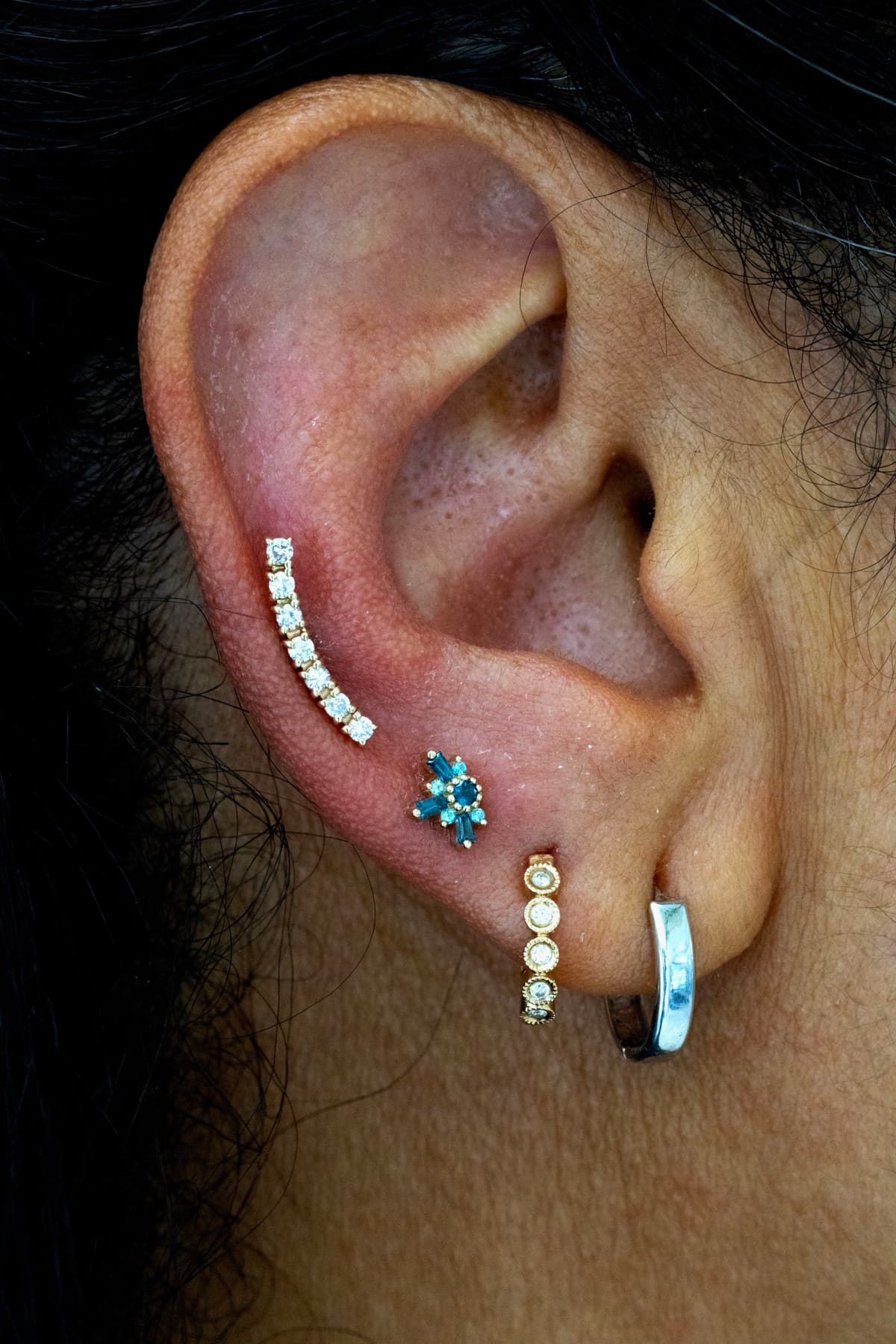
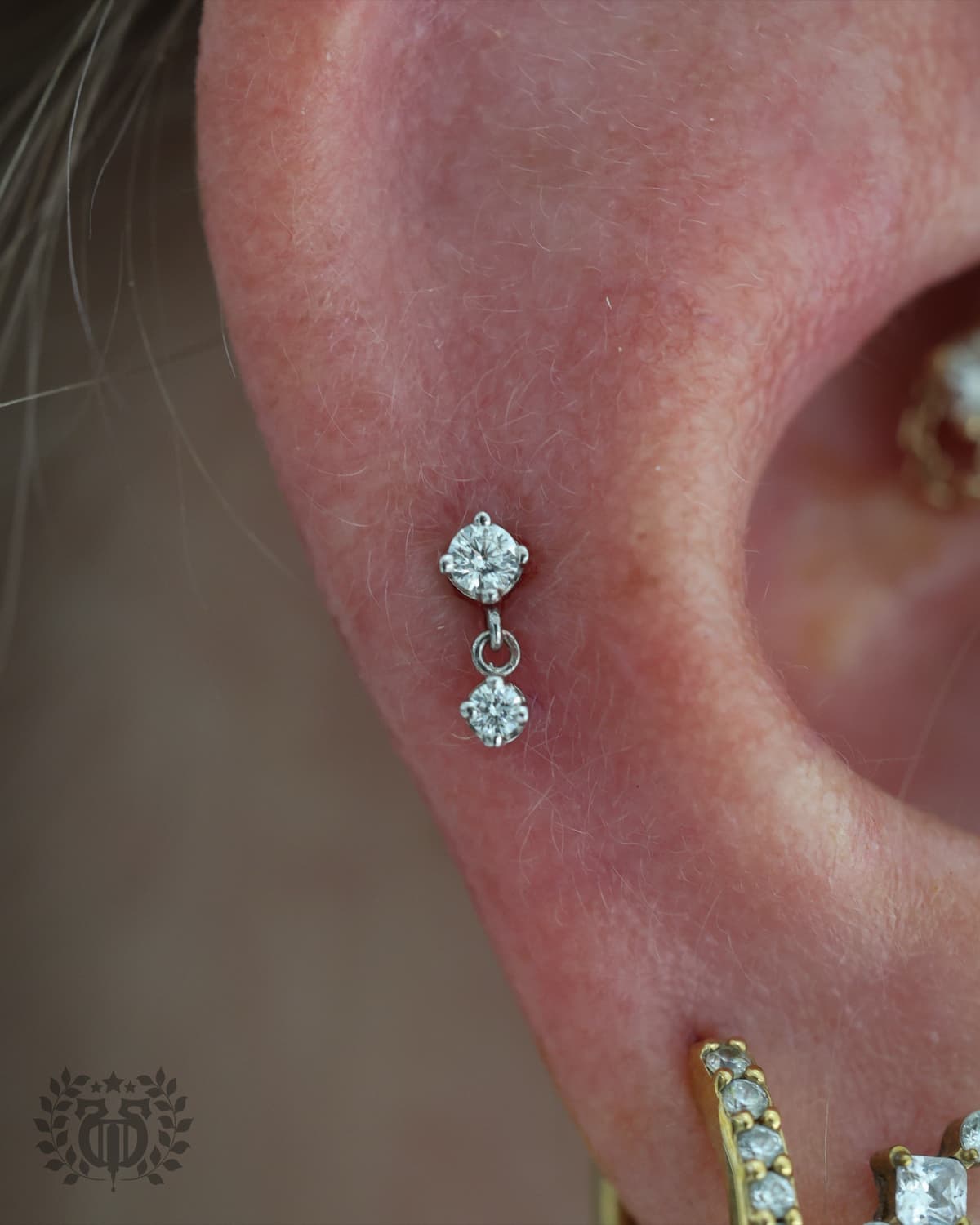
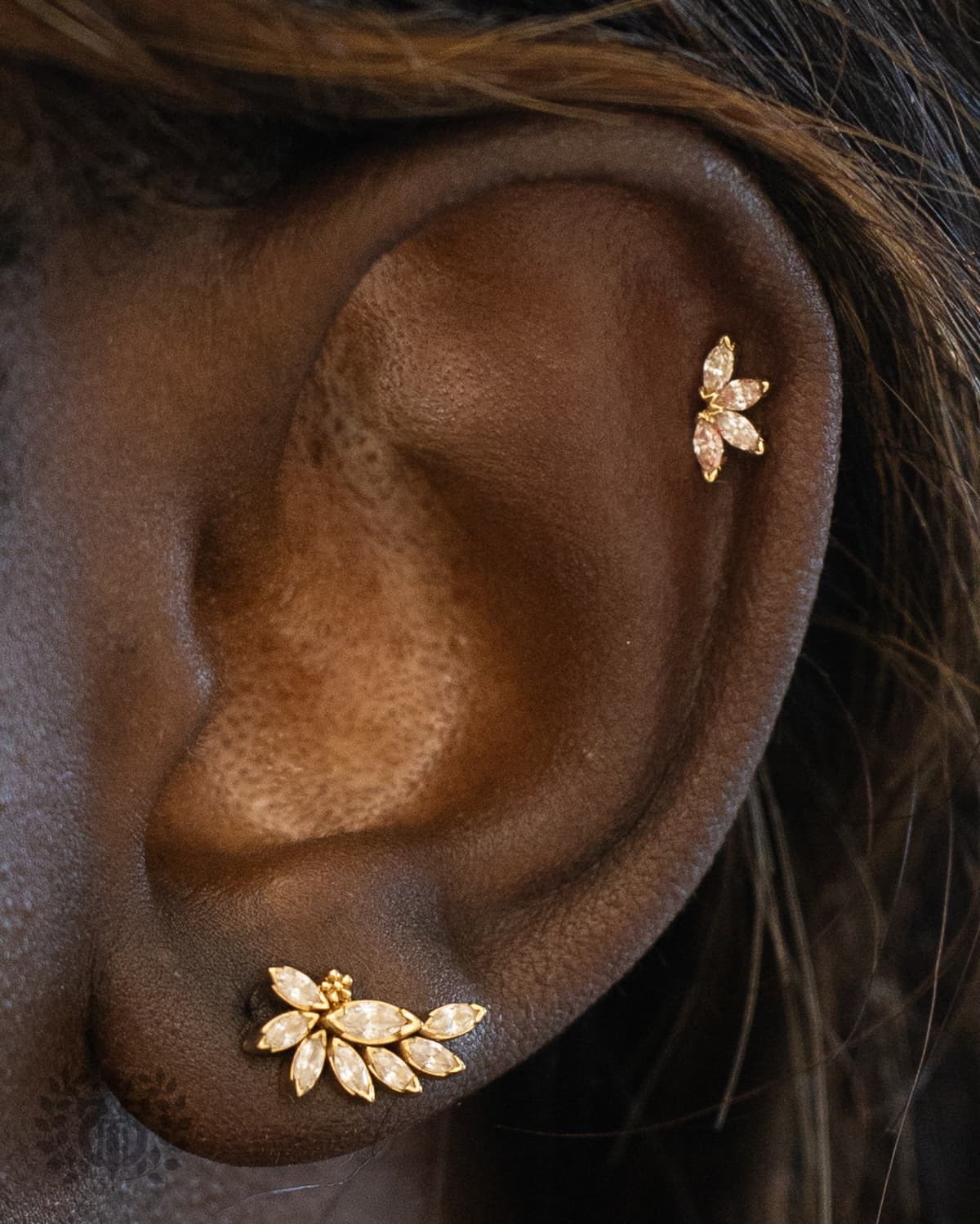
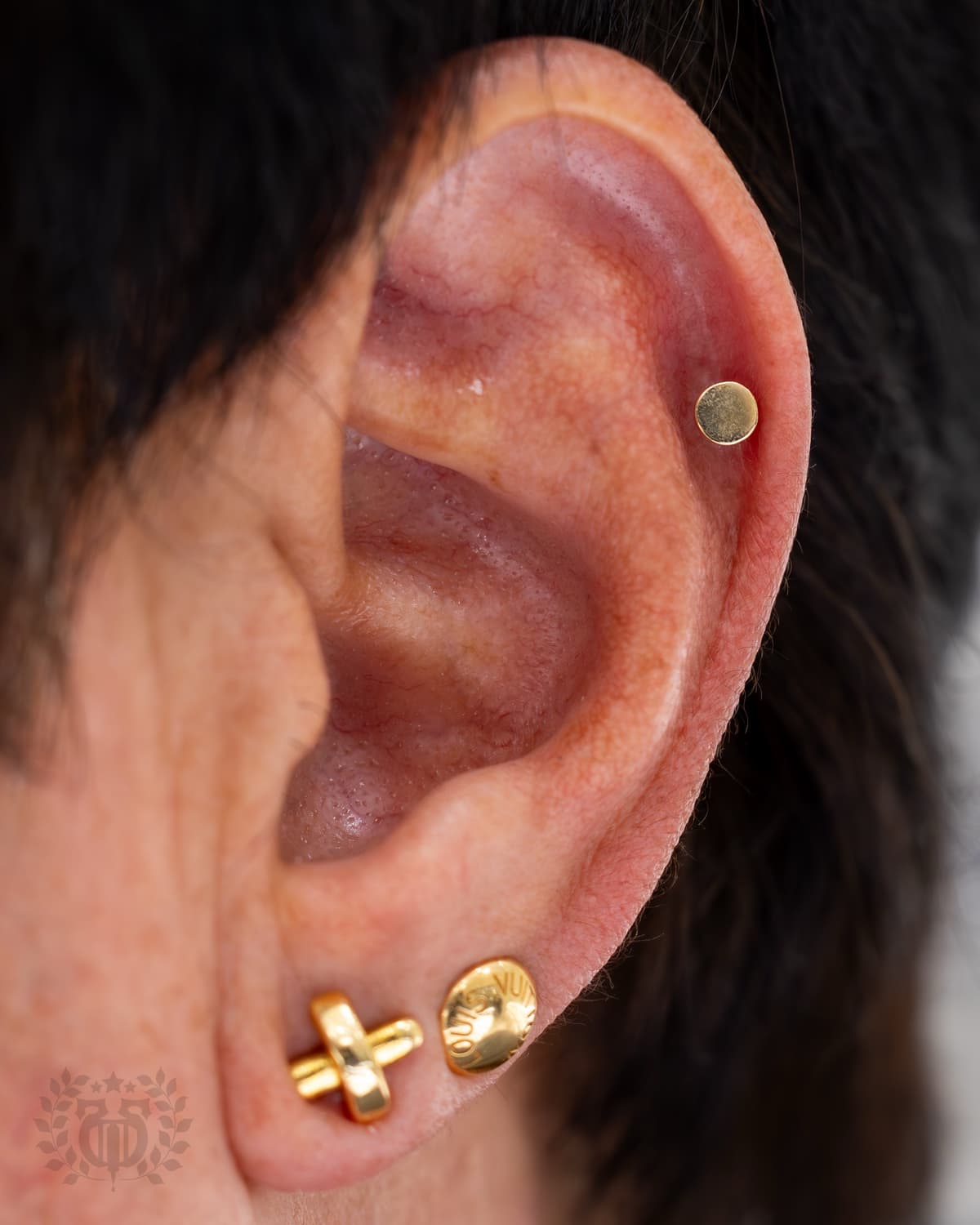
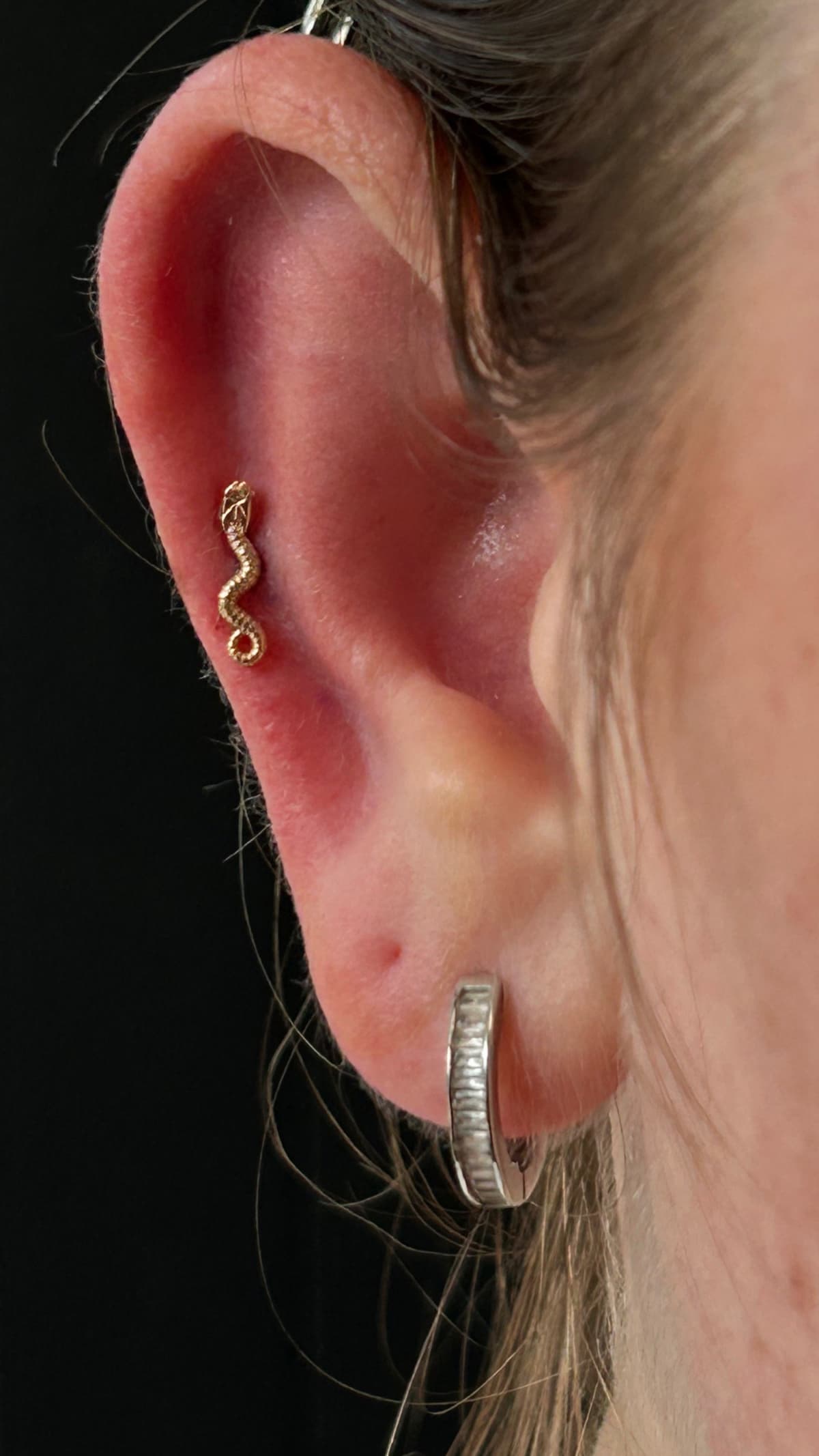
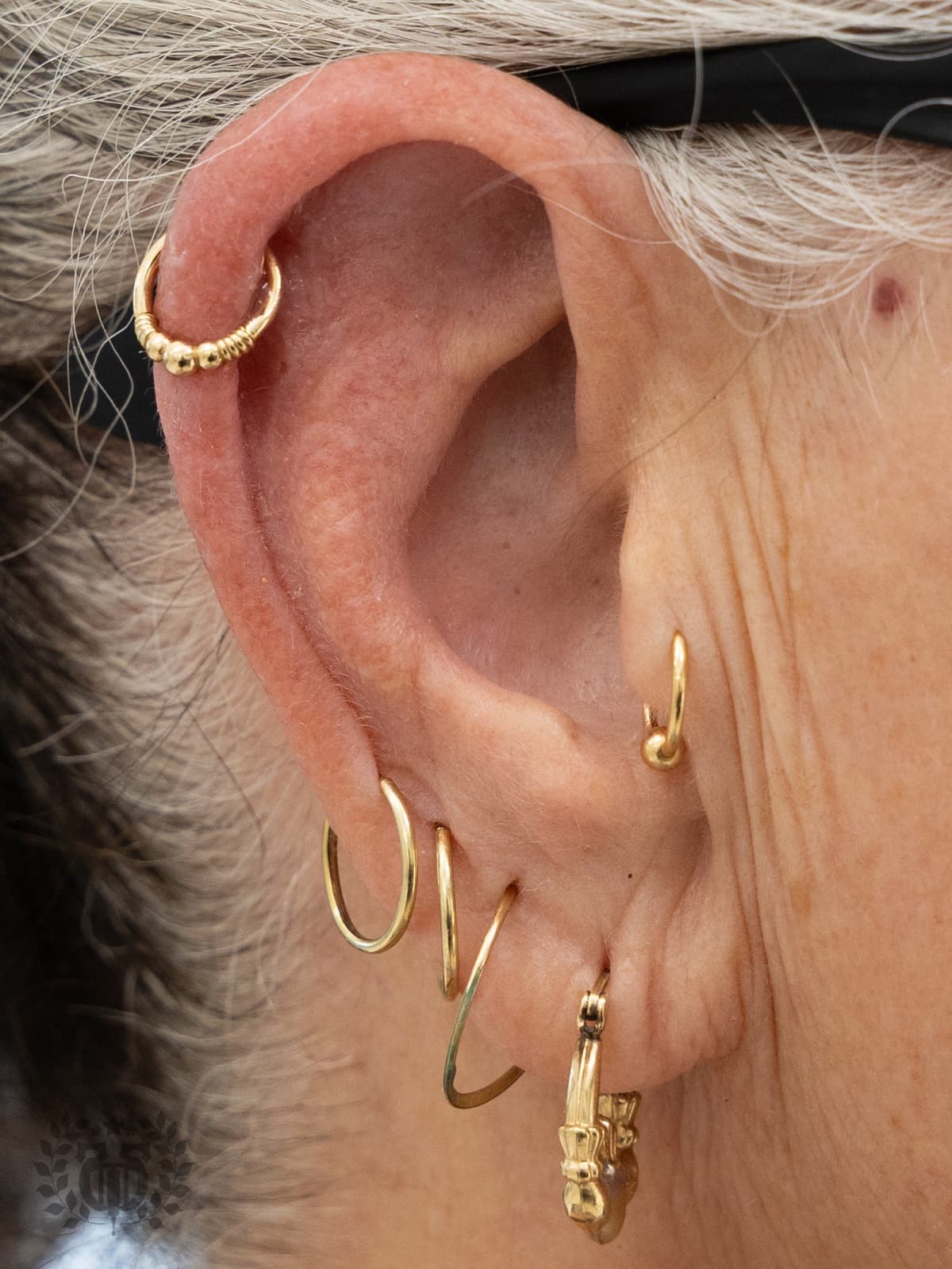
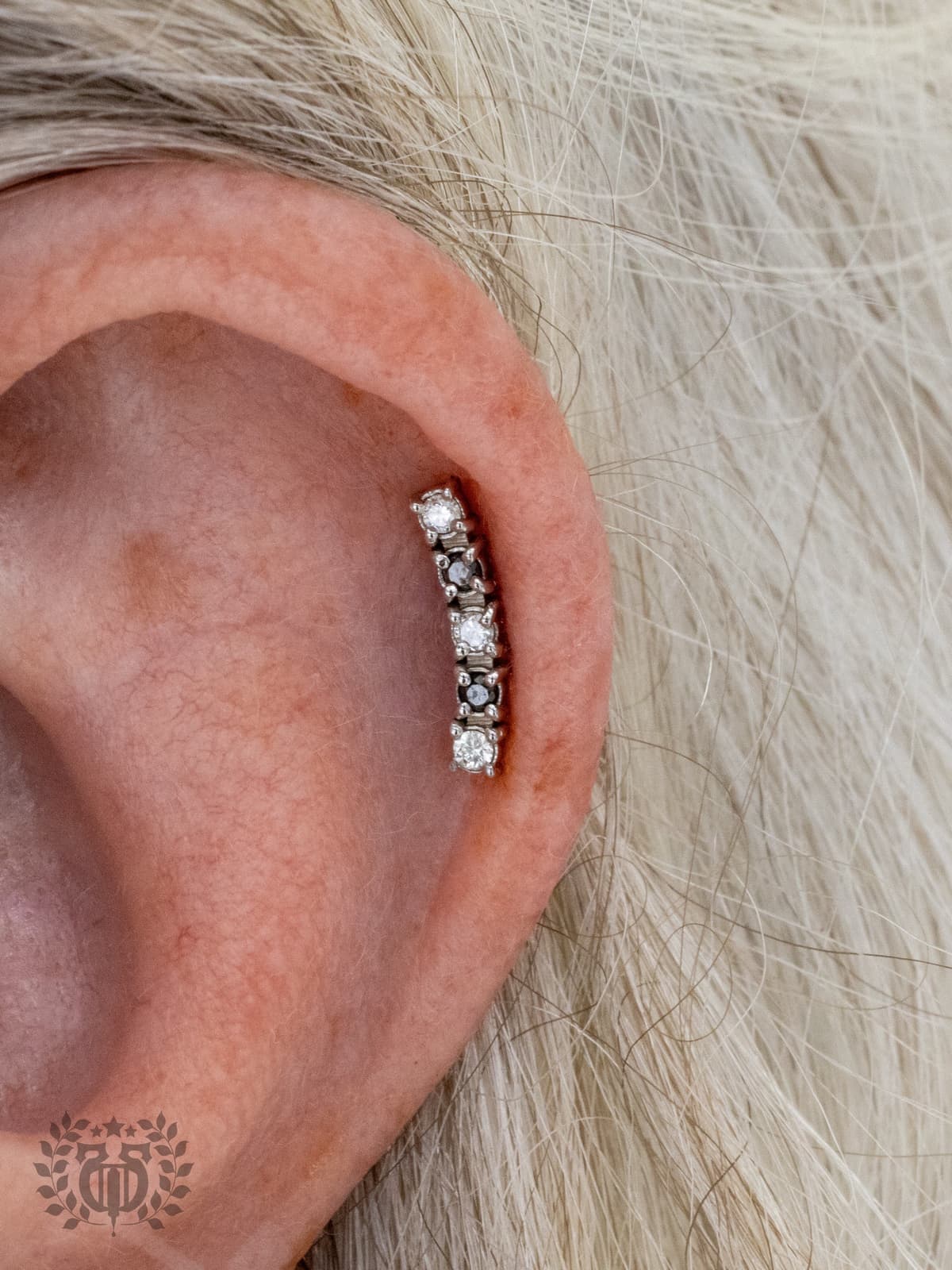
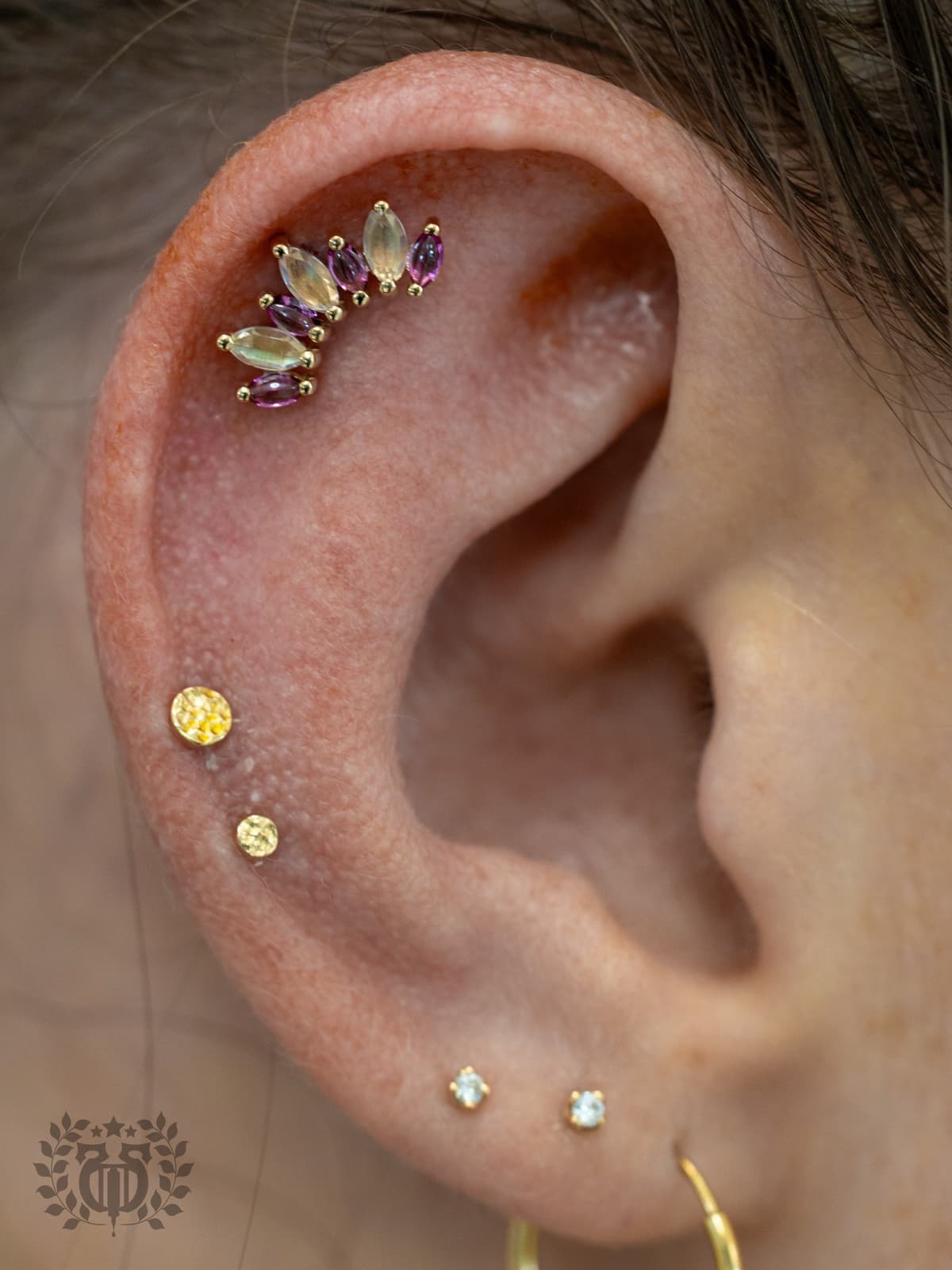
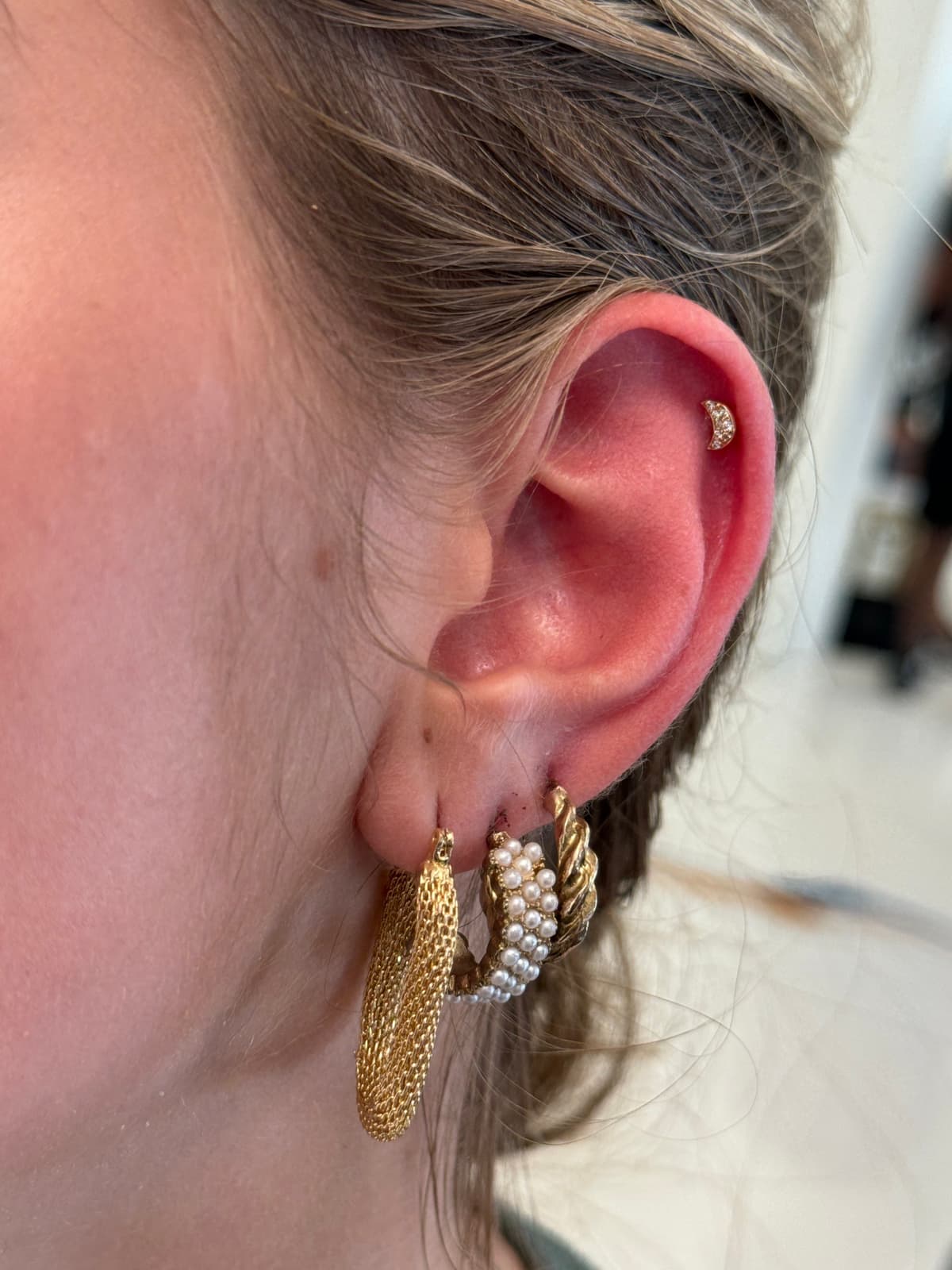
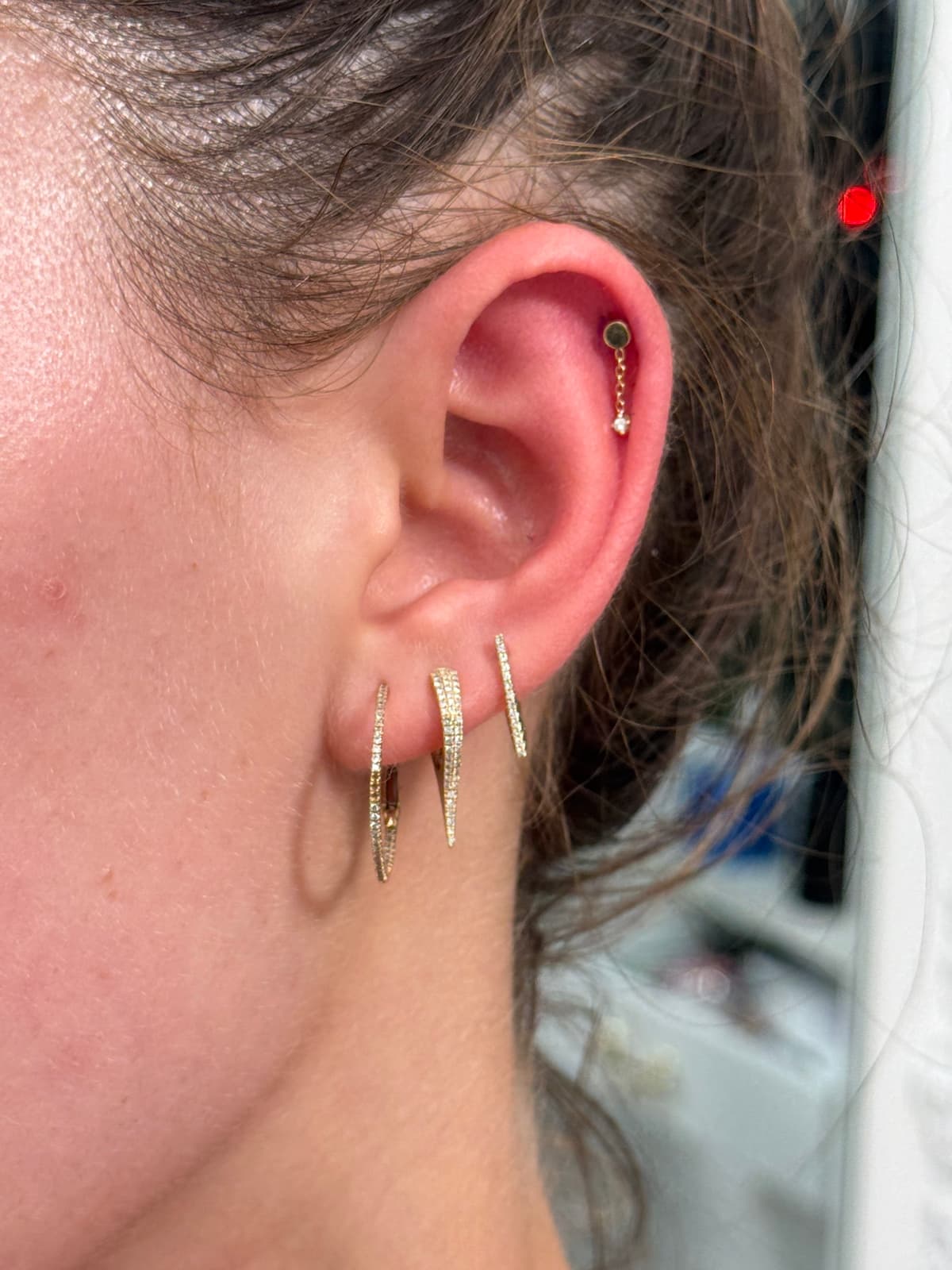
Four regions, ten placements. Knowing which region a placement belongs to tells you most of what you need to know about it.
Everything above your lobe is one continuous sheet of cartilage folded into a shape. It isn't uniform. Some of it is a thin rim you could pinch between two fingers; some of it is a rigid slab several times thicker; some of it is a tucked fold you can barely get a fingertip into. Piercings behave according to which part of that sheet they pass through, not according to what they're called.
So rather than list ten placements as though they're ten equivalent menu items, it's more useful to group them by region. Everything in a region shares roughly the same tissue thickness, the same jewelry profile, the same pressure problems and the same healing behaviour. Once you know the region, the individual placement is mostly a question of where in it you want the metal to sit.
Thin, accessible cartilage along the folded edge of the ear. The most forgiving region and the usual place to start.
Main enemy: glasses arms and sleeping. See the helix page for rim thickness in detail.
The thickest cartilage on the ear. Slowest heals in this group, and the most affected by earbuds.
Main enemy: in-ear headphones and phone calls. Detail on the conch and tragus pages.
The two placements most often ruled out by anatomy. Both need a specific structure that not every ear has.
Main enemy: pressure rather than contact. Have these assessed before you plan around them.
One piece of jewelry through two separate holes. Everything gets harder when the two have to agree with each other.
Main enemy: torque. Any twist on the bar is felt at both ends at once.
A helix at the top curve of the ear is not the same piercing as a helix low on the back rim — the cartilage is measurably thicker in one and the post length differs. Region tells you the shape of the problem; the individual read tells you the numbers.
Piercings in the same region compete for the same pillow, the same earbud and the same swelling. Spreading a plan across the rim and the bowl heals more comfortably than stacking three placements in one area.
Rook, daith and industrial each need a specific structure. We check for it before you book rather than after you've paid, and if the answer is no we'll point at what your ear will carry instead.
Single-use sterile needles, opened in front of you. A gun fractures cartilage instead of cutting a channel, and its plastic body can't be autoclaved. Reusable tools go through a hospital-grade autoclave; the studio is licensed and inspected by LA County.
Implant-grade titanium, ASTM F136, goes in on day one across every placement. Solid-gold BVLA and threadless ends are for healed piercings. Cheap mystery metal in a year-long heal is the single worst economy in this trade.
Every cartilage placement gets a starter post cut long for swelling, and every one of them needs a shorter post fitted once that swelling drops. Multiply that by the number of piercings in your plan and you can see why the sequence matters.

Apollo's Premium Jewelry Partner
Handmade in Los Angeles since 1996. Lifetime guarantee. Implant-grade gold, platinum, and titanium. Over 3,000 original designs in our case — ask your piercer for a tour.
See the BVLA story →A default running order, and the reasoning behind it. Yours may differ once your ear has been read.
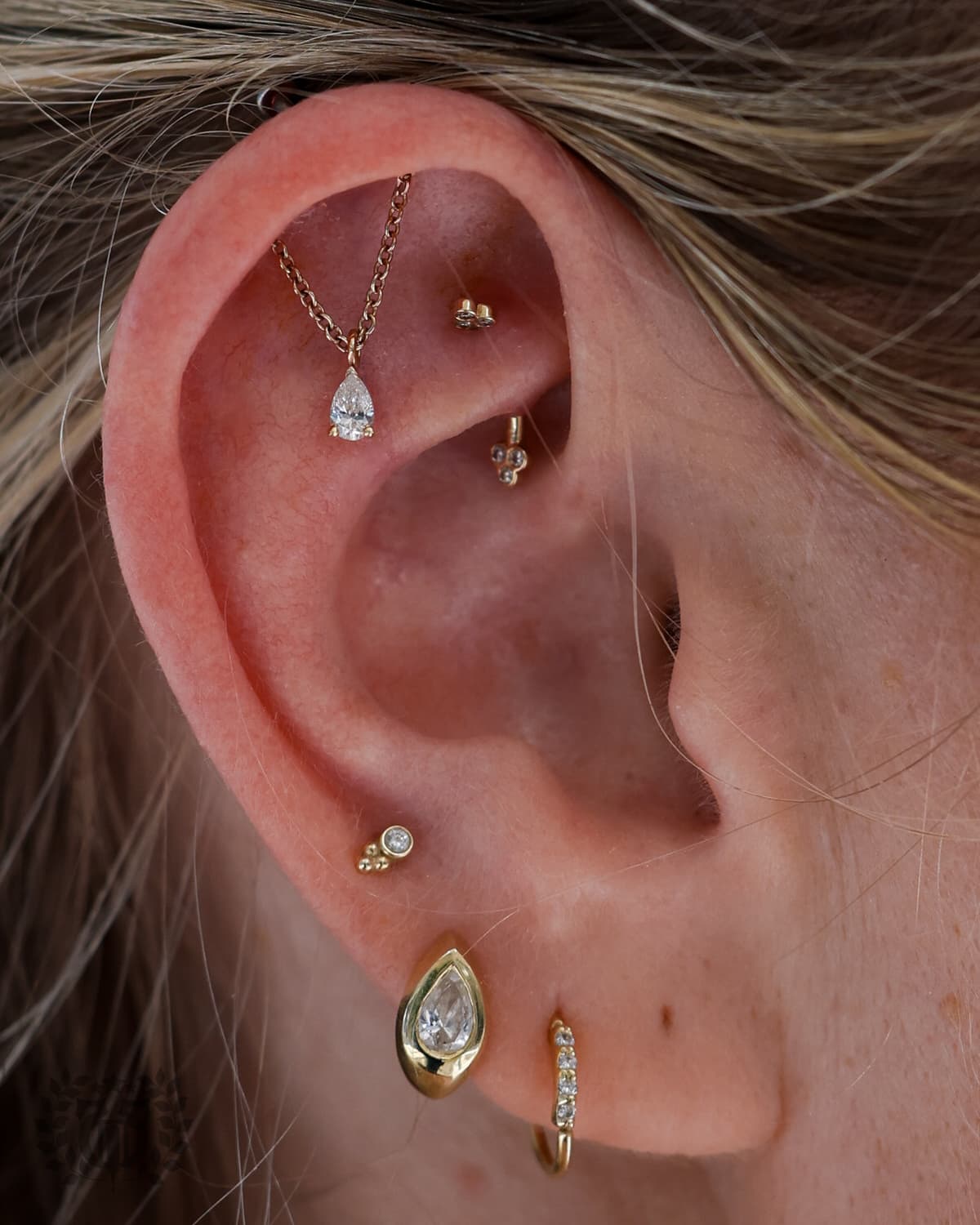
There's no law about this, but there is a default that saves people trouble. Start on the outer rim, move into the bowl, leave the folds until last. Each step is a bit less forgiving than the one before, and by the time you get to the awkward placements you've learned how your own body handles cartilage — which is genuinely useful information that no chart can give you.
The other argument for this order is disappointment management. If your ear turns out not to have a usable rook ridge, finding that out at step one means the whole plan you'd built in your head collapses. Finding it out at step four means you've already got three piercings you like and you're redirecting one budget rather than rethinking everything.
Thin accessible rim, few anatomy requirements, and the placement where you learn how your own cartilage behaves. If a helix gives you trouble, that's worth knowing before you commit to a rook. Heals in 6-12 months. $75.
Moves the plan into the bowl, which balances a rim piercing visually and sits far enough away to heal without competing. Densest cartilage on the ear, so budget 9-12 months. $75.
Small, stiff and sitting directly over the canal, so this one turns on whether you can live without in-ear headphones for the best part of a year. Ask that question before you book it. 6-12 months. $85.
The tucked fold above the canal is the hardest angle of entry in the ear, and not every fold has the depth for it. Worth having assessed early even if you pierce it late. 9-12 months. $85.
Needs a genuinely raised anti-helix ridge to hold a curved bar with both ends visible. Plenty of ears simply don't have one, and forcing it produces a piercing that sits flat and stays irritated. 9-12 months. $85.
One straight bar through two placements, which means both heal on the same piece of metal and any twist is felt at both ends. Only works on ears where the two points line up. Longest heal on the page at 12-18 months. $125.
Clear next step
Come in with a photo and leave with an order of operations — no obligation to be pierced that day
Recommended first step
Book lobes, cartilage, or a styled ear appointment with Apollo.
One anatomical difference explains almost every rule on this page.
Someone with six lobe piercings arrives assuming a seventh hole in the same ear is much the same job. It isn't, and the reason is plumbing.
A lobe is soft tissue with a real blood supply running through it. When you make a channel through it, the cells that build new lining arrive by the most efficient route a body has. Six to eight weeks later it's done, and it was never especially sore.
Cartilage has no blood vessels inside it at all. It's fed by fluid seeping in from the perichondrium — the membrane wrapped around the outside — which is a slow, low-volume delivery system that evolution designed for maintaining a fairly inert structural material, not for emergency repairs. Every cell involved in healing your helix has to get there the long way. That is the whole story, and everything below follows from it.
| What changes | Lobe | Cartilage |
|---|---|---|
| Tissue | Soft, fatty, vascular | Rigid, avascular, fed by diffusion |
| Typical full heal | 6-8 weeks | 6-12 months; industrial 12-18 |
| When swelling peaks | Hours | Around 48 hours |
| Starter post | Roughly final length | Cut long, then downsized at 8-12 weeks |
| Response to a knock | Sore for a day | Sore for weeks; can set healing back |
| Sleeping on it | Tolerable within days | Off that side for months |
| Ring as a starter | Usually fine | A bad idea; movement is transmitted, not absorbed |
| If removed after healing | Often closes | Often stays as a visible pinhole |
Two practical consequences fall out of that table. The first is that "how it looks" is a terrible guide to whether cartilage is healed — the outside closes over long before the channel through the middle has finished lining itself, which is why people who change jewelry at month four so often start again from scratch. The second is that a plan for several cartilage piercings is really a plan about time, not about money. Four placements is not four appointments, it's most of two years of somebody's sleeping arrangements.
None of which is an argument against doing it. It's an argument for knowing the shape of it before you start, which is more or less what the rest of this page is for.
A lobe is in the top row deliberately, for scale
| Piercing Type | Location | Initial Healing | Full Healing | Pain Level |
|---|---|---|---|---|
| Lobe (Classic) | Soft tissue, lower ear | 6-8 weeks | 3-6 months | 2/10 |
| Helix | Upper outer rim cartilage | 3-4 months | 6-12 months | 4-5/10 |
| Forward Helix | Front upper cartilage near temple | 3-4 months | 6-12 months | 5-6/10 |
| Flat | Flat cartilage area (between rook & rim) | 3-4 months | 6-12 months | 6-7/10 |
| Conch (Inner) | Center bowl of ear | 3-4 months | 6-12 months | 5-6/10 |
| Conch (Outer) | Lower center, near anti-helix | 3-4 months | 6-12 months | 5-6/10 |
| Tragus | Small flap over ear canal | 3-4 months | 6-12 months | 4-5/10 |
| Daith | Innermost fold above ear canal | 3-4 months | 9-12+ months | 5-6/10 |
| Rook | Upper inner fold above daith | 3-4 months | 9-12+ months | 6-8/10 |
| Snug | Inner ridge of anti-helix | 4-6 months | 9-12+ months | 7-8/10 |
| Industrial | Two holes connected by barbell | 4-6 months | 9-12+ months | 6-7/10 |
 5000+ clients
The arithmetic of doing four at once versus four across a year — and why the answer is usually somewhere in between.
Money argues for one sitting. Two piercings in a visit is $75 and the Curated Ear covers up to four for $99, which is a fraction of what those placements cost individually. Comfort argues for several. Each fresh cartilage piercing removes a sleeping position and a set of headphones from your life for months, and doing four at once means doing all of that at the same time.
What most people land on, once it's laid out, is a compromise: two or three in one visit spread across both ears, then the rest three to four months later when the first lot have stopped complaining. Every appointment here uses single-use sterile needles opened in front of you and autoclaved reusable tools, whether it's one piercing or four, and the studio is licensed and inspected by LA County either way.
Two fresh cartilage piercings on the same ear takes that side out for months. Split across both ears and you keep somewhere to put your head.
Placements a few millimetres from each other swell into each other and share every irritation. Same-region neighbours are the ones to stagger; opposite-region pairs can go together.
Even if a rook or daith is scheduled for next year, get it assessed now. Knowing your ear can't take one changes the design while the design is still on paper.
Every placement needs a shorter post at roughly eight to twelve weeks. Piercing two together means one return trip instead of two — a genuine argument for batching.
Industrials and rooks are the least forgiving and the most anatomy-dependent. Doing them once the rest of the ear has settled means one difficult heal at a time rather than several.
The starter piece is decided by the geometry of the placement, not by preference. Here's the mapping.
Piercing service only. Jewelry is priced separately in every row, which is where most of the variation lives.
Jewelry sold separately
Jewelry sold separately
Jewelry sold separately
Jewelry sold separately
Jewelry sold separately
Jewelry sold separately
Jewelry sold separately
Jewelry sold separately
Jewelry sold separately
Read the last two rows against the first seven. Four separate visits for four $75 placements is $300 in service fees; the same four under the Curated Ear special is $99. That gap is the strongest argument for batching, and it's the reason the sitting-versus-staging decision above is worth actually thinking about rather than defaulting. Jewelry sits outside all of it — titanium starters are modest, solid-gold BVLA ends are not, and you choose per placement.
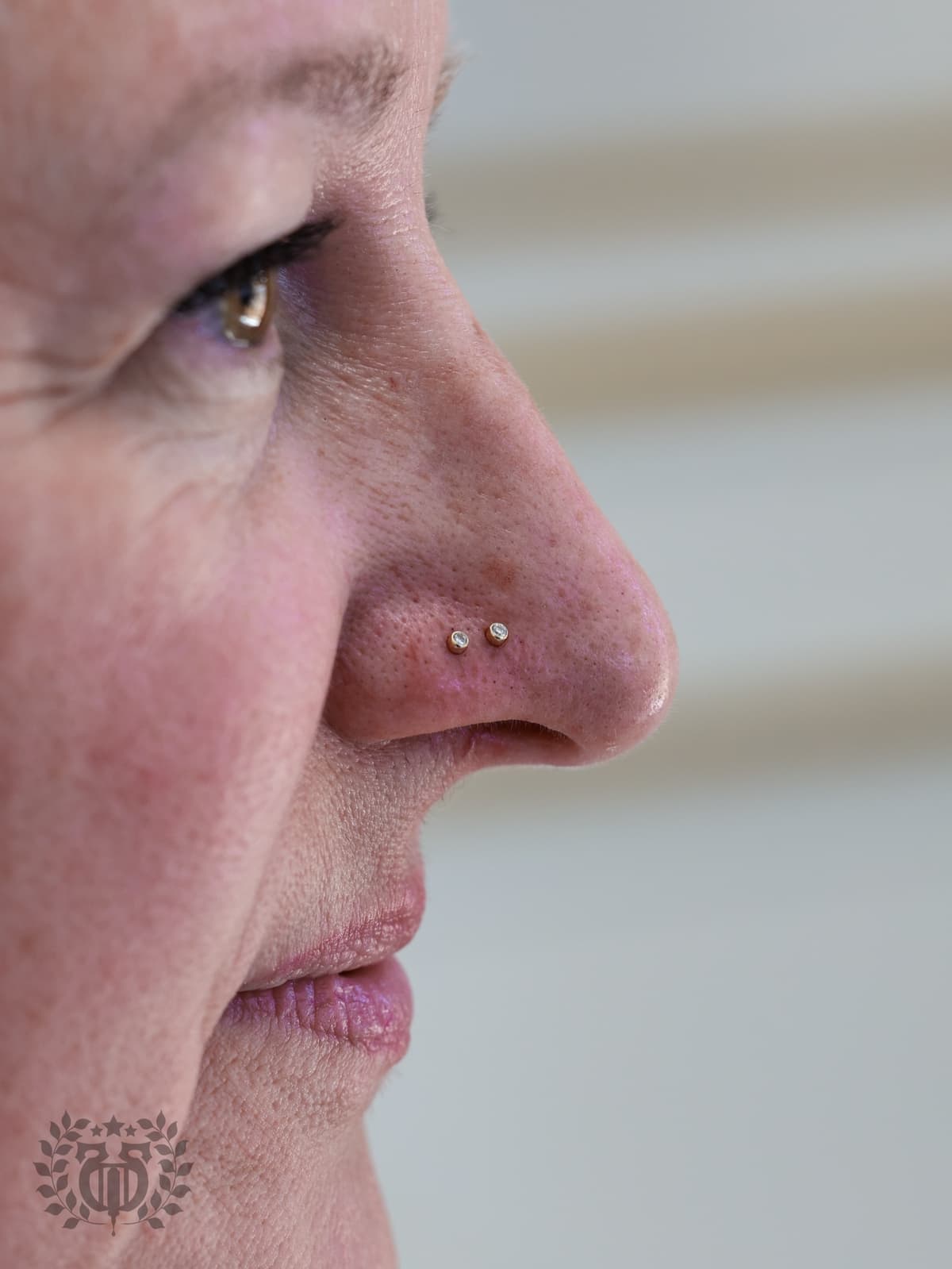
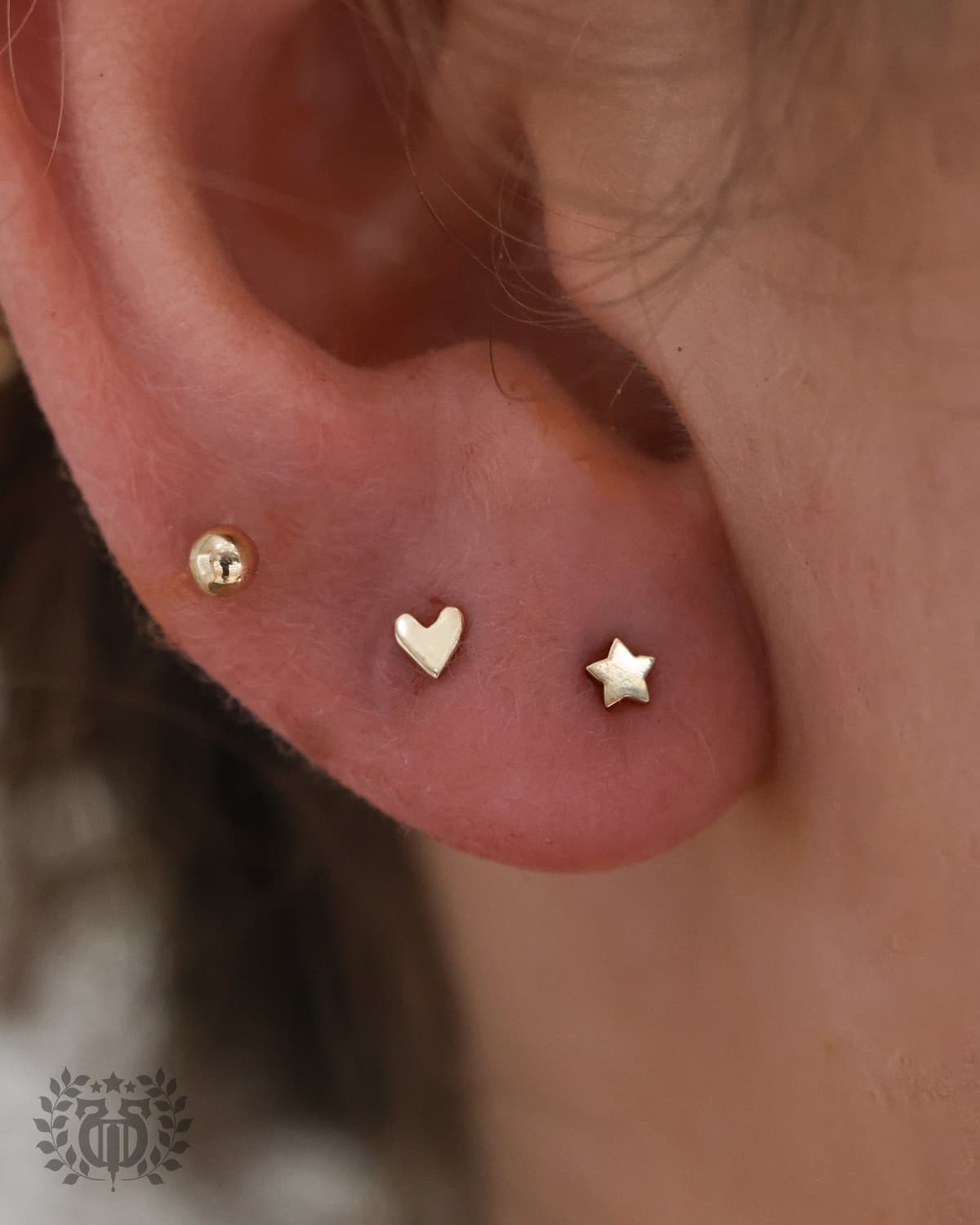
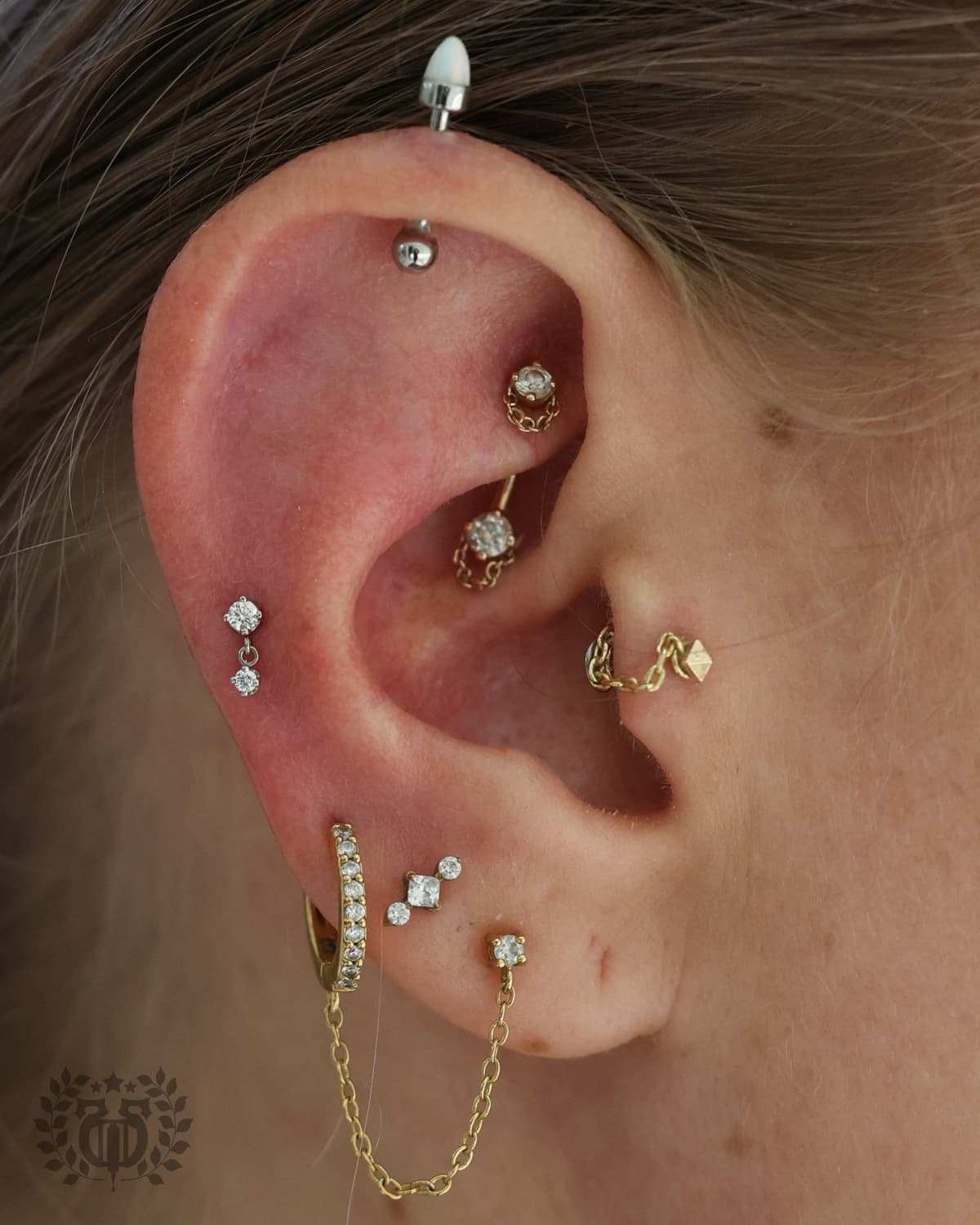
 Senior Piercer
 Senior Piercer
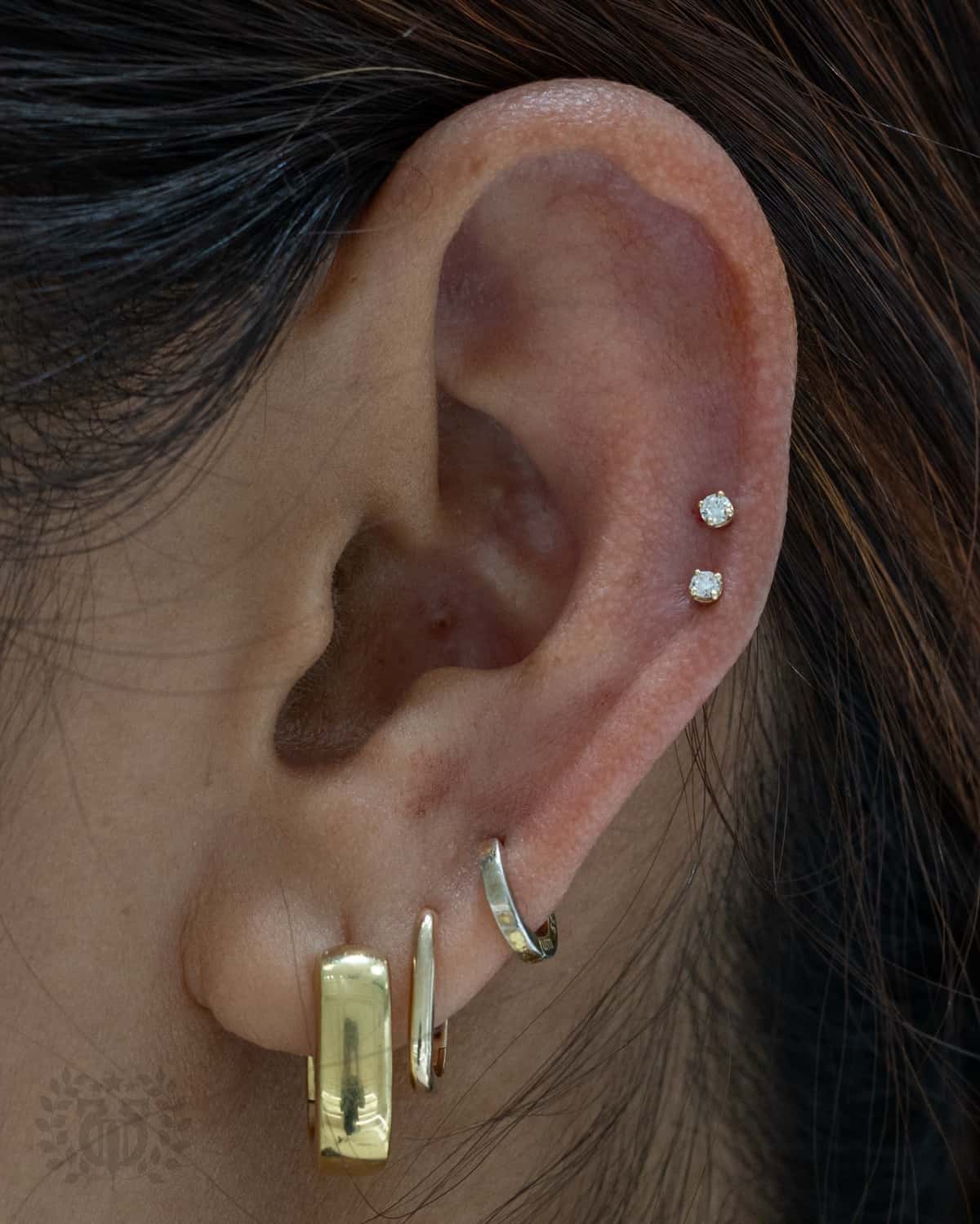
Bunny Vogt has been a Senior Piercer here since 2019 and plans more multi-placement ears than anyone else on the floor. If you arrive with a saved photo of somebody else's ear, she is the one who will tell you which parts of it your anatomy can actually reproduce and in what order to get there.
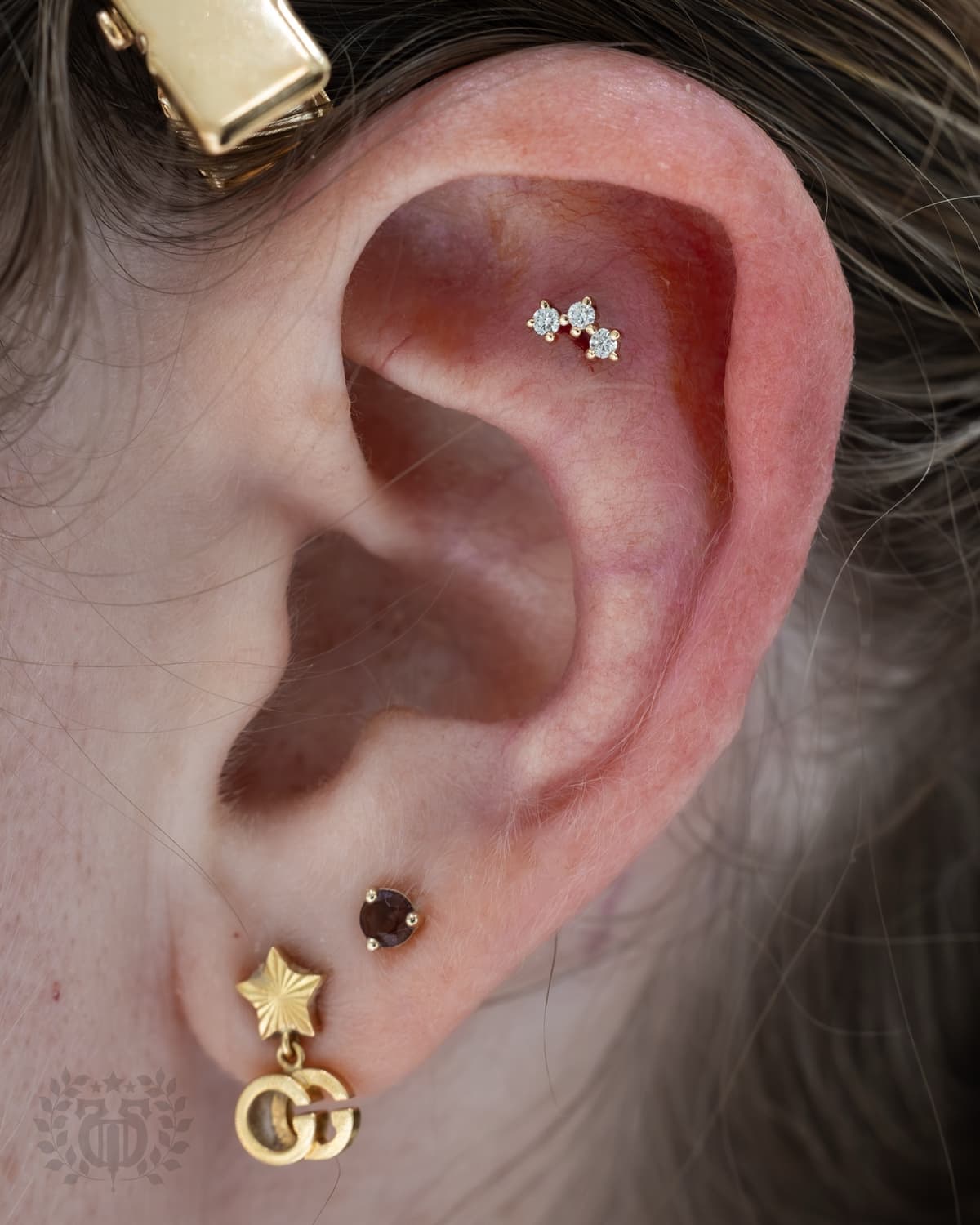
 Founder
 Master Piercer
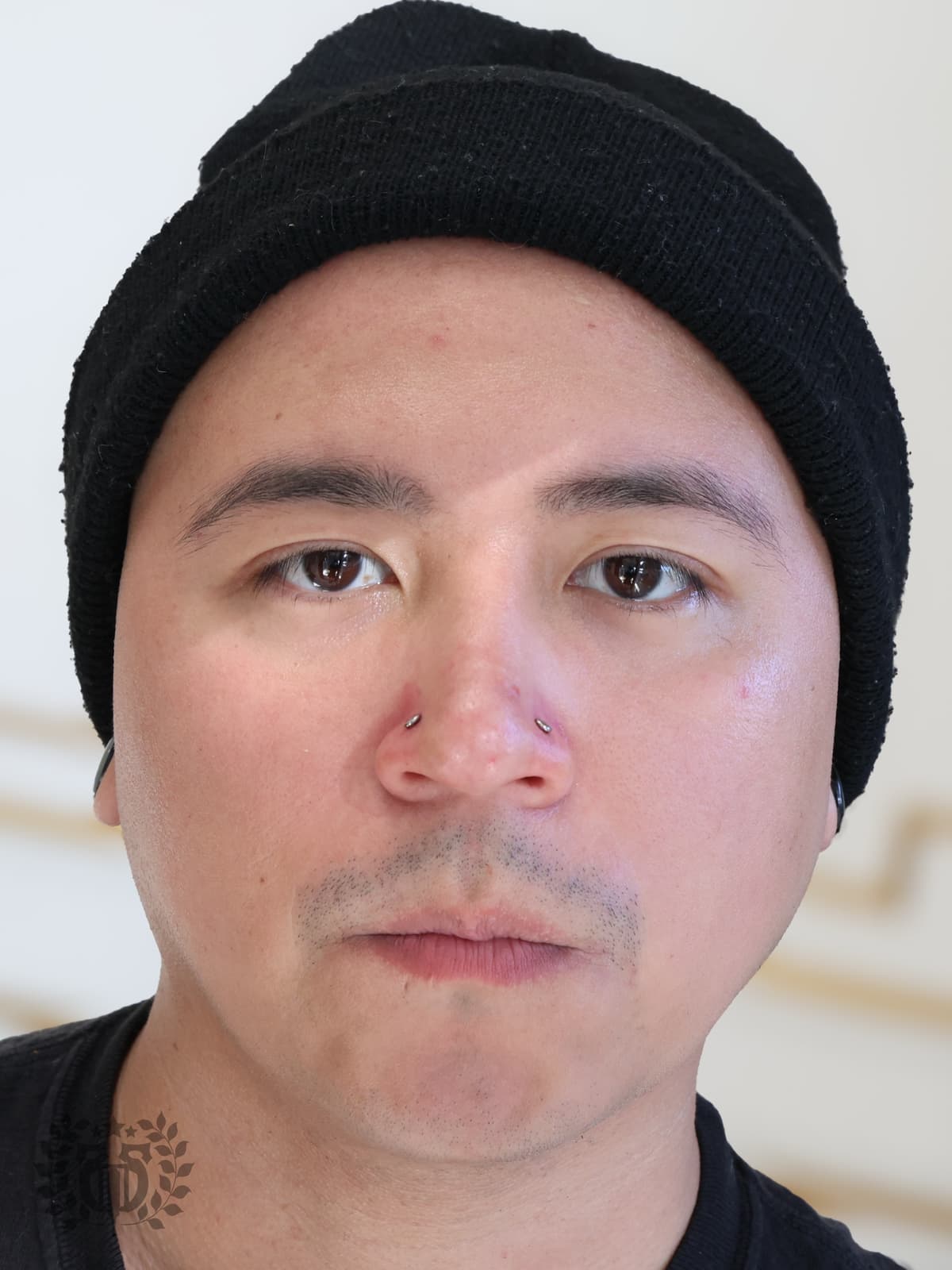
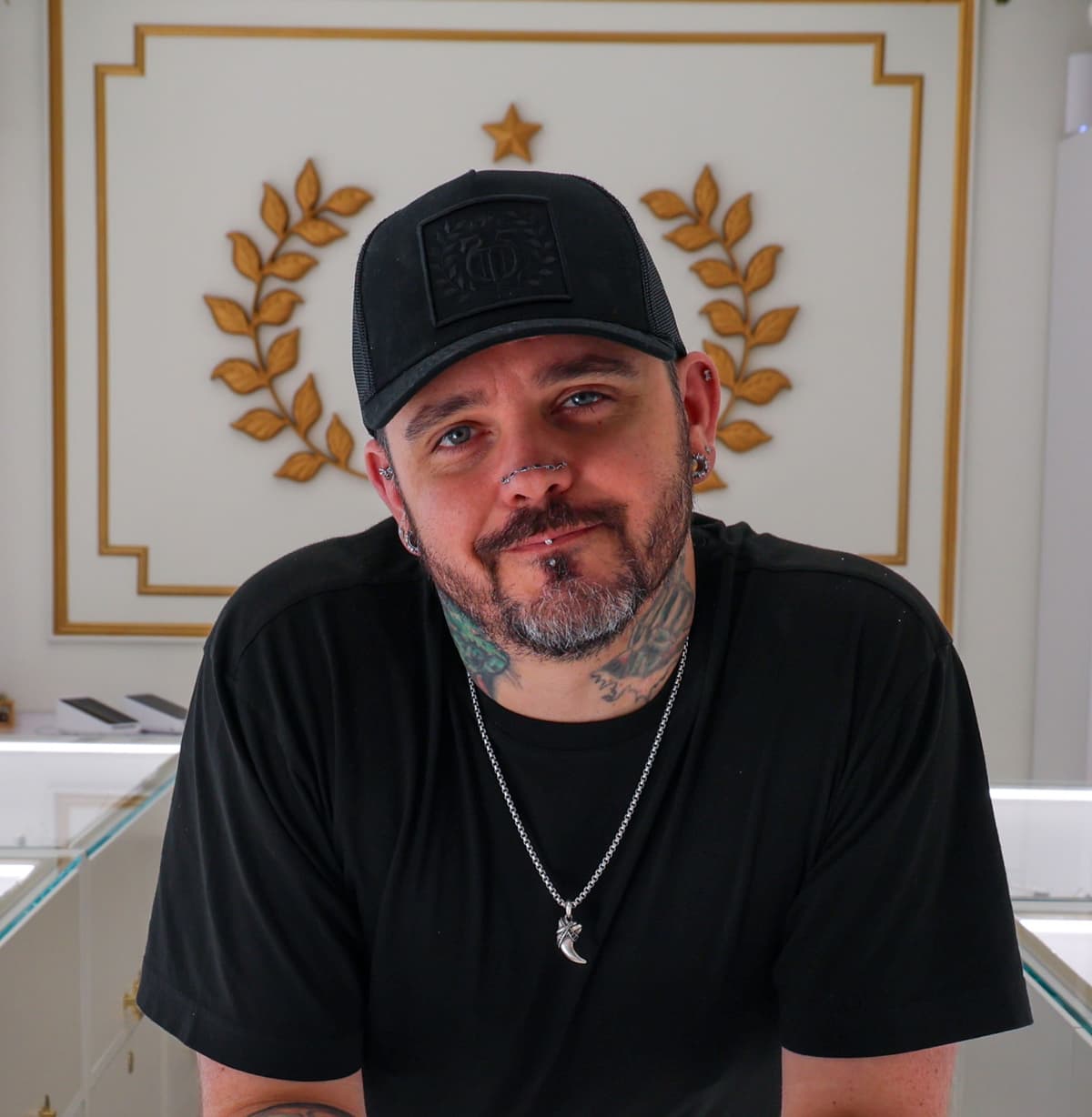
Blue Mason founded the studio and is a Fakir-certified Master Piercer. He takes the placements that other studios turn away: shallow daith folds, anti-helix ridges that barely qualify as ridges, and industrials on ears where the two points don't obviously line up. Sometimes the answer is still no, and he'll say so.
The mapping consult is its own thing, separate from being pierced. You can book it, have it, and leave without any metal going anywhere. Here's what gets looked at.
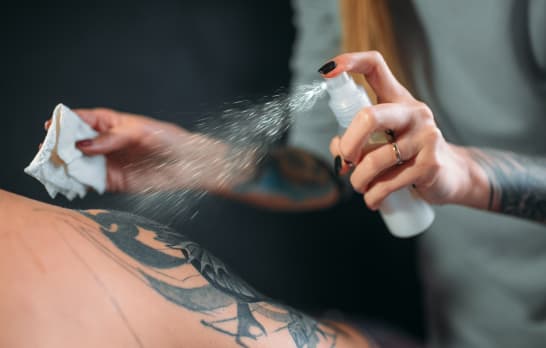
Sterile saline, twice a day, front and back of every placement. Air dry or pat with non-woven gauze. That's it, and it's identical whether you have one piercing or five — which is the good news, because the routine doesn't get longer as the plan grows.
What does scale is the list of things you can't do. Each additional placement subtracts another sleeping position, another set of headphones, another hat or helmet strap. People manage the saline fine and fall down on the pressure, and pressure is what produces the bump. No rotating, ever. No alcohol, peroxide, tea tree oil or ointment. Nothing in a pool, a lake or a hot tub while anything is open.
Then the part that only applies to a multi-placement plan: keep track of which piercing is at what stage. Piercings done three months apart hit their downsize windows three months apart, and the one that's been in longest is the one you're most likely to forget about while fussing over the newest.
Book AppointmentNot on the day, which catches people out. Warmth, tenderness and a bit of puffiness across days two to four is expected on every cartilage placement. Saline twice, front and back. Headphones off, that side off-limits at night from the first night.
Swelling has gone and the long starter post is now catching on things. Every placement in your plan needs a shorter one fitted, and each hits this window on its own schedule. Batched piercings share a return trip; staggered ones don't.
Helix and tragus land at 6-12 months, conch, daith and rook at 9-12, an industrial anywhere up to 18. A placement that's had a month of no tenderness and takes a jewelry change without protest is a placement you can build next to.
These are two different visits and it's worth knowing which one you want before you turn up.
Verbatim reviews from Apollo's Google Business Profile
"I had a wonderful experience getting my ears pierced here! I had a consultation with Bunny and Blue. They helped me map my ear and talk through different options. I wanted a fun third ear piercing, but have small earlobes and uneven first holes. We ended up doing a “constellation” design and I LOVE IT!! They were patient and so helpful mapping out options. They didn’t rush me and were transparent with pricing. 10/10 will go back to them or recommend them to a friend."
"I got a helix piercing and an upper lobe piercing done by Blue. He was very professional and very precise about placement. It didn't hurt at all, and it was a very quick procedure. Blue was very careful and made sure that I was comfortable and he talked to me through every step. Their jewelry is very beautiful and high quality. They carry inventory for every price point. It was a wonderful experience and I will definitely be going back for additional piercings."
Reviews from Google · Read all 623 on Google
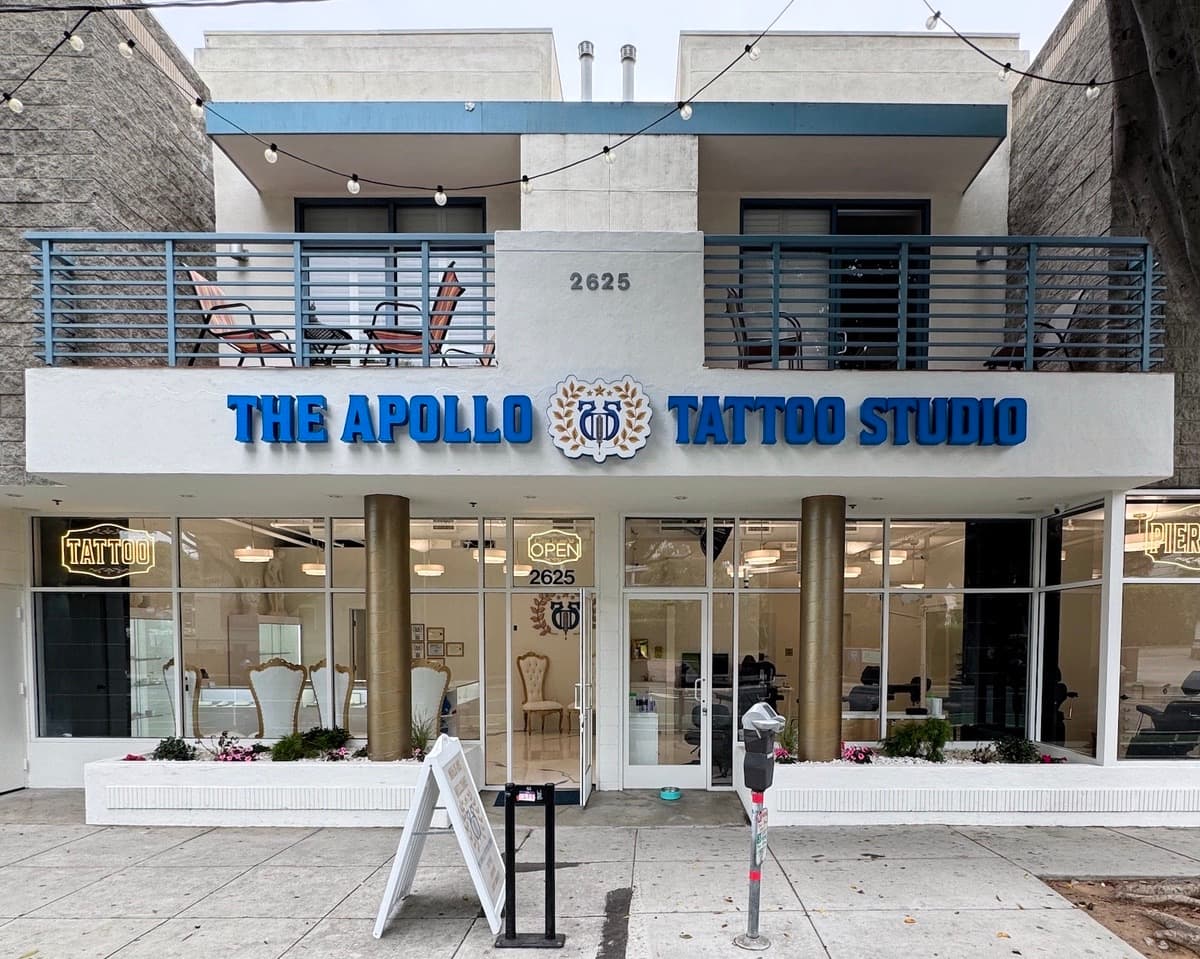
5000+ clients2625 Main Street, open 8am to 8pm seven days. Close enough to the beach that people walk in mid-errand, which is fine for one piercing and not ideal for planning six.
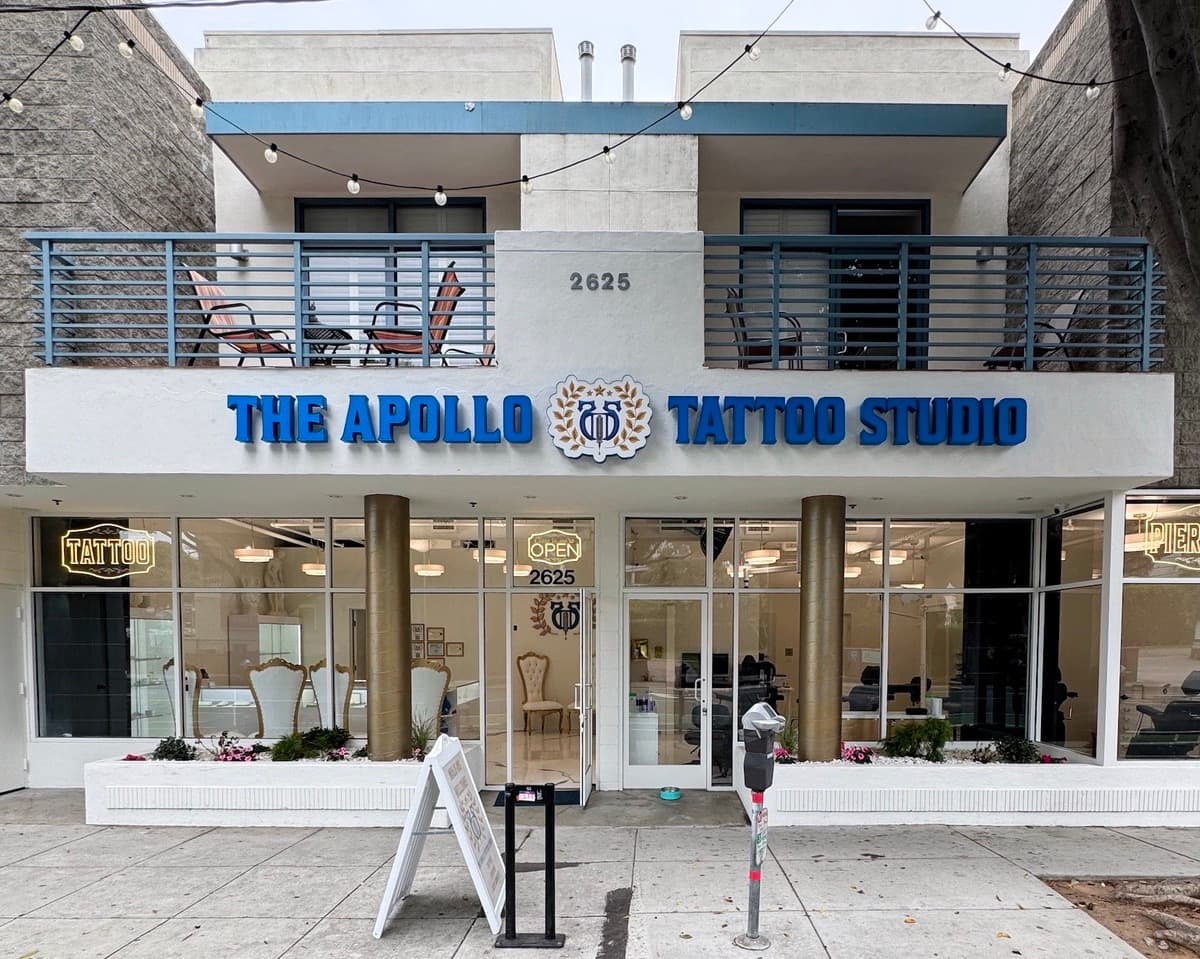
Santa Monica, CA
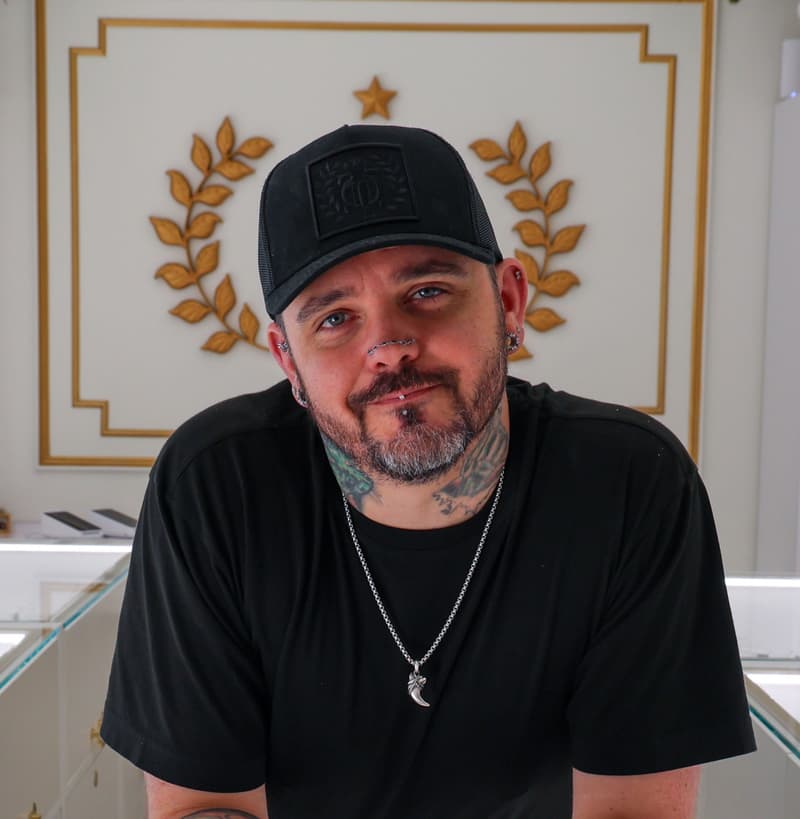
Apollo was founded by Blue Mason in 2007. With 20+ years of body art experience, Blue brings master-level expertise to every piece. Read Blue's story →
Mostly about order, spacing and timing, because that's what people actually get stuck on.
Work outward-in and easy-to-hard. The outer rim — helix, forward helix, flat — is the most forgiving cartilage on the ear and the least dependent on having a particular anatomy, so it's the usual opener. The bowl comes next: conch, then tragus. The folds and ridges go last, because daith and rook are the two placements most likely to come back as "your ear isn't built for that", and it's better to find that out when the rest of the ear is already settled and you have somewhere else to put the jewelry budget.
Two or three is a comfortable ceiling, four under the Curated Ear special if the placements are well spread. The constraint isn't really your immune system, it's geometry and sleep. Every fresh cartilage piercing is a spot you can't put a pillow on, and two on the same ear takes that whole side out of commission for months. When people ask for five, what we usually suggest instead is three now on one ear and the rest in three or four months, split across sides.
Different tissue entirely. A lobe is soft fatty tissue laced with blood vessels; blood carries the cells that do repair work, so the channel lines itself quickly. Cartilage has no blood supply of its own — it's fed by fluid diffusing in from the tissue around it, which is a far slower delivery system. That single fact drives nearly everything else on this page: why cartilage swells for days rather than hours, why it's so unforgiving about being knocked, and why the aftercare instructions are measured in seasons.
That's the sensible way to do it, and it's what a mapping consult is for. We mark out where each placement would go, look at whether the spacing works as a finished picture, and agree an order and rough intervals. Then you come back when each one has settled. The alternative — booking whatever appeals on the day — is how ears end up with a beautiful conch and a helix two millimetres from it that will never stop annoying each other.
Not by looking at it, because cartilage looks finished long before it is. The rough test is that it's had no tenderness, no crusting and no reaction to being knocked for at least a month, and that a piercer has been able to change the jewelry without it protesting afterwards. In practice, adding the next piercing to a different part of the ear at three or four months is usually fine; adding one within a few millimetres of a piercing that isn't fully settled is not.
People's reports are wildly inconsistent, so treat any pain chart with suspicion. That said, the pattern we see: outer rim placements are the mildest, conch and tragus sit in the middle because the cartilage is thicker, and rook and daith rate highest because the needle passes through a dense fold at an awkward angle and takes fractionally longer. Industrial is two passes, so it's twice the brief unpleasantness. All of it is seconds. The part people underestimate is not the piercing, it's day two.
Several. A rook needs a genuinely pronounced anti-helix ridge and a fair number of ears don't have one. A daith needs a fold with enough depth to get a needle through at a workable angle. An industrial needs two points that line up on a straight axis, which is a specific ear shape rather than a common one. A conch can be inner or outer depending on how deep your bowl is. This is why the assessment happens before the booking rather than after.
The service fees are per placement: $75 for lobe, helix and forward helix; $85 for conch, tragus, rook and daith; $125 for an industrial; $175 for a triple ear. Two in one visit is $75 and the Curated Ear covers up to four for $99, so doing several at once is markedly cheaper on the service side. Jewelry is separate in every case and is where the real range lives — a titanium starter and a solid-gold BVLA end are not the same money.
None, for as long as they're healing, which is the single hardest part of building a cartilage ear. That's the practical argument for staggering across both sides rather than stacking one ear: you keep a side to sleep on. A doughnut travel pillow with a hole in the middle is the standard workaround and it's worth buying before the appointment rather than after the first bad night.
A gun doesn't cut — it forces a blunt stud through by pressure, which fractures cartilage rather than making a channel through it. The damage isn't visible from outside, but it shows up as a piercing that stays angry for a year, migrates, or scars. The plastic body of a gun also can't go in an autoclave. Every piercing here is a single-use sterile needle, and every reusable tool is autoclaved. We're licensed and inspected by LA County, and the sealed packs get opened in front of you.
You can, but threaded and threadless cartilage ends are fiddlier than a lobe stud, and the classic failure is dropping the back disc, panicking, and forcing something in at the wrong angle. Come in for the first change at least. After that most people manage their own ends fine, and knowing you can bring it in when a threadless top won't seat is worth more than the confidence of doing it over a sink.
Apollo sits at 2625 Main St in Santa Monica, a block from the beach and easy to reach from anywhere on the Westside. Here's roughly how long it takes to get to us for tattoos and piercings:
There's metered street parking on Main Street and Ocean Park Blvd, plus a public lot on 2nd Street a short walk away. We recommend giving yourself an extra 10 minutes to park on weekends — Main Street gets busy with the farmers market and beach traffic. If you're running late, text us at the studio and we'll hold your appointment.
One placement or the whole map. Either way it begins with somebody reading your ear rather than reading a menu.
Recognized in Santa Monica's Most Loved 2025 & 2026


We'll respond within 24 hours
Or reach us directly:
We use cookies to run this site, remember your preferences, and understand how it's used. Read our Privacy Policy for full details.