Two placements share the name conch, and picking between them is not a style question. The inner conch goes through the deep well next to your ear canal; the outer sits on the broad shelf above it. Which one your ear can carry comfortably depends on how deep that bowl is and how sharply its wall curves away — something a piercer finds by feel in about a minute, and something no photo you bring in can settle.
This is also the thickest, most rigid cartilage in the ear, which is what sets the clock. Expect nine to twelve months, a starter post cut long for the swelling that peaks on day two, and a downsize appointment booked before you leave. Conch piercing at our Santa Monica studio is $85 for the piercing service; you choose the jewelry separately, from implant-grade titanium starters through to solid-gold BVLA ends once you're healed.
Book Your Conch Piercing 5000+ clients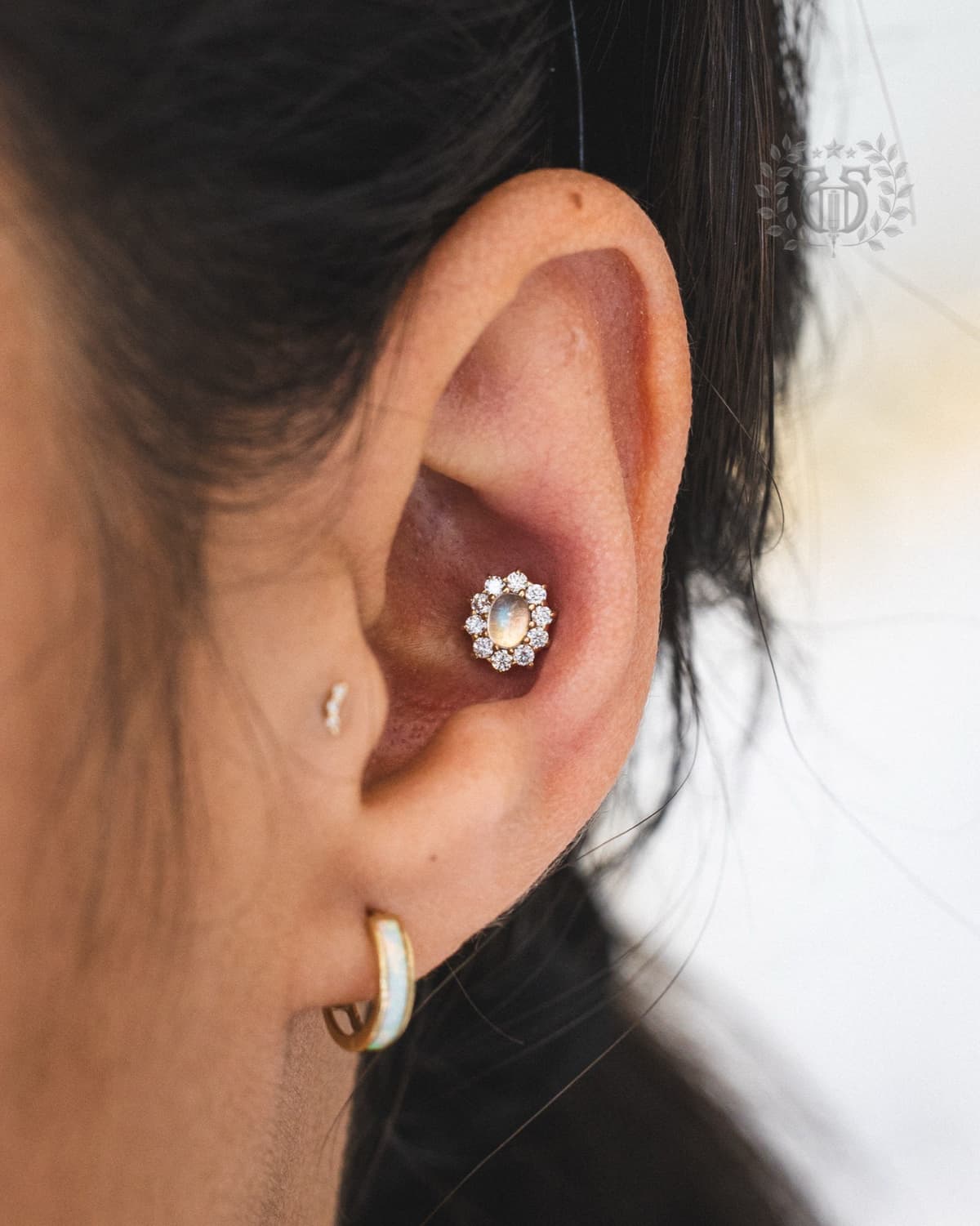
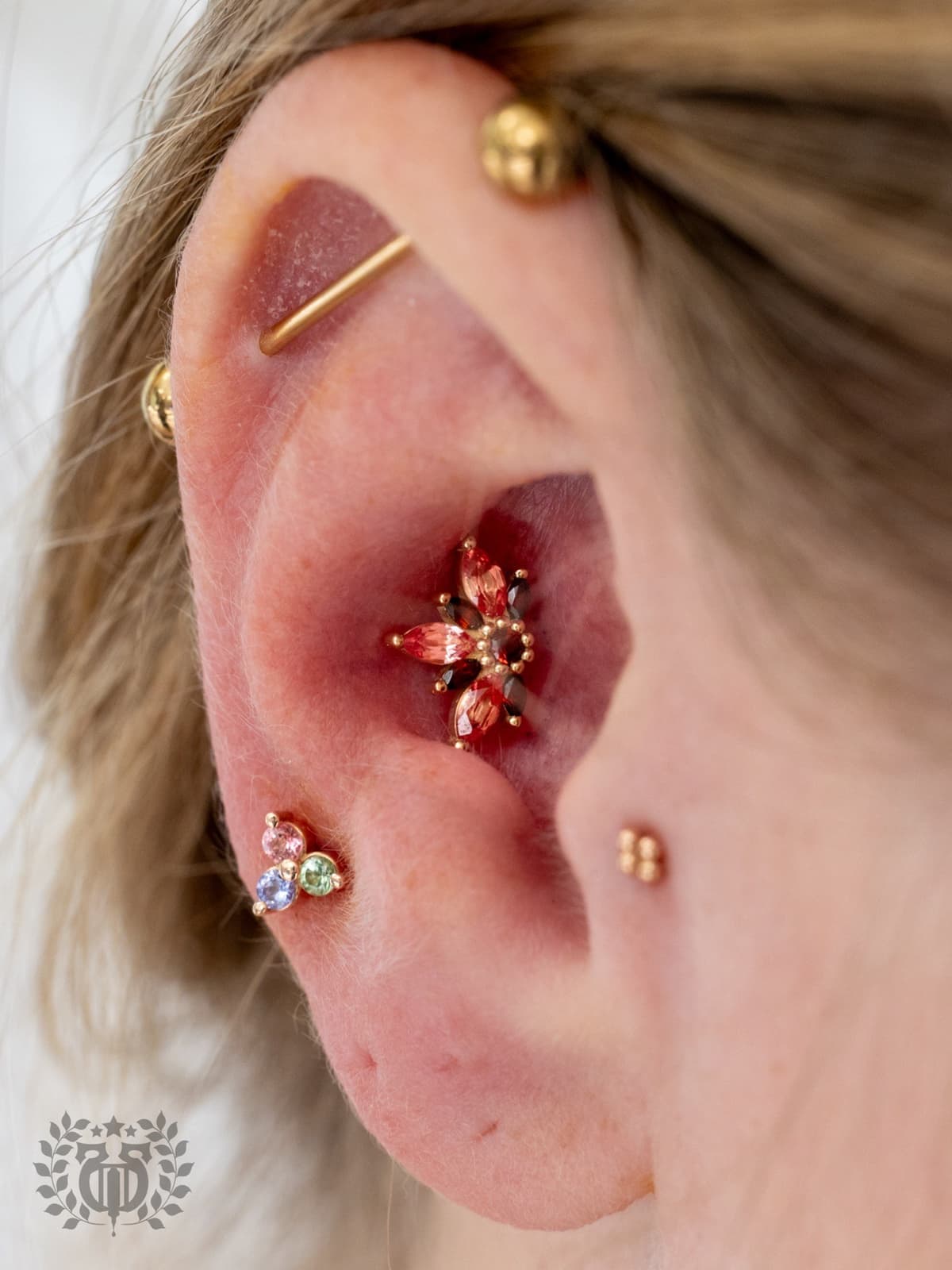
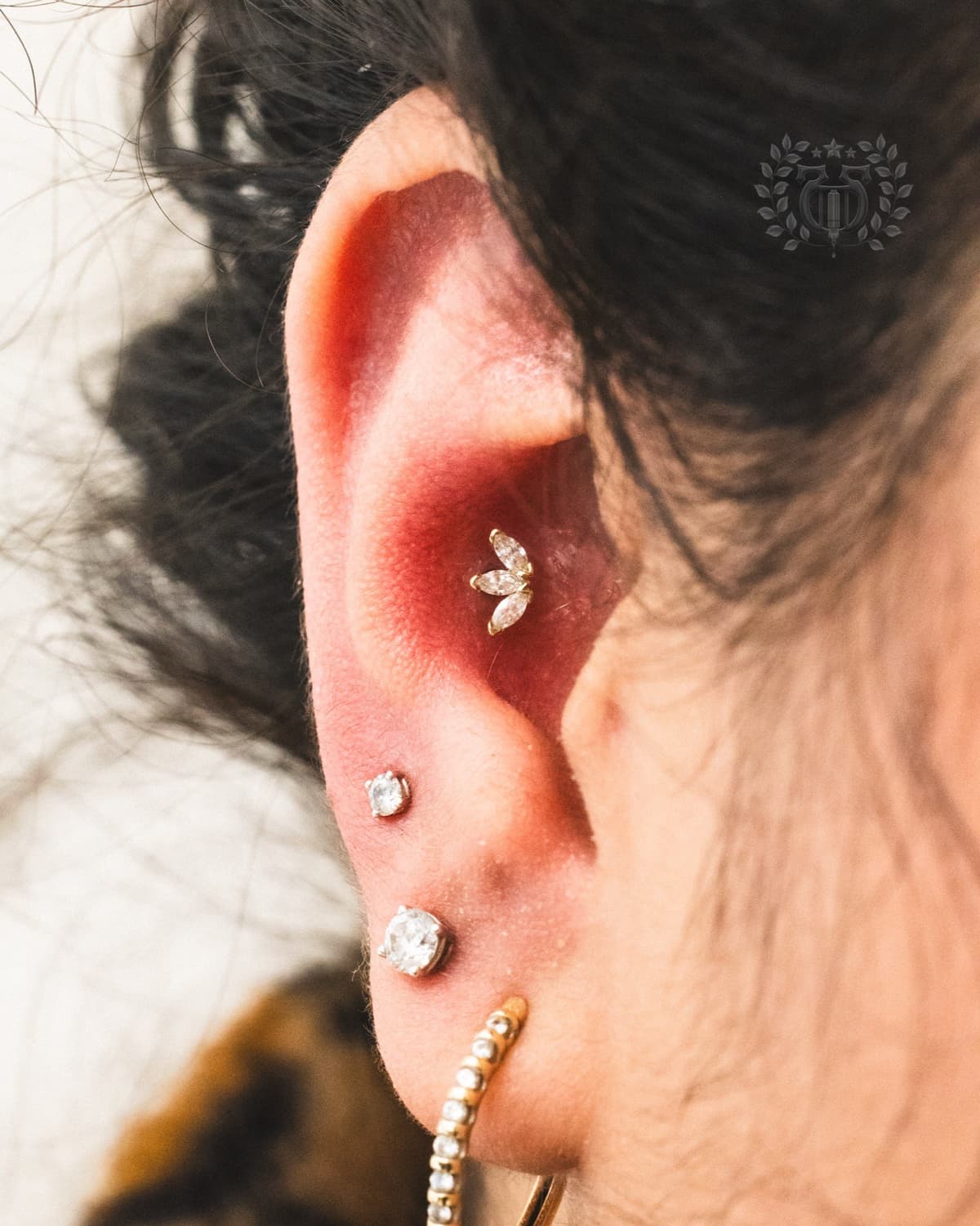
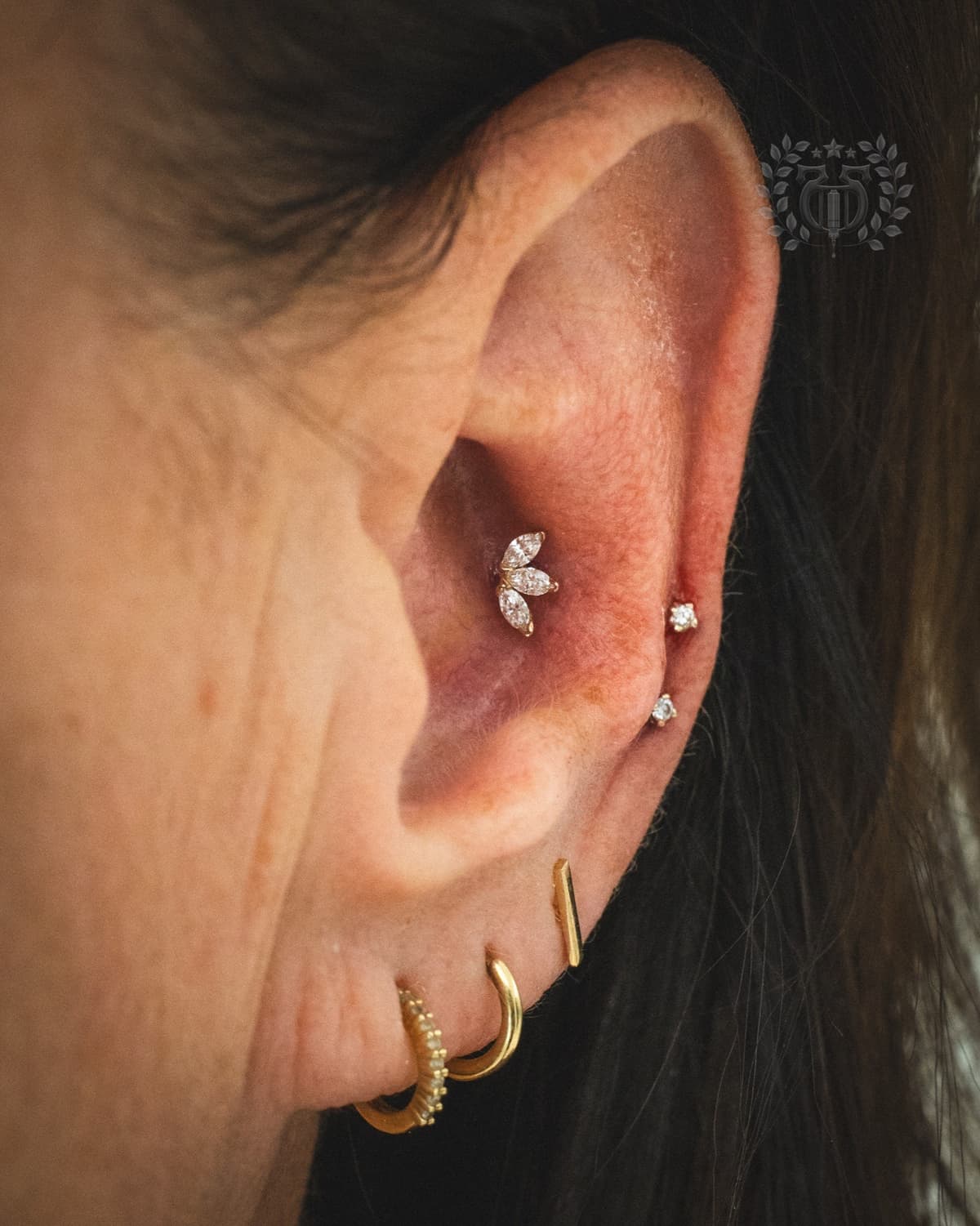
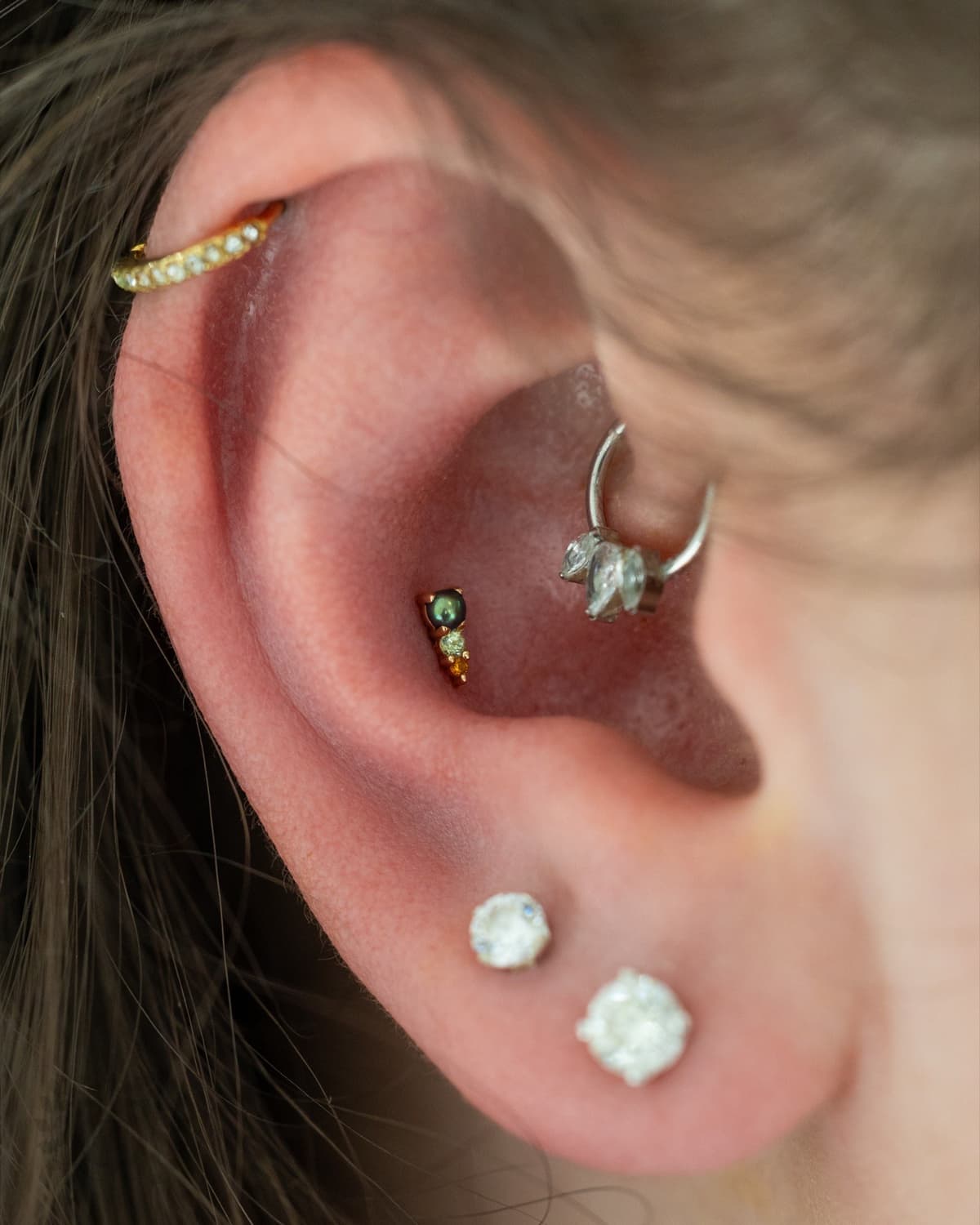
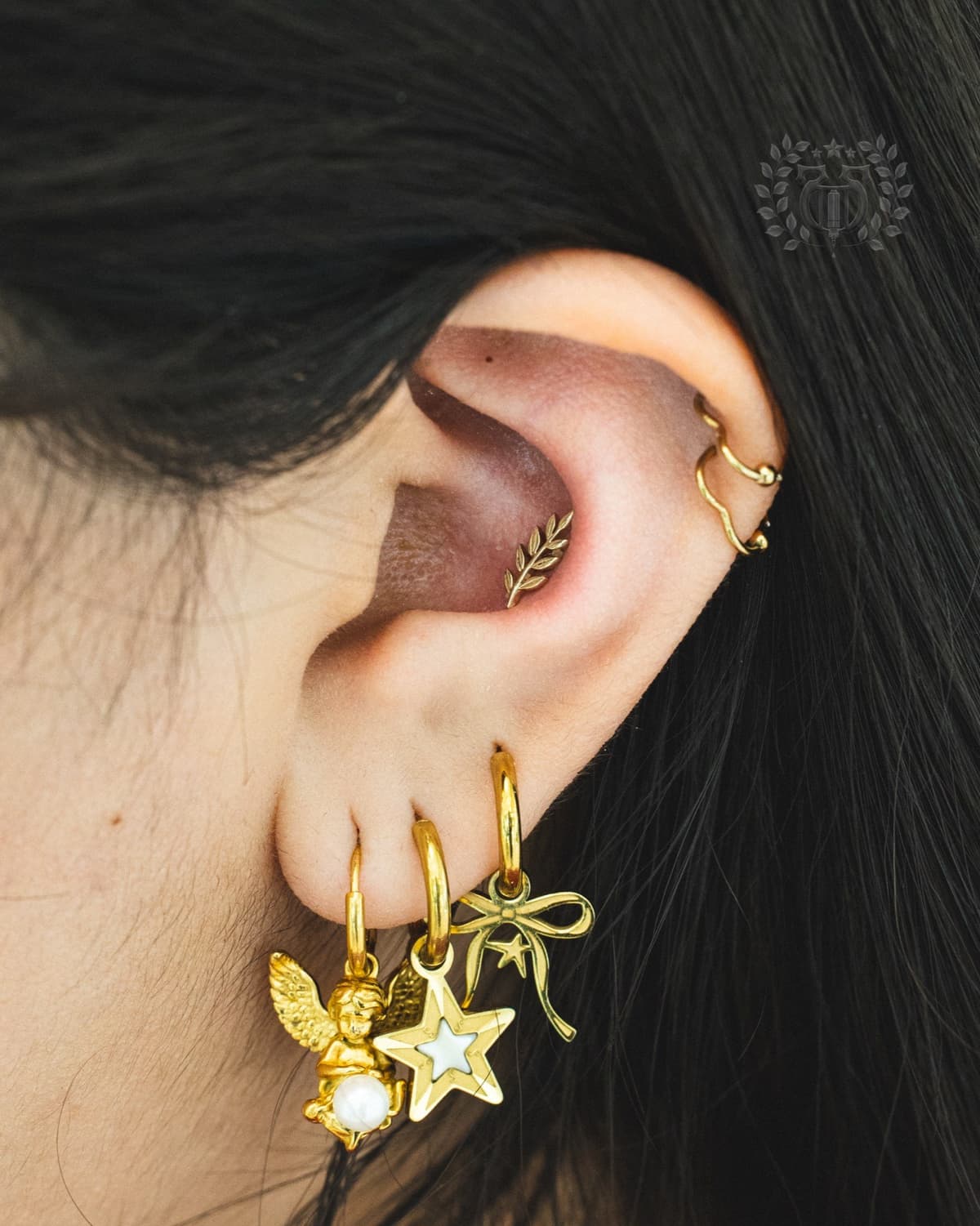
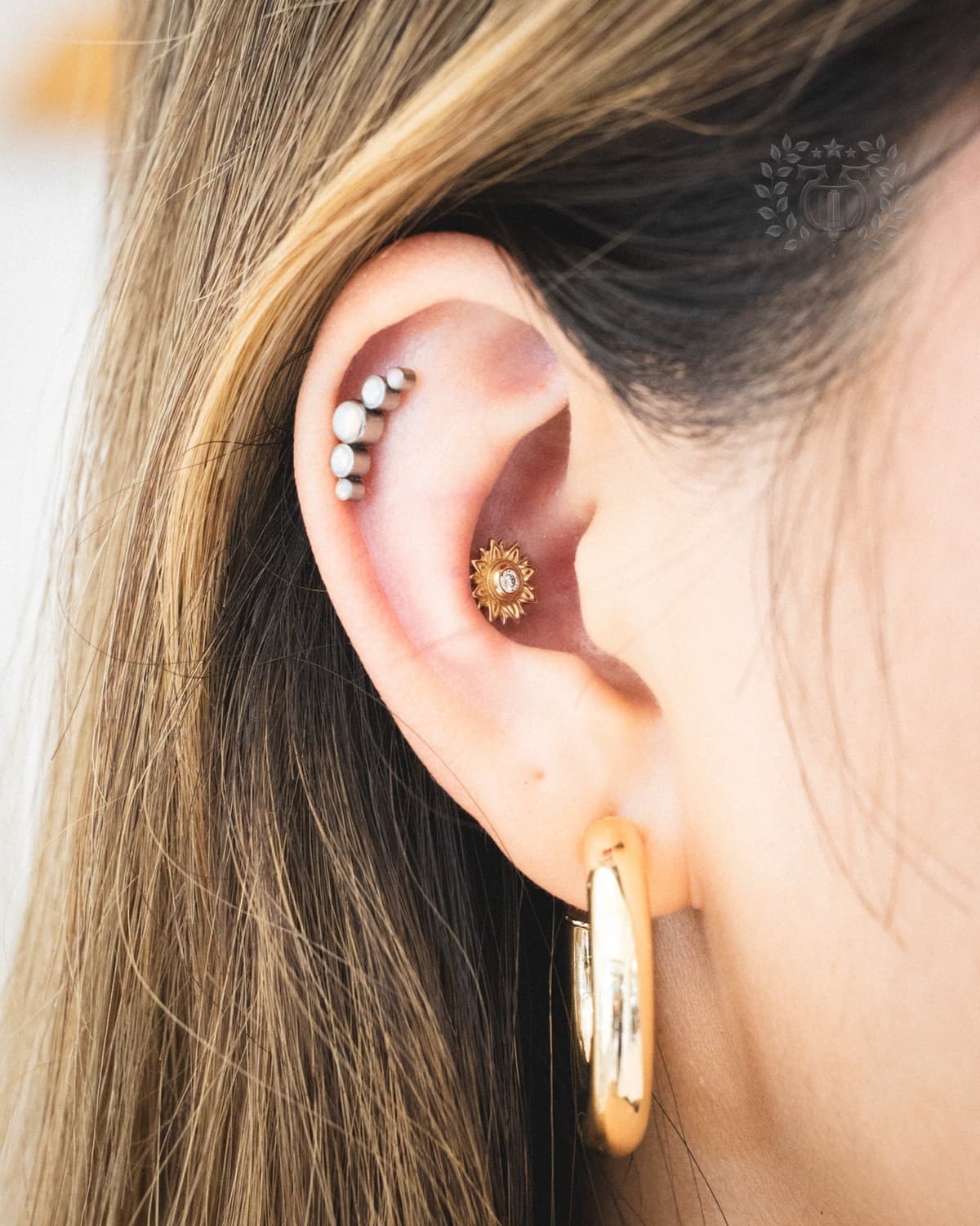
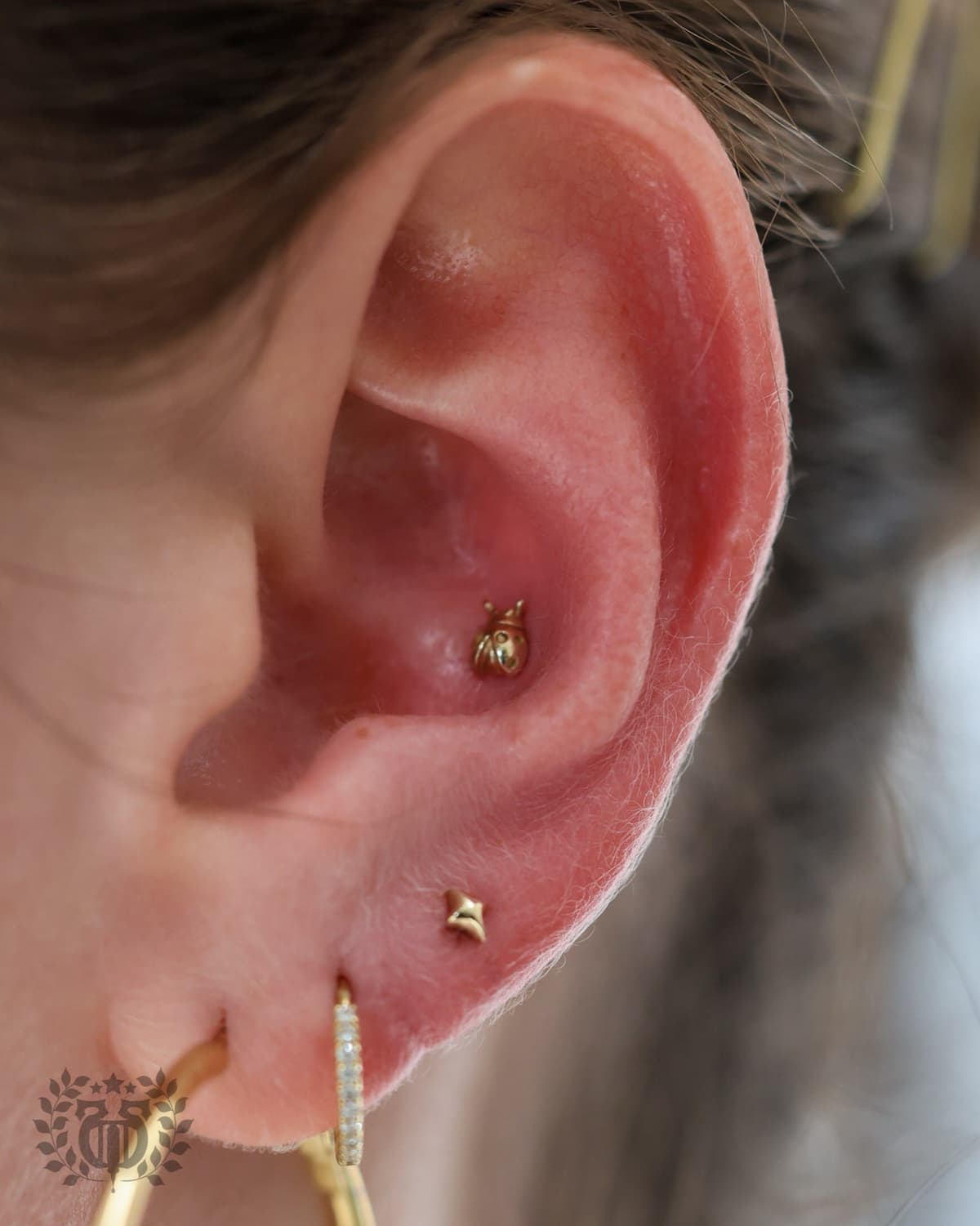
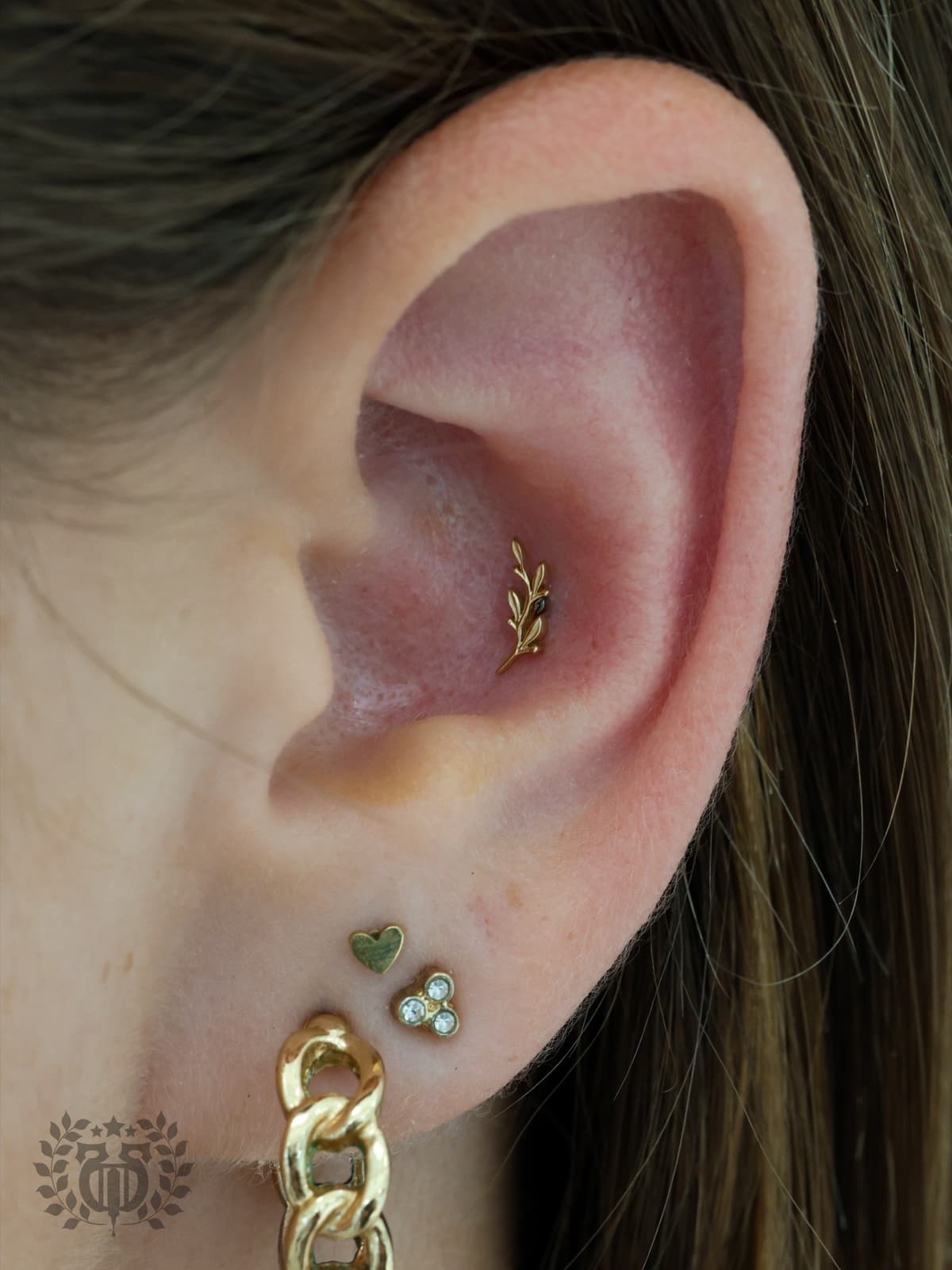
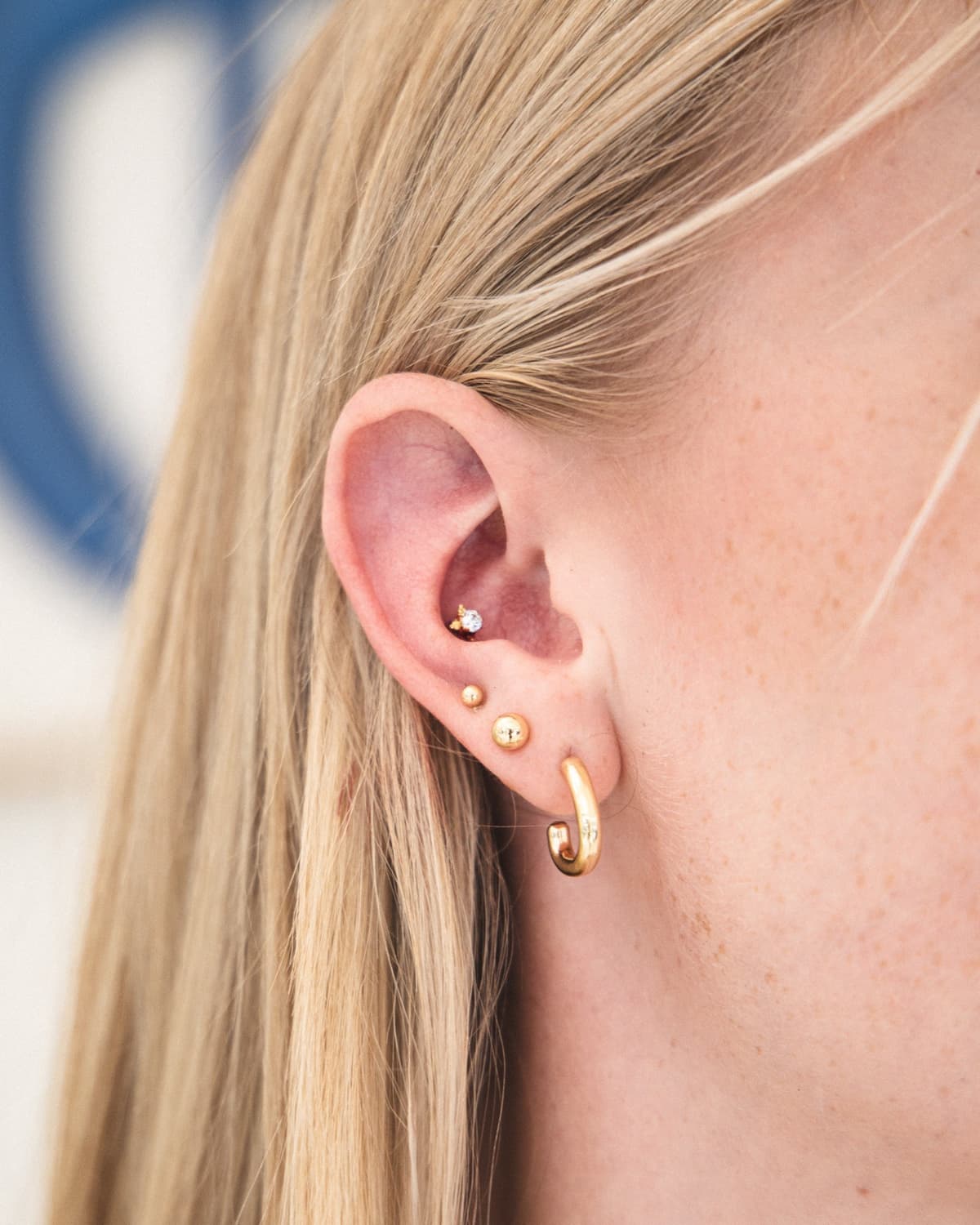
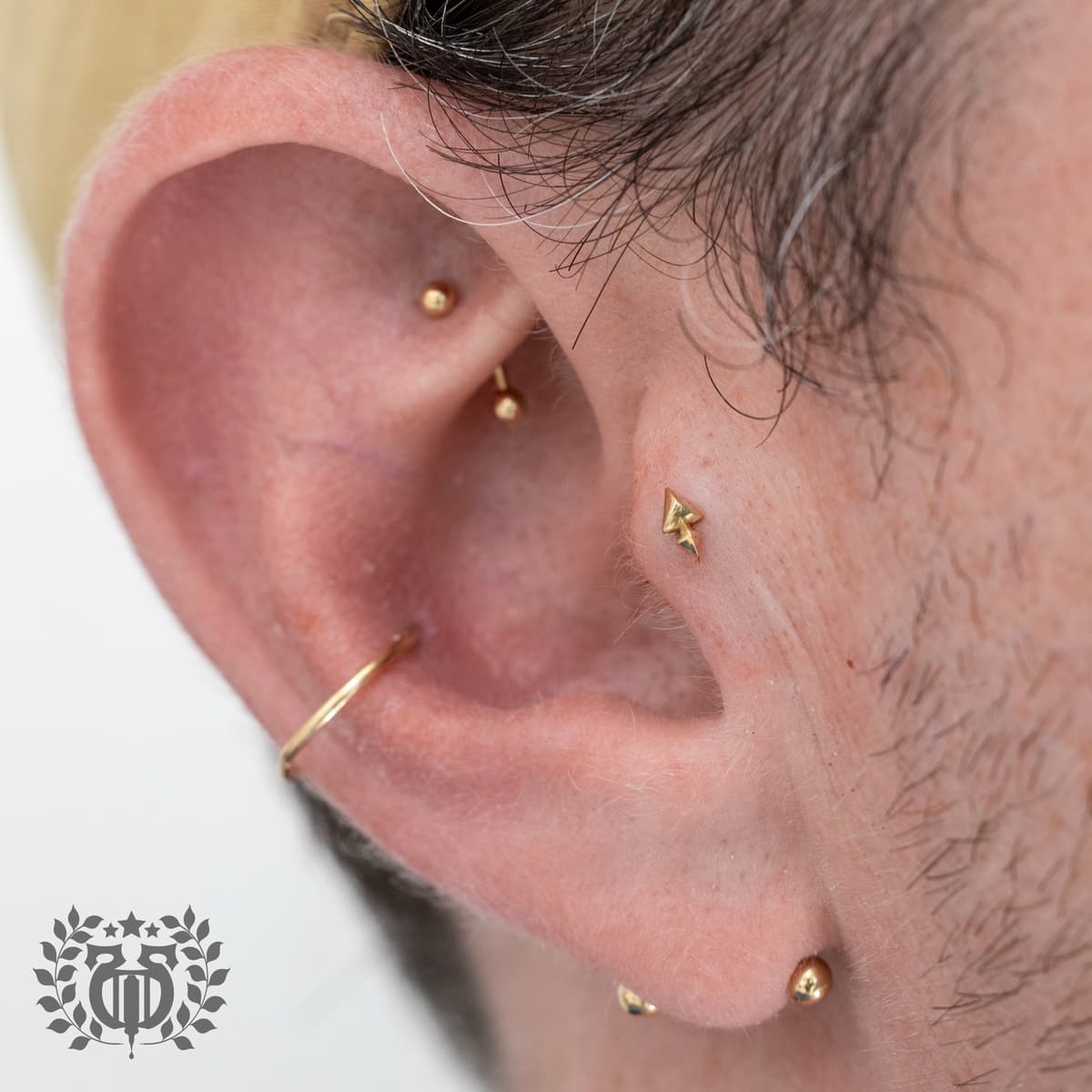
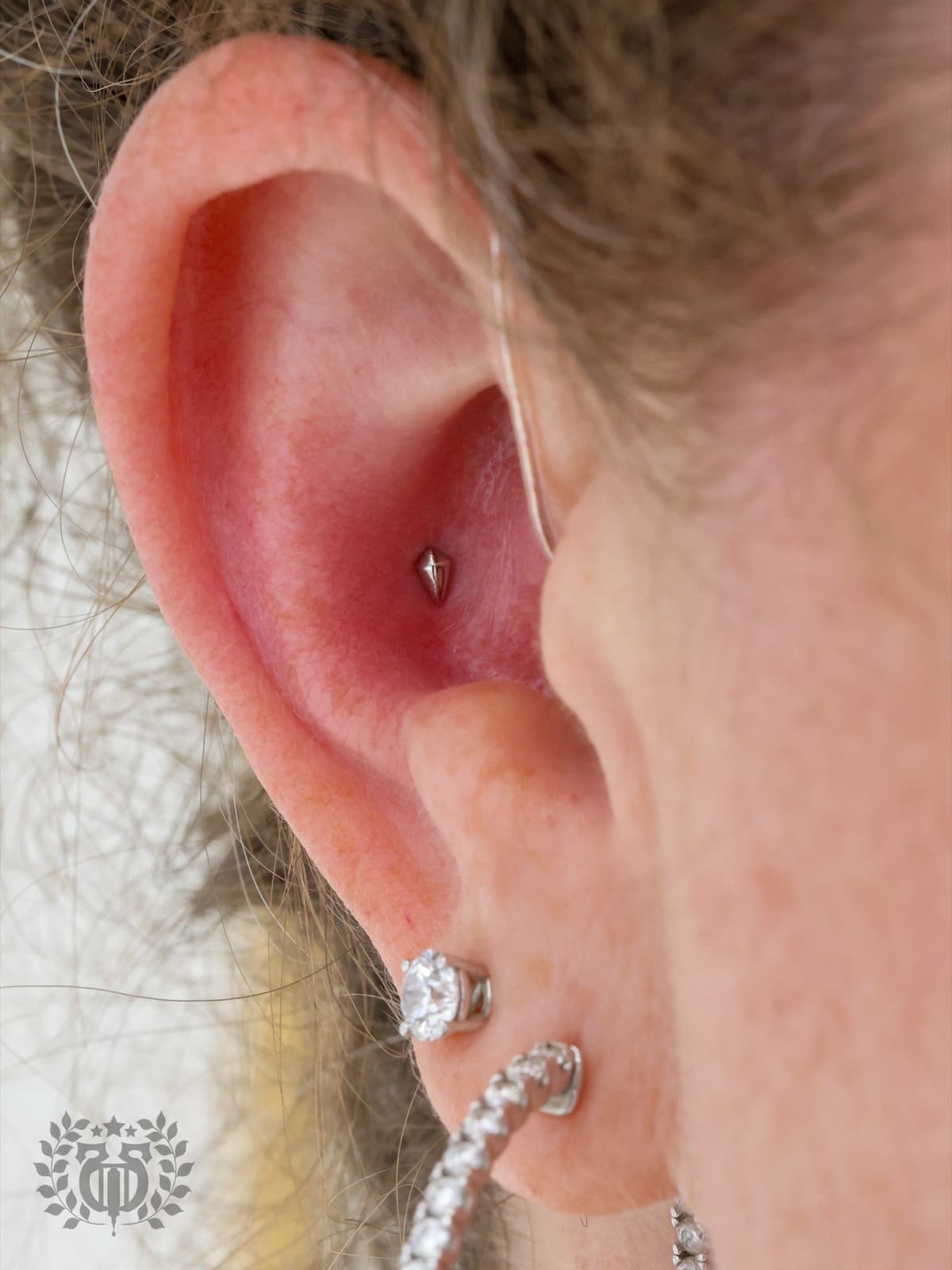
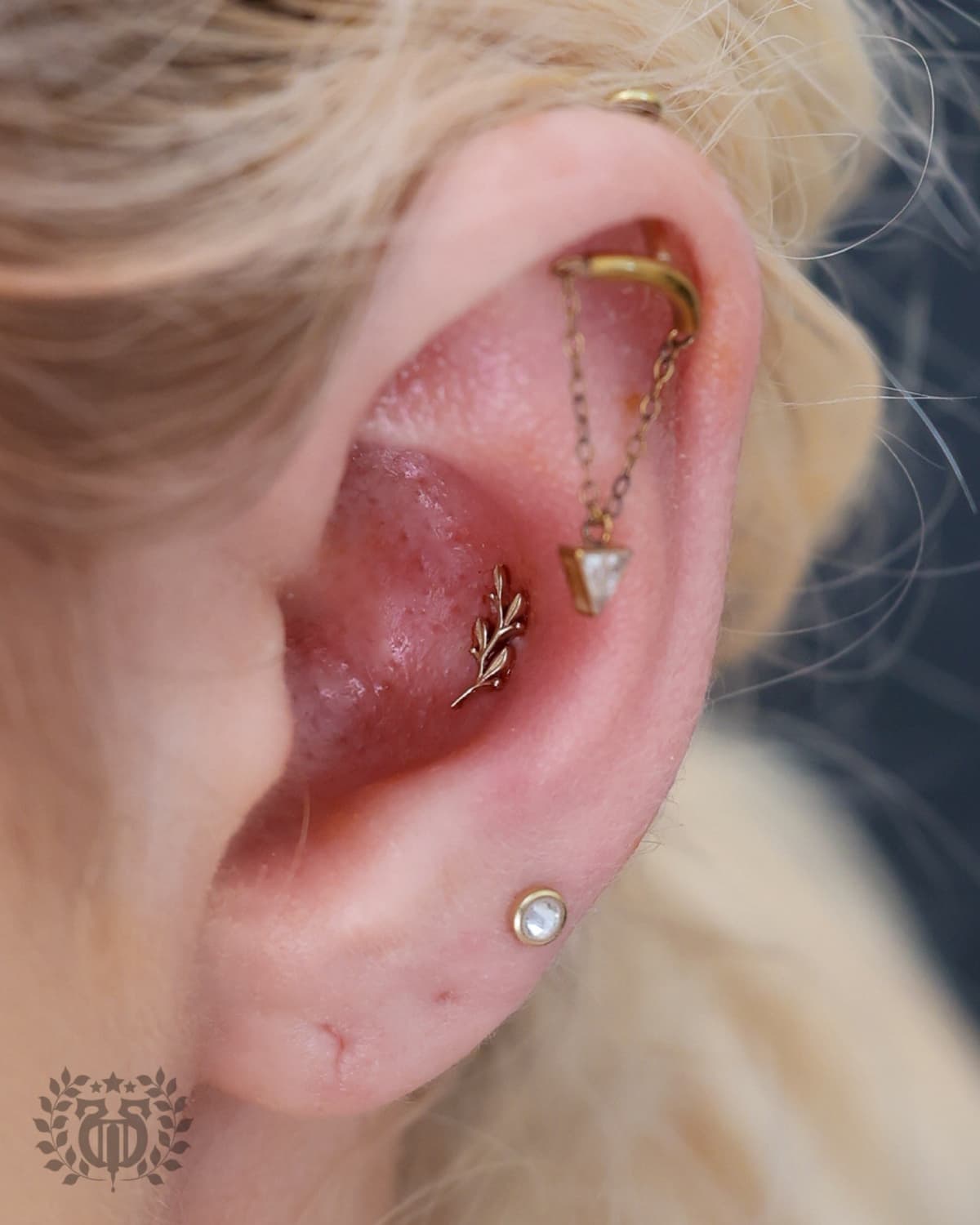
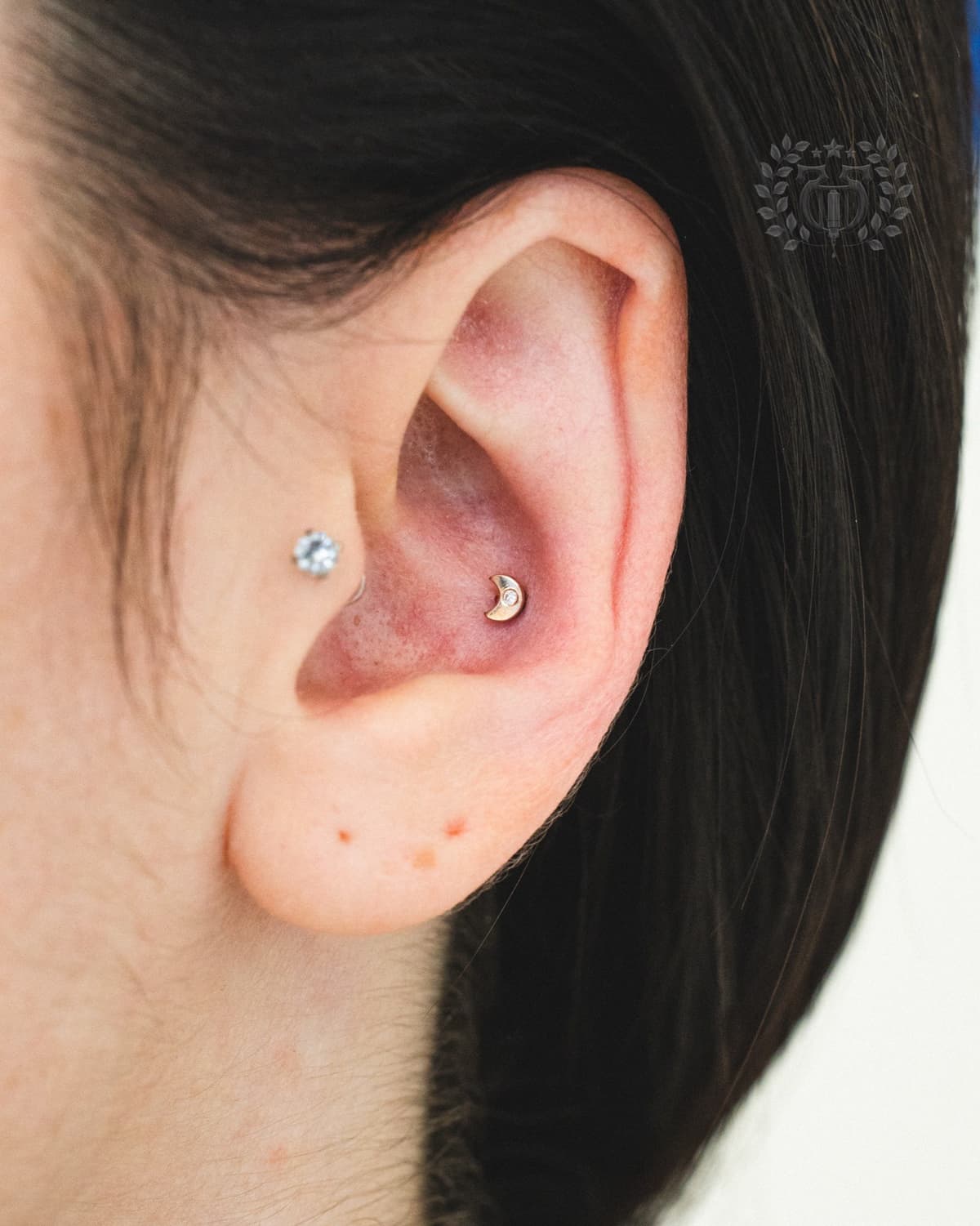
One name, two placements, and an ear that usually has a preference of its own.
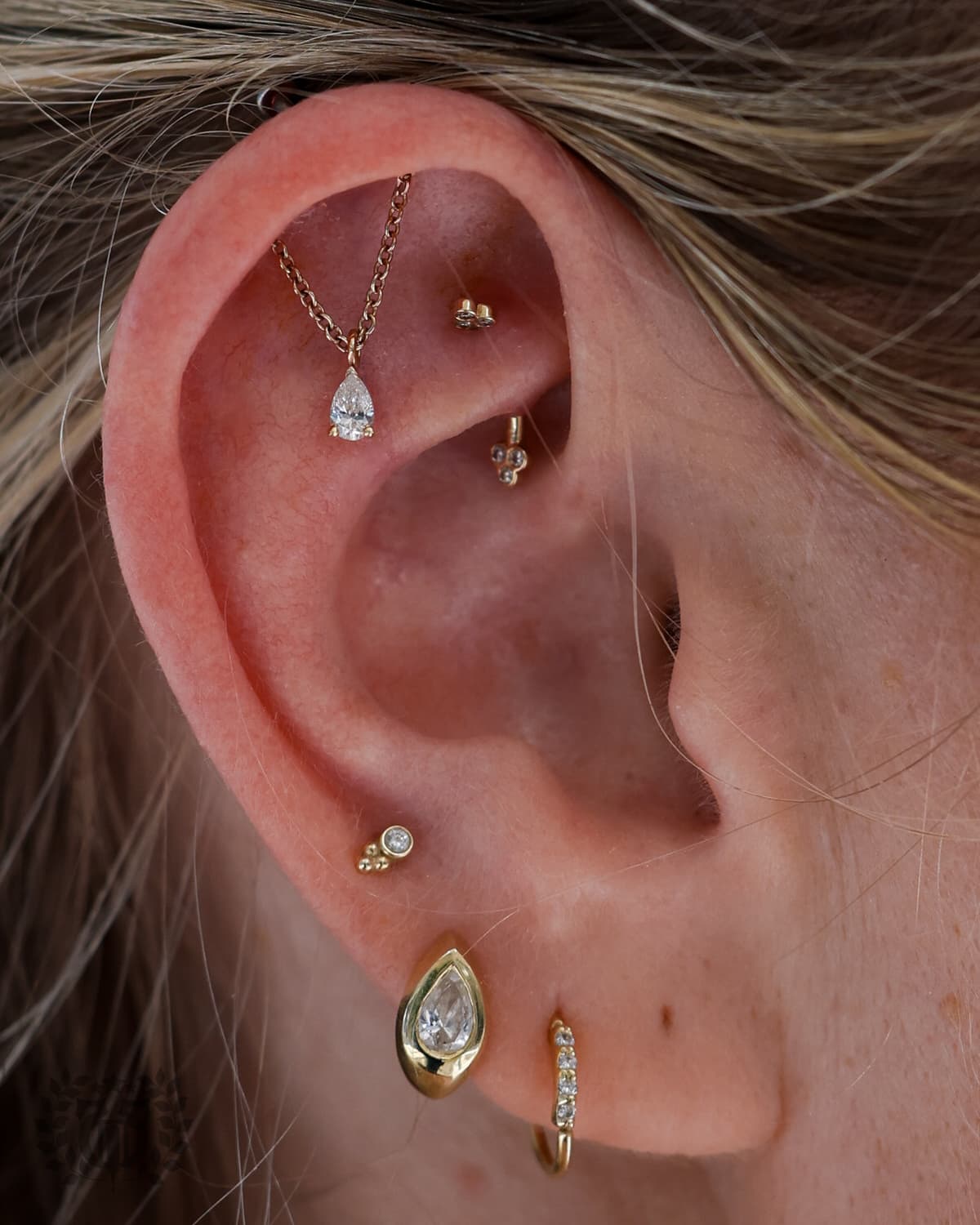
Put a finger inside your ear and press gently into the dished area beside the canal. That well is the inner conch. Now slide the finger up and outwards, over the low ridge, onto the broader flat plate before you reach the raised anti-helix. That shelf is the outer conch, which you'll see listed as a flat in some studios. Same slab of cartilage, two very different pieces of real estate.
What people usually arrive having decided is the look: a single point of light sitting inside the ear, or something wider and higher that catches the eye from the front. Both are reasonable. The trouble is that only one of them may fit you, and the deciding factor is on the back of your ear rather than the front.
Here's why. A conch stud is a flat-back labret, which means there's a small disc pressed against the reverse of the cartilage holding everything in place. In a deep bowl with a steep wall, that disc has to sit somewhere with clearance. Go too close to the point where the wall of the well curves upwards and the disc lands on a slope rather than a flat, tilts, and starts pressing an edge into tissue for the entire heal. That's the mechanism behind most of the lumps people show us at week ten.
Some ears have a broad, shallow bowl with acres of flat in the middle. Those take an inner conch happily. Others have a tight, deep well where the usable flat area is barely wider than the disc itself, and on those the honest answer is that the outer shelf will heal better and look less fussy. There's no way to tell from a photograph, and there's certainly no way to tell from your other ear — the two are rarely built the same.
Angle is the other half of it. The needle needs to cross the cartilage square to the surface at the exact point of entry. On the curved wall of the bowl that's an angle that feels wrong if you're thinking about your head rather than your ear, and it's a common failure in pierced-elsewhere conches we're asked to fix. A conch pierced perpendicular to the skull instead of to the cartilage sits visibly cocked, and it stays that way, because cartilage remembers the channel it was given.
Then there's what you do all day. The inner conch is exactly where an in-ear bud seats. If you live in earbuds — commuting, calls, gym — the outer shelf clears them and the inner one doesn't. Not a reason to avoid an inner conch if you want it, but a reason to hear it said out loud before rather than after.
So the conversation in the chair goes: finger in the ear to read depth, thumb on the shelf to check width, a question about how you sleep, a question about headphones, and then a recommendation. Plenty of people come in wanting one and leave with the other. Some come in with a photo of an ear that simply cannot be reproduced on theirs, and we'd rather say so at the counter than let you find out in eight months.
A deep conch well gives a disc room to sit flat behind the ear. A shallow one pushes the disc against the wall of the bowl. We look at that before we decide inner or outer, because it changes the answer.
The bowl is not a flat plate. It curves, and the needle has to cross it perpendicular to the surface rather than perpendicular to your head. A conch angled to the skull instead of to the cartilage sits crooked forever.
Most conch clients are not starting from an empty ear. If there's a helix at eleven o'clock or a rook overhead, the conch has to be placed with a couple of millimetres of breathing room or the two will fight over the same pillow.
No guns, and no dermal punching for large-gauge conch work. A single-use sterile needle makes a clean channel through dense cartilage; a gun crushes it, which is why gunned cartilage heals badly and often scars.
Conch swelling peaks about forty-eight hours in, not on the day. Your starter post is deliberately long to leave room for that, which is also why you'll be coming back for a shorter one once the puffiness goes.
The follow-up where we shorten your post is the part that decides whether the back of your ear stays smooth. We book it, it costs nothing, and it matters more than any product you could buy.

Apollo's Premium Jewelry Partner
Handmade in Los Angeles since 1996. Lifetime guarantee. Implant-grade gold, platinum, and titanium. Over 3,000 original designs in our case — ask your piercer for a tour.
See the BVLA story →Thick, rigid, poorly supplied with blood — which is why every option below runs on a long clock.
Cartilage has no blood supply of its own. It's fed by diffusion from the tissue around it, which is why a lobe can be done and dusted in eight weeks while an ear piercing an inch higher is still settling at month ten. The conch is the thickest slab of that tissue you own, so it sits at the slow end of an already slow category: nine to twelve months, with the first six of those being genuinely fragile.
That density does one good thing for you. A conch, once healed, is anchored in something substantial and is far less prone to migration than a surface piercing or a thin rim placement. It doesn't drift. What it does instead is remember every insult — a knock from a hairbrush, a week of sleeping on it, a rushed jewelry change — and answer with weeks of grumpiness rather than days.
The deep well beside the ear canal. A stud sits centred in it and reads as a small point of light inside the ear rather than along an edge. Wants a bowl with enough depth that the back disc clears the wall.
The broad flat plate between the bowl and the anti-helix ridge, which is why some studios list it as a flat. Sits higher and further out, clears in-ear buds better, and gives a wide decorative end room to lie properly.
Two placements stacked across the cartilage shelf. It looks deliberate when the spacing is planned and cluttered when it isn't. We usually stagger them across separate visits so you always have a side to sleep on.
A large hoop passing through the conch and wrapping the outer rim of the ear. This is a healed-piercing look, not a starter one, and the diameter has to be measured against your ear rather than picked off a card.
Clear next step
Five minutes with a piercer will tell you whether your bowl wants an inner or an outer
Recommended first step
Book lobes, cartilage, or a styled ear appointment with Apollo.
Two placements in the same slab of cartilage, on much the same clock
| Piercing Type | Location | Initial Healing | Full Healing | Pain Level |
|---|---|---|---|---|
| Conch (Inner) | Center bowl of ear | 3-4 months | 6-12 months | 5-6/10 |
| Conch (Outer) | Lower center, near anti-helix | 3-4 months | 6-12 months | 5-6/10 |
Nobody wants to hear this one, so here it is with the numbers attached.
A large ring passing through the conch and hooking over the rim of the ear is, for a lot of people, the entire reason they want this piercing. Fair enough. It's a good look. The problem is that it's a healed-ear look wearing a fresh-piercing costume, and pretending otherwise is how studios end up with clients who quit at month five.
Think about what a ring does mechanically. It's a loop with weight and a long lever arm, anchored in a channel through rigid tissue that is trying to line itself with new cells. Every time you pull a hoodie over your head, the ring catches and levers. Every time you sleep on that side, the ring is a hard curve pressed between skull and pillow. Every time you towel your hair, it snags. A flat-back stud in the same hole barely moves at all: the disc holds the back, the end holds the front, and the tissue gets left alone to do its slow work.
Ask a piercer what proportion of conch problems arrive attached to a ring and you'll get a wry look. Irritation bumps, channels that widen at one end, a piercing that never quite stops weeping — these cluster around jewelry that moves, and rings move.
The honest arithmetic looks like this. Start with a flat-back post and a conch typically settles in nine to twelve months, with a shorter post fitted somewhere around week eight to twelve. Start with a ring and you are, in practice, adding months rather than shaving them, with a real chance of never quite getting there and having to remove and restart. And a restarted conch is not a fresh conch — you're now piercing scarred cartilage or moving to a different spot in the ear.
So the plan we'll offer is boring and it works: post now, ring at the one-year mark, diameter measured against your actual ear rather than guessed. You'll get the look. You'll get it about eight months later than you wanted, and with an ear that isn't sore.
One footnote. If you already have a healed conch done elsewhere and want to move to a ring, bring it in rather than ordering online. Conch hoop diameter is unforgiving: a couple of millimetres too small and it presses the front of the piercing, a couple too large and it swings and catches. It's measured, not guessed.
 5000+ clients
Most conches are the fourth or fifth piercing in that ear, not the first — so the planning runs backwards from what's there.
Before the conch is discussed at all, we look at what you're wearing and how well it healed. A helix that still gets angry, a lobe stack sitting low, a rook you had done elsewhere — each one changes where the conch can reasonably go.
Cartilage placements need clearance from each other, not just from the edge of the ear. Two piercings a few millimetres apart share a pillow, share a swelling, and irritate each other for months. We're looking for the spot that has room on both sides.
The needle has to pass square to the surface of the cartilage at that exact spot. On the bowl wall that means angling into the head; on the outer shelf it means something flatter. Get this wrong and the jewelry tilts, which no amount of aftercare fixes.
You see the dot and approve it before anything happens. If you've brought a photo of an ear you like, this is the moment we're honest about whether your anatomy will produce that result or something adjacent to it.
If the conch is one of several you want, we leave with a rough order and rough intervals — which side gets what, and roughly how many months apart. That plan is why curated ears look intentional instead of accumulated.
What goes in on day one, what replaces it at the downsize, and what you get to wear at the end.
Service fee only. Jewelry is always priced separately, so you pick the piece rather than inherit one.
Jewelry sold separately
Jewelry sold separately
Jewelry sold separately
Jewelry sold separately
Jewelry sold separately
How the specials work: Any two piercings in one visit is $75 for the service, and the Curated Ear covers up to four placements for $99. Both are piercing fees only. Jewelry is chosen and priced separately across titanium starters, Industrial Strength and solid-gold BVLA, so an $85 conch and an $85 conch can carry very different pieces. If you're weighing the conch against a helix on the outer rim or a tragus over the ear canal, those pages walk through the same trade-offs for their own anatomy.
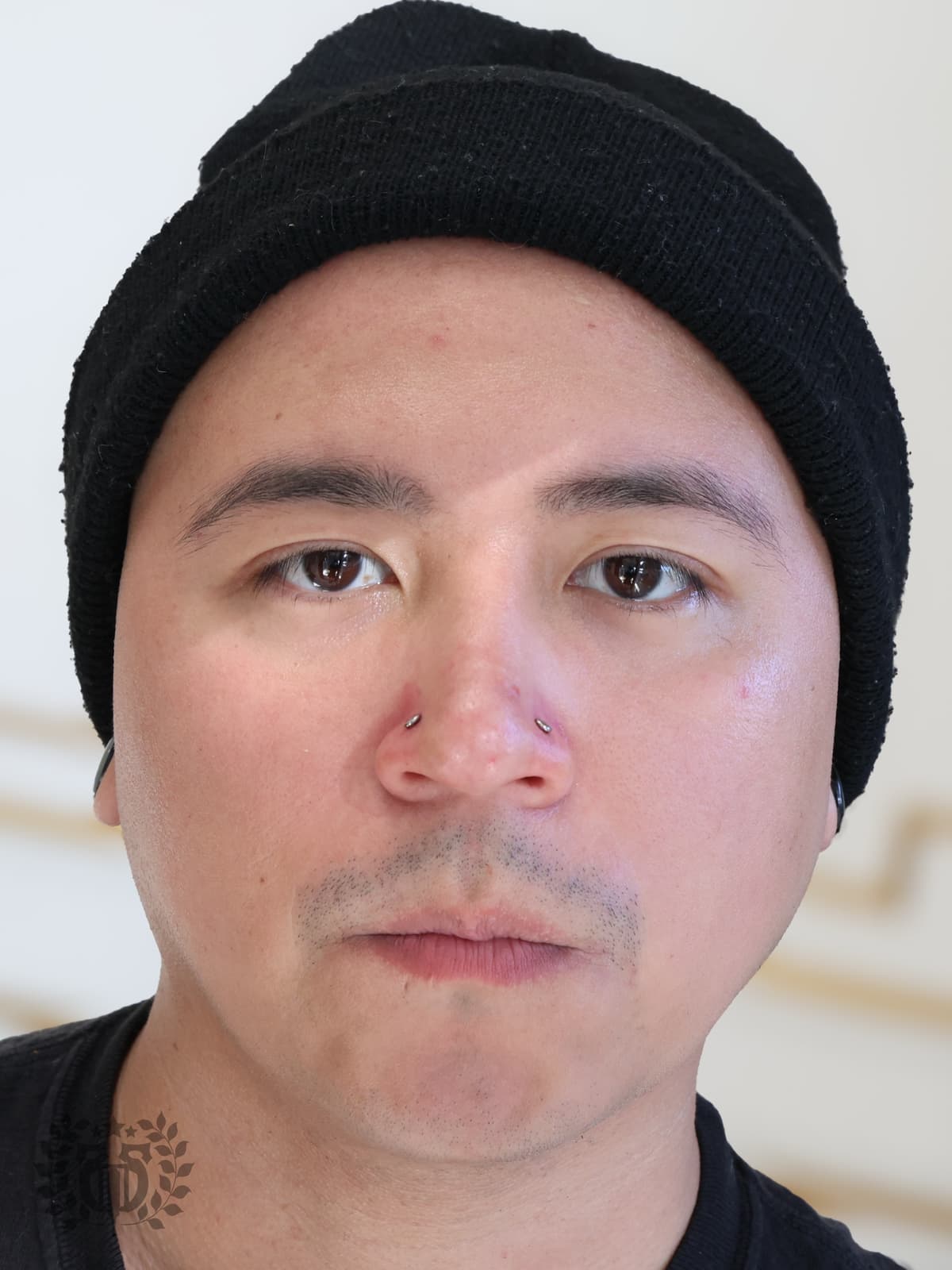

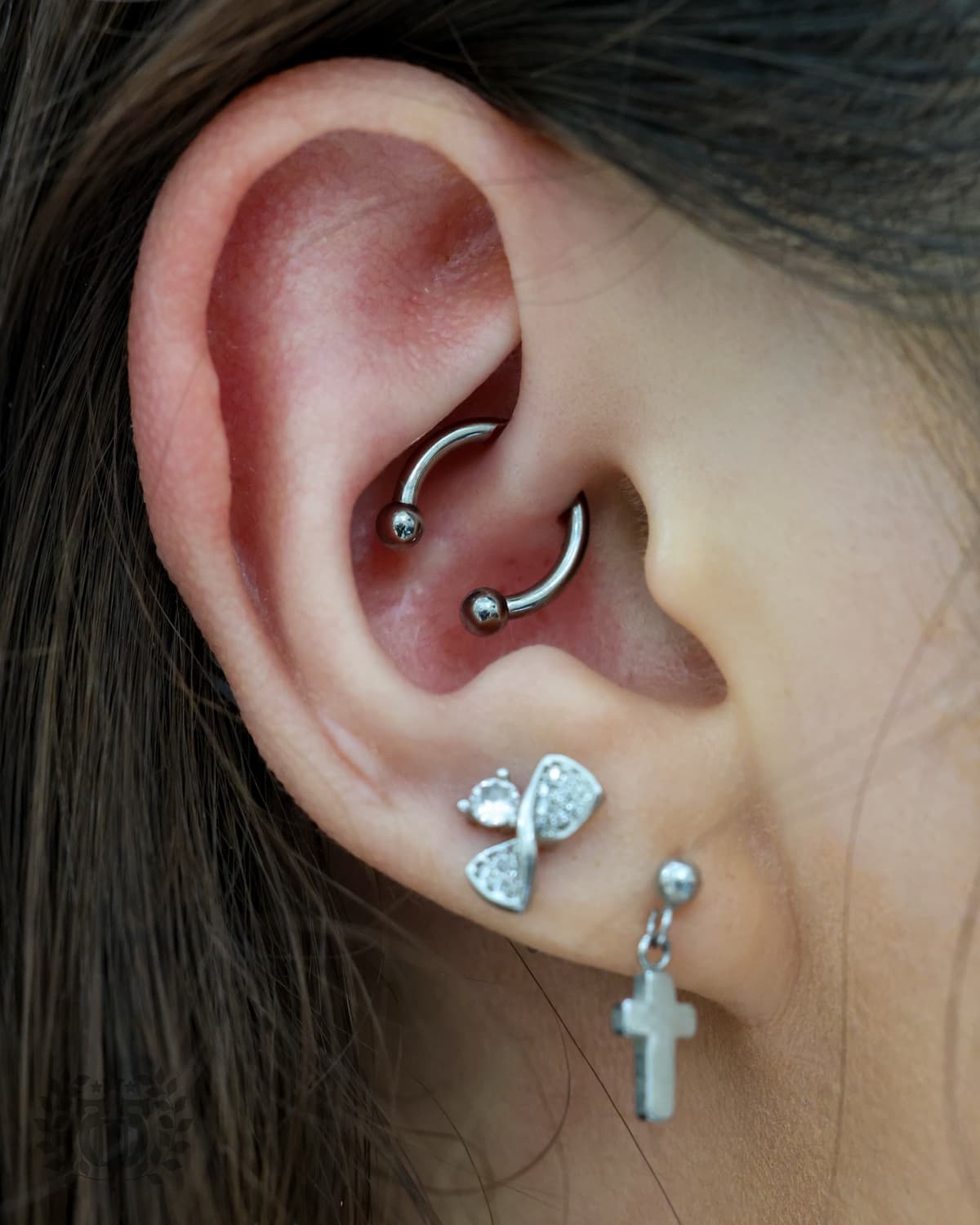
 Senior Piercer
 Senior Piercer
Bunny Vogt has been a Senior Piercer here since 2019 and does most of our curated-ear work. She is the person to see if you want a conch that has to sit alongside a helix, a rook or a lobe stack you already own — the spacing conversation is the part she cares about.
 Founder
 Master Piercer
Blue Mason founded the studio and is a Fakir-certified Master Piercer. On a conch he is looking at bowl depth and wall angle before anything gets marked, because a disc that ends up pressed against the side of the well is the thing that turns a nine-month heal into an eighteen-month one.
The appointment itself is short and mostly conversation. The needle pass takes about a second. Almost everything that determines how this goes happens either in the five minutes before it, or across the year afterwards.

Sterile saline, twice a day, front and back. The back is the half people skip, because it's behind the ear and out of sight, and it's also where the disc sits and where crust accumulates. Spray it, let it soften, dab it dry with something disposable. That's the whole routine.
What you don't do matters more. No rotating — the old advice to twist jewelry has been wrong for years and it tears the lining of a forming channel. No tea tree oil, no alcohol, no ointment, no aspirin paste, no hydrogen peroxide. No taking it out "just to look". And no in-ear buds on that side, which is the rule people break in week three and then wonder about the lump in week six.
Sleeping is the honest difficulty. Nine to twelve months is a long stretch to keep off one side, and a doughnut travel pillow with a hole for the ear is the trick that gets most people through it. If you wake up on it occasionally, that's life. If you wake up on it nightly, you'll see it in the piercing.
Book AppointmentDay one feels fine and day two is the sore one. The bowl puffs, the long post suddenly looks correct, and warmth around the site is expected. Saline twice a day, front and back. Earbuds out on that side from the moment you leave.
The swelling has gone and the extra post length is now something that catches on collars and pillows. We fit a shorter one so the disc lies flush behind the ear. Skipping this appointment is the most common cause of the bump people email us about at month four.
Nine to twelve months in, a piercer checks the channel and tells you whether it's done. That's the point where a wide decorative end or a properly measured conch ring becomes reasonable, and where earbuds can be reintroduced carefully rather than hopefully.
Yes, and a lot of conches happen exactly that way. But the inner-versus-outer read is the sort of thing worth having done unhurried, so here's how the two routes differ in practice.

Verbatim reviews from Apollo's Google Business Profile
"Had a great experience at Apollo for my helix piercing. Booking was easy, the staff helped me choose beautiful jewelry within my budget, and the piercer took her time to make sure the placement was perfect and explained aftercare thoroughly. The space was clean and professional. I came back four weeks later to downsize the post and the follow-up was just as smooth. I’ll definitely be back for future piercings and jewelry."
"I'm so happy I chose Apollo to get my cartilage pierced. It was a great experience. They help you pick out the right piece of jewelry and really understand your vision. Customer service is great, and Bunny, who pierced my ear, was super sweet. She made the overall experience very painless."
Reviews from Google · Read all 623 on Google
5000+ clients2625 Main Street, a few blocks up from the beach. Open 8am to 8pm, every day of the week.

Santa Monica, CA

Apollo was founded by Blue Mason in 2007. With 20+ years of body art experience, Blue brings master-level expertise to every piece. Read Blue's story →
These are the ones that come up at the counter, roughly in the order they come up.
Cup your hand behind your ear and feel for the deep round well next to the canal. That dished-out bowl is the inner conch. The broad shelf between that bowl and the raised anti-helix ridge is the outer conch, which some studios call a flat. A deep, generous bowl takes an inner conch beautifully and gives a stud somewhere to sit without the disc pressing on the wall of the well. A shallow bowl with a wide outer shelf usually reads better as an outer conch. If you already wear a helix or a rook, the answer often gets decided by what's above it rather than by the bowl itself.
Because the needle pass is over in about a second and the cartilage doesn't finish reacting for another eighteen hours. Conch tissue is the thickest, most rigid cartilage in the ear, and it swells inward against the jewelry rather than outward like a lobe. Day two to day four is usually the sorest stretch. A tender, warm, slightly puffy conch in that window is normal. Throbbing that gets worse after day five is not, and that's worth a phone call.
Not for at least nine to twelve months, and only after a piercer has looked at it and agreed the channel is done. A ring moves every time you brush your hair, pull a jumper over your head, or roll onto that side. Every bit of that movement is transmitted through a rigid cartilage channel that has no give in it. Swapping a stud for a ring at month four is the single most common way people restart a heal they had almost finished.
It's not a disqualifier, but it is the thing that decides how your heal goes. The conch sits in the deepest part of the ear, which means a pillow presses on it directly rather than glancing off it the way it does with a helix. Most side sleepers get through this with a travel pillow — the doughnut kind with the hole in the middle — so the ear drops into the gap instead of taking the load. Pick the side you don't favour if you have a preference. Nine months is a long time to sleep on your other shoulder.
Yes, and plenty of people do. Two piercings in one visit is $75 for the piercing service, and up to four placements under the Curated Ear special is $99, jewelry separate either way. The caution is not about your body's ability to heal two at once, it's about your sleeping. Two fresh cartilage piercings on the same ear means that ear is off-limits for months. If you want several, we'll often suggest splitting them across both ears so you still have somewhere to sleep.
It's the question worth asking before you book rather than after. In-ear buds seat against the bowl wall, which is exactly where an inner conch disc sits, and they'll press on it every time. During the heal you need to be off them entirely on that side — not "careful with them", off them. After full healing many people go back to earbuds without much drama, some find a particular bud shape never stops nagging, and a few switch to over-ears permanently. If your job means six hours a day in earbuds, an outer conch or a different placement may serve you better.
Conch work is usually 16g or 14g, with a flat-back labret post cut long enough to leave room for the swelling that arrives on day two. That extra length is deliberate and it's why a fresh conch looks like it's standing slightly proud of the ear. It should not stay that way. Once the swelling has gone — commonly somewhere between weeks eight and twelve — you come back and we fit a shorter post so the disc sits flush against the back of the ear instead of catching on everything.
Nearly always an irritation bump, and nearly always a pressure story rather than an infection one. On a conch the back of the ear is where the disc is, so that's where a too-long post, a phone pressed to the head, a pillow or a helmet strap makes its mark. Treat it by removing the cause, not by adding products: get off that side at night, stop touching it, keep to plain sterile saline, and come in so we can check whether the post length is the culprit. Tea tree oil, aspirin paste and ointments make these worse more often than better.
$85 for the piercing service. Jewelry is priced separately, which means you pick the piece rather than being handed whatever the fee covers. Starter ends are implant-grade titanium; solid-gold BVLA and threadless ends are there for when you're healed and want to change it.
No. Punching is a technique some studios use to remove a plug of cartilage for large-gauge conch jewelry, and it isn't something we do. Every piercing here is done with a single-use sterile needle, and we've never used a gun on cartilage or anywhere else. If you want a large-gauge conch eventually, the route is a standard needle piercing that heals fully and then gets stretched slowly over years.
Cartilage is stubborn about this. A conch removed in the first weeks will usually close over, though it may leave a mark. A conch that has healed for a year and then comes out often stays as a visible pinhole indefinitely, because the fibrous channel that formed doesn't simply fill back in the way lobe tissue does. Worth knowing before you pierce a spot you're unsure about, particularly if your job has a jewelry policy.
Apollo sits at 2625 Main St in Santa Monica, a block from the beach and easy to reach from anywhere on the Westside. Here's roughly how long it takes to get to us for tattoos and piercings:
There's metered street parking on Main Street and Ocean Park Blvd, plus a public lot on 2nd Street a short walk away. We recommend giving yourself an extra 10 minutes to park on weekends — Main Street gets busy with the farmers market and beach traffic. If you're running late, text us at the studio and we'll hold your appointment.
Five minutes with a piercer settles inner versus outer. You can walk in for it, and you're under no obligation to be pierced the same day.
Recognized in Santa Monica's Most Loved 2025 & 2026


We'll respond within 24 hours
Or reach us directly:
We use cookies to run this site, remember your preferences, and understand how it's used. Read our Privacy Policy for full details.